
IRS Letters & Notices
Why Did I Get a Letter From the IRS? Every Reason, Decoded (2026)
The short answer: why did I get a letter from the IRS? Because one of nine automated triggers fired: a balance due, an income mismatch, identity verification, a held refund, missing information, an unfiled return, an audit, a change to your return, or a routine status update. The notice number in the top corner tells you which one.
The envelope has been sitting on the counter since the mail came — official seal, your name in a window, and no way to know from the outside whether it's a bill, an audit, or nothing at all. Here's what changes the moment you open it: almost every IRS letter is generated by a computer, sorted into a small number of known categories, and each category has a known fix. Your job in the next ten minutes is simply to figure out which category you're in.
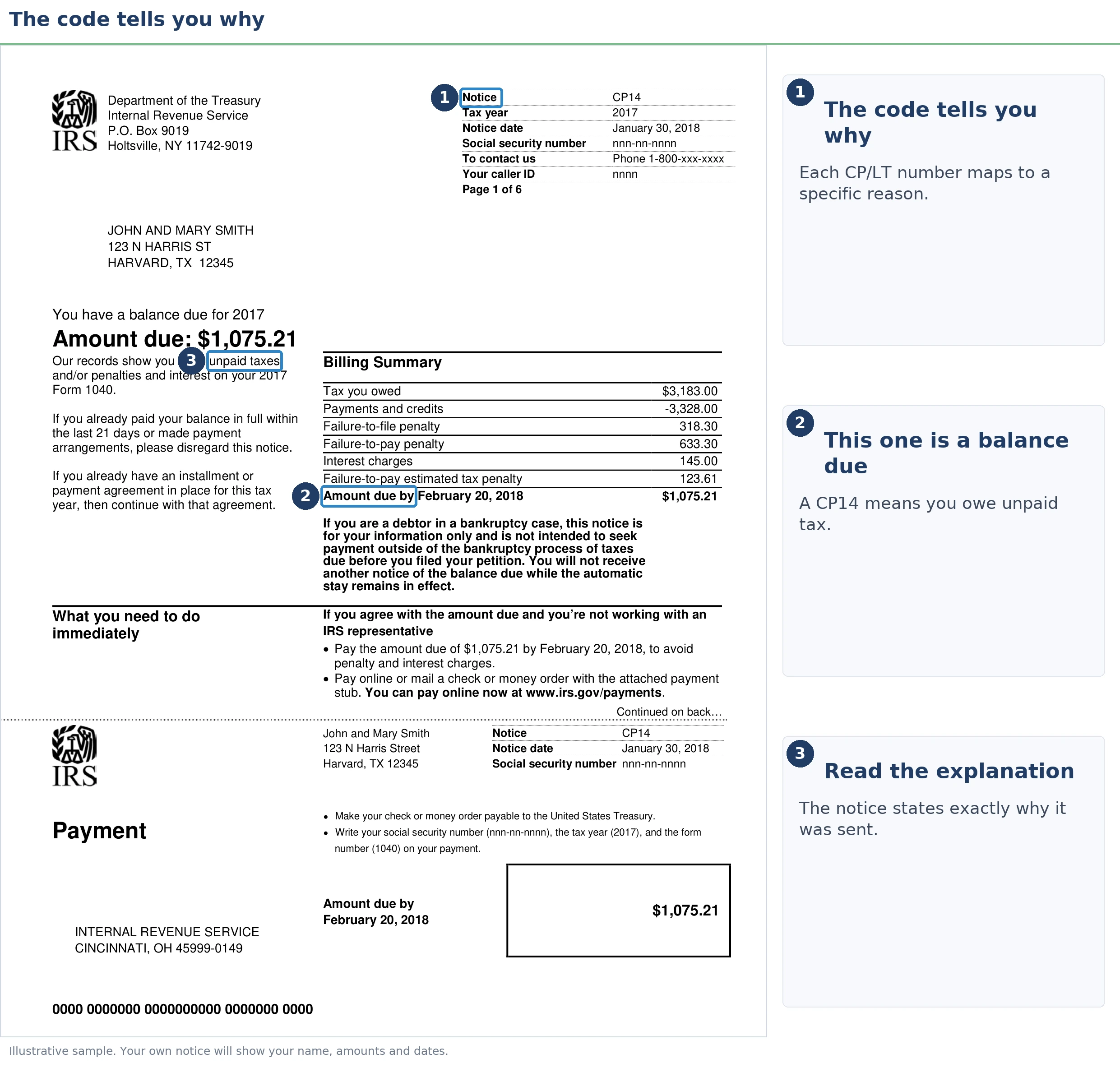
The single most useful thing on any IRS letter is the notice or letter number — a code like CP14, CP2000, LT11, or 5071C. The image below shows exactly what a real IRS letter looks like and where that number sits on the page, so you can find yours before reading another word.
⏱ Your deadline: it's printed on the letter itself, near the notice number on the first page. Response windows differ by letter: a CP14 typically gives about 21 days, an LT11 final notice starts a fixed 30-day clock, and an identity-verification letter holds your refund until you act. Find your date before you do anything else.
Why did I get a letter from the IRS? The notice number answers it
Every genuine IRS letter carries a CP, LT, or Letter number — usually in the top right corner of the first page — and that code tells you exactly why the letter was sent. "CP" numbers come from computer processing, "LT" numbers come from the Automated Collection System, and "Letter" numbers usually come from a specific IRS function like exams or identity protection. Match yours in the table below.
| Notice number | What it's telling you | How urgent |
|---|---|---|
| CP14 | First bill — the IRS says you owe a balance | Respond within roughly 21 days |
| CP501 / CP503 | Reminders of an unpaid balance | Growing — act before the next notice |
| CP504 | Intent to levy your state tax refund | Serious — use the pay-by date printed on it |
| LT11 / Letter 1058 | Final notice before wage or bank levy | 30 days — appeal rights expire after that |
| CP2000 | Income on file doesn't match your return | Respond by the date on the notice |
| 5071C / 4883C | Verify your identity before your return is processed | Your refund waits until you act |
| Letter 12C | Your return is missing a form or schedule | Refund held until you reply |
| CP05 | Refund under review | Usually no action unless the IRS asks |
| CP59 | The IRS has no return on file for a year | File or explain — don't wait for the follow-ups |
| Letter 2645C | Interim "we need more time" letter | No action — keep it with your records |
If your number isn't in the table, don't panic — this list covers the highest-volume mail, and the same triage logic applies to the rest. And if the letter arrived by certified mail, that's a signal in itself: see what a certified letter from the IRS means, because certified delivery almost always marks a legal deadline.
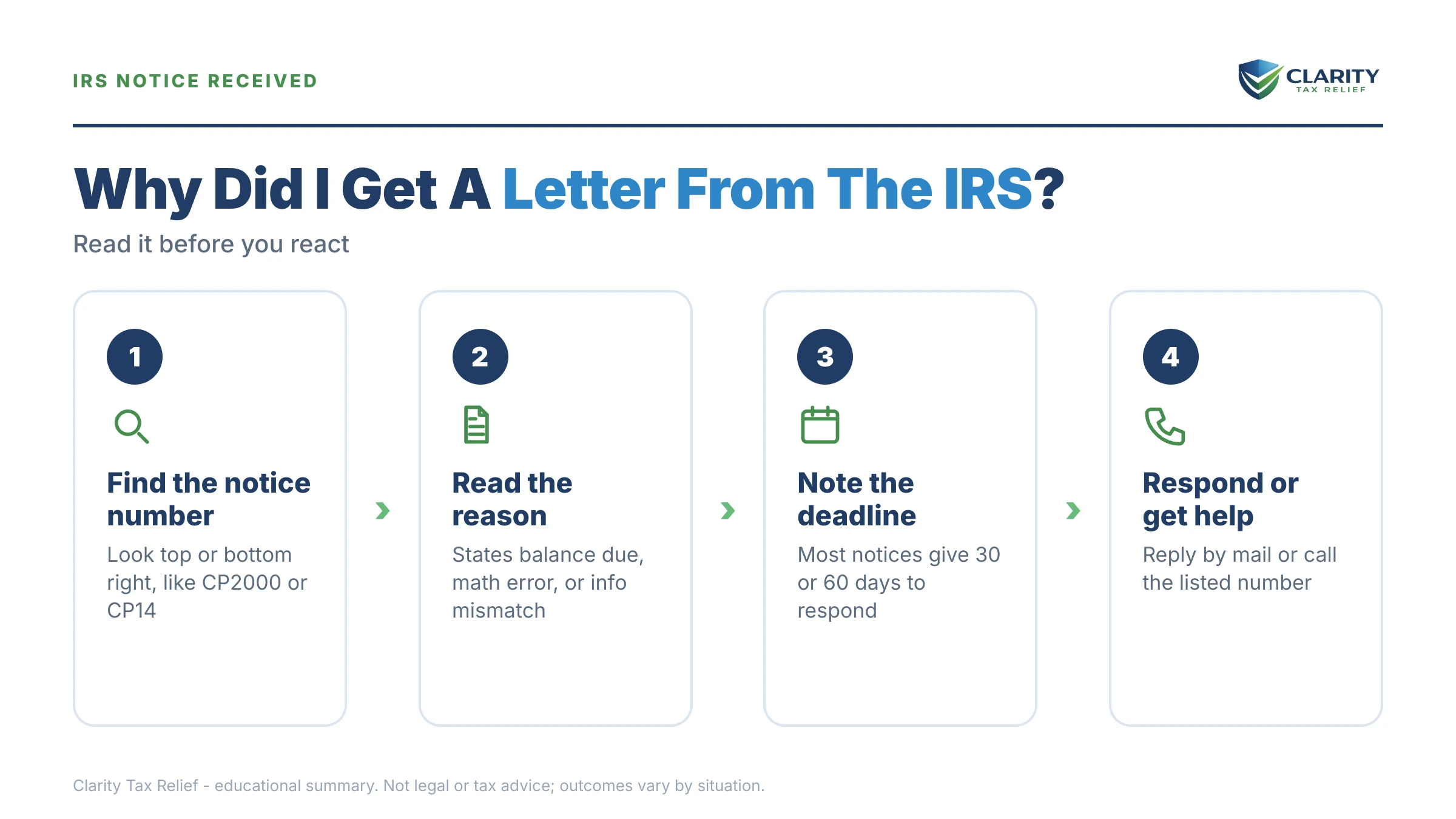
The nine reasons the IRS sends letters
Nearly all IRS mail traces back to nine triggers, and each one points to a different next move. Here's the full set, from most common to least:
- You owe money. The CP14 notice is the IRS's first bill after a return posts with a balance due. If it goes unanswered, reminders follow on an automated schedule — the sequence in the next section.
- Your return doesn't match what employers and banks reported. A CP2000 notice proposes extra tax because a W-2, 1099, or brokerage form on file doesn't appear on your return. It's a proposal, not a bill — you can agree, partially agree, or dispute it.
- The IRS wants to confirm you're really you. A 5071C letter (or its cousins 4883C and 5747C) means a return was filed under your Social Security number and the IRS won't process it — or release your refund — until you verify your identity.
- Your refund is being held or reviewed. A CP05 or 4464C says the IRS is checking income, withholding, or credits before paying out. Frustrating, but usually there's nothing to send unless a follow-up asks for documents.
- Your return is missing something. A Letter 12C asks for a form or schedule the IRS needs to finish processing — often a missing 8962 or proof of withholding. Reply fast; your refund is parked until you do.
- A return is missing entirely. CP59, CP516, and CP518 chase unfiled years. Ignore them long enough and the IRS can file a substitute return for you — with no deductions, no credits, and the highest possible tax.
- You're being examined. Real audits open with Letter 566 or Letter 2205-A, or a CP75 for Earned Income Credit reviews; Letter 525 later delivers the audit report. These letters say "examination" plainly — an audit never hides behind vague wording.
- The IRS changed your return. CP11 means a correction created a balance; CP12 means your refund changed; CP21A and CP22A confirm adjustments after the fact. Check the math — these notices are sometimes wrong.
- It's informational. A Letter 2645C just says the IRS needs more time on something you sent. A CP01A delivers your annual Identity Protection PIN. A CP71 is a yearly reminder of an old balance. None of these demand a payment by themselves.
One more possibility worth ruling out before anything else: the letter isn't from the IRS at all. Scammers copy IRS layouts closely, and the fastest tells are the delivery channel and the payment instructions. Our full guide on how to tell if an IRS letter is real walks through every marker — the short version is that real IRS payments go only to the United States Treasury or through IRS.gov, never gift cards, wire transfers, or payment apps.
What happens if you ignore an IRS letter
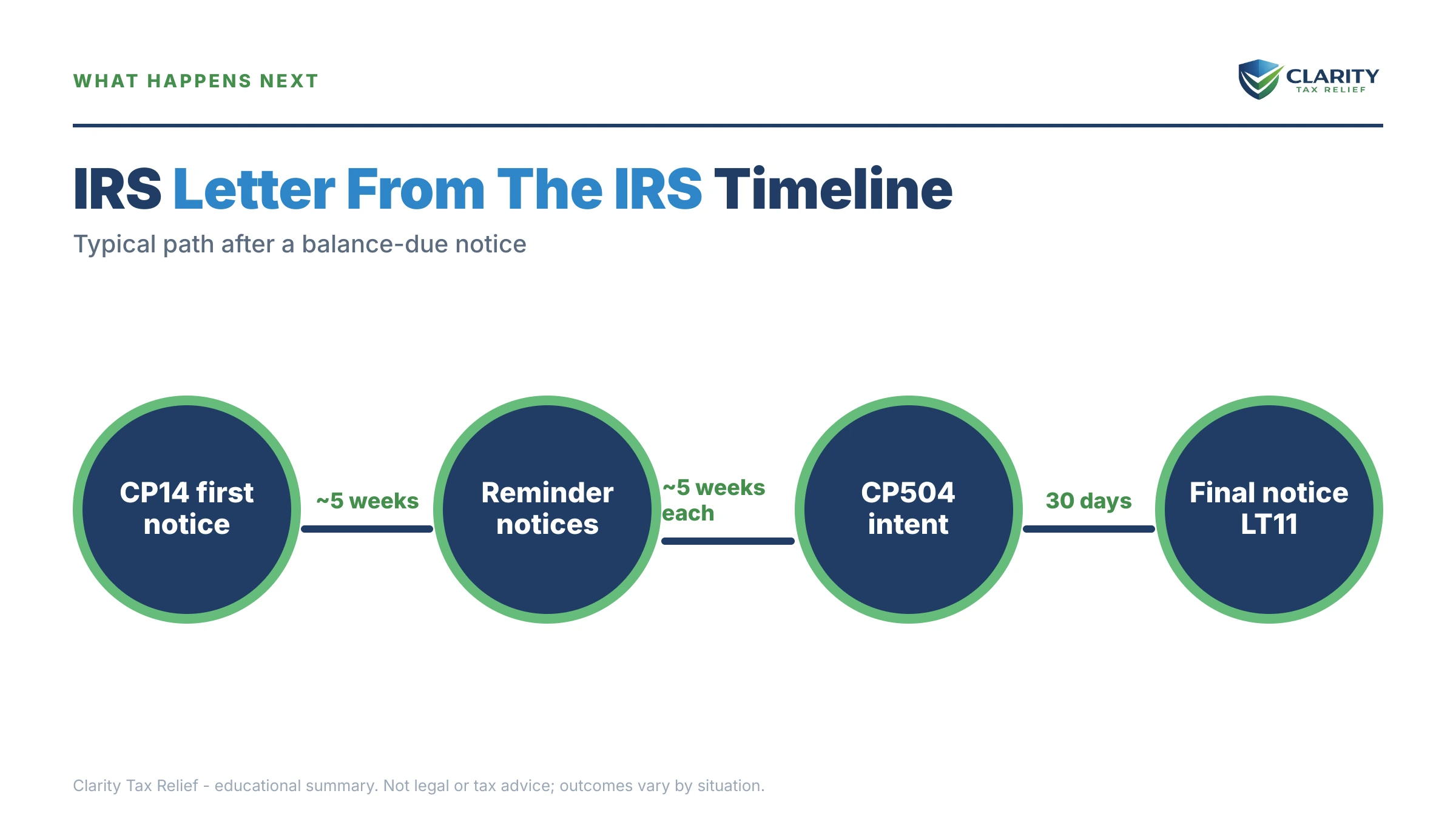
Ignoring an IRS letter never freezes anything — every category escalates on an automated schedule whether or not a human ever reviews your file. For balance-due mail, the sequence runs like this:
- CP14 — the first bill. No enforcement yet; this is the cheapest moment to act.
- CP501 / CP503 — reminder notices. Still just bills, but penalties and interest are compounding monthly.
- CP504 — Notice of Intent to Levy under IRC §6331(d). The IRS can now seize your state tax refund, and a federal tax lien becomes a live risk.
- LT11 / Letter 1058 — the final notice. A 30-day clock starts, along with your Collection Due Process rights (requested on Form 12153). After it runs, the IRS can levy.
- Levy — a bank levy freezes funds with a 21-day hold before the money leaves; a wage levy is continuous until released.
The other tracks escalate differently but just as automatically. An ignored CP2000 hardens into a CP3219A statutory notice of deficiency — a 90-day letter — and then a legally assessed debt. Ignored unfiled-return notices end in a substitute return filed against you. An ignored identity letter simply strands your refund indefinitely.
| Letter | What it means | Response window |
|---|---|---|
| CP14 | First bill for the balance | Typically about 21 days from the notice date |
| CP501 / CP503 | Reminders — balance still growing | By the date printed on each notice |
| CP504 | Intent to levy your state tax refund | The pay-by date printed on the notice |
| LT11 / Letter 1058 | Final notice of intent to levy, with hearing rights | 30 days to pay, arrange, or request a hearing |
| Levy | Bank accounts (21-day hold) or wages (continuous) | Release requires action — waiting changes nothing |
A note on 2026 specifically: the IRS workforce shrank by roughly 27% in 2025, which makes a human harder to reach — but the notice stream, lien filings, and levies are issued by systems that never got smaller. The machine escalates on schedule either way, so the date on your letter is the only clock that matters.
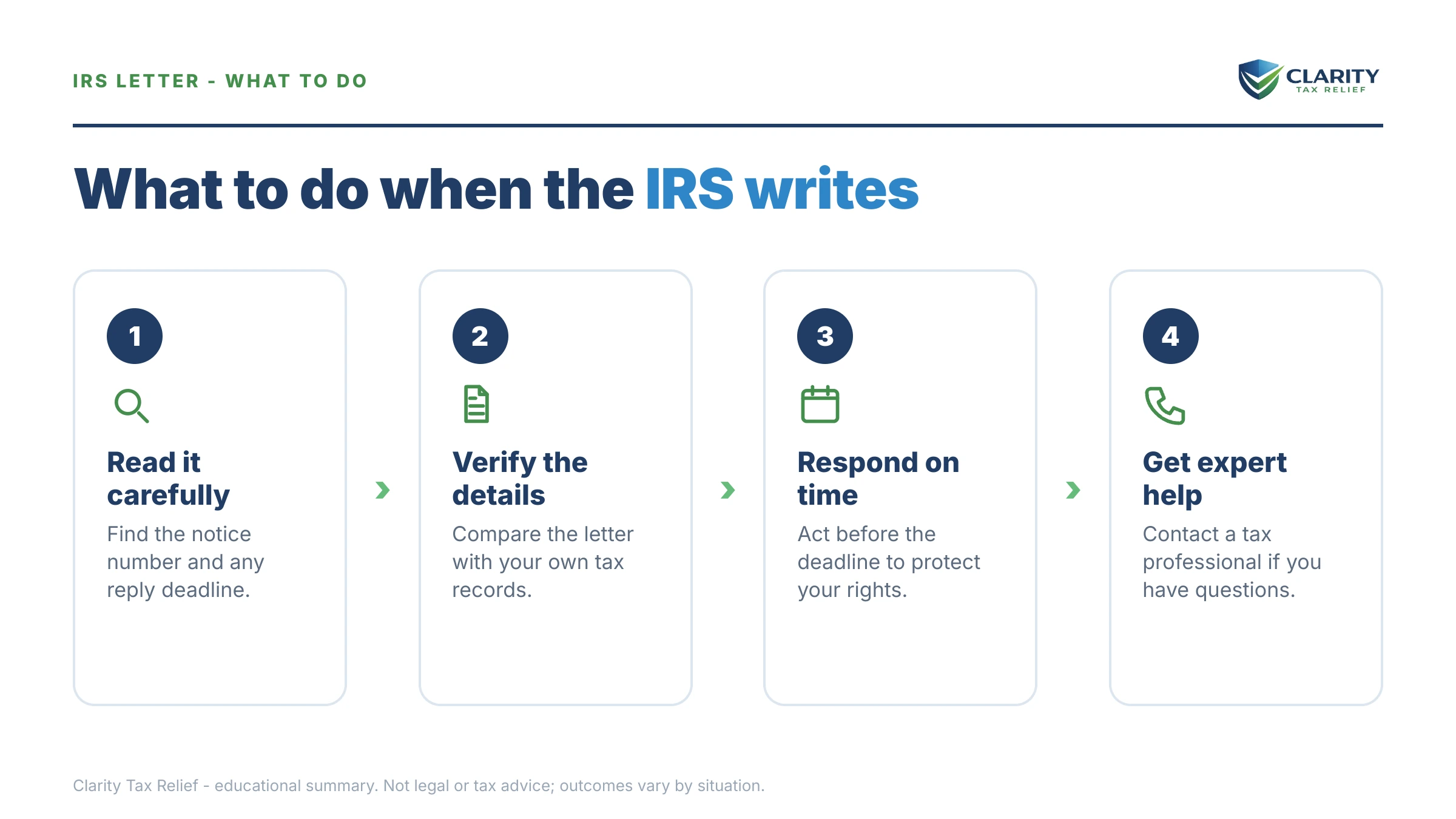
Not sure which letter you're holding — or what its deadline really means?
Send us a photo of it. An experienced tax professional will decode the notice number, confirm your real response window, and map your options — free, confidential, and before the date printed on your letter passes.
If your letter says you owe money: your real options
Every balance-due letter offers two choices — pay in full or face the next notice — but the IRS actually runs several resolution programs, each with its own eligibility line. Which one fits depends on how much you owe and what your finances honestly look like:
| Option | Who it fits | Cost and terms |
|---|---|---|
| Short-term payment plan | Can pay in full within 180 days | $0 setup; interest and penalties continue until paid |
| Guaranteed installment agreement | Owe $10,000 or less and meet basic filing conditions | Simple monthly plan the IRS must accept when conditions are met |
| Streamlined installment agreement | Owe $50,000 or less | Up to 72 months, set up online, no detailed financial disclosure |
| Currently Not Collectible | Paying anything would leave you unable to cover basic living costs | Collection pauses after financial review; the debt and interest remain |
| Offer in Compromise | Assets plus future income genuinely can't cover the debt | $205 fee and 20% down on lump-sum offers (both waived with low-income certification); the IRS accepted roughly 1 in 5 offers in FY2024 |
| First-time penalty abatement | Clean compliance for the prior 3 years, or reasonable cause | Free to request; starting summer 2026, Automatic Exemption from Penalty (AEP) applies some relief automatically, no request needed |
A worked example: $27,500 owed, with a refinance on the line
Say you owe $27,500 and you're a homeowner planning to refinance this fall — a CP14 lands showing the full balance. The failure-to-pay penalty alone runs 0.5% per month: $27,500 × 0.5% = $137.50 a month, with interest compounding on top. Drift for six months while the notices stack up and that's roughly $825 in penalties before a dollar of interest.
The refinance is the bigger risk. If the balance escalates far enough for the IRS to file a Notice of Federal Tax Lien, it hits county records — and your underwriter will find it. Most lenders then require payoff or a lien subordination before closing, which adds weeks and paperwork. (If you're already there, see can I refinance with an IRS lien.)
The fix at this stage is straightforward because $27,500 sits under the $50,000 streamlined line: a 72-month agreement works out to about $27,500 ÷ 72 ≈ $382 a month on the balance alone, with the real payoff running somewhat higher because interest and the monthly penalty keep accruing inside the plan. You can estimate how much penalties and interest add to your own balance with our Penalty & Interest Calculator. Set the agreement up while the debt is still in early-notice status and the refinance stays a routine transaction instead of a subordination project.
How to respond to an IRS letter, step by step
- Find the notice number. Look in the top right corner of the first page — the CP, LT, or Letter number identifies exactly which notice you have and which rules apply.
- Read the deadline and the amount. Locate the response or pay-by date printed on the letter and any dollar figure, and write both down before you do anything else.
- Verify it against your IRS online account. Log in at IRS.gov and compare the balance and notice list there with the letter — never pay or concede based on paper alone.
- Respond before the date on the letter. If the letter is right, pay or set up a payment arrangement; if it's wrong, reply in writing with proof — silence is the only response that always loses.
- Keep a complete paper trail. Save the letter, its envelope, your response, and proof of mailing or payment — some deadlines run from the postmark, and disputes turn on documentation.
When you can handle an IRS letter yourself
Most IRS letters don't require professional help — they require a prompt, documented response. You can almost certainly handle it alone when the letter is an identity verification (follow the letter's instructions online or by phone), a Letter 12C asking for one missing form, a status update requiring nothing, or a first bill you agree with and can pay within 180 days. The IRS's own directory at Understanding your IRS notice or letter covers the routine ones, and payments and simple plans run through IRS.gov/payments in minutes.
Experienced help changes outcomes in a narrower set of situations: a final notice of intent to levy already in hand, multiple unfiled years behind the letter, a disputed CP2000 involving business or investment income, payroll or business-tax mail, or a lien threatening a home sale or refinance. In those cases the order you fix things — returns first, then penalties, then the balance — often changes the final number, and the appeal windows are short and unforgiving.
If your problem is IRS delay rather than IRS demands — a refund review or interim letter that has dragged on for months and is causing real hardship — the Taxpayer Advocate Service is a free, independent route inside the IRS.
Terms on your letter, decoded
- Notice number: the CP, LT, or Letter code in the top corner that identifies exactly which letter you received and what rules govern it.
- Balance due: the total the IRS says you owe — tax, penalties, and interest combined, broken down on the notice.
- Lien vs. levy: a lien is a legal claim against your property (it clouds sales and refinances); a levy is the actual taking of money or wages.
- CDP rights: Collection Due Process — the formal hearing you can request on Form 12153 within 30 days of a final levy notice, which pauses enforcement while it's decided.
- Statutory notice of deficiency: the "90-day letter" (like a CP3219A) that gives you one fixed window to petition Tax Court before proposed tax becomes final.
- CSED: the Collection Statute Expiration Date — the IRS generally has 10 years from assessment to collect, though appeals, offers, and bankruptcy can pause that clock.
IRS letter questions people actually ask
Is a letter from the IRS always bad news?
No — a surprising number of IRS letters are neutral or even good news. A CP12 means the IRS corrected your return and your refund changed, often upward; a CP09 says you may qualify for the Earned Income Tax Credit you didn't claim; a Letter 2645C just says the IRS needs more time. The notice number in the top corner tells you which kind you're holding before you read a single paragraph.
What happens if I ignore a letter from the IRS?
It depends on the track, but every track gets worse. A balance-due letter escalates through reminders to a final notice of intent to levy, after which the IRS can garnish wages and levy bank accounts. An ignored CP2000 becomes a statutory notice of deficiency and then an assessed debt, and an ignored identity-verification letter means your refund simply never gets released.
How do I know if my IRS letter is real or a scam?
A real IRS letter arrives by postal mail — never by email, text, or social media — and any payment it requests goes only to the United States Treasury or through IRS.gov. It will carry a notice number, a tax year, and your truncated Social Security number. Before paying anything, log into your IRS online account and confirm the balance or notice actually exists on your record.
Why would the IRS send me a letter if I don't owe anything?
Plenty of IRS letters have nothing to do with debt. Common no-balance reasons include identity verification before a refund is released, a refund review, a missing form the IRS needs to finish processing your return, a change the IRS made to your return, or an annual informational mailing like your Identity Protection PIN. Read the notice number first — many of these require no payment at all, just a reply.
Does a letter from the IRS mean I'm being audited?
Usually not. Audits open with specific letters — Letter 566, Letter 2205-A, or CP75 for Earned Income Credit reviews — and they say plainly that your return is being examined. Even a CP2000, which proposes extra tax from an income mismatch, is technically an automated document-matching notice, not an audit. Most IRS mail is billing, processing, or verification correspondence.
Can I see my IRS letters online?
Many of them, yes. Your IRS online account has a notices section showing digital copies of certain letters, plus your current balance, payment history, and payment-plan details. Not every letter appears online, though — so keep the paper original, including the envelope, since some deadlines run from the mailing date.
Should I be worried about a certified letter from the IRS?
Treat certified mail as the IRS's highest-priority channel — it's used when a letter starts a legal clock, like a final notice of intent to levy, a lien filing notice, or a statutory notice of deficiency. Sign for it and open it the same day. Refusing delivery changes nothing, because the deadline typically runs from the date the IRS mailed it, not the date you read it.
Why did I get an IRS letter after I already filed and paid?
The three usual culprits are timing, misapplied payments, and leftover penalties. Notices are computer-generated and often cross in the mail with recent payments; payments sometimes post to the wrong tax year; and even a paid-off tax balance can leave a small trail of penalty and interest that generates its own bill. Check your account transcript before you pay anything twice.
Your next 24 hours
- Find the notice number and the deadline. Both sit on the first page of your letter, near the top right. Write them down — they define everything that follows.
- Gather three things: the letter itself (keep the envelope), your most recently filed tax return, and access to your IRS online account so you can verify what the letter claims.
- Get a free letter review. Call (888) 825-7779 or use the 2-minute form. Whatever your letter is, waiting only narrows your options — and if it shows a balance, penalties and interest are compounding every month you hold it unopened.
This guide is general information, not tax or legal advice for your specific situation. Eligibility for IRS programs depends on individual facts and circumstances; no outcome is guaranteed.