
IRS Notices
How to Tell If an IRS Letter Is Real in 2026: The 5-Point Verification Checklist
The short answer: a real IRS letter arrives by U.S. mail, shows a notice or letter number (CP or LTR) in the top-right corner, lists the tax year and a masked version of your SSN, and matches what your IRS online account shows. The IRS never demands gift cards, wire transfers, cryptocurrency, or payment-app transfers.
The envelope has "Internal Revenue Service" in the corner, the letter inside says you owe thousands, and you've also read that scammers now mail fake IRS letters — so you're stuck between paying something you might not owe and ignoring something that might be very real. That paralysis is exactly what both the scammers and the interest clock feed on. The good news: you can settle the real-or-fake question yourself, in about fifteen minutes, without calling anyone.
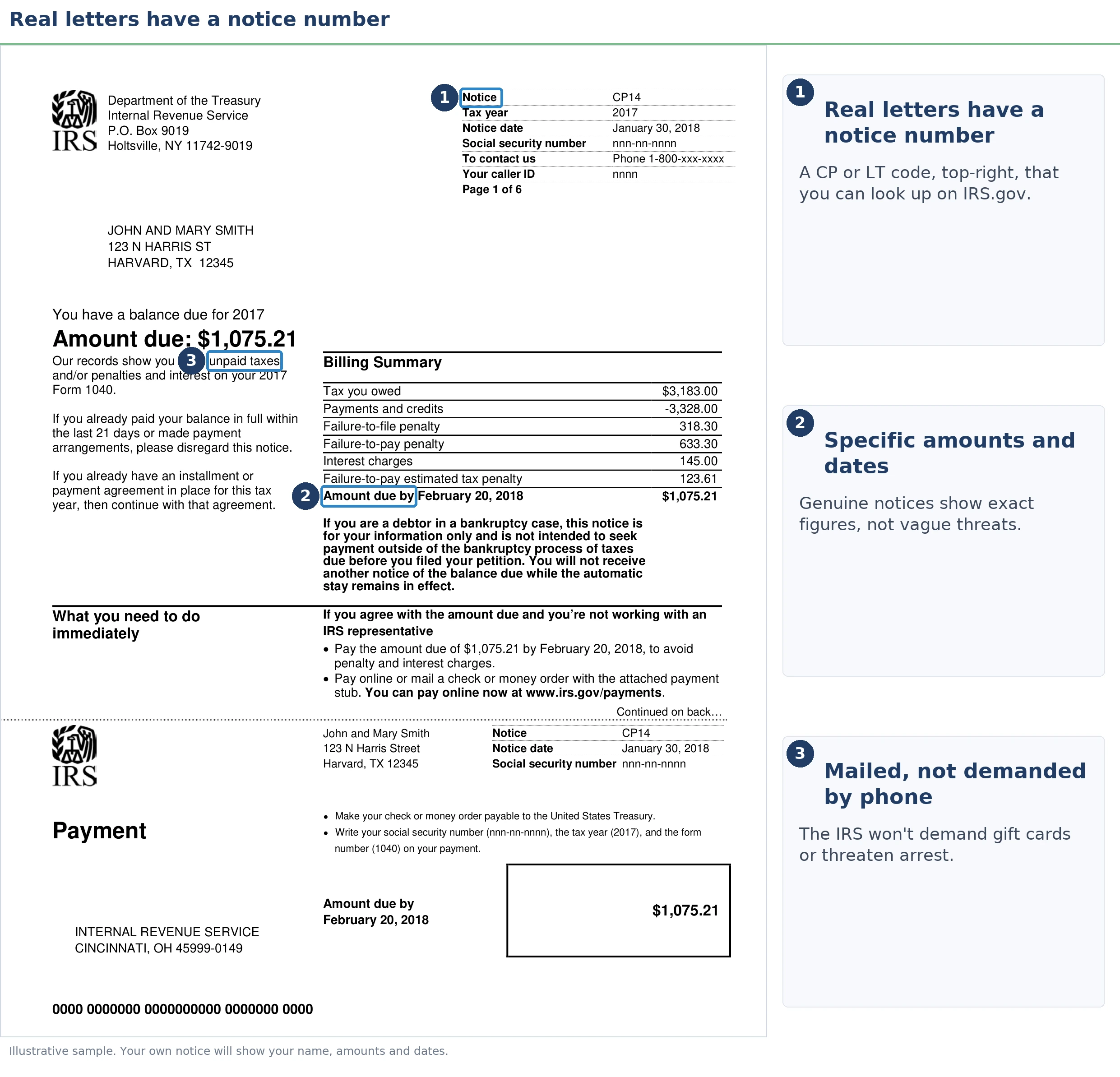
Wondering how to tell if an IRS letter is real starts with knowing what a genuine one looks like — the image below shows you exactly what an authentic IRS notice looks like and where on the page each verification mark sits.
⏱ The clock that matters: this article has no single deadline — but a real IRS notice prints its own response date, and that printed date controls. While you decide whether the letter is genuine, interest compounds daily and the 0.5% monthly late-payment penalty keeps adding to any real balance. Verify first, but verify today.
Why you got a letter from the IRS — and why scammers count on that moment
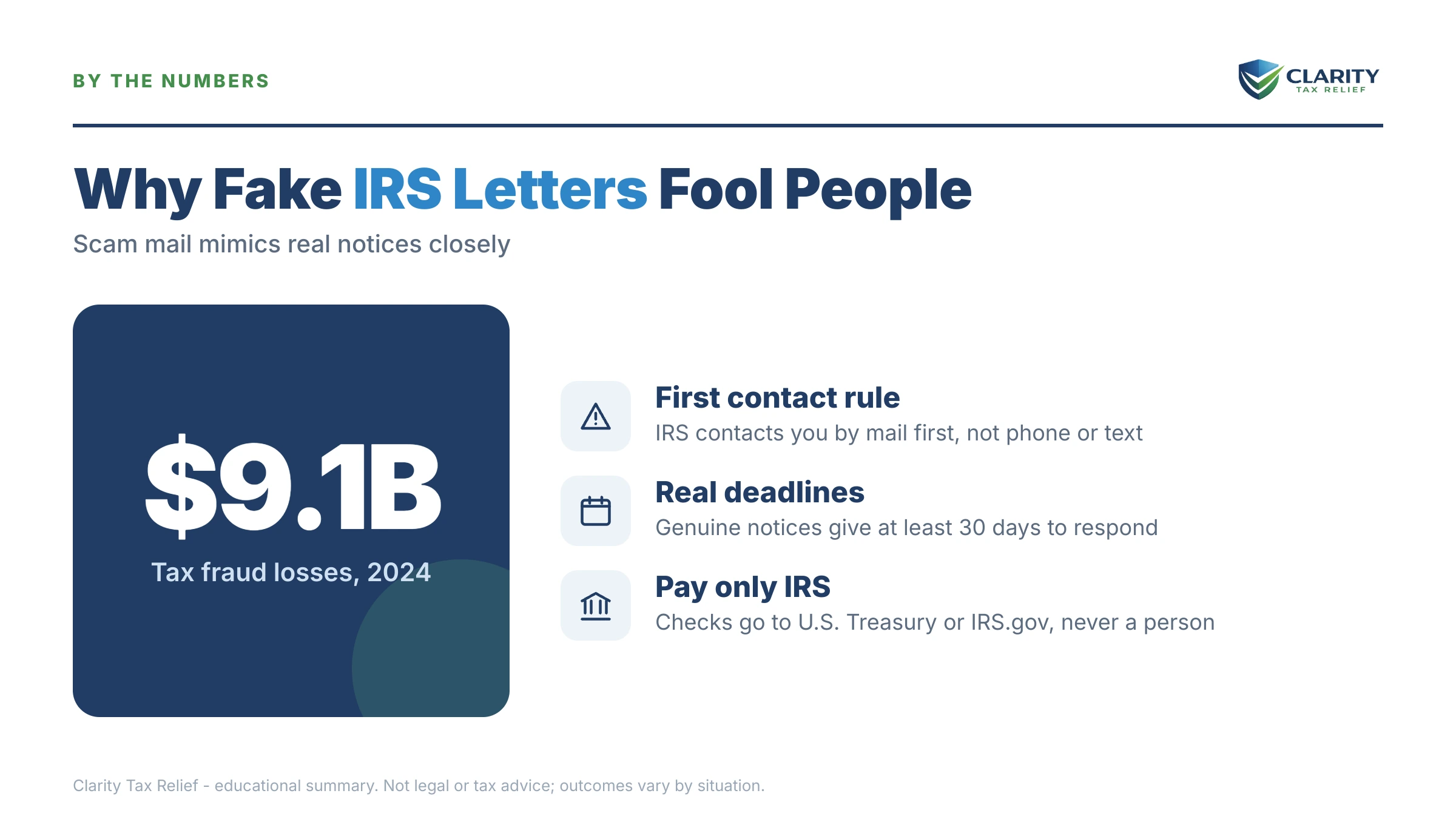
Every real IRS contact about money begins with a letter in the U.S. mail — never an email, text message, or social-media DM. The IRS mails letters for dozens of reasons: a balance due, a math correction, an income mismatch, identity verification, or a reminder that a return was never filed. Our guide to why did I get a letter from the IRS decodes the full range.
Scammers copy this channel precisely because people have learned to distrust "IRS" texts and emails. A paper letter with an eagle seal feels official — and criminals know that fear makes people pay before they check. The defense isn't skepticism about everything; it's a short, mechanical checklist that genuine letters always pass and fakes almost never do.
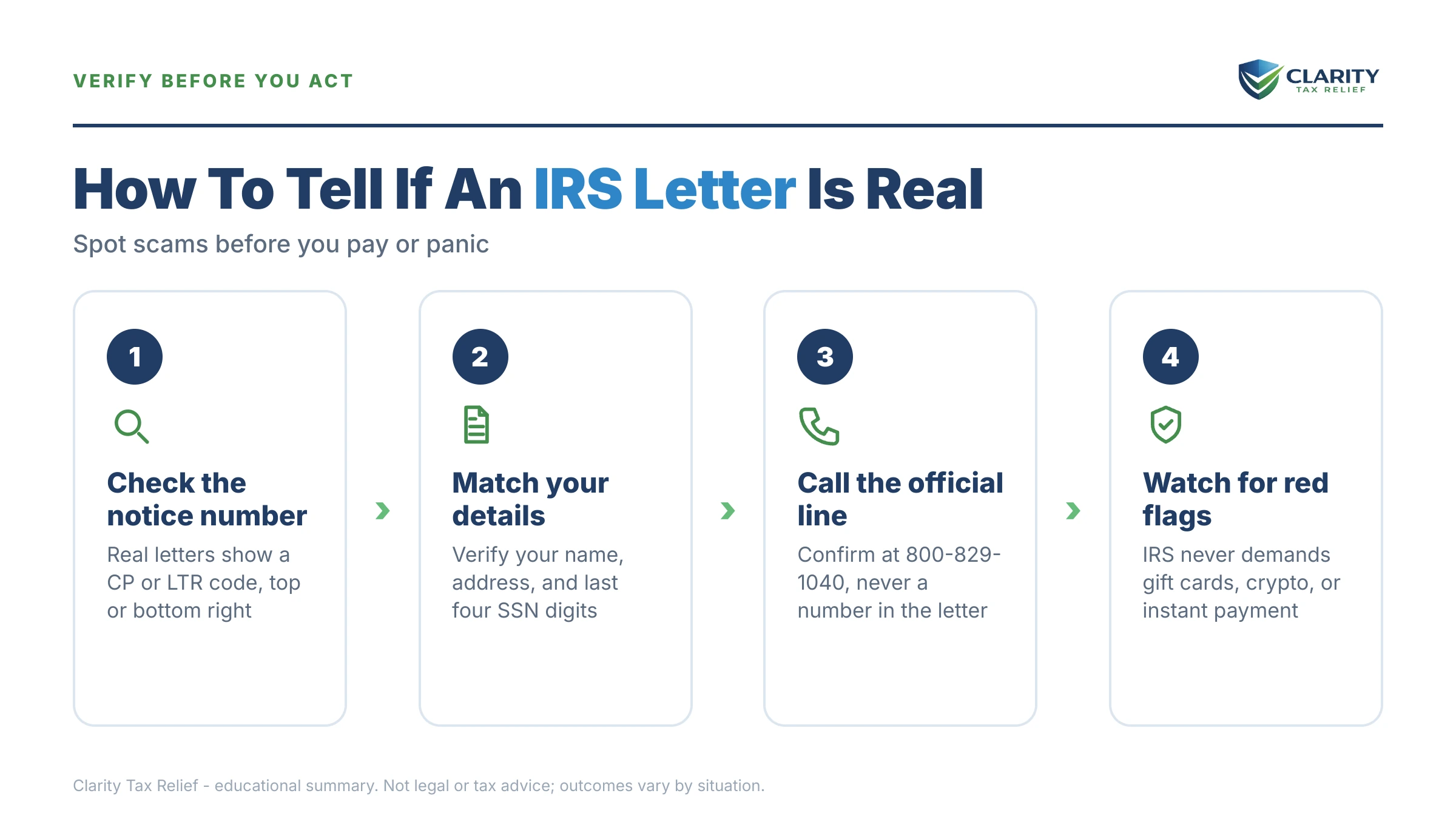
How to tell if an IRS letter is real: the 5 marks to check
Every genuine IRS letter carries a notice or letter number, a notice date, the tax year it covers, a masked taxpayer ID, and a balance (if any) that matches your IRS online account. Here are the five marks, in the order you should check them:
- 1. A notice or letter number. Look in the top-right corner (occasionally bottom-right) for a code like CP14, CP59, or LTR 5071C. This number identifies exactly which form letter you're holding, and you can look it up directly on IRS.gov.
- 2. A notice date and tax year. Real letters tie every claim to a specific tax year and print the date the notice was issued. Vague letters about "your taxes" with no year are suspect.
- 3. A masked SSN or EIN. The IRS truncates your identifier (showing only the last four digits) on most correspondence. A letter printing your full SSN — or demanding you send it — is a red flag.
- 4. Payment instructions that point only to the U.S. Treasury. Genuine letters direct payment to IRS.gov or by check payable to the United States Treasury — never to a person, a company, or an "agent."
- 5. A balance that matches your IRS online account. This is the decisive check. Log in at IRS.gov: if the letter claims you owe $16,400 and your account shows the same balance for the same year, the letter is real. If your account shows nothing, treat the letter as hostile until proven otherwise.
The table below puts the genuine markers and the scam tells side by side, so you can run the comparison with the letter in your hand.
| What to check | Real IRS letter | Fake letter |
|---|---|---|
| How it arrives | U.S. mail; certified mail for high-stakes notices | Email, text, DM — or odd mail like cardboard envelopes |
| Notice number | CP or LTR code in the top/bottom-right corner | Missing, invented, or a code that doesn't exist on IRS.gov |
| Who you pay | United States Treasury or IRS.gov only | A company, a "processing center," or an individual |
| Payment methods | IRS.gov, direct debit, check, money order | Gift cards, wire transfers, crypto, payment apps |
| Phone number | Matches numbers published on IRS.gov | Unlisted number you must call "immediately" |
| Tone and threats | States deadlines and appeal rights; no arrest threats | Threatens arrest, deportation, or same-day seizure |
| Information demanded | References a masked SSN it already has | Asks for full SSN, bank logins, or card numbers |
Fake IRS letters in 2026: the mail scams making the rounds
The fastest scam tell is the payment demand: the IRS accepts payment only to the United States Treasury or through IRS.gov — never gift cards, wire transfers, cryptocurrency, or payment apps. Any letter naming another channel is fake, no matter how good the letterhead looks.
Three mail-scam formats keep resurfacing. First, the fake refund letter: an official-looking notice (one wave arrived in cardboard envelopes) claiming an "unclaimed refund" and asking for your full SSN, bank details, and a photo of your driver's license to release it. Second, the phony lien letter: a "Final Demand" from an invented agency like the "Bureau of Tax Enforcement" threatening a lien or seizure unless you call their number. Third, the verification hijack: a letter that mimics a real IRS identity letter but routes you to a non-IRS phone number or website that harvests your credentials.
The same logic applies off the page. The IRS does not initiate contact by text or email — our guide on whether the IRS calls, texts, or emails you covers every legitimate contact channel. And since 2023 the IRS has ended most unannounced home visits; a revenue officer now generally mails a Letter 725-B to schedule an appointment first. Anyone at your door claiming to be IRS without prior mailed contact deserves the same skepticism as a gift-card demand.
What happens if you ignore a letter that turns out to be real
A real IRS letter you ignore doesn't go away — it's one step in an automated sequence that ends with levy power, and the machine advances whether or not a human ever reviews your file. In 2026, with the IRS workforce down roughly 27% from 2025 cuts, it's harder than ever to reach a person — but the notice stream and automated levies never paused.
If your letter is about a balance due, the sequence runs like this:
- CP14 notice — the first bill, with roughly 21 days to pay or arrange payment before escalation begins (10 business days when the balance is $100,000 or more).
- CP501 / CP503 — reminder bills. Still no enforcement, but the balance grows every month.
- CP504 — Notice of Intent to Levy. The IRS can now seize your state tax refund under IRC §6331(d).
- LT11 / Letter 1058 — the final notice. A 30-day clock starts, along with your Collection Due Process appeal rights. After it runs, wage and bank levies become legal.
If your letter is about unfiled returns — the situation many gig workers land in — the track is different but just as automated: CP59 ("no return filed") escalates through CP516 and CP518, and if you still don't file, the IRS can prepare a Substitute for Return using only the gross income on your 1099s, then mail a CP3219N deficiency notice that becomes a legal assessment 90 days later. Both scams and real letters punish the same behavior: doing nothing.
Not sure if the letter in your hand is real?
Don't guess — and don't pay a stranger to find out. Send us a photo of the letter and an experienced tax professional will confirm whether it's genuine, decode what it actually demands, and map your options. If it's real, interest is accruing while you wonder — the review is free, confidential, and takes minutes.
Common real IRS notices — a quick decoder
Most genuine IRS mail falls into a short list of notice numbers, and each one calls for a different first move. Match the code on your letter against this table:
| Notice / letter | What it means | Your first move |
|---|---|---|
| CP14 | First bill for a balance due | Verify the amount, then pay or set up a plan within ~21 days (10 business days if the balance is $100,000 or more) |
| CP59 | The IRS shows no return filed for a year | File the missing return before the IRS files one for you |
| CP2000 | Reported income doesn't match your return | Compare the proposed change to your records; respond by the printed date |
| CP504 | Intent to levy your state tax refund | Act now — the next notice carries full levy power |
| LT11 / Letter 1058 | Final notice of intent to levy; 30-day clock | Request a CDP hearing (Form 12153) or resolve before day 30 |
| Letter 5071C | Identity verification before a return is processed | Verify only through the official IRS verification site or number |
| CP40 | Your account was assigned to a private collection agency | Save the Taxpayer Authentication Number; pay only the Treasury |
Two real letters deserve special mention because they look so alarming that people assume they're scams: IRS Letter 6173 and IRS Letter 6174, the crypto compliance letters. Both are genuine IRS mail — 6173 requires a response, 6174 doesn't — and both pass every verification mark above.
If the letter is real: your options at a glance
A verified IRS balance under $50,000 can usually be resolved with an online payment plan of up to 72 months — no financial disclosure package, no drama. The full playbook for handling a verified balance on your own lives in our guide to how to settle tax debt yourself; here's the map of which program fits which situation:
| Option | Typical eligibility | Cost / key notes |
|---|---|---|
| Short-term payment plan | Can pay in full within 180 days | $0 setup fee; interest and penalties continue |
| Guaranteed installment agreement | Owe $10,000 or less; returns filed and current | IRS must accept if criteria are met; up to 3 years to pay |
| Streamlined installment agreement | Owe ≤ $25,000 (or ≤ $50,000 with direct debit) | Up to 72 months, set up online, no full financial disclosure |
| Currently Not Collectible | Financials show paying anything creates hardship | Collection pauses; debt and interest remain |
| Offer in Compromise | Assets + future income genuinely can't cover the debt | $205 fee, 20% down on lump-sum offers (both waived with low-income certification); the IRS accepted roughly 1 in 5 offers in FY2024 |
| Penalty relief | Clean compliance for the prior 3 years (First-Time Abate) | Free to request; being replaced by automatic AEP relief starting summer 2026 |
Beware the mirror-image scam here, too: companies that promise to erase any verified balance through a special "secret program." The Fresh Start initiative is a real umbrella of IRS options, not a magic wand — our guide on whether the IRS Fresh Start program is real separates the actual rules from the marketing.
A worked example: the $16,400 letter and three unfiled years
Say you're a gig worker with three years unfiled, and a letter arrives claiming you owe $16,400. Step one is the verification checklist: notice number, tax year, masked SSN, Treasury-only payment instructions, and a matching balance in your IRS online account. Suppose it checks out — it's a real CP3219N built from a Substitute for Return.
Here's what that means. An SFR uses your gross 1099 totals with zero business deductions — no mileage, no phone, no supplies. If your actual expenses would cut your taxable gig income substantially, filing your real returns for those three years could shrink the $16,400 before you ever negotiate payment. That's why the order of operations is: verify, then file, then resolve.
If the balance holds at $16,400, it sits under the $25,000 streamlined threshold, so a 72-month online plan runs roughly $16,400 ÷ 72 ≈ $228 per month before interest and the 0.5% monthly late-payment penalty that keep accruing on the shrinking balance. And because the failure-to-file penalty (5% per month, up to 25%) is ten times the failure-to-pay penalty, filing those missing returns immediately is the single highest-value move — you can estimate what the penalties are adding with our Penalty & Interest Calculator. For the full catch-up sequence, see our guide for people who haven't filed in 3 years.
How to verify an IRS letter is real, step by step
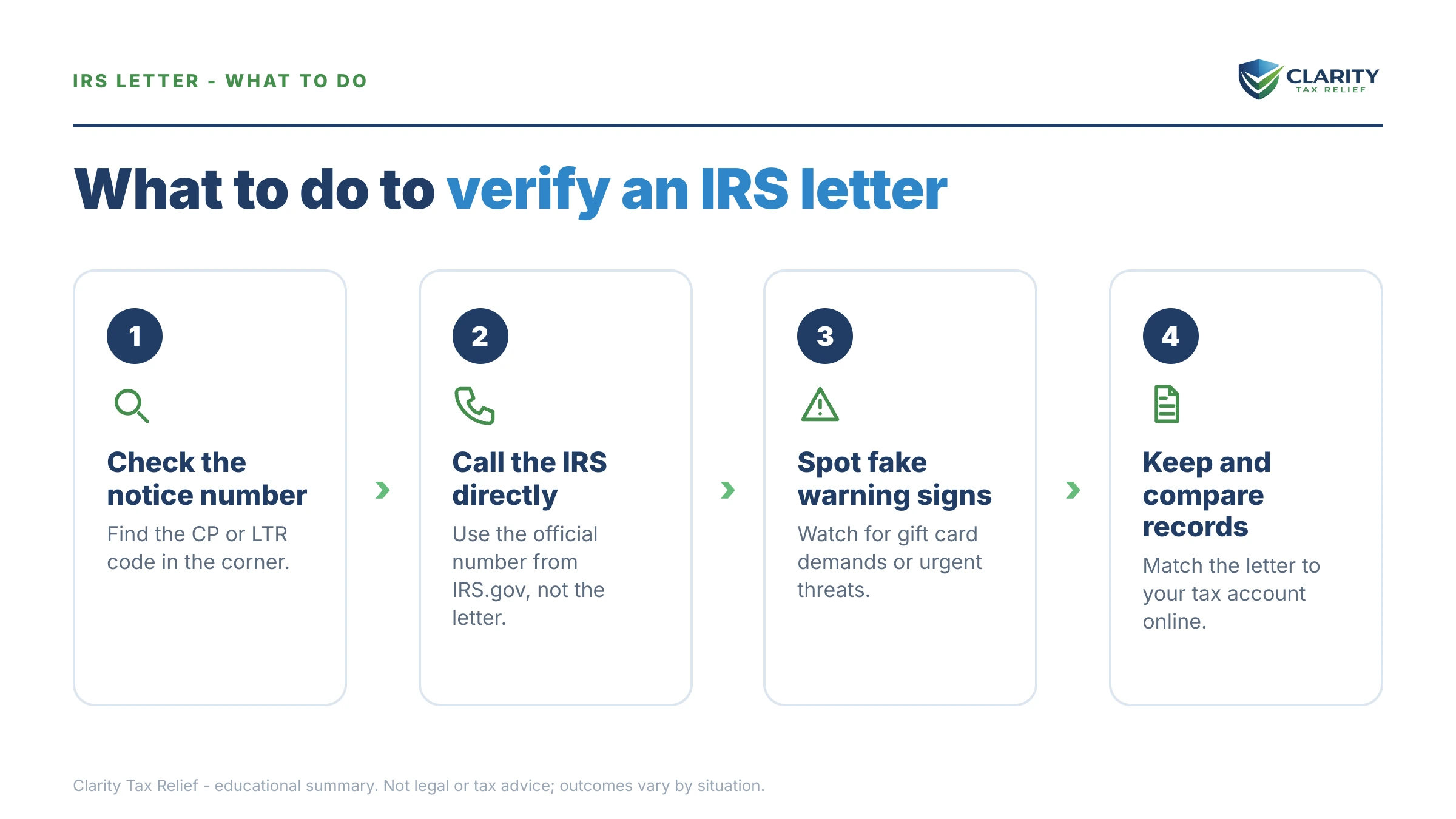
You can verify almost any IRS letter in under fifteen minutes without speaking to a single person — which matters in 2026, when reaching the IRS by phone can take hours. Follow these five steps in order:
- Find the notice or letter number. Look in the top-right corner (sometimes bottom-right) for a code like CP14, CP59, or LTR 5071C, plus a notice date and tax year. Write all three down — they are your verification keys.
- Compare the letter to your IRS online account. Log in at IRS.gov and check whether the balance, tax year, and recent notices match what the letter claims. A genuine balance-due notice mirrors your account; a fake one won't.
- Call the IRS through IRS.gov — never the letter's number. If anything doesn't match, call the IRS at 800-829-1040, the number published on IRS.gov. Scam letters print their own phone numbers so you 'verify' with the scammer.
- Refuse every payment channel except the U.S. Treasury. Pay only through IRS.gov or by check payable to the United States Treasury. Any demand for gift cards, wire transfers, cryptocurrency, or payment apps proves the letter is fake.
- Report a fake letter to TIGTA and the IRS. Report mail scams to the Treasury Inspector General for Tax Administration at 800-366-4484 and forward related scam emails to phishing@irs.gov. Then shred nothing — keep the letter as evidence.
For step two, your IRS online account setup takes about ten minutes with a photo ID, and it becomes your permanent lie detector for every future letter. If the account won't verify your identity, pulling your records the transcript route works too — here's how to get your IRS transcript online. You can also look up any notice number directly at the IRS's Understanding your IRS notice or letter page.
Special cases: private collectors, certified mail, and crypto letters
Three kinds of genuine IRS contact get mistaken for scams more than any others — and each has its own verification key.
Private collection agencies. The IRS really does assign some older accounts to private collectors, but never by surprise: a CP40 notice arrives first, naming the specific agency and containing a Taxpayer Authentication Number that the agency must be able to repeat back to you. Even with a legitimate collector, payment goes only to the United States Treasury — never to the agency. Our guide on whether an IRS debt collector is legitimate walks through the full verification.
Certified mail. A certified letter from the IRS is usually a sign of authenticity, not fraud — the IRS uses certified delivery when the law requires proof you were notified, typically because a rights clock (30 days on an LT11, 90 days on a deficiency notice) is starting. Scammers almost never pay for certified postage.
Crypto letters. Letters 6173 and 6174 read like accusations and arrive out of nowhere, which is why so many recipients assume fraud. Both are real IRS educational-compliance mail, verifiable by their LTR numbers, and 6173 carries a required response.
When you can handle this yourself — and when to get help
If the letter passes the five-point check, matches your online account, and involves a balance you can pay within 180 days, you don't need professional help — pay through IRS.gov or set up the plan yourself and you're done. The same goes for a fake letter: report it to TIGTA, warn family members (these scams target seniors heavily), and move on.
Experienced help changes the outcome in a narrower set of situations: multiple unfiled years where the IRS has already built SFR balances that overstate what you truly owe; a letter that's several steps into the collection sequence (CP504 or LT11), where appeal rights have deadlines; a disputed amount that requires reconstructing income records; or identity theft, where someone filed in your name and every notice compounds the mess. In those cases, the question isn't whether the letter is real — it's what order to fix things in, and that order changes what you pay. If you're comparing help, our checklist of tax relief scams shows what legitimate firms never promise.
Terms on your letter, decoded
- Notice number (CP / LTR): the code identifying which form letter you received — CP for computer-generated notices, LTR for letters — printed in the top or bottom right corner.
- United States Treasury: the only payee ever named on a genuine IRS payment; any other payee is a scam marker.
- Taxpayer Authentication Number: the code on a CP40 notice that a legitimate private collection agency must repeat to prove it really holds your account.
- Substitute for Return (SFR): a return the IRS builds for a non-filer from gross income records only, with no deductions — usually overstating the true tax.
- TIGTA: the Treasury Inspector General for Tax Administration, the watchdog that investigates IRS impersonation scams (800-366-4484).
- CDP rights: Collection Due Process — the formal 30-day appeal right that attaches to a final levy notice like the LT11.
Real vs. fake IRS letter questions, answered
Does the IRS send letters by certified mail?
Yes — the IRS uses certified mail for its highest-stakes letters, like the LT11 final notice of intent to levy and notices of deficiency. Certified delivery usually means a legal clock is starting, often 30 or 90 days. A certified IRS envelope is a strong sign the letter is real, because scammers rarely pay for certified postage — but verify the notice number anyway before responding.
Will the IRS text, email, or call me before sending a letter?
No. The IRS does not initiate contact by email, text message, or social media, and phone calls about a balance come only after multiple mailed notices. Any "IRS" text or email demanding payment is a scam, full stop. The one nuance is private collection agencies, which may call — but only after the IRS mails you a CP40 letter naming the agency first.
How do I verify an IRS letter without calling the IRS?
Log into your account at IRS.gov and compare the balance, tax year, and notices shown there against the letter. A real balance-due notice will match your online account within a few days of the notice date. If your account shows $0 owed and no recent notices, treat the letter as suspect and report it before paying anything.
Why did I get an IRS letter if I don't owe anything?
Many real IRS letters have nothing to do with debt. Common examples include identity-verification letters like the 5071C, refund adjustments, requests for a missing form, and reminders about unfiled returns. Check the notice number in the corner — it tells you exactly which situation you're in — before assuming the letter is either a bill or a fake.
Do scammers send fake IRS letters through the postal mail?
Yes — mail scams are growing precisely because people have learned to distrust emails and texts. Recent versions include fake refund letters in cardboard envelopes, "final notice of tax lien" letters from an invented "Bureau of Tax Enforcement," and letters demanding verification through a non-IRS phone number or website. The payment demand and contact channel expose them: the IRS never asks for gift cards, wire transfers, or account logins.
Are letters from private debt collectors about IRS taxes real?
They can be. The IRS assigns some older accounts to private collection agencies, but only after mailing you a CP40 notice naming the specific agency and giving you a Taxpayer Authentication Number the agency must repeat back. Even with a legitimate agency, payment never goes to the collector — every check is payable to the United States Treasury.
What if the IRS letter is real but I can't pay it?
A real balance doesn't mean you must pay in full today. Balances under $50,000 generally qualify for online payment plans of up to 72 months, hardship status can pause collection, and an Offer in Compromise may apply when your finances genuinely can't cover the debt. Verifying the letter first matters because your options — and deadlines — start from what the real notice says.
Is a letter without a notice number automatically fake?
Not automatically, but treat it as a red flag. Nearly all IRS notices print a CP or LTR number in the top or bottom right corner, and correspondence without one deserves extra scrutiny. Verify through your IRS online account or by calling the IRS at 800-829-1040 — never the number printed on the questionable letter.
Your next 24 hours
- Find the notice number, notice date, and tax year on the letter — top-right corner first, then bottom-right. Those three items are what every verification path runs on.
- Log into (or create) your IRS online account and compare the balance and notices shown there against the letter. While you're at it, pull your last filed return and any 1099s for the year the letter names.
- Get a free professional read. If the letter matches your account — or if you can't get the account verified — send us a photo through the 2-minute form or call (888) 825-7779. If the balance is real, interest and penalties are compounding on it right now; fifteen minutes of clarity today is cheaper than a month of guessing. If you've been contacted about a fake, the Taxpayer Advocate Service and TIGTA are the official reporting channels, and payments on real balances only ever go through IRS.gov/payments.
This guide is general information, not tax or legal advice for your specific situation. Eligibility for IRS programs depends on individual facts and circumstances; no outcome is guaranteed.