
IRS Notices
Certified Letter From the IRS: What It Means and What to Do (2026)
The short answer: a certified letter from the IRS almost always means a legal deadline has started. The IRS uses certified mail when the law requires proof of delivery before it can levy, file a lien, or assess new tax — most often a 30-day final levy notice or a 90-day Notice of Deficiency.
There's a peach-colored PS Form 3849 slip from the mail carrier on your door — or you just signed a green card for an envelope from the Internal Revenue Service — and part of you is tempted to leave it sitting at the post office. Don't. The clock inside is already running, and reading the letter is the only way to learn how much time you actually have.
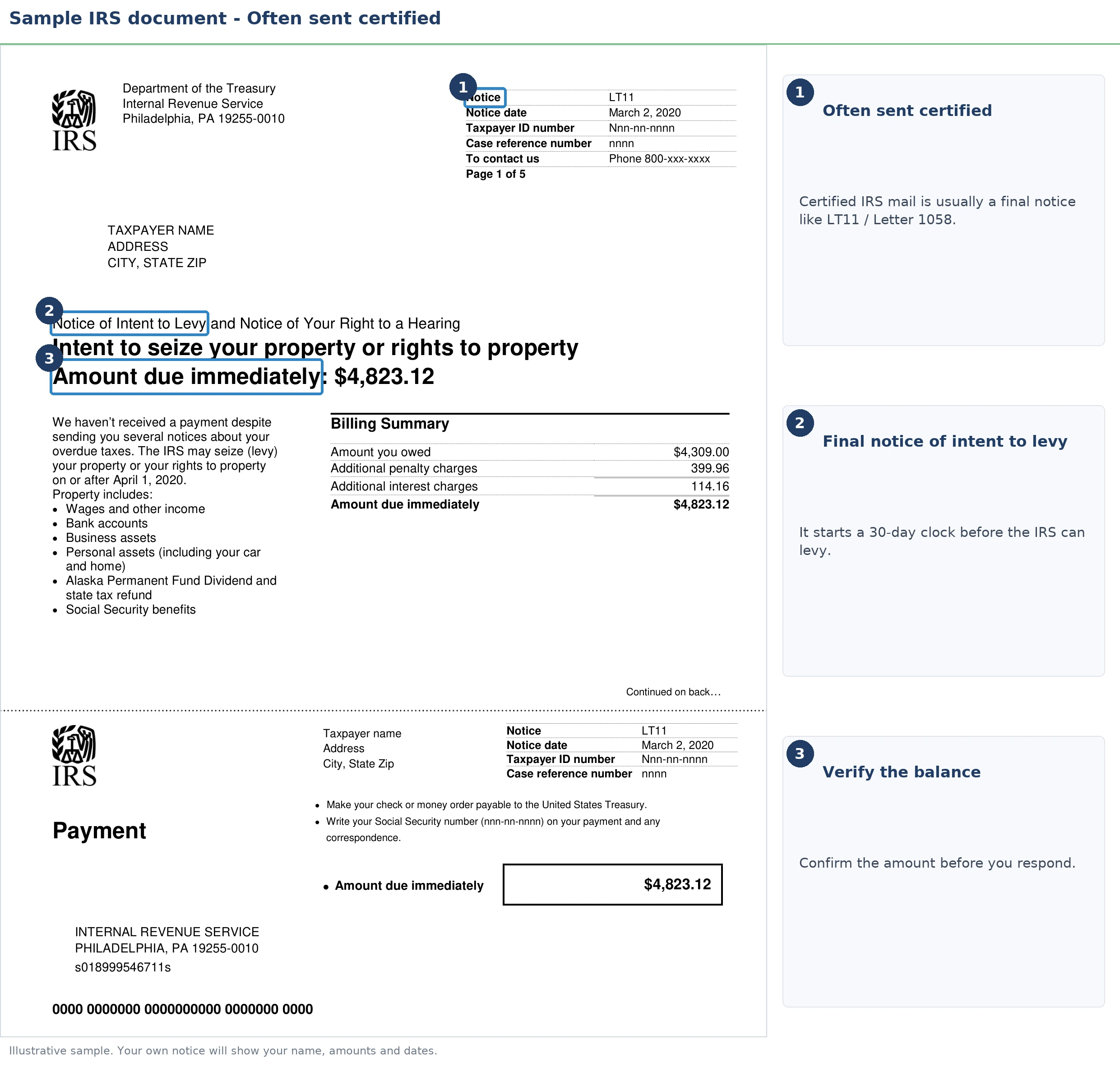
Here's what makes certified mail different from every other IRS envelope: the IRS sends millions of routine notices by regular first-class mail, but it pays for certified delivery only when a statute requires documented proof that it warned you before acting. Refusing the letter, or never picking it up, does not stop the deadline — the clock runs from the date printed on the notice, not the day you sign. The image below shows exactly what a certified IRS letter looks like and where to find the notice number and date that identify your specific deadline.
⏱ Your deadline: the response window printed inside the envelope. Most certified IRS notices start a 30-day clock (final levy notices like the LT11), a 60-day clock (Letter 1153, the trust-fund penalty proposal), or a 90-day clock (a Notice of Deficiency) — all measured from the date printed on the notice, not the day you retrieve it.
Why you got a certified letter from the IRS
The IRS sends certified mail when the law requires proof of delivery before it can enforce — which means the letter inside carries rights you can lose. Three legal triggers account for nearly all certified IRS mail:
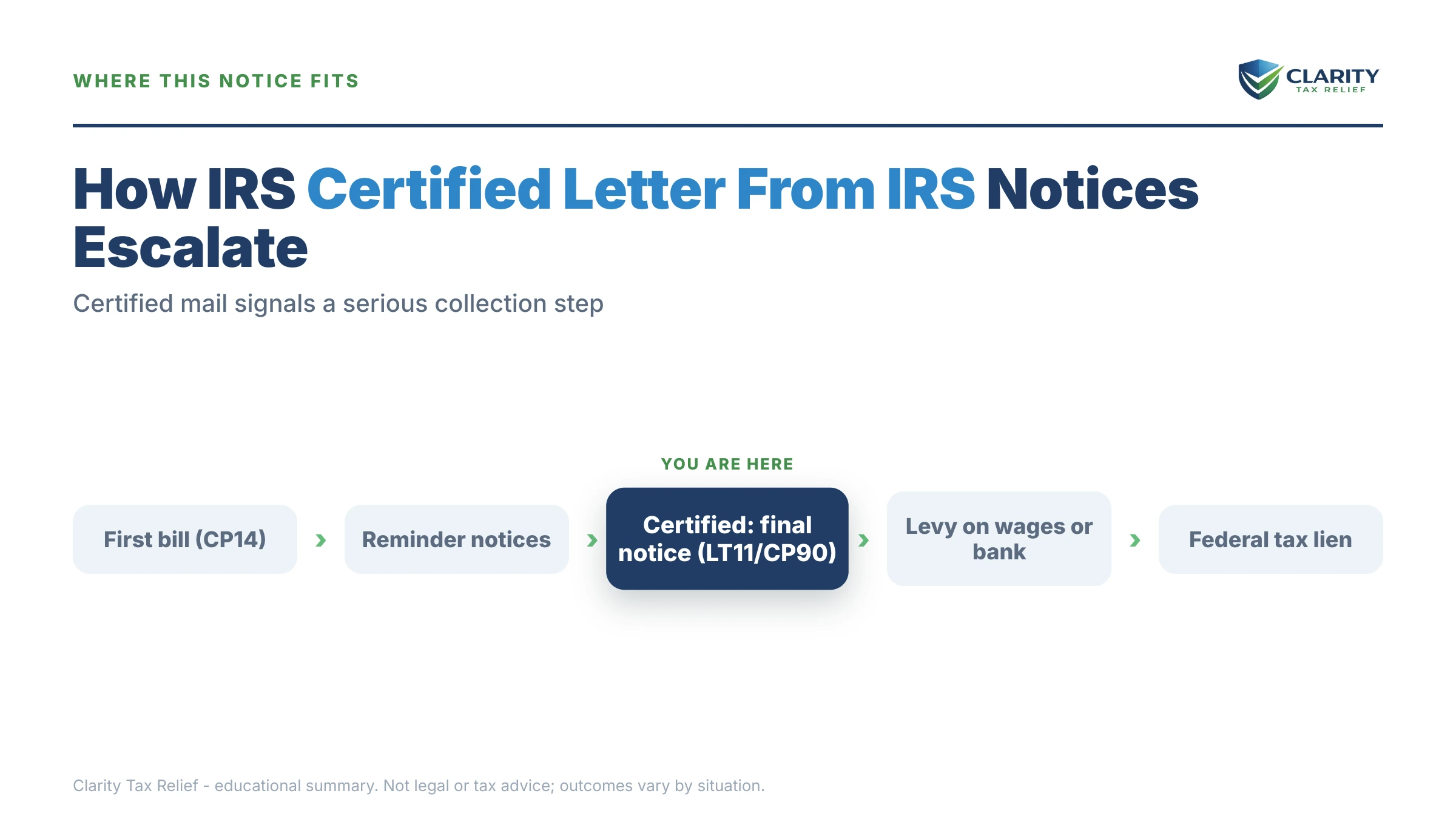
- Pre-levy warnings. Before seizing wages, bank accounts, or your state refund, the IRS must send notice — the CP504 notice (intent to levy your state refund under IRC §6331(d)) and the final notices, the LT11 notice or Letter 1058, which start a 30-day window and your Collection Due Process rights.
- Proposed assessments. Before adding tax you never agreed to, the IRS must send a Notice of Deficiency — the CP3219A notice of deficiency — giving you 90 days to petition Tax Court before the tax becomes final.
- Lien and penalty actions. After filing a federal tax lien, the IRS sends Letter 3172 certified, with 30 days to request a hearing. A proposed Trust Fund Recovery Penalty (Letter 1153) also arrives certified with a 60-day protest window.
Notice what's not on that list: routine bills, refund adjustments, and processing letters. A first bill like a CP14 arrives by regular mail, and a Letter 2645C — the IRS's "we need more time" letter — never comes certified. If you're trying to figure out an ordinary envelope, start with our guide to why did I get a letter from the IRS. Certified is a different category: the government documenting that it warned you.
| Notice / letter | What it means | The clock it starts | The right the deadline protects |
|---|---|---|---|
| CP504 | Intent to levy your state tax refund; not the final notice | Typically 30 days | Time to resolve before the final notice issues |
| LT11 / Letter 1058 | Final Notice of Intent to Levy — wages and bank accounts at risk | 30 days | Collection Due Process hearing (Form 12153) |
| CP90 / CP297 | Final notice variants (individual federal payments / business) | 30 days | Collection Due Process hearing (Form 12153) |
| CP3219A | Notice of Deficiency — proposed additional tax | 90 days | Petition U.S. Tax Court before the tax is assessed |
| Letter 3172 | Notice of Federal Tax Lien filed against you | 30 days | Post-lien Collection Due Process hearing |
| Letter 1153 | Trust Fund Recovery Penalty proposed against you personally | 60 days | Written protest / appeal before assessment |
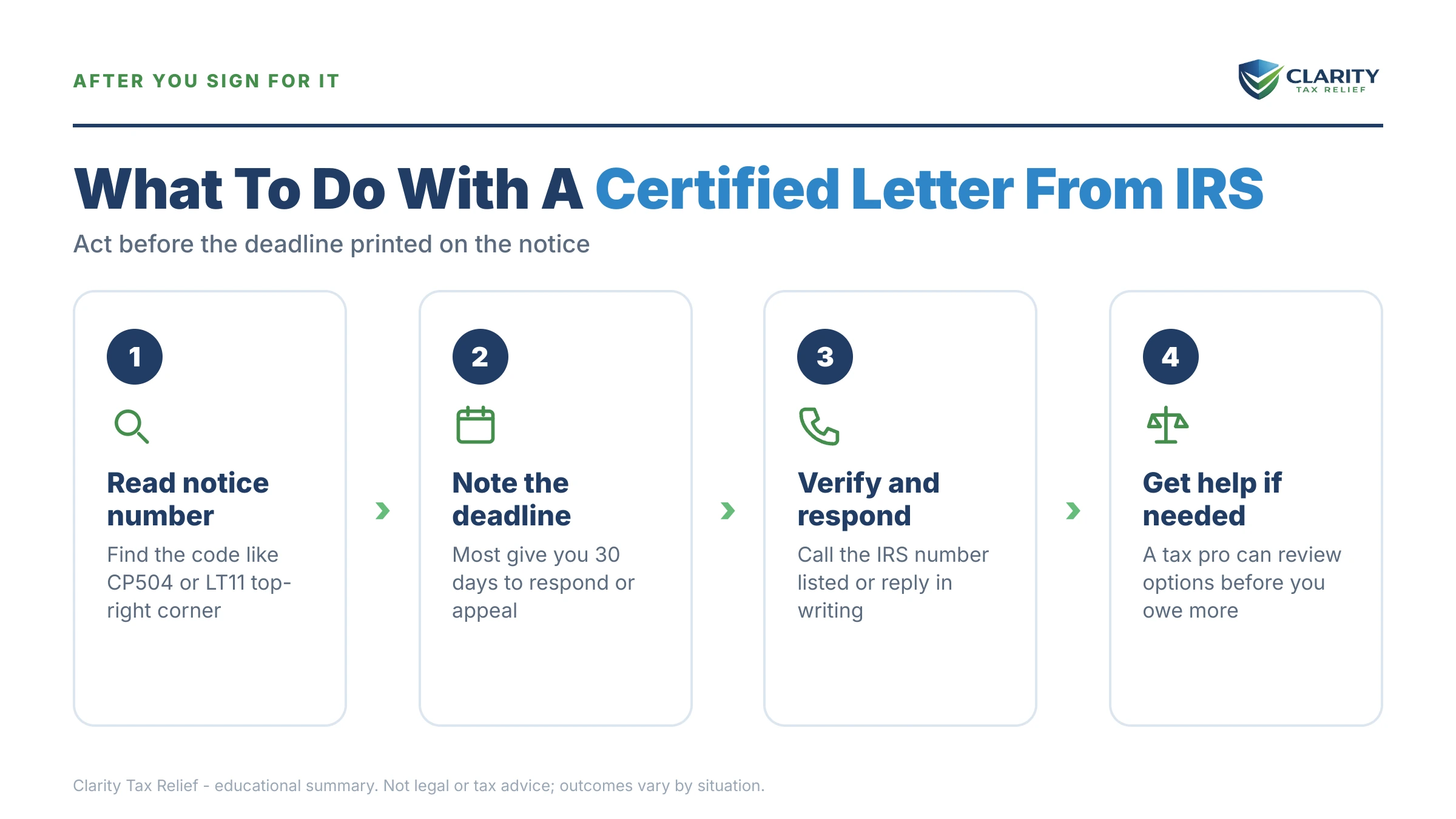
Do you have to sign for certified mail from the IRS?
No signature is required for a certified IRS notice to be legally valid — the IRS only has to mail it to your last known address. That single rule answers the question most people are really asking: "If I don't sign, does the deadline still count?" It does.
USPS will hold an unclaimed certified letter for a limited time — generally about 15 days — and then return it to the IRS marked unclaimed. The IRS treats that as delivered. The 30 or 90 days keep ticking the whole time, and enforcement proceeds on schedule against a letter you never read.
So the strategy question isn't whether to accept it — it's how fast you can get it in your hands. Every day the envelope sits at the post office is a day subtracted from your response window. Pick it up today, read the notice number, and you'll know exactly which situation you're in — which, in most cases, is more manageable than the one you're imagining.
What happens if you ignore a certified IRS letter
Ignoring a certified IRS letter doesn't pause anything — the deadline expires and the enforcement the letter warned about becomes legal. Here is the sequence, stage by stage:
- The response window expires. Thirty, sixty, or ninety days from the notice date — whichever clock your letter started — passes whether or not you opened the envelope.
- Your rights lapse. Miss the 30-day window on a final levy notice and you lose the Collection Due Process hearing that can pause enforcement. Miss the 90-day deficiency window and the proposed tax is assessed without a judge ever hearing your side — leaving only weaker, discretionary remedies afterward.
- Enforcement begins. After a defaulted final notice, the IRS can levy: a bank levy freezes funds with a 21-day hold before the money leaves; a wage levy is continuous until released; Social Security benefits can be reduced by up to 15% through the Federal Payment Levy Program.
- The collateral damage spreads. A federal tax lien attaches to everything you own and appears in public records, and once your total debt crosses $66,000 (the 2026 threshold), the IRS can certify it to the State Department, blocking passport renewal.
One 2026 reality makes this worse: the IRS workforce shrank roughly 27% in 2025, so reaching a human takes longer than ever — but the certified notices, lien filings, and levies are generated by automated systems that never slowed down. Waiting to "hear from a person" is waiting for a levy.
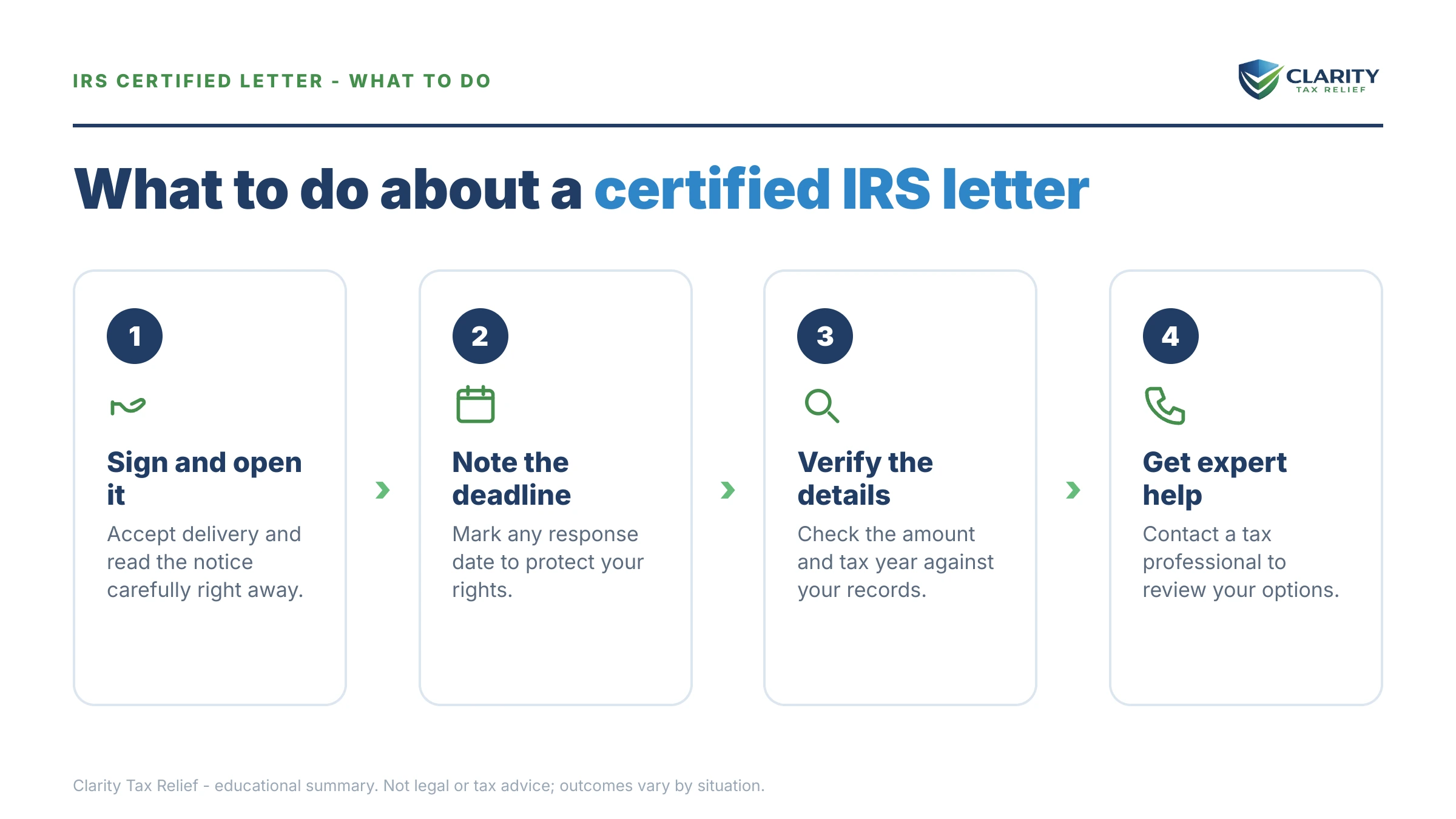
Holding a certified IRS letter right now?
Most certified letters mean a 30-day clock is already running from the date printed inside — not the date you signed. Send us a photo of the notice and an experienced tax professional will tell you which deadline you're on and every option still open — free and confidential.
Your options if the certified letter is about a balance you can't pay
Every certified collection notice can be neutralized by a resolution the IRS itself offers — the letter just doesn't advertise them. Setting up any of these before your window closes stops the levy machinery; which one fits depends on your balance and your finances:
| Option | Who may qualify | Cost | The catch |
|---|---|---|---|
| Short-term payment plan | Can pay in full within 180 days | $0 setup | Interest and penalties keep accruing until paid |
| Guaranteed installment agreement | Individuals only who owe $10,000 or less in income tax (excluding penalties and interest), with all returns filed, timely filing and payment for the past 5 years, and no installment agreement in that period | Setup fee varies | Must pay off within 3 years |
| Streamlined installment agreement | Owe $50,000 or less — up to 72 months, set up online | Setup fee varies; lower with direct debit | Accrual continues; default restarts collection |
| Currently Not Collectible | Paying anything would create genuine hardship | $0 | Debt remains and grows; IRS reviews your income later |
| Offer in Compromise | Assets and income genuinely can't cover the debt | $205 fee + 20% down on lump-sum offers (both waived if AGI ≤ 250% of poverty) | Roughly 1 in 5 offers were accepted in FY2024 — means-tested, never guaranteed |
| Penalty abatement | Clean compliance for the prior 3 years, or reasonable cause | $0 to request | Removes penalties only, not tax; automatic AEP relief begins summer 2026 |
Two notes on that table. First, requesting a Form 12153 CDP hearing within 30 days of a final levy notice generally pauses levy action while your case is heard — and the hearing is exactly where these resolution options get negotiated with appeal rights intact. Second, a streamlined installment agreement is the workhorse here: for balances under $50,000, it can usually be set up online without handing the IRS a full financial disclosure.
A worked example: $23,800, three years unfiled, and a certified LT11
Say you're a gig worker who hasn't filed for three years, and a certified LT11 arrives showing $23,800 — because the IRS filed returns for you. When you don't file, the IRS eventually prepares a substitute for return from your 1099s alone: no mileage, no phone, no supplies, no home office. The assessed number is almost always the worst-case version of your taxes.
Here's how the math can play out — hypothetically:
- Day 1–30: You file Form 12153 within the 30-day window. Levy action on those years is generally paused while the hearing is pending (note: the pause also tolls the 10-year collection statute).
- Meanwhile: You prepare and file the three real returns. If legitimate business expenses cut the assessed liability from $23,800 to, say, $16,000, you've reduced the debt by a third before negotiating anything. Our guide for anyone who hasn't filed in 3 years walks through that catch-up.
- Then: The remaining $16,000 fits a streamlined installment agreement: $16,000 ÷ 72 months ≈ $222/month before ongoing interest and penalties. Even the full $23,800 ÷ 72 ≈ $331/month — a payment, not a levy.
- Also worth checking: the failure-to-file penalty runs 5% per month — ten times the 0.5% failure-to-pay rate — though in months where both penalties apply, the failure-to-file portion drops to 4.5% (5% combined). Either way, a chunk of that balance is likely penalties. You can estimate how much with our IRS Penalty & Interest Calculator, and a clean prior compliance history may support abatement on top.
The sequence matters: hearing request first (to hold the levy), returns second (to shrink the number), payment arrangement last (on the smaller balance). Run it backwards and you end up making payments on tax you never actually owed.
How to respond to a certified letter from the IRS, step by step
- Retrieve the letter immediately. Sign for it or pick it up from USPS the same day. The deadline runs from the notice date, so every day it sits unclaimed is response time lost.
- Identify the notice number and date. Find the notice or letter number and the notice date printed on the first page. Together they tell you which clock is running and when it started.
- Verify the balance in your IRS online account. Log in at IRS.gov and compare the assessed balance and notice history against the letter before paying or responding to anything.
- Choose your response before the window closes. File Form 12153 for a levy notice, petition Tax Court for a deficiency notice, or set up a payment arrangement — any of these beats letting the deadline pass.
- Get experienced help if the stakes are high. If a levy clock is running, years are unfiled, or the balance is disputed, have an experienced tax professional review the letter before you respond.
When you can handle this yourself
Not every certified letter needs professional help. You can likely handle it alone if:
- It's a CP504 for a balance you agree with and can pay — pay at IRS.gov/payments or set up a plan online, and the sequence stops there.
- You owe under $50,000 on filed returns and just need a monthly plan — the IRS's own payment plan portal handles it in about 20 minutes.
- You can pay in full within 180 days — a short-term plan costs nothing to set up.
Experienced help genuinely changes outcomes when the certified letter is a final levy notice and the 30-day window is partly gone, when multiple years are unfiled or the IRS assessed via substitute returns, when the letter proposes a Trust Fund Recovery Penalty against you personally, or when the notice is a deficiency notice you disagree with — because the Tax Court deadline cannot be extended, and the arguments you raise (or waive) in a CDP hearing follow you through the rest of the case. If you're truly stuck between the IRS and a deadline with no resources, the Taxpayer Advocate Service is an independent, free option for hardship cases.
Terms on your certified letter, decoded
- Certified mail / return receipt: a USPS service that documents delivery — the IRS uses it to prove it warned you, as certain statutes require.
- Last known address: the address on your most recent return; mailing there makes the notice legally effective even if you never receive it.
- Collection Due Process (CDP): your right to an independent Appeals hearing before levy — requested on Form 12153 within 30 days of a final notice.
- Notice of Deficiency: the IRS's formal proposal of additional tax; your only pre-payment path to a judge is a Tax Court petition within 90 days.
- Levy vs. lien: a levy takes property (wages, bank funds); a lien is a public legal claim against everything you own. Different letters, different fixes.
- CSED: the Collection Statute Expiration Date — generally 10 years from assessment, though hearings, offers, and bankruptcy pause the clock.
Certified letter from the IRS: your questions answered
Is a certified letter from the IRS always bad news?
Not always catastrophic, but almost always time-sensitive. The IRS pays for certified mail only when the law requires proof of delivery before it can take something from you — usually your money or your appeal rights. That means the letter inside nearly always starts a formal response window, and the window is the reason to act, not panic.
What happens if I don't pick up a certified letter from the IRS?
The deadline runs anyway. Under the tax code, the IRS only has to send the notice to your last known address — it doesn't need your signature for the clock to be valid. Refusing or ignoring the letter just means you burn response days without knowing what you're responding to. Pick it up; the contents never get worse by being read.
Does the deadline start when I sign for the letter?
No — the clock runs from the date printed on the notice itself, not the day you sign for it or pick it up from the post office. If the letter sat at USPS for a week, you've already lost a week of your response window. That's why retrieving certified mail immediately matters.
Can a certified letter from the IRS be a scam?
It's unlikely — scammers rarely pay for certified postage or use USPS at all, preferring calls, texts, and email, which the real IRS doesn't use to start contact. Verify any letter by logging into your IRS online account at IRS.gov and comparing the balance and notice history. Anyone demanding gift cards, wire transfers, or payment-app transfers is a criminal, not the IRS.
Which IRS notices are sent by certified mail?
The most common are the CP504 (intent to levy your state refund), the LT11 or Letter 1058 (final notice of intent to levy), CP90 and CP297 (final notice variants), the CP3219A Notice of Deficiency, Letter 3172 (federal tax lien filed), and Letter 1153 (Trust Fund Recovery Penalty proposal). Each starts a different statutory clock — 30, 60, or 90 days.
Does a certified letter mean the IRS is about to take my bank account?
Only a final notice of intent to levy (LT11, Letter 1058, CP90, or CP297) opens the door to a bank or wage levy, and even then the IRS must wait 30 days from the notice date. If a bank levy does happen later, the bank holds the funds for 21 days before sending them, which is your last window to get it released.
Can I still stop a levy after getting a certified final notice?
Yes — filing Form 12153 within 30 days of the notice date requests a Collection Due Process hearing and generally pauses levy action on those tax years while the hearing is pending. Setting up an installment agreement or being placed in Currently Not Collectible status also stops levies. Interest and penalties keep accruing under every option, but your paycheck and bank account stay intact.
Your next 24 hours
- Get the letter and find two things: the notice or letter number and the notice date on the first page. Count forward 30, 60, or 90 days from that date (per the table above) — that's your real deadline, and it started before you signed.
- Gather three documents: the letter itself, your most recent filed tax return, and a rough picture of your monthly income — everything a response decision depends on.
- Get the letter reviewed free before your window closes: the 2-minute form at claritytaxrelief.com/#consult or (888) 825-7779. Ten minutes with an experienced tax professional turns a certified envelope into a plan.
This guide is general information, not tax or legal advice for your specific situation. Eligibility for IRS programs depends on individual facts and circumstances; no outcome is guaranteed.