
IRS Letters
IRS Letter 2645C: Why the IRS Needs More Time, and What to Do (2026)
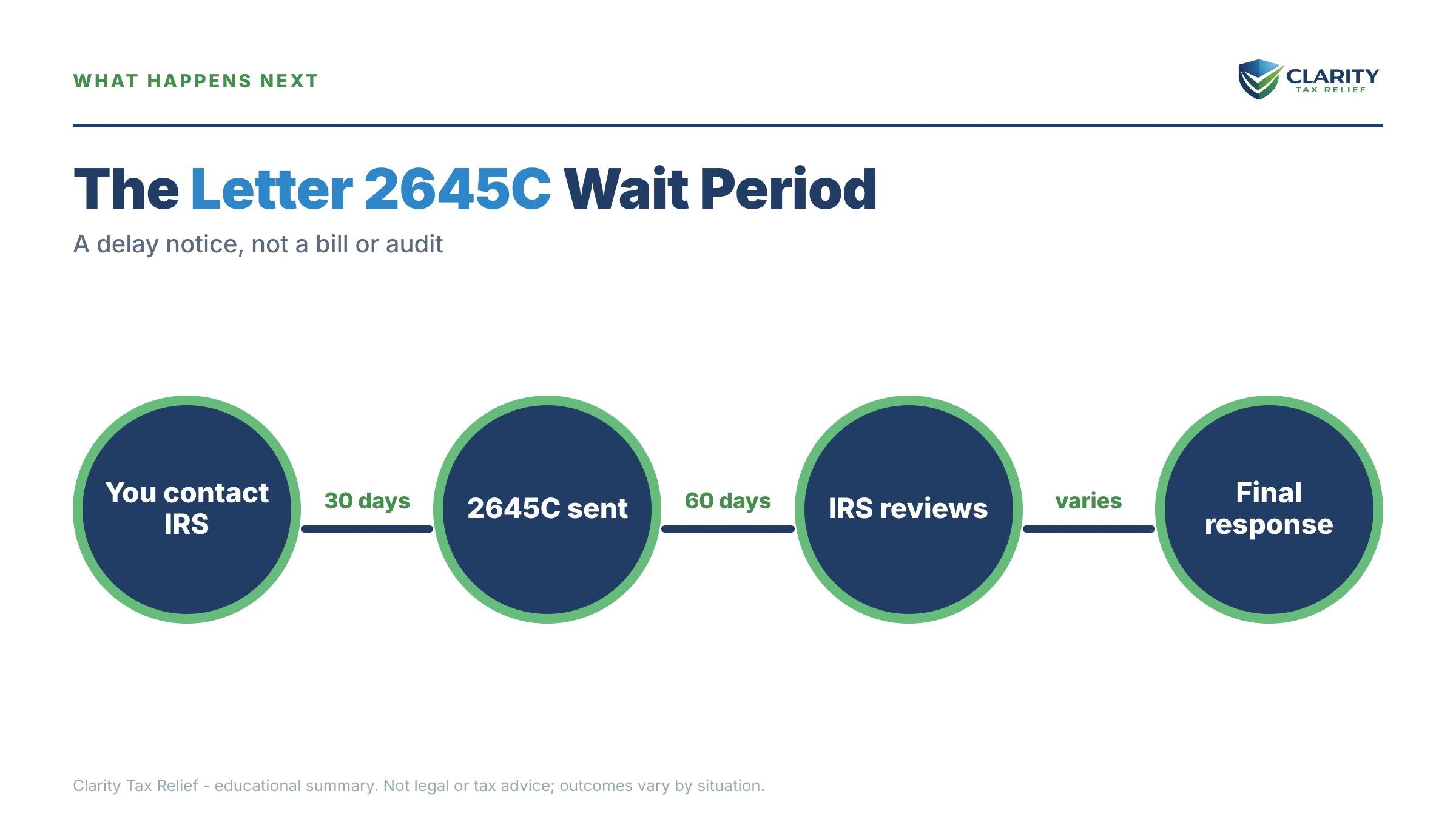
The short answer: Letter 2645C is an interim letter — the IRS received your correspondence, inquiry, or return but needs more time, typically 60 more days, to work on it. It isn't a bill, an audit, or a demand, and usually needs no reply. But any balance behind it keeps accruing penalties and interest.
You mailed the IRS something weeks ago — a CP2000 response, an amended return, a request to remove a penalty — and what came back answers nothing and asks for nothing. Letter 2645C is the IRS telling itself, in writing, that it's behind. In 2026, with the agency's workforce down roughly 27% from the 2025 cuts, it's one of the most-mailed letters in the system.
The image below shows exactly what a genuine Letter 2645C looks like and where to find the two lines that actually matter: the tax year it covers and the date the IRS logged what you sent. If the letter doesn't obviously connect to anything you mailed, start with our decoder on why did I get a letter from the IRS — then come back here.
⏱ The real clock: Letter 2645C sets no deadline for you — but it pauses nothing either. If a balance sits behind your correspondence, the failure-to-pay penalty (0.5% per month) and daily-compounding interest keep accruing through the IRS's entire "additional time," and automated collection notices can keep arriving from a separate IRS unit.
Why you got Letter 2645C
Letter 2645C is the IRS's interim letter: an acknowledgment that something reached your account, paired with a self-granted extension — typically 60 days — to finish working on it. The exact number of days is printed in the letter's opening paragraph, and the follow-up clock runs from the letter date.
The letter is generated when an IRS unit has your item open but can't close it within its normal response window. That's the entire message. Unlike a Letter 12C, which demands documents before your return can move, a 2645C asks you for nothing.
Look near the top for two data points you'll need later: the tax period the letter references, and the "received date" — the day the IRS logged your correspondence. That received date is your proof of timeliness if anyone ever questions when you responded, and it's the reference you'll give when you call.
Here's what a 2645C is most often responding to, and what each version means for you:
| What you sent (or what happened) | What the IRS is working on | Your next move |
|---|---|---|
| Response to a CP2000 notice | The underreporter unit is reviewing your documents | Keep your copy; don't re-send unless asked |
| Penalty relief request (first-time penalty abatement or reasonable cause) | The penalty unit is weighing your request | Consider paying the tax portion so the base stops growing |
| Amended return (Form 1040-X) | The amended-return processing queue | Track it — see where's my amended return |
| Audit correspondence or reconsideration | The exam unit's working file | Watch for a Letter 525 audit report as the next real document |
| Refund inquiry or payment trace | Accounts-management research | Refund interest may accrue in your favor on a held overpayment |
| Nothing — you sent nothing | A third party acted on your account, or an internal referral posted | Check your IRS online account; see the next section |
Letter 2645C when you never contacted the IRS
You can receive Letter 2645C without ever writing to the IRS, because anything that touches your account counts as "correspondence." A tax preparer calling about your return, a power-of-attorney filing, an injured-spouse form attached to a joint return, or one IRS unit referring your file to another can each generate the letter.
Before you worry, spend ten minutes reconstructing what it might be. Did your preparer, spouse, or payroll service contact the IRS on your behalf? Did you file anything unusual this year — an amended return, an extension payment, a withholding change?
If the answer is genuinely nothing, log into your IRS online account and pull your account transcript to see what activity posted. A 2645C alone is not an identity-theft indicator — but unexplained activity you didn't authorize is. In that narrow case, our guide to the Form 14039 identity theft affidavit walks through how to lock the account down.
What happens if you ignore Letter 2645C
Ignoring Letter 2645C costs you nothing by itself — the danger is treating it as a pause button, because the clocks that matter keep running without it. Here's the sequence that typically follows:
- Letter 2645C #1 — acknowledgment plus a self-granted extension, typically 60 days. Nothing for you to do yet.
- A second (sometimes third) interim letter — the IRS can extend itself again, and with 2025's staffing cuts, repeat interim letters on complex correspondence are routine in 2026.
- The real answer — an adjustment notice, a penalty-relief approval or denial, or an exam report such as Letter 525. This next letter can carry an actual deadline and appeal rights — it's the one you cannot afford to miss.
- In parallel, if you owe: the automated collection stream keeps moving — CP501, CP503, then levy-track letters like Letter 1058 — unless a formal hold is placed on your account.
- Silence past the promised date — now the move is yours: call the number on the letter, and escalate to the Taxpayer Advocate if the delay is causing harm.
Stage 4 is the trap that catches people. The unit reading your correspondence and the computer mailing collection notices are different parts of the IRS, and they don't automatically talk to each other. Pending correspondence is not a shield — if a notice with a deadline arrives mid-wait, answer it on its own clock. The IRS layoffs 2026 processing delays made the humans slower; the automated side never slowed down.
Got a Letter 2645C while a balance grows behind it?
An interim letter means your case is in a queue — not that the meter stopped. If penalties and interest are stacking while you wait, or collection notices keep arriving anyway, have an experienced tax professional review your letters free and map where your case actually stands.
Your options while the IRS "works on it"
A Letter 2645C is not a hold on your account: every penalty, interest charge, and automated notice continues unless something else stops it. Knowing which clocks run against you — and which run for you — tells you what's worth doing during the wait.
| Clock or right | During the 2645C wait | Why it matters |
|---|---|---|
| Failure-to-pay penalty | Keeps accruing at 0.5% per month | About $382/month on a $76,400 balance, before interest |
| Interest | Compounds daily, unaffected | Set quarterly; it never pauses for IRS delay |
| Automated collection notices | Continue unless a formal hold is on the account | CP501, CP503 — even levy-track letters — can arrive mid-wait |
| Deadlines on other notices | Keep running — a 2645C extends nothing | A CP2000 window or appeal deadline closes on its own schedule |
| 10-year collection statute (CSED) | Keeps running — in your favor | Ordinary correspondence doesn't pause the IRS's collection window |
| Passport certification | Still possible above the $66,000 threshold (2026) | Passport revoked for tax debt rules don't wait for your letter |
So what's actually worth doing? Three things, depending on your situation:
If a balance sits behind the wait: pay the tax you agree you owe, or set up a payment arrangement on it. That shrinks the base the 0.5% monthly penalty grows on, and it does not forfeit a pending penalty-relief request — if penalties are later removed, they come off the balance. One more 2026 note: if your pending item is a first-time abatement request, the IRS's new Automatic Exemption from Penalty (AEP) begins applying qualifying relief automatically starting this summer, so some pending requests will resolve without any letter at all.
If you're waiting on a refund or an answer: watch your transcript rather than the mailbox — account activity usually posts there before a letter arrives. Our guide on how to read an IRS account transcript shows what movement looks like; a code 971 entry often means the response letter is finally on its way.
If the promised date passes or the delay is causing harm: call the number printed on the letter with the received date handy. If that fails and you're facing hardship — a frozen refund you need for rent, a levy threat on the same account — file Form 911 with the Taxpayer Advocate, the independent unit built for stalled cases.
What the wait costs a self-employed reader: a $76,400 example
Say you're a sole proprietor who underpaid self-employment tax across two strong years and now owes $76,400. You mailed a reasonable-cause penalty request in May; in July, a Letter 2645C arrives asking for 60 more days. This is a hypothetical — but the math is real.
If you do nothing else during those 60 days: the failure-to-pay penalty runs at 0.5% × $76,400 ≈ $382 per month — roughly $764 across the window — and daily-compounding interest accrues on the entire balance on top of that. You can estimate your own accrual with our penalty & interest calculator.
Two more things specific to this reader. First, the September 15 quarterly estimate comes due mid-wait — skip it because "the IRS owes me an answer," and next April stacks a fresh year of debt on the old one. Second, $76,400 sits above the 2026 seriously-delinquent threshold of $66,000: if your debt otherwise meets the certification criteria (assessed, with a lien filed or levy issued), a pending 2645C does nothing to prevent passport certification.
The smarter play: put the tax itself on an agreement now. The penalty request keeps processing either way, and every month on a plan is a month the levy track can't advance.
How to respond to Letter 2645C, step by step
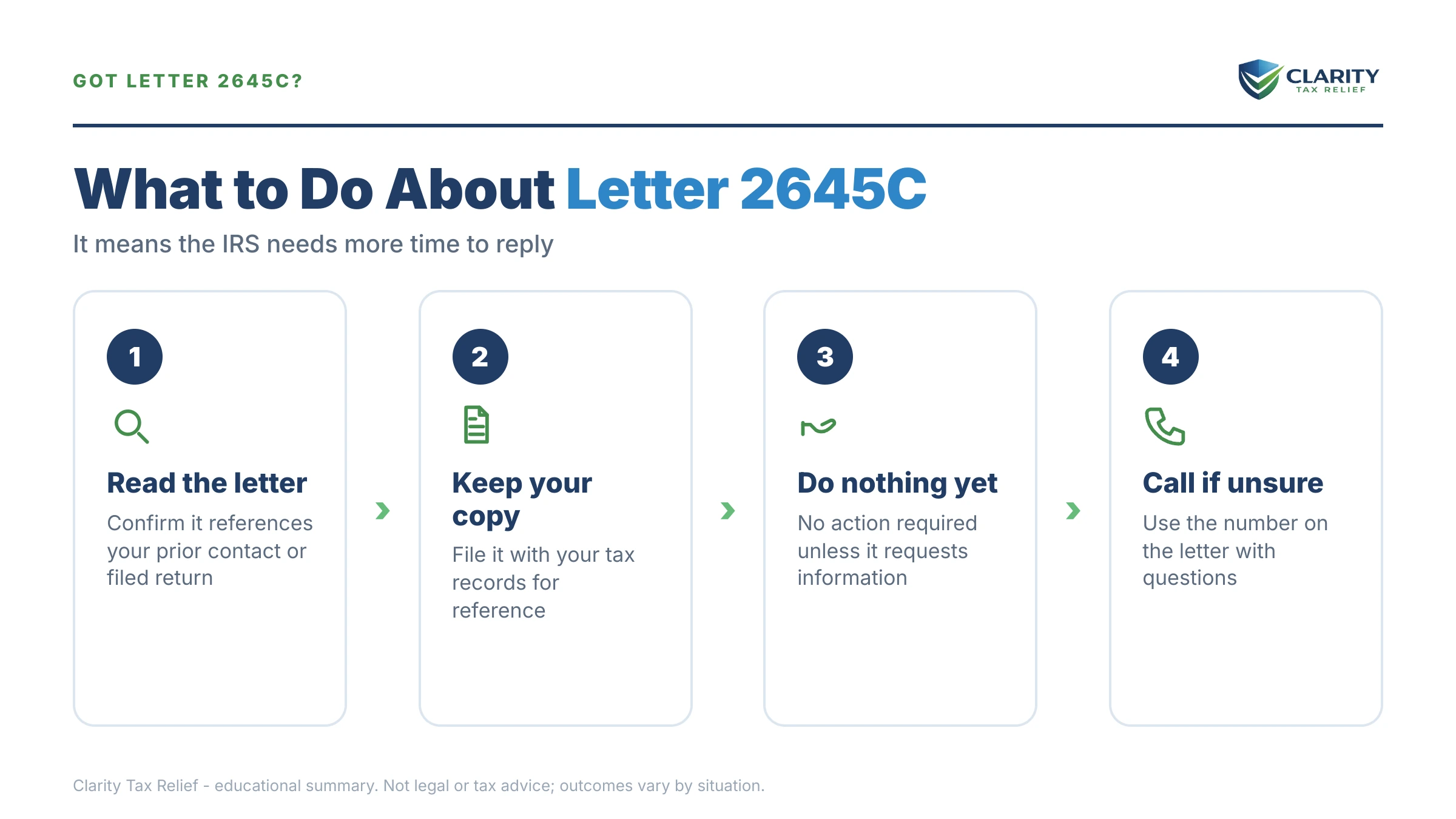
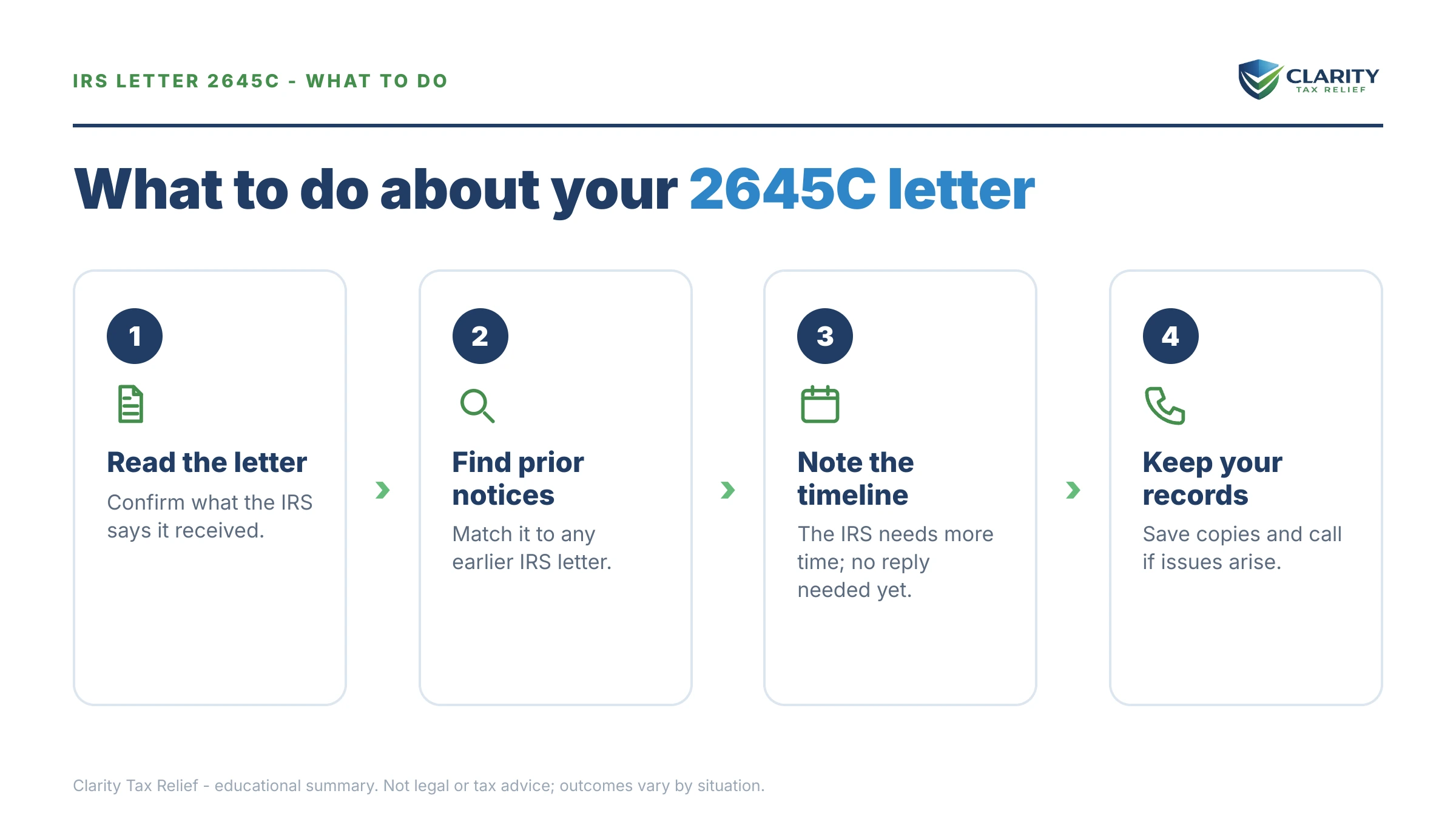
For most people this is a fifteen-minute checklist, not a project:
- Match the letter to what you sent. Check the tax year and received date printed near the top, and pair the letter with the correspondence, amended return, or request it acknowledges.
- Verify it's genuine. A real Letter 2645C demands no payment and no personal information — anything asking for gift cards, wire transfers, or bank logins is a fake, not the IRS.
- Calendar the promised date. Count the number of days stated in the letter (typically 60) from the letter date and set a reminder to check your transcript and your mailbox.
- Protect every other deadline. A 2645C never extends a CP2000 response window, an appeal deadline, or a Tax Court petition date — answer those notices on their own clocks.
- Escalate if the date passes silently. Call the number printed on the letter first; if the delay drags on or is causing financial hardship, file Form 911 with the Taxpayer Advocate Service.
The IRS's own explainer at Understanding your Letter 2645C confirms the core point: no action is required unless the letter specifically asks for something.
When you can handle a Letter 2645C yourself — and when help changes the outcome
Most people who receive a single Letter 2645C with no balance due need to do exactly one thing: calendar the date and wait. If your item is a routine inquiry, a small amended return, or a penalty request on a balance you could pay within 180 days, adding a professional adds cost without changing the queue.
Experienced help changes outcomes in a narrower set of situations: a five-figure balance accruing while two IRS units act independently on your account; a levy-track notice arriving mid-wait; a second or third interim letter sitting on a refund or abatement you genuinely need; or multiple unfiled years underneath the correspondence, where the order you fix things in changes what you ultimately pay. In those cases the value isn't speeding up the IRS — it's making sure the collection side can't hurt you while the correspondence side stalls. The Taxpayer Advocate Service (taxpayeradvocate.irs.gov) is also a free escalation path when delay crosses into hardship.
Terms on your letter, decoded
- Interim letter — a status update that grants the IRS more time; it decides nothing and demands nothing.
- Correspondence — anything that reached your account: a mailed reply, a filed form, a preparer's call, or an internal IRS referral.
- Received date — the date the IRS logged your item; it's your proof of timeliness and your reference number when you call.
- Failure-to-pay penalty — 0.5% of unpaid tax per month while a balance sits, capped at 25%; the wait doesn't pause it.
- CSED — the Collection Statute Expiration Date; the IRS generally has 10 years from assessment to collect, and ordinary correspondence doesn't stop that clock.
- Taxpayer Advocate Service — the independent IRS unit that intervenes in stalled cases causing hardship, reached via Form 911.
Letter 2645C questions, answered
Do I need to respond to Letter 2645C?
Usually no — the letter itself asks for nothing and requires no reply. Your job is to note the additional time stated (typically 60 days), keep your copy of whatever it acknowledges, and calendar the follow-up date. The exception: if the letter arrived alongside a different notice with its own deadline, answer that notice on its own clock — a 2645C never extends other deadlines.
Why did I get Letter 2645C if I never contacted the IRS?
Because "correspondence" is broader than a letter you personally mailed. A tax preparer's call, a power of attorney filing, an amended return, an injured spouse form, or an internal IRS referral can all trigger one. Check your IRS online account and transcript for recent activity; if you find absolutely nothing and no one acted for you, treat it as a prompt to rule out identity misuse.
Is Letter 2645C an audit?
No. Letter 2645C is an administrative status update, not an examination notice. Audits open with different letters — typically Letter 566 or a 2205-series appointment letter — that name the items under review and ask for records. A 2645C asks for nothing. If your original correspondence was audit-related, the letter simply means the exam unit hasn't finished reviewing what you sent.
Does Letter 2645C mean my refund is coming?
Not by itself. If your inquiry or amended return involves a refund, the 2645C only confirms someone is working on it — it makes no promise about the outcome or timing. On the plus side, when the IRS holds an overpayment beyond its normal processing window, it generally owes you interest on the delayed amount. Keep checking your transcript for an 846 refund-issued code.
How many Letter 2645Cs can the IRS send?
There's no limit, and in 2026 back-to-back interim letters are common. Each one grants the IRS another self-declared extension — typically 60 days — and with the IRS workforce down roughly 27% since 2025, complex correspondence often draws two or three before a real answer arrives. After the second letter, it's reasonable to call the number printed on it; after repeated delays with hardship, the Taxpayer Advocate Service can force movement.
Does Letter 2645C stop collections or penalties?
No. The letter is not a collection hold: the failure-to-pay penalty (0.5% per month) and daily interest keep accruing on any balance, and automated notices like the CP501 and CP503 can keep arriving from a separate IRS unit. If a levy-track notice such as an LT11 or Letter 1058 shows up mid-wait, respond to it on its own 30-day clock — your pending correspondence does not protect you.
What should I do if the 60 days pass and I hear nothing?
Call the number printed on the letter — not the general IRS line — with the letter, your original correspondence, and the tax year in front of you. If calls go nowhere and the delay is causing financial harm, file Form 911 to request Taxpayer Advocate Service help; TAS exists precisely for stalled cases. Document every contact date in case you later need penalty relief for IRS delay.
Is Letter 2645C a scam?
A genuine Letter 2645C arrives by postal mail, references a specific tax year, and asks for nothing — no payment, no gift cards, no personal data. That last part is your best scam test: fraudsters want money or information, and this letter requests neither. If you're unsure, ignore any phone number you distrust and verify your account directly at IRS.gov.
Your next 24 hours
- Find three things on the letter: the tax year, the "received date," and the number of additional days stated in the first paragraph. Write the follow-up date on your calendar today.
- Gather your side of the file: your copy of whatever the letter acknowledges (CP2000 response, 1040-X, penalty request), your last filed return, and any collection notices that are still arriving. If you owe and can pay some of it, IRS.gov/payments stops that portion from accruing.
- If a balance is growing behind the wait — or notices keep escalating anyway — get a free case review before the collection side outruns the correspondence side: the 2-minute form or (888) 825-7779.
This guide is general information, not tax or legal advice for your specific situation. Eligibility for IRS programs depends on individual facts and circumstances; no outcome is guaranteed.