
Refunds & Processing
Where's My Amended Return Taking So Long? What's Normal in 2026
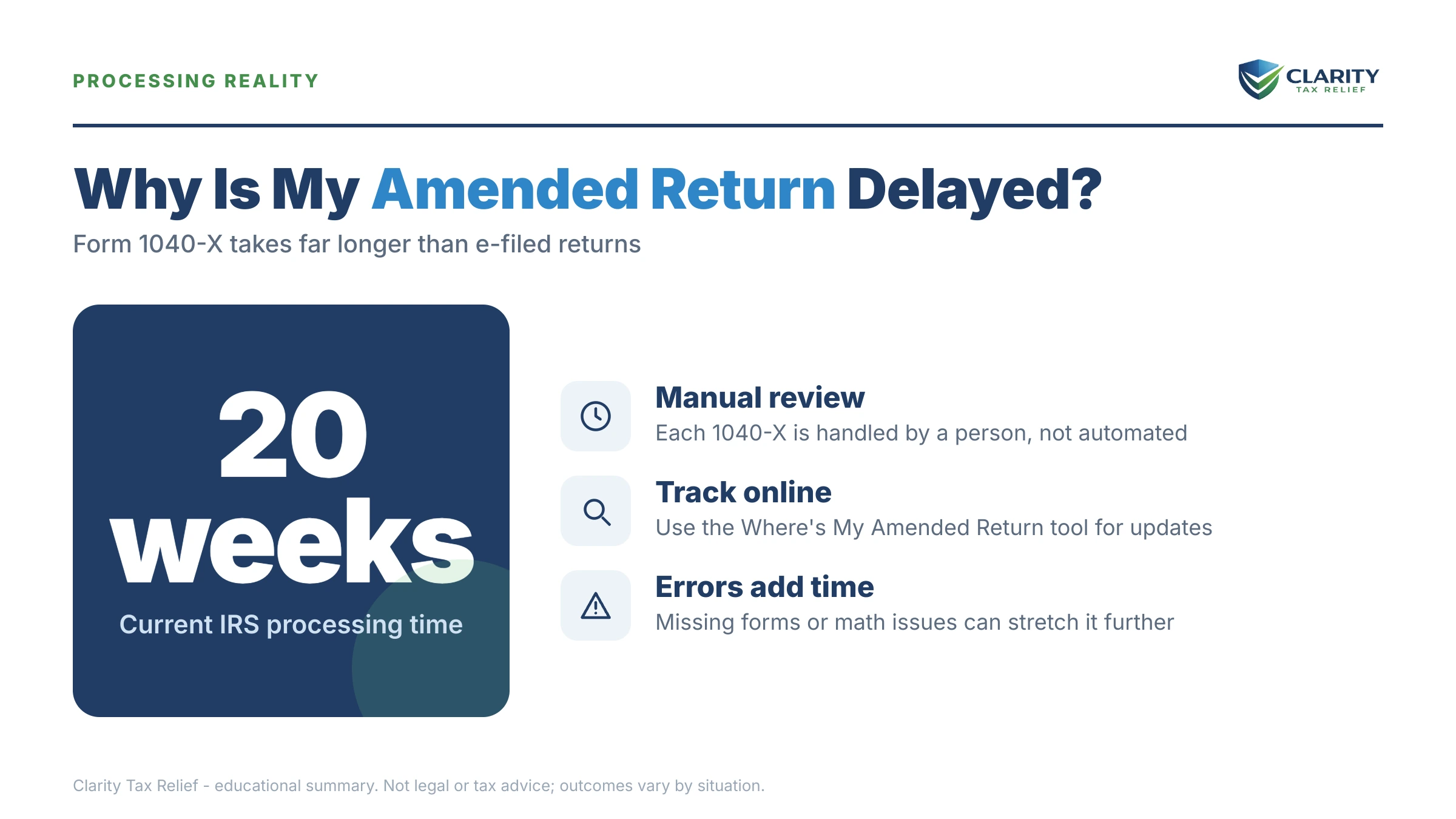
The short answer: if you're asking "where's my amended return taking so long" — amended returns are worked largely by hand, and the IRS tells filers to expect up to 16 weeks, often 20 or more in 2026. If your status says "Received," your Form 1040-X is almost certainly in a queue, not lost.
You filed the 1040-X months ago — e-filed it, or mailed it certified with both your signatures on a joint return — and the tracker has said the same word ever since: Received. You've typed "where's my amended return taking so long" into a search bar more than once, half-convinced the thing fell behind a desk. It almost certainly didn't. Amended returns move through a slow, mostly human pipeline, and there are exact points where waiting stops being the right move. This guide shows you where those points are.
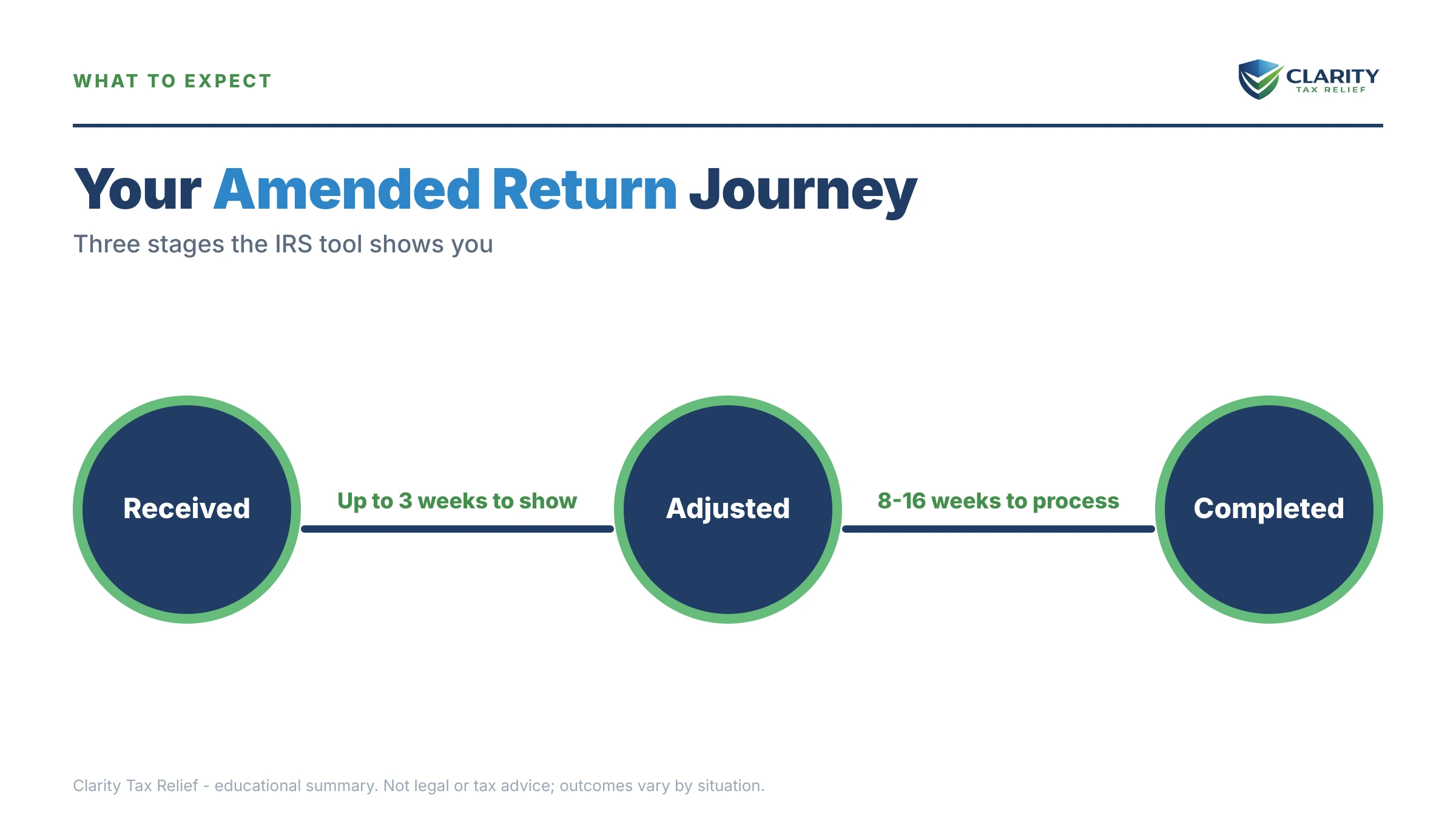
The image below shows exactly what the amended-return status tracker looks like and where each of the three stages appears, so you can tell a normal wait from a genuinely stalled file.
⏱ The clocks that actually matter: the IRS has no legal deadline to finish your Form 1040-X. But if you owe on the year you amended, penalties and interest accrue on the assessed balance every month while you wait. And a refund claim must generally be filed within 3 years of your original return (or 2 years of payment) — the processing wait doesn't extend that window for anything else you still need to claim.
Where's my amended return taking so long? The real 2026 reasons
Amended returns take months because most Form 1040-X filings are reviewed by a person, not a computer. Your original return was scored and processed by automation; your amendment gets compared against that original, line by line, by an IRS employee — and there are far fewer of those employees than there used to be.
The IRS's own guidance says processing can take up to 16 weeks — and for several years it has warned filers that many amended returns take more than 20. Three things push a 1040-X toward the long end of that range in 2026:
- Paper. A mailed 1040-X has to be opened, sorted, and transcribed before it even enters the queue. E-filed amendments (available for recent tax years when the original was e-filed) skip weeks of intake.
- Staffing. The IRS workforce shrank roughly 27% in 2025, and manual-processing units took the hit hardest. Automated systems kept running — human review queues got longer. See our guide to the 2026 IRS layoffs and processing delays for what that means case by case.
- Anything that needs a second look. A large refund claim, a credit that requires verification, a missing signature (a joint 1040-X needs both spouses' signatures — a surprisingly common omission for couples), identity verification, or a carryback claim can route your amendment to a specialized unit with its own queue.
One distinction worth making early: this is a different problem from an original-return refund delay. If it's this year's regular refund that's frozen, see "Where's My Refund" stuck on processing — different tool, different causes, different fixes.
The 1040-X processing sequence: what happens at each stage
Every amended return moves through three visible statuses — Received, Adjusted, and Completed — plus one invisible stage before them. Here is the full sequence, including the parts the tool never shows:
- Weeks 0–3: intake. The tool shows nothing, or "not found." For e-filed 1040-Xs this stage runs about three weeks; mailed returns can take longer just to be entered into the system.
- "Received." Your amendment is logged and sitting in a work queue. This is where most 1040-Xs spend the bulk of the 16-to-20-week window — nothing updates until a person actually works your file, so a static status here is normal, not alarming.
- Manual review. An employee compares the amendment to your original return. If something needs verification, the IRS mails a letter — and processing is suspended until you answer it. This is the one stage where the delay can genuinely be your move to make.
- "Adjusted." The change has posted to your account. On your transcript this shows as code 290 — additional tax assessed if the change increased tax, or code 291 — tax reduced if it went your way.
- "Completed." Processing is finished and a notice is in the mail. If you're owed money, watch for the code 846 — refund issued date on your transcript; it pinpoints the payment date before any letter arrives.
Two things run in parallel with this sequence. First, some 1040-Xs never appear in the tool at all — injured-spouse claims, business amendments, and returns routed to specialty units are common blind spots. Your account transcript is the backup: the codes 976 and 977 — amended return pair confirms the IRS logged your filing even when the tool shows nothing. If you've never pulled one, here's how to get your IRS transcript online in about ten minutes.
Second — and this is the part that costs money — if the year you amended carries a balance due, IRS collection does not pause for your amendment. The notice stream on the assessed balance keeps moving on its own schedule, which is exactly the trap the worked example below walks through.
| Status | What it means | Typical timing |
|---|---|---|
| No record / not found | Your 1040-X hasn't been entered into the system yet | Normal for ~3 weeks after e-filing; longer for mailed returns |
| Received | Logged and waiting in a work queue for a human processor | Often the longest stage — can span most of the 16–20+ week window |
| Adjusted | The change posted to your account (transcript code 290 or 291) | Refund or updated bill typically follows within weeks |
| Completed | Processing finished; a notice is mailed with the result | Refund date appears as code 846 on your transcript |
Amended return stuck while penalties keep accruing?
If you filed a 1040-X to fix a balance and the IRS is still billing you on the old number, every month of queue time costs you penalty and interest. An experienced tax professional can read your transcript, tell you whether the file is queued or suspended, and protect you from collection while it processes — free, confidential, no pressure.
Your options while you wait — and when to escalate an amended return delay
Past the IRS's stated processing window, you have three real escalation paths: the amended-return hotline at 866-464-2050, your account transcript, and the Taxpayer Advocate Service. Which one fits depends on how long it's been and what's at stake:
| Your situation | Your move | What it gets you |
|---|---|---|
| Under 16 weeks since filing | Wait; check the tool weekly, transcript monthly | Confirms movement without burning hours on hold |
| 16–20 weeks, still "Received" | Pull your account transcript; look for code 977 and any letter codes | Tells you whether the file is queued or suspended |
| IRS sent a letter asking for documents | Respond by the letter's stated deadline | Restarts processing — silence leaves the 1040-X suspended indefinitely |
| Past ~20 weeks with no movement | Call 866-464-2050 | A representative can see routing notes the online tool doesn't show |
| Delay is causing financial hardship | File Form 911 with the Taxpayer Advocate Service | An advocate can push a stalled file toward resolution |
| A balance is accruing on the amended year | Set up a payment arrangement on the assessed amount | Stops collection escalation while the correction posts |
The Taxpayer Advocate Service (taxpayeradvocate.irs.gov) is an independent organization inside the IRS, and it exists for exactly this: delays that have blown past normal and are causing real harm. Our Form 911 walkthrough covers what to write and what counts as hardship. And if the underlying problem is a tax debt you're trying to resolve while the amendment processes, the full DIY playbook — plans, hardship status, offers — lives in our guide to how to settle tax debt yourself.
How to respond when your amended return is stuck, step by step
- Confirm the IRS has your 1040-X. Check Where's My Amended Return about three weeks after filing — you'll need your Social Security number, date of birth, and ZIP code.
- Pull your account transcript. Look for transaction code 977 showing the amendment was logged, then code 290 or 291 showing the adjustment posted.
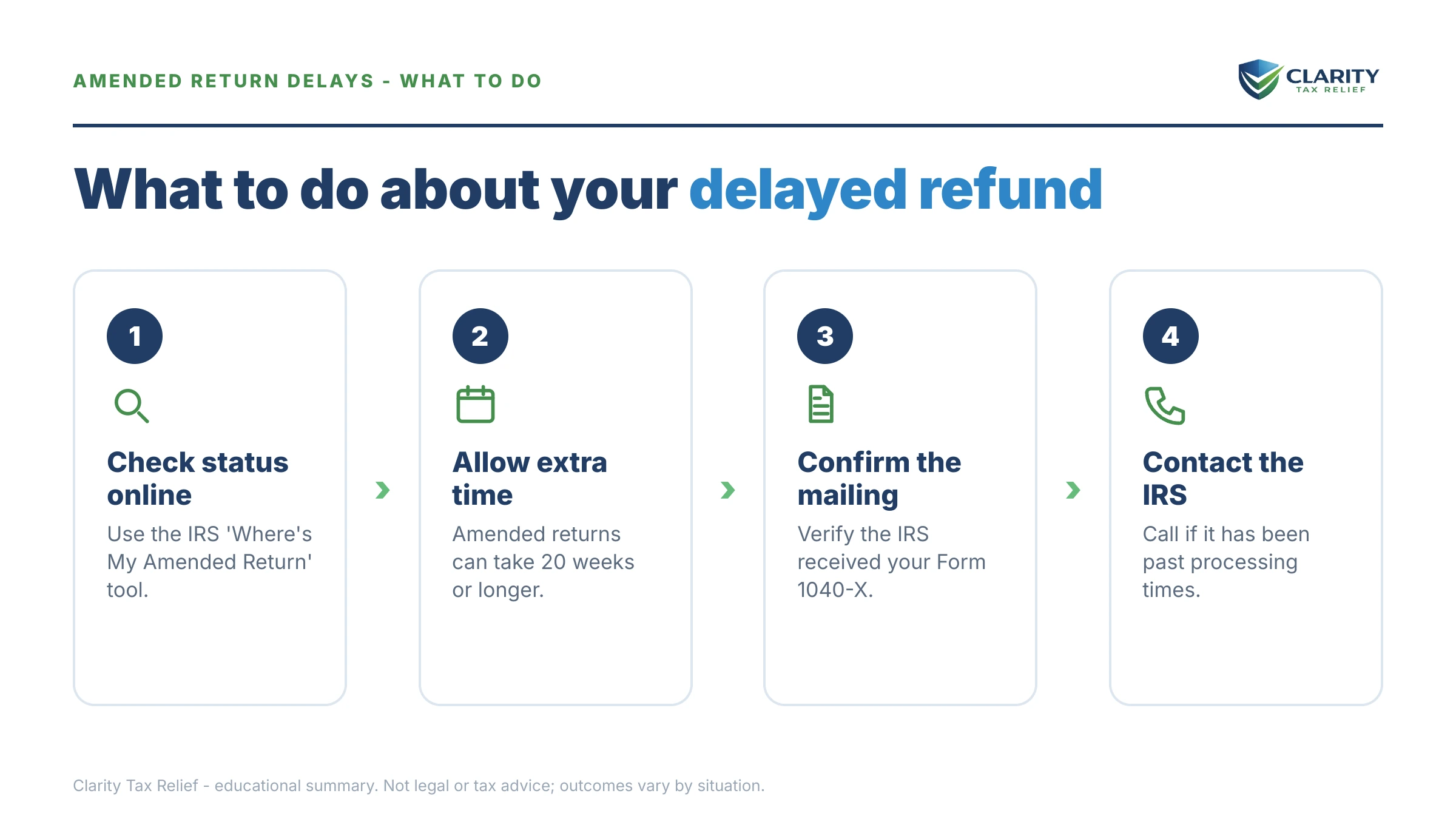
- Answer any IRS letter by its deadline. A request for documents or identity verification suspends processing until you respond — your silence is one of the few things that truly stalls a 1040-X.
- Call the amended-return line once past the window. Dial 866-464-2050 after roughly 20 weeks, or sooner if the tool tells you to contact the IRS.
- File Form 911 with the Taxpayer Advocate Service. If the delay is well past the normal window or is causing financial harm, an advocate can push a stalled file to resolution.
- Protect any balance due on the amended year. Set up a payment arrangement on the assessed amount so collection doesn't escalate while your correction works through the system.
If you amended a joint return to lower a balance: what the 20-week wait costs
Filing a 1040-X does not pause IRS collection on the balance already assessed. This is where a slow amendment turns from an annoyance into a real cost — especially for couples who amended to fix an error that inflated the bill.
Say you and your spouse filed jointly and were assessed $68,500 after a brokerage 1099-B posted without cost basis, making every stock sale look like pure profit. You file Form 1040-X with the corrected basis, and the true liability works out to $21,900 — a $46,600 reduction. While that 1040-X sits in the queue for five months, here's the math on the balance the IRS still shows:
- The failure-to-pay penalty runs 0.5% per month on the assessed balance: 0.5% × $68,500 = about $342 a month, or roughly $1,712 over five months of queue time.
- Interest compounds daily on top of that, at the federal underpayment rate, on the full $68,500 — not on the $21,900 you actually owe.
- The collection-notice stream keeps mailing on schedule. The automated system billing you doesn't know a 1040-X exists until the adjustment posts.
The good news: if the amendment is accepted, penalties and interest are recomputed on the corrected liability, so much of that accrual comes back off. But you shouldn't leave the assessed balance unmanaged in the meantime. You can call the IRS, point to the pending 1040-X, and request a temporary collection hold — it's discretionary, not automatic. And notice the thresholds: at $68,500, the assessed balance sits above the $50,000 ceiling for setting up a long-term payment plan online, but the corrected $21,900 fits comfortably inside a streamlined agreement. Sequencing the amendment and the payment arrangement in the right order is the whole game — our guides on amending a return to lower a tax debt and amended return processing time when you owe taxes go deeper on both halves. To see what your own balance is accruing month by month, run the numbers through our Penalty & Interest Calculator — it estimates the accrual, so you know what the wait is really costing.
One more joint-return wrinkle: if the amendment produces a refund instead, that refund can be intercepted for either spouse's separate debts — old taxes, defaulted student loans, child support. If that's your worry, start with ex-spouse's tax debt took my refund; the injured-spouse remedy described there applies to amended refunds too.
When you can handle the wait yourself
Most amended-return delays need monitoring, not intervention. If you're inside the 20-week window, the tool shows "Received," your transcript shows code 977, and no balance is accruing — you don't need professional help. Check the tool weekly, the transcript monthly, and answer any letter fast. A static "Received" status inside the window is the system working normally, and no phone call speeds it up.
Experienced help changes outcomes in a narrower set of situations: collection notices escalating on a balance you've amended and dispute; a 1040-X that's been routed to examination; multiple amended years interacting with each other; a refund statute that's about to close on money you're still owed; or a delay severe enough to justify a Taxpayer Advocate case that needs to be paired with an actual resolution strategy. In those cases, the order you fix things in changes what you end up paying — and that's worth a free conversation before another month posts.
Terms on your amended-return status, decoded
- Received / Adjusted / Completed: the three stages of the IRS's amended-return tracker — in queue, change posted, and notice mailed, in that order.
- Transaction code 977: the transcript entry confirming your amended return was logged on your account — proof the IRS has it even when the online tool shows nothing.
- Code 290 for $0.00: an adjustment entry that closes the review; a zero-dollar amount means the IRS finished the file without changing your tax.
- RSED (Refund Statute Expiration Date): the deadline — generally 3 years from filing or 2 years from payment — after which a refund claim is legally dead; see the 3-year refund deadline for old returns.
- Taxpayer Advocate Service: an independent organization within the IRS that takes cases where a delay has gone well past normal or is causing financial hardship.
Amended return delay questions, answered
How long is the IRS taking to process amended returns in 2026?
Plan on 16 to 20-plus weeks from the date you filed, and longer if you mailed a paper Form 1040-X. The IRS's official guidance says up to 16 weeks, but it has warned filers for several years that many amended returns take more than 20 weeks — and 2026 staffing cuts have stretched paper processing further. E-filed 1040-Xs generally move faster than mailed ones.
Why does Where's My Amended Return still say 'Received' after months?
'Received' means your 1040-X is in the processing queue — it is not a sign of a problem. Most amended returns sit in this status for the bulk of the 16-to-20-week window, because nothing updates until a person actually works the file. Check your account transcript for transaction code 977; if it's there, the IRS logged your amendment and you're simply waiting your turn.
Can I call the IRS about my amended return?
Yes — the amended-return line is 866-464-2050, but calling before the processing window has passed usually gets you the same status you see online. Call once you're past roughly 20 weeks, or sooner if the tool specifically tells you to contact the IRS. Have your Social Security number, date of birth, ZIP code, and a copy of the 1040-X in front of you.
Does filing an amended return trigger an audit?
No — amending does not automatically trigger an audit. A 1040-X goes through the same screening as any return, and small corrections rarely draw attention. A large change, like a refund claim in the tens of thousands of dollars, can be routed to an examiner for verification, which adds time but is still a review, not a formal audit.
My status changed to 'Adjusted' — when will I get my refund?
'Adjusted' means the IRS has posted your change, and the refund or updated bill typically follows within a few weeks, when the status moves to 'Completed.' Watch your account transcript for code 846, which shows the exact refund date. Direct deposit is generally available only if you e-filed the 1040-X; mailed amendments get a paper check.
Will the IRS pay me interest on a late amended refund?
Generally yes — when the IRS refunds an overpayment months after you claimed it, it typically adds interest at the federal overpayment rate. You don't have to request it; it's calculated automatically and included with the refund. Note that this interest is taxable income in the year you receive it, so expect a Form 1099-INT if it exceeds $10.
Can the IRS take my amended refund for other debts?
Yes. An amended refund is subject to the same offsets as any refund: back federal taxes, state income tax debt, past-due child support, and other federal debts through the Treasury Offset Program. On a joint amendment, either spouse's separate debt can capture the whole refund — an injured-spouse claim on Form 8379 can recover the share belonging to the spouse who doesn't owe.
Does filing a 1040-X stop IRS collection on the balance I already owe?
No — the assessed balance stays fully collectible while your amendment processes, and penalties and interest keep accruing on it. You can call the IRS, point to the pending 1040-X, and request a temporary collection hold, but that hold is discretionary. If notices are escalating, setting up a payment arrangement on the assessed amount protects you while the correction catches up.
Your next 24 hours
- Find your filing date. Pull your e-file confirmation or certified-mail receipt and count the weeks — that one number tells you whether you're inside the normal window or past it, and everything else follows from it.
- Gather your file. Your copy of the 1040-X (the official form page is at IRS.gov: About Form 1040-X), the original return, any IRS letters, and — most useful of all — the amended-year account transcript from your IRS online account.
- If a balance is accruing or the file looks suspended, get it reviewed. A free case review at (888) 825-7779 or the 2-minute form can tell you whether your 1040-X is queued, stuck, or costing you money every month it waits — before another round of penalty and interest posts.
This guide is general information, not tax or legal advice for your specific situation. Eligibility for IRS programs depends on individual facts and circumstances; no outcome is guaranteed.