
Amended Returns & Balances Due
Amended Return Processing Time When You Owe Taxes: What to Expect in 2026
The short answer: amended return processing time when you owe taxes is up to 16 weeks by the IRS's own estimate — and in 2026, often longer. Filing a Form 1040-X does not pause collection: penalties and interest keep accruing on the assessed balance, and IRS notices keep escalating until you act.
You filed the Form 1040-X weeks ago to fix the numbers. "Where's My Amended Return" still says Received — and this morning another IRS envelope arrived, billing you for the full original balance as if your correction never existed. That mismatch isn't your mistake; it's how the IRS's two separate systems work, and there's a specific way to protect yourself while they catch up.
The processing side of the IRS is slow and largely human. The collection side is fast and fully automated. When you owe, you're standing between them — and the image below shows you exactly what checking your amended return's status looks like and where to look for proof the IRS actually has it.
⏱ The real clock: there is no fixed deadline on amended return processing itself — but the 0.5% per month failure-to-pay penalty and daily-compounding interest keep accruing on your assessed balance the entire time it waits, and every collection notice you receive keeps its own printed response deadline. The 1040-X queue and the collection clock run independently.

Amended return processing time when you owe taxes: the real 2026 timeline
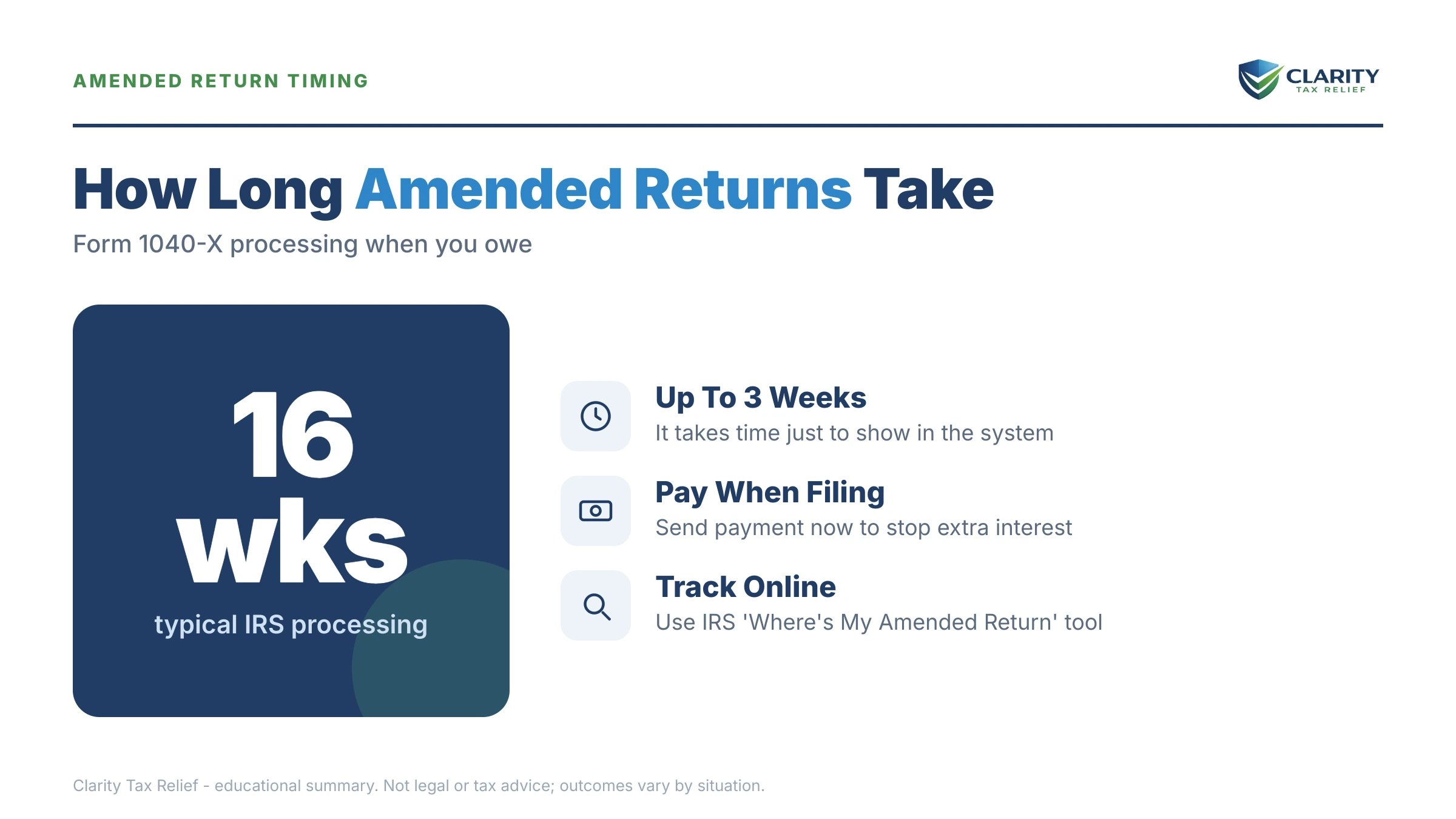
The IRS's published processing estimate for Form 1040-X is up to 16 weeks — and after the roughly 27% workforce reduction in 2025, many amended returns in 2026 take longer than that. Even e-filed 1040-X returns are reviewed by IRS employees, not just computers, which is why staffing cuts hit this queue directly while automated collection notices never slowed down.
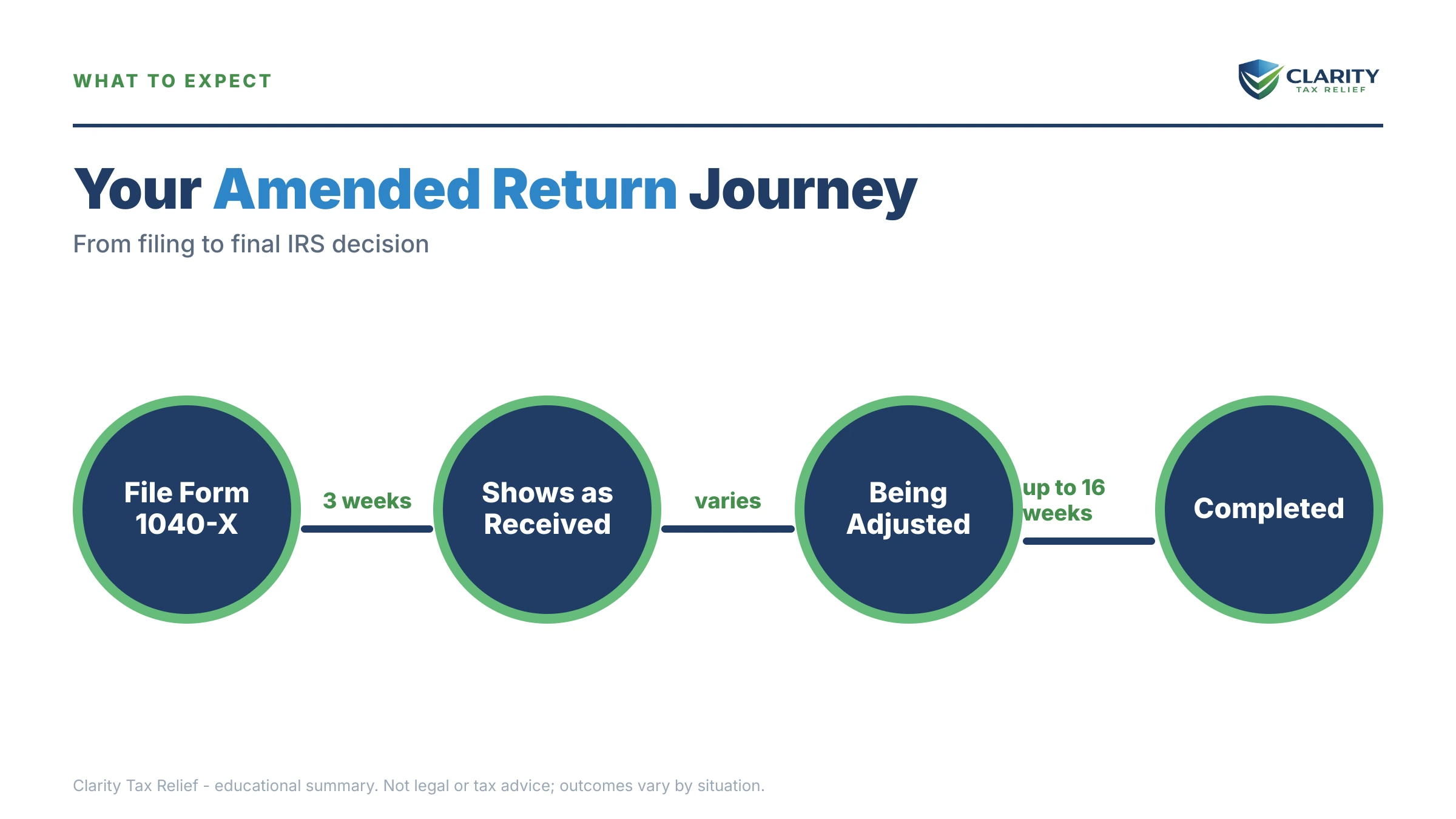
Expect about three weeks after filing before your amendment even appears in the status tool, which shows one of three stages: Received, Adjusted, or Completed. "Adjusted" means an employee has posted the change to your account; "Completed" means the paperwork — a notice, a bill, or a refund — has gone out.
If your question is purely about why the queue moves so slowly, our companion guide on where's my amended return taking so long covers the delay mechanics, and IRS layoffs 2026 processing delays covers the staffing picture. This page covers what changes when a balance due is attached — because for you, waiting isn't just lost time. It's a bill that grows every month.
Why filing a 1040-X doesn't pause IRS collection
Filing an amended return does not stop IRS collection — the assessed balance stays on the books, and the automated notice stream keeps running until your adjustment actually posts. "Assessed" means the amount officially recorded against your account from the original return or a prior IRS change. A 1040-X is a request to change that number; until an employee approves it, the collection computers see only the old figure.
This cuts two ways, and they call for different moves:
- You amended to shrink the debt. The correction can't help you until it posts. Your job in the meantime is to keep enforcement off your back and stop unnecessary accrual — the sections below show how. (Deciding whether amending was even the right tool? See amend return to reduce tax debt.)
- Your amendment adds tax. Interest on the increase runs from the original due date of that year's return, not from the day you amend. Pay as much as you can with the 1040-X; every month of delay compounds a bill that was already backdated.
You can call the number on your most recent notice and ask collections to note the pending amendment and hold enforcement. Agents often will — but the hold is discretionary and temporary, never automatic. Treat it as breathing room, not protection.
What waiting actually costs: say you owe $76,400
Here's a hypothetical to make the math concrete. Say you're retired, living mostly on Social Security, and the IRS has assessed $76,400 against a year when a retirement-account distribution was reported twice — once by the custodian, once on your return. You've filed a 1040-X that should cut the real tax to about $31,400.
While that amendment sits in the queue, the failure-to-pay penalty runs at 0.5% per month on the full assessed balance: $76,400 × 0.5% = $382 a month, roughly $1,910 over a five-month wait — plus interest compounding daily on top (current rates are in our guide to IRS interest rates 2026, or estimate your own accrual with our Penalty & Interest Calculator).
Now run it the smart way. You agree you truly owe about $31,400 — so you pay or arrange that portion now. The accruing base drops to $45,000, cutting the monthly penalty to about $225. And when the IRS posts the reduction (transcript code 291), the penalties and interest tied to the removed $45,000 come off with it. One more stake in this example: $76,400 sits above the 2026 passport-certification threshold of $66,000, while the corrected $31,400 sits safely below it — a reason to push the correction through rather than drift.
What happens if you ignore the balance while you wait
IRS collection escalates on the assessed balance even while your amended return waits in line — the notice stream is automated and does not check the 1040-X queue before firing. Ignored, the sequence runs like this:
- Monthly accrual — the 0.5%-per-month failure-to-pay penalty (up to a 25% cap) plus daily-compounding interest keep building on the full assessed amount.
- Bills and reminders — CP14, then CP501 and CP503, each restating the balance with the new, larger accrual.
- CP504 — Notice of Intent to Levy — the IRS can now seize your state tax refund, and a federal tax lien becomes a live possibility.
- LT11 / Letter 1058 — Final Notice — this starts a 30-day clock and your Collection Due Process rights (requested on Form 12153). After 30 days, levies can begin.
- Levy — bank accounts (funds are held 21 days before they leave), other income, and up to 15% of your Social Security benefit through the Federal Payment Levy Program. See IRS taking 15 percent of Social Security — a pending 1040-X does not switch this off.
- Passport certification — balances over $66,000 in 2026 can be certified to the State Department under CP508C. Details in passport revoked for tax debt.
None of these stages waits politely for your amendment to process. That's the trap of the "I filed the fix, so I'm done" mindset — the fix and the enforcement live in different buildings.
The IRS is billing you while your fix sits in a queue
If penalties are growing on a balance your 1040-X should shrink — or a levy-track notice just arrived mid-wait — send us your latest notice and a copy of your amended return. An experienced tax professional will confirm what's actually accruing, whether a hold or payment arrangement fits, and what your corrected balance means for your options. Free, confidential, no pressure — (888) 825-7779 or the 2-minute form.
Your options while the IRS processes your 1040-X
You can set up a payment arrangement on a balance you're disputing — and doing so is the most reliable way to stop enforcement while your amended return is decided. The arrangement runs on today's assessed number and can be revisited once your adjustment posts. For the full step-by-step on each program, see how to settle tax debt yourself; here's how each behaves specifically during a pending amendment. (The IRS's own overview is on its payment plans page.)
| Option | Who it fits | How it behaves while a 1040-X is pending |
|---|---|---|
| Short-term payment plan | Balance you can pay within 180 days | $0 setup; stops enforcement immediately; accrual continues until paid |
| Streamlined installment agreement | Balances up to $50,000; up to 72 months; online setup | Enforcement stops; payment can be recalculated after your adjustment posts |
| Installment agreement over $50,000 | Requires financial disclosure (Form 433-F) | Slower to set up; see IRS payment plan over $50,000 before you call |
| Currently Not Collectible | Paying anything would prevent basic living expenses | Collection pauses; the debt and accrual remain; see IRS hardship on Social Security for fixed-income cases |
| Offer in Compromise | Assets and income genuinely can't cover the debt | Usually wait until the adjustment posts — an offer built on the wrong balance wastes the $205 fee and months of review |
| Penalty relief (FTA / AEP) | Clean compliance history the prior 3 years; from summer 2026, Automatic Exemption from Penalty applies with no request needed | Can strip failure-to-pay penalties from whatever balance survives the amendment |
What's realistic also depends on the size of the assessed balance the IRS is currently collecting on — not your corrected figure:
| Assessed balance | Realistic path while you wait | Watch for |
|---|---|---|
| Under $10,000 | Guaranteed installment agreement, or pay within 180 days | Small balances rarely justify professional fees — handle it yourself |
| $10,000 – $50,000 | Streamlined installment agreement online, up to 72 months | Above $25,000, direct debit is required for streamlined terms |
| $50,001 – $66,000 | Installment agreement with financial disclosure (Form 433-F) | No online self-service at this level; expect a financial review |
| Over $66,000 | Payment arrangement or CNC after financial review — get a professional read first | Passport certification (CP508C) becomes possible at the 2026 $66,000 threshold |
One quirk worth knowing: if your amendment succeeds and drops you into a lower band, your options improve. In the $76,400 example above, a posted correction to $31,400 turns a financial-disclosure case into a simple streamlined agreement you can set up online — one more reason to protect the account until the 291 posts rather than letting a levy force the issue at the higher number.
How to respond, step by step
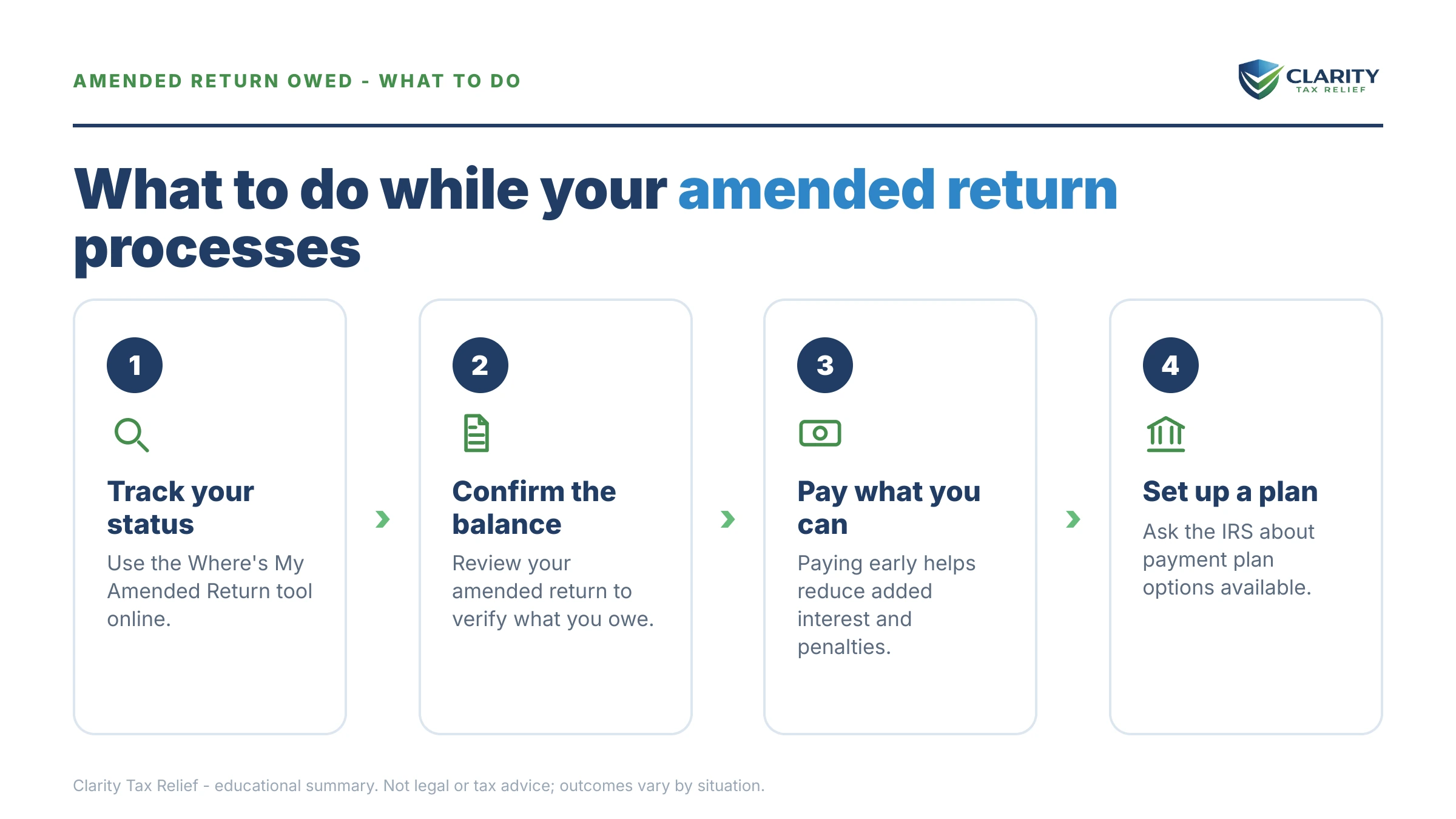
- Confirm receipt. Check the Where's My Amended Return tool or your account transcript for codes 971 and 977 showing the IRS has your 1040-X.
- Pull your account transcript. Note the assessed balance the IRS is collecting on and any notice codes posted against it.
- Pay the undisputed portion. Pay or arrange the amount you agree you owe so penalties stop growing on that part of the balance.
- Answer every collection notice. Respond by the deadline printed on each one — a pending amended return does not answer a notice for you.
- Request a collection hold. Call the number on your latest notice, ask for a hold while the adjustment posts, and write down the agent's ID number and a follow-up date.
- Escalate if the delay causes harm. Contact the Taxpayer Advocate Service if processing has passed the IRS's estimate and collection pressure is hurting you financially.
Reading your transcript while you wait
Your account transcript usually shows amended-return movement before the status tool does — and it's the only place that shows the balance collection is actually running on. The image in this section shows you exactly what to look for and where these entries appear when you check.
| Code | What it means | What to do |
|---|---|---|
| 971 / 977 | Amended return received and queued — see code 977 on an IRS transcript | Confirm the date matches your filing; save a screenshot as proof of receipt |
| 290 | Additional tax assessed — the amendment (or an IRS review) increased the balance; see code 290 on an IRS transcript | Verify the figure against your 1040-X, then pay or arrange the increase quickly |
| 291 | Tax reduced — your amendment was accepted in part or in full; see code 291 on an IRS transcript | Check that the related penalties and interest were recomputed downward too |
| 846 | Refund issued — the correction produced an overpayment | If it never arrives, check whether it was offset to another year or debt |
When the adjustment posts, the IRS mails the result: a CP22A notice if the change leaves a balance due, or a refund notice if you overpaid. Match that notice against your 1040-X line by line — partial adjustments happen, and the notice is your window to dispute anything the IRS didn't accept. You can track the official status anytime at the IRS's Where's My Amended Return tool.
When you can handle this yourself — and when help changes the outcome
Most people waiting on an amended return with a modest balance don't need professional help. Handle it yourself if the assessed balance is one you could pay within 180 days, if the amendment is a simple, well-documented correction to a single year, or if you agree with the assessed amount and just need a payment plan you can set up online (generally balances up to $50,000).
Experienced help changes outcomes in a narrower set of situations: an assessed balance over $50,000 where financial disclosure decides the terms, a final levy notice or actual levy landing mid-wait, multiple years tangled together (some amended, some not), a fixed income where the wrong monthly payment means choosing between the IRS and medication, or an amendment the IRS partially rejects that now needs a formal dispute. In those cases, sequencing — which year to fix first, what to pay, what to hold — often matters more than any single form.
Terms on your transcript and notices, decoded
- Assessed balance — the amount officially on the IRS's books for a tax year; it's the number collection computers act on until an adjustment posts.
- Form 1040-X — the amended individual return; the IRS's official page is About Form 1040-X.
- TC 971 / 977 — transcript codes confirming your amended return was received and entered the processing queue.
- TC 291 — the transcript entry showing the IRS reduced your tax; it's the proof your amendment was accepted.
- CP22A — the notice sent after the IRS processes a change to your return that leaves a balance due.
- FPLP — the Federal Payment Levy Program, which can automatically take up to 15% of federal payments, including Social Security, for unpaid taxes.
- CSED — the 10-year collection statute expiration date; amending to reduce tax doesn't reset it, but new tax assessed on an amendment gets its own 10-year clock.
Amended return and balance-due questions, answered
How long does the IRS take to process an amended return in 2026?
The IRS's own published estimate is up to 16 weeks from receipt, and in 2026 many amended returns take longer because the agency's workforce was cut roughly 27% in 2025. Allow about three weeks after filing before your 1040-X even appears in the Where's My Amended Return tool. If processing has passed the IRS estimate and the delay is causing you financial harm, the Taxpayer Advocate Service can intervene.
Does filing an amended return stop IRS collections?
No. Collection runs on the assessed balance already on the IRS's books, and the notice stream keeps escalating until an employee posts your adjustment. You can call the number on your latest notice and ask for a temporary collection hold while the 1040-X processes, but that hold is discretionary. The reliable protection is a payment arrangement, which stops enforcement while your amendment is decided.
Do penalties and interest keep accruing while my 1040-X is processing?
Yes. The failure-to-pay penalty accrues at 0.5% per month (up to a 25% cap) on the unpaid assessed balance, and interest compounds on top of it, regardless of the pending amendment. If the IRS later accepts your reduction, the penalties and interest tied to the removed tax come off with it. Paying the portion you agree you owe shrinks the base that keeps accruing in the meantime.
What if my amended return shows I owe more tax?
Pay as much as you can when you file the 1040-X, because interest on the additional tax runs from the original due date of that year's return — not from the date you amend. The increase posts to your account as transcript code 290 and joins any existing balance. If you can't pay it in full, the same payment-plan options apply to the combined total.
Can the IRS levy my Social Security while my amended return is pending?
Yes. Once the IRS has issued a final notice of intent to levy, it can take up to 15% of your Social Security benefit through the Federal Payment Levy Program, and a pending 1040-X does not block that. If a levy would leave you unable to cover basic living expenses, you can request a hardship release or Currently Not Collectible status. Acting before the final notice is far easier than unwinding a levy after it starts.
How do I check the status of my amended return?
Use the Where's My Amended Return tool on IRS.gov, which shows one of three statuses: Received, Adjusted, or Completed. Your account transcript is often faster and more detailed — codes 971 and 977 confirm the IRS has your 1040-X, and a later 290 or 291 shows the decision. If neither shows anything roughly three weeks after filing, confirm the return was actually delivered before waiting further.
Should I pay the balance before the amended return is processed?
Pay the portion you agree you genuinely owe — that stops penalties and interest from accruing on it immediately. If your amendment is later accepted and the payment turns out to be more than the corrected tax, the IRS refunds or credits the difference. What you shouldn't do is pay nothing while disputing only part of the balance, because the whole assessed amount keeps accruing until the adjustment posts.
Does filing an amended return increase my audit risk?
Filing a 1040-X is not an automatic audit trigger — millions are processed every year as routine corrections. Large or unusual changes do get closer review, so attach clear documentation supporting exactly what changed and why. A well-documented amendment generally moves faster and draws fewer questions than a bare one.
Your next 24 hours
- Find the assessed balance and the notice date on your most recent IRS letter. That's the number collection is running on and the deadline that controls — not your amended figures.
- Gather your paper trail: your copy of the filed Form 1040-X (with proof of delivery if you mailed it), the original return, your latest IRS notice, and your income records — the SSA-1099 and any 1099-Rs if you're retired.
- Get a free case review — call (888) 825-7779 or use the 2-minute form at the top of this page. Penalties and interest are accruing monthly on the full assessed balance while your amendment waits, so every week of drift has a price you can avoid.
This guide is general information, not tax or legal advice for your specific situation. Eligibility for IRS programs depends on individual facts and circumstances; no outcome is guaranteed.