
IRS Transcript Codes
Code 977 IRS Transcript: What It Means for Your Amended Return (2026)
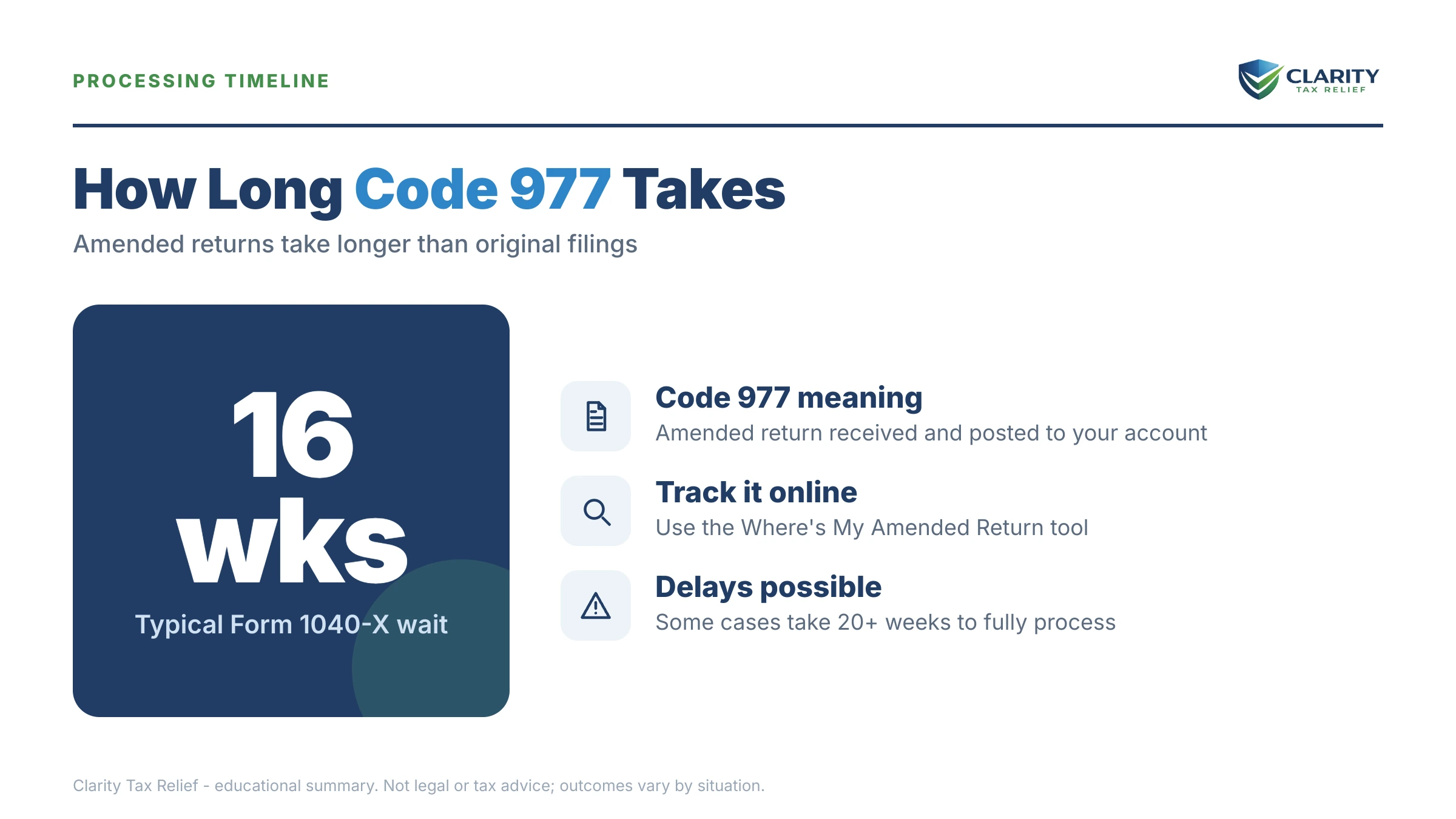
The short answer: the code 977 IRS transcript entry means the IRS received your amended return (Form 1040-X) and posted it to your account on the date shown beside the code. It's a receipt, not a decision. The IRS's stated processing window is up to 16 weeks; the outcome posts later as code 290 or 291.
You filed a 1040-X weeks ago, you've been pulling your transcript every Friday morning, and today a new line finally appeared: 977 — "Amended return filed." Your first question — does this mean they accepted my changes? — has a clear answer: not yet. But the code does confirm your amendment is in the system, and it starts a timeline you can actually track.
The image below shows you exactly where code 977 sits in the transactions section of a real account transcript and which date beside it matters — so you can stop guessing what you're looking at.
⏱ The clock that matters: code 977 sets no response deadline of its own — but if the IRS has already assessed a balance for that year, the failure-to-pay penalty adds 0.5% of the unpaid tax every month while your amended return waits in the queue, with interest compounding on top. Filing a 1040-X does not pause that accrual.
Code 977 IRS transcript meaning: why it posted to your account
Code 977 posts to your IRS account transcript when the IRS logs a Form 1040-X amended return against a tax year that already has an original return on file. It can only appear on a module that already shows code 150 — return filed, because you can't amend a return the IRS never processed.
The date beside 977 is the date the IRS recorded your amended return — for an e-filed 1040-X, usually within about three weeks of acceptance; for a paper 1040-X, whenever it was opened and keyed, which can be well after you mailed it. The 977 date starts the processing clock — nobody has reviewed your changes yet.
You'll almost always see a code 971 with the same date directly above or below it, reading something like "amended tax return or claim forwarded for processing." That 971/977 pair is a routing record, not a mailed notice — different from the standalone notice-issued 971 covered in our code 570 account hold cluster.
Some accounts show code 976 — "duplicate return posted" — instead of 977. That happens when the IRS treats your second filing as a duplicate rather than a formal amendment (common when a second original return was filed instead of a 1040-X). Either way, the practical meaning is identical: the IRS has two returns for the year and has to reconcile them before your account moves. For the broader map of how the transactions section works — dates, cycle codes, running balance — see how to read an IRS account transcript; this page stays on what 976/977 specifically do.
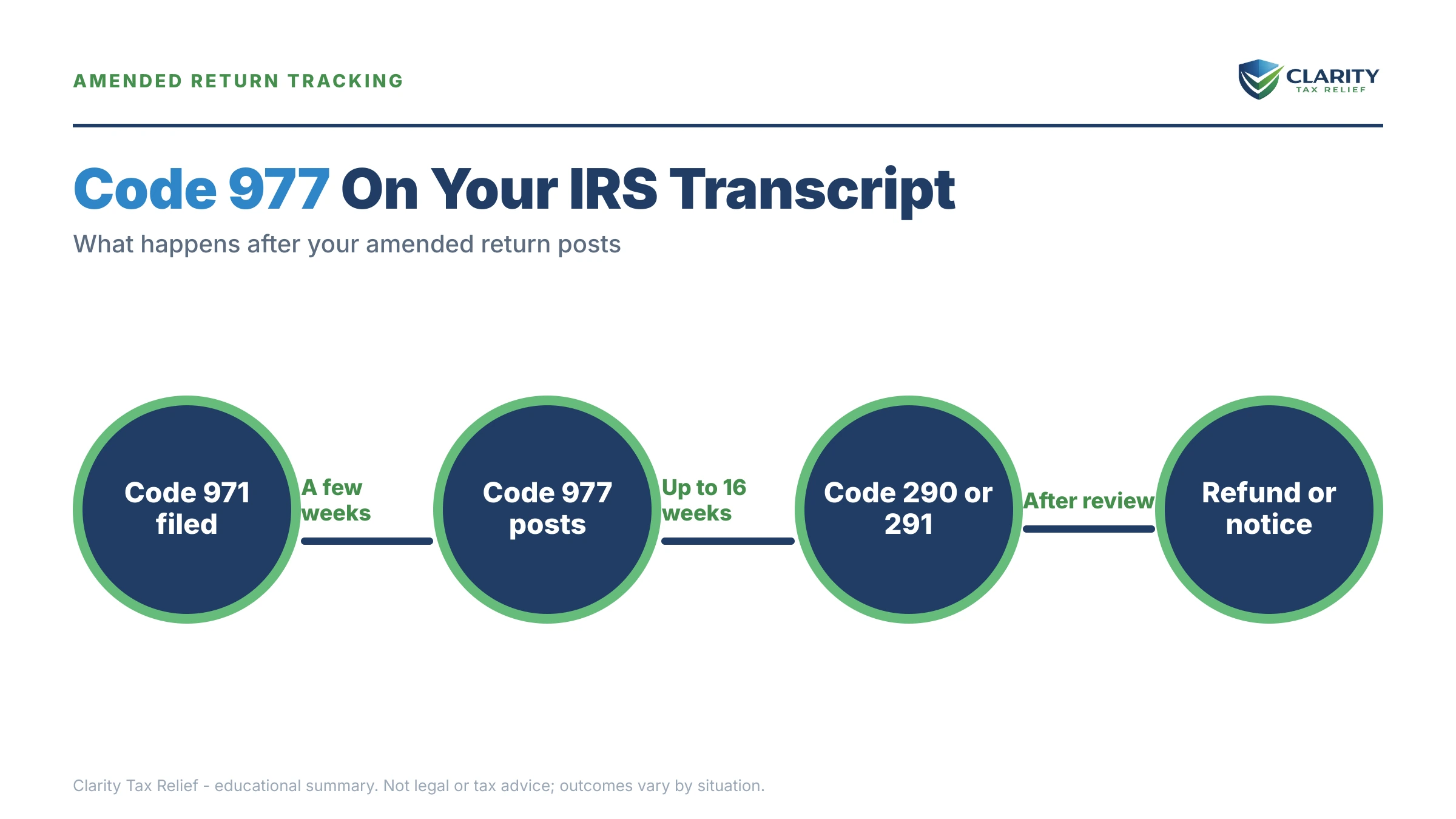
What happens after code 977 posts — the processing sequence
After code 977 posts, your amended return sits in a processing queue the IRS says can take up to 16 weeks — and the result appears on your transcript before any letter reaches your mailbox. In 2026, with the IRS workforce down roughly 27% after the 2025 cuts, many amendments run past that window; the codes are the earliest honest signal you'll get.
The typical sequence looks like this:
- 971 + 977 post together — receipt logged, return routed for processing. You are here.
- Weeks of silence — normal, not a problem. Some accounts pick up a code 570 hold if the amendment needs manual review; that pauses refunds but isn't an audit by itself.
- The adjustment posts — code 291 (tax reduced) if the IRS accepts a decrease, or code 290 (additional tax assessed) if your amendment increases tax. A 290 for $0.00 usually means the IRS closed the review without changing anything — sometimes because it disallowed your claim.
- Money moves or a bill updates — code 846 issues any refund; if a balance remains, the IRS mails an adjustment notice (CP21 or CP22 series) showing the new figure, such as a CP22A when you still owe.
Two warnings hide inside that sequence. First, a pending 1040-X does not stop collection on a balance the IRS has already assessed — the automated notice stream (CP14 → CP501 → CP503 → CP504 → LT11) keeps escalating on the old number while your correction waits in line. You can ask the IRS to hold collection because a claim is pending, but that hold is discretionary, not automatic.
Second, if the IRS disallows your amendment, it sends a formal claim-disallowance letter with appeal rights and a two-year window to contest it in court. Silence after a 290 for $0.00 is not acceptance — it's the moment to act.
Watching code 977 sit still while a balance keeps growing?
Send us your transcript and your 1040-X. An experienced tax professional will map what the IRS is likely to do with your amendment — and how to keep penalties, interest, and collection notices from piling onto a number you're actively disputing. Free, confidential, no pressure.
Reading the codes around 977
Code 977 rarely appears alone — the entries around it tell you where your amendment actually stands.
| Code | What it means | What to do |
|---|---|---|
| 150 | Original return filed and tax assessed — the baseline your 1040-X changes | Nothing; confirms the year is amendable |
| 971 | Paired with 977: amendment routed for processing (not a mailed notice) | Nothing; normal companion entry |
| 976 | Duplicate return posted — second filing treated as a duplicate, not a 1040-X | Wait; the IRS reconciles both returns the same way |
| 977 | Amended return posted — the IRS's receipt for your Form 1040-X | Note the date; count 16 weeks forward |
| 570 | Account hold — amendment pulled for manual review | Wait unless a letter asks for documents; then respond fast |
| 291 | Tax reduced — your amendment (or part of it) was accepted | Check the amount against your 1040-X math |
| 290 | Additional tax assessed — or, at $0.00, review closed with no change | If $0.00 and you expected a reduction, watch for a disallowance letter and appeal |
| 846 | Refund issued — the date money actually moves | Nothing; allow a few days for deposit or mail |
One threshold worth knowing before you count on a refund: an amended refund claim generally must be filed within 3 years of the original return or 2 years of the payment, whichever is later. If your 1040-X went in near that line, the refund statute — not the processing queue — decides what you can get back; see the 3-year refund deadline.
Your options if you owe while the amendment processes
The single biggest mistake after code 977 posts is going silent on an assessed balance for four months while "waiting to see what happens." The collection system doesn't know you filed a 1040-X — it only sees an unpaid assessment. Each of these options keeps you protected while the amendment works through:
| Option | Key threshold or cost | Best fit while a 1040-X pends |
|---|---|---|
| Pay the undisputed portion now | No fee; shrinks the base the 0.5%/month penalty runs on | You agree you owe part of the balance and the amendment disputes the rest |
| Pay in full | No fee; stops penalty accrual entirely | You can afford it — any overpayment is refunded with interest if code 291 later reduces the tax |
| Short-term payment plan | Up to 180 days, $0 setup; interest and penalties continue | The amendment should resolve before the 180 days run out |
| Streamlined installment agreement | Balances up to $50,000; up to 72 months, set up online | The balance is too large to clear in 180 days even after the expected reduction |
| Penalty abatement | First-Time Abate needs a clean prior 3 years; the automatic AEP replaces it starting summer 2026 | Penalties survive even after the tax is corrected |
| Currently Not Collectible | Requires financial disclosure showing genuine hardship | You can't pay anything and collection notices are already escalating |
Two of these deserve a sentence more. An installment agreement set up now can be revised down — or paid off and closed — once code 291 posts and the balance drops; setting it up is protection, not surrender (walkthrough: IRS payment plan online, step by step). And on penalties: if your amendment cuts the tax, the IRS recomputes failure-to-pay penalties on the corrected number automatically, but penalties on the part that survives may still be removable through first-time penalty abatement or, from summer 2026, the automatic AEP exemption.
If you filed the 1040-X specifically to shrink a debt the IRS assessed — after a CP2000, a substitute return, or an audit — the strategy has its own moving parts; that playbook is in amending a return to lower a tax debt.
A worked example: $36,900 assessed, code 977 pending
Say you're a W-2 employee filing single, and the IRS assessed $36,900 after adding a brokerage 1099-B to your return with zero cost basis. You filed a 1040-X reporting the actual basis, which — by your math — cuts the tax by $28,400, leaving a true balance around $8,500. Code 977 just posted. Here's the arithmetic while you wait:
- Failure-to-pay penalty: 0.5% × $36,900 = about $184.50 per month on the full assessed balance. Over a 4-month processing wait, that's roughly $738 in penalties alone.
- Interest: charged on the balance at the IRS's quarterly rate and compounding daily on top of the penalty (current figures: IRS interest rates for 2026).
- The smarter move: pay the $8,500 you agree you owe now. That cuts the accrual base to the disputed $28,400 — and when code 291 posts the reduction, the IRS recomputes penalties and interest on what actually survived. If you'd instead paid the full $36,900, the overpayment comes back with interest after the adjustment.
This is hypothetical, and your penalty math depends on your dates and prior payments — you can estimate your own accrual with our Penalty & Interest Calculator before deciding whether to pay down, pay off, or set up a plan.
How to respond to code 977, step by step
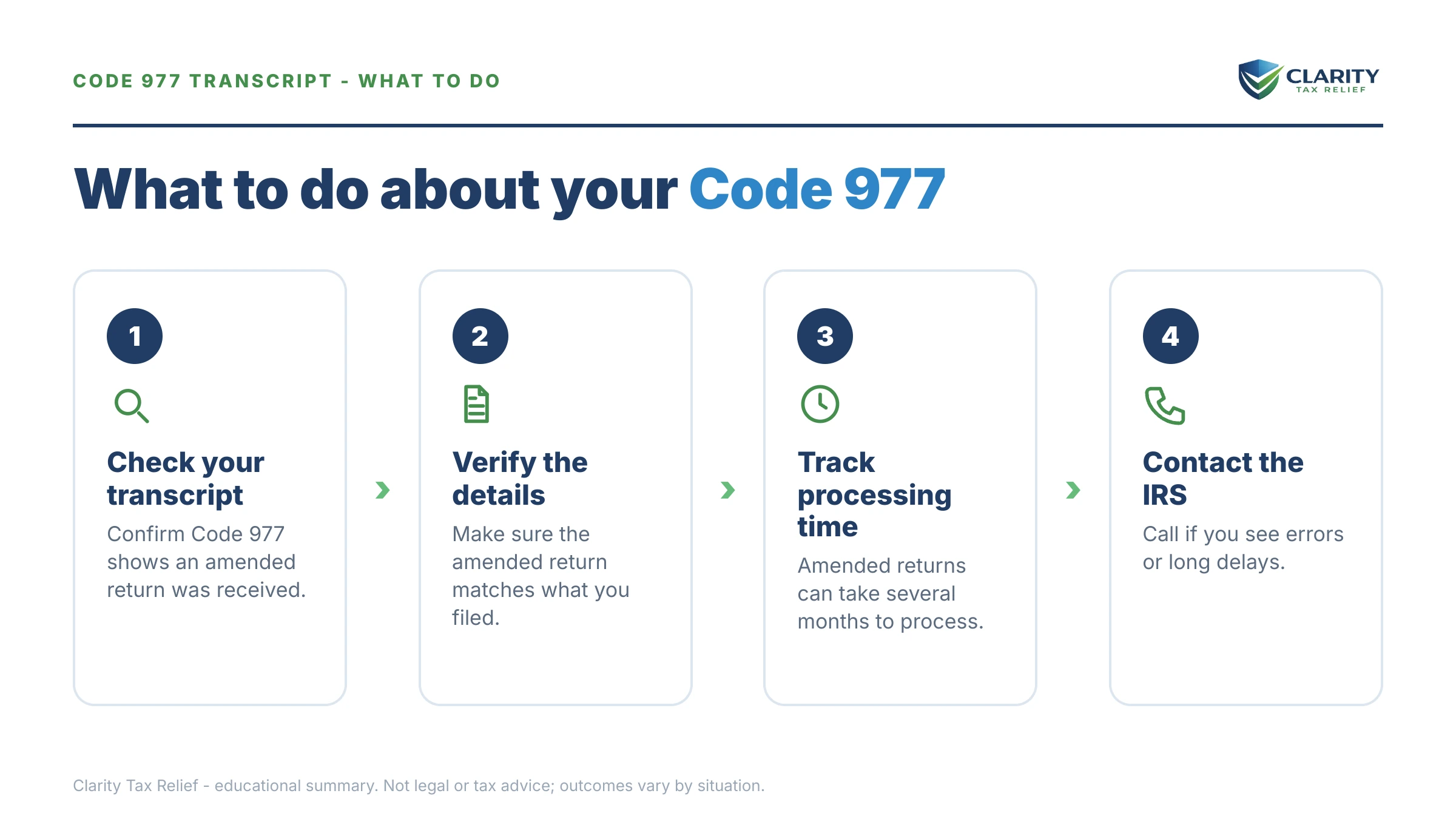
- Match the 977 date to your filing. Confirm the date beside code 977 lines up with when you e-filed or mailed your Form 1040-X — if it's months off, the IRS may have posted a different document to your account.
- Track it on Where's My Amended Return. The IRS tool shows three stages — received, adjusted, completed — and updates roughly weekly. You'll need your SSN, date of birth, and ZIP code.
- Handle any assessed balance now. Pay the portion you agree you owe or set up a payment plan — collection notices and the failure-to-pay penalty don't wait for your amendment to process.
- Watch your transcript for codes 290, 291, and 846. The adjustment posts to the transcript before any letter reaches your mailbox; checking once a week is enough.
- Answer any IRS letter within its stated window. If the IRS asks for documents supporting your amendment and you don't reply, it can disallow the claim entirely — and you'd have to appeal to revive it.
When you can handle this yourself — and when help changes the outcome
If your amendment claims a refund and you owe nothing, code 977 requires nothing from you but patience. Track the IRS's Where's My Amended Return tool, watch for 291 and 846, and give it the full 16 weeks before worrying — our guide to why amended returns take so long covers what "normal slow" looks like in 2026.
Experienced help earns its cost in four situations: a balance already deep in the collection stream (CP504 or LT11 has arrived) while the amendment pends; multiple amended years whose adjustments interact; a 290 for $0.00 that signals a disallowed claim you'll need to appeal on a two-year clock; or an amendment large enough — like the $36,900 example above — that penalty and interest recomputation is real money. If your amended return is stuck far past 16 weeks and causing financial harm, the Taxpayer Advocate Service can also intervene at no cost.
Terms on your transcript, decoded
- Transaction code (TC): the three-digit bookkeeping entries the IRS uses to record every action on your account — 977 is one of hundreds.
- Form 1040-X: the amended individual income tax return; the document whose receipt code 977 records (official page: About Form 1040-X).
- Tax module: the IRS's file for one taxpayer and one tax year; 977 can only post to a module that already holds an original return.
- Adjustment: the 290 or 291 entry that changes your assessed tax — the actual verdict on your amendment.
- "As of" date: a projected interest-and-penalty computation date near the top of the transcript, not a decision deadline — full explanation in our "as of" date guide.
- RSED (refund statute expiration date): the deadline — generally 3 years from filing or 2 years from payment — after which an amended refund claim pays nothing even if it's correct.
Code 977 questions, answered
What does code 977 mean on an IRS transcript?
Code 977 means the IRS received your amended return — Form 1040-X — and posted it to your account for that tax year. The date beside the code is the date the IRS logged the return, not the date anyone reviewed it. Processing happens afterward, and the IRS's stated window is up to 16 weeks from that posted date.
Is code 977 good or bad?
Neither — it's neutral. Code 977 is a receipt confirming your amended return entered the system, which is exactly what you want to see after filing a 1040-X. It doesn't predict the outcome. The result shows up later as code 291 if the IRS reduces your tax, code 290 if it adds tax, or code 290 for $0.00 if it reviews the claim without changing anything.
What is the difference between code 976 and code 977?
Both codes mean a second return posted to a tax year that already had one. Code 977 is the standard "amended return filed" entry for a Form 1040-X. Code 976 is a "duplicate return posted" entry, used when the IRS treats the second filing as a duplicate rather than a formal amendment. Practically, either code means the IRS now has two returns for the year and must reconcile them before anything else happens.
How long after code 977 will I get my refund?
The IRS says amended returns take up to 16 weeks to process, and in 2026 — after the agency cut roughly 27% of its workforce in 2025 — many take longer. If your amendment results in a refund, you'll see code 291 (tax reduced) and then code 846 (refund issued) on your transcript. The 846 date is the date your money actually moves.
Why do codes 971 and 977 show the same date?
They post together as a pair. Code 977 records that your amended return was filed; code 971 with the same date typically reads "amended tax return or claim forwarded for processing" and records that the return was routed to the unit that will work it. A matching 971/977 pair is normal — it doesn't mean a separate notice was mailed to you.
Should I keep paying the IRS while my amended return processes?
Yes — at minimum, keep paying whatever portion of the balance you agree you owe, and stay current on any installment agreement. Filing a 1040-X doesn't pause collection or stop the 0.5% monthly failure-to-pay penalty on an assessed balance. If the amendment later reduces the tax, the IRS recomputes penalties and refunds any overpayment with interest, so you don't lose money by paying.
What code comes after 977?
The next meaningful code is the adjustment. Code 291 means the IRS reduced your tax — the outcome you want if you amended to lower a balance or claim a refund. Code 290 means additional tax was assessed, and code 290 for $0.00 usually means the IRS closed the review without changing your account, sometimes because it disallowed the claim. A code 570 in between just means the account is on hold while someone works the file.
Your next 24 hours
- Find the date beside code 977 on your account transcript and count 16 weeks forward — that's your realistic check-in horizon, and the date to compare against Where's My Amended Return.
- Gather three documents into one folder: your 1040-X copy, the original return it amends, and any IRS notice showing the assessed balance — everything the IRS could ask for, ready to send.
- If a balance is sitting in collections while you wait, get a free case review — the form at claritytaxrelief.com/#consult or (888) 825-7779. Interest and the 0.5% monthly failure-to-pay penalty accrue on the full assessed amount every month the balance sits unaddressed; you can also make a payment any time at IRS.gov/payments.
This guide is general information, not tax or legal advice for your specific situation. Eligibility for IRS programs depends on individual facts and circumstances; no outcome is guaranteed.