
Refunds & Unfiled Returns
Can I Still Get a Refund From 3 Years Ago? The IRS 3-Year Deadline (2026)
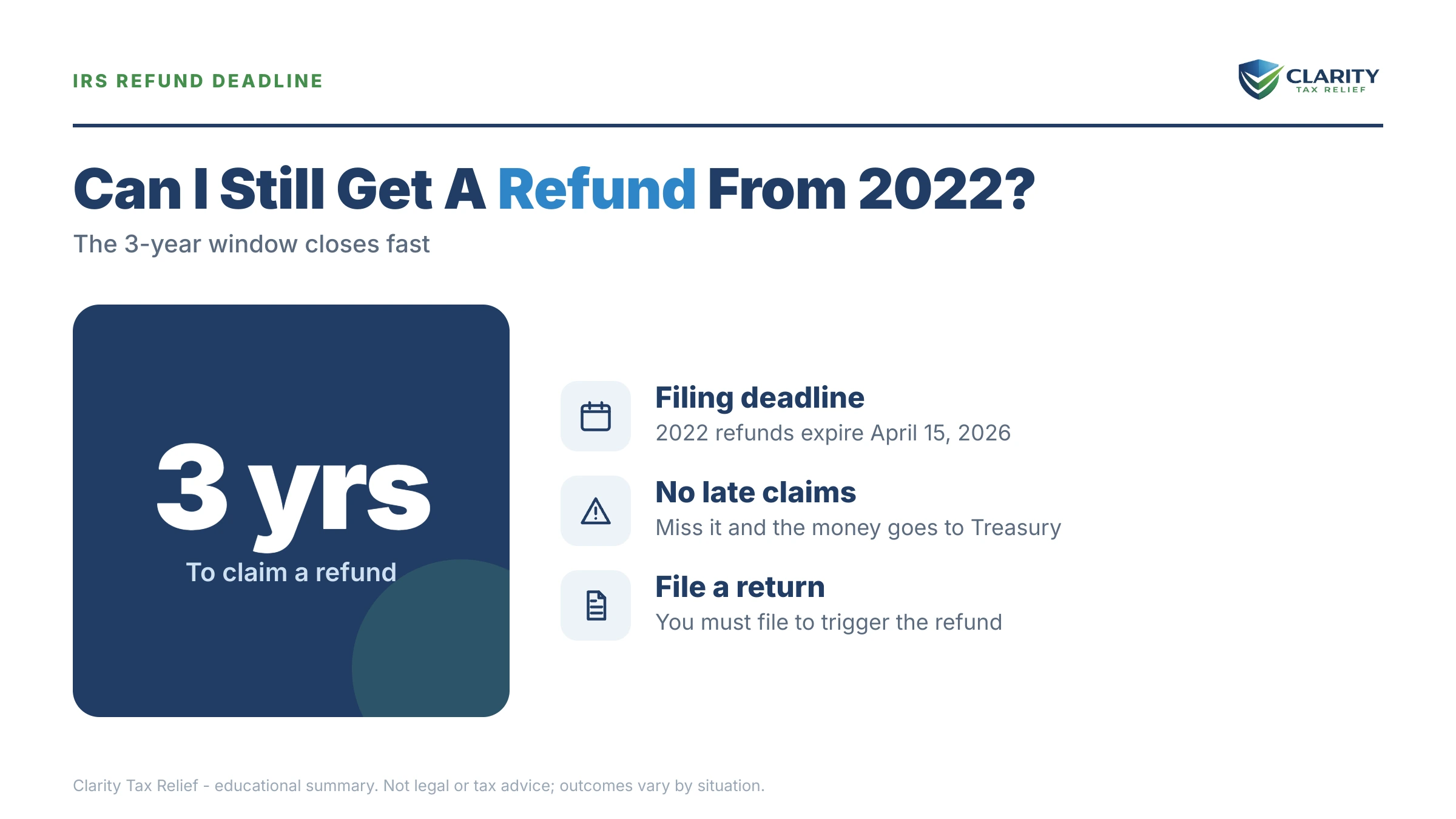
The short answer: yes, you can still get a refund from 3 years ago — if you file in time. You generally have 3 years from the return's original due date to file and claim it. In 2026, tax year 2023 refunds are claimable until April 15, 2027; tax year 2022 is closed for most non-filers.
So the question "can I still get a refund from 3 years ago" has a real answer with a real expiration date — and which side of it you're on depends entirely on the tax year and whether you ever filed an extension. Maybe you sent in quarterly payments as a 1099 contractor back in 2023, never filed the return, and now you're wondering whether that overpayment is still sitting there with your name on it. It probably is — for now.
Here's the part almost nobody tells you: the IRS is holding your money as a credit on your account right this minute, and the image below shows you exactly what that looks like on an IRS transcript and where to look for your old payments. But the credit has a self-destruct date, and the IRS is under no obligation to remind you before it hits.
⏱ The real clock: you generally have 3 years from a return's original due date to file it and claim the refund. For tax year 2023, that's April 15, 2027. The window for tax year 2022 closed in mid-April 2026 for most people — unless you filed an extension back in 2023, which pushes your deadline to around October 15, 2026.
Can I still get a refund from 3 years ago? The 3-year rule in plain English
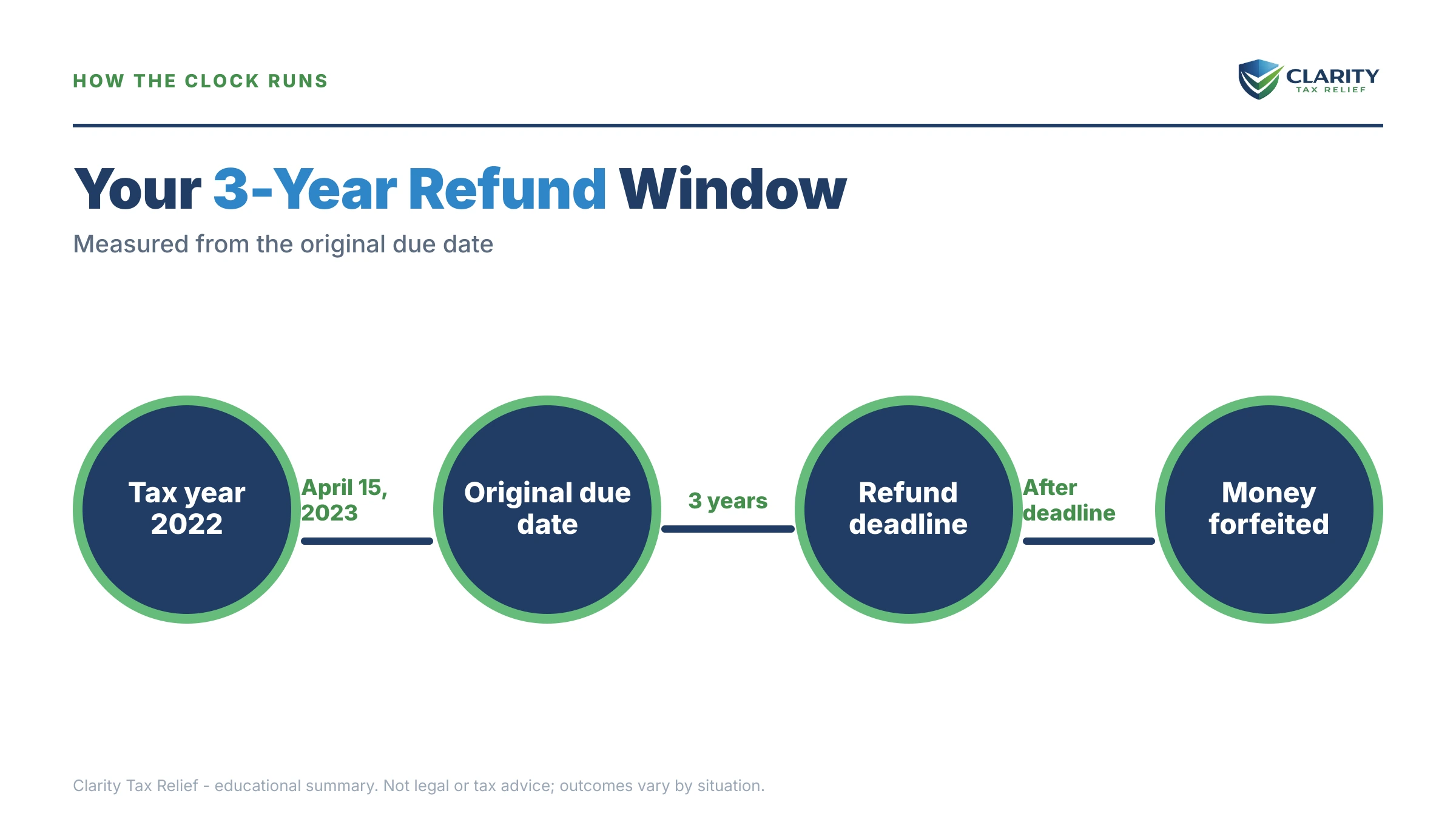
Federal law gives you 3 years from a tax return's original due date to file it and claim your refund — after that, the money permanently becomes the property of the U.S. Treasury. Tax professionals call this cutoff the RSED, the Refund Statute Expiration Date, and it comes from Section 6511 of the tax code.
The full rule has two prongs: you must claim a refund within 3 years of filing the return or 2 years of paying the tax, whichever is later. If you never filed at all, the practical version is simpler — you have three years from the return's original April due date to get it in.
One quirk trips up almost everyone. Your withholding and your quarterly estimated payments are legally treated as paid on the April due date of that year's return, no matter when the money actually left your bank account. So a quarterly payment you sent in June 2023 counts as "paid" on April 15, 2024 — and the three years run from there.
Two things stretch the window. If you filed a Form 4868 extension for that year, the three years run from the October extended deadline instead. And a few narrow exceptions — financial disability, combat-zone service, federally declared disaster postponements — can pause or push the clock. Everything else, including "I didn't know," does not.
| Tax year | Original due date | Last day to claim the refund | Status in July 2026 |
|---|---|---|---|
| 2021 | April 18, 2022 | Mid-April 2025 | Expired — refund is gone |
| 2022 | April 18, 2023 | Mid-April 2026 (≈ Oct. 15, 2026 with an extension) | Expired for most — still open only if you filed an extension in 2023 |
| 2023 | April 15, 2024 | April 15, 2027 (≈ Oct. 15, 2027 with an extension) | Open — roughly nine months left |
| 2024 | April 15, 2025 | April 15, 2028 | Open |
| 2025 | April 15, 2026 | April 15, 2029 | Open — file now if you haven't |
Where your old refund is sitting right now
Every dollar of withholding and estimated tax from an unfiled year sits as a credit on your IRS account transcript for that year, waiting for a return to claim it. You can see it yourself in about ten minutes — our guide to how to get your IRS transcript online walks through the login. The image in this section shows what those entries look like and where the credits appear.
Once you're looking at the transcript for the old year, a handful of codes tell you the whole story:
| What you see | What it means for the old year | What to do |
|---|---|---|
| "No record of return filed" | You never filed for that year; any payments sit as unclaimed credits | File the original return before the 3-year deadline |
| Code 150 | Your return posted for that year | If credits exceed the tax, a refund should follow — or already did |
| Code 806 | W-2/1099 withholding credited, treated as paid on April 15 | This is the money at stake — it expires with the RSED |
| Code 846 | Refund was issued on the date shown | If the check was never cashed, request a reissue — see below |
| Code 826 | Your refund was applied to another tax year you owed | Not lost — check the other year's balance |
| Code 898 | Refund offset to a non-IRS debt (student loans, child support) | The offset notice names the agency that got it |
| Code 570 | A hold is pausing the account | Wait for the follow-up notice or call to resolve the hold |
Two of those codes deserve a closer look if they show up on your year: our guide to the 846 refund issued date explains how to read the payment date, and if a refund was issued years ago but the check expired uncashed, the CP32A notice path gets it reissued — an expired check is not an expired claim, because you filed on time.
What happens if you keep waiting
The IRS will almost never warn you before your refund expires — non-filers who are owed money usually hear nothing at all. The collection machine chases people who appear to owe; people the IRS owes get silence. That silence is the trap, and it plays out in a predictable sequence:
- Today: your withholding and estimated payments sit as credits on the old year's account. No penalties accrue on a refund year — but the credits earn you nothing while they sit.
- Along the way: if your reported income looks like you'd owe, the IRS may send non-filer notices. Occasionally — not reliably — it sends a CP81 notice, its one courtesy heads-up that a refund statute is about to expire. Most people never get one.
- If your 1099 income was high enough: the IRS may file a substitute return for you. An SFR uses single filing status and zero business deductions — for a contractor, that can turn a genuine refund year into an assessed balance on paper, complete with penalties.
- The 3-year mark passes: the RSED hits and the credit is zeroed. The IRS cannot refund it, and — this surprises people most — it cannot even apply the expired credit to a balance you owe for a different year. The money simply ceases to be yours.
That last stage is absolute. Congress wrote the deadline into the statute, so no IRS employee, appeals officer, or hardship argument can revive an expired refund. The escalation here isn't a levy — it's a door quietly locking.
Not sure which of your years are still open?
Send us the years you haven't filed. An experienced tax professional will pull your IRS records, tell you which refunds are still claimable, and flag any year that could bite back — free and confidential, before the April 15, 2027 window on 2023 refunds gets any shorter.
Your options for claiming an old refund
Which deadline applies — and what you file — depends on whether you never filed, filed and overpaid, or already had a refund issued that never reached you:
| Your situation | Deadline that applies | What to file |
|---|---|---|
| Never filed, no extension | 3 years from that year's original April due date | Original Form 1040 for that year, on paper |
| Never filed, extension requested that year | 3 years from the October extended date | Original Form 1040 for that year |
| Filed on time but overpaid (missed credit or deduction) | 3 years from when you filed, or 2 years from payment — whichever is later | Form 1040-X amended return |
| Refund issued but the check expired or was lost | No 3-year loss — your claim was timely | Request a reissue (the CP32A process) |
| Medically unable to manage your finances | Clock suspended during the period of financial disability | The return plus a physician's statement |
| Combat zone or federally declared disaster | Deadline postponed by the relief period | The return by the postponed date |
One honest caveat before you count the money: an old refund never bypasses your other debts. The IRS applies it to any federal tax balance first, then runs it through the Treasury Offset Program for state tax debts, past-due child support, and defaulted federal student loans. If you owe on other years, the refund pays them down — the mechanics are covered in will the IRS take my refund every year. And if those other years carry balances you can't pay, our guide on how to settle tax debt yourself maps every resolution option in one place, so this article can stay focused on the refund side.
Worked example: a 1099 contractor's refund from 2023
A concrete, hypothetical case shows how the deadline and the math interact. Say you worked as a 1099 contractor in 2023, grossed $88,000, and — worried about a big bill — sent the IRS $19,700 in quarterly estimated payments. Then life happened and you never filed the return.
When you finally prepare the 2023 Form 1040, your records show $23,000 in legitimate Schedule C expenses, leaving $65,000 of net profit. Self-employment tax comes to roughly $9,200. After the deduction for half of SE tax, the QBI deduction, and the 2023 standard deduction, income tax lands around $3,950. Total tax: about $13,150 — these figures are rough illustrations; your exact tax depends on filing status, deductions, and credits.
The refund math: $19,700 paid − $13,150 owed = a $6,550 refund. Because estimated payments are treated as paid on April 15, 2024, your deadline to claim it is April 15, 2027.
- File by April 15, 2027: you get $6,550 — and if the IRS takes more than 45 days after receiving the return to pay, it adds interest.
- File May 2027 or later: you get $0. Same return, same numbers, same money you sent in — permanently forfeited.
- One twist: if you also owe, say, $2,100 on your 2024 account, the IRS applies the refund there first (transcript code 826) and sends you the remaining $4,450. Still your money — just routed to your oldest problem first.
How to claim a refund from 3 years ago, step by step
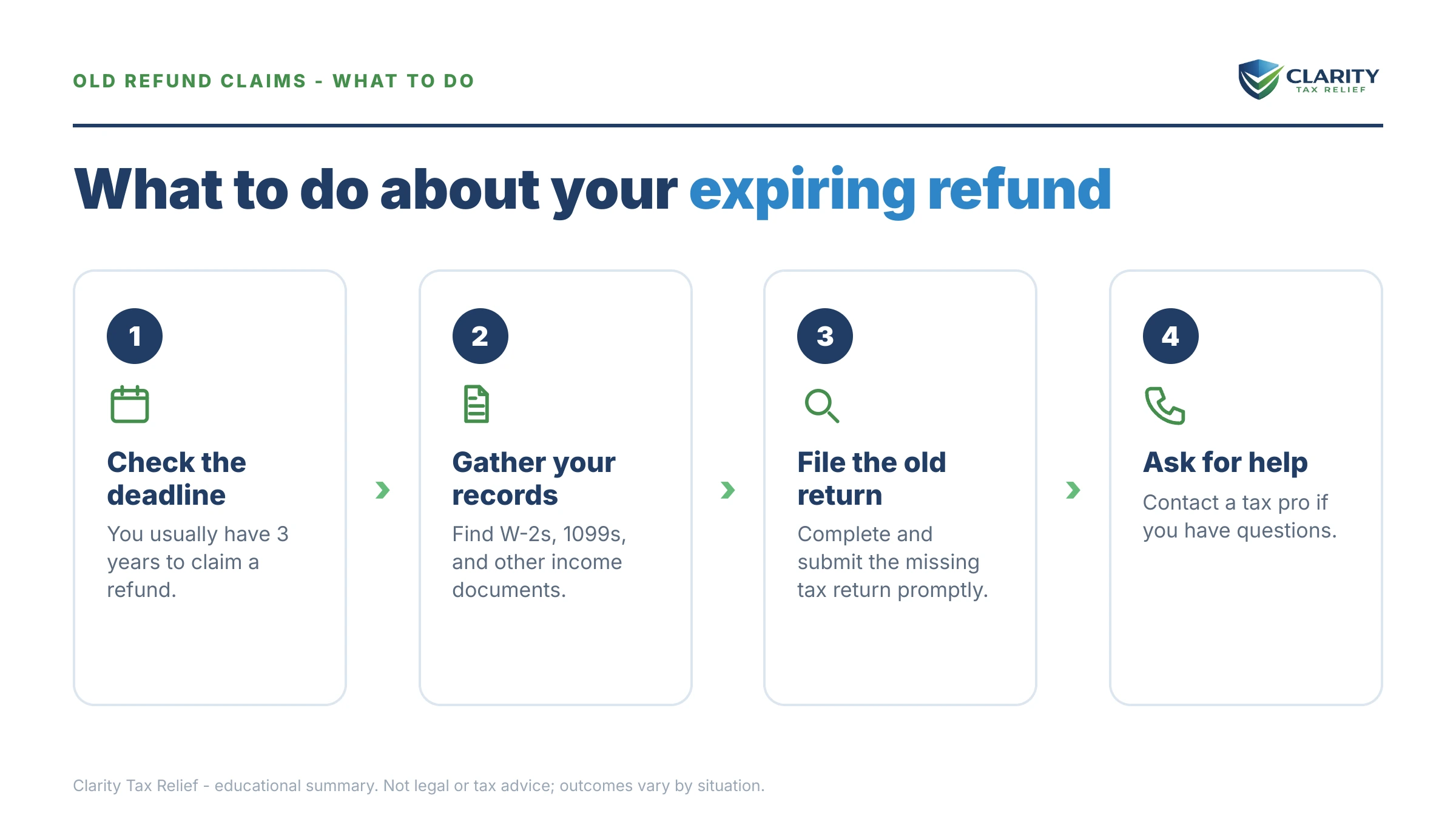
- Confirm the year is still open. Find that return's original due date. If today is within three years of it — or within three years of the October date, if you filed an extension that year — the refund is still claimable.
- Pull your income records. Request your wage and income transcripts from your IRS online account or by mail. They list every W-2 and 1099 filed under your Social Security number for that year, including the withholding you're trying to recover.
- Prepare the return on that year's forms. Use the Form 1040 and instructions for the specific tax year, not the current year's forms. Tax brackets, standard deductions, and credits differ year to year, and the wrong-year form will bounce.
- Mail it certified, return receipt requested. Returns more than two years old generally cannot be e-filed, so print, sign, and mail. The certified-mail postmark is your legal proof that you filed before the refund deadline.
- Track the refund on your account transcript. Paper returns take several weeks to a few months to process. Watch that year's account transcript for code 846, which means the refund was approved and scheduled for payment.
For step 2, our walkthrough of the IRS wage and income transcript shows exactly what to request, and if a former client or employer has vanished, getting old W-2s and income records covers the backup routes. If the refund posts but stalls, see "Where's My Refund" stuck on processing — paper-filed prior-year returns are the slowest lane in the building, especially with 2026 staffing down.
When you can handle this yourself — and when help changes the outcome
A single old refund year is one of the most DIY-friendly problems in tax. If you had one W-2 or a couple of 1099s, your records are intact, and you don't owe for other years, you can pull transcripts, prepare the prior-year return, and mail it yourself — there's no penalty exposure on a refund year, so the worst mistake is slowness.
Experienced help earns its cost in four situations. First, when it's really haven't filed taxes in 3 years — or more — and some years may owe: the order you file in, and which years you file at all, changes the net result. Second, when the IRS already filed a substitute return, because undoing an SFR's inflated assessment takes a specific reconsideration process. Third, when you're a contractor reconstructing Schedule C expenses without clean books — every deduction you can substantiate moves the refund. Fourth, when the deadline is weeks away: a professional knows how to file a protective claim so the postmark, not the processing backlog, decides your rights.
Terms you'll run into, decoded
- RSED (Refund Statute Expiration Date): the last day the law allows the IRS to pay a refund for a given tax year.
- Deemed paid: the rule treating your withholding and estimated payments as paid on the return's April due date, whenever the money actually arrived.
- Lookback rule: the limit that lets a refund claim recover only payments made within the 3 years (plus any extension) before the claim — the reason the deemed-paid date matters so much.
- Refund offset: the automatic diversion of a refund to other debts — IRS balances first, then state tax, child support, and federal student loans.
- Substitute for return (SFR): a return the IRS constructs for a non-filer using only reported income — no deductions, worst-case filing status.
- Financial disability: the narrow exception that suspends the refund deadline while a documented medical impairment prevented you from managing your finances.
Old-refund questions, answered
Can I still get a refund from 3 years ago if I never filed the return?
Usually yes — if you file before the window closes. For an unfiled return, you generally have three years from the original due date (or from the October extended date if you filed Form 4868) to file and claim the money. As of mid-2026, that means tax year 2023 refunds are claimable until April 15, 2027, while the window for 2022 has already closed for most non-filers.
What happens to my refund if I miss the 3-year deadline?
The money is gone permanently — it becomes the property of the U.S. Treasury. The IRS cannot refund it, and it also cannot apply the expired credit to a balance you owe for another year. There is no appeal for simply filing late; the only exceptions are narrow ones like financial disability, federally declared disaster postponements, and combat-zone service.
Can I e-file a tax return from 3 years ago?
Usually not through consumer software, which typically supports e-filing only for the current year and the two prior years. A return older than that generally has to be prepared on that year's forms, printed, signed, and mailed to the IRS. Send it certified mail with return receipt — the postmark is your proof that you beat the refund deadline.
Will the IRS pay me interest on a refund from an old return?
Not for the years you waited — no interest accrues while an unclaimed refund sits on your account. Once you actually file, the IRS generally owes overpayment interest only if it takes more than 45 days after receiving your return to issue the refund. Filing sooner doesn't just protect the money; it starts the only clock that can add to it.
Can the IRS take my old refund for other debts?
Yes. Before it is paid out, an old refund is run through offset — first against IRS balances from other years, then through the Treasury Offset Program for state income tax debts, past-due child support, and defaulted federal student loans. You'll get a notice showing where it went. If you're a 1099 contractor with unpaid balances on other years, expect the refund to land there first.
Does filing an extension change the 3-year refund window?
Yes — if you filed Form 4868 for that year, the three years run from the extended October deadline instead of April. That means a 2022 non-filer who requested an extension back in 2023 can still claim that refund until around October 15, 2026, while a 2022 non-filer without an extension is already out of time.
What if I was too sick to file — is there an exception?
Possibly. The tax code suspends the refund deadline for financial disability — a medically determinable physical or mental impairment that prevented you from managing your financial affairs, documented by a physician's statement. It does not apply if a spouse or someone else was authorized to handle your finances during that period, and the IRS applies the exception strictly.
Do I owe a late-filing penalty on a 3-year-old return if I'm due a refund?
No. The failure-to-file and failure-to-pay penalties are calculated as a percentage of unpaid tax, and a refund year has no unpaid tax — so both penalties compute to zero. The only thing you lose by filing a refund year late is time, and after three years, the refund itself.
Your next 24 hours
- Write down your unfiled years. Log into your IRS transcript account (or check your own records) and list every year without a filed return — then match each against the deadline table above.
- Gather what you have. Any W-2s and 1099s for the open years, proof of estimated payments, your last filed return, and a rough list of business expenses if you were on 1099.
- Get a free case review. Use the 2-minute form or call (888) 825-7779. We'll confirm which refunds are still claimable and build the filing order — the 2023 window closes April 15, 2027, and paper processing eats months of that runway.
Official references: the IRS explains refund timing at IRS.gov/refunds, and if a timely-filed refund is stuck and causing hardship, the independent Taxpayer Advocate Service can intervene at no cost.
This guide is general information, not tax or legal advice for your specific situation. Eligibility for IRS programs depends on individual facts and circumstances; no outcome is guaranteed.