
IRS Notices
IRS CP32A Notice: How to Claim Your Expired Refund Check (2026)
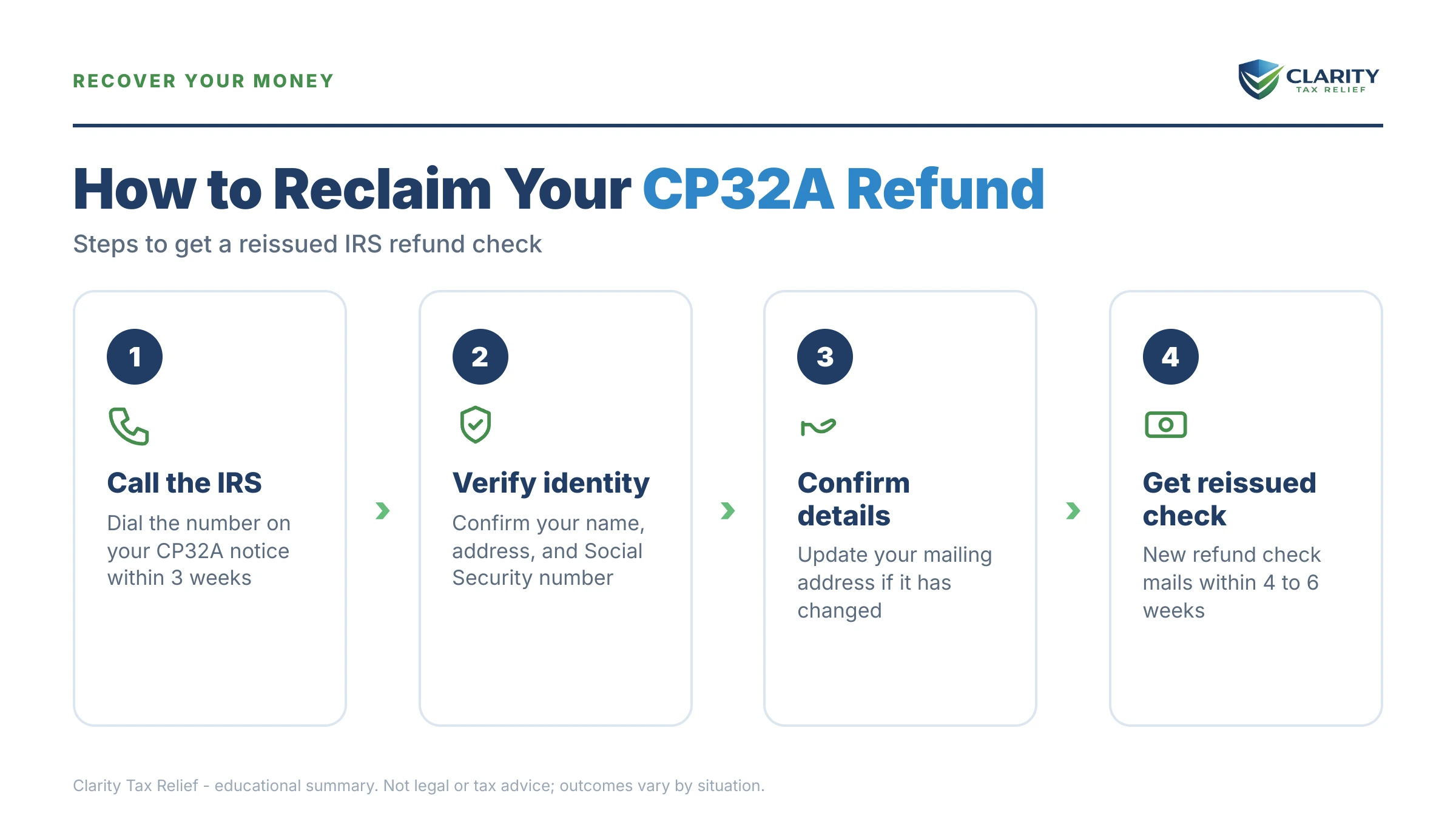
The short answer: a CP32A notice means the IRS mailed you a refund check that was never cashed and has now expired — Treasury checks are void one year after issue. Your money isn't gone. Call the number printed on the notice to request a replacement check; if you owe another tax year, the refund is applied there first.
Every IRS envelope lately has meant trouble — you're behind on another year, and the warning letters have been getting sharper. Then this CP32A notice lands and says the opposite of everything before it: the IRS has been holding money that belongs to you, a refund check that expired before anyone cashed it. That reversal is real, and if you handle it right, this notice can actually shrink the problem sitting in the rest of your mail pile.
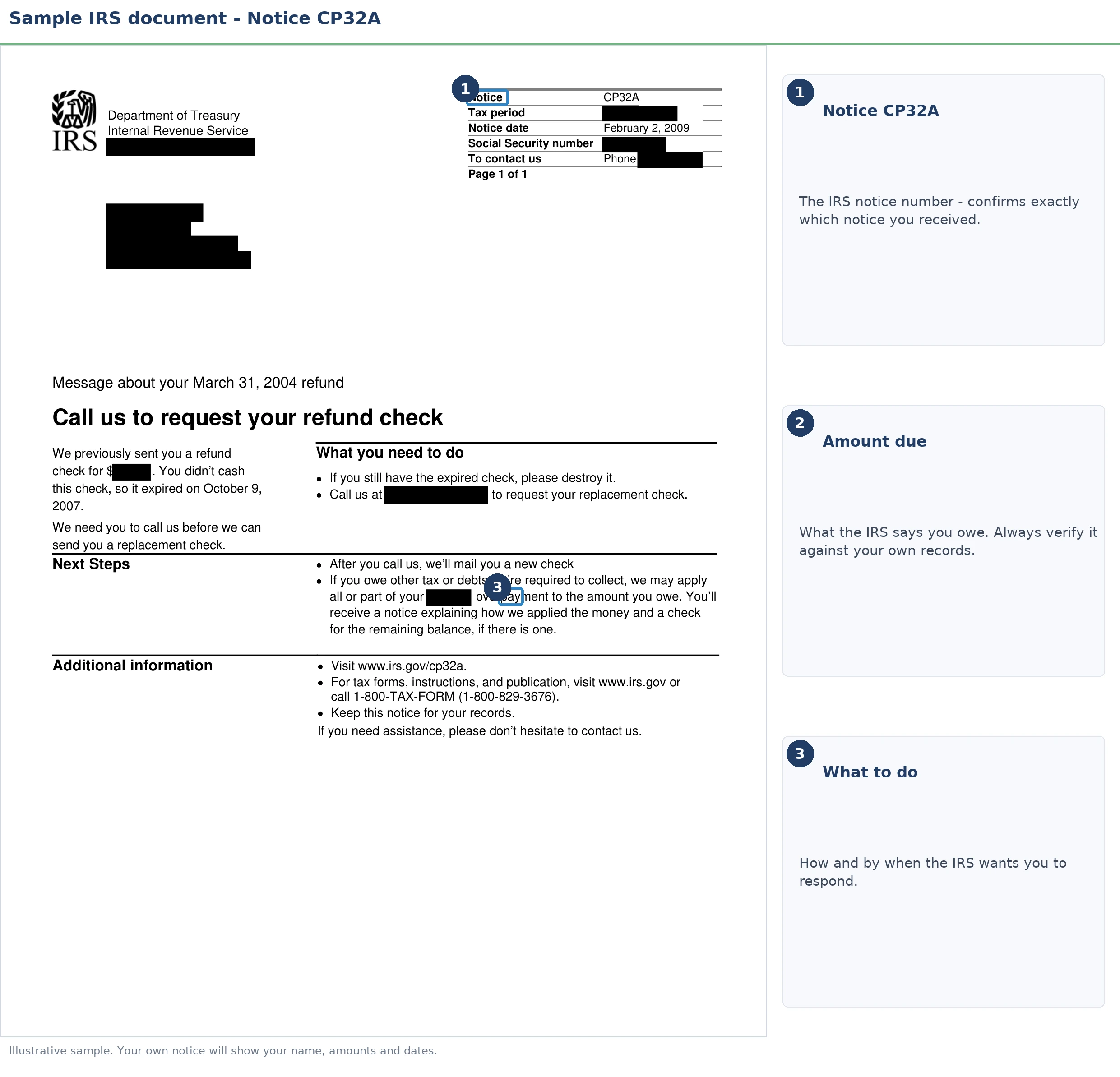
The catch is that a CP32A is the one refund notice that does nothing until you act. Its sibling, the CP32, means a replacement check is already on the way; a CP32A means the IRS is waiting for a phone call from you before it will reissue a dime. The image below shows exactly what a CP32A looks like and where to find the three things you need — the refund amount, the tax year, and the phone number to call.
⏱ Your real clock: a CP32A carries no penalty deadline — this is the IRS owing you, not billing you. But if you owe for any other tax year, penalties and interest on that balance compound every month your unclaimed refund sits idle. And with IRS phone staffing cut sharply in 2025, the call to claim it takes longer than it used to — start early.
Why you got a CP32A notice
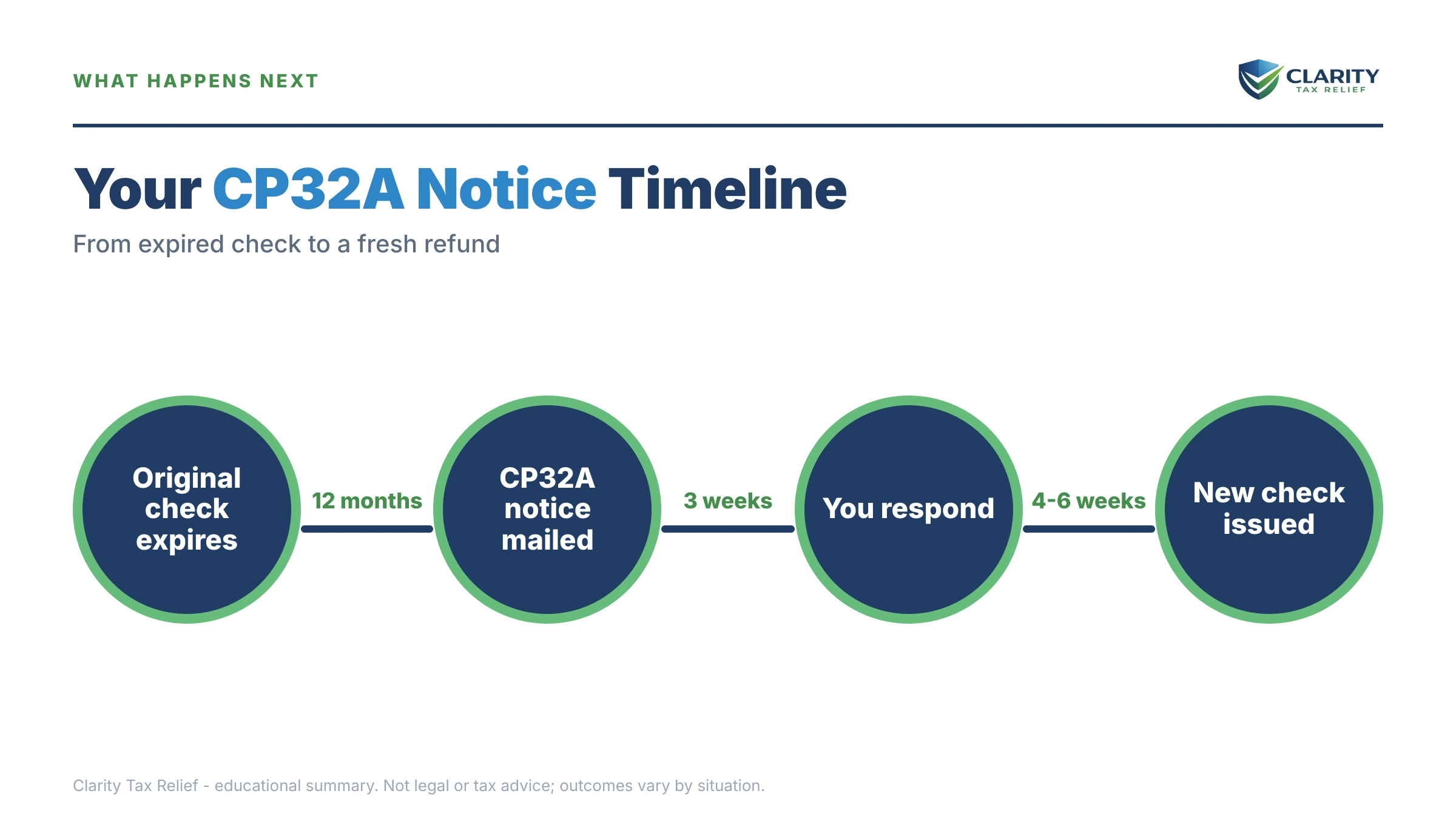
A CP32A notice means the IRS previously mailed you a refund check that was never cashed — and under federal law, U.S. Treasury checks are void one year after their issue date. The check died; the refund behind it did not. The IRS moved the money back onto your account as a credit and sent the CP32A telling you to call and claim it.
How does a refund check go uncashed for a year? The usual suspects:
- You moved. Renters are the classic case — the check chased an old apartment, mail forwarding lapsed, and it either bounced around or sat in someone else's mailbox until it expired.
- It arrived and got set aside. A check tucked into a drawer during a chaotic year quietly passed its one-year mark.
- A name mismatch. Marriage, divorce, or a bank that wouldn't accept the check as printed.
- The taxpayer died. The check was issued to someone who passed away, and nobody was authorized to cash it.
The notice shows the tax year and the refund amount the IRS is holding. Verify both against your copy of that year's return before you call — this notice family has a specific fix, and calling about the wrong year wastes a long hold time. If you're not sure why the IRS writes at all, our decoder on why did I get a letter from the IRS maps the whole notice system.
CP32A vs. CP32 vs. CP53: which refund-check notice do you have?
The IRS uses several different notices for refund-check problems, and each one demands a different action — two of them require nothing from you at all. Check the notice code in the corner before you do anything:
| Notice | What it means | What you must do |
|---|---|---|
| CP32A | Your refund check expired uncashed; the IRS is holding the money as a credit | Call the number on the notice to request a replacement — nothing happens until you do |
| CP32 | The IRS already mailed you a replacement refund check | Nothing — just cash the new check when it arrives |
| CP53 | Your direct deposit failed; a paper check is coming instead | Wait for the check; fix your bank details on next year's return |
| CP49 | Your refund was applied to a back-tax balance you owe | Verify the offset math; any remainder comes to you |
Two other refund-side notices sometimes get confused with this family: a CP05 notice means your refund is being held for review before it's ever issued, and a CP12 notice means the IRS changed your return and adjusted the refund amount. A CP32A is different from both — your refund was already approved and paid out; only the paper failed.
What happens if you ignore a CP32A notice
Nothing on a CP32A escalates into enforcement — but the money does not move one inch toward you until you act, and waiting quietly makes recovery harder. Here's the sequence, in order:
- The credit just sits there. The IRS parks the refund on your account indefinitely. It won't call you, and with the 2025 workforce cuts, no human is assigned to chase you down about money you're owed.
- Your address goes staler. A bad address is probably why the original check died. Every month you wait raises the odds the replacement chases the same dead mailbox — and the CP32A itself may already have been forwarded from an old one.
- Other debts intercept it. If a balance exists — or arises — on another tax year, the IRS applies the credit there. That can work in your favor (more below), but only if you know it's happening; otherwise you get a smaller check than expected and no idea why.
- Retrieval gets bureaucratic. What starts as one phone call can turn into a refund trace on Form 3911 through the Bureau of the Fiscal Service, especially if the original check was stolen or cashed by someone else. Traces take far longer than a simple reissue.
One more reason not to sit on it: the automated collection side of the IRS never paused. If you owe for another year, that account keeps marching toward liens and levies on its own timeline, completely indifferent to the refund credit sitting one screen away.
The IRS is holding your money — and maybe pursuing you at the same time
If your CP32A arrived alongside collection letters for another year, the order you handle them in changes what you keep. Get your CP32A and your full IRS account reviewed free — an experienced tax professional will map the refund against every balance, levy threat, and deadline on your file.
Your options for claiming a CP32A refund
Every CP32A resolution starts the same way — you request the replacement — but where the money actually goes depends on what else is attached to your name. The IRS routes the refund based on your whole account, not just the notice in your hand. Find your row:
| Your situation | What happens to the refund | Your move |
|---|---|---|
| No other tax debts, address current | Full replacement check mailed to your address of record | Call the number on the notice and request it — that's the whole fix |
| You owe the IRS for another year | Refund applied to that balance first; only the remainder is mailed | Check every year's balance in your online account before you call, so the math doesn't surprise you |
| Past-due child support, defaulted federal student loans, or state tax debt | Intercepted through the Treasury Offset Program before it reaches you | Expect an offset notice; disputes go to the agency that claimed the money, not the IRS |
| You've moved since filing | The replacement will go to the old address on file — same failure, round two | Update your address by phone or Form 8822 before requesting the check |
| Joint return, now separated or divorced | The check is issued in both names, and both generally must endorse it | Coordinate with your ex if you can; if you can't, ask the IRS representative about your options |
| The taxpayer has died | The refund belongs to the estate or surviving claimant | The person claiming it generally files Form 1310 with supporting documents |
If offsets are new territory, our guide to the Treasury Offset Program explains which debts can reach a federal refund and how you find out before the check shrinks.
Will the IRS keep your CP32A refund if you owe? A worked example
If you owe the IRS for any other tax year, your CP32A refund is applied to that balance before a replacement check is cut — and used deliberately, that offset can be the fastest way to shut down a levy threat.
Say your CP32A shows a $61,200 refund for tax year 2022 — the result of an amended return you filed after discovering years of over-withholding, with the original check mailed to an apartment you'd left months earlier. Meanwhile, you owe $14,800 for 2024, and the IRS has sent an LT11 notice — the final notice of intent to levy your wages. Here's the math when you call to claim the replacement:
- The IRS applies the credit to the 2024 balance first: $61,200 − $14,800 = $46,400.
- The 2024 account is paid in full — which removes the very debt the levy was being built on.
- The remaining $46,400 goes out as a paper check to your (updated!) address of record.
Two cautions. First, don't let the LT11's 30-day clock run while you wait for the offset to process — that window protects your Collection Due Process rights, which you request on Form 12153, and it doesn't pause for pending refunds. Second, every month the 2024 balance sits unpaid, it grows: the failure-to-pay penalty alone runs 0.5% per month — about $74 on a $14,800 balance — plus interest on top. The refund is worth the same whether you claim it now or later; the debt it could erase is not.
How to respond to a CP32A notice, step by step
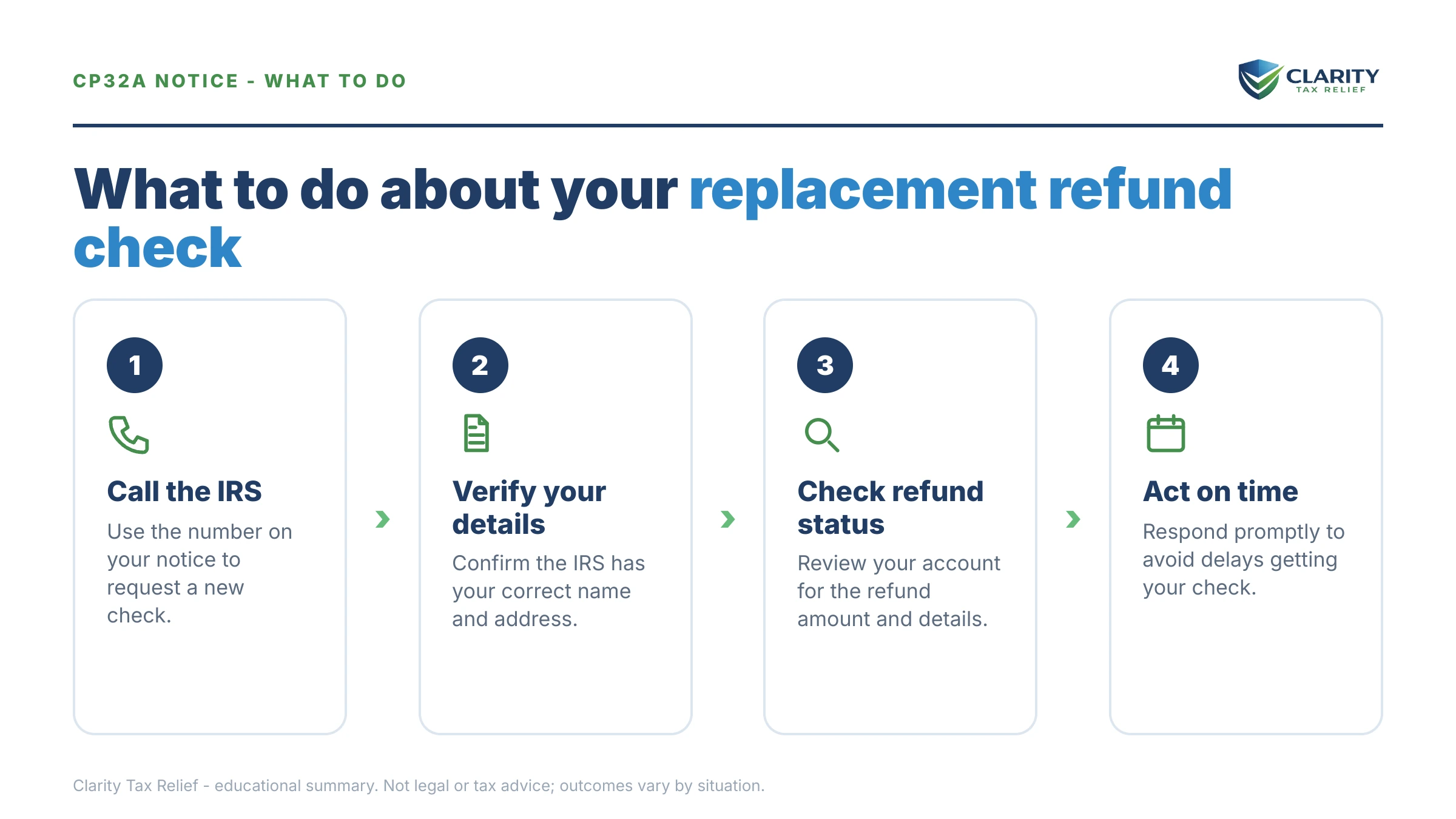
- Verify the refund — log in to your IRS online account and confirm the credit and tax year on the notice match what the IRS shows on file.
- Update your address — if you've moved since filing, correct your address with the IRS — by phone or Form 8822 — before requesting the check, or the replacement will chase the same dead address.
- Call the number printed on your notice — request the replacement check; have the notice, that year's tax return, and your identification information in front of you.
- Check your other tax years — if any year carries a balance, expect the refund to be applied there first and only the remainder mailed to you.
- Follow up if nothing arrives — after several weeks with no check, request a refund trace with Form 3911 so the Bureau of the Fiscal Service can track it.
Step one matters more than it sounds. Refund-themed letters are a favorite scam template, and a real CP32A never asks for bank details by email or text, never demands a "processing fee," and never routes you anywhere but an official IRS phone line. If you don't already have online access, our IRS online account setup walkthrough gets you in — it's the fastest way to confirm the credit is genuinely sitting on your account. And if the phone line defeats you (a 2026 reality), our guide for when you can't reach the IRS on the phone covers the workarounds, including having a representative call with a power of attorney.
When you can handle a CP32A yourself
Most people can resolve a CP32A on their own with one phone call and a correct mailing address. If the refund amount matches your records, you owe nothing on any other year, and you still live where you filed from, you don't need anyone — call, request the check, done. That's the honest answer.
Experienced help changes the outcome in a narrower set of situations:
- A levy or garnishment is in motion on another year. Sequencing the refund offset against the collection clock — and protecting appeal rights while it processes — is where timing mistakes get expensive.
- Multiple years are unfiled. Unfiled returns can hold up how the credit is applied, and the filing order affects what you ultimately keep.
- The original check was stolen or forged. Fiscal Service claims are slow and document-heavy; a professional keeps the trace from stalling.
- The taxpayer died or the refund is from a joint return in a broken marriage. Entitlement questions get legal fast.
If your case never gets traction through normal channels, the Taxpayer Advocate Service — an independent arm of the IRS — can also intervene at no cost.
Terms on your CP32A, decoded
- Expired (stale-dated) check — a U.S. Treasury check that passed its one-year negotiability window and can no longer be cashed by any bank.
- Overpayment credit — the refund amount the IRS moved back onto your account after the check died; it's real money, just parked.
- Refund offset — the IRS applying your refund to a federal tax balance you owe before paying you the rest.
- Treasury Offset Program (TOP) — the federal system that intercepts refunds for non-IRS debts like child support, defaulted student loans, and state taxes.
- Refund trace (Form 3911) — the formal process for tracking a refund check that was lost, stolen, or cashed by someone else.
- Bureau of the Fiscal Service — the Treasury agency that actually prints, tracks, and investigates federal checks; it handles the back end of every trace and forgery claim.
CP32A questions, answered
Is a CP32A notice good news or bad news?
Mostly good news — a CP32A means the IRS owes you money, not the other way around. A refund check was issued in your name, never cashed, and expired after one year. The catch is that the notice requires action: the IRS will not automatically send a replacement, and if you owe for another tax year, some or all of the refund may be applied there first.
How do I get my CP32A replacement refund check?
Call the toll-free number printed on your CP32A notice and request the replacement — the IRS will not reissue the check on its own. Before you call, confirm your mailing address is current with the IRS, since a stale address is the most common reason the original check went uncashed. If you've moved, update your address during the call or file Form 8822.
How long does the CP32A replacement check take to arrive?
The IRS doesn't publish a fixed timeline for reissued refund checks; several weeks is typical, and 2026 staffing cuts have slowed paper processing further. If a reasonable window passes with nothing in the mail, request a refund trace using Form 3911 so the Bureau of the Fiscal Service can track the check. Keep a note of the date you called and the representative's ID.
Why did my original refund check expire?
U.S. Treasury checks are void if not cashed within one year of the issue date. Most CP32A situations trace back to a check that never reached you — a move, a name change, a mail-forwarding lapse — or a check that arrived and got set aside. The refund itself does not expire with the check; only the paper instrument does.
Will the IRS keep my CP32A refund if I owe back taxes?
If you owe the IRS for any other tax year, the refund is applied to that balance before any replacement check is issued, and only the remainder is sent to you. The refund can also be intercepted through the Treasury Offset Program for past-due child support, defaulted federal student loans, or state tax debts. You'll receive a notice explaining any offset that occurs.
What if I never received the original refund check at all?
Tell the IRS representative that when you call — if the check was lost, stolen, or possibly cashed by someone else, ask for a refund trace rather than a simple reissue. The trace (Form 3911) sends the case to the Bureau of the Fiscal Service, which checks whether the original was cashed and reviews the endorsement if it was. A forged endorsement triggers a claims process that takes longer but recovers your money.
Can my CP32A replacement refund be direct deposited?
Generally no — the IRS reissues expired refund checks as paper checks mailed to your address of record, which is why confirming that address is the single most important step before you call. Direct deposit is set when a return is processed, not when a check is replaced. If the paper check fails to arrive, your remedy is a refund trace, not a deposit change.
Your next 24 hours
- Find the refund amount and tax year on your CP32A — they're printed near the top of the notice, along with the phone number you'll call. Confirm the year matches a return you actually filed.
- Gather three things: the notice itself, your copy of that year's tax return, and your IRS online account login (or set one up) so you can see the credit and any balances on other years before you call.
- Get a free case review — if the CP32A is your only IRS mail, one call to the number on the notice likely ends this. But if you're also facing balances, levy warnings, or unfiled years, let us map the whole account first, free: the 2-minute form or (888) 825-7779 — remember, interest and penalties on any balance you owe keep accruing while the refund sits unclaimed.
Primary sources: the IRS's official page, Understanding your CP32A notice, and the agency's general refunds hub at IRS.gov.
This guide is general information, not tax or legal advice for your specific situation. Eligibility for IRS programs depends on individual facts and circumstances; no outcome is guaranteed.