
IRS Notices
IRS CP53 Notice: Direct Deposit Failed, Paper Check Coming (2026)
The short answer: a CP53 notice means the IRS tried to direct-deposit your tax refund, your bank rejected the deposit, and the IRS is mailing you a paper check instead. Your refund is not lost. In most cases you don't need to do anything — the check typically arrives within a few weeks of the notice date.
You watched the deposit date come and go, refreshed your bank app a dozen times, and the money never landed — and now a CP53 notice from the IRS explains why. The bank bounced the deposit back. The good news: the refund is still yours, it's already been converted to a paper check, and your only real jobs are to confirm the address it's headed to and know exactly when you're allowed to escalate.
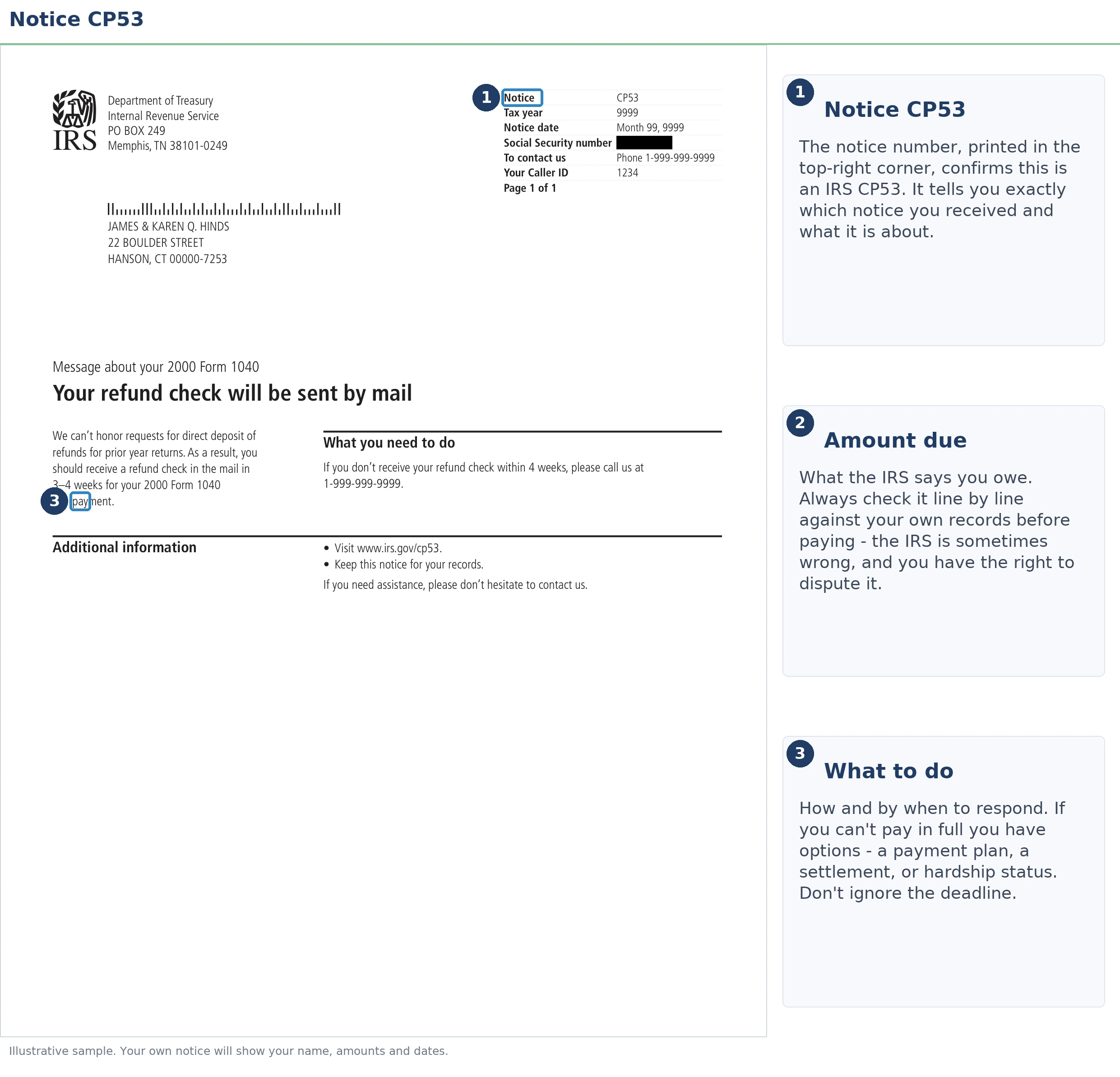
The image below shows exactly what a CP53 looks like and where to find the refund amount and the check timeframe on your copy — those two lines tell you almost everything you need.
⏱ Your two clocks: there is no response deadline on a CP53 — but two real timers matter. First, the check-arrival window printed on your notice (typically a few weeks). Second, a U.S. Treasury refund check is valid for one year from its issue date; let it sit longer and it voids, and you'll be chasing a reissue instead of cashing a check.
Why you got a CP53 notice
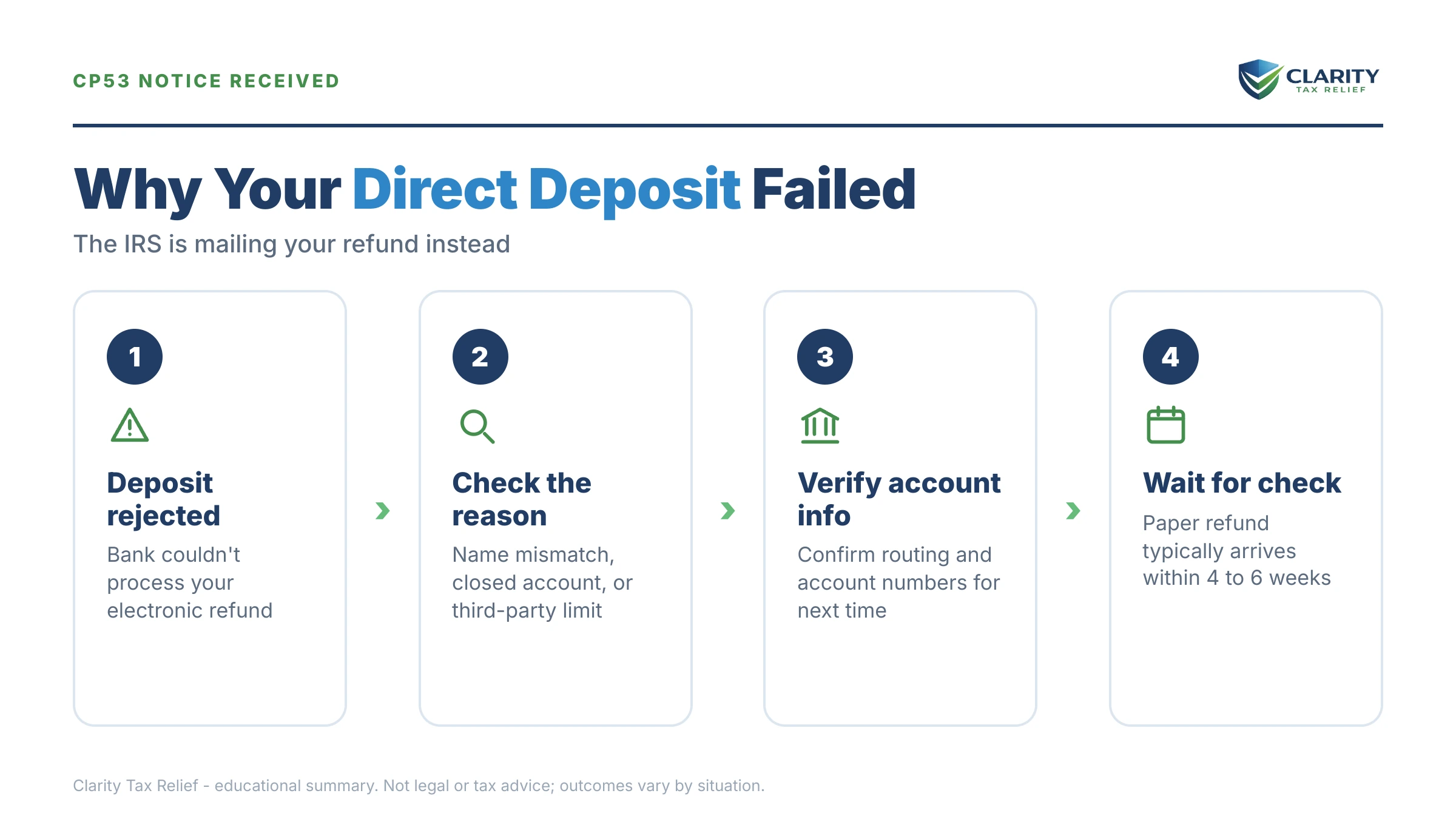
A CP53 notice is issued for exactly one reason: the bank account on your tax return refused the IRS's electronic refund deposit, so the refund reverted to the IRS and is being reissued as a paper check. Nothing about your return is being questioned, audited, or reduced by this notice — it's a delivery failure, not a tax problem.
The rejection almost always traces back to one of these:
- A mistyped routing or account number — one transposed digit and the deposit either bounces or, worse, lands somewhere else (more on that below).
- A closed account. If you shut down the account after filing — common when self-employed people close a business checking account — the bank returns the funds automatically.
- A name mismatch. Many banks reject deposits when the name on the refund doesn't match the account owner — a joint refund aimed at one spouse's solo account, or a personal refund aimed at an LLC's business account.
- The three-deposit rule. The IRS allows no more than three electronic refunds into a single financial account per year. The fourth converts to a paper check automatically — this catches families and preparers who route multiple refunds to one account.
- A refund-transfer product that failed. If your preparer deducted their fee from your refund, the money routes through a temporary partner-bank account first. When that leg fails, the CP53 check comes directly to you at your address — not to the preparer.
- A foreign account. IRS refunds can only be direct-deposited to U.S. financial institutions.
One important contrast: a CP53 means the bank rejected the money and sent it back. If you entered the wrong account number and that account accepted the deposit, you won't get a CP53 — the IRS considers the refund delivered, and recovering it means working with that bank directly. So in a strange way, this notice is the better outcome.
If you're not sure why any IRS letter shows up when it does, our decoder on why did I get a letter from the IRS maps the whole notice system; this page covers only the CP53.
First, confirm the refund amount matches your return
The single most useful check on a CP53 is comparing its refund figure to the refund on your filed Form 1040. If the numbers match, this really is just a delivery issue. If the CP53 amount is smaller than the refund you filed for, something happened to the money before the deposit ever failed:
- The IRS corrected a math or credit error and adjusted your refund — that usually comes with a separate CP12 notice explaining the change.
- Part of the refund was taken for past-due federal tax — see CP49 refund applied — or intercepted for state tax, child support, or federal student loans through the Treasury Offset Program.
Also rule out the lookalikes. If your refund is delayed but no deposit was ever attempted, you may be dealing with a review hold — that's the CP05 notice — or a name/SSN mismatch, which triggers a CP54 notice instead. A CP53 only exists after the IRS approved and sent your money; on your transcript, you'll already see the 846 refund issued date for the failed deposit.
What happens after a CP53 if you do nothing
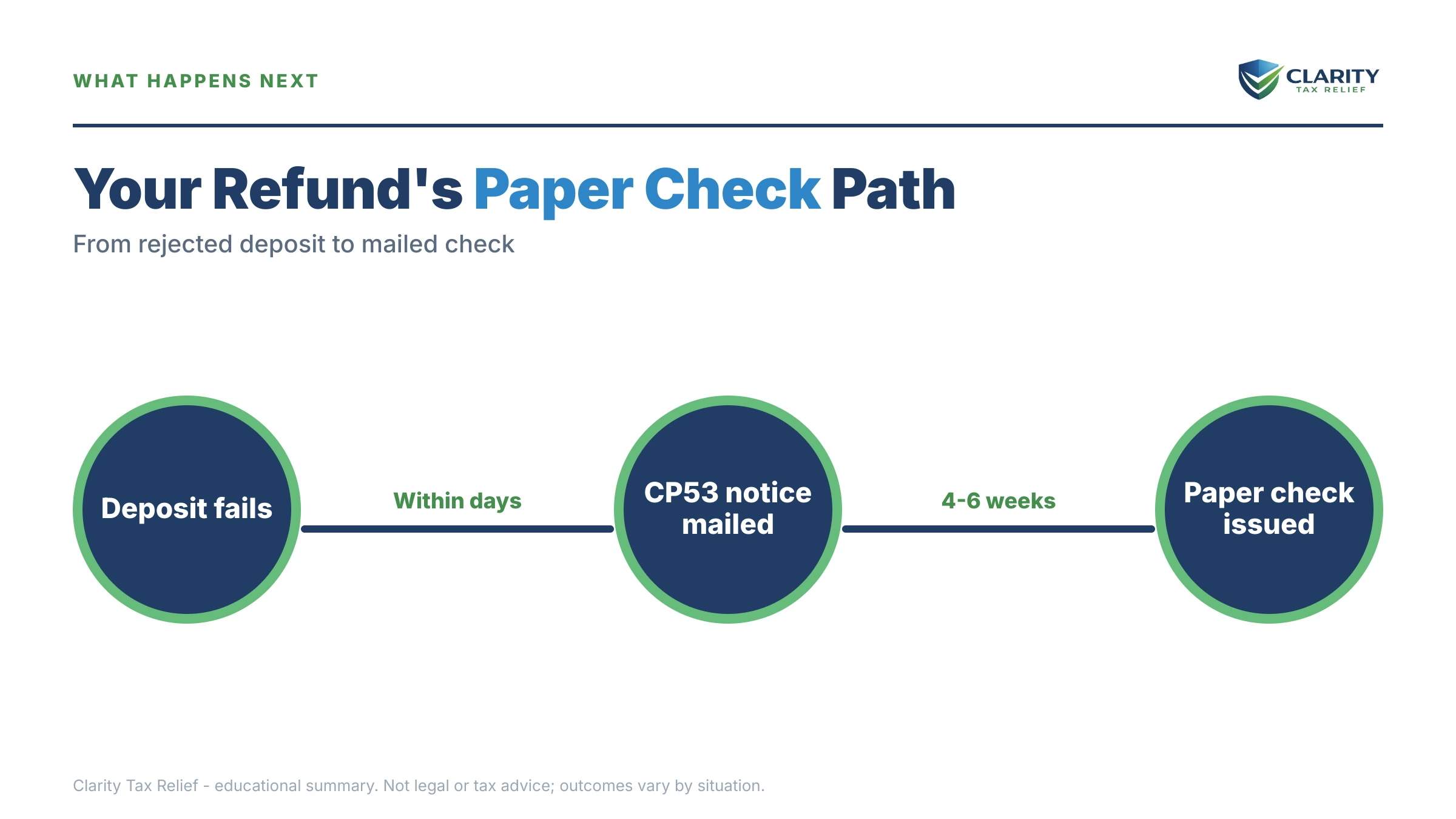
After a CP53, the IRS mails a paper check to the address on your most recent return — and that check stays valid for one year from its issue date. For most people the sequence ends quietly at stage three. The trouble cases are stale addresses and stolen mail, and each stage has a specific remedy:
- Deposit rejected. Your bank returns the funds to the IRS electronically. The refund reverts to your account at the IRS.
- CP53 mailed. The IRS notifies you of the conversion and states its own check timeframe. You are here.
- Paper check mailed. It goes to the address on your latest return unless the IRS has a newer one on file. If it arrives and you cash it — done.
- Check doesn't arrive. Once the IRS's published waiting period passes (four weeks from mailing for most filers), you can demand a refund trace by phone or on Form 3911.
- Trace runs. If the check was never cashed, the IRS voids it and issues a replacement. If someone else cashed it, the Bureau of the Fiscal Service opens a claim and sends you a package with a copy of the cashed check.
- Check never cashed within a year. Treasury checks void after one year, and the IRS eventually sends a CP32A notice about the expired check. The money is still yours — but now you're requesting a reissue on top of everything else.
| Stage | What happens | Typical timing |
|---|---|---|
| Bank rejects the deposit | Funds return to the IRS; refund reverts to your account | Within days of the scheduled deposit date |
| CP53 issued | IRS tells you a paper check is coming | Shortly after the rejection posts |
| Check mailed | Sent to the address on your most recent return | Window stated on the notice — typically a few weeks |
| Check missing | You can start a refund trace | 4 weeks after mailing (6 with forwarding on file) |
| Trace complete | Replacement check, or a claim package if it was cashed | Varies — often several more weeks |
| Check never cashed | Check voids; CP32A follows; reissue required | 1 year after the check's issue date |
CP53 arrived with a wrong amount — or with other IRS letters?
A paper check fixes a bounced deposit. It doesn't fix a refund that was adjusted, offset, or tangled with back taxes or unfiled years. Send us your CP53 and anything that came with it — an experienced tax professional will decode exactly where your refund stands, free and confidential.
Your options when the paper check doesn't arrive
The IRS will trace a missing refund check four weeks after mailing — six weeks if you have a forwarding address on file with the post office, and nine weeks if the check went to a foreign address. Those published waiting periods are the gate: before they pass, the IRS will tell you to keep waiting; after they pass, you have real levers.
- Refund trace by phone. Single filers can usually start a trace by calling the number on the CP53. The IRS checks whether the check was cashed.
- Refund trace on Form 3911. Joint filers must use Form 3911, Taxpayer Statement Regarding Refund — the IRS won't start a joint trace by phone, and both spouses sign. Married couples: don't burn a week on hold to learn this.
- Never cashed → replacement. If the trace shows the check outstanding, the IRS voids it and issues a new one. Don't cash the original if it turns up later.
- Cashed by someone else → claim. The Bureau of the Fiscal Service sends a claim package with a copy of the cashed check and the endorsement. You dispute the signature, and the review takes additional weeks — but forged-endorsement claims do get paid.
- Genuine hardship while you wait. If the delayed refund is causing an eviction, utility shutoff, or similar harm, the Taxpayer Advocate Service can push a stalled trace — here's how to contact the Taxpayer Advocate Service.
| Your situation | Wait before tracing | What you can do then |
|---|---|---|
| Check mailed to your standard address | 4 weeks from mailing | Trace by phone, or file Form 3911 |
| USPS forwarding address on file | 6 weeks from mailing | Trace by phone, or file Form 3911 |
| Check sent to a foreign address | 9 weeks from mailing | File Form 3911 |
| Married filing jointly | Same windows as above | Form 3911 required — both spouses sign; no phone trace |
| Trace shows check was cashed | After trace results | Bureau of the Fiscal Service claim package; dispute the endorsement |
One quiet consolation on long delays: the IRS generally owes you interest when a refund is issued more than 45 days after the filing deadline or the date you filed, whichever is later. A trace-and-reissue cycle often crosses that line. The interest arrives with the refund — and it's taxable next year.
Say your refund is $31,200: what a failed deposit really costs
Say you're a 1099 contractor who had a strong 2025 and over-set-aside all year: you paid $58,000 in quarterly estimated payments, your final tax bill came to $26,800, and your return claims the difference — $58,000 − $26,800 = a $31,200 refund. You closed the business checking account listed on the return back in February, the bank bounced the deposit, and the CP53 arrived.
Here's the real cost. It isn't a penalty — there is none for you on a CP53. It's timing. If you were counting on that $31,200 to cover your June 15 second-quarter estimate (see the quarterly estimated tax deadlines 2026), a few weeks of check float means fronting that payment from cash flow — or underpaying the quarter and accruing an underpayment penalty on money the IRS is simultaneously holding for you. The IRS won't net the two automatically.
Two fixes for next year: keep the refund account open until the money lands, or skip the round trip entirely by applying part of the refund directly to next year's estimates on your return — an election you make when you file, not after.
How to respond to a CP53, step by step
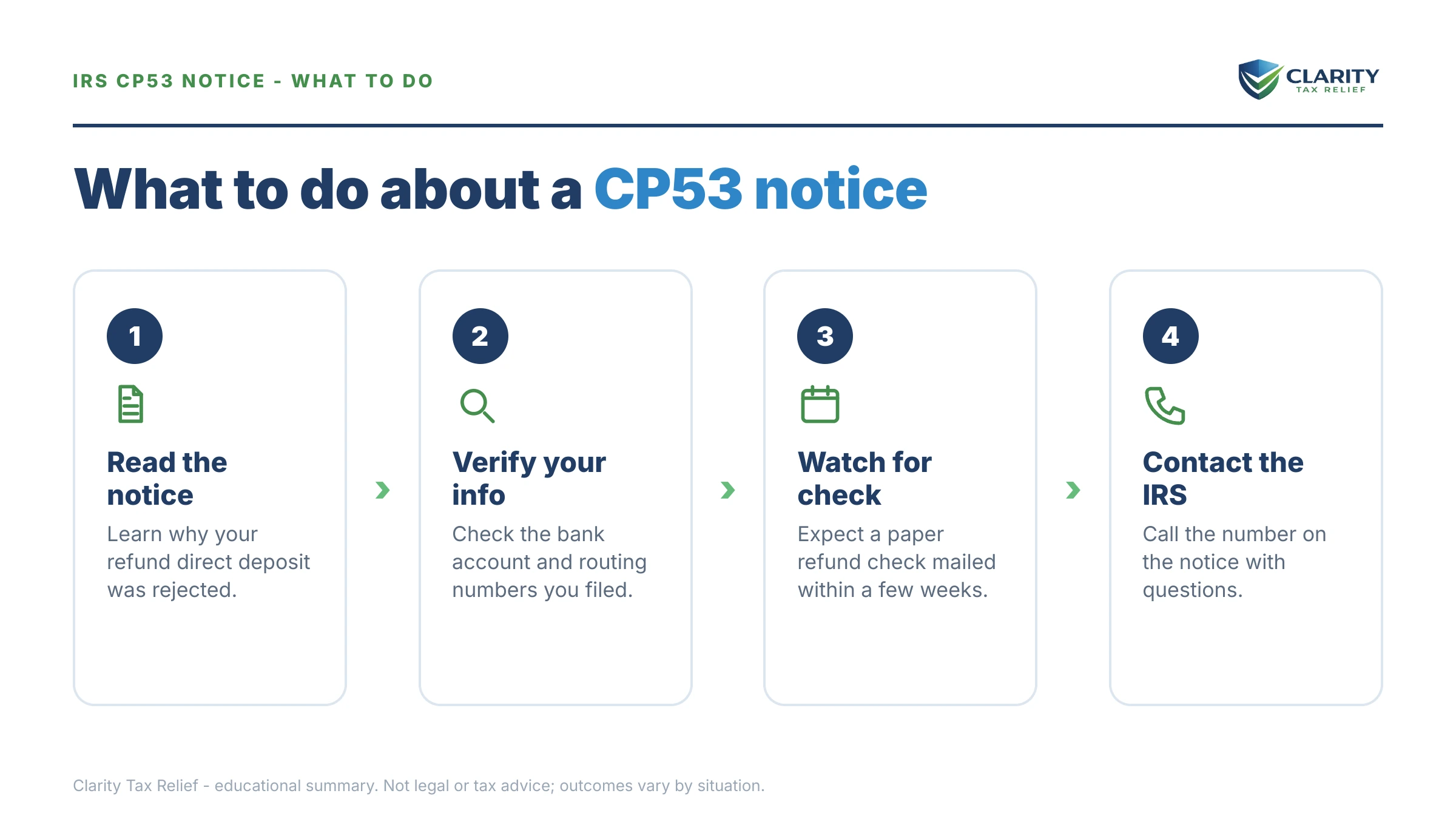
- Match the notice to your return: confirm the refund amount on the CP53 equals the refund on your filed Form 1040 — if it's smaller, an adjustment or offset happened first.
- Verify your mailing address: check the address the IRS has in your online account; if you've moved, file Form 8822 and set up USPS forwarding the same day.
- Ask your bank what bounced: a two-minute call tells you whether it was a closed account, a name mismatch, or a bad account number — so it doesn't repeat next year.
- Track the check: watch Where's My Refund and your IRS online account, and give the check the full window printed on your notice.
- Request a refund trace if it doesn't arrive: call the number on the notice or file Form 3911 — four weeks after mailing for most filers, six if your mail is forwarded.
- Get a professional review if anything else is off: a different amount, an offset you don't recognize, or other IRS letters in the same season are signs the refund is tangled in a bigger account issue.
If you haven't set up online access yet, our IRS online account setup walkthrough takes about ten minutes and lets you watch the check status yourself instead of calling. And if the tracker still says "processing" even though your CP53 says a check went out, see "Where's My Refund" stuck on processing — the tools update on different schedules.
When you can handle a CP53 yourself (almost always)
A CP53 is one of the few IRS notices that most people should handle entirely on their own. If the amount matches your return and your address is current, the correct move is to do nothing but wait the stated window — no professional can make the Treasury print a check faster, and anyone who charges you to "expedite" a CP53 is selling you the waiting you'd do for free.
Experienced help changes the outcome in a narrower set of cases: the refund was offset against back taxes or other debts you dispute, the amount was adjusted and you disagree with the change (compare your CP53 against any CP11 notice or CP12 in the same stack), the check was cashed by someone else and the endorsement claim stalls, or you have unfiled years and this refund is the first thread of a larger account problem. In those situations, the CP53 is a symptom — and treating the symptom won't fix the account.
Terms on your CP53, decoded
- Refund trace — the IRS's formal search for a refund payment, which tells you whether a check was cashed and triggers a replacement if it wasn't.
- Form 3911 — the one-page "Taxpayer Statement Regarding Refund" that starts a trace in writing; required for joint filers.
- Bureau of the Fiscal Service — the Treasury agency that actually prints, mails, and investigates government checks; it handles claims when a refund check is cashed by the wrong person.
- Three-deposit rule — the IRS limit of three electronic refunds into any one bank account per year; deposit number four becomes a paper check.
- Code 846 — the transcript entry marking the date your refund was released; on a CP53 account it reflects the deposit that later bounced.
- Stale check — a Treasury check more than one year past its issue date; it can no longer be cashed and must be reissued.
CP53 questions people ask
How long does it take to get my refund check after a CP53 notice?
Your CP53 states its own timeframe, and paper checks typically arrive within a few weeks of the notice date. The IRS won't trace a missing check until four weeks after it was mailed — six weeks if you have a forwarding address on file. If your window has passed, request a refund trace by phone or with Form 3911 rather than waiting longer.
Do I need to respond to a CP53 notice?
Usually no — a CP53 is informational, and the paper check is already in motion. You only need to act if the refund amount doesn't match your return, your mailing address has changed since you filed, or the check doesn't arrive within the notice's stated window. In those cases, update your address with Form 8822 or start a refund trace.
Why did my bank reject my IRS tax refund direct deposit?
The most common reasons are a mistyped routing or account number, an account that was closed before the deposit date, or an account that isn't in your name — many banks reject deposits when the names don't match. The IRS also limits refunds to three electronic deposits into any single account per year; a fourth converts to a paper check automatically.
Can the IRS resend my refund by direct deposit after a CP53?
No. Once your return is filed, the IRS cannot change or accept new bank account information for that refund. A rejected deposit converts to a paper check automatically, and there is no way to switch it back. The fix is for next year: triple-check the routing and account numbers on the return before you file.
What if I moved after filing and a CP53 check is coming?
Update your address with the IRS immediately using Form 8822 or by calling the number on your notice, and set up USPS mail forwarding as a backup. The check goes to the address on your most recent return unless the IRS has something newer. If a forwarding address is on file, expect a longer wait — the IRS won't trace the check until six weeks after mailing.
What happens if my CP53 refund check never arrives?
Request a refund trace once the waiting period passes — four weeks after the check was mailed for most filers. If the check was never cashed, the IRS voids it and issues a replacement. If someone else cashed it, the Bureau of the Fiscal Service sends you a claim package with a copy of the cashed check to dispute the signature. Joint filers must request the trace on Form 3911; the IRS won't start a joint trace by phone.
Will the IRS pay interest on my delayed refund?
Sometimes. The IRS generally owes you interest when a refund is issued more than 45 days after the filing deadline or the date you filed, whichever is later. A CP53 conversion alone usually doesn't cross that line, but a failed deposit plus a trace and reissue can. Any interest of $10 or more is taxable income, and the IRS will send you a Form 1099-INT for it.
Is a CP53 notice a scam?
A genuine CP53 arrives by postal mail and never asks you for anything — no payment, no bank details, no verification link. That's the tell: because the IRS cannot redeposit a failed refund, anyone who contacts you offering to 'fix your direct deposit' if you confirm your account number is a scammer. Verify the notice by checking your account at IRS.gov, not by calling numbers from texts or emails.
Your next 24 hours
- Pull two numbers off your CP53: the refund amount and the check-arrival window. Compare the amount against the refund line on your filed return — a match means this is purely a delivery issue.
- Gather your proof of address and tracking access: confirm the IRS has your current address (online account or Form 8822 if you've moved), and bookmark Where's My Refund at IRS.gov so you can watch the check status without phone queues.
- If the amount is wrong or other IRS letters came with it, get a free case review before you spend weeks waiting on a check that was already offset or adjusted — the 2-minute form at claritytaxrelief.com/#consult or (888) 825-7779.
The IRS's own explanation of this notice is at Understanding your CP53 notice, and if a stalled refund is causing genuine financial harm, the Taxpayer Advocate Service is the independent, free escalation path inside the IRS.
This guide is general information, not tax or legal advice for your specific situation. Eligibility for IRS programs depends on individual facts and circumstances; no outcome is guaranteed.