
IRS Notices
IRS CP54 Notice: The Name/SSN Mismatch Holding Your Refund (2026)
The short answer: a CP54 notice means the name or Social Security number on your tax return doesn't match Social Security Administration records, so the IRS is holding your refund until the two records agree. Respond with the documents the notice requests — the refund stays frozen until you do.
You filed early, the math showed money coming back, and instead of a deposit date you're holding a letter that says the IRS can't confirm who you are. Take a breath: a CP54 isn't an audit, a penalty, or a bill. It's a data mismatch — and your refund is the hostage until one field gets corrected.
There are four versions of this notice — CP54B, CP54E, CP54G, and CP54Q — and the code printed in the corner changes what the IRS is waiting for. The image below shows exactly what this notice looks like and where to find your version.
⏱ The clock on a CP54 runs against you, not the IRS. There's no levy or penalty deadline — but your refund stays frozen until you respond, and refund claims generally expire three years after the return's original due date. If your notice prints a respond-by date, that date controls.
Why you got a CP54 notice
A CP54 notice means the name or taxpayer identification number on your return doesn't match the Social Security Administration's records, and the IRS won't finish processing your refund until the two agree. The check is automated: IRS computers compare your SSN and your name control — generally the first four letters of your last name — against SSA's master file, and any character that doesn't line up trips the hold. (If you're sorting a whole stack of IRS mail, start with why did I get a letter from the IRS for the big picture.)
The usual triggers, roughly in order of how often we see them:
- A name change SSA never got. You married, divorced, or legally changed your name, used the new name on the return, but never filed Form SS-5 with the Social Security Administration.
- Hyphenated or compound last names. "Garcia Lopez" on the card and "Garcia-Lopez" on the return can be enough to break the automated match.
- A typo or transposed digit in the SSN — yours, a preparer's, or a software autofill error.
- ITIN issues. Filers using an Individual Taxpayer Identification Number often get flagged over name order or a number that doesn't match the ITIN assignment letter.
- A recently issued SSN or name update that hadn't reached the file the IRS matched against when your return processed.
What a CP54 is not: it isn't an audit and it isn't a balance due. A refund held for income verification is a CP05 notice (or a CP05A notice if the IRS wants documents), and if the IRS changed your refund amount itself you'd be holding a CP12 notice. A CP54 questions one thing only: whether the identity data on the return matches the government's own file.
CP54B vs. CP54E vs. CP54G vs. CP54Q: which one you have
The IRS sends four CP54 variants, and all four trace back to the same name/TIN mismatch — what differs is which money is stuck and whether this is the first ask or a reminder. CP54Q means the IRS already wrote to you once and got no answer, so your refund has been sitting frozen the entire time.
| Notice | What it means | What's held up | Your move |
|---|---|---|---|
| CP54B | Name or TIN on your refund return doesn't match SSA records | Your refund | Reply with the documents the notice lists |
| CP54E | Same mismatch on a return claiming estimated tax payments | Credit for your estimated payments | Verify the payments and reply with corrected name/TIN information |
| CP54G | Name or TIN mismatch — the IRS needs more information to finish processing | Your refund | Same response as CP54B |
| CP54Q | You never answered an earlier CP54 | Your refund — still | Respond now; the hold doesn't expire on its own |
One neighboring notice worth ruling out: if the IRS approved your refund but the direct deposit bounced back from your bank, that's a CP53 notice — a delivery problem, not an identity one. The response paths are completely different.
What happens if you ignore a CP54 notice
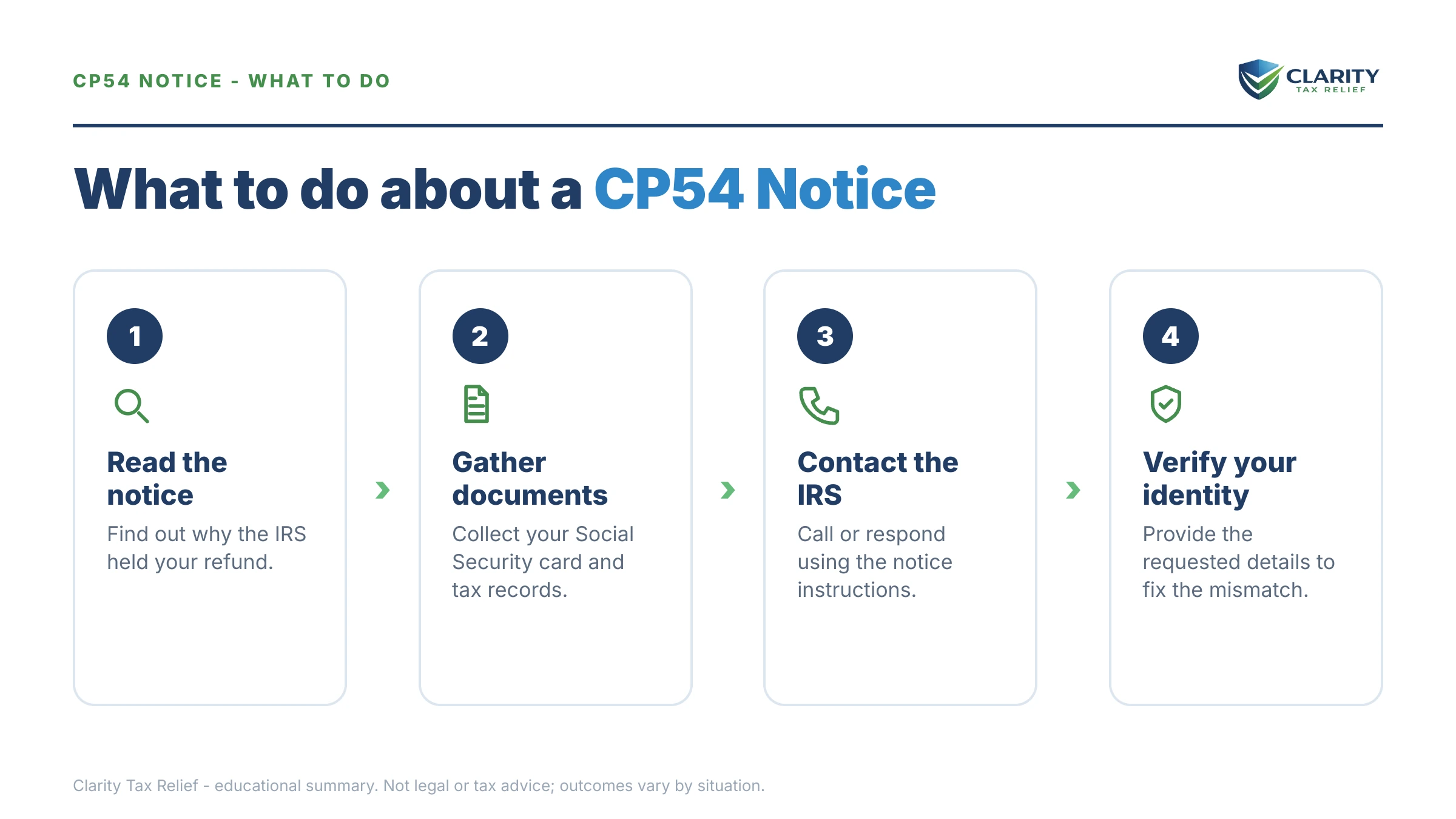
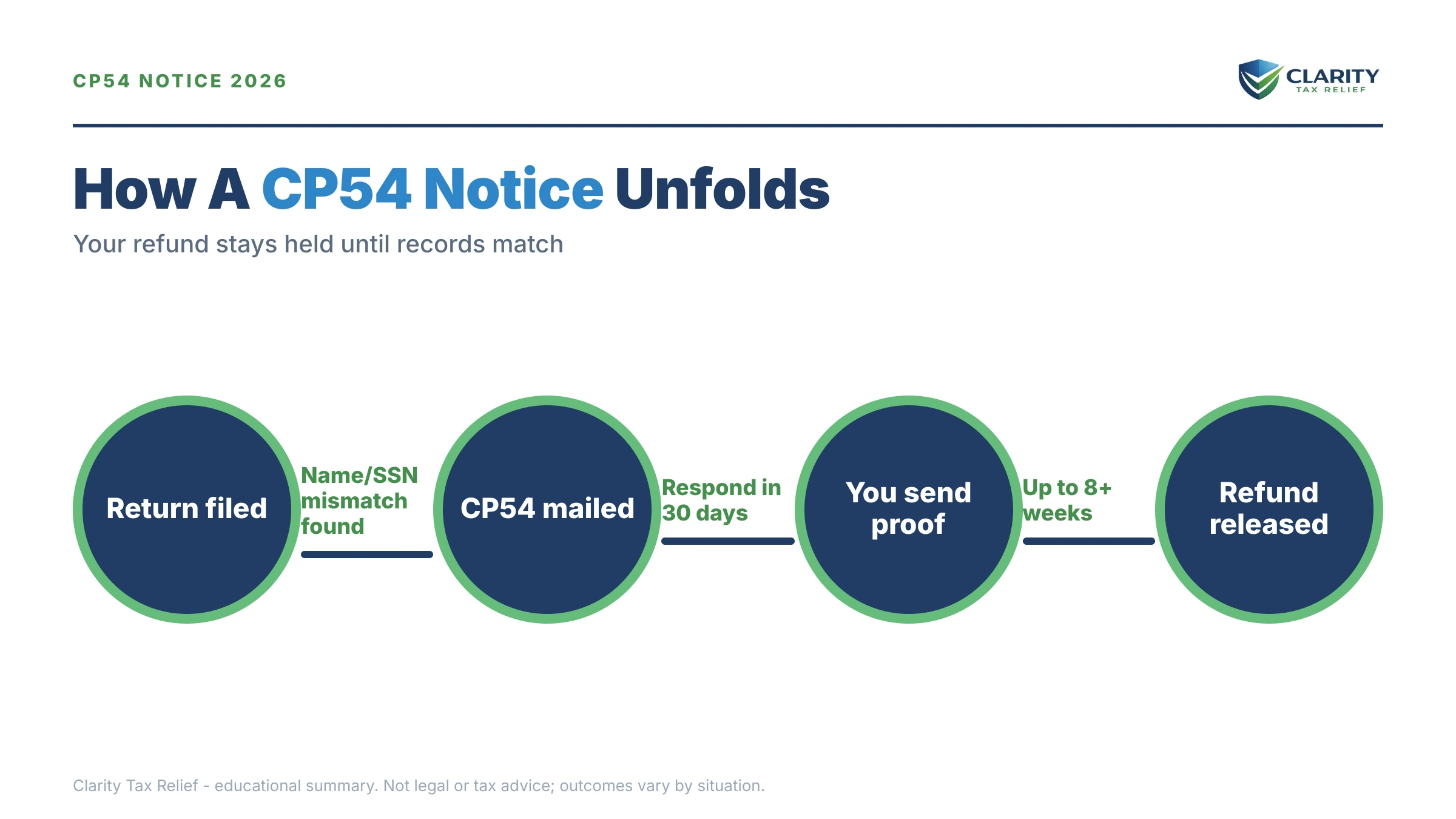
Ignoring a CP54 costs you nothing in penalties and everything in refund: the hold never expires on its own. Unlike a balance-due notice, there is no levy, no lien, and no collection machine behind this letter — the only money at risk is yours. Here's the sequence when a CP54 goes unanswered:
- CP54B or CP54G arrives — your refund is frozen. Nothing else happens: no penalty accrues against you, no enforcement starts.
- No response → CP54Q — the IRS sends its follow-up reminder. The refund is still held, and the file still shows an unresolved mismatch.
- The hold continues indefinitely — and because the mismatch lives in the underlying records, next year's return trips the exact same filter. Some filers lose a refund to a CP54 two or three years running before anyone fixes the root cause. A frozen refund also can't be applied forward to next year's estimated payments.
- The refund statute expires — refund claims generally die three years after the return's original due date. Past that point the frozen money becomes the government's permanently; see can I still get a refund from 3 years ago for how that cutoff works.
One small consolation: when a legitimately delayed refund is finally released, the IRS generally adds interest for the wait — but that interest is taxable income the year you receive it. It's a poor trade for months without your money.
Holding a CP54 while your refund sits frozen?
Send us a photo of the notice. An experienced tax professional will pinpoint which record is wrong — your return or SSA's file — and exactly what to send so the release isn't delayed a second time. Free, confidential, no pressure.
Fixing the mismatch: does the IRS or SSA hold the wrong record?
The fastest CP54 fix is sending the right document to the right agency the first time. This is where most people lose weeks: they reply to the IRS when the outdated record actually sits at the Social Security Administration, so the computers re-run the same failed match. The IRS matches against SSA's file — it doesn't keep its own — which means an SSA-side problem can only be fixed at SSA.
| What went wrong | Who fixes it | What to send |
|---|---|---|
| Typo or transposed SSN on the return | The IRS — reply to the notice | Copy of your Social Security card plus the corrected number |
| Name changed (marriage, divorce, court order) but SSA never updated | SSA first, then the IRS | Form SS-5 with proof of the change; then your notice reply |
| You filed under a new name before SSA finished processing it | The IRS — reply to the notice | Confirmation of the name SSA currently has on file |
| ITIN filer with a name-order or number mismatch | The IRS — reply to the notice | Copy of your ITIN assignment letter |
| Someone may have used your SSN | The IRS — identity-theft channel | Form 14039 identity-theft affidavit |
That last row deserves one caution. If the notice references a return you never filed, or shows income and a filing status that aren't yours, stop treating this as a routine mismatch — read someone filed taxes in my name and take the identity-theft path instead. For everyone else, a CP54 is clerical, not criminal.
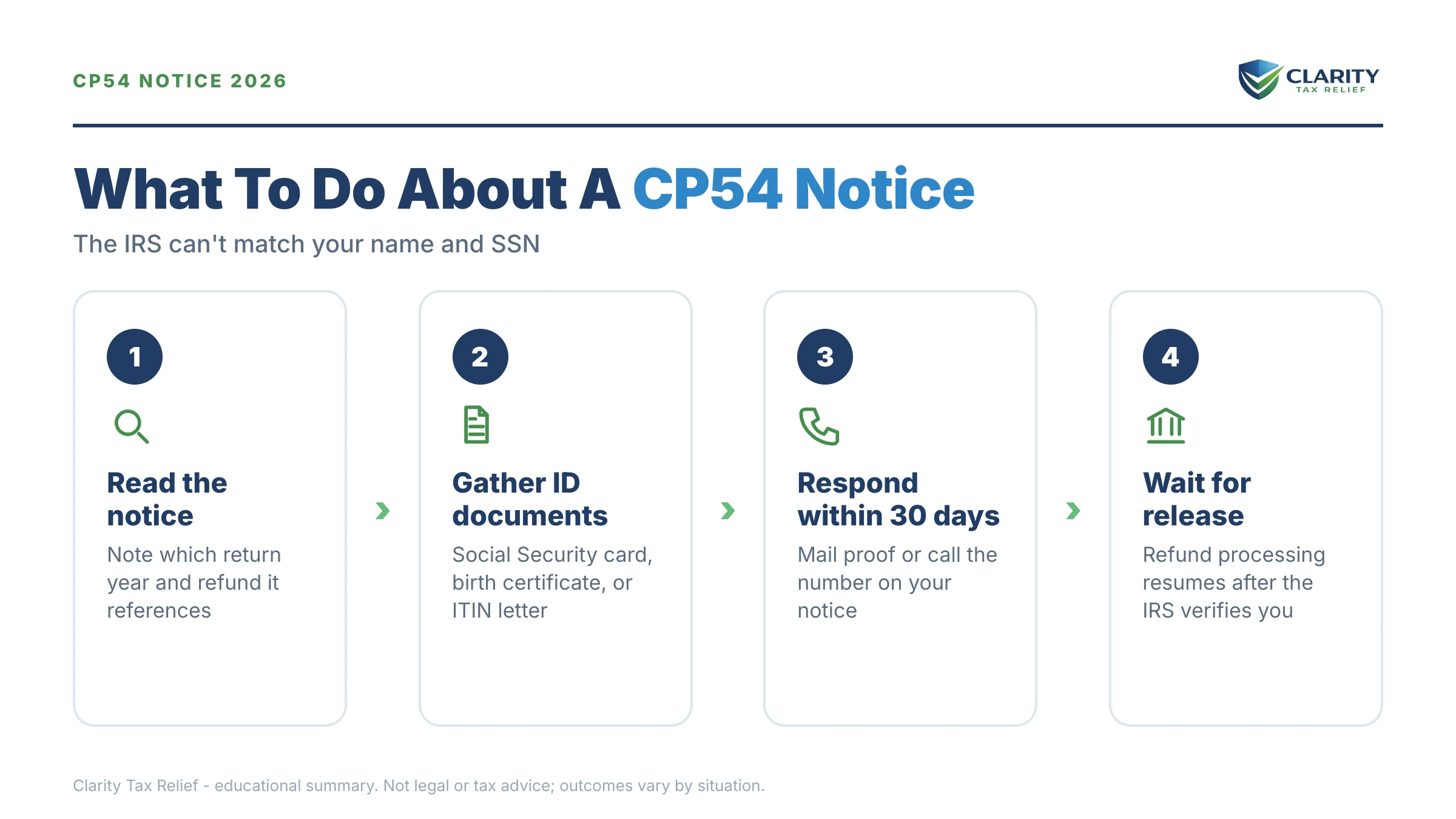
How to respond to a CP54 notice, step by step
- Find your notice code and compare documents. Check the top corner for CP54B, CP54E, CP54G, or CP54Q, then set your filed return next to your Social Security card and compare the name and SSN character by character.
- Identify which record is wrong. Either the return has a typo, or the Social Security Administration's file is outdated. The answer decides where your fix goes.
- Correct the wrong record. If the return had the error, reply to the notice with a copy of your Social Security card and the corrected information. If SSA's file is outdated, file Form SS-5 with SSA first, then respond to the notice.
- Respond exactly as the notice directs. Mail copies — never originals — to the address printed on the notice, or call the phone number on it. Keep a dated copy of everything you send.
- Track the release. Watch your IRS online account and Where's My Refund for movement, and follow up if nothing changes after several weeks.
If you've never used the IRS's online tools, our IRS online account setup walkthrough gets you in — it's the fastest way to confirm the hold has actually lifted, since your account updates before any letter reaches your mailbox.
What a frozen refund actually costs: a $19,700 example
Say you're a 1099 contractor who sent the IRS $9,000 in estimated payments each quarter — $36,000 for the year. Equipment purchases and a slow fourth quarter pushed your Schedule C income down, so total tax — income tax plus self-employment tax — came to $16,300. The math: $36,000 paid − $16,300 owed = a $19,700 refund. You married in November, filed in February under your new hyphenated name, and SSA still has the old one. Result: CP54G, and $19,700 parked at the Treasury.
Here's what the freeze costs in practice. Your plan was to apply that refund toward this year's quarterlies. Instead, the June 15 estimate comes due while the money is frozen, so you front $9,000 from operating cash — and again in September if the hold drags. The refund isn't reduced by a dime, but your working capital takes an $18,000 hit for a data-entry mismatch.
The fix, in order: file Form SS-5 with SSA and proof of the marriage (SSA updates typically take a few weeks), then mail the CP54G response confirming the corrected record. Do it the other way around — reply to the IRS while SSA still shows the old name — and the match fails again and the wait restarts. This example is hypothetical, but the sequencing lesson is universal: fix SSA first whenever SSA holds the stale record.
When you can handle a CP54 yourself
Most people can resolve a CP54 notice on their own, without paying anyone. If the cause is a typo, a hyphen, or a name change you simply never reported to SSA, the fix is a document copy and a stamp — the IRS's own page at Understanding your CP54B notice lists what to include, and name updates start at the Social Security Administration. This is a self-service notice, and we'd rather tell you that than manufacture a reason to call.
Experienced help changes the outcome in a handful of situations: the notice points to a return you never filed (identity theft), you're an ITIN filer with layered documentation issues, more than one year's refund is frozen, the refund is approaching the three-year expiration, or the CP54 is tangled up with other IRS problems — back balances, unfiled years, or an offset you don't understand. In those cases the order of operations matters, and getting it wrong can burn months. If your response went in long ago and nothing has moved, a refund stuck in limbo is also exactly what the Taxpayer Advocate Service exists for when the delay causes financial hardship — and our guide to "Where's My Refund" stuck on processing covers the follow-up playbook.
Terms on your notice, decoded
- TIN (taxpayer identification number): the umbrella term for the number on your return — an SSN for most filers, an ITIN for those not eligible for one.
- Name control: the shortened name — generally the first four letters of your last name — that IRS computers match against SSA's file; it's why hyphens and compound surnames trip CP54s.
- SSA records: the Social Security Administration's master file of names and numbers. The IRS matches against it rather than keeping its own, so an outdated SSA record can only be fixed at SSA.
- Form SS-5: the SSA application used to update your name or replace your card — the first stop after any legal name change.
- ITIN assignment letter: the IRS letter issued when your ITIN was created; it shows the exact name and number the IRS expects to see on your return.
- RSED (refund statute expiration date): the deadline — generally three years from the return's original due date — after which an unclaimed refund is forfeited permanently.
CP54 questions, answered
Is a CP54 notice serious?
It's low-danger but time-sensitive — a CP54 carries no penalty, no levy, and no audit; the only money at stake is your own refund. That refund stays frozen until you respond, and refund claims generally expire three years after the return's original due date. Treat it as urgent for your wallet, not a threat to your record.
How long after responding to a CP54 will I get my refund?
The IRS doesn't publish a fixed release timeline for CP54 responses — most refunds move within several weeks after the reply posts, but paper correspondence is slower than usual in 2026 after the IRS cut roughly 27% of its workforce in 2025. Track progress through your IRS online account rather than waiting on the mail. If months pass with no movement and the delay is causing hardship, the Taxpayer Advocate Service can intervene.
What's the difference between CP54B, CP54G, and CP54Q?
CP54B and CP54G both mean the name or taxpayer ID on your refund return doesn't match Social Security Administration records, and both hold your refund until you reply — the response steps are the same. CP54Q is the follow-up the IRS sends when you never answered the first notice; your refund is still frozen. CP54E is the fourth variant, flagging the same mismatch on a return claiming estimated tax payments.
Did I get a CP54 because I changed my name when I got married?
Very likely — a name change used on a tax return but never reported to the Social Security Administration is the single most common CP54 trigger. Update SSA first by filing Form SS-5 with proof of the change, then respond to the notice; if you reply to the IRS while SSA's file still shows your old name, the mismatch just repeats. The same applies after divorce or a court-ordered name change.
Is a CP54 notice a sign of identity theft?
Usually not — the overwhelming majority of CP54s trace to a typo, a name change, or an ITIN name-order issue, not fraud. But if you didn't file the return the notice references, or it shows income or a filing status that isn't yours, treat it differently: file Form 14039, the identity-theft affidavit, and follow the IRS identity-theft process instead of a routine CP54 reply.
Does a CP54 notice mean I owe the IRS money?
No — a CP54 is a refund-side notice, not a bill. It doesn't assess tax, add penalties, or start collection; it holds money the IRS already agrees is yours until an identity-data mismatch is fixed. If the IRS changed your refund or balance because of a math error, you'd get a CP12 or CP11 instead.
Can I just file my return again to fix a CP54?
No — never file a second return to fix a CP54. A duplicate return creates its own processing flags and can delay your refund far longer than the original mismatch would have. Respond to the notice with the documents it asks for, and if your Social Security record is the outdated piece, correct it with SSA using Form SS-5.
What happens if I never respond to a CP54?
Your refund simply never arrives. The IRS sends a CP54Q reminder, the hold continues indefinitely, and the same mismatch will flag every future return you file. The hard stop is the refund statute: claims generally expire three years from the return's original due date, after which the frozen money becomes the government's permanently.
Your next 24 hours
- Find your notice code and any respond-by date. Check the top corner of the letter for CP54B, CP54E, CP54G, or CP54Q, and note the tax year it covers.
- Gather three documents. Your Social Security card (or ITIN assignment letter), a copy of the return you filed, and any name-change paperwork — marriage certificate, divorce decree, or court order.
- Get a free case review. If the documents don't make clear which record is wrong, this is the second year a refund has frozen, or the CP54 sits on top of other IRS problems, call (888) 825-7779 or use the 2-minute form — your refund stays parked until the mismatch is fixed, and every month of delay is a month without your own money.
This guide is general information, not tax or legal advice for your specific situation. Eligibility for IRS programs depends on individual facts and circumstances; no outcome is guaranteed.