
IRS Notices
IRS CP05A Notice: What Documents to Send and Your Deadline (2026)
The short answer: a CP05A notice means the IRS is holding your refund and needs documents from you — usually proof of your income and federal withholding — before it will release the money. Respond by the date printed on the notice, typically 30 days, or the IRS can reduce or eliminate your refund.
You filed months ago, the refund never showed up, and now instead of a deposit the mailbox holds a CP05A telling you to prove your own paycheck. If you were counting on that money to catch up on rent — or to head off a levy circling your bank account — the timing feels brutal. But unlike the quieter CP05 notice, a CP05A finally gives you something to do, and doing it well is usually exactly what shakes the refund loose.
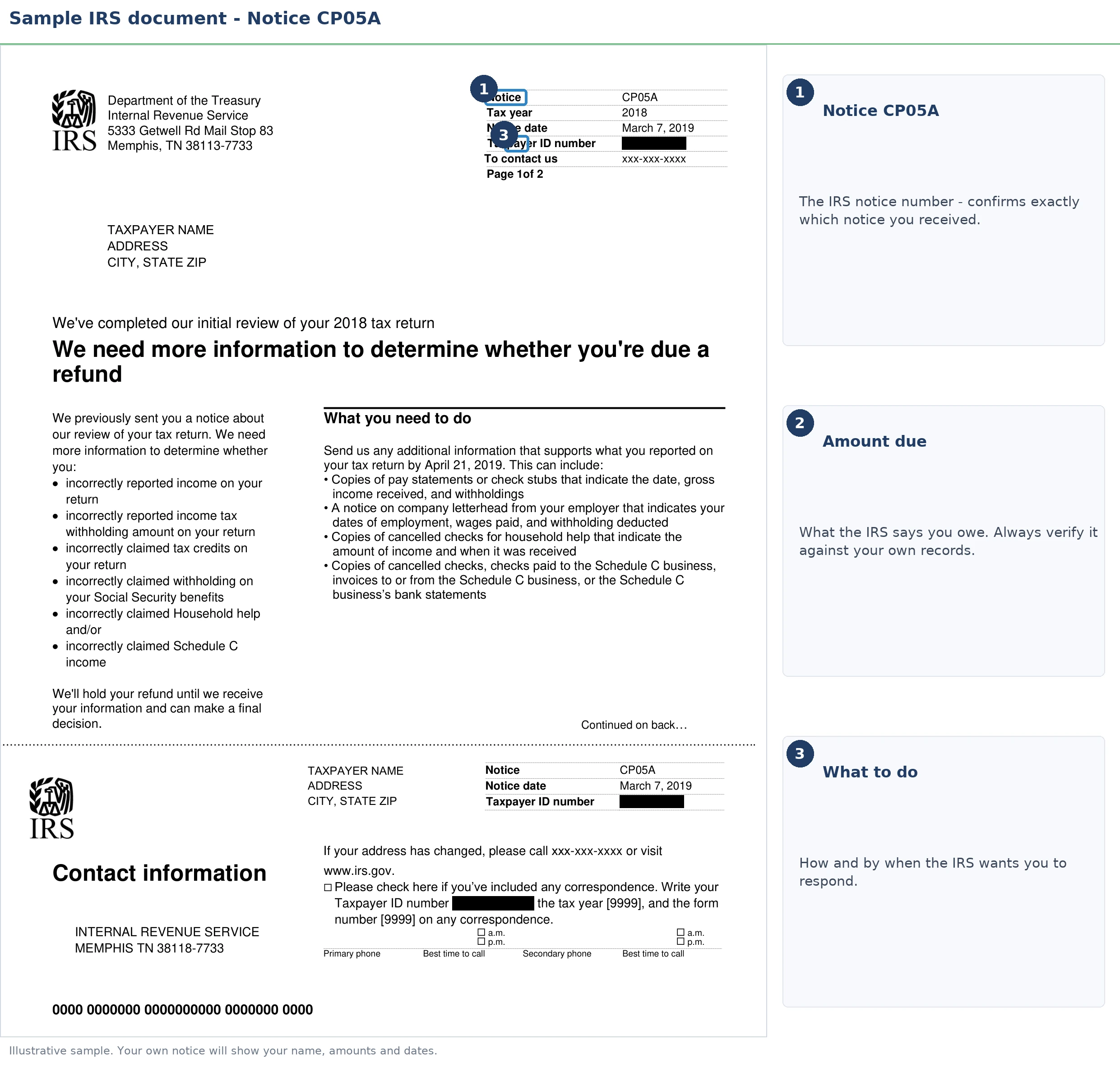
The image below shows exactly what a CP05A looks like and where to find the two things that matter most — your response date and the list of items the IRS wants you to prove.
⏱ Your deadline: the response date printed on your CP05A — typically 30 days from the notice date. Miss it and the IRS finishes the review using only what it could verify on its own, which usually means a smaller refund, no refund, or in some cases a bill.
Why you got a CP05A notice
A CP05A notice means the IRS could not match something on your return — most often your reported wages or federal withholding — against what employers and payers filed, and it will not release your refund until you prove it. The notice lists the exact items in question on page one: income, withholding, tax credits you claimed, business income, or household-employee income.
Behind the scenes, your return was flagged by the IRS's return-integrity screening before your refund was ever scheduled. Common triggers are specific: an employer that filed its wage reports late or never filed them, withholding that looks high relative to the reported wages, a first-time claim of a refundable credit, or self-employment income with no third-party form backing it. On your transcript, this hold usually shows up as code 570 on your IRS transcript — the freeze that stops the refund from posting.
A CP05A is not a bill and not a full audit — nobody is claiming you owe money yet. If you want the broader map of how IRS letters fit together, see why did I get a letter from the IRS; this page covers only what a CP05A demands.
CP05 vs. CP05A: one asks you to wait, one asks you to act
A CP05 tells you the IRS is reviewing your refund and requests nothing; a CP05A tells you the review cannot finish without your documents. If you got a CP05 notice or a 4464C letter first, the CP05A means the IRS tried to verify your return on its own and failed. That "A" is the whole difference — it converts a passive wait into an active deadline.
This distinction matters for strategy. On a CP05, sending unrequested paperwork accomplishes little. On a CP05A, silence is the worst move available: the review will conclude either way, and without your documents it concludes against you.
What happens if you ignore a CP05A
If you don't respond to a CP05A by the printed date, the IRS can remove every item it couldn't verify and recalculate your refund without them. The sequence runs on its own — and in 2026, with the IRS workforce down roughly 27% from the 2025 cuts, the automated side of this process is the part still running at full speed:
- The response window closes. Nothing dramatic happens the day after — but the review proceeds without your side of the story, using only what the IRS matched independently.
- Unverified items come off the return. Withholding the IRS couldn't confirm against employer filings and credits without documentation are disallowed, and your refund is refigured.
- An adjustment notice arrives. A CP12 notice if you still get a smaller refund, or a CP11 notice if the changes wipe out the refund and leave a balance due. Disallowed credits can also trigger deficiency procedures with their own response deadlines.
- If a balance results and goes unpaid, the standard collection track begins — bills, reminder notices, and eventually levy notices, the same sequence every unpaid balance rides.
- Recovering the money afterward is slow. Once items are disallowed, getting them back means an amended return or audit reconsideration — processes measured in months, versus the weeks a timely CP05A response takes.
| Stage | What's happening | Typical window |
|---|---|---|
| Refund hold begins | Return flagged for verification; code 570 posts to your transcript; the refund stops before it's scheduled | Varies — often before any letter arrives |
| CP05 or Letter 4464C | IRS reviews on its own; no action requested from you | The letter states its own review window |
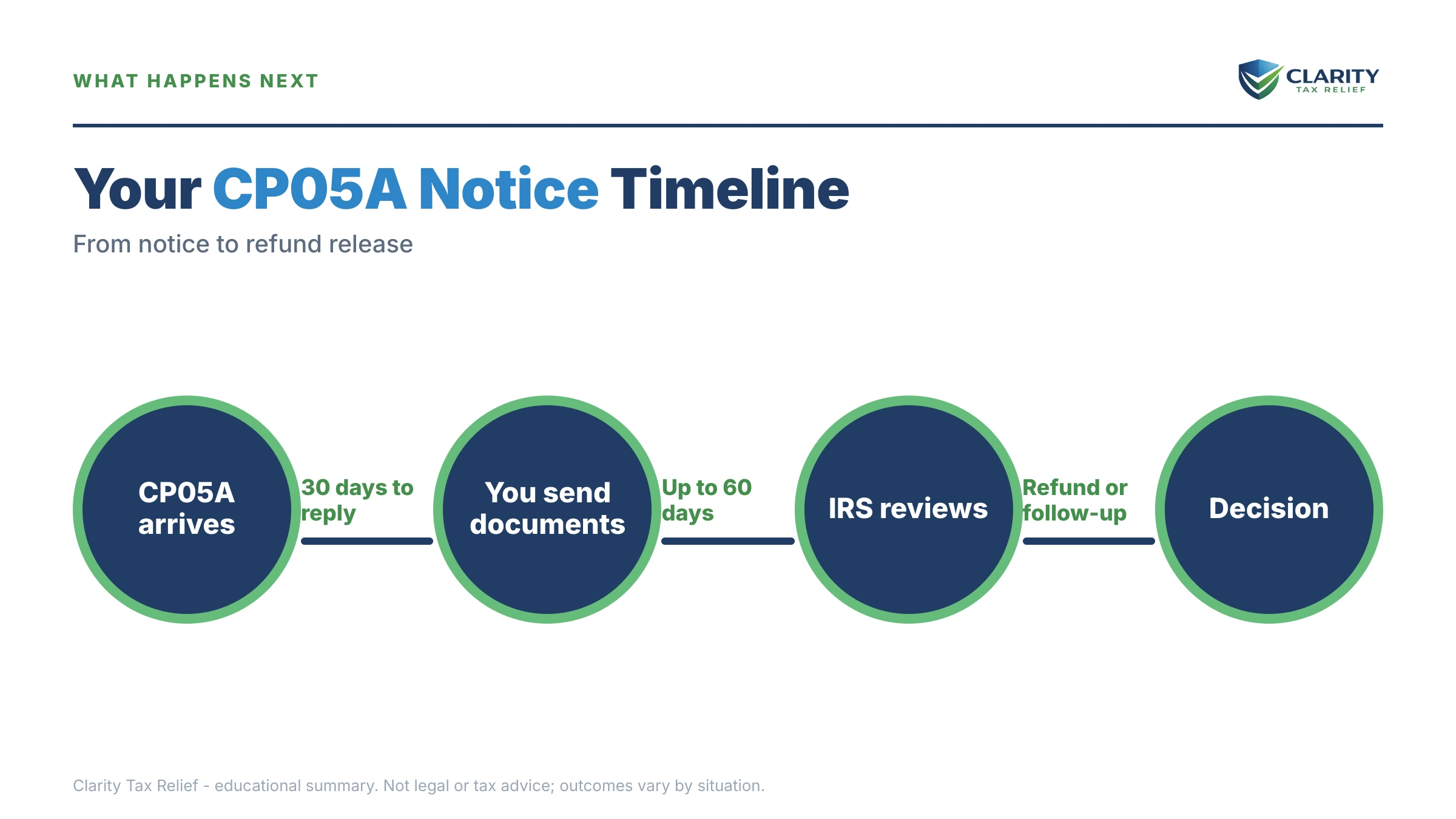
| CP05A | IRS needs your documents to finish; respond by the printed date | Typically 30 days from the notice date |
| IRS reviews your response | Documents matched against employer and payer filings | Typically up to 60 days after receipt |
| Outcome | Refund released (code 846) — or an adjustment notice if items couldn't be verified | Follows the review |
Holding a CP05A with the response date getting close?
Send us a photo of it. An experienced tax professional will map exactly what to send for each item on your notice — and how to get the hold released — free, before your printed deadline passes.
What documents to send with your CP05A response
The strongest CP05A response answers every item listed on page one of the notice with a document the IRS can independently believe. Don't send your whole file — send exactly what proves the flagged items, organized so a reviewer can match your numbers to the return in minutes.
| Item under review | Documents that prove it |
|---|---|
| Wages and federal withholding | All W-2s, your final paystub of the year showing year-to-date federal income tax withheld, and a letter from the employer or its payroll company on letterhead |
| 1099 / gig / self-employment income | 1099-NEC or 1099-K forms, bank statements showing the deposits, and invoices or a simple income ledger |
| Tax credits (EITC, Child Tax Credit) | Birth certificates, school or medical records showing your child's name and your address, and custody or residency documents |
| Household employee income | Schedule H, payroll records, and proof of federal tax withheld from household wages |
| Estimated tax payments claimed | Payment confirmation numbers, bank statements, or canceled checks showing payments to the U.S. Treasury |
Three situations change what you send:
Your employer never filed — or shut down. This is the single most common CP05A trigger: your W-2 says tax was withheld, but the IRS has no matching employer filing. Your final paystub of the year, showing year-to-date federal withholding, becomes your best evidence, backed by an employer or payroll-company letter if you can get one. Pull your own IRS wage and income transcript first so you know exactly which form is missing — and if you never received the W-2 at all, start with our guide for when your employer didn't send a W-2.
You're self-employed or 1099. There's no withholding to verify, so the IRS is questioning the income itself — usually because you reported income no third party filed a form for, or claimed a credit built on it. Bank statements plus a dated invoice list or ledger carry more weight than a self-prepared summary alone. Married filing jointly? Cover both spouses' income items; a joint refund stays frozen until every flagged item on the return is verified, not just yours.
Your credits are the flagged item. Residency proof for your kids — school, medical, or lease records tying the child's name to your address for more than half the year — is what reviewers accept. If the IRS wants a full examination of the credit rather than verification, you'd get a CP75 notice instead, which is a formal EIC audit with different stakes.
Say your refund is $7,400: what responding is actually worth
Here's a hypothetical to make the stakes concrete. Say you're renting, one month behind, a state levy is threatening your checking account, and you filed in February expecting $7,400 back. That refund is $9,800 of federal withholding minus $2,400 of total tax. Of the withholding, $6,700 came from your main job — verified, because that employer filed its W-2s — and $3,100 came from a second job whose employer never filed anything.
If you respond with the second job's final paystub showing $3,100 of year-to-date federal withholding, plus a payroll letter: the full $7,400 is releasable, and because it's now well past the filing deadline, overpayment interest is generally added on top.
If you don't respond: the IRS disallows the unverified $3,100. Your refund becomes $6,700 − $2,400 = $4,300. You've lost $3,100 you were legally owed — and clawing it back afterward means an amended return or reconsideration measured in months, while the rent and the levy don't wait. One paystub, faxed on time, is the entire difference.
How to respond to a CP05A notice, step by step
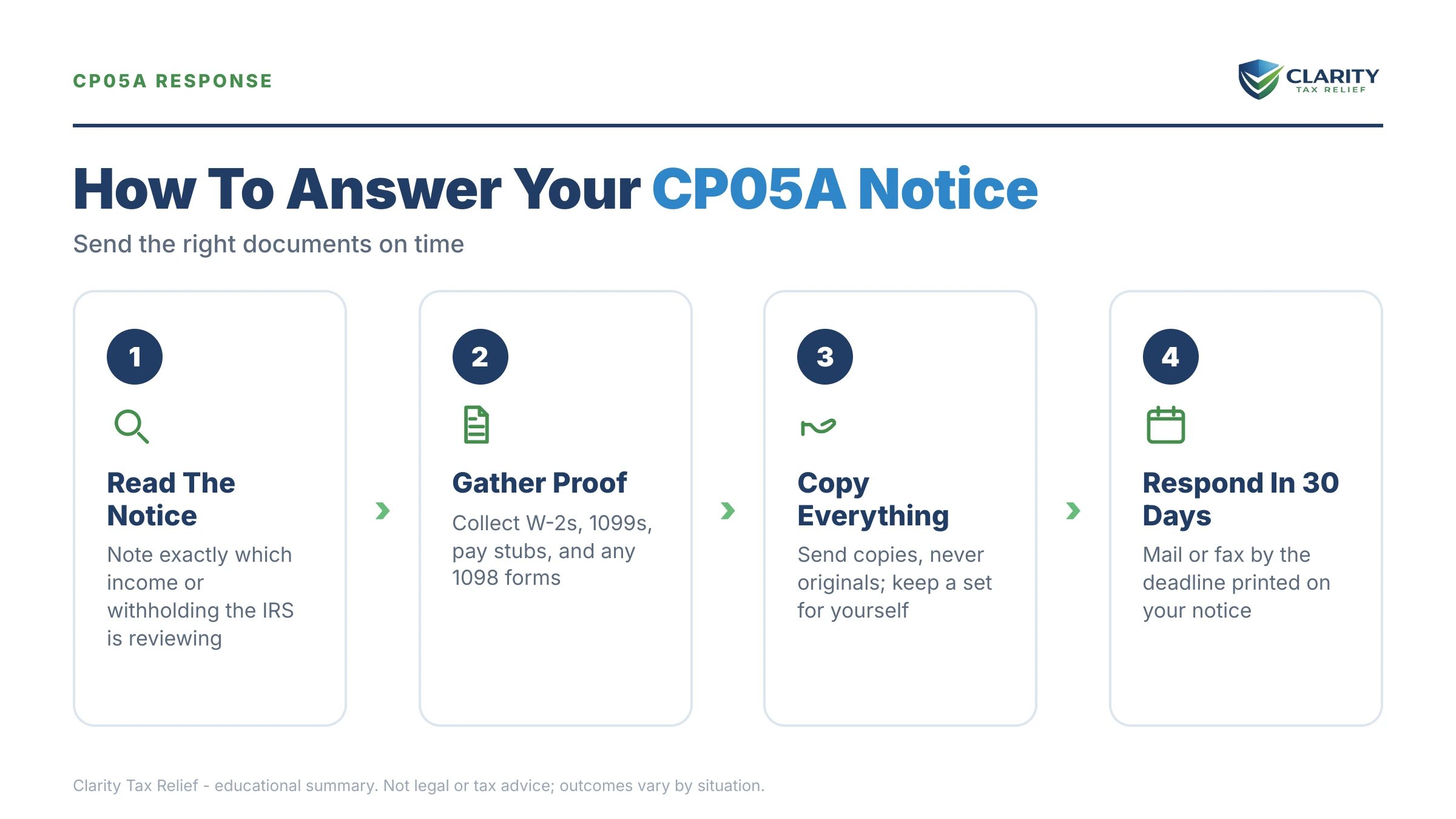
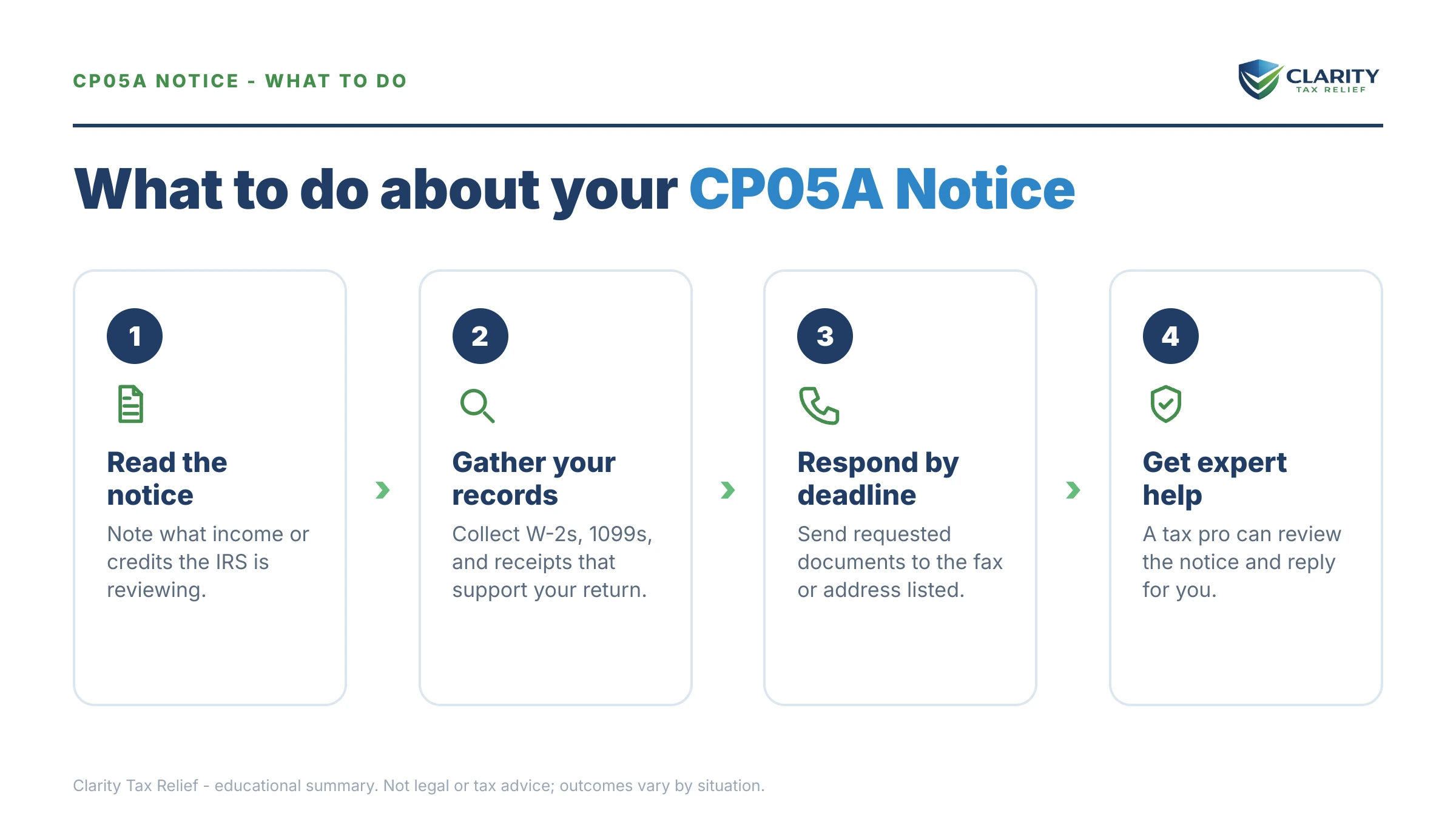
- Read the notice line by line: find the tax year, the specific items under review, the response date, and the fax number printed on it.
- Gather proof for every listed item: W-2s, your final paystub of the year, 1099s, and an employer letter if your withholding is the issue.
- Copy everything: send copies, never originals, and write your SSN and the tax year on each page along with the notice stub.
- Fax your response if you can: the fax number on the notice posts days faster than mail; if you must mail, use certified mail with a return receipt.
- Track the review: watch your IRS account transcript for code 846, and follow up if 60 days pass after the IRS receives your documents with no update.
How long until the refund arrives after you respond
The IRS typically takes up to 60 days after receiving your CP05A documents to finish the review — and with 2026 staffing down sharply, some verifications run past that. When the review clears, code 846 — refund issued date posts to your account transcript with the actual payment date, usually before any letter tells you.
Two pressure valves exist if the wait becomes unbearable. First, if the hold is causing genuine economic hardship — a pending eviction, a utility shutoff, or a levy about to hit your bank account — the Taxpayer Advocate Service can push a stalled case forward; the Form 911 walkthrough shows how to ask. Second, remember interest runs in your favor: when the refund finally issues more than 45 days after the filing deadline (or your filing date, if later), the IRS generally adds overpayment interest automatically.
When you can handle a CP05A yourself
Most CP05A responses are genuinely do-it-yourself. If your notice lists one employer's wages and withholding, you have the W-2 and your final paystub, and the numbers match your return — gather, copy, fax, done. You don't need to pay anyone for that, and you shouldn't.
Experienced help changes the outcome in narrower situations: an employer that vanished without filing, leaving you to reconstruct withholding from partial records; self-employment income under review with thin documentation; a refund that has already been adjusted away and now needs reconsideration; multiple years frozen at once; or a hold that's colliding with a real emergency — eviction or a levy — where a hardship request and the document response need to move in parallel. In those cases, how the evidence is assembled and framed is often the difference between release and disallowance.
The IRS's own explainer lives at Understanding your CP05A notice, you can pull your transcripts free at the IRS Get Transcript page, and hardship help is described at the Taxpayer Advocate Service.
Terms on your notice, decoded
- Refund hold (code 570): the transcript code that freezes your refund while the IRS verifies your return — it posts before, and outlasts, the letters.
- Return-integrity screening: the automated IRS filter that checks refunds for identity, income, and withholding problems before money goes out; CP05As come from this pipeline, not from an auditor.
- Wage and income transcript: the IRS's record of every W-2 and 1099 filed under your SSN — your fastest way to see exactly what the IRS could and couldn't verify.
- Code 846: the transcript entry meaning "refund issued," with the date the money actually moves.
- Adjustment notice: the letter (CP12 or CP11) the IRS sends if it changes your return after the review — the paper trail of what was disallowed.
- Overpayment interest: interest the IRS adds to your refund when it pays you late; it's automatic, and it's taxable the year you receive it.
CP05A questions, answered
What is the difference between a CP05 and a CP05A notice?
A CP05 says the IRS is reviewing your refund and asks for nothing; a CP05A says the review cannot finish without documents from you. Getting a CP05A means the IRS could not verify items on its own — most often your wages or federal withholding. Unlike a CP05, it carries a printed response deadline, typically 30 days, and the refund stays frozen until you answer.
How long after responding to a CP05A will I get my refund?
Plan on up to 60 days after the IRS receives your documents, and 2026 staffing cuts mean some reviews run longer. If everything checks out, code 846 posts to your account transcript with your refund date. If 60 days pass with no update, call the number on your notice — or contact the Taxpayer Advocate Service if the delay is causing a genuine hardship like a pending eviction.
What happens if I ignore a CP05A notice?
The IRS finishes the review without you and removes every item it could not verify — unconfirmed withholding and unproven credits — then recalculates your refund. You will get an adjustment notice showing a smaller refund, no refund, or even a balance due. Reversing that later takes months through amended returns or audit reconsideration, versus weeks if you respond by the printed date.
Is a CP05A notice an audit?
Not formally — it is a pre-refund verification run by the IRS's return-integrity screening, not an examination. But it works like a small, focused audit of specific line items: prove them or lose them. If the IRS wants a full examination of credits like the Earned Income Tax Credit, you would receive a different letter, such as a CP75.
What documents should I send with my CP05A response?
Match each item listed on page one of your notice: for wages and withholding, send W-2s plus your final paystub of the year showing year-to-date federal tax withheld; for 1099 income, the 1099s and bank records; for credits, proof your dependents lived with you. Send copies, never originals, include the notice stub, and write your SSN and the tax year on every page.
What if my employer never filed my W-2 or went out of business?
An employer that never filed its wage reports is the most common reason withholding cannot be verified — and it is fixable. Send your final paystub showing year-to-date federal withholding, any W-2 copy you received, and a letter from the employer or its payroll company if you can get one. Your wage and income transcript shows what the IRS has on file, so you know exactly what is missing.
Can the Taxpayer Advocate Service speed up a CP05A refund?
Yes, when the delay is causing economic hardship — a pending eviction, a utility shutoff, or a levy threatening your bank account all qualify. File Form 911 or call the Taxpayer Advocate Service and be ready to document the hardship. TAS cannot skip the verification, but it can push a stalled case to the front of the line.
Does the IRS pay interest on a refund delayed by a CP05A?
Generally yes: if your refund is issued more than 45 days after the filing deadline or the date you filed, whichever is later, the IRS adds overpayment interest automatically. You do not have to request it, but the interest is taxable income for the year you receive it. A CP05A hold does not erase that right — verification only pushes the payment date.
Your next 24 hours
- Find two things on the notice: the response date and the list of items under review on page one. Circle both — everything you send exists to answer that list before that date.
- Gather your proof: the notice itself, your tax return for the year shown, every W-2 and 1099, and your final paystub of the year showing year-to-date federal withholding.
- Get a free case review before your response date passes: use the 2-minute form or call (888) 825-7779 — an experienced tax professional will confirm exactly what your notice needs and how to get the refund hold released.
This guide is general information, not tax or legal advice for your specific situation. Eligibility for IRS programs depends on individual facts and circumstances; no outcome is guaranteed.