
IRS Notices
IRS CP75 Notice: The EITC Audit Holding Your Refund — What to Do (2026)
The short answer: a CP75 notice means the IRS is auditing part of your tax return — usually the Earned Income Credit, dependents, filing status, or education credits — and holding the refund tied to those items. Send the documents listed on your notice by the response date (typically 30 days) to get your money released.
You filed months ago, watched "Where's My Refund" sit frozen, and now the answer is in your hands: the IRS wants you to prove your own kids live with you before it pays. That's maddening — and it's also winnable. The CP75 tells you exactly what to prove, and taxpayers who send the right documents get their refund released.
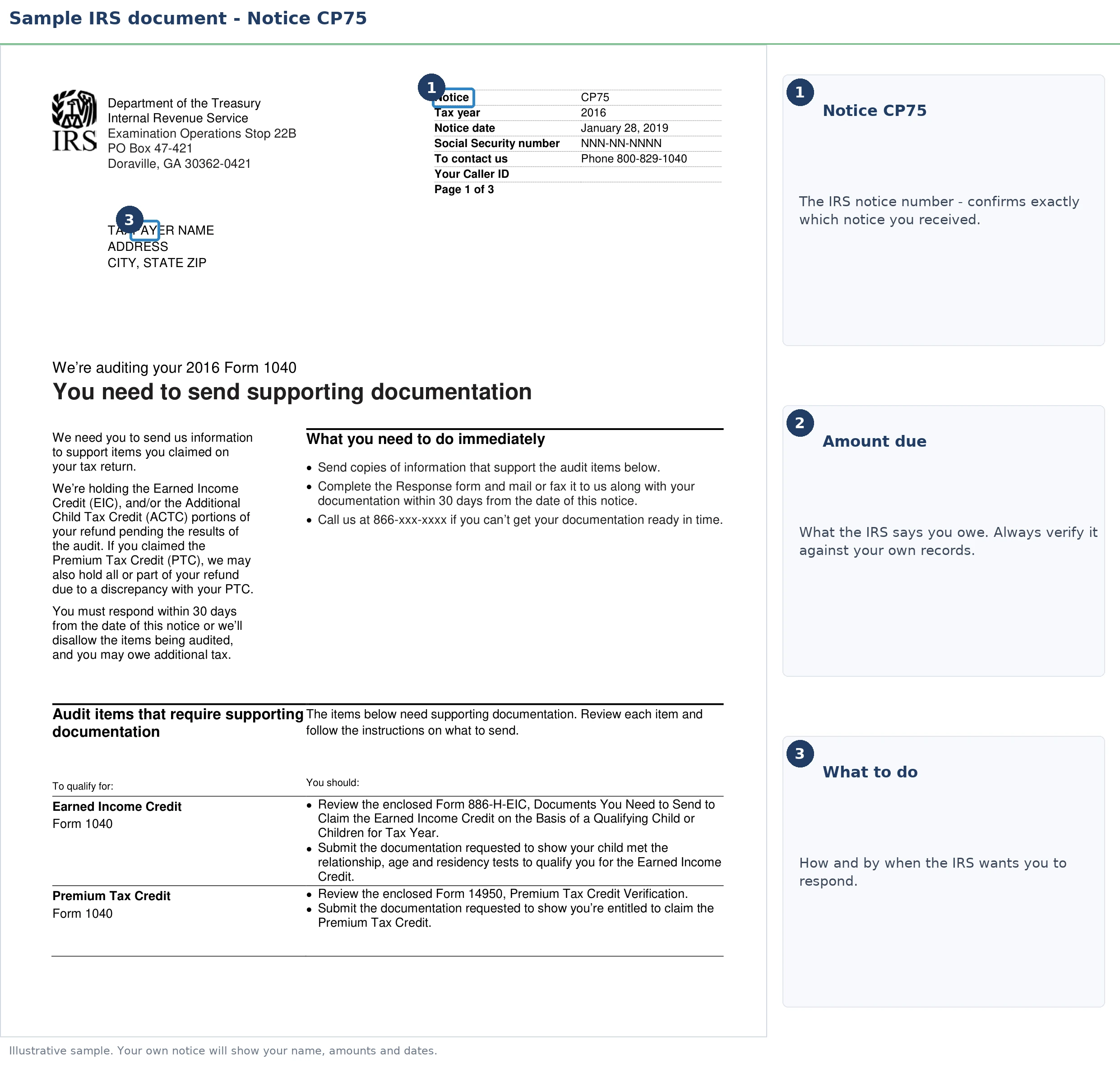
Two lines on page one of your CP75 control everything: the list of items under audit and your response date. The image below shows exactly what a CP75 looks like and where those lines sit, so you can find yours before reading further.
⏱ Your deadline: the response date printed on your CP75 — typically 30 days from the notice date. Miss it and the IRS moves to disallow the credits, keep the held refund, and potentially restrict your ability to claim the EITC in future years.
Why you got a CP75 notice
A CP75 notice means the IRS selected your return for a correspondence audit before releasing your refund — most often to verify the Earned Income Tax Credit. Unlike a bill or a math-error letter, nothing has been assessed yet. The IRS is saying: prove these claims and we'll pay you.
The most common triggers are specific and mechanical:
- The same child appears on two returns. If an ex, a relative, or the other parent also claimed your child's Social Security number, the system flags both returns. If that's your situation, our guide to when both parents claimed the same child walks through the tiebreaker rules.
- Self-employment income that lands near the EITC sweet spot. Schedule C income with round numbers and no 1099s behind it draws extra scrutiny, because reported income directly sets the credit amount.
- Address mismatches. The child's school district, a prior-year return, or third-party records show a different address than the one you filed under — common for renters who moved mid-year.
- A prior disallowance. If your EITC was denied before, later claims get checked more often.
Being selected is not an accusation of fraud — EITC returns are audited at high rates precisely because the rules about residency and relationship are easy to get wrong innocently. For the bigger picture on how the IRS decides who gets mail at all, see why did I get a letter from the IRS.
What a CP75 holds — and what it doesn't
A standard CP75 freezes only the portion of your refund tied to the credits under audit — not your whole financial life. Withholding you overpaid is generally still released; it's the EITC and Additional Child Tax Credit dollars that wait. The lettered variants shift this slightly: a CP75A asks for the same proof in a different processing posture, and a CP75D holds the entire refund because the IRS is also verifying your income and withholding. Your notice's first page states which items and which dollars are frozen.
Equally important is what a CP75 is not. It is not a levy, a lien, or a bill — you don't owe anything today, and nothing is being taken from your paycheck or bank account. It's also not the same as a refund review: if your letter says CP05 notice, the IRS is reviewing your return internally without opening an exam, and a CP05A notice requests documents but still isn't a formal audit. A CP75 is a formal audit — which means the outcome creates appeal rights, and non-response creates real consequences.
What happens if you ignore a CP75
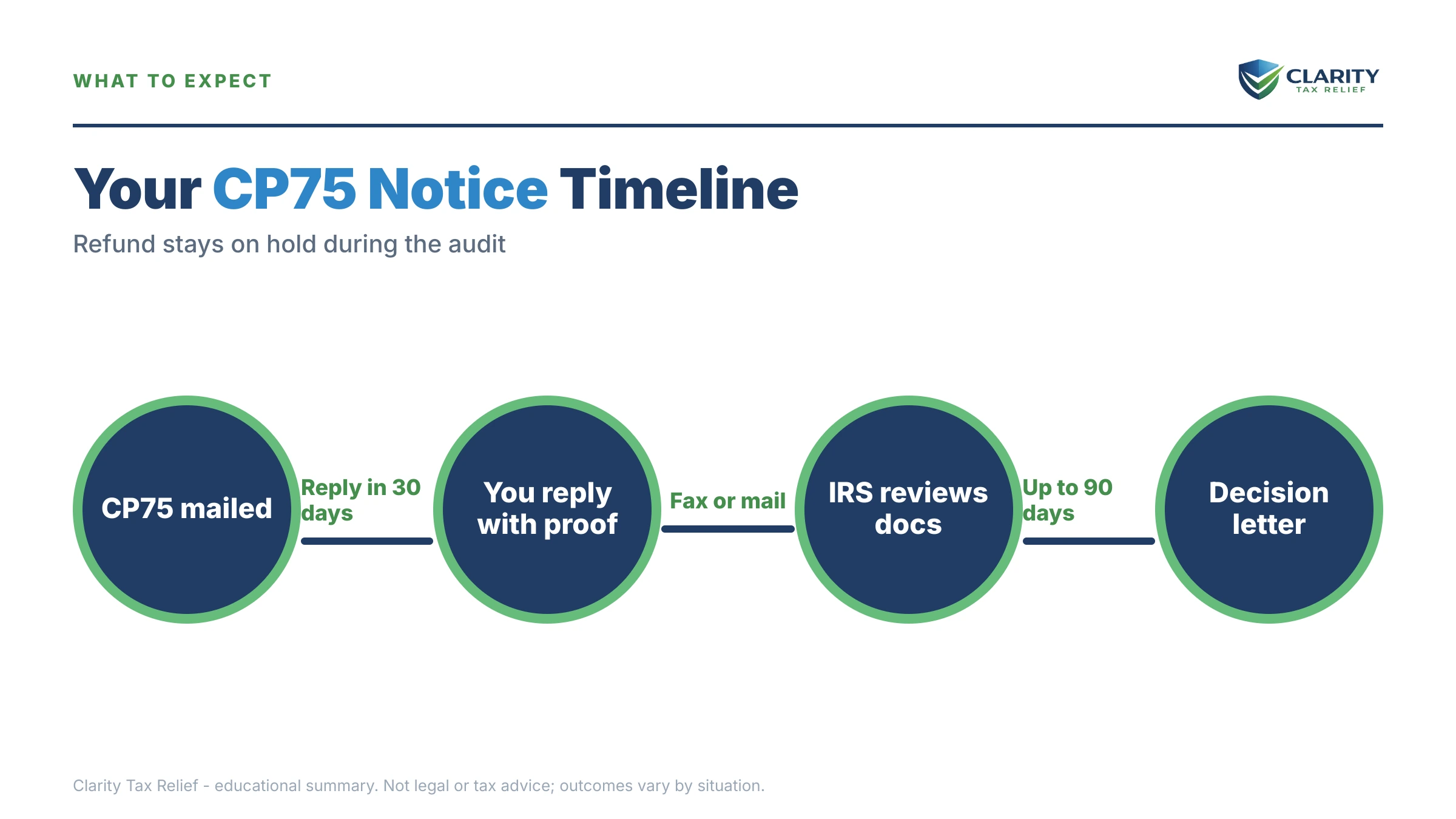
Ignoring a CP75 ends with the IRS disallowing your credits, keeping the held refund, and possibly banning you from the EITC for two years. The sequence is automated and runs whether or not a human examiner ever calls you:
- CP75 arrives. The audit opens and the credit portion of your refund freezes. You are here — the stage with the most control and the least paperwork.
- No response → audit report. The IRS sends an examination report proposing to disallow every audited item, recalculating your return as if the credits never existed.
- Notice of Deficiency. If you still don't respond, a CP3219A notice of deficiency follows — the statutory 90-day letter that is your last stop before the change becomes final.
- Final disallowance. The held refund is never paid, any portion already issued becomes a balance due with interest, Form 8862 attaches to every future EITC claim, and a 2-year ban is possible if the IRS decides the claim was reckless.
Each stage closes a door. Here's what you lose at each one:
| Stage | Your window | What you lose if it passes |
|---|---|---|
| CP75 notice | Response date on the notice (typically 30 days; extensions available by phone) | The chance to close the audit with documents alone and get the refund released |
| Examination report proposing disallowance | The response window printed on the report | The chance to dispute with the examiner or request an IRS Appeals conference |
| CP3219A Notice of Deficiency | 90 days to petition Tax Court | Your right to challenge the disallowance in Tax Court before it's final |
| Final assessment / disallowance | None — the change posts to your account | The held refund; audit reconsideration becomes your only real backdoor |
One more 2026 reality: the IRS workforce shrank roughly 27% in 2025, so document reviews are slower — but the disallowance machinery is automated and never slowed down. Responding late hurts you twice: the deadline machine keeps moving while your paperwork sits in a smaller queue.
Holding a CP75 with your refund frozen?
Send us a photo of your notice before your response date passes. An experienced tax professional will decode exactly which items are under audit, which documents will actually satisfy the examiner, and how to package them — free, confidential, no pressure.
What to send: proving your EITC and dependent claims
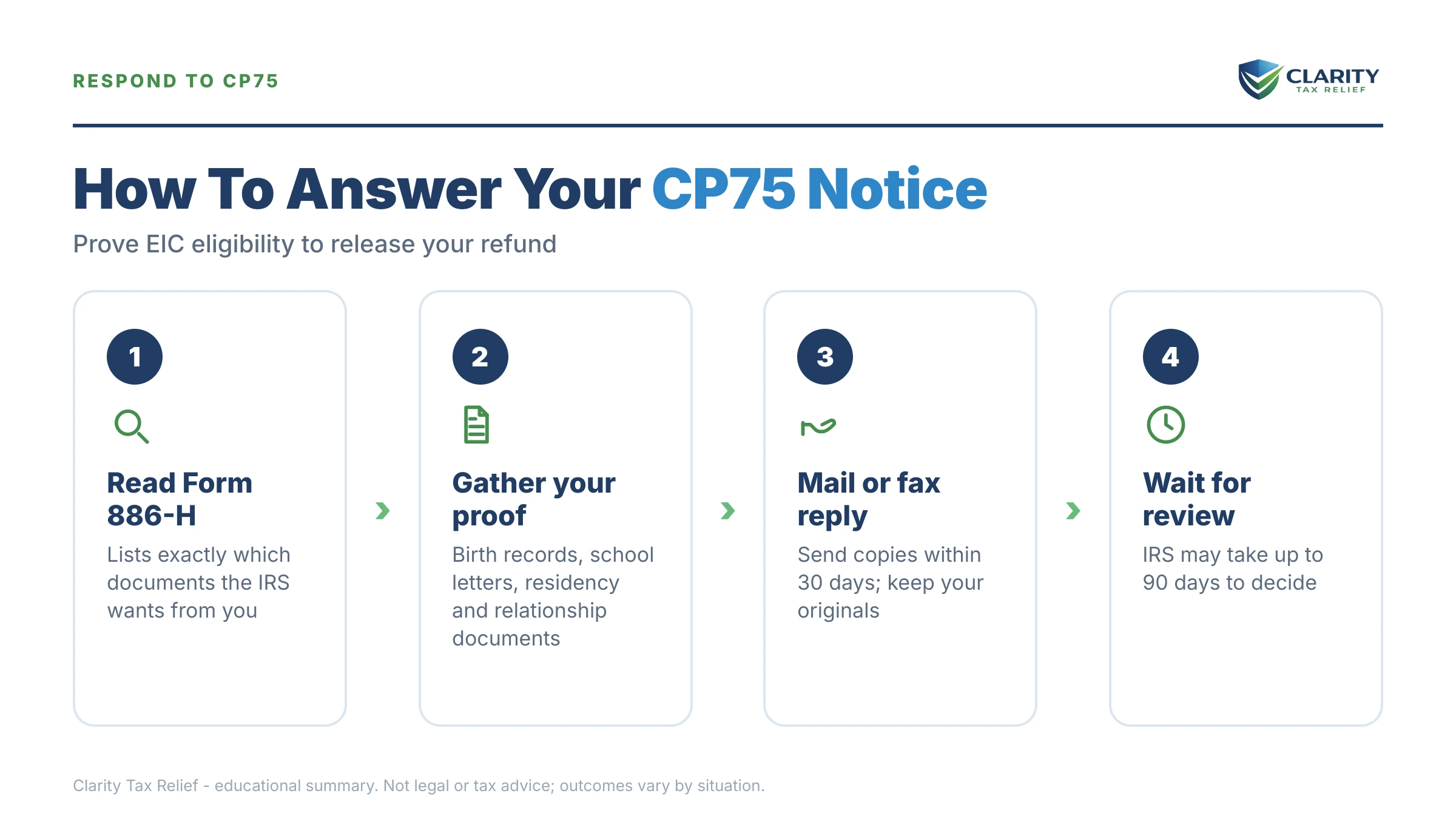
The IRS tells you exactly what it accepts — the Form 886-H series enclosed with (or named on) your CP75 is the examiner's own checklist. Match your documents to that list instead of sending everything you own. The core things you're proving are relationship, residency for more than half the year, and (if self-employed) the income behind the credit.
| Item under audit | IRS checklist | Documents that work |
|---|---|---|
| Relationship to the child | Form 886-H-EIC / 886-H-DEP | Birth certificate chain connecting you to the child; adoption, custody, or placement papers for non-parent caregivers |
| Residency (child lived with you 6+ months) | Form 886-H-EIC | School and medical records showing the child at your address; your lease naming the child as an occupant; a dated, signed landlord statement; letters on letterhead from a school, doctor, or social-service agency |
| Head of household filing status | Form 886-H-HOH | Lease and rent receipts, utility bills, and grocery/household records showing you paid more than half the cost of the home |
| Self-employment income | Listed on your notice | 1099s, invoices, bank statements showing deposits, mileage and expense logs, business licenses — records that reconstruct the Schedule C |
| American Opportunity Credit | Form 886-H-AOC (when audited) | Form 1098-T plus receipts for tuition, fees, and required course materials |
Renters have a real advantage they often overlook: your lease is a dated, third-party document. If your child is named on it as an occupant, that plus one school or medical record covering the same months is a strong residency package. If your child isn't on the lease, a signed landlord statement listing everyone who lived in the unit and for what dates fills the gap. Our deeper guide to EIC audit proof of residency covers reconstructed proof for the hard cases — mid-year moves, informal custody, and kids who stayed with grandma part of the year.
Two packaging rules the examiner cares about: documents must cover more than half of the tax year under audit (a single September school letter proves September, not the year), and every address must match the address on the return or come with a one-page explanation of the move.
A worked example: the $6,200 refund
Say your refund is $6,200 — clearly hypothetical numbers: $3,900 of EITC, $1,600 of Additional Child Tax Credit, and $700 of over-withheld tax. A standard CP75 freezes the $5,500 credit portion ($3,900 + $1,600); the $700 of withholding is generally released.
Now run both outcomes. Respond with a solid residency package and the IRS releases the $5,500 — your total cost was postage and a few phone calls. Don't respond, and the math compounds: you lose $5,500 this year, Form 8862 attaches to every future claim, and if the examiner adds a 2-year ban, two more years of similar credits — potentially another $11,000 if your income and family stay the same — are off the table. A missed 30-day window can quietly cost more than $16,000 across three tax years. That's why the response date is the single most valuable line on the notice.
How to respond to a CP75 notice, step by step
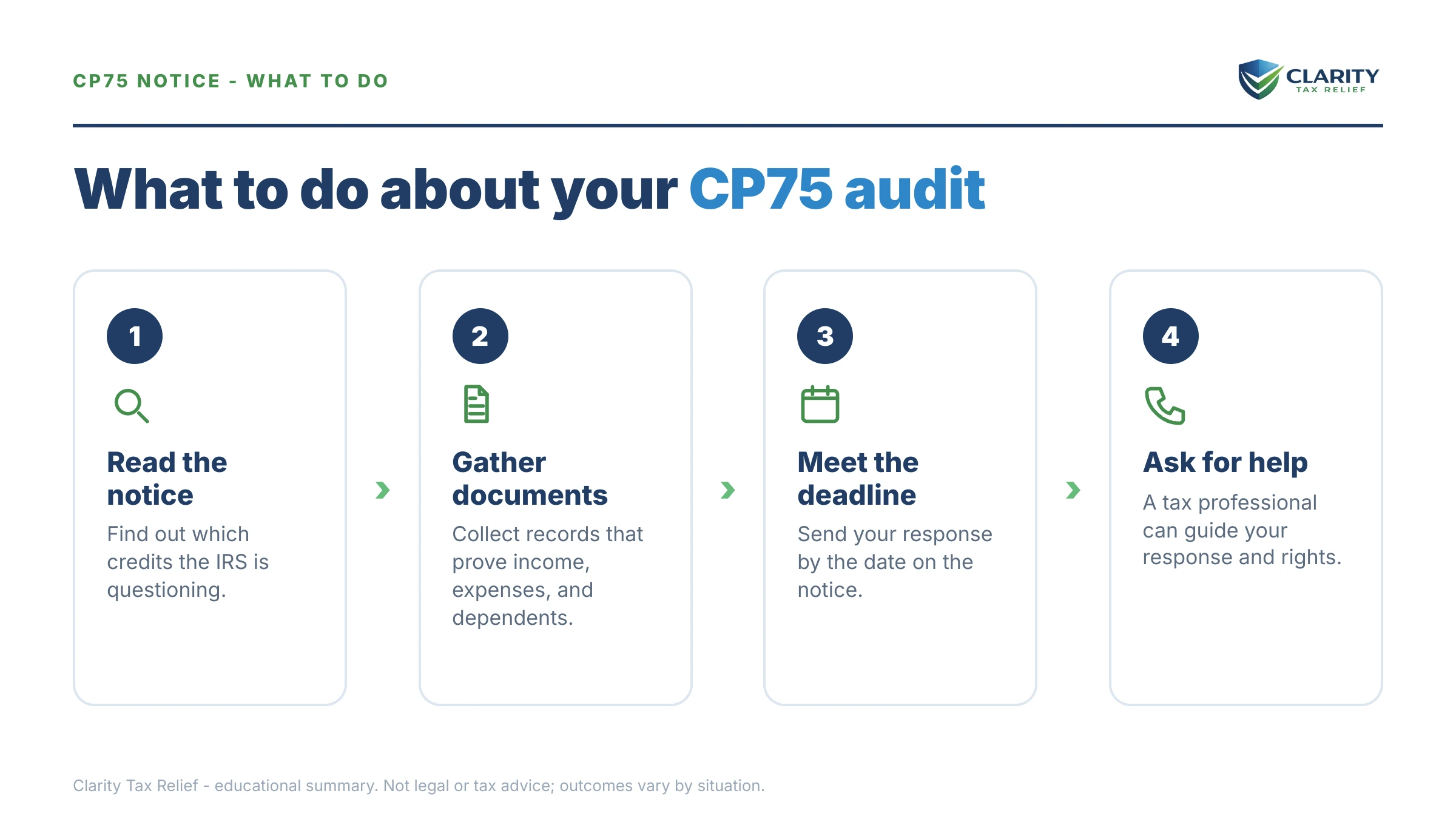
- Read page one of your CP75. Note the tax year, the specific items under audit, and the response date — those three lines control everything you do next.
- Pull the Form 886-H checklist named on your notice (886-H-EIC, 886-H-DEP, or 886-H-HOH). It lists exactly which documents the IRS accepts — don't guess.
- Gather records that cover more than half the year and show the same address for you and your child — school records, medical records, your lease, and a landlord statement work together.
- Copy everything and attach the response page from your notice. Send copies only — never mail original birth certificates or leases.
- Send it by the response date with proof of delivery to the address or fax number printed on your notice, and keep proof of mailing or the fax confirmation.
- Track the audit and follow up. Check your IRS online account for updates, and call the number on the notice if you've heard nothing after several weeks.
If the IRS disallows your credits anyway
A disallowance after a CP75 is a proposed audit result — not the end of the road. Your options, in the order they arise:
- Disagree with the examiner. Respond to the audit report with additional documents or a written explanation of why your proof meets the rules. You can also request a conference with IRS Appeals before anything is assessed.
- Petition Tax Court. If a Notice of Deficiency arrives, you have 90 days to file — see how the 90 day letter Tax Court petition process works. Many EITC cases settle with IRS counsel before trial once documents surface.
- Request audit reconsideration. If the deadline already passed, audit reconsideration lets you reopen the exam with new documentation — slower, but real.
- Handle the aftermath correctly. After any disallowance, the IRS may send a CP79 notice telling you Form 8862 is now required to claim the credit again. Attach it the next year you qualify — skipping it gets the claim auto-rejected. If part of the refund was already paid out, the clawback can also carry a 20% accuracy related penalty when the IRS finds negligence, so dispute that finding rather than accepting it by default.
The bans deserve their own sentence: a 2-year EITC ban applies only for reckless or intentional disregard, and a 10-year ban only for fraud. An honest claim with thin paperwork should end in disallowance, not a ban — if an examiner proposes one anyway, that's a specific finding you can and should contest.
When you can handle a CP75 yourself
Most CP75 audits are genuinely DIY-able. If your child lived with you all year, the school and doctor have your current address, and your lease or landlord can confirm the household, you can assemble the package from the 886-H checklist and win this by mail — no representation needed. If money is the constraint, a Low Income Taxpayer Clinic represents qualifying taxpayers in exactly these audits for free.
Experienced help changes the outcome in the messier cases: the other parent also claimed the child and the tiebreaker rules are genuinely in dispute; your child moved between homes mid-year and no single document covers six months; the audit targets your self-employment income and you need to reconstruct a Schedule C; an examiner has proposed a 2-year ban; or the 30-day window already passed and you're into deficiency or reconsideration territory. In those situations, how the evidence is framed — not just what exists — decides the result.
If the frozen refund is creating a genuine emergency — an eviction notice, a utility shutoff — the Taxpayer Advocate Service can intervene; our Form 911 walkthrough shows how to ask.
Terms on your notice, decoded
- Correspondence audit — an IRS examination conducted entirely by mail and fax; a CP75 opens one.
- Form 886-H-EIC — the IRS's own checklist of documents that prove an EITC claim; matching it is the whole game.
- Disallowance — the IRS removing a credit from your return and recalculating as if you never claimed it.
- Notice of Deficiency — the statutory letter (CP3219A) that starts a 90-day clock to challenge the change in Tax Court.
- Form 8862 — the form you must attach to reclaim the EITC after any disallowance; without it, future claims are rejected automatically.
- Two-year ban — a penalty barring EITC claims for 2 years, imposed only when the IRS finds reckless or intentional disregard of the rules.
CP75 questions, answered
Is a CP75 notice an audit?
Yes — a CP75 is a correspondence audit, the mail version of an IRS examination. The IRS isn't questioning your whole return; it's auditing specific items, usually the Earned Income Credit, dependents, filing status, or education credits, and it holds the related refund while it waits. You respond by mail or fax, not in person, and strong documents usually close it without further escalation.
How long does it take to get my refund after responding to a CP75?
There's no fixed timeline — the IRS reviews your documents and either releases the held refund or sends a report explaining what's still missing. In practice, correspondence audits often take a few months, and 2026 staffing cuts have stretched processing further. If the hold is causing serious financial hardship, the Taxpayer Advocate Service can sometimes expedite a decision — ask for help using Form 911.
What documents prove my child lived with me if I rent?
A lease naming your child as an occupant, a signed statement from your landlord on letterhead, and school or medical records showing your child at your address are the strongest proof for renters. The records need to cover more than half the tax year and match the address on your return. A single document rarely does it alone — send two or three that reinforce each other.
What if I can't get all the documents before the CP75 deadline?
Call the number on your notice and ask for more time — the IRS routinely grants extensions on CP75 audits when you ask before the response date passes. In the meantime, send what you have with a note explaining what's coming. A partial, on-time response keeps your audit open and cooperative; silence is what triggers disallowance.
What happens if I ignore a CP75 notice?
The IRS disallows the credits under audit, keeps the held portion of your refund, and sends an audit report followed by a Notice of Deficiency. You'd then have 90 days to petition Tax Court before the disallowance becomes final. Non-response can also bring a two-year EITC ban for reckless disregard and a Form 8862 requirement on every future return that claims the credit.
Will the IRS ban me from claiming the EITC?
Only in specific situations. If the IRS decides you claimed the credit with reckless or intentional disregard of the rules, it can ban you for 2 years; fraud brings a 10-year ban. An honest claim that simply lacked paperwork usually results in disallowance without a ban — but after any disallowance, you must attach Form 8862 the next time you claim the credit.
Will I get the part of my refund that isn't under audit?
Usually, yes. A standard CP75 freezes only the portion of your refund tied to the credits being audited — withholding you overpaid is generally released. The exception is the CP75D variant, which holds the entire refund because the IRS is verifying your income and withholding themselves. Page one of your notice says which portion is frozen.
Your next 24 hours
- Find two lines on page one of your CP75: the list of items under audit and the response date. Write the date on your calendar — it's typically 30 days from the notice date, and everything runs off it.
- Start the document pile tonight: the notice itself, your tax return for that year, your lease, and any school or medical records already in the house. Request whatever's missing tomorrow — schools and doctors' offices take days to respond, and your window is finite.
- Get a free CP75 review before you mail anything: use the 2-minute form or call (888) 825-7779. Getting the package right the first time is what gets a held refund released — a rejected package restarts the clock with less of it left.
For the IRS's own explanation of this notice, see Understanding your CP75 notice and the qualifying rules on the IRS Earned Income Tax Credit page. If the refund hold is causing financial hardship, the Taxpayer Advocate Service is an independent IRS office that can step in.
This guide is general information, not tax or legal advice for your specific situation. Eligibility for IRS programs depends on individual facts and circumstances; no outcome is guaranteed.