
IRS Forms
Form 911 Taxpayer Advocate Request: How to Fill It Out and File It (2026)
The short answer: a Form 911 Taxpayer Advocate request asks the Taxpayer Advocate Service — an independent organization inside the IRS — to take over a stuck or harmful case, free of charge. You qualify if IRS action is causing you financial harm, or your issue has sat more than 30 days past normal processing.
You've mailed your proof twice, sat on hold until the line dropped, and the IRS is still pulling money from your Social Security over a balance you've been trying to fix for months. When the normal channels go silent, Form 911 is the pressure valve Congress built for exactly this — a way to put a human with authority on your file.
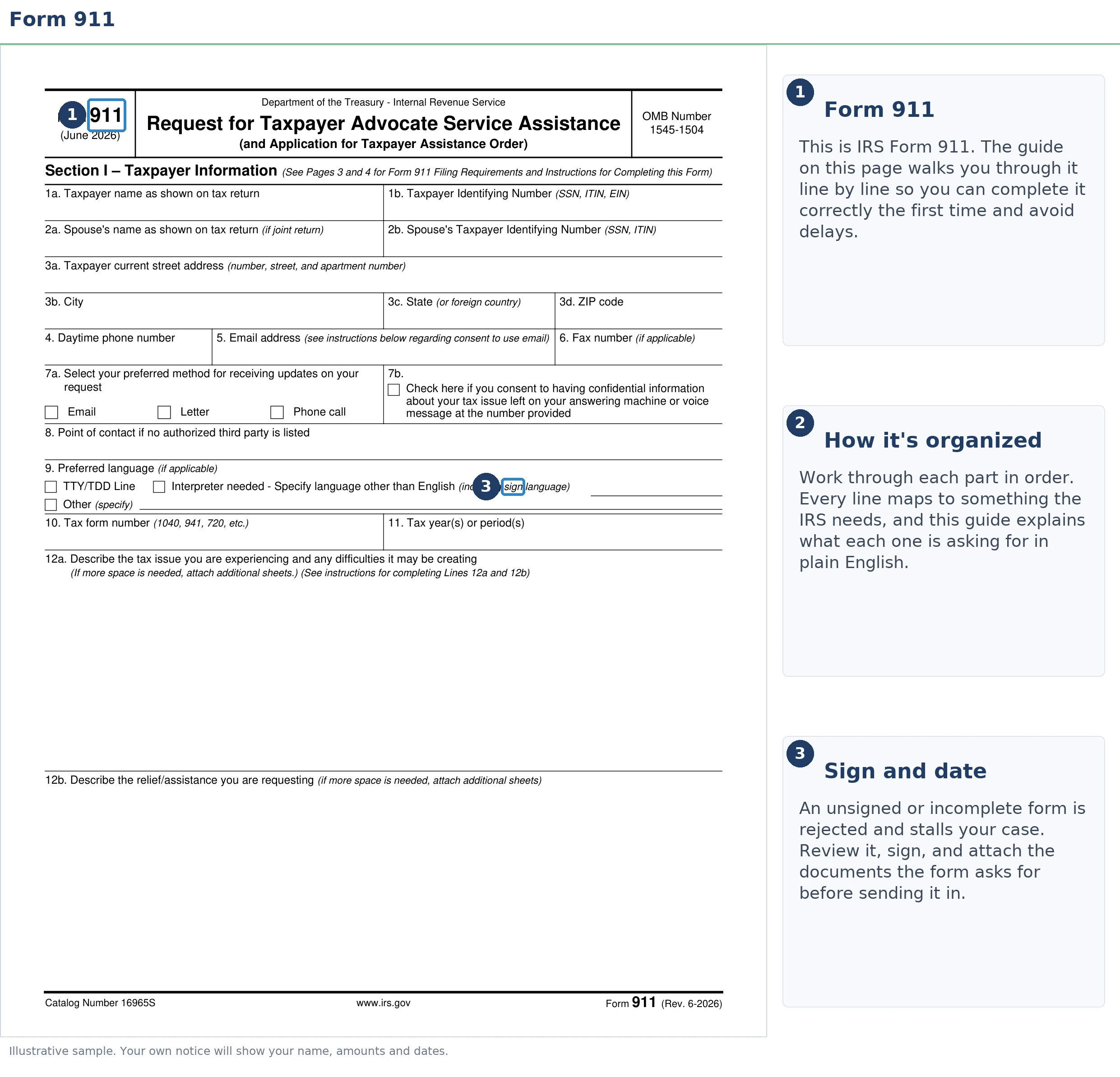
The image below shows exactly what Form 911 looks like and where to look — including the two narrative boxes that carry your entire case, where most weak requests fail.
⏱ The real clock: Form 911 has no filing deadline — but the meter on your account never stops. Interest compounds daily, the failure-to-pay penalty adds 0.5% of your balance every month, and any levy already in place keeps taking money while you wait. File as soon as you meet a TAS criterion.
What Form 911 is and when to file it
Form 911 is the "Request for Taxpayer Advocate Service Assistance (and Application for Taxpayer Assistance Order)" — the free, one-page form that puts an independent advocate inside the IRS on your case. The Taxpayer Advocate Service (TAS) reports to Congress, not to IRS Collections, and it exists to fix cases the regular machinery has broken or ignored.
What makes TAS different from calling the IRS again: once your case is accepted, you get one named case advocate with a direct phone number. That advocate can reach into the units handling your account, demand movement, and — in extreme cases — apply for a Taxpayer Assistance Order under IRC §7811, a legal directive telling the IRS to stop or take a specific action.
Form 911 is a rescue tool, not a first move. If you just got your first letter and haven't tried the normal channel yet, start with our guide to why you got an IRS letter and respond there first — TAS will ask what you've already tried. For the broader picture of when the Advocate fits, see how to contact the Taxpayer Advocate Service; this page covers the form itself.
Who qualifies for Form 911 Taxpayer Advocate help
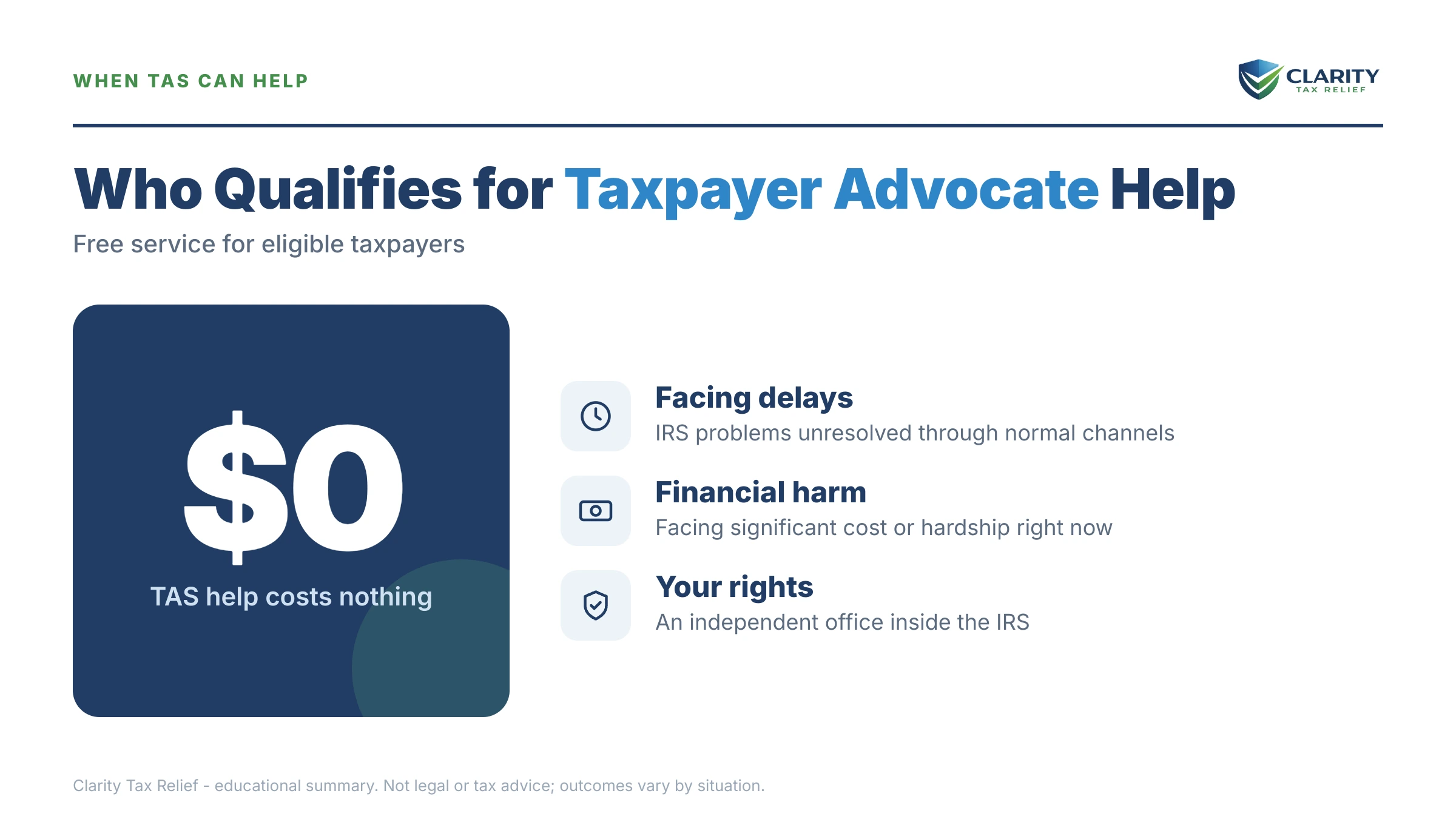
TAS accepts cases that meet at least one of its case criteria, and the two doors most people walk through are economic burden and systemic delay. "Economic burden" means IRS action or inaction is causing real financial harm — you can't cover rent, utilities, or medication. "Systemic delay" means your issue has gone more than 30 days beyond normal processing time, or the IRS missed a date it promised you.
| TAS case criterion | What it means | Example that qualifies |
|---|---|---|
| Economic burden | IRS action or inaction is causing (or is about to cause) financial harm | A levy on Social Security leaves you unable to cover rent and medication |
| Immediate threat of adverse action | Enforcement is about to hit and normal channels can't stop it in time | A bank levy is about to take the funds you need for this month's bills |
| Systemic delay | Your issue has run more than 30 days beyond normal processing | A Form 14039 identity theft affidavit filed months ago with no movement |
| Broken promise / no response | The IRS missed a date it gave you, or never answered at all | You were told to expect a decision by a date that passed weeks ago |
What does not qualify: simple disagreement with the amount you owe (that's an Appeals issue), a refund still inside normal processing windows, or a case you haven't yet raised through regular channels. TAS is the escalation path, and the strongest requests show you already tried the normal route and it failed.
What happens if you stay stuck and do nothing
A stalled IRS case has a measurable monthly cost: the failure-to-pay penalty adds 0.5% of your balance every month, and interest compounds daily on top. Waiting for the IRS to notice your problem on its own is a losing bet in 2026 — the workforce was cut roughly 27% in 2025, which is why you can't reach the IRS on the phone, but the automated systems that issue notices and levies never stopped. Here's the sequence a stuck case follows:
- The balance grows. Penalties and interest post automatically every month, whether or not a human has read your last letter.
- The notice stream keeps escalating. The collection sequence — reminder, intent to levy, final notice — runs on autopilot. Your unanswered correspondence doesn't pause it.
- Levies attach and stay. The IRS can take your state refund, up to 15% of Social Security through the Federal Payment Levy Program, and funds in your bank account. A wage or benefit levy is continuous until it's released.
- Your rights windows close. The 30-day window to request a Collection Due Process hearing after a final notice doesn't wait for the IRS to answer your mail — appeal rights can lapse while you're on hold.
IRS taking money while your case sits in a pile?
If a levy is hitting your Social Security or bank account while your paperwork goes unanswered, every month costs you real money — interest and penalties keep accruing until someone forces the case forward. An experienced tax professional can review your situation free and tell you whether Form 911, a hardship release, or another route gets it stopped fastest.
Your options: Form 911 vs. the other ways to unstick a case
Form 911 is one of several ways to force movement on a frozen IRS case — and the only one that is free, formal, and staffed by people inside the building. Which route is fastest depends on whether your problem is a broken process, a legal dispute, or an enforcement clock already running:
| Route | Best for | Cost |
|---|---|---|
| Form 911 to the Taxpayer Advocate | Hardship caused by IRS action, or a case stuck 30+ days past normal handling | Free |
| CDP hearing — Form 12153 | Stopping a levy after a final notice (LT11/Letter 1058) — must be filed within 30 days | Free to request |
| Appeals — Form 12203 | Disagreeing with an IRS decision on the merits, not the process | Free to request |
| Congressional inquiry | The same stuck cases as TAS — your representative's caseworker opens an inquiry that routes through TAS | Free |
| Low Income Taxpayer Clinic | Ongoing representation in a dispute, if your income qualifies | Free or nominal |
| Professional representation — Form 2848 | Complex cases: active levies plus hardship math, multiple years, business debt | Professional fees |
These routes stack. A common pattern in hardship cases: file Form 911 to get an advocate assigned, while a representative under Form 2848 works the levy release and the underlying resolution in parallel. And note what's missing from the table — there is no paid "fast lane" into TAS. Anyone selling one is selling you a free form.
How to respond, step by step
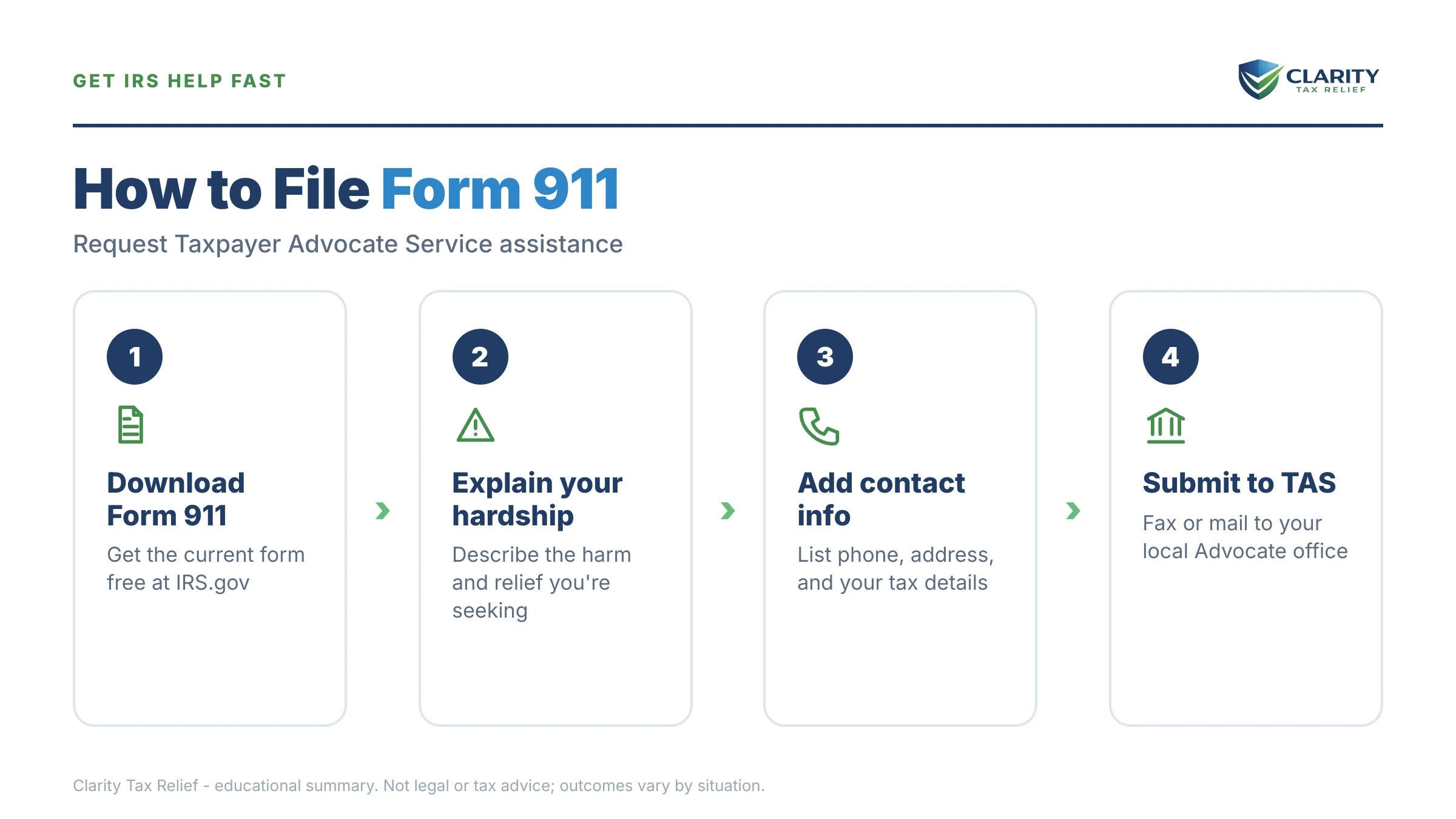
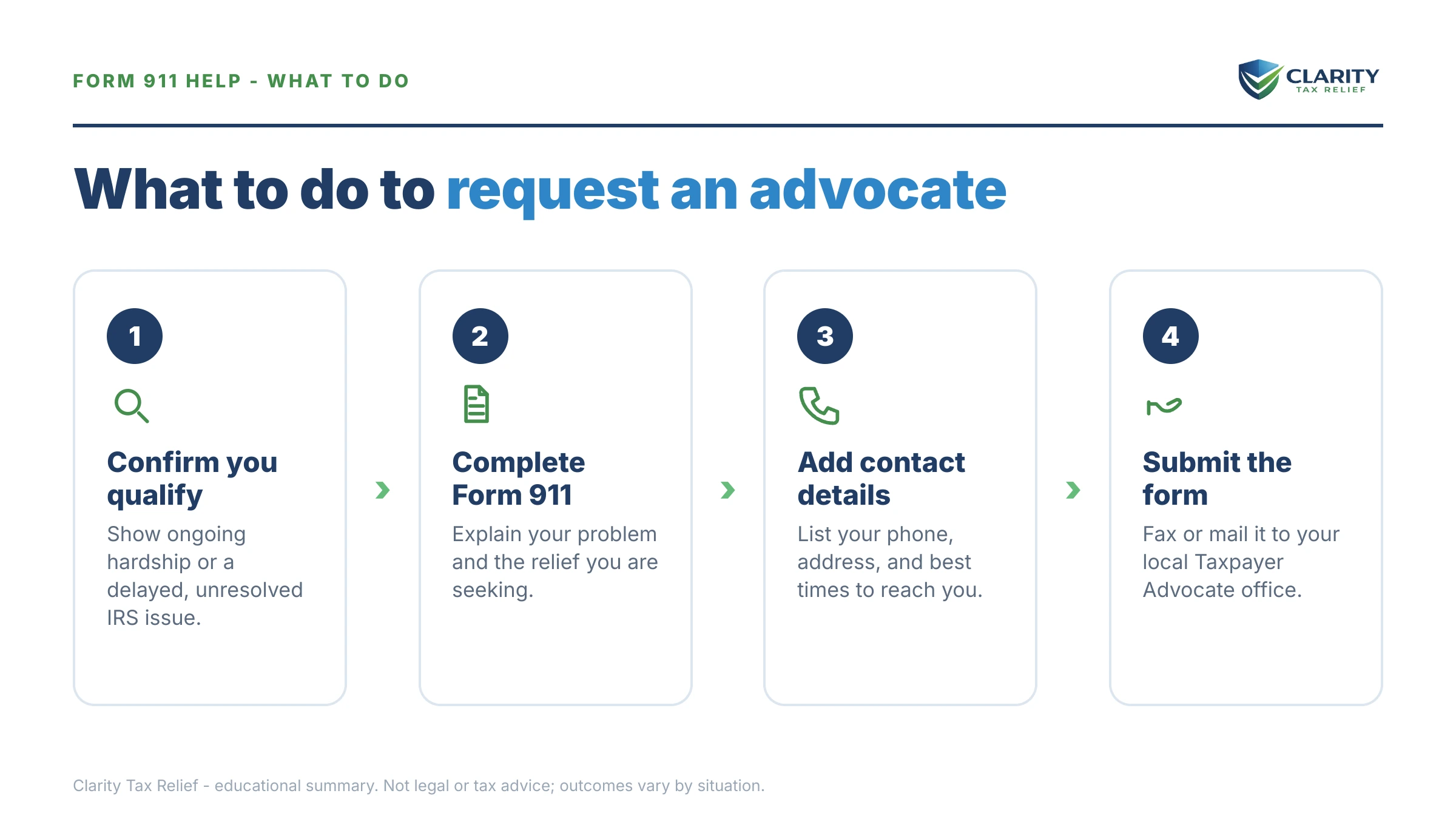
- Confirm you qualify — Match your situation to a TAS case criterion: IRS action causing financial harm, or a delay more than 30 days past normal processing.
- Complete Form 911 — Fill in Section I with your identifying details, state the specific facts of the problem in the first narrative box, and name the exact relief you want in the second. (Download it from the IRS's Form 911 page.)
- Attach your proof — Copy every relevant IRS notice, your monthly income-and-expense numbers, and anything you already sent the IRS that went unanswered.
- Submit it to your local TAS office — Fax it (usually fastest) or mail it to the Taxpayer Advocate office for your state — every state has at least one; find yours at taxpayeradvocate.irs.gov — or call 1-877-777-4778 to open a case by phone.
- Answer the advocate's contact — Respond the same day your case advocate calls or writes, and send anything they request immediately — silence is the most common reason cases close unresolved.
The two boxes that decide your case
Most Form 911 requests succeed or fail on two narrative boxes: the description of your problem and the description of the relief you want. Section I's identifying fields — name, SSN, address, the tax form involved (usually 1040), and the tax years — are straightforward. The narrative boxes are where TAS decides whether you meet a criterion.
The problem box wants facts, dates, and dollar amounts — not frustration. Write it like a timeline: what happened, when you responded, what the IRS did or didn't do, and exactly what the harm is. "I mailed proof of payment on March 3 and again on April 20; the IRS never responded; a levy began June 10 and takes $285 from my Social Security each month" beats three paragraphs about how unfair it feels.
The relief box wants a specific ask. "Please help me" gives your advocate nothing to execute. "Release the Social Security levy due to economic hardship and place my account in Currently Not Collectible status" gives them a to-do list. Name the action, and if you know it, the program.
Three details filers miss: on a joint liability, both spouses should sign. If a representative is filing for you, Section II is where their information goes, backed by a power of attorney. And Section III is for IRS use only — leave it blank; an IRS employee fills it in when they refer a case to TAS themselves.
Say you owe $6,200: a worked Form 911 example
Say you're retired, you owe $6,200 from a year when a pension cash-out went underreported, and the IRS is now taking 15% of your Social Security through the Federal Payment Levy Program while your hardship letter sits unanswered. This is a hypothetical, but the math is how TAS will see it:
- Monthly Social Security benefit: $1,900. FPLP levy: 15% × $1,900 = $285 per month.
- Left after the levy: $1,900 − $285 = $1,615.
- Basic monthly expenses: rent $1,150 + medications $260 + utilities and food $370 = $1,780.
- Shortfall: $1,780 − $1,615 = $165 short every month — that's economic burden, in numbers.
On the Form 911, the problem box lays out that timeline and those figures. The relief box asks for two things: release of the FPLP levy as an economic hardship levy release, and placement in Currently Not Collectible status so collection pauses while the budget stays this tight. Attached: the levy notice, the benefit statement, the rent receipt, and the pharmacy printout.
One honest alternative worth naming: at $6,200 — under the $10,000 ceiling — a guaranteed installment agreement could also stop enforcement, at roughly $90–$100 a month over 72 months as interest accrues. But this budget is already $165 underwater, which is exactly why the hardship route, not a payment plan, is the right ask on this form.
When you can handle Form 911 yourself
Form 911 was built for taxpayers to file on their own — it's free, one page, and requires no representative. If your case is a single stuck item with clean facts — a delayed refund past 30 days, an unanswered identity-theft affidavit, a misapplied payment the IRS won't fix — write the two boxes yourself, attach your notices, and fax it. You don't need to pay anyone to do that, and TAS itself never charges.
Experienced help changes outcomes in a narrower set of situations: a levy is actively taking money and the hardship math has to be built from a real budget the IRS will accept; there are multiple unfiled years underneath the stuck issue; the debt is business or payroll tax; or the endgame is an Offer in Compromise whose numbers need to survive IRS scrutiny. In those cases, Form 911 opens the door — but what you ask for once it opens is where the case is won or lost.
Terms on Form 911, decoded
- Taxpayer Advocate Service (TAS): the independent organization inside the IRS that helps taxpayers whose cases are stuck or causing hardship — free.
- Case advocate: the single named TAS employee assigned to your case, with a direct phone number.
- Taxpayer Assistance Order (TAO): a legal directive under IRC §7811 ordering the IRS to take, or stop, a specific action — the "big stick" Form 911 formally applies for.
- Economic burden: TAS shorthand for IRS action or delay that's causing real financial harm — the fastest lane into a case assignment.
- Systemic burden: a case stuck because an IRS process or system failed — delays past 30 days, missed promise dates, lost responses.
- Federal Payment Levy Program (FPLP): the automated program that takes up to 15% of federal payments, including Social Security, for back taxes.
- Currently Not Collectible (CNC): account status that pauses IRS collection when paying would prevent you from covering basic living expenses; the debt remains and interest accrues.
Form 911 questions, answered
How long does it take the Taxpayer Advocate to respond to Form 911?
TAS prioritizes economic-burden cases, and most filers hear from an advocate within roughly one to two weeks — sometimes faster when money is actively being levied. Full resolution usually takes weeks to a few months depending on what the IRS has to unwind. In 2026, staffing cuts across the IRS have stretched some timelines, so send complete documentation the first time to avoid back-and-forth delays.
Does filing Form 911 stop an IRS levy or garnishment?
Not automatically — the form itself has no legal power to freeze collection. But your case advocate can contact the collection unit directly and push for a levy release, and if the levy is causing economic hardship, the IRS is required by law under IRC Section 6343 to release it. In extreme cases the Advocate can pursue a Taxpayer Assistance Order directing the IRS to stop a specific action.
Is there a fee to file Form 911?
No — Form 911 and everything the Taxpayer Advocate Service does is completely free. Be wary of anyone selling Taxpayer Advocate filing as a standalone paid service; the form is one page and TAS never charges. An experienced tax professional may reasonably prepare one as part of broader representation, but the TAS help itself always costs nothing.
Can the Taxpayer Advocate reduce the amount I owe?
No — TAS fixes process problems; it does not settle debts. Your advocate cannot cut your balance, but they can push a stalled penalty-abatement request, amended return, or Offer in Compromise file to a decision, which often changes what you ultimately pay. If your goal is paying less, the tool is an abatement request or an offer — TAS is how you get those requests unstuck.
Where do I send Form 911?
Fax or mail it to the Taxpayer Advocate Service office for your state — every state, plus D.C. and Puerto Rico, has at least one, and fax is usually faster. Find your local office's address and fax number at taxpayeradvocate.irs.gov, or call TAS at 1-877-777-4778 and an intake specialist can open a case by phone. Don't send it to a general IRS address; it will crawl.
Can I file Form 911 for a delayed tax refund?
Yes, if the delay has run more than 30 days past normal processing time, if the IRS missed a date it promised you, or if the held refund is causing financial hardship — for example, you can't cover rent or medication without it. A refund that is still inside normal processing windows won't qualify, so check your refund status and account transcript first.
Will the Taxpayer Advocate help if I disagree with how much the IRS says I owe?
Generally no — disputes over the amount belong in IRS Appeals, through Form 12203 for smaller cases or a Collection Due Process hearing if you received a levy notice. TAS steps in when the process breaks: lost responses, blown deadlines on the IRS's side, or collection that ignores your hardship. One exception: if the IRS denied you an appeal right you were entitled to, that procedural failure is squarely TAS territory.
Your next 24 hours
- Pull your paper trail. Find your most recent IRS notice and note the tax year, the balance, and the notice number — those go straight into Section I of Form 911, and the dates anchor your problem-box timeline.
- Build your harm file. Gather the levy or hold notice, your benefit or income statement, and your core monthly bills (housing, utilities, medications). If your money-in minus money-out shows a shortfall, that's your economic-burden case in three documents.
- Get a free case review. If money is actively being taken or your case involves more than one stuck issue, have an experienced tax professional map the fastest route — Form 911, hardship release, or both — before you file. Use the 2-minute form or call (888) 825-7779; every month unresolved adds penalties and interest.
This guide is general information, not tax or legal advice for your specific situation. Eligibility for IRS programs depends on individual facts and circumstances; no outcome is guaranteed.