
IRS Levies
Levy Causing Hardship: How to Get an IRS Hardship Levy Release in 2026
The short answer: a levy causing hardship must be released — IRC §6343(a)(1)(D) requires the IRS to lift any levy that prevents you from paying reasonable basic living expenses. You prove the hardship with a financial statement, usually Form 433-F. On a bank levy, you have 21 days before the frozen money actually leaves.
Your card declined at the supplier this morning, the bank confirmed an IRS levy froze the account, and payroll for your crew is due in four days. That knot in your stomach is real — but so is the law working in your favor here. The IRS is not allowed to keep a levy in place that leaves you unable to cover basics, and a release can move in days, sometimes hours, once you prove it.
Whether you're holding Form 668-A (a bank levy) or Form 668-W (a wage levy), the image below shows exactly what the levy paperwork looks like and where to find the numbers that control your timeline.
⏱ Your real clock: on a bank levy, the bank holds the frozen funds for 21 days before sending them to the IRS. A release obtained inside that window puts the money back in your account; after the funds transfer, you're fighting for a refund instead of a release. A wage levy has no waiting period — it takes part of every paycheck until it's released.
What counts as a levy causing hardship under IRS rules
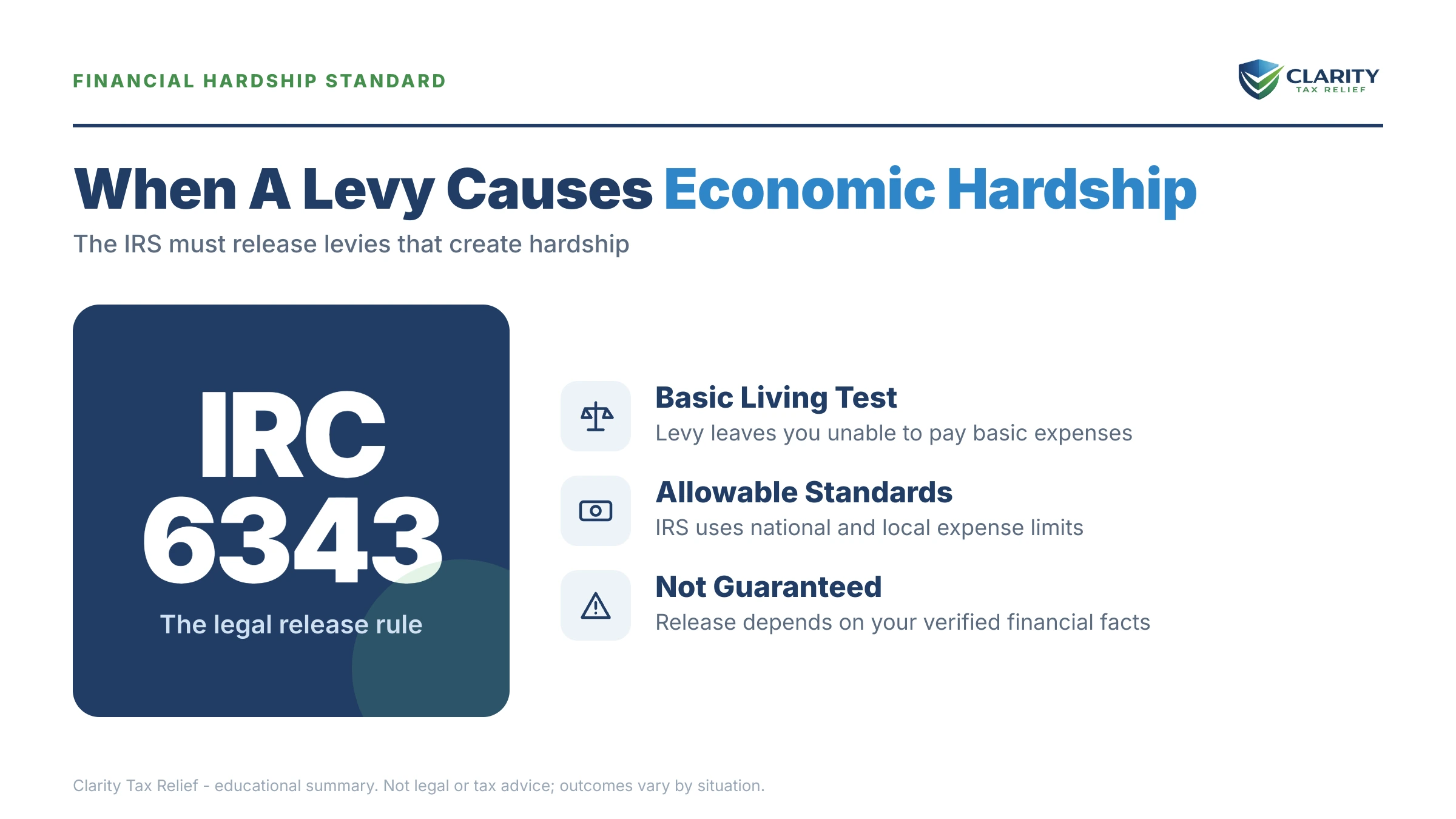
The IRS is required by federal law — IRC §6343(a)(1)(D) — to release a levy that leaves you unable to pay reasonable basic living expenses. This isn't a favor the agent grants; it's a legal duty once the hardship is proven.
"Basic living expenses" is a defined standard, not a feeling. The IRS measures your budget against its IRS allowable living expenses standards: national amounts for food and clothing, local caps for housing and transportation, plus actual health care costs and current tax obligations. If the levy pushes you below those numbers, you likely qualify — but the IRS makes the final determination after verifying your income and expenses on Form 433-A or 433-F.
One critical fine-print point for business owners: the economic-hardship standard applies to individuals, not to corporate entities. A sole proprietor or single-member LLC owner is an individual — a levy on your business account counts if it stops you from paying your own rent, groceries, or medical bills. A corporation or multi-member LLC can't claim personal hardship for itself, but it can still pursue release on other grounds, like entering an installment agreement or showing that release will help the IRS actually collect.
Two things hardship release is not. It's not debt forgiveness — the balance survives, and interest keeps running. And it's not automatic — the IRS doesn't know your budget until you put it in front of them.
Why the IRS levied you when you clearly can't afford it
An IRS levy is issued by an automated system that has never seen your budget. Before it fired, the system mailed a final notice — usually an LT11 or Letter 1058 — and waited out the 30-day window it triggered. If that letter went to an old address or got buried in a stack of mail, the levy still counts as legally noticed.
This matters in 2026 more than ever: the IRS workforce shrank by roughly 27% in 2025, so reaching a human is harder — but the levy machine was never furloughed. The system will keep enforcing until someone feeds it the financial facts that legally stop it. That someone is you.
If you're still inside 30 days of the final notice, you also have Collection Due Process appeal rights — request the hearing with Form 12153, which generally halts further levy action while the appeal is pending.
The clock on each type of levy
Different levies run on different clocks, and the clock decides how fast you must move. A bank levy is a one-time grab with a 21-day hold; a wage levy repeats every payday until released.
| Levy type | Your window | What you can still do |
|---|---|---|
| Bank levy (Form 668-A) | 21-day hold before funds leave the bank | Get a hardship release faxed to the bank inside the hold and the money stays yours |
| Wage levy (Form 668-W) | Continuous — hits every paycheck until released | Prove hardship or set up a resolution; the employer stops withholding once the release arrives |
| Accounts receivable levy (business) | Attaches to what customers owe you when the levy is served | Seek release before customers pay the IRS instead of you — this one can strangle cash flow fastest |
| Social Security levy (FPLP) | Up to 15% of each monthly benefit, ongoing | Assert hardship to have the Federal Payment Levy Program levy released |
If it's your paycheck being levied, the exempt amount the IRS must leave you is small — often far below your actual bills. You can estimate what a wage levy would leave you with using our IRS wage garnishment calculator, and the broader playbook lives in our guide on how to stop IRS wage garnishment.
What happens if you don't act
A levy causing hardship does not release itself — every path to release starts with you contacting the IRS. Wait, and the damage compounds in a specific order:
- The 21-day hold expires. On a bank levy, the bank transmits every frozen dollar to the IRS. Your fight changes from "release the levy" to "return my money" — a much harder claim with narrower legal grounds.
- A wage levy keeps taking every paycheck. Your employer is legally required to keep sending the money until a written release arrives. There is no cap on how many pay periods it runs.
- The business damage multiplies. Miss payroll and employees walk. Worse, if you cover net paychecks by skipping payroll tax deposits, you create fresh 941 back taxes — and personal exposure to the Trust Fund Recovery Penalty. New payroll debt is treated far more harshly than the old balance that triggered this levy.
- The system finds your next source. With no resolution on the account, automated collection can serve the next levy — another bank, your receivables, a payment processor — because nothing told it to stop.
- Interest and penalties keep stacking. The failure-to-pay penalty (0.5% per month) and daily-compounding interest run through all of it, so the balance behind the levy grows even while you're being levied.
Levy freezing money you need to live on?
If it's a bank levy, the 21-day hold is already counting down. Get your levy paperwork reviewed free today — an experienced tax professional will tell you whether hardship release fits your numbers and what to say when you call.
Your options for an economic hardship levy release
Proving economic hardship with a financial statement is the fastest legal route to a levy release — but it's not the only one, and the right path depends on your numbers and how much time is left on the clock.
| Release path | What you submit | Typical speed | Key limit |
|---|---|---|---|
| Hardship release + CNC status | Form 433-F with proof of income and expenses | Same day to a few days once you reach an agent | Debt remains; individuals only; IRS reviews your finances later |
| Installment agreement | Payment proposal (Form 9465 or by phone) | Often days; levy is generally released once the agreement is in place | Payment must fit IRS math; interest and penalties continue |
| Taxpayer Advocate Service | Form 911 citing economic burden | Days — built for emergencies collection won't fix | TAS pushes the IRS; it can't erase the debt |
| CDP hearing (Form 12153) | Hearing request within 30 days of the final notice | Generally pauses levy action while pending | Only if you're still inside the 30-day window |
| Bankruptcy automatic stay | Bankruptcy petition | Immediate stop on collection | A major legal step with lasting consequences — see below |
Hardship release paired with Currently Not Collectible is the natural landing spot for most people searching this phrase. The same Form 433-F that proves the levy must be released also supports moving the whole account into Currently Not Collectible status, which pauses levies going forward while your finances stay underwater. If your income comes from self-employment, the expense math gets more scrutiny — a small-business P&L needs to clearly separate business costs from household costs.
An installment agreement works when you can genuinely afford something monthly. Balances up to $50,000 can qualify for streamlined terms over up to 72 months, and getting an agreement accepted generally gets the levy lifted. Don't agree to a payment that re-creates the hardship — the IRS will accept a number you can't actually sustain.
The Taxpayer Advocate Service is your lever when the phone lines fail you. TAS exists precisely for cases where IRS action is causing economic harm, and a Form 911 marked as an economic-burden case gets assigned to a human advocate who can push a release through when ACS won't pick up.
An Offer in Compromise is a longer-term settlement tool, not an emergency release button — it takes months and only works when the IRS's own math shows it can't collect the full balance. And bankruptcy's automatic stay stops a levy immediately, but it's a decision with years of consequences; read does bankruptcy stop an IRS levy before treating it as a levy tactic. For a full ranking of speed-to-release across every path, see how to get an IRS levy released.
A worked example: the $6,200 bank levy
Say you run a two-employee landscaping company as a sole proprietor, and a levy freezes $6,200 — your entire operating balance. Here's the hardship math you'd put in front of the IRS:
- Net self-employment income after business costs: about $6,200/month
- Household expenses at the IRS allowable standards: rent $1,850 + food/clothing $825 + vehicle $1,250 + utilities $480 + health insurance $610 + current-year estimated taxes $1,100 = $6,115/month
- Payroll due in four days: $3,100 in net wages, payable only from the frozen $6,200
On paper, the IRS could argue you have $6,200 − $6,115 = $85/month of collectible income. But the levy didn't take $85 — it took the whole month's operating cash. Miss payroll and the crew quits, the $6,200/month income collapses, and you can't cover the $6,115 of basic expenses at all. That is a textbook levy causing hardship: presented with a Form 433-F showing these numbers inside the 21-day hold, this is the kind of case the IRS typically releases — once the financial picture is documented and verified. (Hypothetical figures — your allowable amounts depend on your county and family size.)
How to respond to a levy causing hardship, step by step
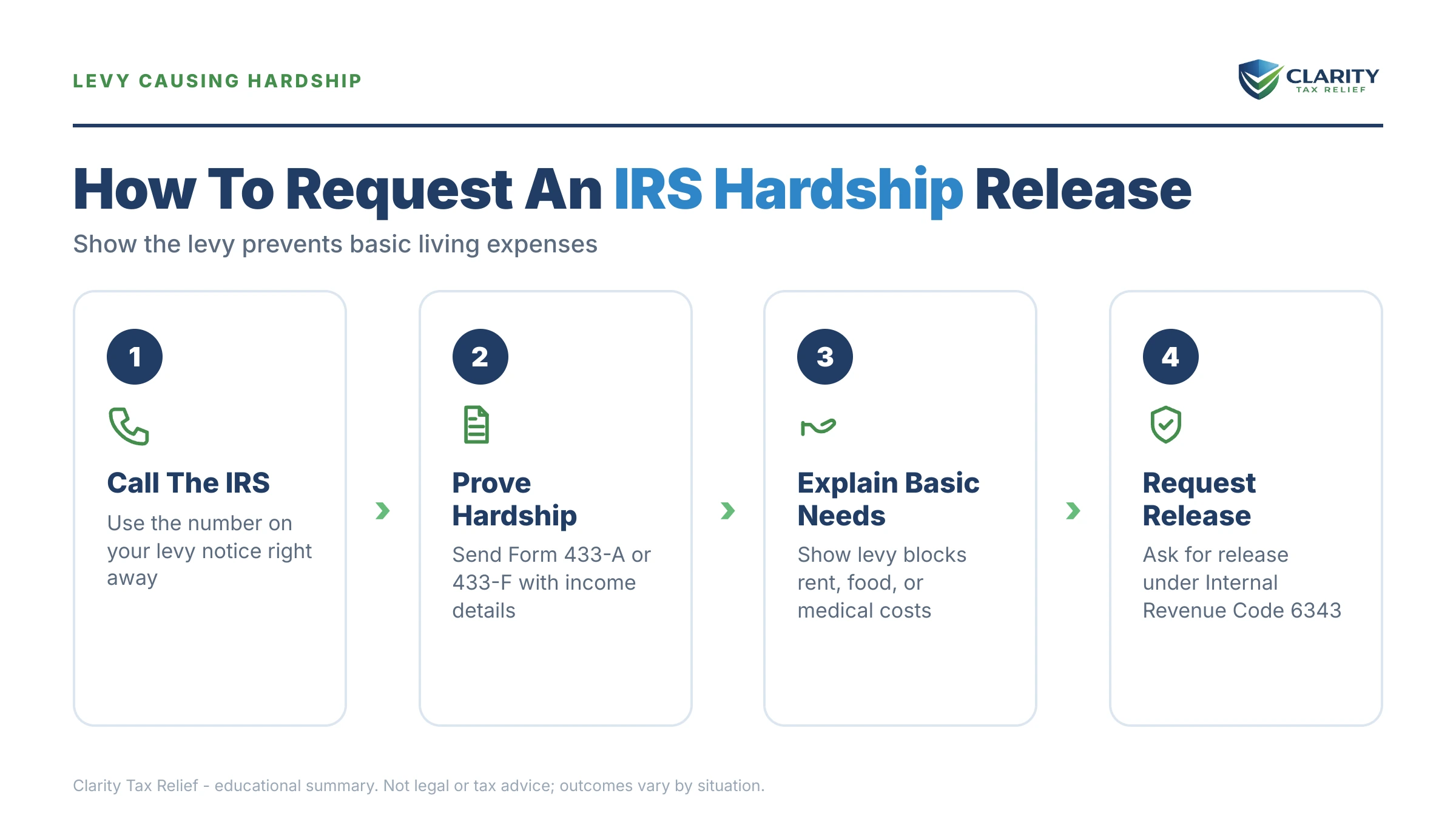
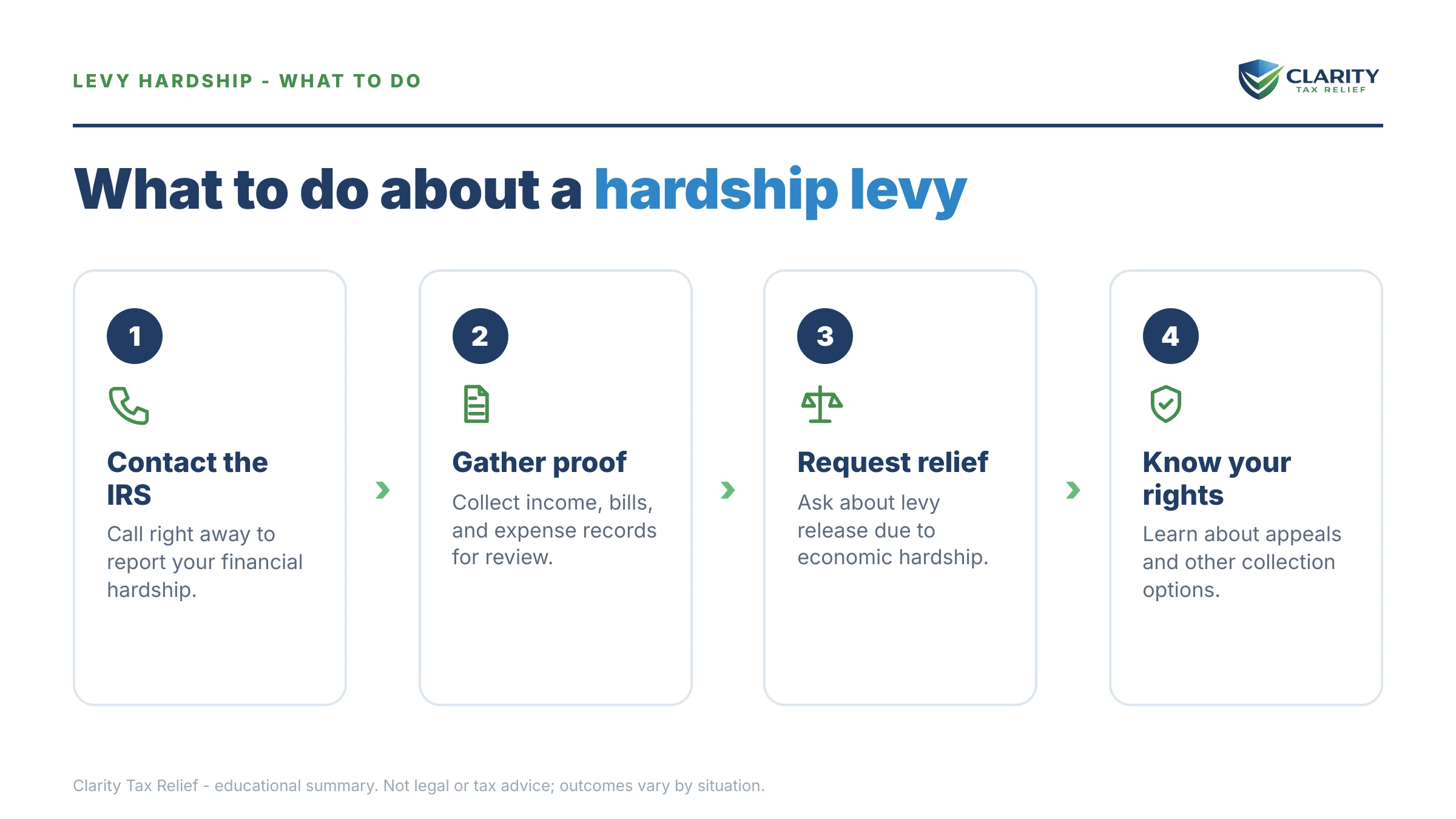
- Call the IRS at the number on your levy paperwork today. Use the phone number printed on the levy notice or Form 668. Tell the agent the levy is causing economic hardship and ask for a release under IRC §6343.
- Complete Form 433-F before you call, if you can. List every income source and expense, and have proof ready to fax or upload — lease or mortgage statement, utility bills, payroll records, and three months of bank statements.
- Ask for the release to be sent directly to your bank or employer. The IRS can fax a levy release the same day it's approved. Direct transmission beats waiting on the mail — especially inside a 21-day bank hold.
- Escalate to the Taxpayer Advocate with Form 911 if you stall. If you can't reach an agent or the release is refused despite real hardship, the Taxpayer Advocate Service takes economic-burden cases and can force movement in days.
- Lock in Currently Not Collectible status or a payment plan. A release without a follow-up status invites a second levy. Ask the agent to code the account before you hang up.
- File any missing returns fast. Unfiled years keep your account in the levy queue and block most long-term resolutions, even after a hardship release.
Our Form 433-F walkthrough shows line by line how to present income and expenses so the hardship is obvious on the first read — the single biggest factor in whether the call ends with a release.
When you can handle this yourself
Most single-levy hardship releases can be handled without professional help if your finances are simple. If you're a W-2 earner with one levy, expenses clearly under the IRS standards, and all returns filed, calling with a completed Form 433-F and asking for a hardship release is genuinely a DIY task. The same is true if you can simply afford a payment plan — set it up at the IRS payment plans page and the levy issue resolves itself.
Experienced help changes outcomes in four situations. First, when a 21-day bank hold is already running and there's no margin for a botched first call. Second, when you're self-employed with payroll — the business-versus-household expense math is exactly where agents push back, and where new 941 exposure lurks. Third, when you have multiple unfiled years, because the release is only round one of a longer fight. Fourth, when this is a repeat event — if you've been through a release before and got hit again, read the IRS levied me again, because the fix this time has to include a durable status, not just a release. For the fastest-possible-turnaround playbook when funds are days from leaving, see our guide to emergency levy release for hardship.
Terms on your levy paperwork, decoded
- Levy vs. lien: a levy takes your property; a lien is a legal claim against it. You can have a lien with no levy — and a levy release doesn't remove a lien.
- Form 668-A / 668-W: the actual levy documents — 668-A goes to banks and other third parties as a one-time grab; 668-W goes to your employer and repeats every payday.
- Economic hardship: the legal standard for mandatory release — the levy leaves you unable to pay reasonable basic living expenses, measured against IRS expense standards.
- Allowable Living Expenses (ALE): the IRS's published caps for housing, food, transportation, and other necessities that define what "basic" means in the hardship test.
- Currently Not Collectible (CNC): an account status (transcript code 530) that pauses active collection because you can't pay; usually paired with a hardship release.
- Release vs. return: a release stops a levy before the money is gone; a return is the harder process of getting back funds the IRS already received.
Levy hardship questions, answered
What qualifies as economic hardship for an IRS levy release?
Economic hardship means the levy leaves you unable to pay reasonable basic living expenses — housing, food, utilities, transportation, health care, and current taxes. The IRS measures this against its Allowable Living Expense standards, not your actual lifestyle spending. You prove it with a financial statement, usually Form 433-F, plus documents like a lease, utility bills, and pay stubs or business profit-and-loss records.
How fast can the IRS release a levy for hardship?
A hardship release can happen the same day you call if you reach an agent and can support your numbers on the spot. The IRS can fax the release directly to your bank or employer, which matters most on a bank levy where funds transfer after the 21-day hold. In practice, gathering documents and reaching the right unit often takes several days — start immediately.
Does a hardship release erase my tax debt?
No — a levy release under IRC §6343 stops the seizure but leaves the balance in place, and interest and the failure-to-pay penalty keep accruing. Most hardship releases pair with Currently Not Collectible status, which pauses collection while your finances stay tight. You'll still want a longer-term plan, because the debt survives until it's paid, settled, or the 10-year collection statute expires.
Can a business get a levy released for economic hardship?
The economic-hardship release standard applies to individuals, so a corporation or multi-member LLC can't claim it for the entity itself. Sole proprietors and single-member LLC owners are individuals, so a levy on their business account can qualify when it prevents them from meeting basic living expenses. Entities can still pursue release on other grounds — an installment agreement, or showing release will facilitate collection.
Can the IRS release a hardship levy if I have unfiled returns?
Yes — the Tax Court held in Vinatieri v. Commissioner (2009) that the IRS must release a levy causing economic hardship even when returns are unfiled. Expect the agent to press hard for the missing returns anyway, and unfiled years will block you from Currently Not Collectible or a payment plan afterward. File the missing returns quickly so a second levy doesn't follow the release.
Can I get money back that the IRS already took?
It's much harder after funds leave the bank, but not always impossible. The IRS has authority to return levied money in limited situations — for example, when the levy was premature, violated procedure, or returning it will facilitate collection — and third parties whose money was seized can file a wrongful levy claim. Move before the 21-day hold expires whenever you can; releases are far easier than refunds.
Does a hardship release stop the IRS from levying again?
No. A release lifts the specific levy in front of you; it doesn't bar future levies on the same debt. If your account isn't moved into Currently Not Collectible or a payment plan, the automated system can issue a new levy once it sees fresh income or bank activity. Locking in a status after the release is what actually keeps you protected.
Can the IRS levy my Social Security if it causes hardship?
The IRS can take up to 15% of Social Security through the Federal Payment Levy Program, but an FPLP levy causing hardship can be released the same way — by proving your expenses exceed your income under the IRS standards. Low-income taxpayers are supposed to be filtered out of FPLP automatically, but the filter isn't perfect; call and assert hardship if the 15% cut breaks your budget.
Your next 24 hours
- Find the form number and date on your levy paperwork. If it says 668-A, ask your bank what day it received the levy and count 21 days forward — that's your funds-transfer date. If it says 668-W, your next payday is the deadline.
- Gather your hardship proof: last filed return, three months of bank statements, lease or mortgage statement, utility bills, payroll obligations, and income records — everything a Form 433-F asks for.
- Get a free case review before you call the IRS. If a bank hold is running, every day matters. Call (888) 825-7779 or use the 2-minute form and an experienced tax professional will map your fastest release path — free and confidential.
The IRS's own overview of levies and releases is at IRS.gov: What is a levy, and if you can't get traction through normal channels, the Taxpayer Advocate Service exists for exactly this kind of economic-burden case.
This guide is general information, not tax or legal advice for your specific situation. Eligibility for IRS programs depends on individual facts and circumstances; no outcome is guaranteed.