
IRS Collections
How to Get an IRS Levy Released in 2026 (Fastest Release Paths)
The short answer: to get an IRS levy released, call the number on your levy notice and get into a resolution the IRS must honor under IRC §6343 — full payment, an installment agreement, or documented economic hardship. A bank levy gives you 21 days before funds leave; a wage levy repeats every payday until released.
Your paycheck just came up hundreds of dollars short, or your bank froze the account you've been rebuilding since the divorce — and the debt behind it may not even feel like yours. If it came from a joint return, the IRS can collect from you alone, whatever the decree says. That's brutal to read, but the release rules cut in your favor: the IRS is required to lift a levy in specific situations, and this guide walks you through every one.
The paperwork your bank or employer received tells you which clock you're on. The image below shows exactly what that levy paperwork looks like and where to find the form number that determines your window to act.
⏱ Your clock: a bank levy comes with a 21-day hold — your bank must hold the funds for 21 days from the date it receives the levy (not the date printed on the IRS notice) before sending the money to the IRS, and a release issued inside that window keeps the funds in your account. A wage levy has no expiration date: it takes every paycheck until the IRS issues Form 668-D releasing it.
Why the IRS levied you — and why it was legal
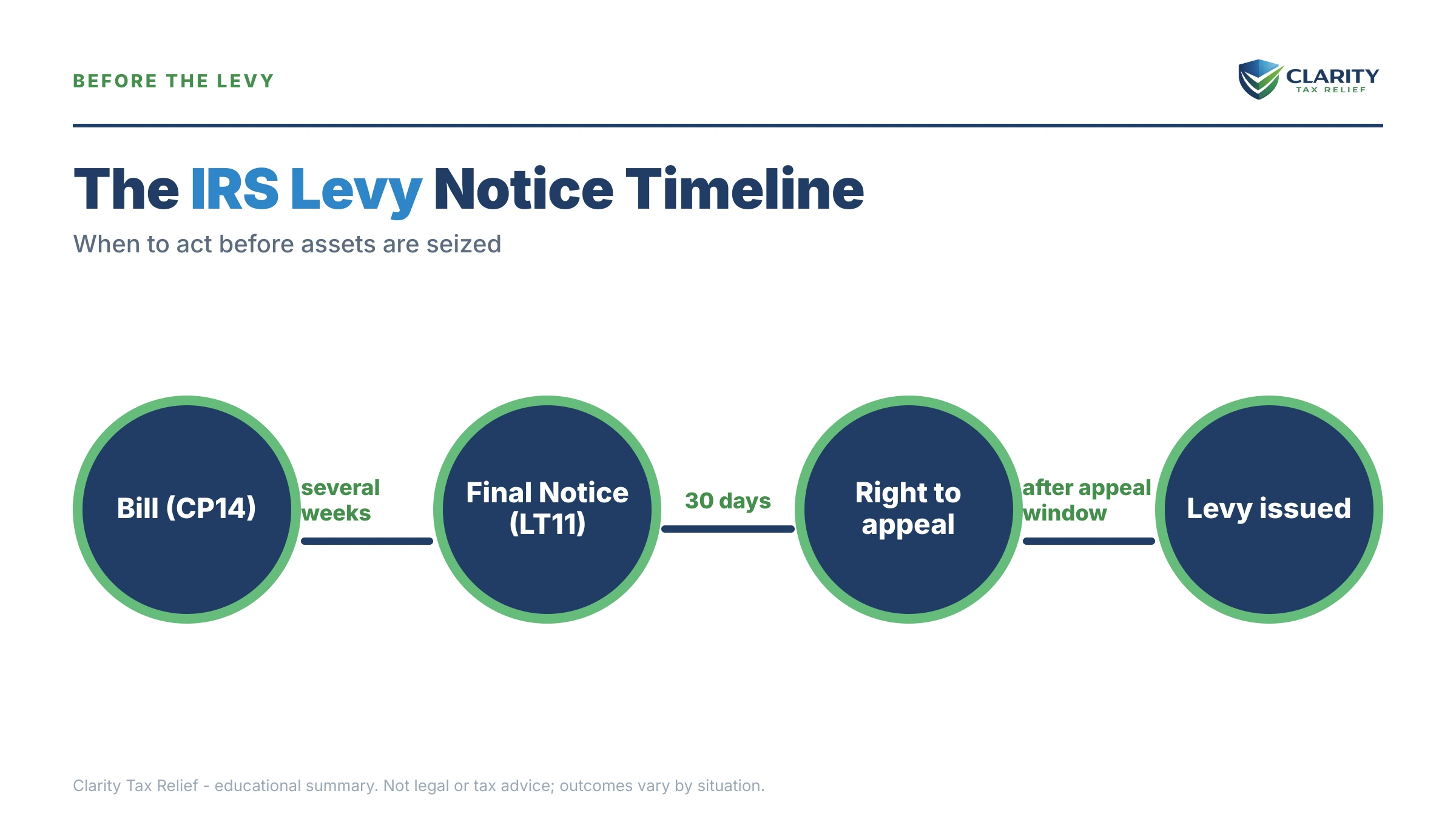
The IRS can levy only after it sends a Final Notice of Intent to Levy and waits at least 30 days. That final notice — an LT11 notice or Letter 1058 — went to your last known address, which is exactly how divorced filers get blindsided: the warning often lands at the old marital address while the levy lands on your current paycheck.
By the time money is actually being taken, the legal groundwork is done. The one major exception is a jeopardy levy, an emergency seizure without the usual 30-day warning, which has its own defense rules.
What matters now is that "levied" is not "lost." Congress wrote mandatory release conditions into IRC §6343 — the IRS doesn't release levies as a favor; it releases them because the law says it must once you meet one of the conditions below.
What each levy type gives you: deadlines and rights
Each levy source carries a different window and a different surviving right — the bank levy is the only one with a hard countdown. Match your situation to the row that fits before you decide how fast to move.
| What was levied | Your window | The right you still have |
|---|---|---|
| Bank account (Form 668-A) | 21-day hold before the bank forwards funds | A release issued before day 21 keeps the money in your account |
| Wages (Form 668-W) | None — repeats every payday | Mandatory release under §6343 through an agreement or hardship claim; an exempt amount protects a small slice of each check |
| Social Security (FPLP) | None — up to 15% of each monthly benefit | Hardship or Currently Not Collectible status stops future offsets |
| 1099 / contractor pay | One-time — grabs only what the payer owes you that day | Future invoices need a new levy; a resolution stops the cycle |
| State tax refund | Taken once, when the state issues it | Doesn't recur unless a new refund arises; resolving the balance ends it |
The bank-levy countdown has its own tactics — see irs bank levy 21 days for exactly what your bank can and can't do during the hold. If it's your paycheck, the mechanics of stopping it live in our guide on how to stop irs wage garnishment; you can also estimate what a wage levy would leave you each payday with our IRS Wage Garnishment Calculator.
What happens if you do nothing while the levy runs
An IRS levy never burns itself out — it keeps collecting, and the IRS keeps widening the net, until you act or the balance is gone. The sequence looks like this:
- The current levy keeps taking. A wage levy hits every paycheck, leaving only the exempt amount. A bank levy's funds leave on day 21 — and future deposits are exposed to a fresh levy at any time.
- The IRS adds sources. A second bank account, a new employer, contractor payments, even up to 15% of Social Security benefits through the Federal Payment Levy Program — automated systems find income and attach it.
- The balance grows underneath. The 0.5%-per-month failure-to-pay penalty plus daily-compounding interest keep accruing, so the levy chases a moving target.
- A federal tax lien can follow (or already has). That clouds your title and complicates the refinance or home sale a divorce often requires.
- Bigger triggers wait upstream. If accruals push a balance past $66,000 (the 2026 threshold), the IRS can certify it to the State Department, blocking passport renewal.
In 2026, the IRS workforce is down roughly 27% — it is genuinely harder to reach a human to negotiate a release. The levy systems, though, are automated and never stopped. Waiting doesn't make the levy fade; it just means the money keeps leaving while you queue.
Money already leaving your paycheck or bank account?
If your bank was levied, the 21-day hold is your window to keep those funds. Get your levy reviewed free today — an experienced tax professional will map the fastest release path for your exact situation. Call (888) 825-7779 or use the 2-minute form.
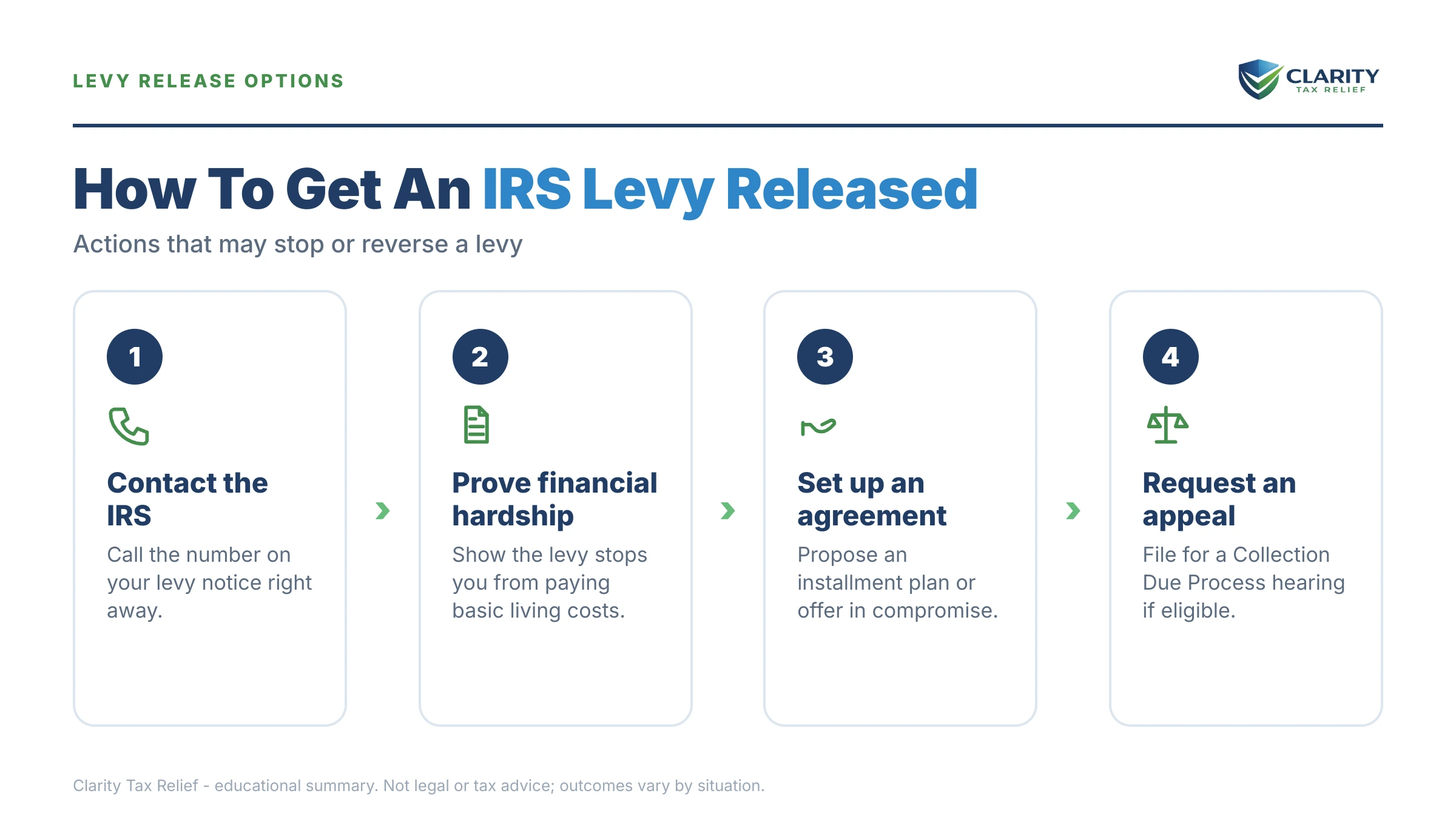
The 8 ways to get an IRS levy released
Under IRC §6343, the IRS must release a levy when the tax is paid, the collection statute has expired, an installment agreement is in place, the levy creates economic hardship, or release would actually help the IRS collect. In practice, those legal grounds translate into eight paths:
- Pay the balance in full. Fastest on paper, rarely realistic mid-levy — and never drain hardship funds to do it when a cheaper path exists.
- Enter an installment agreement. The workhorse release. Once the agreement is in place, §6343 requires the release unless the agreement itself says the levy continues — uncommon for wage and bank levies. A streamlined installment agreement covers balances up to $50,000 over up to 72 months without a full financial disclosure (direct debit required above $25,000 for online setup).
- Prove economic hardship. If the levy leaves you unable to pay basic living expenses, release is mandatory — even though the debt remains. The full test and documentation are covered in levy causing hardship, and if you're days from missing rent, see the emergency route in irs levy release hardship.
- Get placed in Currently Not Collectible status. The formal version of hardship: collection pauses account-wide, not just for this levy, while your finances stay underwater. You'll document income and expenses, usually on Form 433-F.
- Submit an Offer in Compromise. A pending OIC generally stops new levy action, and you can request release of an existing levy while it's reviewed. The IRS accepted roughly 1 in 5 offers in FY2024, so treat it as a genuine but selective path — not a levy-release trick.
- Appeal. If you still have Collection Due Process rights from the final notice, a timely Form 12153 CDP hearing request generally suspends levy action while Appeals reviews your case. Even after the CDP window, a CAP appeal can challenge the levy itself.
- Show the collection statute expired. The IRS generally has 10 years from assessment to collect (paused by appeals, an OIC, or bankruptcy). If your CSED has passed on the levied year, the levy must be released.
- Prove the money isn't yours — or the timing was illegal. If the IRS grabbed property belonging to someone else (a joint account funded by a parent, for example), that's a wrongful levy claim. And filing bankruptcy triggers the automatic stay, which halts levies immediately — details in does bankruptcy stop irs levy.
Which path is fastest depends mostly on what you owe:
| Your balance | Fastest release path | What it requires |
|---|---|---|
| Under $10,000 | Guaranteed installment agreement | Individuals only, with an income-tax balance of $10,000 or less (excluding penalties and interest), all returns filed, timely filing and payment for the past 5 years with no installment agreement in that period, and full payment within 3 years — the IRS must accept it |
| $10,000–$25,000 | Streamlined installment agreement | Up to 72 months; no financial statement needed |
| $25,001–$50,000 | Streamlined agreement with direct debit | Direct-debit payments; can be set up online, up to 72 months |
| Over $50,000 | Negotiated agreement or CNC | Form 433-F financials; the IRS reviews ability to pay |
| Any amount, can't cover basics | Economic hardship release / CNC | Documented income vs. IRS allowable living expenses |
| Any amount, disputed or not yours | CDP appeal or wrongful levy claim | Timely Form 12153, or proof the levied property belongs to someone else |
A worked example: releasing a wage levy on $36,900
Say you owe $36,900 from a joint return filed during your marriage, your divorce decree assigned that debt to your ex — and the IRS just levied your paycheck anyway. That's legal: a joint return makes both signers fully liable, and the decree doesn't bind the IRS. Here's the release math.
At $36,900, you're under the $50,000 streamlined ceiling, so no full financial disclosure is required. Spread over the maximum 72 months, the base math is $36,900 ÷ 72 ≈ $513 per month. Because you're above $25,000, setting it up online means agreeing to direct debit — and the IRS structures the payment so the balance, plus the interest and penalties that keep accruing, is fully paid within the term, so expect the actual figure to run somewhat higher than the raw division.
Compare that to doing nothing: a wage levy on a $4,200 monthly salary could leave you only the exempt amount — often a fraction of your check — every single payday. A ~$513 agreement payment you chose beats a levy taking two or three times that, and the moment the agreement is accepted, you can ask the agent to fax the release to payroll.
There's also a second front worth opening: because the $36,900 traces to your ex's side of a joint return, separation of liability under §6015(c) may split the debt after divorce so you only owe the portion attributable to you. A pending innocent-spouse request generally pauses collection against you while the IRS decides — meaning the payment plan gets the levy off your check now, and the relief request works on shrinking what the plan has to repay.
How to get an IRS levy released, step by step
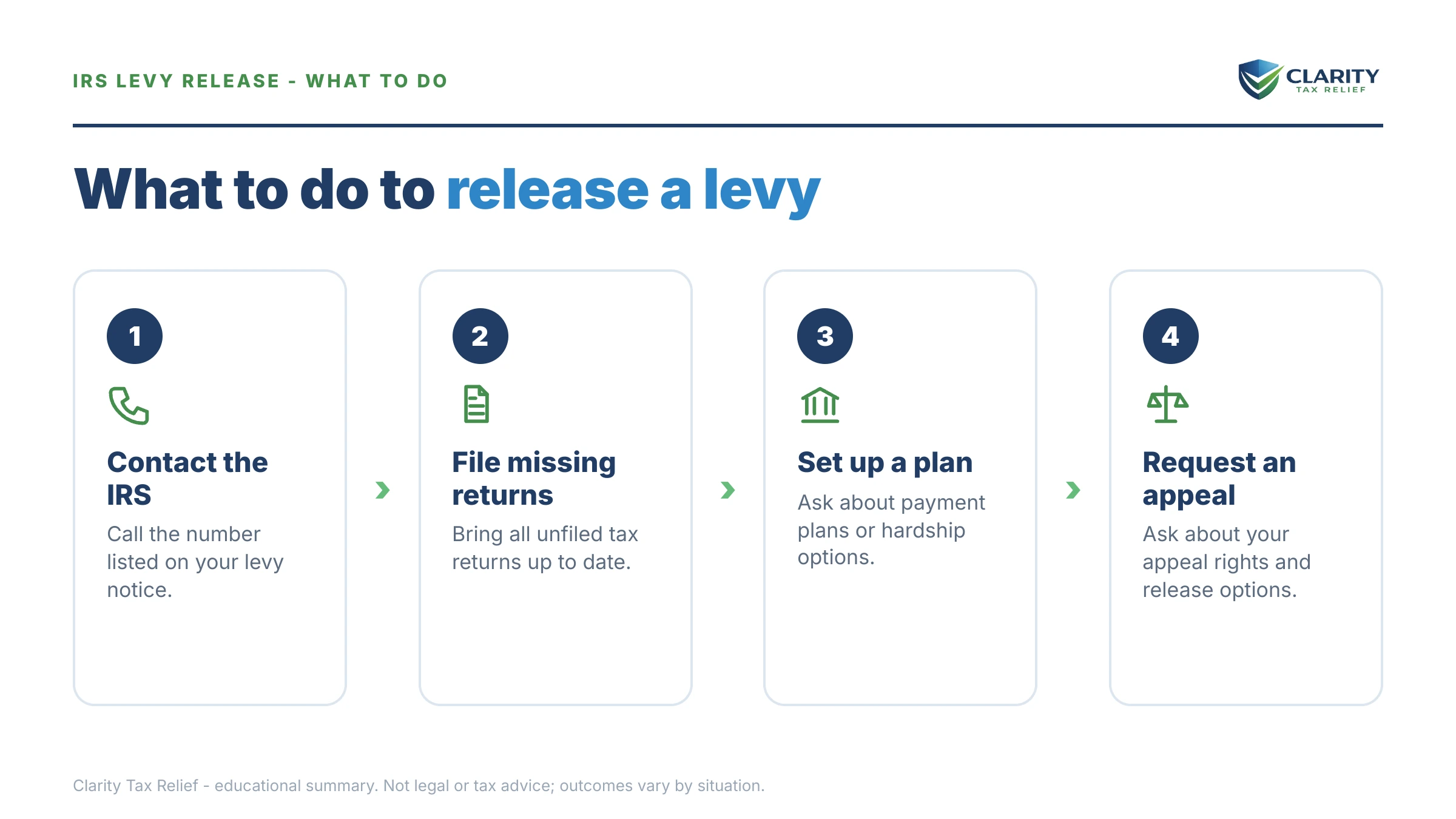
- Identify the levy type. Get the levy paperwork from your bank or payroll department. Form 668-A means a one-time bank levy with a 21-day hold; Form 668-W means a continuous wage levy. The form number sets your clock and your strategy.
- File any missing returns. The IRS generally won't finalize an installment agreement or hardship status while required returns are unfiled. File them, or get them prepared immediately — filing compliance is the gate to every release path.
- Gather your financial snapshot. Pull your last two pay stubs, three months of bank statements, your monthly living expenses, and last year's return. If you'll claim hardship or owe above the streamlined limits, complete Form 433-F before you call.
- Call the number on the levy notice and propose a resolution. Ask for a levy release based on the resolution that fits: full payment, an installment agreement, or economic hardship under §6343. Request the release on the same call — don't wait for it to happen automatically.
- Confirm the release in writing. Ask the agent to fax Form 668-D to your employer or bank while you're on the line, note the agent's ID and the fax confirmation, then verify with payroll or the bank that the release was received and applied.
When you can handle the release yourself — and when help changes the outcome
If you owe under $25,000, agree with the balance, and have every return filed, you can usually get the levy released yourself with one long phone call. Set up the streamlined agreement, ask for the release, and confirm the fax to payroll — no professional required, and anyone who tells you otherwise is selling something.
Experienced help genuinely changes outcomes in a narrower set of situations: a bank levy mid-hold where the release must land before day 21; multiple unfiled years blocking every resolution; a hardship claim that lives or dies on how the expense documentation is presented; a joint-liability case where an innocent-spouse or separation-of-liability request should run alongside the release; or business and payroll debt, where levy rules are harsher. In those cases, the order of moves — returns first, release second, liability relief third — often matters more than any single move.
Two honest cautions. First, if a released levy comes back, it's almost always because the underlying agreement defaulted — see irs levied me again before you assume the IRS made an error. Second, if the IRS won't act on a valid hardship claim, the Taxpayer Advocate Service exists precisely to intervene when a levy is causing significant harm.
Terms on your levy paperwork, decoded
- Form 668-A: the one-time levy sent to banks and other third parties — it grabs only what's there the day it arrives.
- Form 668-W: the continuous wage levy sent to your employer — it repeats every payday until released.
- Form 668-D: the release of levy — the document your employer or bank needs before they stop sending your money to the IRS.
- Levy release vs. return of property: a release stops future taking; getting back money already sent to the IRS is a separate, much rarer request.
- Economic hardship (§6343): the legal standard requiring release when a levy prevents you from paying reasonable basic living expenses.
- CSED: the Collection Statute Expiration Date — generally 10 years from assessment, after which the IRS can no longer levy for that debt.
IRS levy release questions, answered
How long does it take the IRS to release a levy?
Once you reach an agreement, the IRS can issue the release the same day — an agent faxes Form 668-D directly to your employer's payroll department or your bank. Ask for the fax confirmation and give payroll a heads-up so the release is applied before your next check. If you're inside a bank levy's 21-day hold, a release issued before the hold ends means the money never leaves your account.
Will the IRS give back money it already took with a levy?
Usually not — a levy release stops future collection but doesn't automatically return funds already sent to the IRS. The IRS can return levied money in limited situations, such as when the levy was premature, violated its own procedures, or returning the funds helps collection succeed under an agreement. Money taken from a bank account can still be saved if the release arrives within the 21-day hold, before the bank forwards it.
Does setting up a payment plan release an IRS levy?
Generally yes. Under IRC §6343, the IRS must release a levy when you enter an installment agreement, unless the agreement itself allows the levy to continue — which is uncommon for wage and bank levies. For a balance like $36,900, a streamlined agreement of up to 72 months usually qualifies without a full financial statement, and you can request the release on the same call that sets up the plan.
Can the IRS levy my paycheck for a joint tax debt after divorce?
Yes. A joint return creates joint and several liability, and the IRS can collect the entire balance from either spouse no matter what your divorce decree says — the decree binds your ex, not the IRS. If the debt traces to your ex's income or errors, separation of liability relief under §6015(c) or innocent spouse relief may remove your share, and a pending request generally pauses collection against you while it's reviewed.
Does bankruptcy stop an IRS levy?
Yes — filing bankruptcy triggers the automatic stay, which stops levy action immediately, including an active wage levy. It doesn't erase the debt by itself: recent income taxes usually survive Chapter 7, and the IRS resumes collection when the stay lifts unless the tax is discharged or paid through a Chapter 13 plan. Bankruptcy is a serious step, so weigh it against a payment plan or hardship release first.
What counts as economic hardship for a levy release?
Economic hardship means the levy prevents you from paying reasonable basic living expenses — rent or mortgage, utilities, food, transportation, and health care — measured against IRS allowable expense standards. If your numbers show the levy leaves you unable to cover those basics, the IRS must release it under §6343(a)(1)(D), even though you still owe the tax. You'll need to document income and expenses, usually on Form 433-F.
Can the IRS levy me again after releasing a levy?
Yes. A release ends that specific levy, not the IRS's right to collect the balance. If you default on the agreement that earned the release, or a hardship review shows your income has recovered, the IRS can issue a new levy — usually after a fresh warning notice. Staying current on whatever resolution got the levy lifted is what keeps a second one from landing.
How much of my paycheck can an IRS wage levy take?
A wage levy takes everything above a small exempt amount based on your filing status, dependents, and pay period — it's not a percentage. For many single filers, the exempt amount leaves only a few hundred dollars per weekly paycheck. Your employer calculates it from the Form 668-W package you complete, and the levy repeats every payday until the IRS issues a release.
Your next 24 hours
- Find the form number on the levy paperwork. Ask payroll or your bank for a copy: 668-A means the 21-day bank clock is running; 668-W means every paycheck is exposed until a release lands.
- Gather your release package. Last year's return, your two most recent pay stubs, three months of bank statements, and a list of monthly living expenses — everything a release request needs, whatever path fits.
- Get the levy reviewed free. Especially if a bank hold is ticking or the debt traces to an ex-spouse's return, call (888) 825-7779 or use the 2-minute form — an experienced tax professional will identify the fastest release path before the levy takes another check.
When you're ready to act on your own, payment options live at IRS.gov/payments and plan details at the IRS payment plans page.
This guide is general information, not tax or legal advice for your specific situation. Eligibility for IRS programs depends on individual facts and circumstances; no outcome is guaranteed.