
IRS Levies
IRS Levied Me Again: Why a Second Levy Hits After a Release (2026)
The short answer: a second IRS levy after a release almost always means the underlying debt was never resolved — the release only lifted one seizure. The usual triggers: a defaulted installment agreement, removal of hardship (CNC) status, a rejected offer, or a newly assessed year. Bank funds sit frozen for 21 days before transfer.
You already fought this fight once. You got the levy released, your paycheck came back whole, and you moved on — maybe even started a refinance. Now your payroll department says a new levy arrived, and you're typing "IRS levied me again" wondering how something that was fixed came back. It came back because releases aren't fixes — but the same paths that worked before still work, and this guide shows how to make the fix permanent this time.
Before anything else, look at the form number on the new paperwork — it determines your clock. The image below shows exactly what this levy paperwork looks like and where to find the form number and the tax periods it covers.
⏱ The clock that matters: if this levy hit your bank account, you have 21 days from the day the bank freezes the funds before the money is sent to the IRS. If it's a wage levy, there is no waiting period — it takes part of every paycheck until it is released. Details on the bank timeline: IRS bank levy 21 days.
Why the IRS levied me again: the five usual triggers
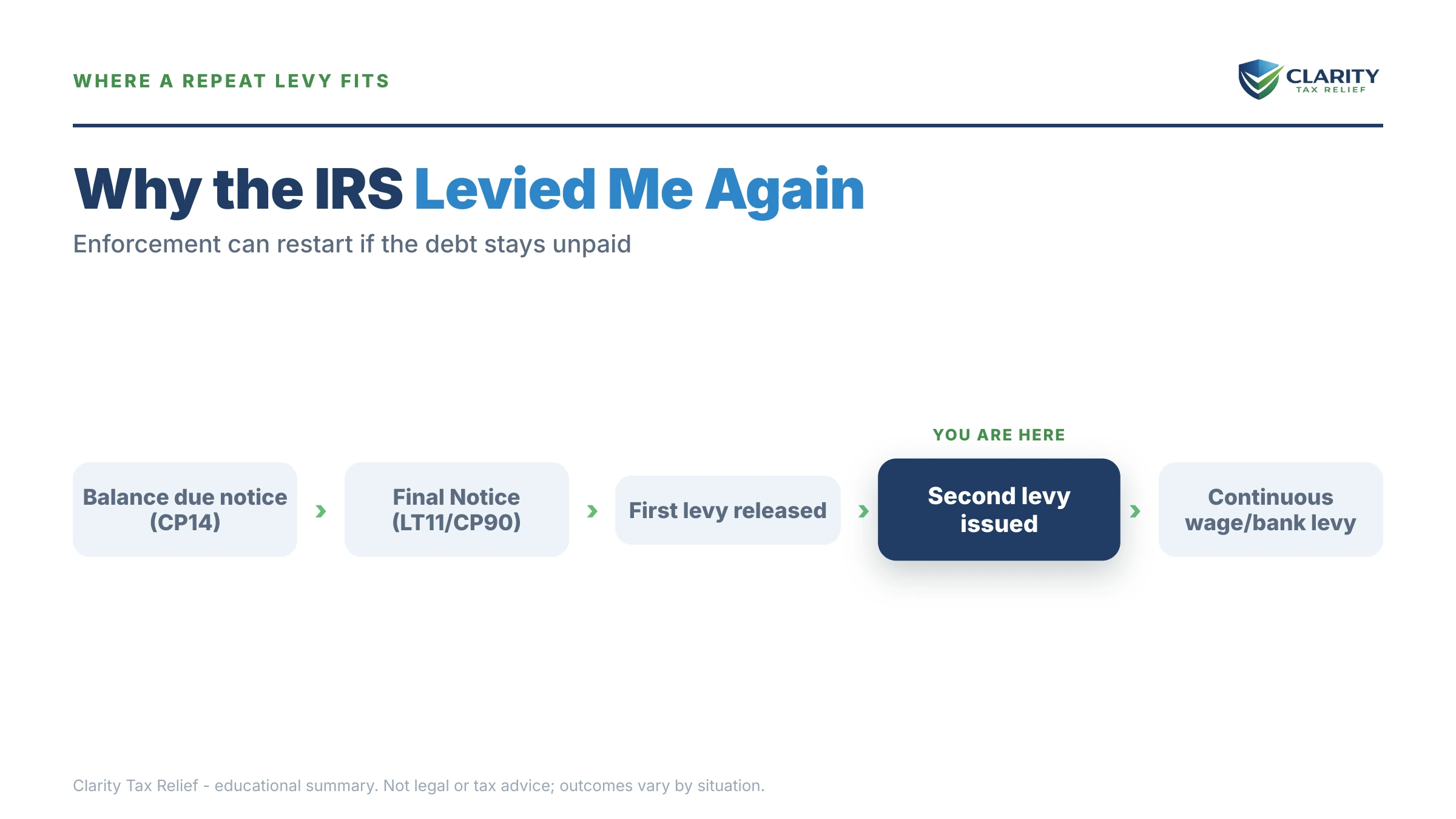
A levy release under IRC §6343 lifts one specific seizure — it does not reduce your balance by a dollar or stop the next levy from issuing. The IRS's automated collection system re-checks unresolved accounts continuously, and when the condition that earned your release ends, a new levy goes out. Five triggers cover almost every repeat levy:
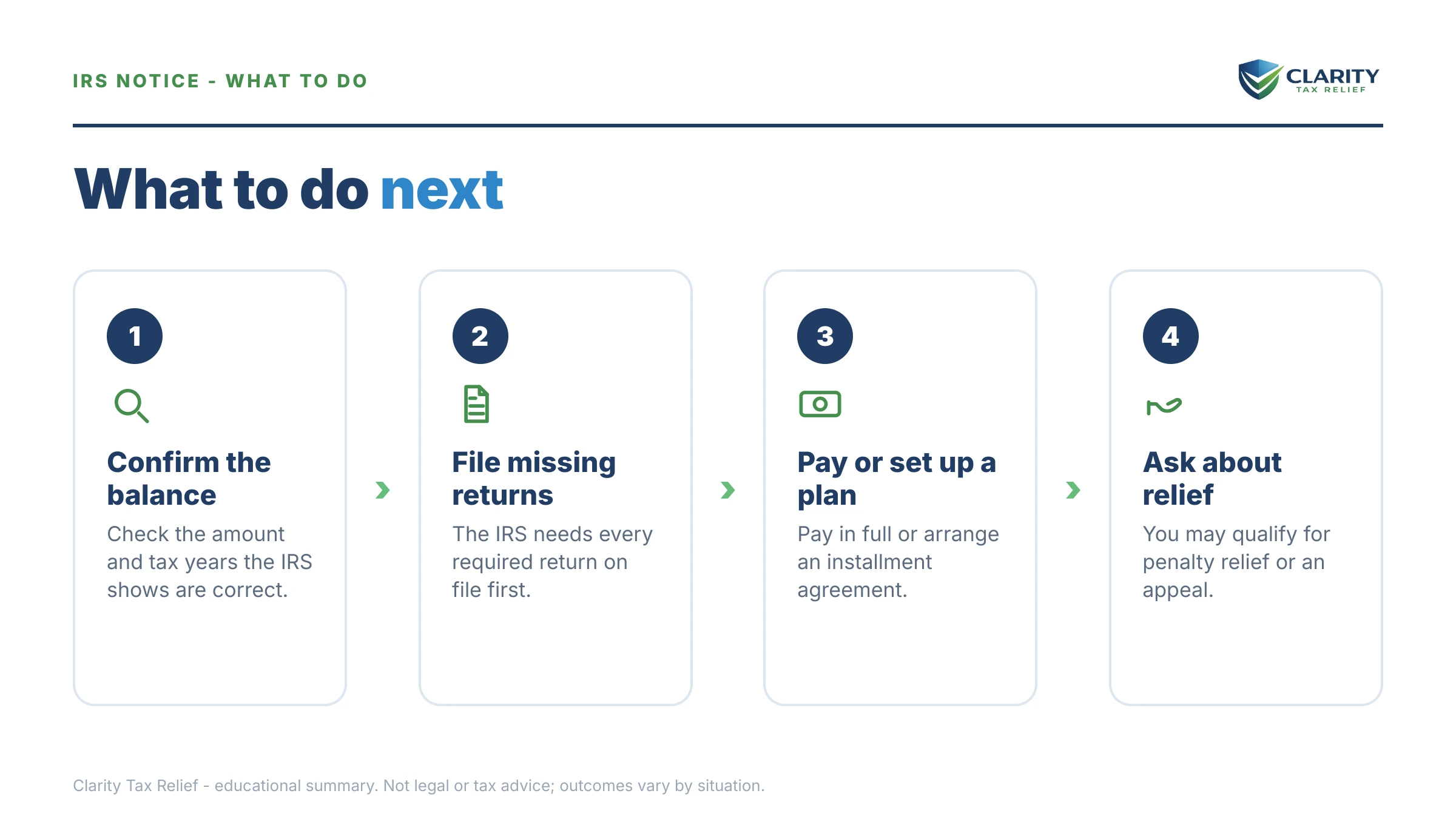
- Your installment agreement defaulted. A missed payment, a new balance you didn't pay, or an unfiled return terminates the agreement. The warning is a CP523 notice — if it went to an old address, the first sign of default is often the levy itself.
- Currently Not Collectible status was removed. CNC is reviewed against your reported income; a raise, a new job, or a strong 1099 year can reactivate collection without a phone call. See CNC status removed.
- An Offer in Compromise was rejected or withdrawn. Collection generally holds while an offer is pending — the hold lifts the moment the offer closes without acceptance.
- A new tax year was assessed. If you filed another balance-due return while the old debt sat unresolved, the new year joins the account and can generate its own levy after its own final notice.
- The release was never followed by a resolution. A hardship release, or a release granted to let a specific paycheck through, is conditional. If nothing replaced it — no plan, no CNC determination, no offer — the account simply cycled back into the levy queue.
Does the IRS have to warn you before levying again?
The IRS only owes you one Collection Due Process notice per tax period — a second levy on the same tax year usually arrives with no new 30-day warning. That surprises almost everyone. The LT11 or Letter 1058 you received before the first levy satisfied the legal notice requirement for those periods permanently. Only a levy reaching a new period restarts the 30-day clock and your Form 12153 CDP hearing rights.
That doesn't leave you without options. Even when CDP is used up, the Collection Appeals Program still lets you challenge the levy action — see CAP appeals — and a hardship release is available at any time regardless of appeal rights.
| Your situation | Notice you should receive | Window | Right you can still use |
|---|---|---|---|
| Levy covers a new tax period | LT11 / Letter 1058 | 30 days from the notice date | CDP hearing (Form 12153) — levy paused while pending |
| Levy covers the same period as before | Often none — CDP notice already given | No new 30-day clock | CAP appeal (Form 9423); hardship release request |
| You missed a 30-day CDP window | — | Up to 1 year from the LT11 date | Equivalent hearing (no Tax Court appeal; levy not automatically paused) |
| Installment agreement defaulted | CP523 | The cure date printed on the CP523 (typically about 30 days) | Reinstate before termination and levies generally stay off |
| Bank account levied | Bank receives Form 668-A; you get a copy | 21 days before funds transfer | Release request before the hold expires |
What happens if you ignore a repeat levy
An unresolved repeat levy escalates from one income source to every income source the IRS can see. The sequence isn't a threat — it's how the automated system works through an account that keeps showing "unresolved," and in 2026, with IRS staffing down roughly 27%, the automation runs whether or not a human ever reviews your file:
- The wage levy keeps taking every paycheck. A Form 668-W is continuous — it doesn't stop at some total; it stops only when released or the debt ends. Estimate what it leaves you each payday with our IRS Wage Garnishment Calculator.
- Bank accounts get levied repeatedly. Each new Form 668-A captures that day's balance, each with its own 21-day hold. New deposits after the levy date are safe — until the next levy lands.
- Federal payments get tapped. The Federal Payment Levy Program can take up to 15% of Social Security benefits continuously.
- A federal tax lien is filed or refiled. Unlike the levy, the lien attaches to your home's title — and it is what freezes a refinance in underwriting.
- Passport certification. Once a seriously delinquent balance crosses $66,000 (the 2026 threshold), the IRS can certify it to the State Department, which can deny or revoke your passport.
- Revenue officer assignment. Accounts that cycle through multiple levies without resolution can move from the automated system to a human collector with asset-review authority.
Levied a second time right now?
The last fix didn't hold — this one has to. Get your levy paperwork reviewed free before your next paycheck or the 21-day bank deadline runs out. An experienced tax professional will identify what triggered the re-levy and the fastest release path that sticks.
Your options after a second levy
Every release path that worked the first time still works for a second levy — but this time it has to end in a resolution, not just a release. Which path fits depends on what triggered the re-levy:
- Reinstate the defaulted agreement. If a CP523 default caused this, reinstatement is usually the fastest route — a reinstatement fee applies, and levies generally lift once the agreement is back in force. Walkthrough: reinstate irs payment plan.
- Set up a new payment plan. Balances of $50,000 or less can qualify for a streamlined agreement of up to 72 months; above that, the IRS wants a Form 433-F financial statement first — see irs payment plan over 50000. Interest and penalties keep accruing on any plan.
- Request a hardship release under §6343. If this levy leaves you unable to pay basic living expenses, the IRS is required to release it — often the same day, with proof. Full playbook: irs levy release hardship. Pair it with Currently Not Collectible status so collection stays paused instead of recycling.
- Submit an Offer in Compromise — if the math works. Collection generally holds while an offer is pending, but the IRS accepted roughly 1 in 5 offers in FY2024; it's a means-tested program, not an escape hatch, and a rejected offer is exactly what triggers some second levies.
- Appeal the levy action. A CAP appeal (Form 9423) can challenge a levy even when your CDP rights are used up; the decision is final but fast.
- Bankruptcy's automatic stay stops active levies while the case is open, but it's a serious step with tax-specific rules — an option to evaluate with counsel, not a reflex.
For the mechanics of getting any levy lifted — who to call, what to say, what proof to have ready — see how to get irs levy released, and for the wage-specific version, the full guide on how to stop irs wage garnishment.
What your transcript tells you about the re-levy
Your account transcript shows the exact event that put your account back in the levy queue — usually in one of five code patterns. Pull it before you call the IRS, so you're negotiating from facts instead of guesses:
| Code pattern | What it means for your repeat levy | What to do |
|---|---|---|
| 971 (notice issued) shortly before the levy | A CP523 default notice or a final notice for a new period went out — possibly to an old address | Match the 971 date to the notice; if it's a CP523, ask about reinstatement before termination |
| 530 posted, then reversed | Your hardship (CNC) status ended — usually because reported income rose | Re-document current income and expenses; request CNC again if hardship still exists |
| 480 followed by 481 or 482 | An Offer in Compromise was pending, then rejected (481) or withdrawn (482) — the collection hold lifted | Decide fast: appeal the rejection within its window, or move to a payment plan before levies stack |
| 520 followed by 521 | A bankruptcy or litigation freeze was released; collection resumed where it left off | Confirm which years survived; resolve remaining balances directly |
| New 150 / 290 on another year | A fresh assessment joined the account — the levy may cover more periods than the last one did | Check every period listed on the levy form; new periods carry fresh CDP rights |
What a second levy means at $61,200 — with a refinance on the line
Say you owe $61,200 across two tax years, your installment agreement defaulted while you were gathering refinance documents, and a new wage levy just hit — here's the realistic math. This is a hypothetical, not a client story:
- Full-balance plan: $61,200 is above the $50,000 streamlined line, so the IRS will want a Form 433-F financial statement. Spread over 72 months, that's roughly $850 per month before the interest and penalties that keep accruing on the declining balance.
- Pay-down play: paying $11,201 up front drops the balance to $49,999 — under the streamlined threshold, where a direct-debit agreement of up to 72 months (about $694/month on the remaining balance) can be set up without the full financial disclosure.
- The accrual risk: if most of that $61,200 is tax, the 0.5%-per-month failure-to-pay penalty alone adds up to roughly $306 a month, plus compounding interest. Left unresolved, the balance can cross the $66,000 passport-certification threshold in around a year — adding a passport problem to a levy problem.
- The refinance: the wage levy doesn't cloud your title, but the federal tax lien that typically accompanies a balance this size does. A lien subordination on Form 14134 asks the IRS to let the new lender take priority so the loan can close — and some homeowners use closing proceeds to pay the IRS down or off. Lenders will also want to see an active, current installment agreement, which is one more reason the resolution has to hold this time.
How to respond to a second levy, step by step
- Identify the levy type. Check the form number on the paperwork — Form 668-W is a continuous wage levy that hits every paycheck; Form 668-A is a one-time bank or account levy with a 21-day hold.
- Find the trigger. Pull your recent notices and your account transcript to see what ended the earlier hold — a CP523 default, CNC removal, a rejected offer, or a newly assessed tax period.
- Call before the clock runs. Contact the IRS collection line — or have a representative do it — before the 21-day bank deadline or your next payday, with your income and expense numbers ready.
- Replace the release with a resolution. Reinstate the defaulted agreement, set up a new payment plan, request Currently Not Collectible status, or start an Offer in Compromise so your account shows resolved, not just released.
- Document hardship if it applies. If the levy leaves you unable to cover basic living expenses, request a release under IRC §6343 and be ready to prove income and expenses on the same call.
Payment options and plan setup live at the IRS payment plans page and IRS.gov/payments. If a levy is causing immediate economic harm and you can't get traction through normal channels, the Taxpayer Advocate Service can intervene.
When you can handle this yourself
A repeat levy with a simple cause is often a one-phone-call fix. If your agreement defaulted over a single missed payment, you agree with the balance, and you can resume paying — or you can pay the whole thing within 180 days — call the IRS, reinstate or set up the plan, and ask for the levy release on the same call. You don't need to hire anyone for that.
Experienced help changes outcomes when the situation is layered: a levy in motion while a refinance or closing is pending, multiple tax years with different notice histories, a balance over $50,000 where the Form 433-F numbers determine your payment, hardship documentation the IRS keeps rejecting, or business and payroll debt mixed into the account. In those cases, the order you fix things in — and how the financial statement is presented — often matters more than the program you pick.
Terms on your levy paperwork, decoded
- Levy release: the IRS lifting one specific seizure — the debt, penalties, and interest all remain.
- Continuous levy: a Form 668-W wage levy that attaches to every paycheck until released, unlike a one-time bank levy.
- CDP (Collection Due Process): your one formal hearing right per tax period, triggered by the final notice (LT11/Letter 1058) and requested on Form 12153.
- Equivalent hearing: a late CDP request allowed up to one year after the final notice — heard by Appeals, but with no Tax Court review and no automatic levy pause.
- CAP (Collection Appeals Program): a fast appeal of a specific collection action on Form 9423, available even after CDP rights are used; the decision is final.
- CSED: the Collection Statute Expiration Date — generally 10 years from assessment, paused by offers, bankruptcy, and CDP hearings.
Second-levy questions, answered
Can the IRS levy me again after releasing a levy?
Yes. A levy release only lifts that one specific seizure — it does not settle, pause, or forgive the debt underneath it. Unless the release was replaced by an active resolution (a payment plan, Currently Not Collectible status, or a pending offer), the IRS's automated system can and usually does issue a new levy. For the same tax period, it generally does not have to send a new final notice first.
Does the IRS have to send a new final notice before levying me a second time?
Only for tax periods that were never covered by an earlier final notice. Collection Due Process rights attach once per tax period, so if you already received an LT11 or Letter 1058 for that year, a second levy can issue with no new 30-day warning. If the new levy covers a year you were never warned about, you get a fresh LT11 and a fresh 30-day CDP window.
How many times can the IRS levy my bank account?
As many times as it takes until the debt is resolved or the 10-year collection statute expires. Each bank levy is a one-time grab of whatever sits in the account the day it lands, with a 21-day hold before the funds transfer to the IRS. That 21-day window exists specifically so you can request a release — but a release without a resolution just invites the next levy.
Why did my wage garnishment start again after it was released?
Because the event that earned the release ended. The most common triggers are a defaulted installment agreement (announced by a CP523 notice), removal of Currently Not Collectible status after your reported income rose, a rejected or withdrawn Offer in Compromise, or a new balance assessed for another tax year. Your employer then received a fresh Form 668-W, which stays attached to every paycheck until released again.
Can I still get a hearing to fight a second levy?
Usually yes, just not always the same hearing. If the second levy covers a new tax period, you get full Collection Due Process rights via Form 12153 within 30 days of the final notice. If you missed a 30-day window, you can request an equivalent hearing for up to one year after the LT11 date. If CDP is used up, the Collection Appeals Program (Form 9423) still lets you challenge the levy action itself.
Will a second levy stop me from refinancing my house?
The levy itself does not attach to your home's title — but the Notice of Federal Tax Lien that often accompanies balances this size does, and that is what stalls underwriting. A lien subordination request on Form 14134 can let the new lender take priority so the refinance closes, and some borrowers pay the IRS from the loan proceeds at closing. Start that paperwork early; it is not a same-week process.
How fast can a second levy be released?
The same day in genuine hardship cases, and often within days once a resolution is in place. IRC §6343 requires the IRS to release a levy that prevents you from paying basic living expenses — you will need to prove income and expenses on the call. For a bank levy, the release must be secured within the 21-day hold or the funds transfer. This time, pair the release with a payment plan or hardship status so it holds.
Does the 10-year collection statute stop repeat levies?
Eventually — the IRS generally has 10 years from the date each tax was assessed to collect, and levies must stop when that clock (the CSED) expires. But the clock pauses during a pending Offer in Compromise, bankruptcy, and Collection Due Process hearings, so it often runs longer than 10 calendar years. Until it expires, nothing prevents the IRS from levying the same sources repeatedly.
Your next 24 hours
- Find the form number and tax periods on the new levy paperwork. Form 668-W (wage) vs. Form 668-A (bank) sets your clock, and the periods listed tell you whether any new year — with fresh appeal rights — was added.
- Gather three things: the levy paperwork plus any recent notices (especially a CP523 or LT11), your last filed return, and a current pay stub or the bank statement showing the freeze.
- Get a free case review before the next paycheck cycle or the 21-day bank deadline. Call (888) 825-7779 or use the 2-minute form — an experienced tax professional will pinpoint the re-levy trigger and the release path that ends the cycle instead of restarting it.
This guide is general information, not tax or legal advice for your specific situation. Eligibility for IRS programs depends on individual facts and circumstances; no outcome is guaranteed.