
Tax Liens
Tax Lien Subordination: How Form 14134 Lets Your Refinance Close (2026)
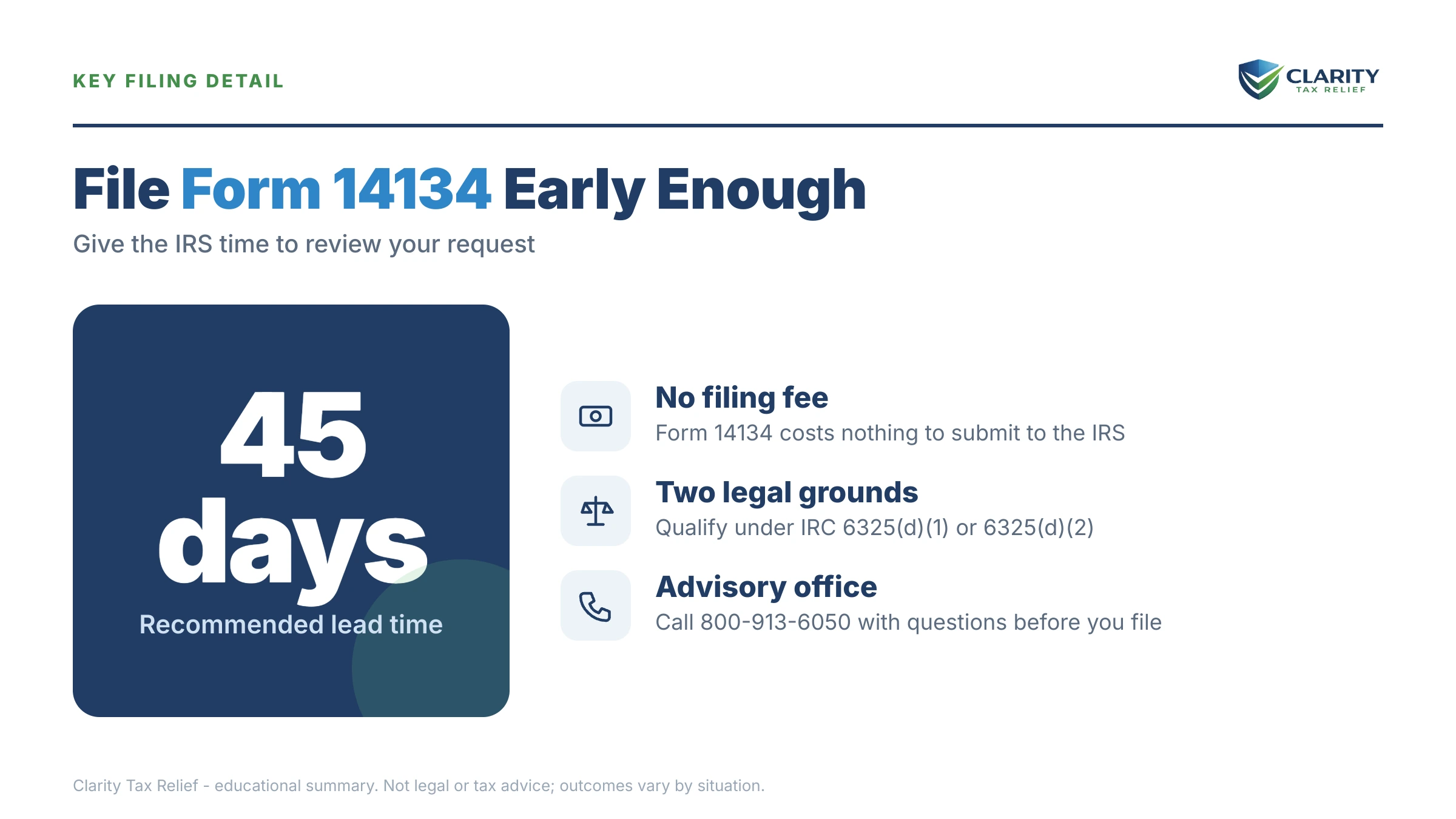
The short answer: tax lien subordination means the IRS agrees, through Form 14134, to let a new loan jump ahead of its federal tax lien so your refinance can close. The lien stays filed and the debt stays owed — only the priority order changes. There's no application fee, and the IRS asks for at least 45 days before closing.
The divorce decree gave you the house — and a deadline to get your ex off the mortgage. Then the lender's title search turned up a federal tax lien from a joint return year, and underwriting stopped cold. Here's the part nobody at the closing table told you: the IRS approves these requests routinely when the paperwork shows it comes out ahead, and this page is the map for getting yours approved.
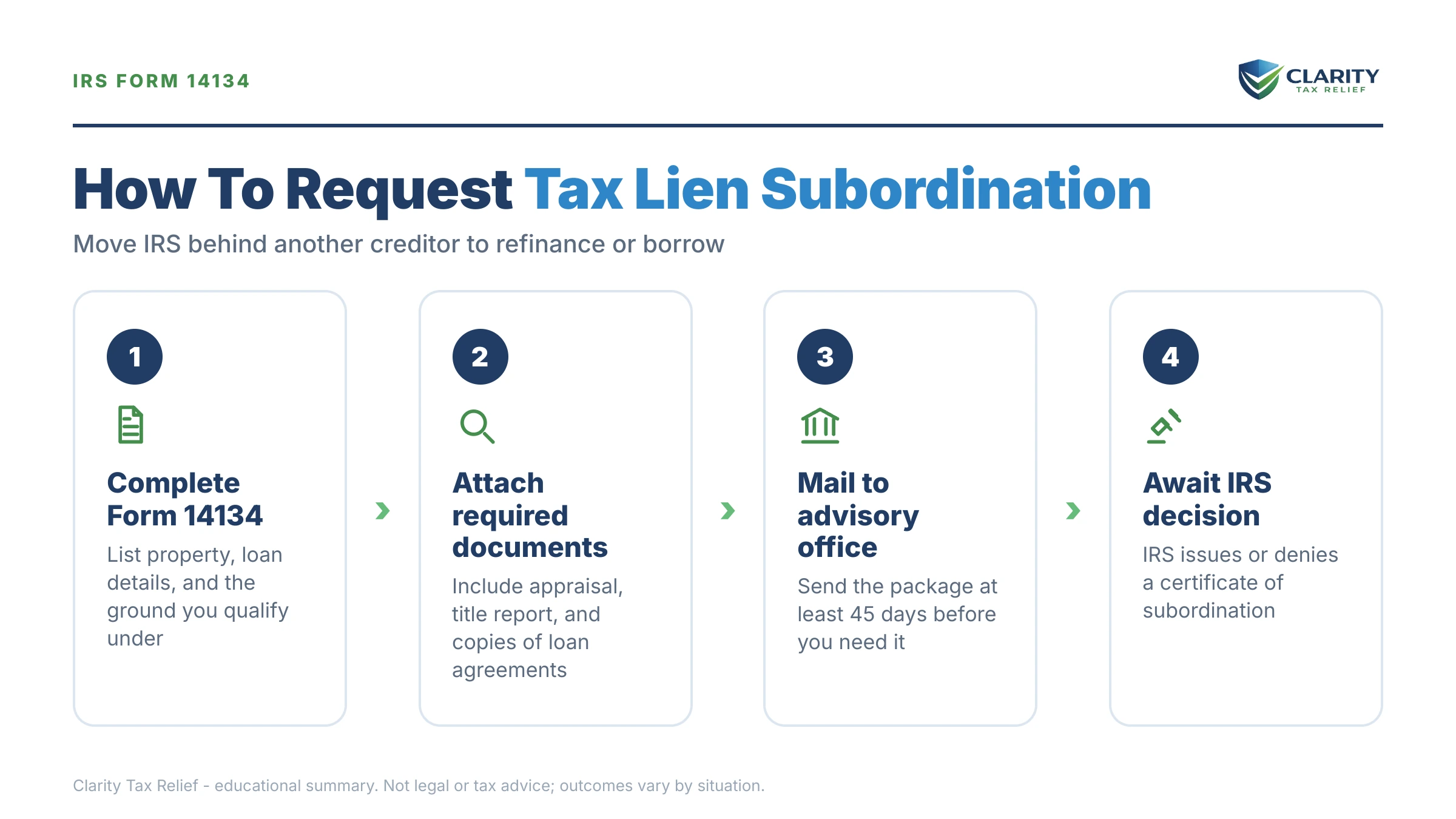
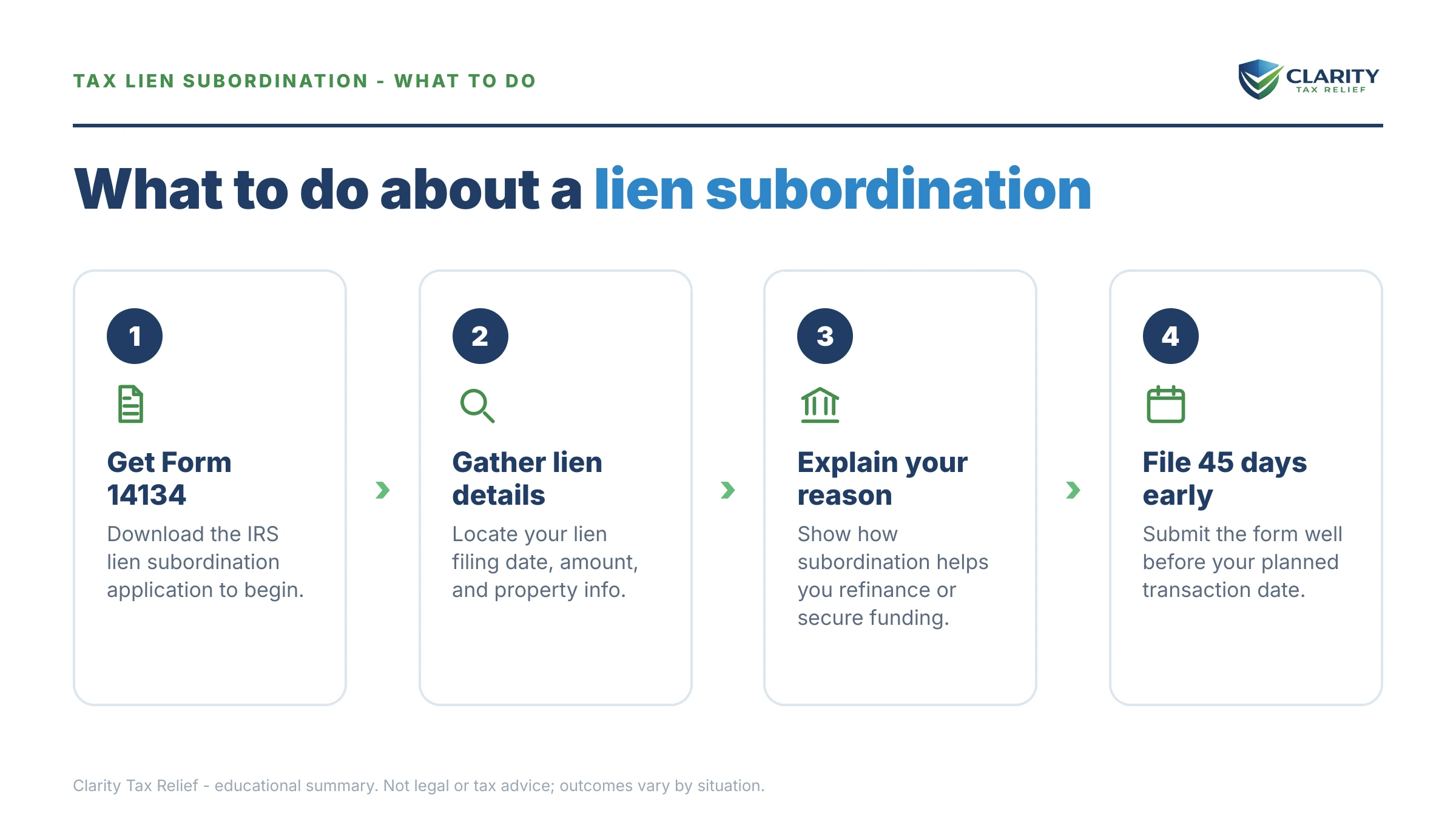
Form 14134 is a short application, but the Advisory Group rejects packets over small omissions. The visual guide below maps the key facts and deadlines, so you can keep the big picture in view as you read section by section.
⏱ Your real clock: the IRS asks you to submit Form 14134 at least 45 days before your closing or settlement date. That window runs from the day a complete packet reaches the Advisory Group — an incomplete application restarts it. Meanwhile, interest and the monthly failure-to-pay penalty keep accruing on the underlying balance.
Why a federal tax lien blocks your refinance
A federal tax lien attaches to everything you own — including the home equity a refinance lender needs first claim on. Lien priority generally runs "first in time, first in right": whoever recorded first gets paid first if the property is ever sold or foreclosed. Our guide to tax lien vs mortgage priority walks through the ordering rules in detail.
Here's the trap specific to refinancing. Your original mortgage keeps its priority because it was recorded before the lien — but a refinance pays that loan off and records a brand-new one, which would land behind the IRS. No lender will fund a first mortgage that sits in second position behind the government. So the file dies in underwriting, even though you have plenty of equity and solid credit.
Subordination solves exactly this. The IRS issues a Certificate of Subordination of Federal Tax Lien saying, in effect: "this one specific new loan may step ahead of us." The lien itself never leaves the record — it keeps its claim on whatever equity remains and on everything else you own, as our guide to a federal tax lien on your house explains. If you're weighing whether a lender will even start the file, see can I refinance with an IRS lien for the lender-side view.
One useful exception: this problem is mostly a refinance problem. If you're buying a different home, a purchase-money mortgage generally takes priority over an existing tax lien without any application — the details are in our guide to buying a house while owing the IRS.
The two legal grounds for IRS lien subordination
IRC §6325(d) gives the IRS two separate reasons to approve tax lien subordination: money now, or more money over time. Every Form 14134 application must fit one of them, and choosing the right one shapes your entire packet.
§6325(d)(1) — the IRS gets paid from the deal. You're doing a cash-out refinance, and the net proceeds — what's left after the old mortgage payoff and reasonable closing costs — go to the IRS through escrow at closing. The IRS subordinates because it receives an amount equal to the lien position it gives up. This is the cleanest, most commonly approved ground. It doesn't require paying the whole balance; it requires paying over what the equity actually yields.
§6325(d)(2) — the deal makes the debt easier to collect. No money changes hands at closing, but the refinance improves the IRS's position anyway — typically because a lower interest rate cuts your monthly mortgage payment, and you commit the difference to an installment agreement. This ground works, but it lives or dies on collection math: the Advisory Group needs to see old payment, new payment, and exactly where the freed-up cash goes. A vague "this will help me pay" gets denied; a signed direct-debit agreement proposal gets approved.
What happens if you try to close without subordination
A refinance blocked by a tax lien doesn't stall quietly — the loan file, the divorce clock, and the IRS balance all keep moving against you. Here's the sequence when the lien goes unaddressed:
- The title search flags the Notice of Federal Tax Lien. It's recorded at the county — there is no closing where it stays hidden.
- Underwriting conditions the loan on lien resolution. The lender won't fund behind the IRS, so the file sits in "suspended" status waiting on a certificate that hasn't been requested.
- Your rate lock expires and your appraisal goes stale. Extending a lock costs money; re-locking at a higher rate can kill the deal's economics entirely — especially a §6325(d)(2) argument built on payment savings.
- The balance keeps compounding. The failure-to-pay penalty accrues at 0.5% per month on top of daily interest, so the payoff figure at your eventual closing is higher than the one on today's notice.
- Decree deadlines come due. Many divorce decrees require the refinance within a set period — miss it and the decree's enforcement terms, sometimes including a forced sale, can come into play. The IRS won't wait for family court: as our guide to divorce decree IRS debt explains, the decree doesn't bind the IRS at all.
- IRS collection continues in the background. The lien is a passive claim, but the unpaid balance behind it still moves through the normal notice stream toward levy authority. Subordination fixes the closing; only a payment arrangement stops the escalation.
Trying to close over a tax lien right now?
The IRS wants your Form 14134 packet at least 45 days before closing — and an incomplete one restarts that clock. Send us your lien notice and loan terms; an experienced tax professional will map the fastest path to your closing date, free and confidential.
Your options: subordination vs. discharge, withdrawal, and release
Subordination is one of four certificates the IRS issues against a filed tax lien, and picking the wrong one costs you weeks you don't have. Each solves a different problem, and none of them carries an IRS application fee.
| Certificate (form) | What it does | When it fits |
|---|---|---|
| Subordination (Form 14134) | Lets one specific new loan move ahead of the lien; the lien stays filed | Refinancing, or borrowing against property you're keeping |
| Discharge (Form 14135) | Removes the lien from one specific property; it stays on everything else | Selling a property — a buyer needs clear title, not just priority |
| Withdrawal (Form 12277) | Pulls the public lien notice as if it had never been filed | Balance of $25,000 or less on a direct-debit plan (plus other conditions), or an erroneous filing |
| Release (Certificate of Release) | Extinguishes the lien entirely | Balance paid in full or otherwise satisfied, or the collection statute has expired |
The neighbors of subordination, briefly: if you're selling rather than refinancing, you want a tax lien discharge on Form 14135 instead — a certificate of subordination is worthless to a buyer. If your balance is at or under $25,000 and you can commit to a direct-debit installment agreement, a lien withdrawal (Form 12277) may remove the public filing entirely, which can be better than subordination if your timeline allows. Once the debt is fully paid, the lien is extinguished by a certificate of release of tax lien — the shared background on that process lives in our guide to getting a lien released after payment. And if your assessment is approaching the 10-year mark, check does an IRS tax lien expire before spending on an application — a lien near its Collection Statute Expiration Date may self-release soon anyway. You can estimate that deadline with our CSED Calculator.
Which path fits you comes down to two numbers: how much equity the refinance can free up, and how large the lien balance is relative to it.
| Your situation | Realistic path | Why it works |
|---|---|---|
| Cash-out proceeds cover the entire IRS balance | Pay the IRS through escrow at closing — no subordination needed | Full payment satisfies the lien; the release follows |
| Cash-out covers part of the balance | Form 14134 under §6325(d)(1) | The IRS gets the net equity now; the remainder goes on a payment plan |
| Rate-and-term refinance, no cash out | Form 14134 under §6325(d)(2) | The lower payment funds a larger monthly IRS payment |
| Selling the property instead of keeping it | Form 14135 discharge | Buyers need the lien off the property, not merely behind a loan |
| Balance ≤ $25,000 and direct debit is workable | Consider Form 12277 withdrawal | Removes the public filing itself, if you meet the conditions and have time |
| Assessment near the 10-year mark | Verify the CSED before applying | A lien approaching statute expiration may self-release |
A worked example: subordinating a $19,700 lien after a divorce
Say you owe the IRS $19,700 from a jointly filed year, the decree awarded you the house, and it gives you twelve months to refinance your ex off the mortgage. The home appraises at $285,000 and the existing mortgage payoff is $221,000 — about $64,000 in equity, all of it sitting behind the lien. This is a hypothetical, but the arithmetic is exactly what the Advisory Group runs. Two workable paths:
Path A — cash-out under §6325(d)(1). Suppose the lender approves you for a new loan of $243,000. After the $221,000 payoff and roughly $7,300 in closing costs, about $14,700 in net proceeds remains — and every dollar of it goes to the IRS through escrow at closing. The IRS issues the certificate conditioned on receiving that $14,700, because that's what its lien position in the property was actually worth. The remaining balance — roughly $5,000 plus accrued penalties and interest — goes on a streamlined installment agreement: at about $130 a month, it clears in roughly four years even as interest continues to accrue.
Path B — rate-and-term under §6325(d)(2). Suppose there's no room for cash out, but the refinance drops your total payment from $1,740 to $1,436 — $304 a month freed up, committed to a direct-debit installment agreement. At $304 a month, $19,700 pays off in about 65 months before accruals — call it roughly five and a half to six years with interest — comfortably inside the 72-month streamlined window. Your application says, with numbers: approving this refinance turns a passive lien into $304 a month of actual collections. That is precisely the argument §6325(d)(2) was written for.
Either way, notice what subordination did not do: it didn't reduce the $19,700, didn't remove the lien from the record, and didn't stop interest. It removed exactly one obstacle — the priority problem standing between you and the closing table.
What goes in your Form 14134 packet
The IRS Collection Advisory Group — not your local IRS office, and not the ACS phone line — decides subordination applications, and it decides entirely on paper. Publication 784 is the IRS's own preparation guide, and the pattern in denials is consistent: applications fail on documentation, not on merit. The visual guides in this article map the timeline and the practical steps, so you can see where each item below fits before you start writing.
| Item | Why it's required | Common rejection trigger |
|---|---|---|
| Signed Form 14134 | The application itself, made under penalties of perjury | Unsigned, or wrong legal ground checked |
| Current property valuation | Establishes the equity the lien has a claim to | Stale appraisal, or no valuation at all |
| Title report | Shows every recorded lien and its priority date | Junior liens omitted, so the equity math doesn't hold up |
| Proposed loan terms or commitment letter | Identifies exactly what jumps ahead of the lien, and the new payment | Terms change before closing, invalidating the review |
| Estimated settlement statement | Under §6325(d)(1), proves what the IRS receives at closing | Proceeds math that doesn't foot to the loan amount |
| Written basis statement | Explains why the IRS comes out ahead under (d)(1) or (d)(2) | A hardship plea instead of collection math |
Mail the packet to the Advisory Group office assigned to the state where the property sits — Publication 4235 lists the addresses. The official form, current revision, and instructions are on the IRS's page for Form 14134, Application for Certificate of Subordination of Federal Tax Lien.
How to apply for tax lien subordination, step by step
- Pull your exact IRS balance and lien details. Get a current payoff figure from your IRS online account or the lien unit, and note every tax year listed on the Notice of Federal Tax Lien.
- Choose your legal ground. Use §6325(d)(1) if the IRS gets paid from closing proceeds; use §6325(d)(2) if the refinance frees up money that increases what the IRS collects.
- Assemble the Form 14134 packet. Include the signed form, a current appraisal, a title report, the proposed loan terms, and an estimated settlement statement showing what the IRS receives.
- Mail the packet to the IRS Advisory Group at least 45 days before closing. Publication 4235 lists the correct office for your property's state; keep proof of mailing.
- Coordinate the conditional certificate with escrow. Under §6325(d)(1) the certificate takes effect when the title company sends the agreed amount to the IRS at closing.
- Resolve the remaining balance. Set up an installment agreement for what's left so penalties stop compounding and the lien can eventually be released.
One practical note on step five: the Advisory Group typically issues the certificate conditionally — it becomes effective only when the promised funds actually move at closing. Give your loan officer and the title company a copy early. Escrow officers who have handled one of these before will route the IRS payoff line on the settlement statement without drama; ones who haven't will appreciate the 45 days of runway.
When you can handle Form 14134 yourself
You can file Form 14134 yourself, and for a single lien with a clean §6325(d)(1) payoff at closing, many people should. If one tax year is on the lien, the title report is clean, your lender has issued firm terms, and the settlement statement plainly shows the IRS receiving the net proceeds, the application is mostly careful assembly. The IRS's plain-language overview at Understanding a Federal Tax Lien plus Publication 784 will get a diligent filer through it.
Experienced help changes the outcome in specific situations. Multiple lien filings across several tax years mean multiple payoff figures and a priority chart that has to reconcile perfectly. A §6325(d)(2) application is a persuasion document — it needs installment-agreement math the Advisory Group will accept, not just a lower payment. Divorce cases layer joint liability on top: whether the lien attached to your interest, your ex's, or both changes the equity analysis, and a possible innocent-spouse angle can change the whole strategy. And if your closing is inside the 45-day window already, a packet that's right the first time is the only packet that saves the deal. If the Advisory Group denies you, the request can be appealed through the Collection Appeals Program — our guide to CAP appeals covers that route — and the Taxpayer Advocate Service can intervene when an IRS delay is about to cost you the closing.
Terms on your subordination application, decoded
- Notice of Federal Tax Lien (NFTL): the public document the IRS records at your county to announce its claim against your property.
- Subordination: the IRS agreeing that one specific new loan gets paid before its lien — the lien itself stays in place.
- Priority: the order creditors get paid from a property, generally set by recording date — "first in time, first in right."
- Advisory Group: the specialized IRS unit that reviews and decides lien certificate applications, organized by the property's state.
- Settlement statement: the closing document (a Closing Disclosure or similar) listing every dollar in and out of the transaction — including the line paying the IRS.
- CSED: the Collection Statute Expiration Date — generally 10 years from assessment, after which the lien behind an unpaid balance self-releases unless the clock was paused or the lien refiled.
Already have loan terms and a closing date on the calendar? Have your Form 14134 packet reviewed free before it goes in the mail — inside a 45-day window, a first-time-right application is the difference between closing and re-locking your rate: (888) 825-7779.
Tax lien subordination FAQs
How long does IRS tax lien subordination take?
Plan on the full 45 days the IRS asks for between submitting Form 14134 and your closing date. Complete, well-documented packets can move faster, but an incomplete application restarts the review, and the Advisory Group will not be rushed by your rate-lock expiration. Submit as soon as you have loan terms and an appraisal, not after underwriting is finished.
How much does Form 14134 cost to file?
There is no IRS application fee for Form 14134 — subordination, discharge, and withdrawal certificates are all free to request. Your real costs are the supporting documents: a current appraisal, a title report, and any professional help you hire. Be wary of anyone charging a large fee just to "unlock" a free IRS form; the value of help is in the collection math and packet quality, not access.
Does subordination remove the federal tax lien?
No. Subordination changes only the priority order — the new loan moves ahead of the lien, but the Notice of Federal Tax Lien stays filed in the public record and keeps its claim against your remaining equity and other property. To actually remove the lien you need full payment and a certificate of release, a qualifying withdrawal, or expiration of the collection statute.
What is the difference between lien subordination and lien discharge?
Subordination (Form 14134) lets a new loan jump ahead of the lien on property you are keeping — it's the refinance tool. Discharge (Form 14135) removes the lien from one specific property entirely — it's the sale tool, because a buyer needs clear title, not just priority. Choosing the wrong form is a common reason applications bounce back with weeks lost.
Can I refinance my house with an IRS tax lien on it?
Yes, and it happens routinely — but not by hoping the lien goes unnoticed. If your cash-out covers the full balance, the title company simply pays the IRS at closing. If it covers only part, or you're doing a rate-and-term refinance with no cash out, Form 14134 subordination is the path lenders will accept. The lien must be addressed on paper either way, because it will appear on every title search.
Will the IRS subordinate its lien if it gets no money at closing?
It can, under IRC §6325(d)(2), if you show the refinance makes the debt easier to collect — usually because a lower mortgage payment frees up money you commit to a monthly installment agreement. The IRS approves these when the collection math clearly favors it, so your application needs specific numbers: old payment, new payment, and the payment plan the difference will fund.
My divorce decree says my ex is responsible for the tax debt — do I still need subordination?
Yes. A divorce decree divides responsibility between you and your ex, but it does not bind the IRS: on a jointly filed year, each spouse remains liable for the full balance, and the lien attached accordingly. To refinance the house into your name, you resolve the lien issue first — then pursue your ex under the decree, or explore innocent spouse relief if the debt stems from their errors.
What happens if the IRS denies my subordination request?
You can fix the deficiency and reapply, or appeal the denial through the Collection Appeals Program (CAP). Most denials are curable: a stale appraisal, missing loan terms, a settlement statement that doesn't show what the IRS receives, or a §6325(d)(2) argument with no collection math behind it. Ask the Advisory Group employee what was missing before you escalate.
Does a state tax lien need its own subordination?
Yes. Form 14134 covers only the federal tax lien — if a state agency has also filed a lien, it has its own process and its own timeline. California's FTB, for example, handles its own lien subordinations under state law. Have your title company pull every recorded lien early, because each one must be resolved separately before your closing can fund.
Facing a state lien on the same title report? Start with our guide to the FTB tax lien if California is involved — state liens run on state rules, not the IRS's.
Your next 24 hours
- Find the lien details. Pull the Notice of Federal Tax Lien from your title report or closing file and write down the recording date, the tax years listed, and the amount shown.
- Gather the loan file. Your appraisal, loan estimate or commitment letter, current mortgage statement, and your latest IRS balance — that's the entire raw material of a Form 14134 packet.
- Get a free case review. The Advisory Group's 45-day clock only starts when a complete packet arrives — have an experienced tax professional check yours before it goes in the mail. Call (888) 825-7779 or use the 2-minute form.
This guide is general information, not tax or legal advice for your specific situation. Eligibility for IRS programs depends on individual facts and circumstances; no outcome is guaranteed.