
IRS Liens & Forms
IRS Lien Withdrawal Form 12277: How to Erase a Filed Tax Lien From the Public Record (2026)
The short answer: IRS lien withdrawal Form 12277 asks the IRS to withdraw a filed Notice of Federal Tax Lien, erasing it from the public record as if it had never been filed. You can qualify after the debt is paid and released — or while still owing, if your balance is $25,000 or less on a direct-debit installment agreement.
You probably didn't find the lien by opening an IRS envelope. Your loan officer ran a title search on the refinance and a Notice of Federal Tax Lien came back attached to your house — and now the whole loan is on hold. Here's the good news: the IRS built a specific, no-fee process to make that filing disappear, and Form 12277 is how you start it.
Withdrawal is different from — and stronger than — the lien release most people assume is the end of the story. A release says "paid." A withdrawal says "treat this filing as if it never existed," and the IRS records that correction with the same county office that holds the original lien.
Form 12277 is a single page, but two sections on it decide whether your request is approved or bounced. The image below shows you exactly what the form looks like and where those sections sit, so keep reading before you fill anything in.
⏱ The real clock: there is no IRS deadline to file Form 12277 — but the most-used qualifying path requires three consecutive direct-debit payments to post before you're eligible, and processing after that typically takes several more weeks. If a refinance is on your calendar, the math says start now, not the month before closing.
Withdrawal vs. release: why the difference decides your refinance
A lien release closes out the lien; a lien withdrawal removes the public filing as if it had never been made — and only withdrawal cleans the county record a refinance underwriter will pull. The two documents are not interchangeable, and asking for the wrong one wastes months.
When you pay a tax debt in full, the IRS issues a certificate of release of tax lien (Form 668(Z)). That's real progress — the lien no longer encumbers your property. But the original Notice of Federal Tax Lien stays in the land records forever, with the release stapled to it. Title searches still surface both documents, and some lenders still ask questions.
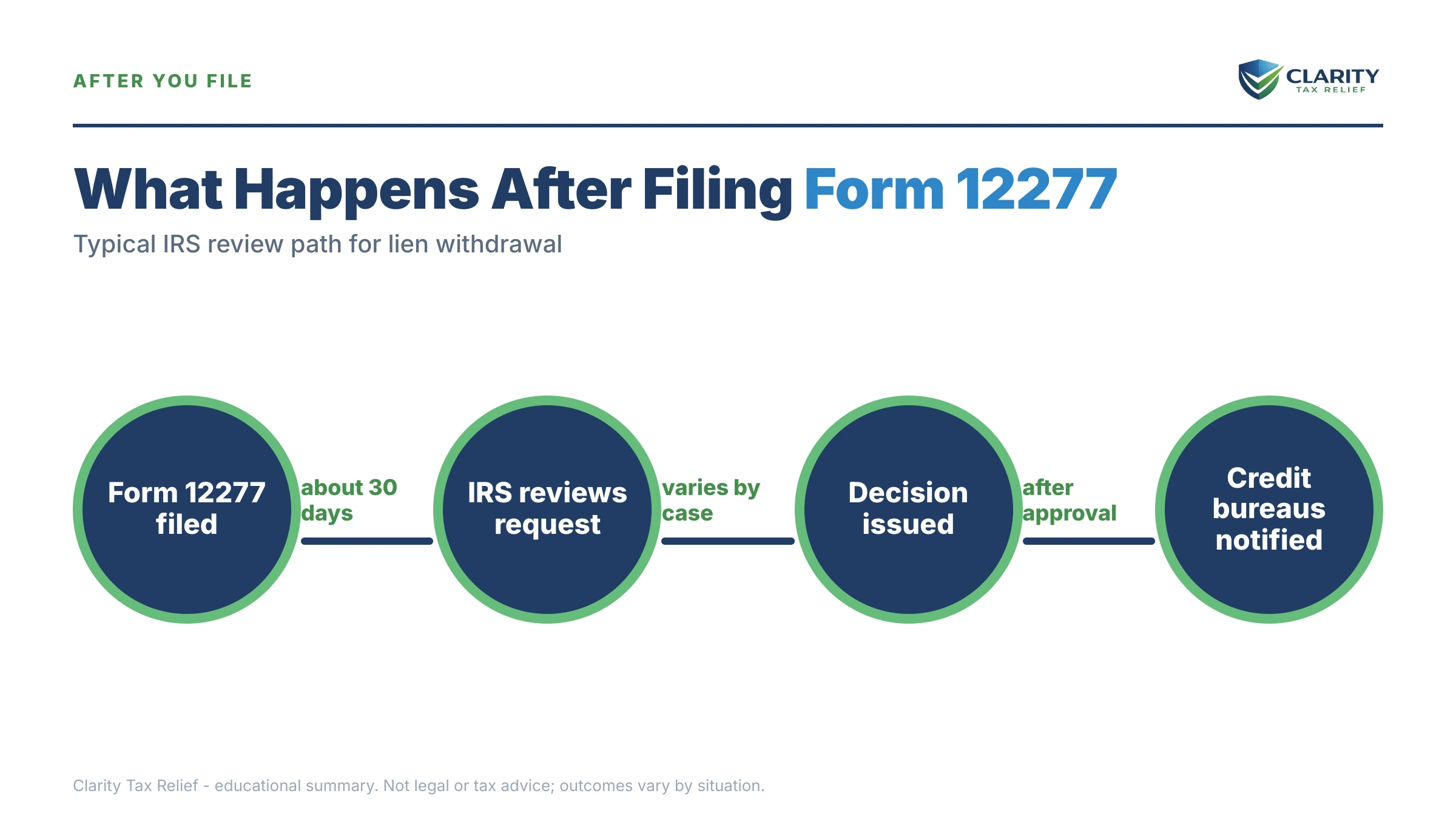
A withdrawal goes further. The IRS issues Form 10916(c), Withdrawal of Filed Notice of Federal Tax Lien, and files it with the recording office, formally retracting the notice. On Form 12277 you can also ask the IRS to send copies of the withdrawal to creditors and credit reporting agencies you name — useful ammunition for your underwriter's file. For the broader timeline of how releases work after payment, see the full guide on how long for the IRS to release a tax lien; this article stays focused on the withdrawal application itself.
One honest caveat: if you still owe, withdrawal removes only the public notice. The underlying statutory lien — the IRS's silent legal claim — survives until the debt is paid or the collection statute runs out. That's why the IRS grants pre-payment withdrawals only in narrow, defined situations, covered next.
Who qualifies for IRS lien withdrawal in 2026: the four legal grounds
IRC §6323(j) gives the IRS exactly four grounds to withdraw a filed tax lien, and each one is a checkbox in section 11 of Form 12277. Your application lives or dies on picking the right box and proving it.
| Ground (Form 12277, section 11) | What you must show | Typical proof to attach |
|---|---|---|
| Notice filed prematurely or not per IRS procedures | The lien was filed before required notices went out, during a bankruptcy stay, or against the wrong person or period | Copies of the notices you did (or didn't) receive, bankruptcy filing dates, account transcripts |
| You entered an installment agreement (Fresh Start direct-debit path) | Balance of $25,000 or less, a direct-debit installment agreement that full-pays within 60 months or before the CSED, three consecutive direct-debit payments made, all returns filed, no prior DDIA default | IA acceptance letter, bank statements showing the three consecutive debits |
| Withdrawal will facilitate collection | Removing the notice helps the IRS get paid faster — e.g., a refinance or business loan that funds a payoff can't close with the notice on record | Lender letter or loan conditions naming the lien, closing statement draft showing IRS payoff |
| Best interest of you and the government | Withdrawal serves both sides — the most common use is after full payment and release, when you want the record scrubbed; the Taxpayer Advocate can also consent on your behalf | Certificate of release (Form 668(Z)) or proof of full payment |
Two of these grounds do nearly all the work for homeowners. If you've already paid in full, the "best interest" box plus your certificate of release is a routine, commonly-granted request. If you still owe, the Fresh Start direct-debit route is the main path — and it has hard edges: $25,000 or less, a direct debit installment agreement (a regular mail-a-check plan does not count), three consecutive debits posted, and full compliance on filing. Married couples should note the $25,000 test applies to the assessed balance on the account, so a joint liability is measured once, not per spouse.
The "facilitate collection" ground is the sleeper option for refinancers who owe more than $25,000: if you can document that the lien notice is the only thing blocking a loan that would pay the IRS, withdrawal can be argued as helping collection. It's discretionary and gets more scrutiny — this is where a well-built application matters most.
What happens if you leave the lien filed
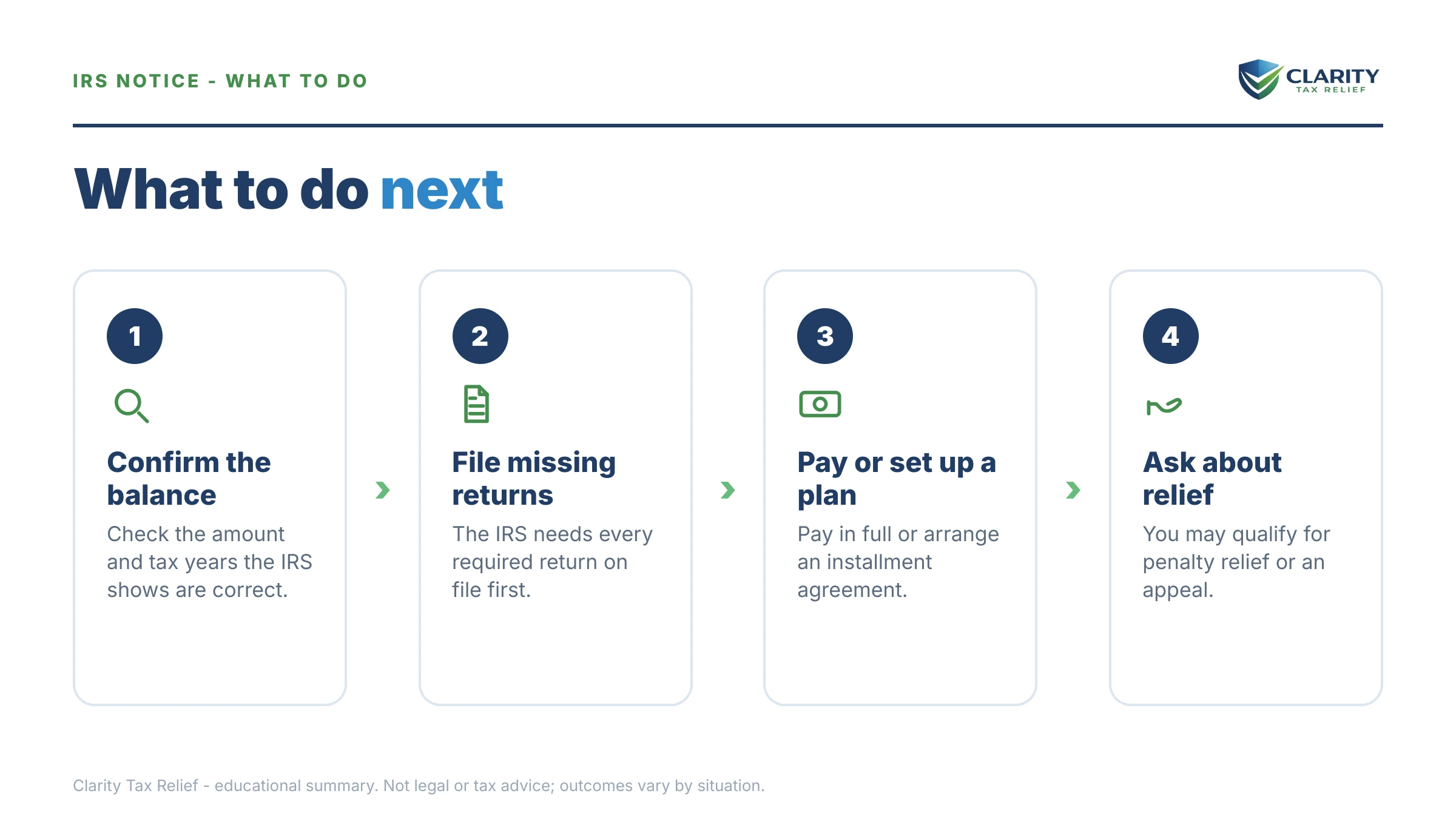
A filed Notice of Federal Tax Lien stays in the county record until it is released, withdrawn, or the collection statute expires — it does not fade out on its own. Here's the sequence if you do nothing:
- The filing sits in the land records. Every title search — refinance, HELOC, sale, even some business credit checks — surfaces it. (It arrived with Letter 3172 notice of federal tax lien, which also carried appeal rights that expire quickly.)
- Underwriting stalls or dies. Because a recorded federal lien can jump ahead of a new loan, most lenders won't close over it — the mechanics are in tax lien vs mortgage priority.
- The balance keeps growing. Interest compounds daily and the 0.5%-per-month failure-to-pay penalty keeps stacking, so the payoff the title company demands rises every month you wait.
- The IRS can refile. Liens generally self-release at the 10-year collection statute, but the IRS can refile before that date if the debt is still open — details in does IRS tax lien expire. You can estimate your own expiration date with our CSED Calculator.
- Even after payoff, the paper trail remains. A release ends the lien but leaves the filing history in the record — only a granted Form 12277 withdrawal retracts it.
One 2026 reality worth naming: the IRS workforce shrank roughly 27% in 2025, and Collection Advisory Groups — the offices that decide these applications — are not immune. Clean, complete applications move; sloppy ones sit in a queue with no one chasing them.
Is a filed tax lien blocking your refinance?
Get your lien file reviewed free. An experienced tax professional will map whether withdrawal, subordination, or a payoff at closing gets you to the table fastest — while interest keeps accruing and the filing sits in the record, waiting is the one option that always costs more.
Withdrawal, release, discharge, or subordination: which lien tool fits
Withdrawal is one of four tools for a filed federal tax lien, and each solves a different problem — the fastest path to a closing is often a combination, not a single form.
| Tool & form | What it does | When it fits a refinance |
|---|---|---|
| Withdrawal — Form 12277 | Retracts the public filing as if never made; Form 10916(c) is recorded | Debt paid and released, or ≤ $25,000 on direct debit, or the loan itself funds the payoff |
| Release — Form 668(Z) | Closes the lien because the debt is satisfied or the statute expired; filing history remains | Automatic after full payment — the payoff-at-closing route ends here, then 12277 cleans up |
| Discharge — Form 14135 | Removes one specific property from the lien; the lien survives on everything else | You're selling the property rather than refinancing — see tax lien discharge |
| Subordination — Form 14134 | Lets a new lender move ahead of the IRS in priority; the lien stays filed | You owe too much for withdrawal and the closing date is near — see tax lien subordination |
The decision usually comes down to two questions: is the debt paid, and how soon is closing? Paid and released → file 12277 under best-interest and wait for the record to clear. Still owing under $25,000 → convert to direct debit, make three payments, then file. Owing more with a closing date bearing down → subordination gets the loan closed, the payoff or paydown happens at the table, and withdrawal becomes the cleanup step. The full lender-side picture is in can I refinance with an IRS lien.
A worked example: $68,500 owed, a refinance on the line
Say you owe $68,500 across two tax years, the Notice of Federal Tax Lien is recorded against your home, and a cash-out refinance would free about $90,000 in equity. You're over the $25,000 direct-debit threshold, so a straight Form 12277 withdrawal isn't available yet. You have three realistic routes — all hypothetical numbers, shown so you can run your own:
- Route 1 — pay down, then withdraw. Pay $43,501 to bring the balance to $24,999. Convert the remainder to a direct-debit agreement: $24,999 ÷ 60 months ≈ $417/month plus accruing interest. After three consecutive debits post (about three months), file Form 12277 under the installment-agreement ground. Add several weeks of Advisory processing and recording: roughly five to six months to a clean record. Best when you have cash but the refinance isn't urgent.
- Route 2 — subordinate, close, pay off, then withdraw. Apply for subordination with Form 14134 so the new lender takes first position. The refinance closes, $68,500 of the $90,000 cash-out goes to the IRS at the table, the lien is then released — and Form 12277 afterward scrubs the filing from the record. Best when the closing date is fixed and the loan itself is the payoff source.
- Route 3 — argue "facilitates collection" up front. If your lender will state in writing that it will fund only without the recorded notice, and the loan pays the IRS in full, a 12277 on the facilitate-collection ground asks the IRS to withdraw first so the loan can close. Discretionary, slower to persuade, but it exists precisely for this fact pattern.
Notice what all three routes share: the IRS collects, which is exactly why they work. Applications framed around how the government gets paid are the ones Advisory approves.
How to file Form 12277, step by step
- Pull the filed lien notice. Get a copy of the Form 668(Y) from your county recorder or the IRS Centralized Lien Operation — Form 12277 asks for its serial number, filing date, and recording office.
- Confirm your withdrawal ground. Match your situation to one of the four boxes in section 11 — paid-and-released, the $25,000 direct-debit path, facilitating collection, or best interest — before you write anything.
- Complete Form 12277. Fill in your identifying information, attach a copy of the Form 668(Y) if you have it, check the correct ground, and explain your basis in section 12 in plain, specific terms.
- Attach your proof. Include the evidence for your ground — the certificate of release, direct-debit agreement confirmation and payment history, or the lender letter showing how withdrawal speeds payment.
- Mail it to the Collection Advisory Group. Send the package with tracking to the Advisory office for the state where the lien was recorded (addresses are in Publication 4235), or to your assigned revenue officer if you have one.
- Follow up and record the withdrawal. If you have not heard back in about 45 days, call the Advisory office; once approved, confirm Form 10916(c) was recorded and send copies to your lender and any creditors you listed.
There is no fee to file Form 12277, and if you're denied you can appeal through the Collection Appeals Program (CAP) or fix the defect and reapply. Watch your account transcript too: code 583 transcript is the entry that reflects the lien release or withdrawal posting on the IRS side.
When you can handle Form 12277 yourself
Most taxpayers can file Form 12277 on their own when the debt is already paid and released — that version is a straightforward paperwork exercise: attach the release, check the best-interest box, explain in one paragraph, mail it, follow up. The same is true if you're squarely inside the direct-debit rules with three clean payments and every return filed.
Experienced help changes the outcome in the harder fact patterns: you owe more than $25,000 and need the facilitate-collection argument built with lender documentation; you're juggling subordination and withdrawal against a closing date; the lien covers multiple years or a IRS lien jointly owned property situation where only one owner owes; or the lien was filed defectively and the premature-filing ground needs transcript evidence. Those applications are won or lost on how the package is framed, and a denial costs you months. If your situation reads like the second list, have a professional look before you mail anything — that review is what the free consultation is for.
Terms on Form 12277 and your lien paperwork, decoded
- Notice of Federal Tax Lien (NFTL) / Form 668(Y): the document the IRS records at your county to publicly announce its claim — this is what Form 12277 withdraws.
- Statutory lien: the IRS's automatic legal claim that arises when tax is assessed and unpaid; it exists whether or not anything is recorded, and withdrawal does not erase it while you still owe.
- Form 10916(c): the withdrawal certificate the IRS issues and records when your Form 12277 is granted.
- Form 668(Z): the certificate of release recorded when the debt is satisfied — proof the lien ended, but not a retraction of the original filing.
- CSED: the Collection Statute Expiration Date — generally 10 years from assessment, pausable by appeals, an offer in compromise, or bankruptcy; liens self-release at the CSED unless refiled.
- Collection Advisory Group: the IRS unit that decides lien withdrawal, discharge, and subordination requests; Publication 4235 lists the office for each state.
One more record-related note for anxious borrowers: withdrawal will not change your credit score, because the bureaus dropped tax liens years ago — the full story is in tax lien on credit report. The battlefield in 2026 is the public record, not the credit file.
Form 12277 questions, answered
What is the difference between a lien release and a lien withdrawal?
A release means the IRS closed out the lien because the debt was paid or the collection statute expired — but the original filing stays in the public record with a release attached to it. A withdrawal removes the Notice of Federal Tax Lien from the record as if it had never been filed. If you want a clean title history for a refinance or loan, withdrawal is the stronger outcome, and you can request it even after a release by filing Form 12277.
Can I get an IRS lien withdrawn if I still owe money?
Yes, through the Fresh Start direct-debit path. You may qualify if you owe $25,000 or less, are on a direct-debit installment agreement that will pay the balance in full within 60 months or before the collection statute expires, have made three consecutive direct-debit payments, and are current on all filing and payment requirements. If you owe more, paying the balance down to $25,000 first can open this door.
How long does the IRS take to process Form 12277?
There is no statutory deadline, and timing varies with Advisory Group workload; most requests take several weeks to a couple of months. Once approved, the IRS issues Form 10916(c) and files it with the same recording office that holds the original lien notice. If a refinance closing is already scheduled, tell your lender the withdrawal is pending and ask an experienced tax professional whether subordination is a faster parallel track.
Does a lien withdrawal remove the lien from my credit report?
The three major credit bureaus stopped reporting tax liens in 2018, so the lien is almost certainly not on your credit report today. What withdrawal fixes is the public record — county land records and title searches, which is where lenders actually find liens now. Form 12277 also lets you ask the IRS to notify creditors and credit reporting agencies you list that the notice was withdrawn.
Where do I mail Form 12277?
Send it to the IRS Collection Advisory Group that covers the state where the Notice of Federal Tax Lien was filed; Publication 4235 lists the current addresses. If a revenue officer is assigned to your account, send it to that officer instead. Keep a copy and mail it with tracking so you can prove when it arrived and follow up.
What happens if my Form 12277 request is denied?
You can appeal through the Collection Appeals Program (CAP), or fix the defect and reapply. Common denial reasons are owing more than $25,000 on the direct-debit path, not yet having three consecutive direct-debit payments posted, or having unfiled returns. Address the specific reason stated in the denial letter before refiling — a corrected second application often succeeds where the first one failed.
Do I need a lien withdrawal to refinance my house?
Not always. A lender can close if the IRS subordinates its lien using Form 14134, or if the balance is paid at closing and the lien is released. Withdrawal is the cleanest outcome because the filing disappears from the record entirely, but it is not the fastest — subordination is often the practical route when a closing date is near and withdrawal is the cleanup step afterward.
Your next 24 hours
- Find the recording details on your lien. Pull out the Form 668(Y) (or Letter 3172) and locate the serial number, the recording office, and the filing date — Form 12277 cannot be completed without them.
- Gather your proof. Your installment agreement acceptance letter or certificate of release, bank statements showing direct-debit payments, your last filed return, and any lender letter that names the lien.
- Get the free case review. Send us what you found — the form at claritytaxrelief.com/#consult takes two minutes, or call (888) 825-7779. We'll tell you which withdrawal ground fits, or whether subordination gets your refinance closed faster — because interest accrues and the filing stays in the record every week it goes unaddressed.
Primary sources: the IRS's official pages for Form 12277, Application for Withdrawal of Filed Form 668(Y) and Understanding a Federal Tax Lien, plus IRS payment plans and installment agreements for the direct-debit setup that unlocks the $25,000 withdrawal path.
This guide is general information, not tax or legal advice for your specific situation. Eligibility for IRS programs depends on individual facts and circumstances; no outcome is guaranteed.