
Tax Liens
IRS Lien on Jointly Owned Property: What the IRS Can Reach in 2026
The short answer: an IRS lien on jointly owned property attaches only to your ownership interest — never your co-owner's share. Under IRC §6321, the federal tax lien reaches every property right you hold, including half of a co-owned home. Your co-owner's equity stays theirs, but the lien clouds the whole title until it's resolved.
Maybe the title company called during a sale, or your spouse pulled the county records and found a Notice of Federal Tax Lien with only your name on it — filed because payroll debt from your business followed you home. Their first question is the right one: is their half of the house on the hook? The answer is more protective than you'd fear, and more fixable than the recorded document makes it look.
The image below shows what a recorded Notice of Federal Tax Lien looks like and where to find the three things that decide everything here: the balance, the tax periods covered, and — critically — whose name is listed as the taxpayer.
⏱ Your deadline: if the IRS just recorded the lien, Letter 3172 gives you a window — typically 30 days from the deadline printed on the letter — to request a Collection Due Process hearing on Form 12153. If that window has already passed, there is no fixed clock, but interest and penalties keep growing the balance the lien secures every month.
Why the IRS lien reaches property you don't fully own
A federal tax lien attaches to all property and rights to property you hold — including your fractional interest in anything you co-own — the moment tax is assessed, you're billed, and you don't pay. That's IRC §6321, and it doesn't care whose name shares the deed. If you own 50% of a house with a spouse, parent, or business partner, the lien grabs your 50%.
For a business owner, the path here usually runs through the company. Entity-level debt like unpaid 941s becomes personal when the IRS assesses the trust fund recovery penalty against you as a responsible person — and once it's personal, the lien lands on personal assets, including the home you own jointly with a spouse who never touched the payroll account.
Two versions of the lien matter. The statutory lien is silent — it exists the moment you're assessed and don't pay, with nothing recorded anywhere. The Notice of Federal Tax Lien (NFTL) is the public county filing, announced to you by Letter 3172, that puts lenders, title companies, and buyers on notice. Both attach to your interest only. A lien and a levy are also different animals — the lien is a claim, not a seizure; the lien vs. levy distinction matters when you're deciding how fast to move.
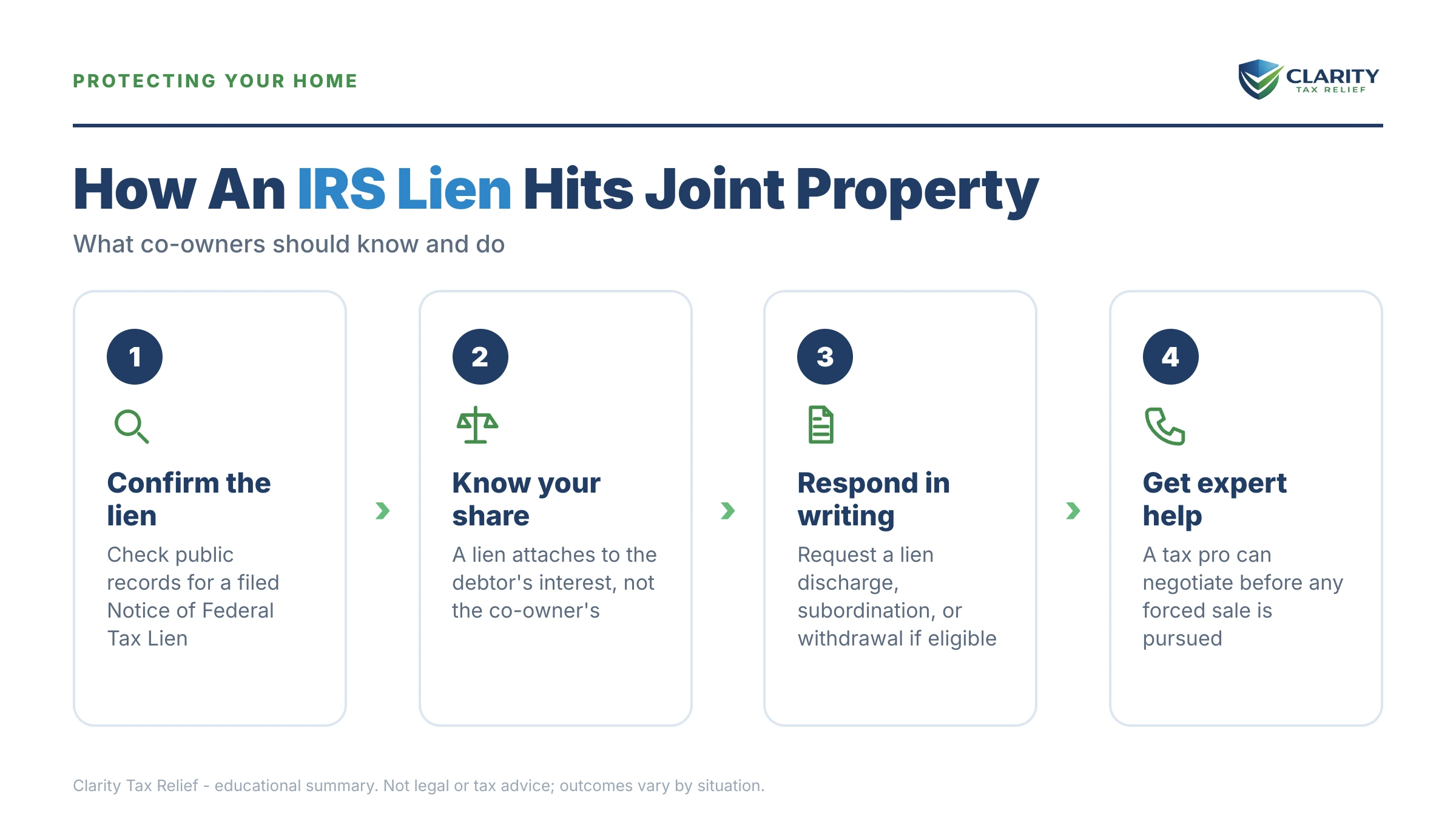
What the lien attaches to, by ownership type
How your deed reads determines exactly how much of the property the IRS lien reaches. Pull the deed before you do anything else — the four common forms of title produce four different answers:
| How title is held | What the IRS lien attaches to | What it means for the co-owner |
|---|---|---|
| Tenancy in common | The liable owner's stated percentage (often 50%, but whatever the deed says) | Co-owner's percentage is untouched; they can even sell their own share separately |
| Joint tenancy with right of survivorship | The liable owner's equal fractional share | Co-owner's share is protected while alive; survivorship can change who owns what — and what the lien follows |
| Tenancy by the entirety (married couples, some states) | The liable spouse's interest — reachable per United States v. Craft (2002), despite state-law protections | Non-liable spouse's interest stays free of the lien, but entirety title no longer blocks the IRS entirely |
| Community property (AZ, CA, ID, LA, NV, NM, TX, WA, WI) | Potentially some or all of the community estate, depending on state law — even assets titled in the non-liable spouse's name | The least protective form for a non-liable spouse; state-specific analysis is essential |
| Joint bank or brokerage accounts | The liable owner's contributions and withdrawal rights — often treated as reachable up to the full balance | Co-owner may have to prove which deposits were theirs to protect them |
The tenancy-by-the-entirety row surprises people most. Before 2002, married couples in entirety states often assumed the IRS couldn't touch a home titled that way. The Supreme Court's Craft decision ended that: the federal lien attaches to the liable spouse's interest even in entirety property, whatever state law says about other creditors. The non-liable spouse's interest remains protected — but the title is clouded all the same.
Community property runs the other direction. In the nine community property states, one spouse's tax debt can expose community assets — sometimes including wages and property held in the non-liable spouse's name. If you're in one of those states, don't assume the general rule on this page protects your spouse; the analysis is state-specific.
What happens if you ignore the lien
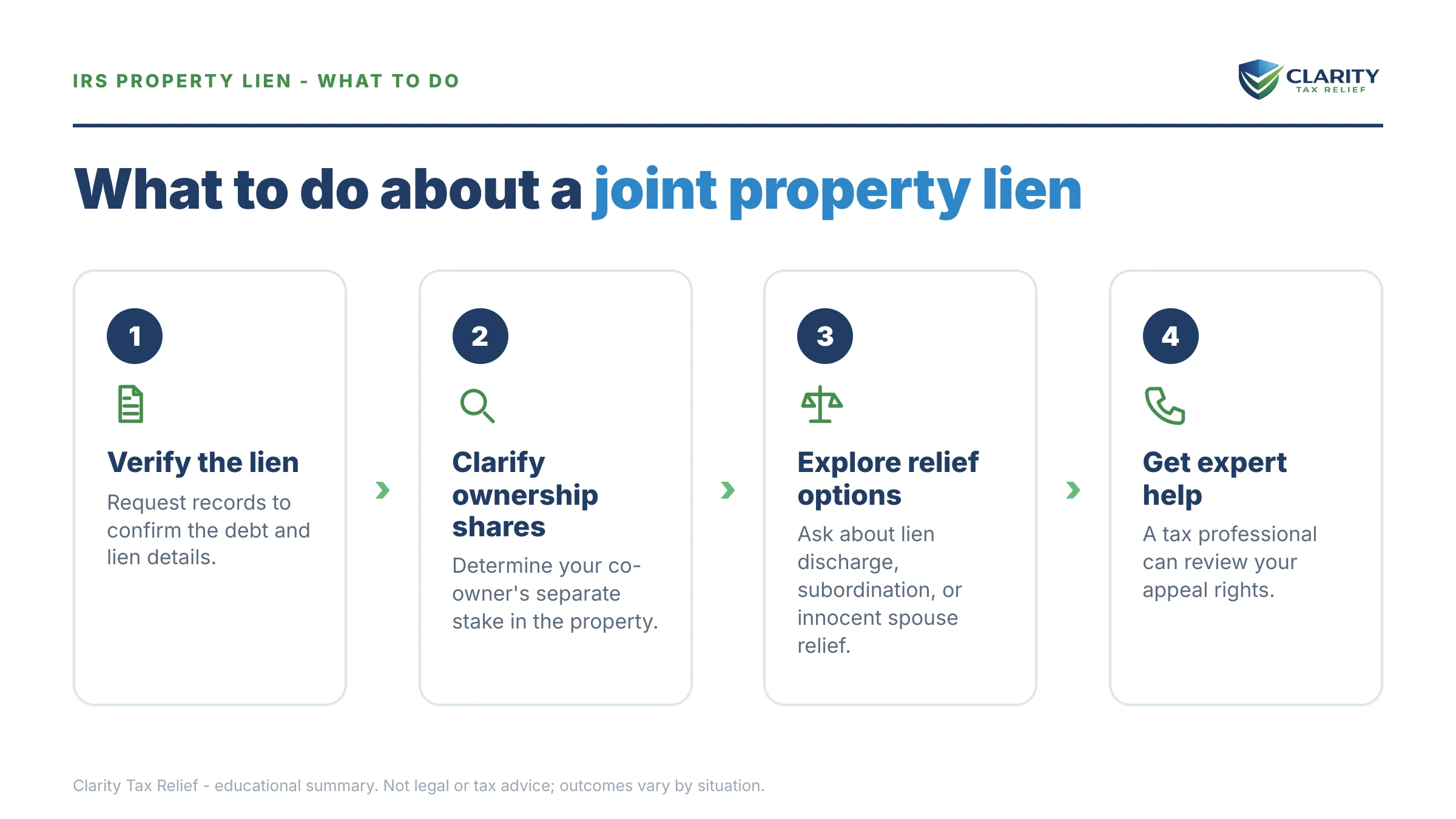
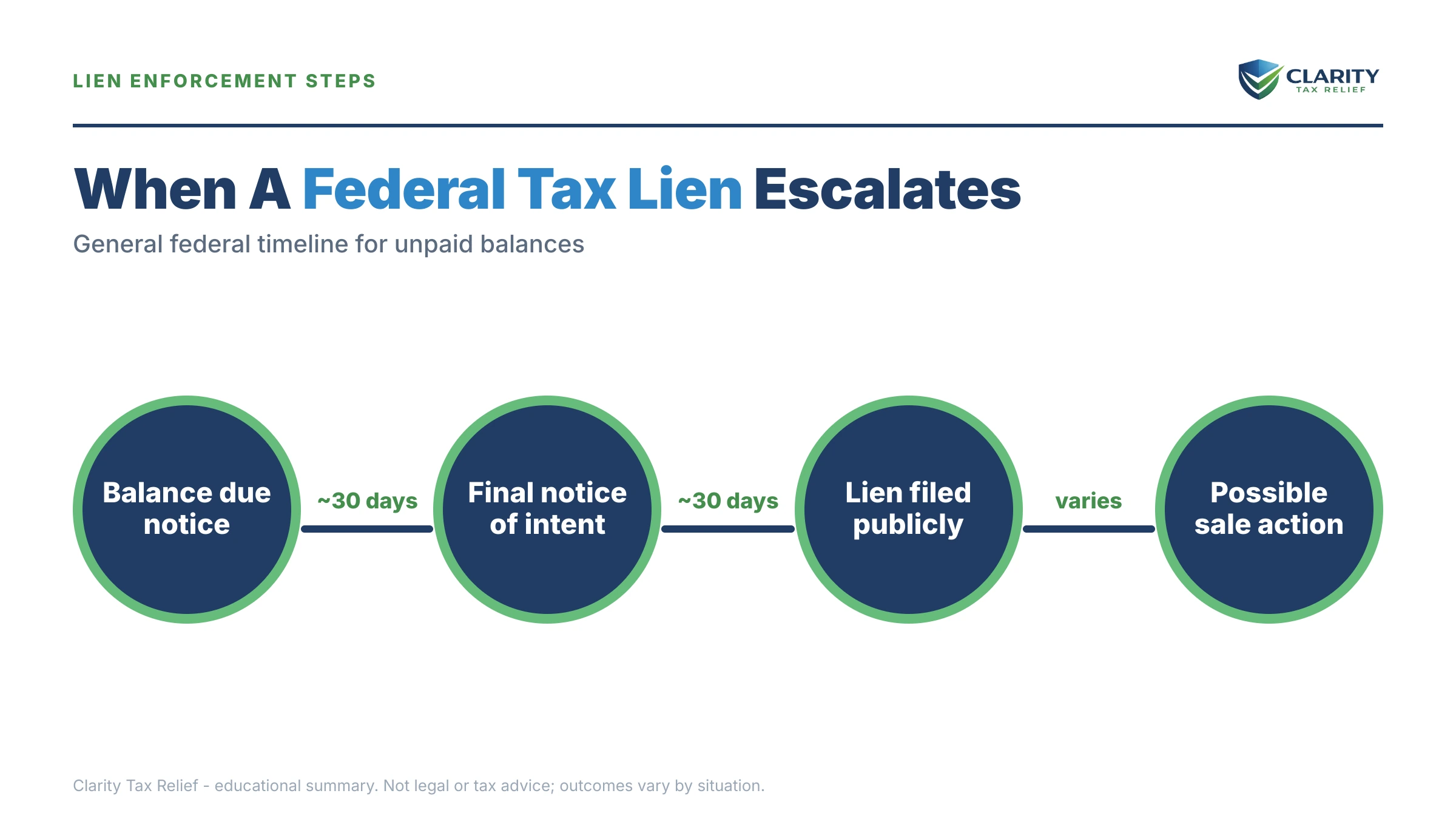
A recorded Notice of Federal Tax Lien stays attached to your share of the property until the debt is paid, the collection statute expires, or the IRS formally removes it. Nothing dramatic happens on any particular day — that's exactly why liens quietly become expensive. The sequence runs like this:
- The silent lien arises — assessment plus unpaid demand. No public record yet, but the claim already exists against your interest in everything you own.
- The NFTL is recorded — Letter 3172 arrives, the lien hits the county records, and every future title search on the property finds it. Sales stall, refinances get flagged, and your co-owner learns their home has an IRS filing on it.
- The balance compounds — interest and the monthly failure-to-pay penalty keep growing the amount the lien secures, so the payoff at any future closing is bigger than the number on the recorded notice.
- Collection escalates on a separate track — the lien itself never takes money, but the same unpaid balance drives levy notices, and a final notice of intent to levy opens the door to bank and wage seizures.
- In rare, large cases: judicial foreclosure — under IRC §7403 the government can sue to foreclose the lien and force a court-ordered sale of the entire property, paying the non-liable co-owner their share from the proceeds. Courts weigh the harm to the innocent owner, and the IRS saves this for big balances with no cooperation — but it exists.
The lien generally follows the debt to its expiration at the 10-year collection statute, though the IRS can refile in some situations and several events pause the clock. You can estimate your own timeline with our CSED Calculator — but for most co-owned property, waiting a decade with clouded title is the most expensive "option" on the board.
Is an IRS lien sitting on property your co-owner half-owns?
Every month adds interest to the balance the lien secures — and if a sale or refinance is pending, the paperwork has to be sequenced right or the closing slips. Get the lien filing and your deed reviewed free by an experienced tax professional. No pressure, no obligation.
IRS lien on jointly owned property: your options for removing it
The IRS has three property-specific tools — discharge, subordination, and withdrawal — plus full release, and each one fits a different goal for co-owned property. The right choice depends on whether you're trying to sell, refinance, or simply clean up the record:
| Option | How you get it | When it fits jointly owned property |
|---|---|---|
| Full release | Pay the balance (or let the collection statute expire); the IRS must release the lien within 30 days of full payment | You can pay in full — often out of your share of sale proceeds at closing |
| Certificate of discharge | Form 14135, filed well before closing | You're selling and your share of the equity won't cover the whole debt — the IRS removes the lien from this property in exchange for your share of proceeds |
| Subordination | Form 14134 | You're refinancing — the IRS lets the new lender jump ahead of the lien so the loan can close, usually because the refi helps you pay |
| Withdrawal | Form 12277 | You're in (or entering) a qualifying direct-debit payment plan, or the filing was premature — pulls the public notice as if never filed |
| CDP hearing | Form 12153 within the Letter 3172 window | The lien was just filed and you want an appeals officer to consider alternatives before the filing hardens |
| Resolve the underlying debt | Payment plan, Offer in Compromise, or hardship status | Always — the lien is a symptom; fixing the balance is what ultimately clears the title for both owners |
Two things co-owners consistently get wrong. First, a discharge removes the lien from one property, not from you — any remaining balance still follows you and your other assets. Second, deeding your share to your co-owner does not shake the lien; it follows the interest through the transfer, and a below-value transfer after assessment invites a fraudulent-conveyance fight. The mechanics of getting the lien off the record after payment are covered in our guide to getting a lien released after payment.
Selling or refinancing when only one owner owes
You can sell or refinance jointly owned property with an IRS lien on it — the lien changes the closing math, not the legal ability to close. Title companies handle these regularly; what kills deals is starting the IRS paperwork too late. The instructions to Form 14135 tell sellers to apply at least 45 days before closing, and in 2026 — with IRS staffing down sharply — earlier is safer.
Say you owe $48,300 from a trust fund recovery penalty after your company fell behind on payroll deposits, and you own your home 50/50 with your spouse, who owes nothing. You sell for $420,000. The mortgage payoff is $285,000 and selling costs run $25,000, leaving $110,000 in net proceeds — $55,000 for each owner. At closing, the IRS is paid from your $55,000: the $48,300 plus whatever interest has accrued since the notice was recorded. Your spouse walks away with their full $55,000, untouched.
Now change one number: suppose the equity is thinner and your half comes to only $40,000. A Form 14135 discharge lets the sale close anyway — the IRS takes your entire $40,000 share, releases the lien from the property so the buyer gets clean title, and the remaining roughly $8,300 (plus accruals) stays with you personally to resolve through a payment plan or other program. The house is free; you're not — yet.
Refinancing works on the same logic through subordination instead of discharge. The full playbooks are in selling a house with an IRS lien and refinancing with a tax lien. One reassurance for your co-owner along the way: the lien is a public record at the county, but tax liens no longer appear on consumer credit reports at all — ours or theirs — as explained in our guide to the tax lien on credit report question.
How to respond to an IRS lien on jointly owned property, step by step
- Pull the lien record — get a copy of the recorded Notice of Federal Tax Lien from your county recorder or your Letter 3172, and confirm the balance, tax periods, and whose name is on it.
- Confirm how title is held — read your deed to see whether you own as joint tenants, tenants in common, tenants by the entirety, or community property; this sets exactly what the lien reaches.
- Check your appeal window — if Letter 3172 arrived recently, the printed deadline (typically 30 days) controls your right to a Collection Due Process hearing on Form 12153.
- Match the fix to your goal — apply for a discharge (Form 14135) to sell, subordination (Form 14134) to refinance, or set up a resolution on the underlying debt to earn a release or withdrawal.
- Get the numbers reviewed before closing — a professional can sequence the application, escrow instructions, and payoff so the sale or refinance actually closes on time.
When you can handle this yourself
Plenty of joint-property lien situations don't need professional help. If the balance is small and you can pay it in full — especially from your share of sale proceeds at a closing that's already funded — the title company and a payoff letter from the IRS handle most of it, and the lien must be released within 30 days of payment. A straightforward Form 14135 discharge on a clean 50/50 sale with an experienced escrow officer is also very doable on your own; the IRS's federal tax lien page links the forms and instructions.
Experienced help changes outcomes in a different set of cases: when the lien traces to business payroll debt and the trust fund assessment itself may be contestable; when you're in a community property state and your spouse's separate assets are in question; when a §7403 suit or revenue officer is already involved; when multiple tax years are stacked on the lien; or when a closing date is weeks away and the discharge application has to be right the first time. In those situations, the cost of a misstep is measured in lost closings and co-owner equity, not filing fees.
Terms on your lien paperwork, decoded
- Notice of Federal Tax Lien (NFTL): the public document recorded at the county that announces the IRS's existing claim to lenders and buyers — the lien itself arose earlier, silently, at assessment.
- Tenancy by the entirety: a married-couple form of title in some states that blocks most creditors — but not, after United States v. Craft, the federal tax lien on the liable spouse's interest.
- Discharge vs. release vs. withdrawal: discharge frees one property from the lien; release ends the lien because the debt is satisfied or expired; withdrawal erases the public filing as if it never happened.
- Judicial foreclosure (§7403): a federal lawsuit that can force the sale of an entire co-owned property, with the non-liable owner compensated from the proceeds — rare, and reserved for large uncooperative cases.
- CSED: the Collection Statute Expiration Date — generally 10 years from assessment, pausable by appeals, offers, and bankruptcy — after which the lien securing the debt generally dies with it.
Joint-property lien questions, answered
Can the IRS put a lien on property I own jointly with someone else?
Yes. The federal tax lien attaches to every property interest the person who owes holds, including a half interest in a co-owned home, land, or account. It does not attach to the co-owner's share, but because the lien clouds the title to the whole parcel, any sale or refinance will require dealing with the IRS before closing.
Does an IRS lien attach to my spouse's half of our house?
No — if only you owe, the lien attaches to your interest, not your spouse's. The Supreme Court held in United States v. Craft (2002) that this is true even for property held as tenants by the entirety. The exception is community property states, where state law can expose some or all of the community estate to one spouse's tax debt.
Can the IRS force the sale of jointly owned property?
It can, but it rarely does. Under IRC §7403 the government can sue in federal court to foreclose the lien and sell the entire property, paying the non-liable co-owner their share of the proceeds. Courts weigh the harm to the innocent co-owner, and the IRS reserves this tool for large balances where no other resolution worked.
Can we sell the house if the IRS lien only names one owner?
Yes. The most common path is a certificate of discharge on Form 14135: the IRS agrees to remove the lien from the property in exchange for the liable owner's share of the net proceeds at closing. The co-owner's share is paid to them normally. If the liable owner's share covers the full balance, the lien is satisfied entirely.
Does an IRS lien on joint property show up on my co-owner's credit report?
No — and it doesn't show on yours either, because the credit bureaus removed all tax liens from consumer credit reports in 2018. The lien is still a public record at the county recorder, so any lender running a title search will find it. It affects the property's marketability, not the co-owner's credit score.
Does signing my share over to my co-owner remove the IRS lien?
No. Once the lien attaches, it follows the interest through the transfer, so your co-owner would receive the property with the lien still on it. Worse, a transfer for less than full value after the tax was assessed can be challenged as a fraudulent conveyance, which can create liability for the person who received the property.
What happens to the lien if a joint owner dies?
It depends on how title is held and state survivorship law. If the non-liable co-owner dies first and the liable owner inherits a bigger interest, the lien automatically attaches to that larger interest. If the liable owner dies, the lien generally follows whatever interest passes to the estate or survivors — the debt does not simply vanish at death.
Estate scenarios have their own rules — see IRS lien after death for how liens interact with a decedent's co-owned property. If the IRS process itself has stalled your case — a discharge application sitting unanswered before a closing, for instance — the Taxpayer Advocate Service can intervene when you face significant hardship, and payments on the underlying balance always go through IRS.gov/payments.
Your next 24 hours
- Find the recorded notice. Pull the Notice of Federal Tax Lien from your county recorder (or your Letter 3172) and note the balance, the tax periods, and the taxpayer name — that name defines whose interest is encumbered.
- Gather your deed and the debt paperwork. The deed shows how title is held; the assessment notices show whether this is personal income tax or a trust fund penalty from the business — the answer changes your options.
- Get a free case review. Send both documents through the 2-minute form or call (888) 825-7779. An experienced tax professional will map exactly what the lien reaches, what your co-owner keeps, and the fastest route to clean title — before another month of interest grows the payoff.
This guide is general information, not tax or legal advice for your specific situation. Eligibility for IRS programs depends on individual facts and circumstances; no outcome is guaranteed.