
Tax Liens
Tax Lien on Credit Report: What Actually Shows Up in 2026 (and How to Remove the Lien)
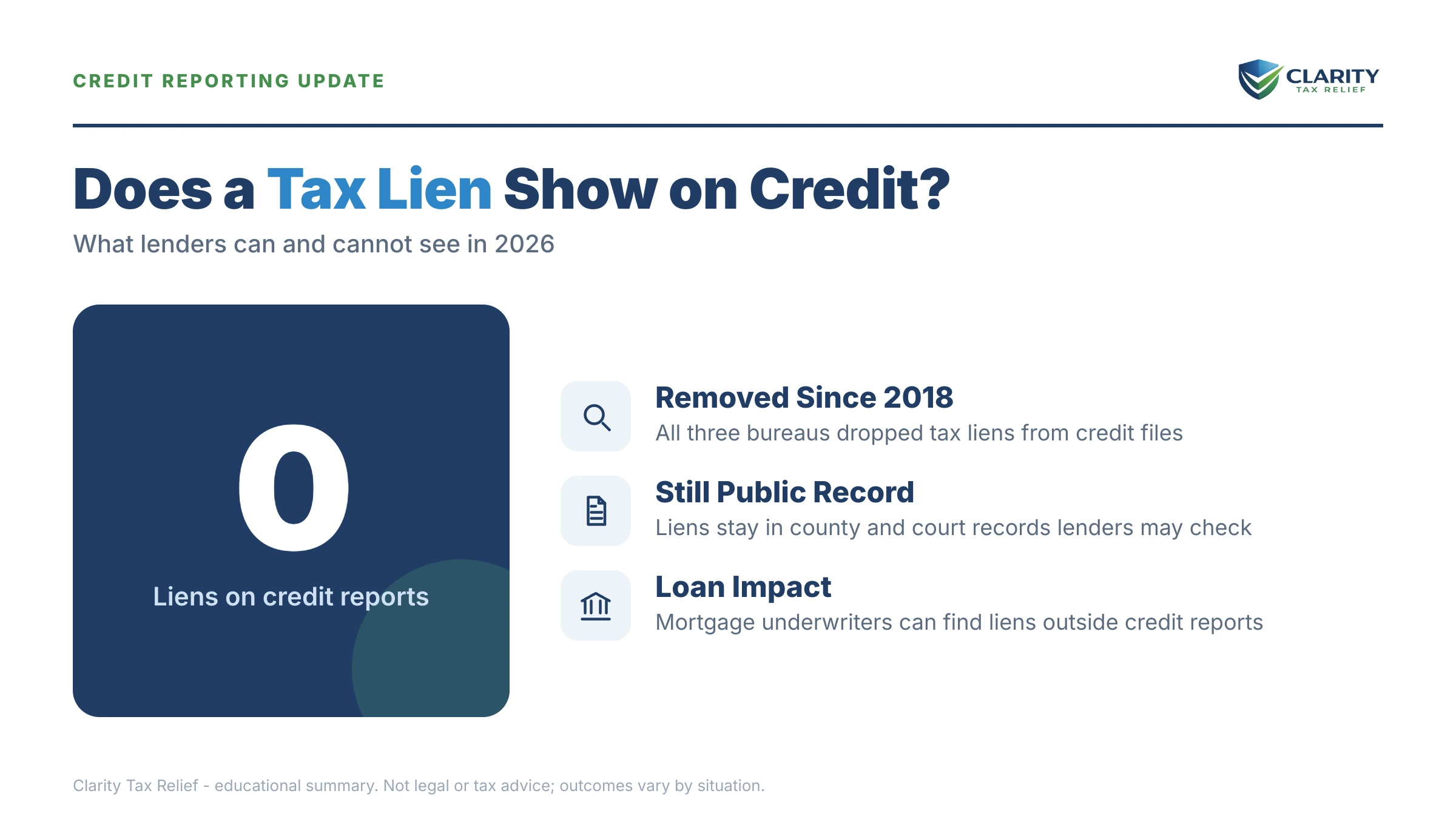
The short answer: you will not find a tax lien on credit reports in 2026. Equifax, Experian, and TransUnion removed every tax lien — federal and state — from consumer credit files by April 2018, so a lien no longer touches your FICO score. But the lien is still a public record, and lenders still find it.
You pulled all three of your credit reports and there's no lien anywhere — yet a lender just flagged a "federal tax lien of record" and put your application on hold. If you run your own business, that mismatch is exactly how the modern lien works: invisible to the credit bureaus, fully visible to anyone who searches public records.
Both halves of the problem are fixable. This guide covers why liens came off credit reports, everywhere a lien still surfaces in 2026, and every path — release, withdrawal, discharge, subordination — for getting the filing itself off the record. The image below shows exactly what a filed Notice of Federal Tax Lien looks like and where to find the amount, the tax periods, and the refile deadline on the form.
⏱ Your deadline: if the lien was just filed, the Letter 3172 that announced it starts a 30-day clock to request a Collection Due Process hearing with Form 12153 — the deadline is printed on the letter. Miss it and you lose the strongest forum for contesting the filing, while interest and the monthly late-payment penalty keep growing the balance the lien secures.
Tax lien on credit report rules: what changed in 2018
All three credit bureaus — Equifax, Experian, and TransUnion — removed tax liens from consumer credit reports by April 2018, and they have never returned. The change came out of the National Consumer Assistance Plan, an agreement the bureaus reached after regulators found that public-record data like liens and judgments was frequently matched to the wrong person.
The bureaus first purged most civil judgments and about half of tax liens in July 2017, then dropped the remaining tax liens the following spring. New lien filings were shut out at the same time. Because the data never enters your credit file, neither FICO nor VantageScore can factor it in.
The removal covered federal and state liens alike. So a Notice of Federal Tax Lien filed against you in 2026 has zero direct effect on your credit score — which surprises a lot of people who expected a 100-point drop and got nothing.
Here's the trap in that good news: many taxpayers check their score, see no damage, and conclude the lien doesn't matter. It matters — just through a different pipe. Owing the IRS hurts you indirectly through loan denials and stalled closings, not through your score; we break down that distinction in does IRS debt affect your credit score.
Where a federal tax lien still shows up in 2026
A Notice of Federal Tax Lien is a public record filed at your county recorder or secretary of state, and serious lenders check public records — not just credit reports. The credit bureaus stopped repeating that data; the courthouse never stopped publishing it.
| Where the search happens | Does the lien appear? | What it can affect |
|---|---|---|
| Consumer credit reports (Equifax, Experian, TransUnion) | No — removed by April 2018 | FICO and VantageScore: no direct impact |
| County recorder / secretary of state | Yes — this is where the NFTL is filed | Anyone who searches your name or business |
| Title search on a home sale or refinance | Yes | Closings stall until the lien is paid, discharged, or subordinated |
| Public-records data vendors (e.g., LexisNexis) | Yes | Mortgage, SBA, and business-loan underwriting |
| Business credit bureaus (Dun & Bradstreet, Experian Business) | Can appear | Equipment financing, vendor terms, business credit lines |
| IRS account transcript (code 582) | Yes | Any lender that requests your tax transcripts |
For a sole proprietor, the exposure is doubled. The lien attaches to your personal property and everything the business uses — equipment, inventory, receivables — because a sole proprietorship isn't legally separate from you. And business credit bureaus were never part of the 2018 consumer agreement, so the lien can sit on your Dun & Bradstreet file while your personal report stays clean.
If you want to see exactly what a lender will see, run the search yourself first. Our guide to the tax lien public record walks through where liens are recorded county by county and how to pull a copy of the filing. For how the lien stacks up against your existing home loan at a title search, see tax lien vs mortgage priority.
Why the IRS filed the lien against you
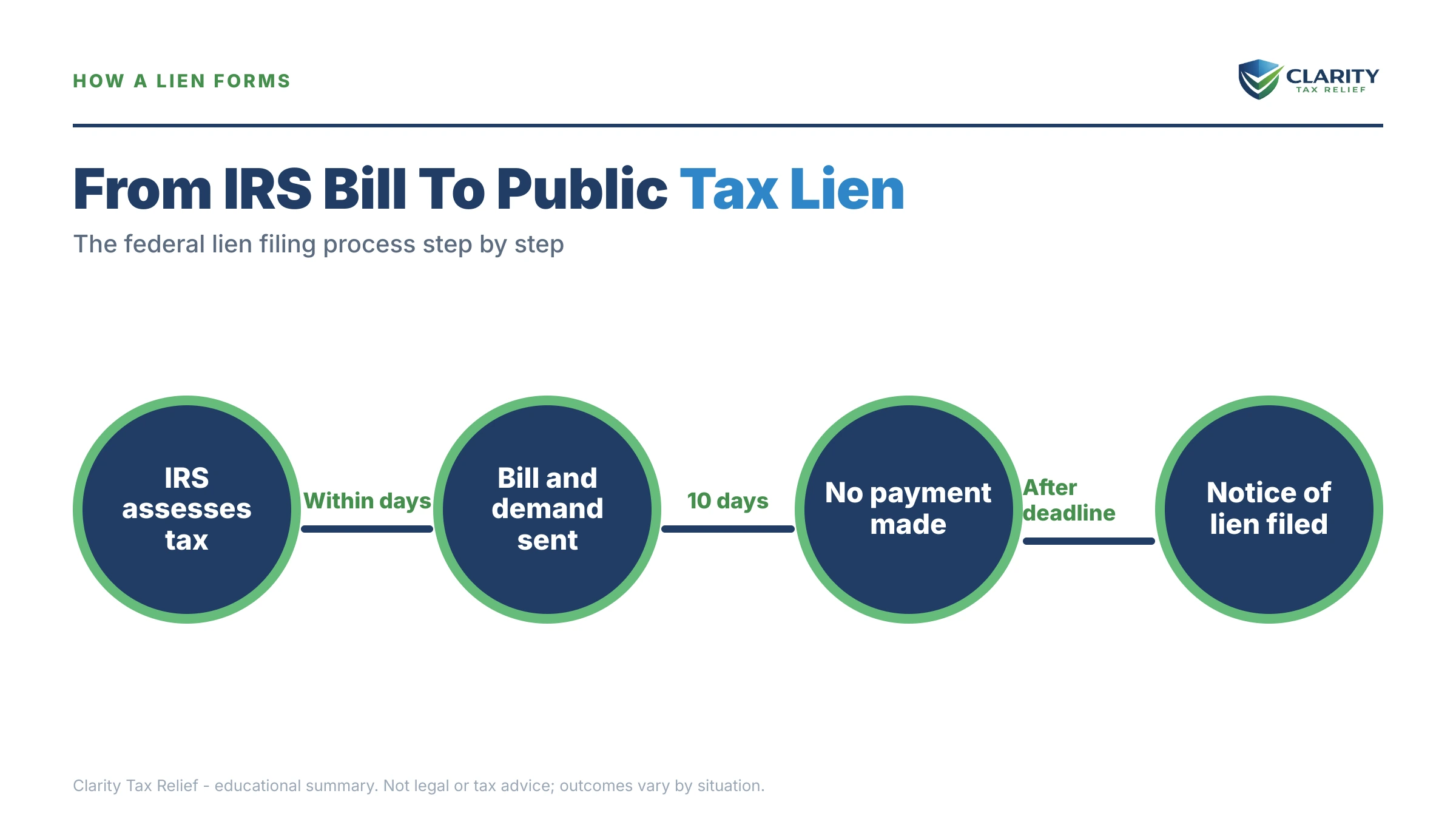
The IRS generally files a Notice of Federal Tax Lien once an unpaid balance reaches roughly $10,000 and the demand for payment has gone unanswered. That threshold is policy, not law — a revenue officer can file lower when collection looks at risk — but $10,000 is the practical trigger for most automated filings.
Two liens are actually in play. A "silent" statutory lien arises automatically once tax is assessed, the IRS demands payment, and you don't pay — no paperwork, no publicity. The NFTL is the public version: it's filed to put other creditors on notice and lock in the government's place in line. The filing is what Letter 3172 announces, and it's the filing — not the silent lien — that lenders find. If that letter is what brought you here, start with our Letter 3172 notice of federal tax lien guide.
The lien never arrives out of nowhere. It sits at a specific point in the collection sequence:
| Stage | Notice | What it means for the lien |
|---|---|---|
| 1 | CP14 — first bill | Typically about 21 days to pay; once it goes unpaid, the silent statutory lien attaches |
| 2 | CP501 / CP503 — reminders | Balance grows monthly; still no public filing |
| 3 | CP504 — intent to levy state refund | Account moves to enforcement; a public lien filing becomes likely on balances over ~$10,000 |
| 4 | Letter 3172 — NFTL filed | The lien is now public record; 30 days to request a CDP hearing |
| 5 | LT11 / Letter 1058 — final notice of intent to levy | After 30 days, actual seizure (bank, wage, receivables) can begin |
You can confirm exactly where your account stands without waiting for mail: the filing posts to your IRS account transcript as code 582, usually alongside a code 971 for the Letter 3172 itself.
What happens if you do nothing about the lien
A filed tax lien doesn't sit still — it attaches to property you acquire after the filing date and secures every new dollar of penalty and interest. Left alone, the situation moves through predictable stages:
- The lien attaches to everything. Your home, vehicles, business equipment, and accounts receivable — plus anything you buy or earn later. There is no carve-out for "business only" or "personal only" when you're a sole proprietor.
- The secured balance keeps growing. The failure-to-pay penalty accrues at 0.5% per month (up to 25%) and interest compounds daily. The lien automatically covers the growing total, not just the amount printed on the filing.
- Collection moves from claim to seizure. The lien itself takes nothing — it's a recorded claim. But the next escalation is an LT11 or Letter 1058 final notice, and 30 days after that the IRS can levy bank accounts, wages, and your business receivables. The distinction matters; see lien vs. levy.
- Sales and refinances hit the title wall. Any closing involving real property stalls until the lien is paid from proceeds, discharged, or subordinated — often on someone else's timeline, with a buyer waiting.
- The IRS can refile near the collection deadline. The notice contains self-release language keyed to the 10-year collection statute, but the IRS can refile before that date passes — and events like an offer in compromise or bankruptcy pause the clock. Waiting it out is covered honestly in does an IRS tax lien expire, and you can estimate your own deadline with our CSED Calculator.
One 2026 reality check: the IRS workforce shrank roughly 27% in 2025, but lien filings and the levy notices that follow are generated by automated systems. Fewer humans answering phones has not meant fewer filings — it has meant it's harder to reach someone to undo one.
A lien blocking a loan — or a Letter 3172 in hand?
Send us the lien notice or the lender's denial. An experienced tax professional will confirm what's actually filed, whether your 30-day hearing window is still open, and the fastest removal path for your numbers — free and confidential.
How to get a tax lien off public records: your options
Full payment forces the IRS to release a federal tax lien within 30 days — but withdrawal, which erases the filing as if it never happened, is the outcome lenders actually care about. Each removal tool has its own eligibility rules:
| Option | Who qualifies | What happens to the public record |
|---|---|---|
| Pay in full | Anyone who can raise the money | Certificate of Release issued within 30 days; you can then request withdrawal with Form 12277 |
| Fresh Start withdrawal (Form 12277) | Balance typically $25,000 or less, on a direct-debit installment agreement that full-pays within 60 months (or before the collection deadline), with 3 consecutive payments made and all returns filed | Lien withdrawn — treated as if never filed |
| Withdrawal after release | Debt satisfied and you're current on filing requirements | The filed notice comes off the record instead of sitting there marked "released" |
| Discharge (Form 14135) | Selling a specific property where the IRS gets its interest from the proceeds, or the property has no equity | Lien removed from that property only — stays on everything else |
| Subordination (Form 14134) | Refinancing where the new loan improves the IRS's position (lower payment frees cash, or loan proceeds pay tax) | Lien stays filed, but the new lender moves ahead of it |
| Offer in Compromise completed | Accepted offer with all terms met — means-tested, and the IRS accepted roughly 1 in 5 offers in FY2024 | Lien released once the offer amount is paid |
| Collection statute expires | The 10-year clock runs out with no refile and no tolling events | Lien self-releases by its own terms |
Release and withdrawal are not the same document, and lenders treat them differently. A release says "paid"; the original filing still shows in the record's history. A withdrawal wipes the filing itself. The mechanics of the paid-in-full route — including how fast the certificate actually arrives — are in our guide to getting a lien released after payment, and the withdrawal request itself is a short form we walk through in lien withdrawal (Form 12277).
If a transaction is on the calendar, the tool changes. A pending sale usually runs through discharge — covered in selling a house with an IRS lien — while a refinance runs through subordination, covered in refinancing with a tax lien. Both require a documentation package submitted well before closing; the IRS asks for these applications at least 45 days ahead when possible.
Payment plans themselves are set up through the IRS directly — see the official IRS payment plans page for current terms. Note that interest and penalties keep accruing on any plan; the lien tools above control the public record, not the cost of the debt.
What a $31,200 balance looks like with a lien on it (worked example)
Say you owe $31,200 as a self-employed sole proprietor — two years of underpaid quarterlies that crossed the ~$10,000 filing threshold, and the NFTL is now recorded at your county. This is hypothetical, but the math is the real decision most people in this range face:
Path A — straight payment plan. A streamlined direct-debit installment agreement over 72 months runs $31,200 ÷ 72 ≈ $434 per month before interest, and the failure-to-pay penalty typically drops to 0.25% per month while an approved agreement is in effect. The catch: at $31,200 you're over the $25,000 withdrawal ceiling, so the lien stays on the public record until the balance is paid — potentially into 2031 or 2032. Every loan application in between hits the filing.
Path B — buy your way under the withdrawal line. Pay $6,200 up front to bring the balance to $25,000, then set up a direct-debit agreement that full-pays within 60 months: $25,000 ÷ 60 ≈ $417 per month. After three consecutive direct-debit payments — about three months — you're typically eligible to request withdrawal with Form 12277. If granted, the lien comes off the record as if never filed, years before the debt is done.
Same debt, nearly the same monthly payment — but Path B can clear the public record in months instead of years. For a sole proprietor who needs equipment financing or a business line of credit, that $6,200 is often the cheapest money in the whole plan. (The IRS decides withdrawal requests case by case, so eligibility is a doorway, not a promise.)
How to respond to a federal tax lien, step by step
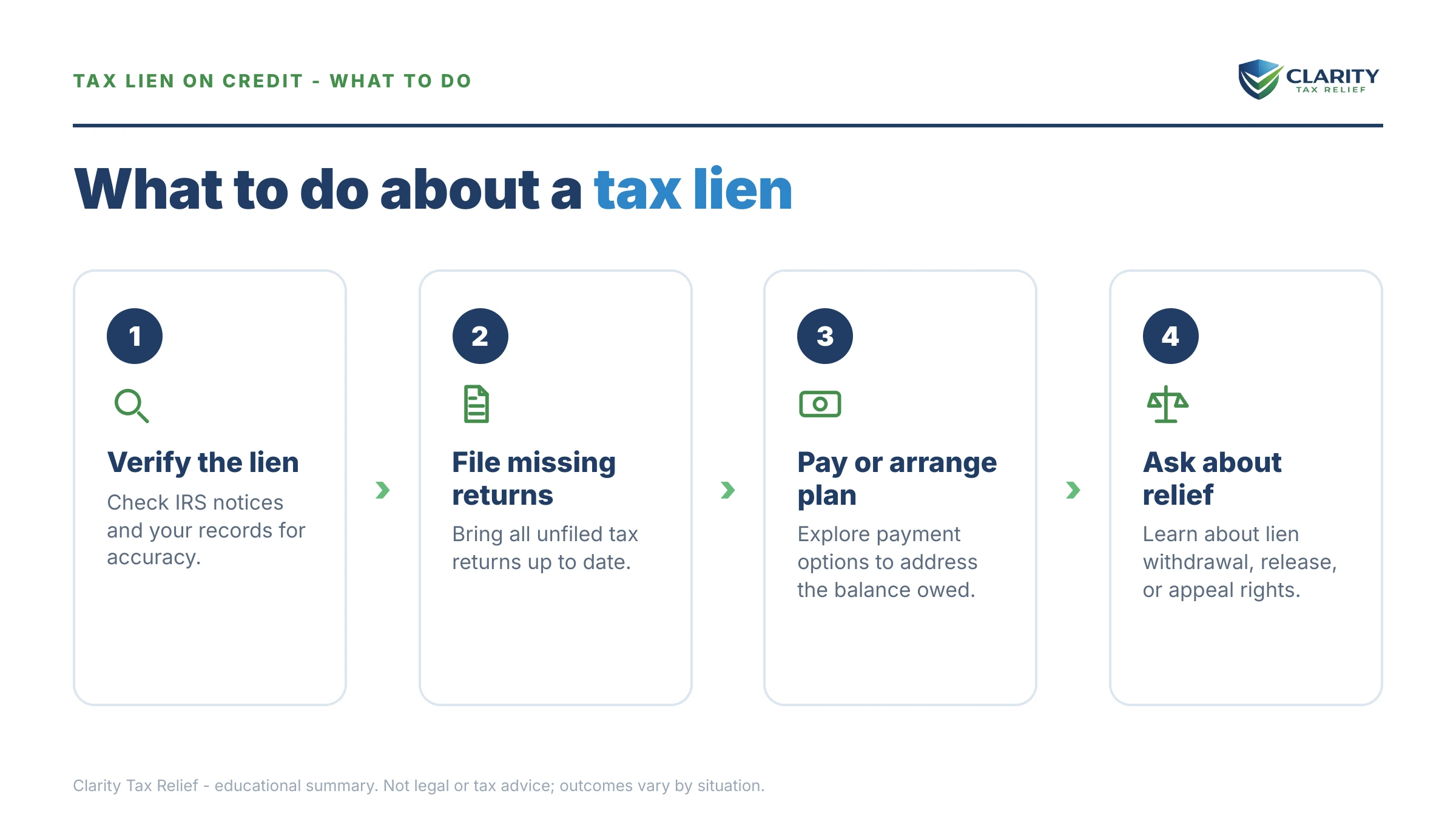
- Confirm the lien is real and current. Pull your IRS account transcript and look for code 582, then search the records of the county where you live or where your business operates.
- Check the date on your Letter 3172. If it arrived within the last 30 days, you can still request a Collection Due Process hearing with Form 12153 — the only stage where the lien filing itself can be contested.
- Verify the balance and your collection deadline. Compare the lien amount to your IRS online account, and note the assessment dates that drive the 10-year collection statute.
- Pick the resolution path that fits your numbers. Full payment forces release within 30 days; a qualifying direct-debit plan opens the door to withdrawal; discharge or subordination handles a pending sale or refinance.
- File the removal paperwork once you're eligible. Form 12277 requests withdrawal, Form 14135 requests discharge, and Form 14134 requests subordination — each with its own documentation package.
- Confirm the record actually cleared. Get your Certificate of Release or withdrawal notice from the IRS and verify the county recorder indexed it against the original filing.
The IRS's own overview of how liens work, including the official pages for each certificate, is at Understanding a federal tax lien.
When you can handle this yourself — and when help changes the outcome
Plenty of lien situations are genuinely do-it-yourself. If the debt is already paid, requesting withdrawal with Form 12277 is a short application you can file on your own. If you owe under $25,000, agree with the balance, and have all returns filed, you can set up a direct-debit plan online and request withdrawal after three payments without paying anyone anything.
Experienced help earns its cost in the messier versions: a closing or refinance on a deadline (discharge and subordination packages have to be sequenced with escrow, and a rejected application can kill a sale); a balance you dispute or that came from a substitute return; multiple unfiled years, since the IRS won't grant withdrawal without filing compliance; business receivables exposed to the levy that follows the lien; or offer-in-compromise math on self-employment income, where the IRS's calculation of what you can pay rarely matches your own. If a lien plus a hardship is costing you housing or the ability to operate, the independent Taxpayer Advocate Service can also intervene at no cost.
Terms on your lien notice, decoded
- Notice of Federal Tax Lien (NFTL): the public document recorded at your county or state that announces the government's claim to other creditors.
- Release: the IRS's confirmation the debt is satisfied — the lien stops encumbering your property, but the original filing stays in the record's history.
- Withdrawal: removal of the filed notice as if it never existed, requested with Form 12277 — the cleanest result for lending purposes.
- Discharge: removal of the lien from one specific property (Form 14135) so it can be sold; the lien stays on everything else.
- Subordination: the IRS agreeing to let another creditor's claim move ahead of the lien (Form 14134), usually to let a refinance close.
- CSED: the Collection Statute Expiration Date — generally 10 years from assessment. The lien's self-release language keys off this date, but tolling events and refiling can extend it.
If the lien is holding up a loan or a closing right now, a free case review with an experienced tax professional can map the fastest removal path for your exact numbers — or call (888) 825-7779.
Tax lien and credit questions, answered
Do tax liens show up on credit reports in 2026?
No. Equifax, Experian, and TransUnion removed all tax liens from consumer credit reports by April 2018 under the National Consumer Assistance Plan, and they have not been added back. That means a federal tax lien filed against you in 2026 will not appear on your credit report or lower your FICO or VantageScore directly. The lien remains a public record, though, which is how lenders still discover it.
How do lenders find a tax lien if it's not on my credit report?
Lenders pull public-records data from sources the credit bureaus no longer supply: county recorder and secretary of state filings, title searches, and third-party data vendors such as LexisNexis. Mortgage underwriters also review your tax transcripts and ask directly about tax debt on the application. Lying on a mortgage application is fraud, so the lien surfaces one way or another whenever real underwriting happens.
Do state tax liens appear on credit reports?
No. The 2018 removal covered every tax lien — federal and state alike — so a state lien or tax warrant will not show on your Equifax, Experian, or TransUnion report either. State liens are still public records with real teeth, though: a New York tax warrant, for example, is a docketed civil judgment that title companies and lenders will find immediately.
How do I get a federal tax lien removed from public records?
There are two main routes. Paying the balance in full requires the IRS to issue a Certificate of Release within 30 days, and you can then request withdrawal of the filed notice with Form 12277. If you can't pay in full, the Fresh Start withdrawal path is typically available once your balance is $25,000 or less and you've made three consecutive payments on a direct-debit installment agreement that will pay the debt off within 60 months.
What's the difference between a lien release and a lien withdrawal?
A release means the debt is satisfied and the lien no longer encumbers your property, but the original filing stays in the public record with a release attached. A withdrawal removes the Notice of Federal Tax Lien as if it had never been filed, which is what lenders and title companies prefer to see. You can request withdrawal with Form 12277 after a release, or earlier under the Fresh Start direct-debit rules.
Can I get a mortgage or refinance with a tax lien?
Sometimes, but the lien has to be dealt with in the loan structure. Most conventional lenders require the lien paid or withdrawn before closing; some will proceed if the IRS subordinates its lien to the new mortgage using Form 14134, or if you're on a documented payment plan. FHA loans generally allow a lien with a payment plan and a history of on-time payments. Expect the title search to surface the lien every time.
At what amount does the IRS file a tax lien?
There's no statutory minimum, but IRS policy generally reserves lien filings for unpaid balances of $10,000 or more after the demand for payment goes unanswered. A revenue officer can file below that threshold when collection is at risk, and balances above $10,000 don't automatically get a lien — setting up a direct-debit installment agreement early often heads the filing off entirely.
Does a tax lien show up on business credit reports?
It can. The 2018 removal was an agreement among the three consumer bureaus; business credit bureaus such as Dun & Bradstreet and Experian Business were never part of it, and public-record filings like tax liens can still appear on business credit files. For a sole proprietor, that means the lien may hurt equipment financing, vendor terms, and business lines of credit even while your personal score looks untouched.
How long does a federal tax lien last?
A federal tax lien generally lasts as long as the IRS can collect the debt — 10 years from assessment, extended by anything that pauses the collection statute, such as an offer in compromise, bankruptcy, or a Collection Due Process hearing. The filed notice contains self-release language tied to that deadline, but the IRS can refile before it passes, so waiting out the clock is rarely a plan.
Your next 24 hours
- Find two things on your paperwork: the total amount and "Last Day for Refiling" on the lien copy, and the response deadline printed on your Letter 3172 — if that letter arrived within the last 30 days, your hearing rights are still open.
- Gather your file: the lien notice, your last filed return, the balance shown in your IRS online account, and — if you're self-employed — a rough profit-and-loss picture, since it drives which removal path fits.
- Get the lien reviewed free: use the 2-minute form or call (888) 825-7779. Whether the play is a hearing request, a withdrawal-eligible payment plan, or a discharge package for a pending sale, the balance grows with interest and penalties every month the filing sits — the review costs nothing and tells you which door to walk through.
This guide is general information, not tax or legal advice for your specific situation. Eligibility for IRS programs depends on individual facts and circumstances; no outcome is guaranteed.