
IRS Transcript Codes
Code 582 Transcript Entry: The IRS Lien Indicator, Explained (2026)
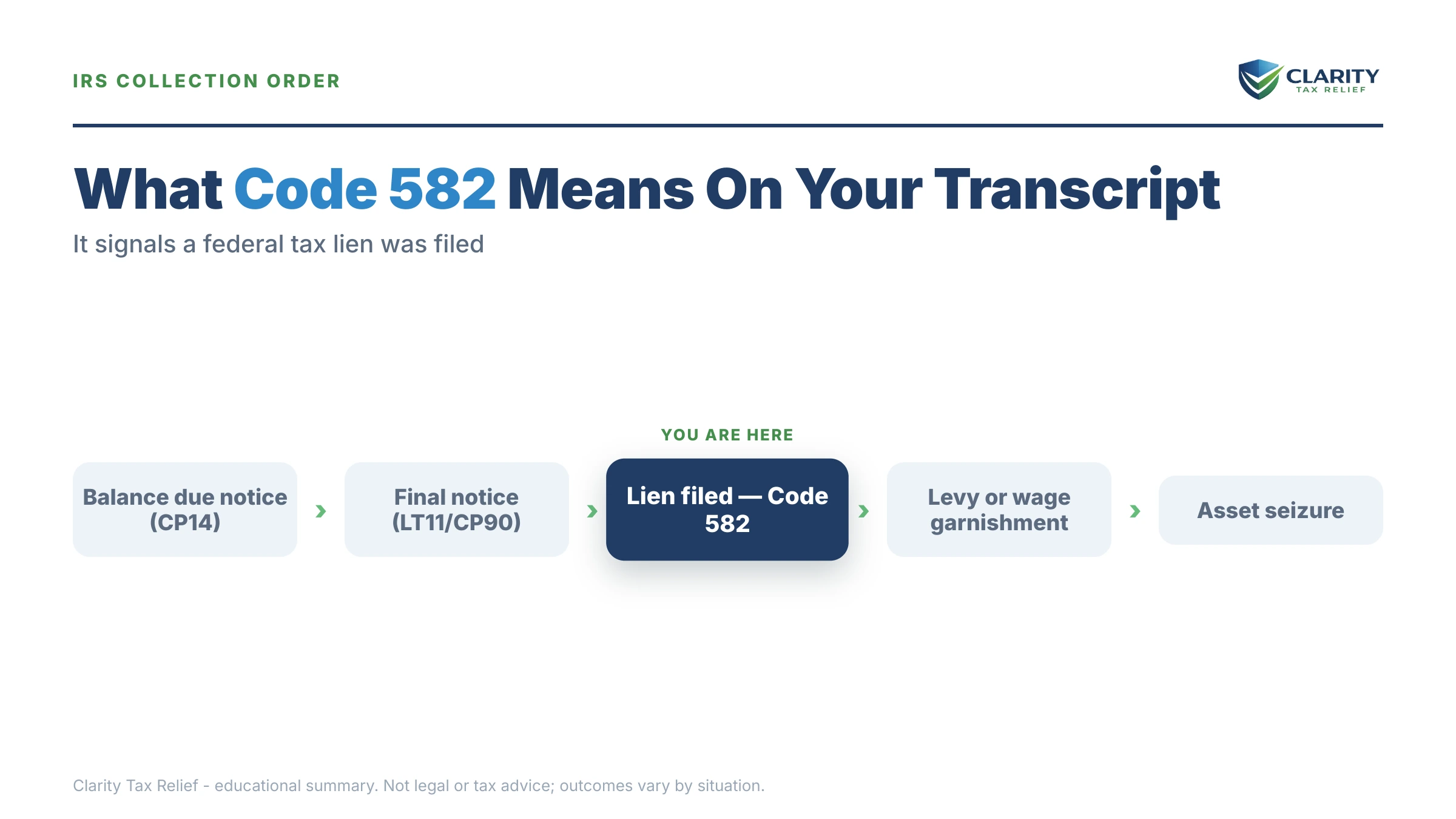
The short answer: a code 582 transcript entry means the IRS has set a federal tax lien indicator on that tax period — a Notice of Federal Tax Lien has been filed or is being filed. It is not a levy and not a new charge. Letter 3172 follows with your appeal deadline, and code 583 later marks the lien's release.
You logged into your IRS account between payroll runs to check where a balance stood, scrolled the transaction list, and stopped on three digits you hadn't seen before: 582. That line means the IRS has moved from billing the debt to legally securing it against what you own. It's a real escalation — and it's workable, in a specific order this guide walks through.
Code 582 rarely arrives alone. It sits in a module that already shows an assessment and a balance, and it comes paired with a mailed letter that starts a formal appeal clock. The image below shows you exactly where a 582 entry sits on an account transcript and which date next to it matters most.
⏱ Your deadline: the Collection Due Process request date printed on Letter 3172 — the lien-filing notice that follows a code 582 entry. You typically have 30 days from that letter to file Form 12153. Miss it, and you keep some appeal options but permanently lose the path to Tax Court review of the lien filing.
Why IRS code 582 is on your transcript
Code 582 posts when the IRS sets a federal tax lien indicator on a tax period — almost always because it has filed a Notice of Federal Tax Lien (NFTL) in the public records where you live or do business. The lien itself arose earlier and silently: under IRC §6321, a statutory lien attaches automatically once tax is assessed, the IRS demands payment, and the balance goes unpaid. The 582 entry marks the moment that private claim became a public one.
The public filing is what changes your life. It establishes the IRS's priority against other creditors, shows up in title searches and commercial credit files, and attaches to everything you own now and everything you acquire while it stands — real estate, vehicles, business equipment, inventory, and accounts receivable. The IRS typically files once an unpaid balance climbs past roughly $10,000, though it can file at any amount, and it files faster on payroll tax debt than almost anything else.
If transcript lines are new territory, our guide to how to read IRS account transcript entries covers the layout; this page stays focused on 582 and the codes that travel with it.
| Code | What it means | What to do |
|---|---|---|
| 582 | Lien indicator set — a Notice of Federal Tax Lien was filed for this period | Locate Letter 3172 and calendar the appeal deadline printed on it |
| 583 | Lien indicator reversed — the lien was released, withdrawn, or otherwise cleared | Confirm the certificate posted to county records; keep a copy |
| 150 / 290 | The original or additional tax assessment the lien secures | Verify the amount is right before you negotiate around it |
| 196 / 276 | Interest and failure-to-pay penalty posting to the same balance | Expect the secured amount to keep growing until the debt resolves |
| 971 | Notice issued — often the transcript's marker for the lien-filing letter itself | Match the 971 date to the letter in your mail pile |
Trace the chain upward from the 582 line: the debt usually starts at a code 150 irs transcript assessment, then grows through entries like code 196 transcript interest charges until the balance is large enough that the IRS files. When the lien later clears, a code 583 transcript entry reverses the indicator — that reversal is the goal this whole page points toward.
What happens if you ignore code 582
A filed federal tax lien doesn't seize anything today — it quietly attaches to everything you own and waits, while the balance behind it keeps compounding. Ignoring it plays out as a sequence, not a single event:
- Letter 3172 arrives. The IRS must mail it within five business days of filing the lien. The Collection Due Process clock printed on it starts running.
- The appeal window closes. Once the printed date passes, you lose the right to challenge the filing before an independent appeals officer with Tax Court review behind it. A weaker "equivalent hearing" remains available, generally for up to a year — but with no court backstop.
- The balance grows every month. Interest and the failure-to-pay penalty keep posting to the same module the lien secures, so the claim gets bigger while you wait.
- The public record does its damage. Consumer credit bureaus no longer report tax liens, but lenders, landlords, bonding companies, factoring firms, and commercial credit bureaus all pull public records. For a business owner, a lien can quietly kill a line of credit or a contract bid.
- The levy track catches up. The lien and the levy are separate tools running on the same debt. If the balance stays unresolved, an LT11 or Letter 1058 final notice follows — and after its own 30-day window, the IRS can levy bank accounts (a 21-day hold before funds leave) and garnish wages continuously.
- Payroll debt goes personal. If the lien secures unpaid 941 taxes, the IRS can assess the trust-fund portion against owners, officers, and check-signers individually — producing a second lien in your own name against your house and personal accounts.
- The IRS refiles at the deadline. The filed notice carries its own refile date tied to the 10-year collection statute. On larger balances, expect a refile rather than a quiet expiration.
None of this needs a human at the IRS to happen. In 2026, with the agency's workforce down sharply, the lien, notice, and levy systems run automated — the machine files and escalates whether or not anyone answers the phone.
| Event | Timing | Right at stake |
|---|---|---|
| NFTL filed; code 582 posts | Date shown on the transcript line | Lien attaches to current and after-acquired property |
| Letter 3172 mailed | Within 5 business days of filing | Your formal appeal clock starts |
| Form 12153 due | Date printed on Letter 3172 (typically ~30 days) | Collection Due Process hearing with Tax Court review |
| After the CDP deadline | Generally up to 1 year | Equivalent hearing only — no Tax Court backstop |
| Debt fully paid | Release due within 30 days | Certificate of Release; code 583 posts |
| Collection statute expires | 10 years from assessment (pausable) | Lien self-releases — unless the IRS refiles first |
Just found code 582 and a Letter 3172?
Send us the transcript and the letter. An experienced tax professional will confirm exactly what the lien secures, whether the appeal window printed on your Letter 3172 is still open, and which exit path fits your numbers — free, confidential, no pressure.
Your options: five ways out from under the lien behind code 582
Every exit from a filed lien runs through one of five doors, and each has its own form and its own eligibility test. The debt drives the lien — so most paths start by resolving the balance, then clearing the public record.
| Path | How you request it | What it does |
|---|---|---|
| Release | Automatic — due within 30 days of full payment or statute expiration | Extinguishes the lien; the filing stays in county records marked released |
| Withdrawal | Form 12277 | Pulls the notice from public record as if never filed; generally requires an improper filing or a direct-debit plan with a balance of $25,000 or less |
| Discharge | Form 14135 | Removes one specific property from the lien so a sale can close |
| Subordination | Form 14134 | Lets a lender move ahead of the lien so a refinance can fund |
| CDP appeal | Form 12153, by the Letter 3172 deadline | Challenges the filing itself and forces a review of collection alternatives |
Underneath those doors sit the standard resolution tools: a payment plan (over $50,000 means financial statements rather than an online setup), Currently Not Collectible status for genuine hardship, or an Offer in Compromise where your assets and income genuinely can't cover the debt — the IRS accepted roughly 1 in 5 offers in FY2024, so treat it as math, not marketing. Note the honest catch: a lien filing usually survives a payment plan. You pay monthly while the lien sits in the record, until the balance drops into withdrawal territory or reaches zero.
Two links worth having open while you work this: the letter 3172 notice of federal tax lien guide for what your appeal letter says line by line, and the form 12153 cdp hearing walkthrough if you decide to appeal. If your goal is scrubbing the public record, the irs lien withdrawal form 12277 guide covers the withdrawal rules in depth.
One more clock runs in your favor: the lien can't outlive the debt. The 10-year collection statute caps how long the IRS can collect, though appeals, an OIC, or bankruptcy pause it. You can estimate your own expiration date with our CSED Calculator — an estimate, not a promise, but a useful anchor for strategy.
A worked example: a $76,400 lien on a business with payroll
Say you run a six-employee company and the module behind your 582 entry totals $76,400 — two quarters of unpaid Form 941 deposits plus a personal 1040 balance. Here's how the math plays out, hypothetically:
- Payment plan: $76,400 is above the $50,000 streamlined ceiling, so no click-through online agreement — expect Form 433-series financials and a negotiated plan. As a rough anchor, $76,400 ÷ 72 months ≈ $1,061/month before interest; the real payment runs higher because interest keeps accruing on the declining balance.
- Withdrawal: the direct-debit withdrawal path generally requires a balance of $25,000 or less — meaning you'd need to pay down $76,400 − $25,000 = $51,400 before Form 12277 becomes realistic. It also generally excludes operating businesses with payroll tax debt, so the practical plan is: resolve the balance, then clear the record.
- Subordination: if your building holds, say, $60,000 in equity, Form 14134 can let a refinance lender jump ahead of the lien — pulling $40,000 out to crush most of the balance is often the fastest single move a lien-burdened owner has.
- The personal exposure: if roughly $48,000 of the $76,400 is trust-fund money — withheld income tax plus the employees' share of FICA — that $48,000 can be assessed against you personally if the business can't pay, creating a second lien in your own name.
That last bullet is why payroll-backed liens move faster than income-tax liens. Our guides to 941 back taxes and the tax lien on business assets cover the business-side mechanics — receivables, inventory, and what a lien does to factoring and credit lines.
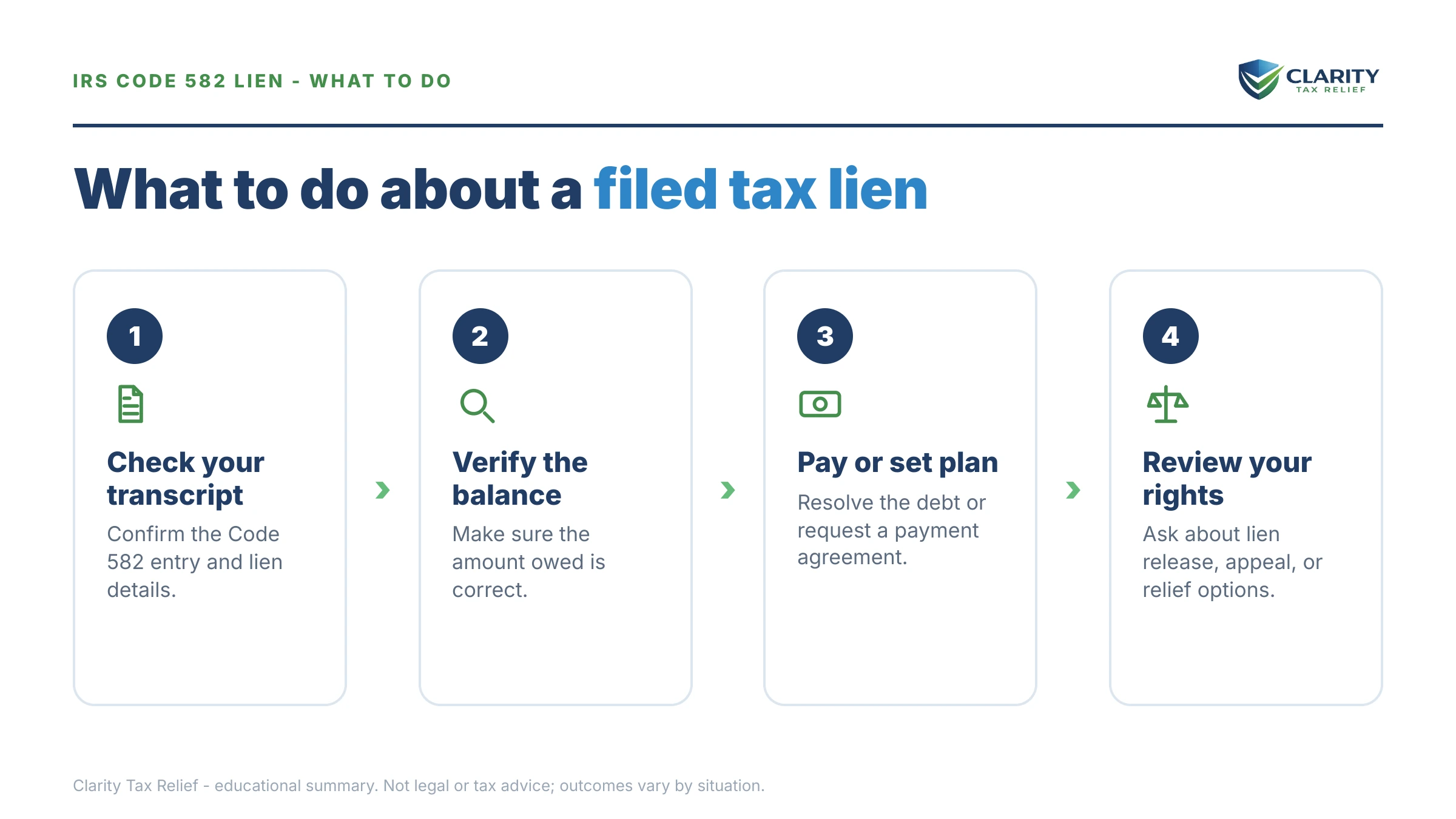
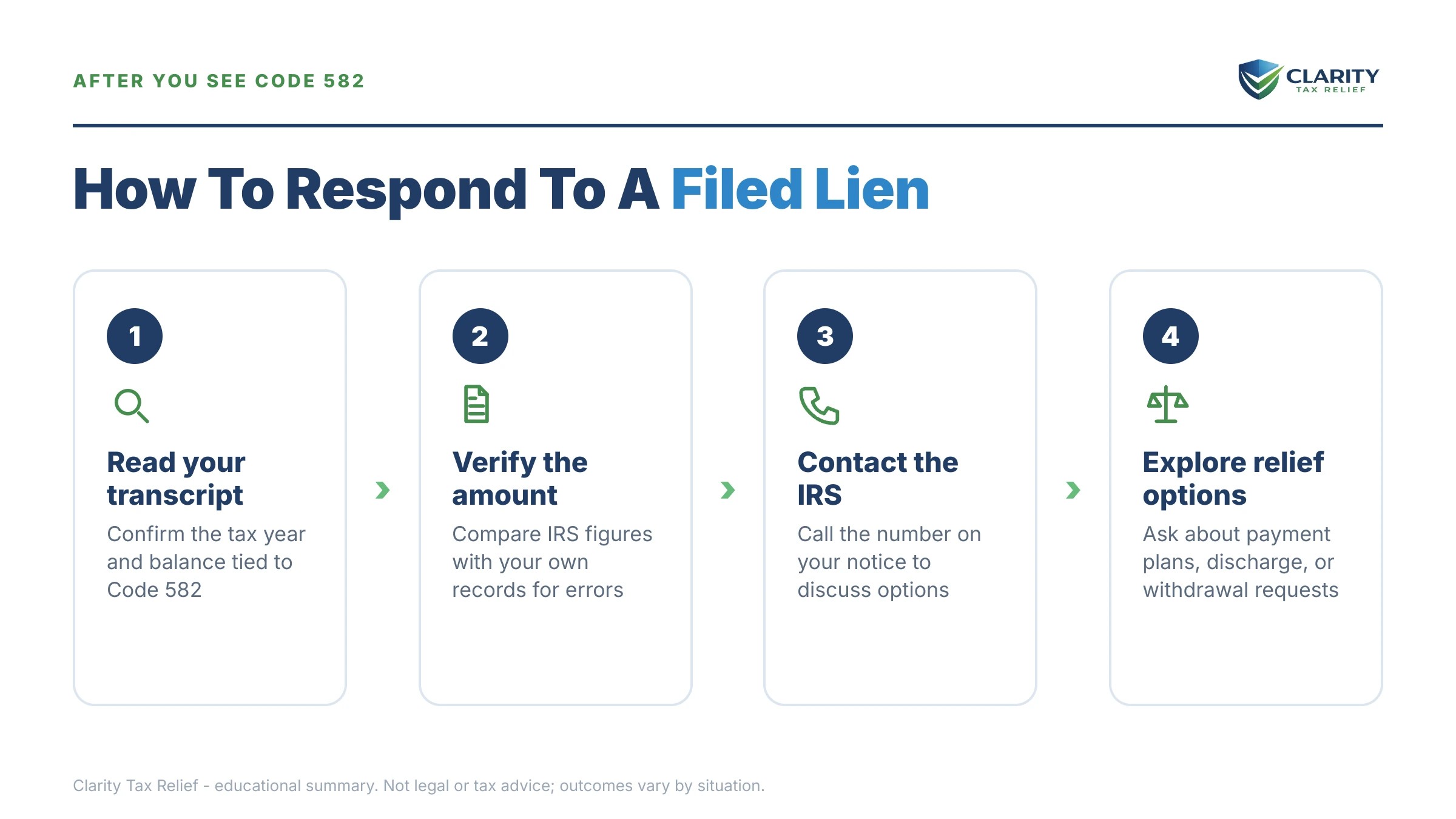
How to respond to code 582, step by step
- Confirm the assessment behind the lien. Pull the full account transcript for the period and find the code 150 or 290 assessment and the current balance the lien secures.
- Calendar the Letter 3172 deadline. Find the Collection Due Process request date printed on the letter and write it down — it is the only appeal clock that includes Tax Court rights.
- File Form 12153 if you need to appeal. Request a Collection Due Process hearing before the printed date to challenge the filing or propose a collection alternative.
- Pick your resolution path. Pay in full, set up an installment agreement, or document hardship — how the lien exits depends on how the debt resolves.
- Request withdrawal or confirm release. After resolution, file Form 12277 where you qualify, or verify that code 583 and the Certificate of Release posted.
When you can handle code 582 yourself
Plenty of lien situations don't need professional help. If you can full-pay the balance, do it — the release is automatic within 30 days of payment, code 583 posts, and your job is just confirming the certificate hit the county records. Likewise, if you agree with the debt, it's a single tax year, and you can pay it down and maintain a direct-debit plan, the withdrawal application is a form you can file yourself.
Experienced help changes outcomes in four specific situations: the CDP deadline is days away and you dispute the underlying liability; the debt includes payroll taxes and a trust-fund investigation could reach you personally; a sale or refinance is pending and needs a discharge or subordination package done right the first time; or the balance is over $50,000 and the financial-statement negotiation determines what you pay for years. In those cases, the order of operations — appeal, financials, resolution, then record-clearing — is where cases are won or lost.
Terms on your transcript, decoded
- NFTL: the Notice of Federal Tax Lien — the public filing that turns the IRS's automatic legal claim into one lenders and title companies can see.
- Lien vs. levy: a lien is a claim securing the debt against your property; a levy is the actual taking of wages or bank funds — see irs lien vs levy for the full distinction.
- CDP: Collection Due Process — your right to an independent appeals hearing (with Tax Court review) if requested by the deadline on Letter 3172.
- Withdrawal vs. release: a release ends the lien but leaves the filing in the record marked satisfied; a withdrawal removes the notice as if it had never been filed.
- Self-releasing lien: every filed notice contains its own last-refile date; if the IRS doesn't refile by then, the lien releases by its own terms.
- CSED: the Collection Statute Expiration Date — generally 10 years from assessment, pausable by appeals, an OIC, or bankruptcy, and the outer limit of the lien's life.
One decoded myth deserves its own line: since 2018, filed tax liens no longer appear on the three consumer credit bureaus — the details are in our tax lien on credit report guide — but the public record still reaches every lender who looks for it.
Code 582 transcript questions, answered
What does code 582 mean on an IRS transcript?
Code 582 is the IRS transaction code for a federal tax lien indicator — it means the IRS has filed, or is in the process of filing, a Notice of Federal Tax Lien for that tax period. It is not a new charge and not a levy. Look for Letter 3172 in the mail: it confirms the filing and gives you a deadline to appeal.
Does code 582 mean a lien was filed against my house?
Not specifically — a federal tax lien attaches to everything you own, not one named asset. The IRS doesn't pick your house; the lien automatically covers real estate, vehicles, business equipment, receivables, and property you acquire later. It becomes a practical problem for your house when you try to sell or refinance, which is what the discharge and subordination certificates exist to solve.
Will the tax lien behind code 582 show up on my credit report?
Not on consumer credit reports — Equifax, Experian, and TransUnion stopped reporting tax liens in 2018. But the Notice of Federal Tax Lien is still a public record at the county or state level, and lenders, commercial credit bureaus, bonding companies, and title searches will find it. For a business owner, the commercial-credit impact is usually the bigger cost.
How do I get code 582 removed from my transcript?
Code 582 itself isn't removed — it's reversed by code 583 when the lien is released or withdrawn. Full payment triggers a Certificate of Release within 30 days. A withdrawal (Form 12277) goes further and pulls the notice from public record, generally available if the filing was improper or you owe $25,000 or less on a direct-debit payment plan.
Is code 582 the same as a levy?
No. A lien (code 582) is a legal claim that secures the debt against your property; a levy is the actual seizure of wages, bank funds, or assets. The lien doesn't take anything from you today. But both run on the same unpaid balance, so a levy notice like LT11 often follows if the debt stays unresolved.
How long does the lien behind code 582 last?
Generally as long as the collection statute — 10 years from the assessment date, though appeals, an offer in compromise, or bankruptcy can pause that clock. The filed notice contains its own refile deadline; if the IRS doesn't refile by then, the lien self-releases. Don't count on outlasting it: the IRS routinely refiles on larger balances.
Does the lien attach to my business's assets and receivables?
Yes, if the liability is the business's — the lien reaches inventory, equipment, and accounts receivable, which can choke off financing and factoring. If the debt includes unpaid payroll taxes, the IRS can also assess the trust-fund portion against owners and check-signers personally, creating a second lien in your own name. Payroll-tax liens deserve faster attention than income-tax liens.
Can I get a payment plan after code 582 posts?
Yes — a lien filing doesn't disqualify you from an installment agreement, hardship status, or an offer in compromise. Over $50,000, expect to provide financial statements rather than a streamlined online setup. The lien usually stays in place while you pay, but a direct-debit agreement can open the door to withdrawal once the balance qualifies.
Your next 24 hours
- Find the date next to the 582 entry and the tax period it posted to, then dig out Letter 3172 from your mail — the appeal deadline printed on that letter is the one clock that matters right now.
- Gather your paper: account transcripts for every year showing a balance, the lien letter, your last filed return, and — if the debt involves your business — the most recent quarter's payroll records and a rough profit-and-loss.
- Get the lien reviewed free before the window on your Letter 3172 closes: the 2-minute form at claritytaxrelief.com/#consult or a call to (888) 825-7779. An experienced tax professional will map which exit path fits your balance — while every appeal right is still on the table.
For deeper primary-source reading: the IRS's own overview at Understanding a Federal Tax Lien, the official IRS payment plans page for setting up an agreement, and the Taxpayer Advocate Service if the lien is causing hardship the normal channels won't fix.
This guide is general information, not tax or legal advice for your specific situation. Eligibility for IRS programs depends on individual facts and circumstances; no outcome is guaranteed.