
Tax Liens
Tax Lien on Business: What the IRS Can Reach — and How to Remove It (2026)
The short answer: a tax lien on business assets attaches to everything the business owns — inventory, equipment, accounts receivable, bank funds — plus anything it acquires later. If you're a sole proprietor, it covers your personal assets too. The lien doesn't seize anything by itself, but it chokes off credit and complicates any sale until you resolve the balance.
Maybe you found out the hard way: an equipment lender or line-of-credit officer ran a routine records search, found a Notice of Federal Tax Lien, and the financing you were counting on stalled. Or a Letter 3172 landed in your mailbox announcing the filing. Either way, the claim is now public, and every commercial lender who checks will see it. The good news: a lien is a claim, not a seizure — your doors stay open, and there are five distinct ways off this list.
The image below shows exactly what a filed Notice of Federal Tax Lien looks like and where to find the amount, the tax periods it covers, and the refile deadline that controls how long the filing lasts.
⏱ Your deadline: if the lien was just filed, the Letter 3172 notice of federal tax lien that announced it gives you 30 days to request a Collection Due Process hearing (Form 12153) — the exact date is printed on the letter. Miss it and you lose the right to have the filing reviewed in Tax Court. Separately, once you pay in full, the law requires the IRS to release the lien within 30 days.
Why the IRS filed a tax lien against your business
A federal tax lien arises automatically under IRC §6321 the moment tax is assessed, the IRS demands payment, and you don't pay. That "statutory lien" is invisible — nobody else knows about it. What changed your situation is the Notice of Federal Tax Lien (NFTL), the public filing at your county recorder or state office that tells every lender, title company, and commercial credit bureau the IRS has a claim ahead of them.
As a matter of policy, the IRS typically files an NFTL once a balance passes $10,000 — though it can legally file at any amount, and revenue officers working business and payroll cases file faster. The filing usually follows ignored balance-due notices: the IRS wanted to secure its position before your assets move.
For a self-employed sole proprietor, the debt behind the lien is usually unpaid 1040 balances — self-employment tax and income tax from years without enough estimated payments. When we get to the image of the notice, check the "Kind of Tax" and "Tax Period" columns: they tell you exactly which years and which tax types are secured, and whether the amount matches your records.
Sole proprietor vs. LLC vs. corporation: whose lien is it?
A sole proprietorship is not a separate legal person, so a lien for your tax debt reaches business and personal property alike. Your work truck, your shop inventory, your personal savings account, and your house are all one estate in the IRS's eyes. There is no wall to hide behind — and no wall protecting the business from a "personal" tax debt either.
Entities change the picture, but less than owners hope:
- Single-member LLC: for income tax you're still the taxpayer, so the lien names you — and it reaches your interest in the LLC. In practice, a disregarded single-member LLC gives a sole-proprietor-style business very little lien protection.
- Corporation or multi-member LLC with entity debt (like unpaid 941 payroll tax): the lien names the entity and its EIN, and attaches to entity assets — not automatically to your home.
- The payroll exception: unpaid trust-fund payroll taxes can be assessed against owners and check-signers personally through the Trust Fund Recovery Penalty, creating a second, personal lien alongside the business one.
One more distinction worth 30 seconds: a lien is a claim; a levy is the taking. If money has actually left an account, you're past the lien stage — see lien vs. levy: the difference.
What a tax lien on business assets actually reaches
The federal tax lien attaches to all property you own now and all property you acquire while the lien exists — including next month's receivables and next year's equipment. But the law carves out one exception that keeps your doors open, and one trap that quietly kills your financing. Both are in the table below.
| Asset | Does the lien attach? | What it means day to day |
|---|---|---|
| Inventory on your shelves | Yes | You still control and sell it — the lien doesn't lock the stockroom. |
| Goods sold to customers in the ordinary course of business | Buyers take them free of the lien | Federal law protects ordinary retail purchasers, so normal sales continue. Customers never inherit your lien. |
| Accounts receivable | Yes, including future invoices | Factoring companies and AR lenders stop advancing once they find the filing — the collateral is now second to the IRS. |
| Equipment, tools, vehicles | Yes | You keep using them, but you can't sell or refinance them with clear title without a discharge or payoff. |
| Business bank funds | Yes (claim only) | Money doesn't move — that would take a levy, which requires separate final notices. |
| Property you acquire later | Yes, automatically | The lien follows you into new equipment, new receivables, even a new venture under your name. |
| Your home and personal accounts (sole proprietor) | Yes | Sole-proprietor debt is personal debt — the lien makes no business/personal distinction. |
The financing trap deserves its own paragraph, because it's the most common way a lien blindsides an operating business. Lenders who hold a security interest in revolving collateral — inventory, receivables — generally keep priority only for a limited period after the NFTL is filed (federal law gives most such lenders roughly a 45-day window). After that window, new advances and newly acquired collateral fall behind the IRS — which is why a working line of credit often freezes within weeks of the filing, even though nothing was seized. Anyone can confirm the filing themselves; here's where liens are recorded and how the tax lien public record lookup works.
What the lien does not do since 2018: appear on your consumer credit report. The damage now runs through commercial credit bureaus, bonding companies, and title searches instead — quieter, but just as real when you need capital.
What happens if you ignore a business tax lien
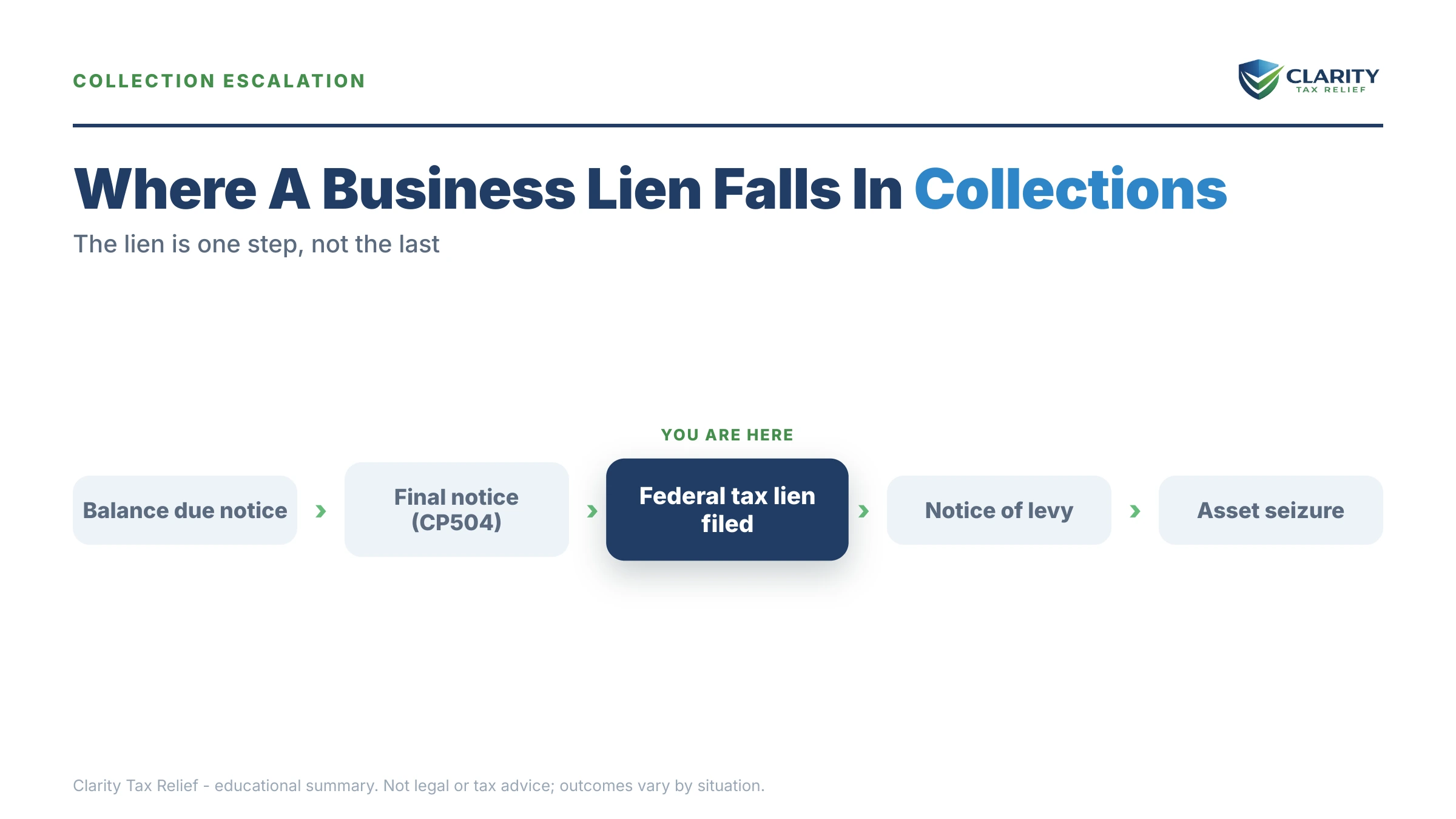
A filed lien is the IRS securing its claim before enforcement begins — ignoring it doesn't pause anything. The account keeps moving through an automated sequence, and each stage removes options the earlier stage still had:
- Lien filed (you are here). Public record. Credit tightens, the failure-to-pay penalty adds 0.5% per month, and interest compounds daily on the whole balance.
- Balance-due notices continue, culminating in a CP504 — the IRS can then take your state tax refund.
- LT11 / Letter 1058 final notice. A 30-day clock starts, along with your Collection Due Process rights. This is the last exit before enforcement.
- Levies begin. Business bank accounts (funds held 21 days before they're sent to the IRS), and — devastating for a service business — an IRS levy on accounts receivable that redirects client payments straight to the Treasury. Sole proprietors' personal accounts are equally exposed.
- A revenue officer takes the case in persistent or growing-balance situations, with asset seizure as the endpoint in extreme cases. If the debt grows past $66,000 (the 2026 threshold), passport certification enters the picture.
- Near the 10-year mark, the IRS can refile the lien in limited situations rather than let it lapse.
Note what's absent from that list: a human reviewing your file. IRS staffing fell roughly 27% in 2025, but the notice and levy systems are automated — the sequence runs whether or not anyone at the IRS ever reads your correspondence. Getting ahead of it is on you.
Lien filed against your business?
If your Letter 3172 is recent, the 30-day appeal window may still be open — and even if it isn't, the right resolution can stop the sequence before levies start. Get your lien and balance reviewed free by an experienced tax professional: call (888) 825-7779 or use the 2-minute form.
Your options: how to remove a tax lien from your business
There are five legitimate ways a federal tax lien stops hurting a business: release, withdrawal, discharge, subordination, and expiration. Each has different eligibility and does something different to the public record — and which resolution program you pair it with (payment plan, offer, hardship status) determines which lien remedies open up. The background on installment agreements and offers lives in our guide to how long the IRS takes to release a tax lien; here's how each path applies when the lien sits on a business.
| Option | What it does to the lien | Typical eligibility |
|---|---|---|
| Pay in full | Release required within 30 days; you receive a certificate of release of tax lien | Anyone — payment can come from savings, a sale, or borrowed funds |
| Withdrawal (Form 12277) | Removes the filing as if it never happened — the strongest remedy for credit | Generally: balance $25,000 or less, direct-debit installment agreement, on-time payment history, all returns filed |
| Discharge (Form 14135 tax lien discharge) | Frees one specific asset so it can be sold with clear title; lien stays on everything else | Selling a specific asset — usually where the IRS gets the sale proceeds or the asset has little equity |
| Subordination (Form 14134 tax lien subordination) | Lets a lender move ahead of the IRS so a loan or refinance can close; lien remains | Financing that helps the IRS get paid — e.g., a loan that pays down the tax debt or keeps the business producing income |
| Streamlined installment agreement | Stops escalation; lien stays filed, but opens the withdrawal path as the balance drops | Individuals (including sole proprietors) owing $50,000 or less, payable within 72 months |
| Offer in Compromise | Lien released after the accepted offer is fully paid | Means-tested: your assets plus future income genuinely can't cover the debt; roughly 1 in 5 offers were accepted in FY2024 |
| Currently Not Collectible | Pauses levies, not the lien — the IRS may even file one as a condition of CNC (see does CNC stop a tax lien) | Documented hardship: paying anything would leave you unable to cover necessary living/operating expenses |
| Expiration at the CSED | Lien self-releases when the 10-year collection statute runs — details in does an IRS tax lien expire | Automatic, but the clock pauses during OICs, bankruptcy, and appeals — estimate yours with our CSED Calculator |
If the debt is entity-level (941, 1120), the plan runs through the business side of the IRS instead — thresholds and paperwork differ, and our guide to the business IRS installment agreement covers those rules. And if a state has filed its own lien alongside the federal one — California's is a separate animal with a 20-year collection statute — see our FTB tax lien guide; never assume federal timelines apply to a state filing.
A $36,900 lien, worked through: the sole proprietor's math
Say you're a self-employed sole proprietor and the IRS filed a lien for $36,900 in unpaid self-employment and income tax across two years. Here's how the three realistic paths actually pencil out — this is a hypothetical illustration, not a promise of any outcome:
- Streamlined installment agreement. $36,900 is under the $50,000 ceiling, so you can set up a 72-month plan online without submitting full financials. The raw math is $36,900 ÷ 72 = $512.50/month — but interest and the monthly late-payment penalty keep accruing, so budget meaningfully above that to actually pay off in 72 months. Faster is cheaper: the same debt at $1,025/month clears in roughly half the time and cuts total interest substantially.
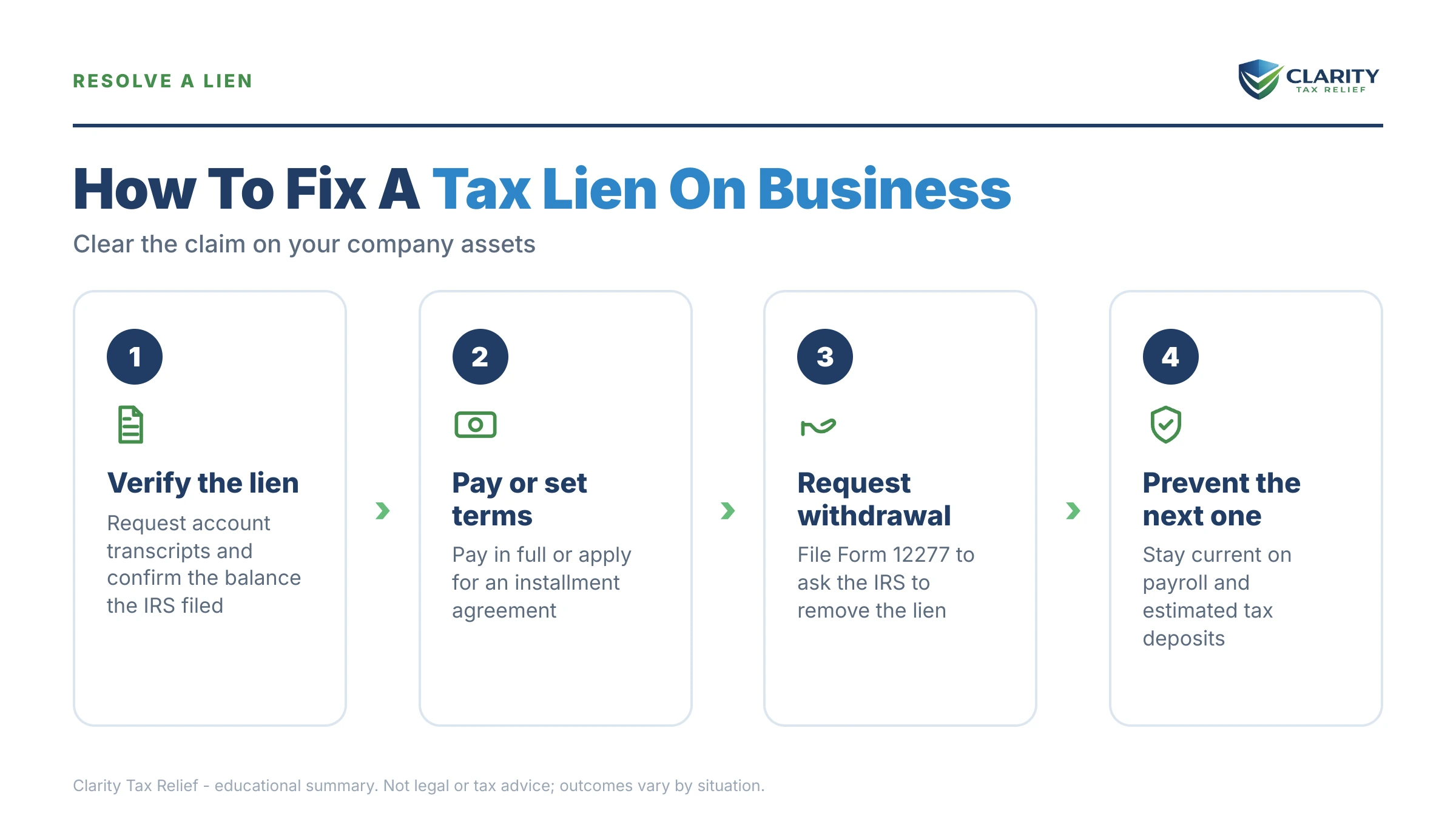
- The withdrawal play. The lien-withdrawal program generally requires a balance of $25,000 or less. $36,900 − $11,900 = $25,000: pay the balance down by $11,900, convert to direct debit, make the required run of on-time payments, and you can request Form 12277 withdrawal — erasing the filing from the record while you finish paying. For a business that lives on credit, this is often worth accelerating.
- Offer in Compromise — only if the math is real. Suppose your equipment and truck carry $6,000 in equity and, after IRS allowable expenses, you clear $300/month. A lump-sum offer is roughly equity plus 12 months of that disposable income: $6,000 + ($300 × 12) = $9,600. If your actual numbers look like that, an offer is worth exploring — the $205 fee and 20% down payment are waived with low-income certification (AGI at or below 250% of the poverty level). If your business reliably nets more, the IRS's own math will price the offer near full pay, and the installment route wins.
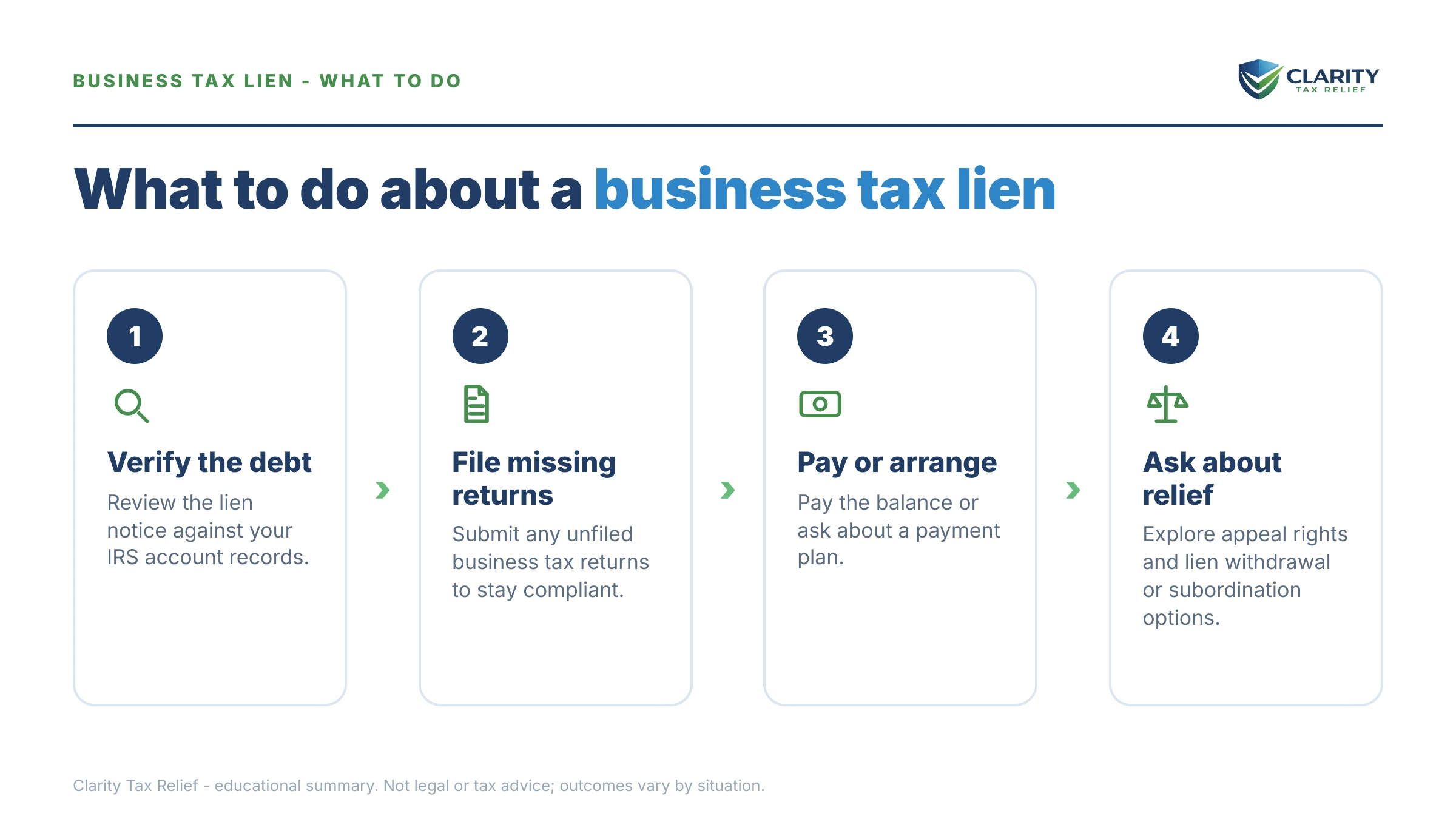
How to respond to a tax lien on your business, step by step
- Find your deadline. Pull out the Letter 3172 that announced the lien filing and calendar the Collection Due Process request date printed on it — that 30-day window is your one shot at a Tax Court-reviewable appeal of the filing.
- Verify the debt and the name on the lien. Check your IRS online account or transcripts to confirm the balance, the tax periods listed, and whether the lien is filed against you personally, your entity's EIN, or both.
- Choose your resolution path. Match your cash flow to an option: full payment, a streamlined or business installment agreement, an Offer in Compromise, or Currently Not Collectible status if paying anything would sink the business.
- Set it up before enforcement escalates. Establish the agreement — or file Form 12153 within the CDP window if you dispute the lien — so the account never reaches the levy notices that follow.
- Request the lien remedy that fits. Apply for withdrawal (Form 12277), discharge (Form 14135), or subordination (Form 14134) as your situation allows, then confirm the release or withdrawal actually posts in the county or state records where the lien was filed.
What each option costs — and how long it takes
Every lien remedy is free or cheap to request from the IRS itself — the real costs are time, interest that keeps accruing while you decide, and the financing you lose while the filing sits in the record.
| Option | Upfront cost | Typical timeline |
|---|---|---|
| Short-term payment plan (up to 180 days) | $0 setup | Set up same day online; interest and penalties continue until paid |
| Streamlined installment agreement (≤ $50k) | Modest setup fee — lowest for online direct debit, reduced or waived for qualifying low-income taxpayers | Often approved online the same day; up to 72 months to pay |
| Lien release after full payment | $0 | Required by law within 30 days of full payment |
| Lien withdrawal (Form 12277) | $0 to apply | Typically weeks after you meet the eligibility conditions; then confirm the recording is updated |
| Discharge / subordination (Forms 14135 / 14134) | $0 filing fee | Several weeks of IRS review — apply well before any closing date, not the week of |
| Offer in Compromise | $205 fee + 20% down on lump-sum offers (both waived with low-income certification) | Commonly many months; deemed accepted if the IRS doesn't decide within 2 years, with narrow exceptions — a returned or rejected offer stops the clock, and time during court disputes does not count |
| Currently Not Collectible | $0 (requires financial disclosure) | Weeks to establish; reviewed periodically — the lien typically remains the whole time |
When you can handle a business tax lien yourself
Plenty of lien situations don't need professional help. You can confidently go it alone when:
- You can pay in full — pay, wait for the certificate of release, and confirm the recording is updated. Done.
- You owe under $25,000, agree with the balance, and have steady income — set up a direct-debit agreement online, then request withdrawal yourself once you qualify.
- No transaction is pending — if you're not trying to borrow, sell, or bond a job right now, a clean streamlined agreement quietly solves the problem over time.
Experienced help changes outcomes in the harder cases: a loan, sale, or refinance closing on a deadline (discharge and subordination packages are technical and slow to fix if bounced); levy notices already arriving; multiple unfiled years that must be resolved before any agreement sticks; payroll or trust-fund debt where personal liability is in play; and OIC math on fluctuating self-employment income, where how business assets and income are presented moves the offer amount significantly. If any of those describe you, a free review before you file anything can save both money and months — start with the 2-minute form.
Terms on your lien notice, decoded
- Notice of Federal Tax Lien (NFTL): the public filing of the lien — the statutory lien itself existed silently from the moment you were assessed and didn't pay.
- Self-releasing lien: the NFTL contains its own expiration language — if the IRS doesn't refile by the date shown in column (e), the filing operates as its own release.
- CDP (Collection Due Process): your right, within 30 days of Letter 3172, to an independent appeals hearing on the lien filing, with Tax Court review if you disagree.
- Withdrawal vs. release: a release says the debt is satisfied; a withdrawal removes the filing from the record as if it were never made — better for credit and lender searches.
- Discharge vs. subordination: discharge frees one asset from the lien so it can be sold; subordination keeps the lien but lets a specific lender's claim jump ahead of it.
- Superpriority purchaser: a customer buying your goods at retail in the ordinary course of business — they take the goods free of the lien, which is why sales continue.
- CSED: the Collection Statute Expiration Date — generally 10 years from assessment, when both the debt and the lien die, subject to pauses for offers, bankruptcy, and appeals.
Business tax lien questions, answered
Does a tax lien on a business apply to my personal assets?
If you operate as a sole proprietor, yes — the business and you are the same legal person, so the lien attaches to your home, vehicles, and bank accounts as well as business assets. If a corporation or multi-member LLC owes the tax, the lien names the entity, though unpaid payroll taxes can trigger a separate personal assessment against owners through the Trust Fund Recovery Penalty.
Can I still run my business with an IRS tax lien filed against it?
Yes. A lien is a claim, not a seizure — you keep operating, and customers who buy your inventory in the ordinary course of business take it free of the lien. The real damage is to credit: lenders, factoring companies, and equipment financers who search public records will usually freeze or deny new financing until the lien is resolved.
Does a tax lien freeze my business bank account?
No. A lien is a legal claim against your assets; a levy is the actual taking, and it requires separate final notices with their own 30-day appeal window. If money actually left your account, you are dealing with a levy, not the lien. That said, an unresolved lien means the account keeps escalating toward exactly those levy notices.
How do I remove a tax lien from my business?
Full payment forces a release within 30 days by law. Short of that: a withdrawal (Form 12277) is generally available once the balance is $25,000 or less on a direct-debit installment agreement; a discharge (Form 14135) frees one asset so you can sell it; and a subordination (Form 14134) lets a lender jump ahead so financing can close. The lien also self-releases when the 10-year collection statute expires.
Does a business tax lien show up on my credit report?
Not on consumer credit reports — the three bureaus stopped including tax liens in 2018. But the Notice of Federal Tax Lien is a public record filed with your county or state, and business lenders, commercial credit bureaus, bonding companies, and title companies search those records directly. So it can still sink a loan application even though it never touches your FICO score.
Can I sell my business or its equipment with a tax lien on it?
You can, but the lien follows the assets unless it is dealt with at closing. Buyers' attorneys and title companies will find the filing, and in practice the IRS gets paid from the proceeds before you do. For a sale of a specific asset, a Certificate of Discharge (Form 14135) removes that asset from the lien — apply well before your closing date.
Does setting up a payment plan remove the tax lien?
Not automatically. An installment agreement stops levies and further collection notices, but the filed lien stays in the public record while you pay. The exception: once your balance is $25,000 or less and you're on a direct-debit agreement, you can generally request a full lien withdrawal after a run of on-time payments — which removes the filing as if it never happened.
How long does a federal tax lien on a business last?
Generally 10 years from the date the tax was assessed — the same collection statute that governs the debt itself. When that deadline passes, the lien self-releases by its own terms, though the IRS can refile in limited situations and events like an Offer in Compromise or bankruptcy pause the clock. Waiting it out means a decade of blocked credit while penalties and interest grow.
Will the IRS file a lien if my business owes less than $10,000?
Usually not — as a matter of policy the IRS typically reserves lien filings for balances above $10,000, and often waits longer. But it has the legal authority to file at any balance, and revenue officers handling payroll or business cases file more aggressively. The statutory lien itself exists automatically once tax is assessed and unpaid, whether or not anything is filed publicly.
Your next 24 hours
- Find two things on your Letter 3172: the Collection Due Process deadline printed on it, and the tax periods and amount listed on the lien — confirm they match your records before you plan around them.
- Gather your file: the lien notice, your last two filed returns, a rough picture of business income and expenses, and any loan or sale that's currently pending — those deadlines shape which lien remedy to pursue first.
- Get the lien reviewed free: if your CDP window is still open, or a levy notice is in the stack, timing matters — call (888) 825-7779 or use the 2-minute form and an experienced tax professional will map release, withdrawal, discharge, or subordination against your actual numbers.
The IRS's own overview of lien basics is at Understanding a federal tax lien, and payment-plan options are laid out on the IRS payment plans page. If a lien or looming levy is causing hardship the normal channels won't fix, the independent Taxpayer Advocate Service can intervene.
This guide is general information, not tax or legal advice for your specific situation. Eligibility for IRS programs depends on individual facts and circumstances; no outcome is guaranteed.