
IRS Liens
Tax Lien Discharge (Form 14135): Selling Property With a Federal Tax Lien in 2026
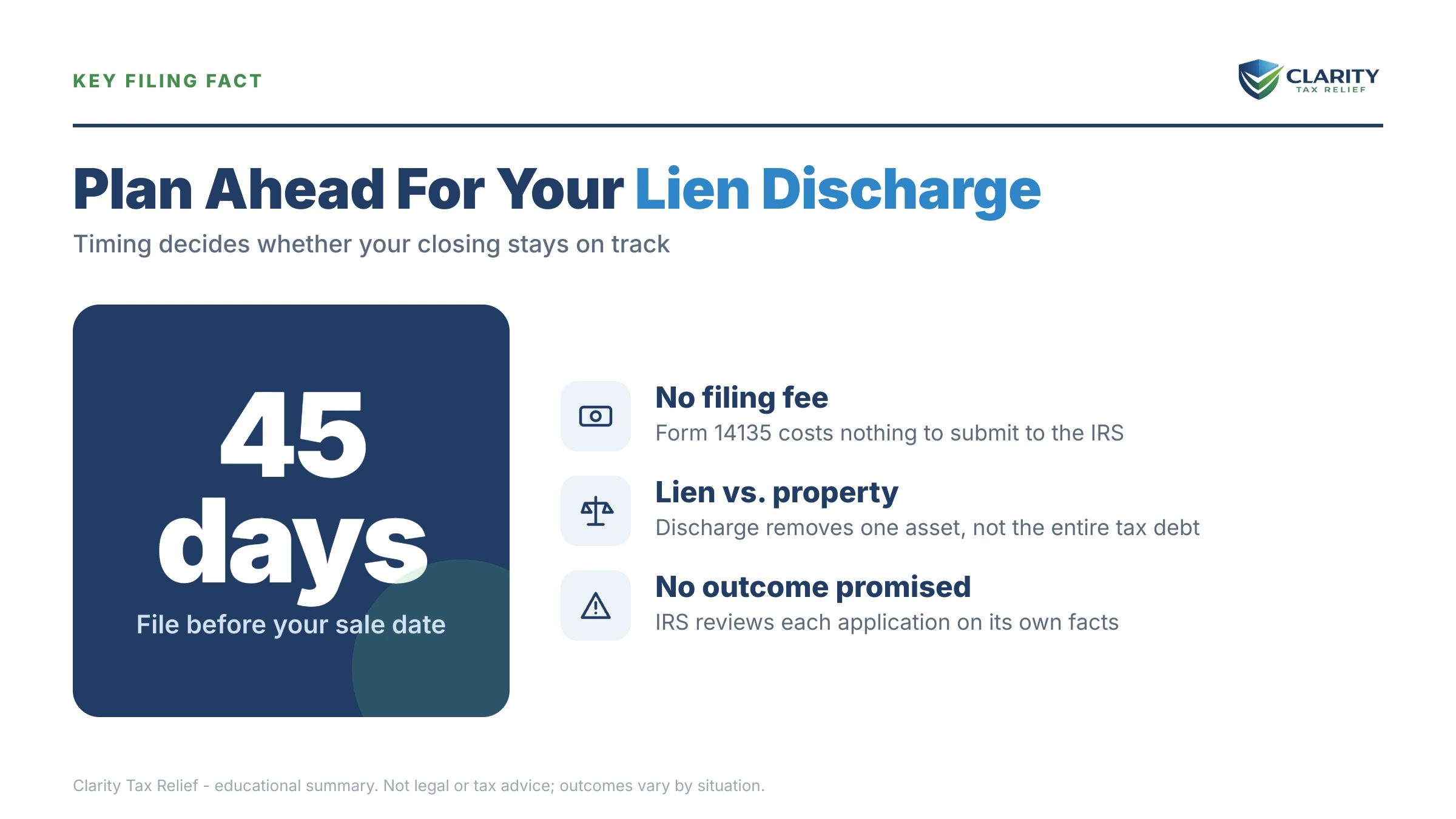
The short answer: a tax lien discharge removes the IRS lien from one specific property so a sale or closing can go through — the lien stays on everything else you own, and the debt survives. You apply with Form 14135, there's no fee, and the IRS wants your application at least 45 days before closing.
The title search on your sale came back, and buried in it is a Notice of Federal Tax Lien — recorded against you, attached to the property, and standing between you and your closing date. Your buyer's lender won't fund until it's dealt with. This is exactly the problem a tax lien discharge exists to solve, and the path runs through one form: Form 14135, the Application for Certificate of Discharge of Property from Federal Tax Lien.
The good news: the IRS approves discharges routinely when the math works, because a closing usually means money moving toward the tax debt. The image below shows you exactly what Form 14135 looks like and where the sections that decide your application live, so keep reading before you start filling anything in.
⏱ Your real clock: the IRS asks you to submit Form 14135 at least 45 days before your closing or settlement date (per Publication 783). There's no statutory deadline — but miss that lead time and your closing, not the IRS, is what blows up. Count back 45 days from your contract's closing date today.
Why there's a federal tax lien blocking your sale
A federal tax lien attaches automatically to everything you own — including this property — once the IRS assesses a debt, demands payment, and doesn't get it. No judge, no court filing. When the IRS then records a Notice of Federal Tax Lien (Form 668(Y)) at your county recorder, the lien becomes public, and it announced itself to you with Letter 3172, the notice of federal tax lien filing letter.
That public recording is why your title company found it. Liens sit in county land records where every title search looks — you can run the same lookup yourself using our guide to the tax lien public record. On your IRS account transcript, the filing shows as code 582.
If your debt came from years you never filed — common for 1099 and gig workers, where the IRS eventually built the balance from substitute-for-return assessments — the lien attached the same way, and it also grabs property you acquire after the filing. That "after-acquired property" reach matters later in this article, because it's why a discharge doesn't end your lien problem, only this property's piece of it. For how the lien affects your home more broadly, see our guide to a federal tax lien on your house.
One clarification before anything else: a lien is a claim, not a seizure. Nobody is taking the property — the lien just rides along with the title and demands to be addressed when the title changes hands. The lien vs. levy difference matters, because your options here are paperwork options, not emergency ones.
Tax lien discharge vs. release, subordination, and withdrawal
A discharge frees one named property from the lien; a release ends the lien against everything you own. People use these words interchangeably and apply for the wrong thing constantly — the IRS has four separate lien remedies, on four separate forms, and each fixes a different problem.
| Remedy | Form | What it does | When it fits |
|---|---|---|---|
| Discharge | Form 14135 | Removes the lien from one specific property; lien survives on everything else | Selling or transferring a property while you still owe |
| Subordination | Form 14134 | Lets another creditor jump ahead of the IRS; lien stays in place | Refinancing — you keep the property, a lender needs priority |
| Release | Certificate 668(Z), issued by the IRS | Ends the lien entirely, against all your property | Debt paid in full, bonded, or no longer enforceable |
| Withdrawal | Form 12277 | Pulls the public notice as if never filed | Improper filing, or qualifying direct-debit payment plans |
So: keeping the property and refinancing? You want tax lien subordination, Form 14134's job — and our guide to refinancing with a tax lien walks that path. Paying the balance in full at closing? You don't need a discharge at all; escrow pays the IRS and a certificate of release of tax lien follows — timing details are in our hub on how long the IRS takes to release a tax lien. Think the lien never should have been filed, or you're on a qualifying direct-debit plan? That's lien withdrawal on Form 12277.
Form 14135 is for one situation: the property is leaving your hands and the sale proceeds can't (or won't) pay the IRS in full. That's this article.
What happens if you try to close without a discharge
A recorded federal tax lien follows the property into the buyer's hands unless it's paid, discharged, or otherwise resolved before closing — which is why no title company will insure around it. Here's the sequence when a lien-encumbered sale is left to sort itself out:
- The title search surfaces the Notice of Federal Tax Lien. This happens in almost every financed sale — the recording exists precisely so it gets found.
- The buyer's lender refuses to fund. No lender closes on collateral carrying a federal lien senior to their new mortgage. The title company issues a requirement: lien resolved or no policy.
- The closing date slips — and a rushed Form 14135 can't beat the clock. The IRS wants the application 45 days out. Applications filed a week before closing routinely arrive too late, and buyers with rate locks and moving trucks walk.
- The deal dies, and the underlying debt keeps compounding. Interest and the monthly failure-to-pay penalty accrue on the full balance. The IRS's automated collection stream continues in parallel — a lien does not pause levies on wages or bank accounts.
- The lien outlasts your patience. The lien generally self-releases when the 10-year collection statute runs, but the IRS can refile before that happens when the statute has been extended — see whether an IRS tax lien expires in your situation. Waiting it out is rarely a plan when a sale is on the table today.
The takeaway: the lien doesn't kill your sale — the calendar does. Every stage above is avoidable if the discharge application goes in early and complete.
Under contract with an IRS lien on the title?
Get your Form 14135 package reviewed free before the 45-day window to your closing date closes. An experienced tax professional will run the payoff math, pick the right §6325(b) provision, and flag anything Advisory will bounce — before it costs you the sale.
The five ways the IRS grants a tax lien discharge
Every discharge is granted under one of five provisions of IRC §6325(b), and Form 14135 makes you pick which one you're applying under. The IRS isn't judging your hardship or your story here — it's running property math: what is the government's lien actually worth in this property, and is it getting that value (or adequate protection) in the deal?
| Provision | When it fits | What the IRS gets |
|---|---|---|
| §6325(b)(1) | Your remaining property is worth at least double the tax debt plus all senior claims on it | Nothing at closing — the rest of your property fully secures the debt |
| §6325(b)(2)(A) | The sale has equity, but not enough to pay the IRS in full | Payment of its lien interest — the net proceeds after senior claims and reasonable closing costs |
| §6325(b)(2)(B) | The property is underwater — senior mortgages and costs consume the entire price | Nothing — the IRS's lien interest in the property is zero |
| §6325(b)(3) | Competing claims to the proceeds need sorting out after closing | Proceeds held in an escrow fund the lien attaches to, pending resolution |
| §6325(b)(4) | A third party who owns property the lien attached to wants it cleared | A cash deposit or bond equal to the government's lien interest |
In practice, most owner sales run through §6325(b)(2)(A) or (b)(2)(B) — either the IRS gets the leftover equity, or it acknowledges there isn't any. Two details decide which side of that line you're on:
Priority. Claims recorded before the Notice of Federal Tax Lien — typically your purchase mortgage and property taxes — get paid first, ahead of the IRS. Claims recorded after generally don't. Recording dates on the title report are everything; our guide to tax lien vs. mortgage priority covers who gets paid first and why a HELOC taken out after the lien filing can't cut in line.
Reasonable costs. The IRS accepts ordinary closing costs — commissions, recording fees, prorated property taxes — as deductions before its share. It scrutinizes anything unusual: above-market commissions, seller concessions to a related buyer, or "repair credits" that look like equity leaking out the side door.
Two alternatives worth naming before you commit to the discharge path. First, if the proceeds can pay the balance in full, skip Form 14135 — a full payoff through escrow is faster and ends the lien everywhere, not just here; our guide to selling a house with an IRS lien compares both routes. Second, if you're tempted to cancel the sale and simply outlast the lien, remember the collection statute is 10 years from assessment and pausable by appeals, offers, and bankruptcy — you can estimate your own dates with our CSED Calculator, but for most sellers with a live contract, waiting years beats nothing and loses to closing next month.
Worked example: a $41,800 lien and a condo sale that can't cover it
This is a hypothetical, not a client story. Say you're a gig worker who didn't file for three years; the IRS assessed the missing years, the balances total $41,800, and a Notice of Federal Tax Lien got recorded against your condo. Now you're under contract to sell. Here's the math the IRS will run:
- Contract price: $285,000
- Mortgage payoff (recorded years before the lien, so senior): $233,400
- Commissions and ordinary closing costs: $19,950
Net proceeds: $285,000 − $233,400 − $19,950 = $31,650. That's less than the $41,800 you owe, so escrow can't pay the IRS in full — a straight payoff-and-release is off the table. But $31,650 is exactly the government's lien interest in this property, so this is a textbook §6325(b)(2)(A) discharge: you apply on Form 14135, the IRS issues a conditional commitment, escrow wires the IRS $31,650 at closing, and the certificate of discharge clears the condo's title.
After closing you still owe $41,800 − $31,650 = $10,150, the lien still exists against your other assets, and interest keeps running. At that size, a streamlined installment agreement set up online (available for balances up to $50,000, over as long as 72 months) is usually the clean finish — and once you're paying by direct debit, a lien withdrawal may even become possible.
Now flip one number. If your mortgage payoff were $272,000 instead, the math goes $285,000 − $272,000 − $19,950 = −$6,950. The IRS's lien interest is zero, and §6325(b)(2)(B) applies: the discharge is granted, the IRS receives nothing at closing, and the entire $41,800 survives for you to resolve separately. Underwater sellers are often shocked this exists — the IRS discharges liens from no-equity property because blocking the sale would get it nothing anyway.
How to apply for a tax lien discharge, step by step
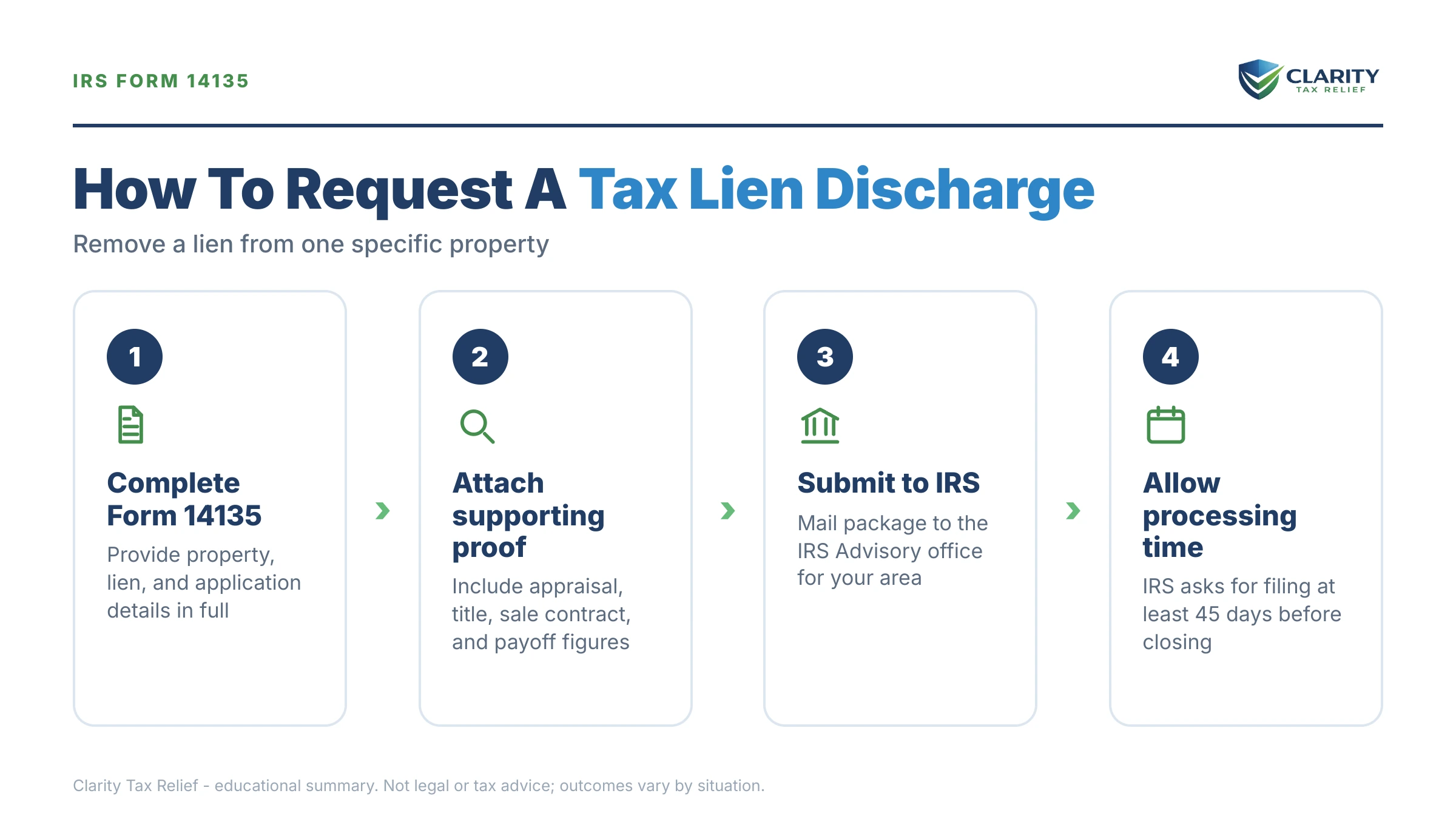
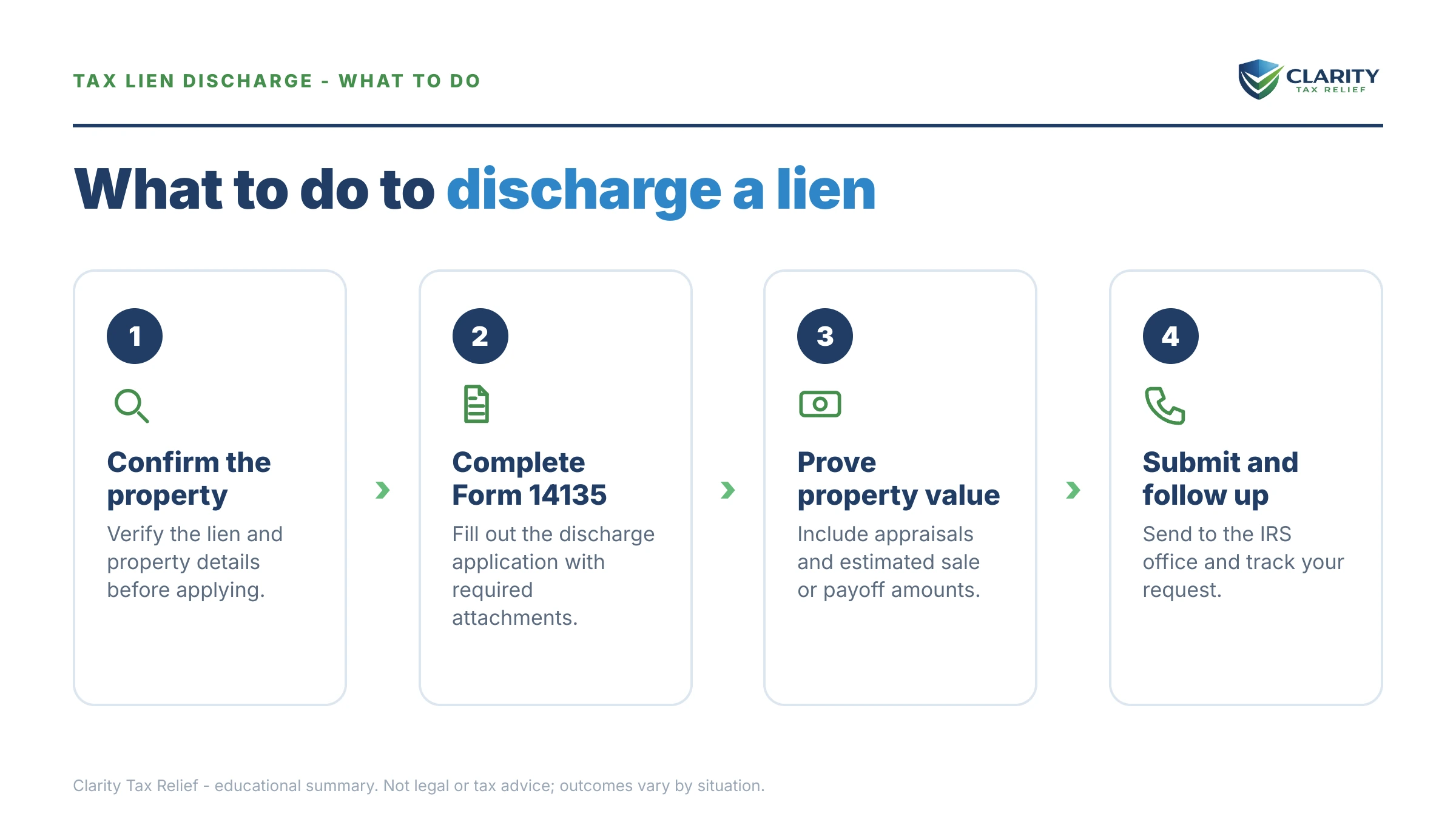
Form 14135 is free to file, but the application lives or dies on its attachments. Publication 783 is the official instruction set; here is the working sequence:
- Order the paperwork that drives the math: Get a title report, your mortgage payoff letter, and your current IRS payoff amount — these three numbers decide which discharge provision fits.
- Complete Form 14135: Identify the property, the recorded Notice of Federal Tax Lien, the §6325(b) provision you're applying under, and the proposed closing details, following Publication 783.
- Attach the supporting documents: Include the signed sale contract, the title report, all payoff letters, a proposed closing statement showing every cost, and an appraisal or valuation if the price could be questioned.
- Send the package to IRS Collection Advisory: Mail it to the Advisory office that covers the property's location, at least 45 days before your closing date.
- Coordinate the conditional commitment with escrow: The IRS issues a conditional commitment letter stating exactly what it must receive at closing — give it to your title or escrow officer so the payment is wired correctly.
- Confirm the certificate of discharge is issued and recorded: After closing, verify the IRS issued the certificate and that it's recorded in the same county records where the lien was filed.
| Stage | When | What happens |
|---|---|---|
| Gather documents | As soon as you list — 60+ days before closing | Title report, payoff letters, IRS balance; catch surprises while there's time to fix them |
| Submit Form 14135 | At least 45 days before closing | Package goes to the Collection Advisory office covering the property |
| Advisory review | Inside the 45-day window | An advisor verifies values, priorities, and costs — and requests anything missing |
| Conditional commitment | Before closing | Letter states the exact amount (or zero) the IRS must receive for the discharge to issue |
| Closing | Settlement day | Escrow pays the IRS per the commitment; deed transfers |
| Certificate of discharge | After the IRS receives payment/proof | Certificate issues and gets recorded, clearing this property's title |
Two practical notes. The Advisory office assignment goes by where the property sits, not where you live — the correct address list is in IRS Publication 4235. And IRS staffing is down sharply after the 2025 workforce cuts, which makes complete-on-first-submission matter more than ever: a package that bounces for a missing payoff letter can eat weeks you don't have.
Three years unfiled? File before you apply
If the IRS built your balance through substitute-for-return assessments, filing your real returns first can shrink the payoff — sometimes dramatically. An SFR gives a 1099 worker no business deductions: no mileage, no supplies, no platform fees, and usually the worst filing status. The result is a balance far above what you actually owe — the mechanics are in our guide to when the IRS filed a substitute return for you.
Why it matters here: the discharge math starts from your assessed balance. In the worked example above, if accurate returns dropped the $41,800 to $29,000, the same $31,650 in net proceeds would now pay the IRS in full — meaning a complete lien release instead of a discharge, and $2,650 back in your pocket at closing.
The tension is timing. Corrected assessments take time to process, and your closing may not wait. When the calendar is tight, the working play is to file the returns, apply for the discharge on the current numbers, and let any later adjustment come back as a refund of overpayment. Our guide for people who haven't filed in 3 years covers the catch-up sequence itself — which returns, in what order, with what records.
When you can handle Form 14135 yourself — and when help changes the outcome
Plenty of sellers get their own discharge approved without professional help. You're a good DIY candidate when the picture is simple: one recorded lien, one senior mortgage, an arm's-length sale at an obviously fair price, 60+ days until closing, and all your returns filed. In that case the application is document assembly — Publication 783 is genuinely followable, and there's no fee to lose.
Experienced help earns its cost when any of these are true: the closing is inside 45 days and the application has to be right the first time; there are multiple liens, multiple years, or both federal and state liens on title (state liens are separate applications to separate agencies — California's, for instance, runs through the FTB tax lien process, and the FTB's collection window is 20 years, not 10); the IRS's balance is built on SFR assessments that filing could shrink; the sale is to a relative or at a price Advisory will question; or the leftover balance is large enough that the discharge should be sequenced with a payment plan, hardship status, or offer strategy rather than handled alone. The order you fix things in changes what you ultimately pay.
One honest boundary: no professional can make the IRS take less than its lien interest in the property. Anyone promising to "wipe the lien off" a property with real equity, without the IRS getting paid, is selling something that doesn't exist.
If your closing is already inside the 45-day window, don't research your way through the week — have your discharge package reviewed free today so it goes to Advisory complete the first time.
Terms on Form 14135 and your lien paperwork, decoded
- Notice of Federal Tax Lien (NFTL): the public document (Form 668(Y)) recorded at the county that makes the IRS's automatic lien visible to lenders and title companies.
- Certificate of discharge: the document the IRS issues after approval, removing the lien from the one property named in it — and nothing else.
- Lien interest: what the government's claim is actually worth in this property — the value left after senior claims and reasonable costs of sale.
- Senior encumbrance: a claim recorded before the NFTL (usually your mortgage) that gets paid ahead of the IRS at closing.
- Advisory (Collection Advisory group): the specialized IRS unit that reviews and decides discharge and subordination applications — not the general collections line.
- CSED: the Collection Statute Expiration Date — 10 years from assessment, pausable by certain events — after which the lien generally self-releases if the IRS hasn't refiled.
Tax lien discharge questions, answered
What is a tax lien discharge?
A tax lien discharge removes the federal tax lien from one specific piece of property while the lien stays attached to everything else you own. It exists mainly so a sale or transfer can close with clean title. The debt itself is not reduced — you apply with Form 14135 under one of five provisions in IRC §6325(b), and the IRS decides based on the property math, not hardship.
How long does a tax lien discharge take?
The IRS asks you to submit Form 14135 at least 45 days before the sale or closing date, and the Advisory group works the application inside that window. There is no guaranteed turnaround — incomplete packages are the most common cause of delay, because the reviewing advisor has to stop and request the missing document. A complete application with the contract, title report, and payoff letters moves fastest.
Does Form 14135 cost anything to file?
No — the IRS charges no fee for a discharge application. Your real costs are the documents that support it: a title report, payoff letters, and possibly an appraisal if the IRS questions the sale price. Compare that to what an unresolved lien costs you — a dead sale contract and a balance that keeps growing with interest and penalties.
Can I sell my house if the IRS has a lien on it?
Yes. If your equity covers the full balance, escrow simply pays the IRS at closing and the lien is released. If your equity covers only part of the balance — or none of it — a discharge under §6325(b)(2)(A) or (b)(2)(B) lets the sale close anyway, with the IRS taking its share of the proceeds (or nothing, if there is no equity).
What if my house is worth less than my mortgage?
You can still get a discharge. Under IRC §6325(b)(2)(B), the IRS will discharge property in which its lien interest is zero — meaning the mortgage and other senior claims eat the entire sale price. You prove it with the contract, the title report showing recording dates, and the payoff figures. The IRS receives nothing at closing, and your full tax balance survives the sale.
Does a discharge reduce the tax I owe?
No. A discharge frees one property from the lien; it does not touch the underlying debt or the lien on your other assets. Whatever balance remains after closing keeps accruing interest and late-payment penalties until you resolve it — through a payment plan, hardship status, an Offer in Compromise if you qualify, or expiration of the 10-year collection statute.
What's the difference between a lien discharge and a lien release?
A release ends the lien entirely, against everything you own — it happens when the debt is paid, becomes unenforceable, or the IRS accepts a bond. A discharge frees only one named property while the lien survives everywhere else. If your sale proceeds will pay the balance in full, you don't need a discharge; escrow pays the IRS and a release follows.
Do I have to file my unfiled returns before applying for a discharge?
Practically, yes — file first. The discharge decision is driven by property math, but your payoff figure comes from your assessed balances, and if the IRS created those balances through substitute-for-return assessments, they are almost always inflated. Filing accurate returns for the missing years can shrink the number escrow has to send the IRS, sometimes by thousands of dollars.
Why would the IRS deny a Form 14135 application?
The usual reasons are math and documentation: a sale price below market value (especially to a relative or related party), missing payoff letters or title work, closing costs the IRS considers excessive, or a proposed IRS payment smaller than its actual lien interest in the property. Denials come with an explanation, and you can fix the package and reapply — or ask for a manager conference.
Your next 24 hours
- Find your lien and your closing date. Pull the recording information from your Letter 3172 or the title report, and count the days between today and your settlement date. If it's under 45, everything else moves to today.
- Gather the three numbers that decide your case: your mortgage payoff letter, your estimated closing costs from the sale contract, and your current IRS balance (from your IRS online account or most recent notice) — plus your last filed return.
- Get the package reviewed free before it goes to Advisory. Send us the numbers through the 2-minute form or call (888) 825-7779 — an experienced tax professional will confirm the right §6325(b) provision and what happens to the balance the sale can't cover, while your 45-day window is still open.
Primary sources: the IRS's overview of how liens work is at Understanding a federal tax lien; the application itself is Form 14135 (PDF); and the official instructions, including the 45-day submission guidance, are in Publication 783 (PDF).
This guide is general information, not tax or legal advice for your specific situation. Eligibility for IRS programs depends on individual facts and circumstances; no outcome is guaranteed.