
Tax Liens
Tax Lien vs Mortgage Priority: Who Gets Paid First in 2026
The short answer: tax lien vs mortgage priority comes down to one rule — first recorded, first paid. A mortgage recorded before the IRS files its Notice of Federal Tax Lien keeps priority; one recorded after is junior. The big exception: a purchase-money mortgage generally beats even a previously filed tax lien.
You don't even own the home yet. You're renting, a levy notice is sitting on the counter, and the IRS says you owe $68,500 — and now you're trying to work out whether the lien behind that levy would stand ahead of a mortgage if you ever buy, or torpedo the loan entirely. The rules here are mechanical, not mysterious, and once you can read the two dates that matter, you can predict exactly who gets paid first.
Everything turns on the day the Notice of Federal Tax Lien — Form 668(Y) — was recorded at the county. The image below shows what a recorded NFTL looks like and where to look for that filing date, because it, not the date you first owed the tax, controls your place in line.
⏱ The real clock: lien priority carries no 30-day letter — the Notice of Federal Tax Lien locked in its place in line the day it was recorded. What keeps moving is the balance behind it: interest and the late-payment penalty accrue monthly, and the lien automatically attaches to any property you acquire from here forward.
How tax lien vs mortgage priority actually works
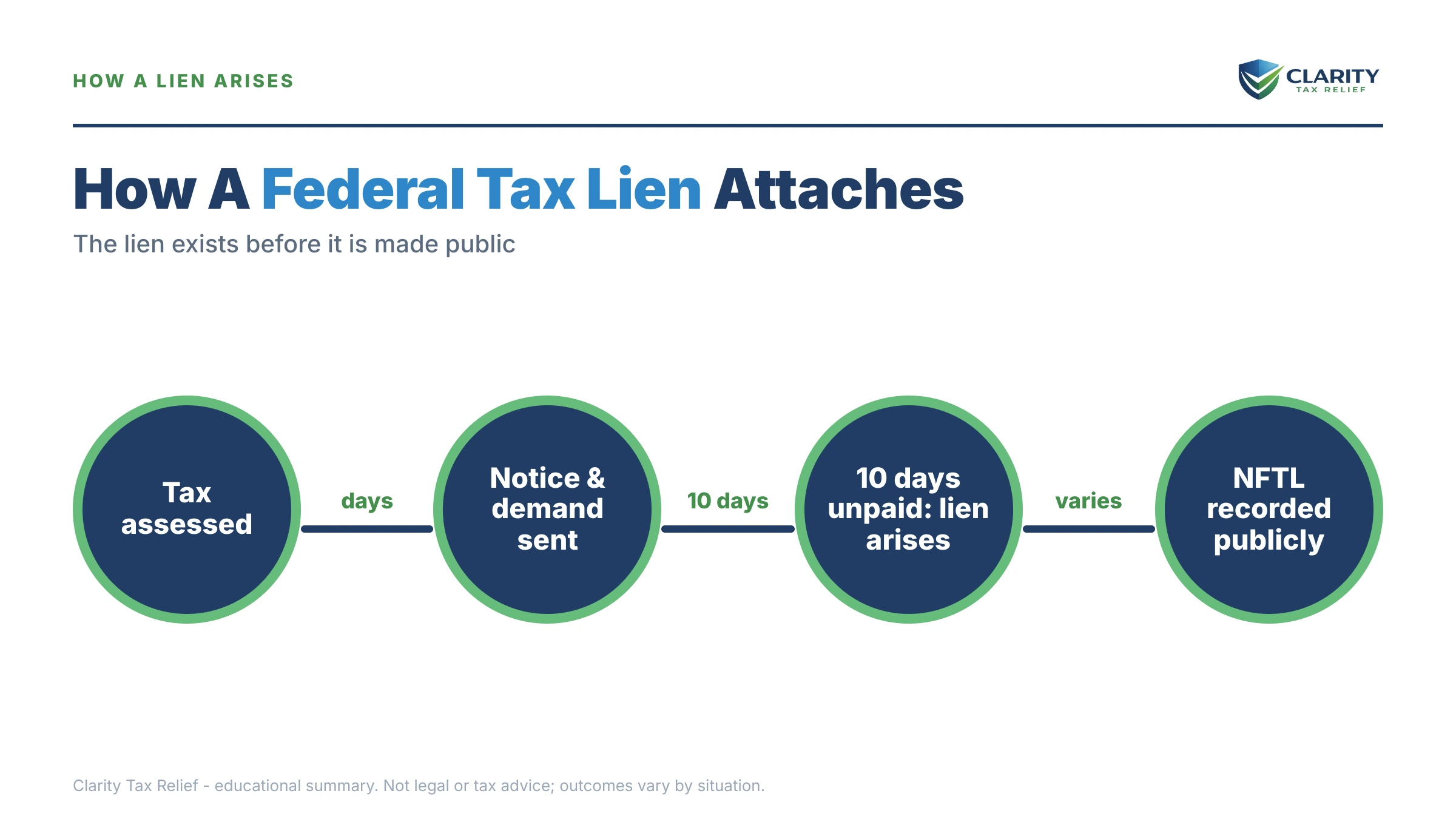
Federal tax lien priority follows "first in time, first in right": whichever claim was properly recorded first gets paid first from the property. The lien itself arises automatically under IRC §6321 the moment the IRS assesses your tax and you don't pay — it's invisible at that stage. But under IRC §6323, the IRS can't beat a mortgage lender, a buyer, or a judgment creditor until it files the Notice of Federal Tax Lien (NFTL) in the public record.
That filing date is the whole game. A mortgage recorded in 2019 stands ahead of an NFTL filed in 2024 — forever, no matter how large the tax debt grows. A second mortgage or HELOC recorded after the NFTL stands behind the IRS, which is why lenders run title searches before every closing.
Two wrinkles matter more than anything else on this topic:
- The purchase-money exception. A loan used to buy the property — a purchase-money mortgage — generally takes priority over a tax lien that was already on file against you. Long-standing IRS guidance (Rev. Rul. 68-57) recognizes this: the home only exists in your hands because of the loan, so the lender's claim comes first. Legally, this is why owing the IRS doesn't make buying impossible.
- The 45-day rule for future advances. A HELOC recorded before the NFTL keeps priority for its existing balance, but draws made more than 45 days after the lien filing (or made with actual knowledge of it) can fall behind the IRS under §6323(d). An "open" credit line is not a permanent shield.
One claim beats everyone: local property taxes. Real-estate tax liens carry superpriority under state law and §6323(b)(6), jumping ahead of both the mortgage and the federal lien. If the house is co-owned, the federal lien attaches only to the debtor's share — how that plays out is its own puzzle, covered in our guide to an IRS lien on jointly owned property.
| Scenario | Who stands first | Why |
|---|---|---|
| Mortgage recorded before the NFTL was filed | The mortgage | First in time, first in right — §6323(a) |
| Second mortgage or HELOC recorded after the NFTL | The IRS | The tax lien was on record first |
| Purchase-money mortgage closed after the NFTL was filed | The lender | Purchase-money exception (Rev. Rul. 68-57) |
| HELOC draws made 45+ days after the NFTL filing | The IRS (as to those draws) | The §6323(d) 45-day future-advance rule |
| Local property taxes vs everyone | The property-tax lien | Superpriority under §6323(b)(6) and state law |
Why there's a lien in your record while you're still renting
A federal tax lien attaches to everything you own — and everything you acquire later — not just real estate. That's why the IRS files NFTLs against renters: the lien reaches your car, your bank accounts, a future inheritance, and any home you buy down the road, the day you take title. The IRS isn't waiting for you to own something; it's reserving its place in line for when you do.
The lien is also a different tool from the levy notice on your counter. The lien is a claim that secures the debt; the levy is the seizure that collects it — the distinction, and why they escalate on separate tracks, is laid out in our guide to the IRS lien vs levy difference. You can have a filed lien with no levy in motion, or a levy with no filed lien.
The NFTL doesn't arrive out of nowhere. It sits at the end of a notice sequence, and when it's filed the IRS must tell you — via Letter 3172, the notice of federal tax lien filing — which opens a 30-day window to request a Collection Due Process hearing on Form 12153. That hearing is where a lien filing can be challenged or traded for a resolution.
| Stage | What it means | Your window |
|---|---|---|
| CP14 | First bill after assessment — the lien already exists silently under §6321 | ~21 days before escalation |
| CP501 / CP503 | Reminder bills; balance compounding monthly | Typically weeks apart |
| CP504 | Intent to levy your state refund; NFTL filing commonly follows this stage | 30 days per the notice |
| NFTL filed + Letter 3172 | Lien becomes public record; priority position locks in | 30 days to request a CDP hearing (Form 12153) |
| LT11 / Letter 1058 | Final notice of intent to levy wages and bank accounts | 30 days + CDP rights |
What happens if you ignore a filed tax lien
A filed tax lien never forecloses on a schedule — it waits, grows, and collects when the property moves. Ignoring it doesn't trigger a dramatic seizure; it triggers a slow squeeze that plays out in this order:
- The balance compounds. Interest and the 0.5%-per-month failure-to-pay penalty keep accruing behind the lien, so the payoff a title company must clear grows every month.
- The lien spreads to new property. Everything you acquire — a car, a home, an inheritance — arrives already encumbered. The lien files once and attaches forever after.
- Levy enforcement runs on a parallel track. The same balance feeds the CP504 → LT11 sequence. A bank levy freezes funds for a 21-day hold before they're sent; a wage levy runs continuously until released.
- Transactions stall. Any sale or refinance surfaces the NFTL in the title search, and the deal stops until the IRS is paid, discharged, or subordinated.
- In a foreclosure, priority becomes real money. If a senior mortgage forecloses with proper notice to the IRS (at least 25 days before the sale under §7425), the tax lien is stripped from the property and paid only from surplus proceeds — and the IRS keeps a 120-day right to redeem the home from the foreclosure buyer.
- At the far end, refile or expire. The lien tracks the 10-year collection statute; the IRS can refile it if the statute was extended, or it self-releases when the clock runs out — the mechanics are in our guide to whether an IRS tax lien expires.
A worked example: a $68,500 lien in a foreclosure payout
Say you owe $68,500, the NFTL was filed in 2024, and in 2027 you buy a $290,000 home with a $260,000 purchase-money loan. The loan closes senior to the lien despite being later in time — that's the purchase-money exception at work. The lien attaches to your new equity the day you take title, in second position.
Now say the loan later fails and the lender forecloses. The house sells at auction for $285,000. The waterfall runs strictly by priority:
- Foreclosure costs and fees: $12,000 — paid first
- Senior mortgage balance: $248,000 — paid second
- Surplus remaining: $285,000 − $12,000 − $248,000 = $25,000 — goes to the IRS lien
The IRS collects $25,000 of its $68,500, the lien is stripped from that property — and the remaining $43,500 still follows you, attaching to whatever you own next. Flip the numbers and you see why the IRS is patient: if the home instead appreciated to $340,000 against a $248,000 loan, the lien would sit on $92,000 of equity, fully covered. Hypothetical numbers, but the arithmetic is exactly how a payout runs.
Lien filed, levy in motion, and $68,500 on the meter?
The order you respond in matters — the levy needs to stop first, then the lien gets moved or resolved. Get both notices reviewed free by an experienced tax professional, while interest is still the only thing growing.
Your options: four ways to move a lien out of the way
The IRS has four distinct certificates for lien problems, and each fits a different transaction — using the wrong one wastes months. Release ends the lien entirely; withdrawal erases the public filing; discharge frees one property; subordination lets one new loan jump the line. How a paid-off lien actually comes off the record is covered in our hub on getting a lien released after payment — here's how the four compare when the lien is still live:
| Option | What it does to priority | Typical eligibility | How to request |
|---|---|---|---|
| Release | Extinguishes the lien everywhere | Balance paid in full, settled through an accepted offer, or the collection statute expires | Automatic within 30 days of satisfaction (§6325); Certificate of Release, Form 668(Z) |
| Withdrawal | Removes the NFTL from public record as if never filed | Most commonly: assessed balance of $25,000 or less on a direct-debit installment agreement, in filing compliance | Form 12277 lien withdrawal |
| Discharge | Frees one specific property; lien survives on everything else | A sale where the IRS is paid its lien interest from proceeds, or the property has no equity for it | Form 14135 tax lien discharge |
| Subordination | Lets one new loan stand ahead of the lien | A refinance that pays the IRS from proceeds or improves its ability to collect | Form 14134 tax lien subordination |
Which one fits maps neatly to the transaction. Selling? Discharge — the mechanics of closing with the IRS in the payoff chain are in our guide to selling a house with an IRS lien. Refinancing? Subordination — and the lender-side realities are covered in refinancing with a tax lien. Trying to clean up the record after getting into a payment plan? Withdrawal.
Behind every certificate sits the underlying balance, and that's where the standard resolution menu applies: a payment plan (balances under $50,000 can qualify for a streamlined agreement of up to 72 months online), hardship status, or an Offer in Compromise when the math genuinely supports one — the IRS accepted roughly 1 in 5 offers in FY2024, so it's a qualification question, not a coupon. And because the lien lives and dies with the 10-year collection statute, knowing your dates matters: you can estimate when your clock runs out with our CSED Calculator.
How to respond, step by step
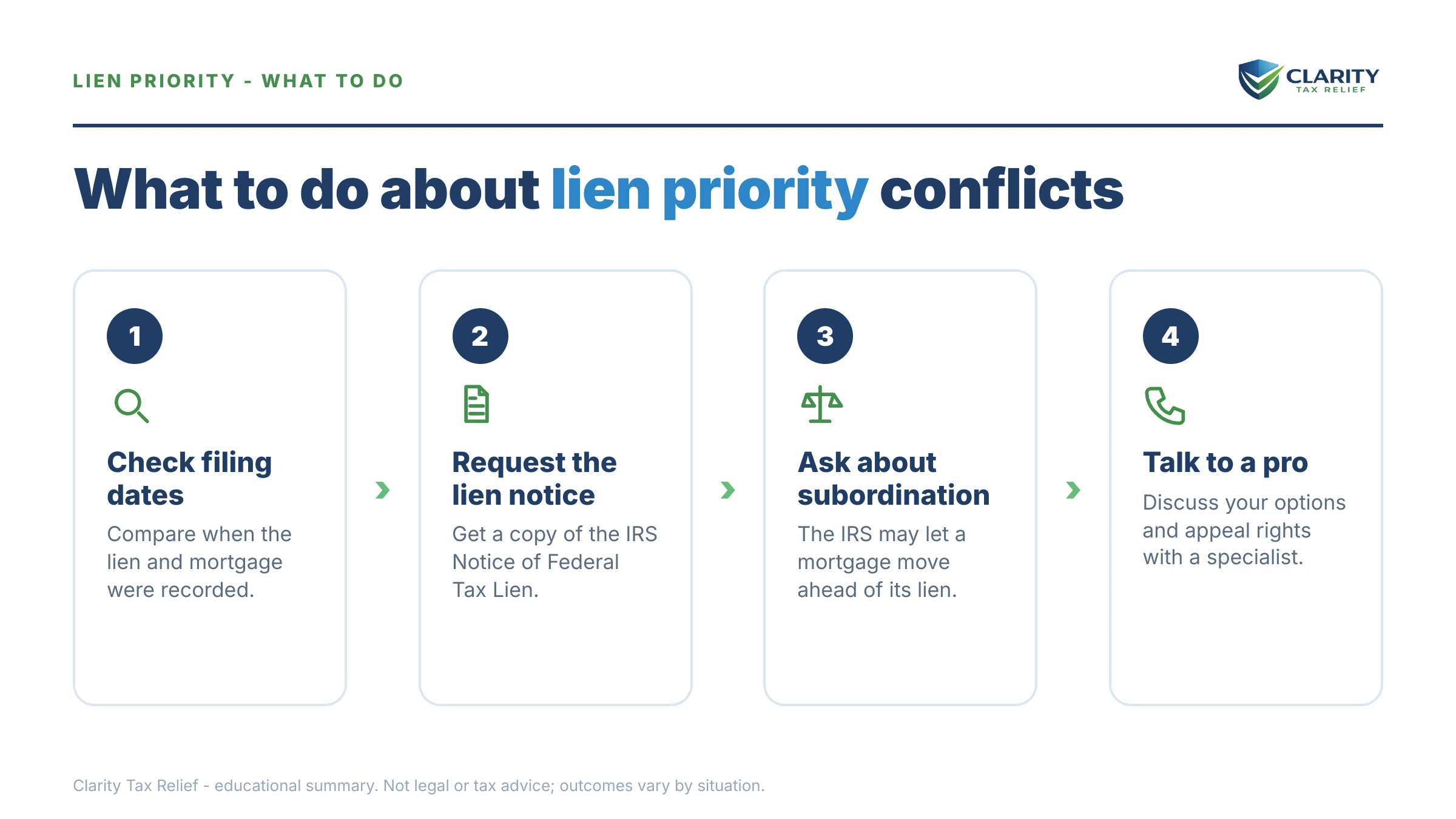
- Pull the recorded documents. Order a copy of the Notice of Federal Tax Lien from your county recorder and note its filing date; compare it to the recording date on any mortgage or deed involved.
- Verify the balance and the clock. Log into your IRS online account, confirm the exact payoff behind the lien, and check how much of the 10-year collection statute remains.
- Match the fix to the transaction. Choose subordination (Form 14134) for a refinance, discharge (Form 14135) for a sale, and withdrawal (Form 12277) or release for cleanup after the balance is resolved.
- File the application early. Submit the certificate application to the IRS Advisory group at least 45 days before your closing date, with the contract, payoff statements, and appraisal attached.
- Resolve the underlying balance. Set up a payment plan, submit an offer, or document hardship so the lien stops driving enforcement and can eventually be released.
Buying a house with a filed tax lien: the renter's path
A filed tax lien makes buying harder, not impossible — because the purchase-money mortgage's legal priority protects the lender. The law is on your side at the closing table; underwriting often isn't. Many conventional lenders decline over an open NFTL regardless of priority, while government-backed programs are frequently workable when you can document an installment agreement in good standing with a payment history behind it.
Since 2018, the lien doesn't appear on your credit report at all — the bureaus dropped tax liens entirely, as we explain in tax lien on credit report — but lenders still find it through the title search and public-records check. The practical sequence for a renter with a levy in motion and a purchase on the horizon: stop the levy, get the balance into a formal agreement, season a few payments, then apply. The full lender-by-lender picture is in buying a house while owing the IRS.
One trap to avoid: buying first and hoping the lien goes unnoticed. It attaches to the new home the day you close, sits behind your purchase-money loan, and surfaces the moment you refinance or sell — with several more years of interest stacked on top.
When you can handle this yourself — and when help changes the outcome
Plenty of lien-priority situations need no professional at all. If your mortgage predates the NFTL, your priority is already secure — nothing to fix. If you've paid the balance in full, the release is automatic within 30 days, and chasing a slow one is a phone call, not a case. If you owe under $25,000 and can sustain a direct-debit installment agreement, requesting withdrawal on Form 12277 is genuinely a do-it-yourself form.
Experienced help earns its cost when money and deadlines collide: a levy already in motion alongside the lien (release paths and sequencing matter), a closing date racing a 45-day certificate application, a foreclosure where surplus proceeds are about to be distributed by priority, multiple unfiled years sitting under the assessment, or an Offer in Compromise where the equity the lien secures is exactly what the IRS's offer math will count. In those cases the question isn't whether the rules apply — it's whether the paperwork lands correctly on the first pass, because a rejected certificate application can kill a transaction.
If a closing, a levy, and a $68,500 balance are all converging at once, a free case review at the 2-minute form or (888) 825-7779 can tell you which piece to move first before anything else is filed.
Terms on your lien paperwork, decoded
- NFTL (Form 668(Y)): the public filing that turns the IRS's silent statutory lien into a recorded claim with priority against later creditors.
- First in time, first in right: the default rule — whichever claim hit the public record first is paid first from the property.
- Purchase-money mortgage: a loan used to buy the property itself; it stands ahead of even an earlier-filed tax lien.
- Subordination vs discharge vs withdrawal vs release: letting one loan jump ahead; freeing one property; erasing the public filing; ending the lien entirely — four different certificates, four different forms.
- Right of redemption (§7425): the IRS's 120-day window after a foreclosure sale to take the property back from the buyer by paying the sale price.
- CSED: the Collection Statute Expiration Date — the end of the 10-year collection window the lien is tied to, pausable by appeals, an offer, or bankruptcy.
Tax lien vs mortgage priority: your questions, answered
Does a mortgage take priority over an IRS tax lien?
Yes, when the mortgage was recorded before the IRS filed its Notice of Federal Tax Lien — priority follows the first-in-time rule under IRC §6323. A mortgage recorded after the NFTL is junior to it, with one major exception: a purchase-money mortgage used to buy the home generally stands ahead of even a previously filed tax lien.
Can I get a mortgage if the IRS has already filed a tax lien?
Legally, yes — a purchase-money mortgage takes priority over a filed tax lien, so the lender's collateral is protected. Practically, most lenders' underwriting says otherwise: many require the lien to be paid, subordinated, or covered by a documented payment agreement before closing. Government-backed loan programs tend to be more flexible than conventional ones when you can show an installment agreement in good standing.
What happens to an IRS tax lien in a foreclosure?
If a senior mortgage forecloses and gives the IRS proper notice — at least 25 days before the sale — the tax lien is removed from the property, and the IRS is paid only from any surplus left after senior claims. The IRS then has 120 days to redeem the property under IRC §7425 by paying the foreclosure buyer. Your tax debt itself survives; only the lien's grip on that property ends.
Does an IRS tax lien attach to a house I buy after the lien is filed?
Yes. A federal tax lien attaches to all property you own and all property you acquire later, for as long as the lien exists. Buy a house next year and the lien attaches the day you take title — behind your purchase-money mortgage, but ahead of most later creditors. That's why resolving the balance before buying usually beats hoping the lien goes unnoticed.
Can the IRS foreclose on my house itself?
It can, but it's rare. The IRS needs a federal court's approval to seize or foreclose on a principal residence — either a court-approved seizure under IRC §6334(e) or a Department of Justice lien-foreclosure suit under §7403 — and it reserves those for large balances with substantial equity. Far more common: the lien simply sits on the title and collects when you sell, refinance, or the mortgage forecloses.
Does an IRS tax lien show up on my credit report in 2026?
No. The three major credit bureaus removed tax liens from consumer credit reports in 2018, and that hasn't changed. But the Notice of Federal Tax Lien is still a public record at your county recorder, and mortgage lenders find it through title searches and public-records checks, not your credit file. So the lien can block a closing even though your score never mentions it.
How long does a federal tax lien stay on my property?
Generally 10 years from the date the tax was assessed — the lien tracks the collection statute (CSED) and self-releases when the statute expires, unless the IRS refiles it because the clock was extended. Appeals, an offer in compromise, or bankruptcy can pause that clock and stretch the lien's life, so two liens filed the same year can expire years apart.
Do state tax liens and property tax liens beat a mortgage?
Property tax liens usually do — local real-estate taxes carry superpriority under state law and IRC §6323(b)(6), jumping ahead of both the mortgage and the federal tax lien. State income-tax liens follow each state's own recording and priority rules, which often mirror first-in-time but not always. Never apply the federal rules to a state lien without checking that state's statute.
Will the IRS move its lien aside so my refinance can close?
Often, yes — through subordination. The IRS grants Form 14134 subordination when the refinance either pays it something from the proceeds or improves its odds of collecting, such as by lowering your payment so you can afford an installment agreement. It doesn't remove the lien; it just lets the new loan stand ahead of it for that transaction.
Your next 24 hours
- Find the filing date. Pull the Notice of Federal Tax Lien from your county recorder's records (or from the Letter 3172 you received) and write down the date it was recorded — that single date sets every priority answer on this page.
- Gather the paper. Your last filed return, every IRS notice you've received — especially any levy notice — and your current income figures, so the balance and the collection clock can be verified against the IRS's own records.
- Get the free case review. With a lien on record and a levy in motion, the balance compounds monthly until something is filed. Call (888) 825-7779 or use the 2-minute form and an experienced tax professional will map which move — levy release, certificate, or resolution — comes first.
For the primary sources behind this guide, see the IRS's own overview at Understanding a federal tax lien, the payment-arrangement options at IRS payment plans and installment agreements, and — if the IRS's own process is causing you harm it won't fix — the Taxpayer Advocate Service.
This guide is general information, not tax or legal advice for your specific situation. Eligibility for IRS programs depends on individual facts and circumstances; no outcome is guaranteed.