
Federal Tax Liens
IRS Lien After Death: What Happens to the Estate and Heirs (2026)
The short answer: an IRS lien after death does not disappear. The federal tax lien stays attached to the property the person owned when they died and follows that property into the estate — and usually to whoever inherits it. It must be paid, discharged, or allowed to expire before the property gets clear title.
The lien didn't die with your relative. The house, the accounts, the equipment from their business — the IRS's claim moved right along with those assets into the estate. That's the fact that surprises most families, and it's the one that controls what you can and can't do next.
Here's the calm version of what you're facing, in order: why the lien survives, who is actually on the hook (and who isn't), and the exact paperwork that clears it so you can sell, refinance, or distribute what's left. The image below shows you what a recorded Notice of Federal Tax Lien looks like and where to find the tax years and amount that control your options.
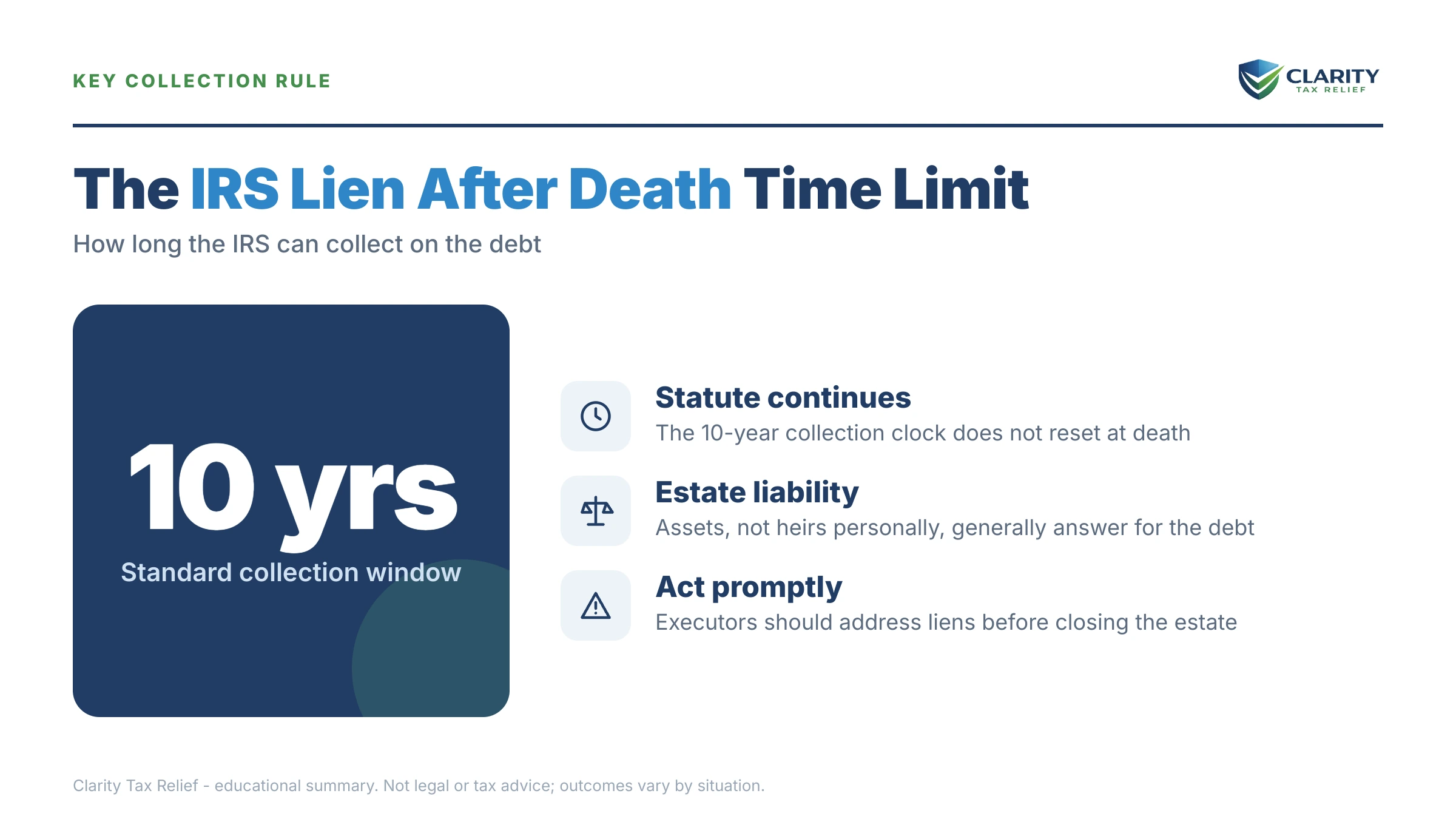
⏱ The clock that matters: death does not reset the 10-year collection statute. An income-tax lien counts down from the date the tax was assessed — not the date of death. A separate estate tax lien under IRC §6324 runs a fixed 10 years from the date of death. Interest and any surviving penalties keep accruing on the debt until it's resolved.
Why there's still an IRS lien after death
A federal tax lien attaches to all property and rights to property the taxpayer owned — and that attachment does not end when the person dies. Under IRC §6321, the moment tax is assessed and a demand goes unpaid, a lien arises against everything the person owns. Death simply transfers the encumbered property to the estate with the lien still riding on it.
Think of it like a mortgage. When someone with a mortgage dies, the loan doesn't vanish — the house passes to the estate still carrying the debt. A tax lien behaves the same way. The estate can't hand a clean asset to an heir if the IRS's claim was already stapled to it.
Two different liens can be in play, and it matters which one you're dealing with:
- Income tax lien (IRC §6321): secures unpaid 1040 income tax, self-employment tax, or trust-fund penalties the person owed while alive. This is often recorded publicly as a Notice of Federal Tax Lien. Most families dealing with a deceased relative's back taxes are facing this one.
- Estate tax lien (IRC §6324): a separate, automatic lien on estate assets for any estate tax due. It exists without any filing and lasts 10 years from the date of death. Most modest estates never trigger it, because the debt is ordinary income tax — not estate tax.
Whether the lien was formally recorded before death or not, the underlying statutory lien travels with the property. The distinction only changes priority against third parties — the recording, covered in tax lien vs mortgage priority, decides who gets paid first when the asset sells.
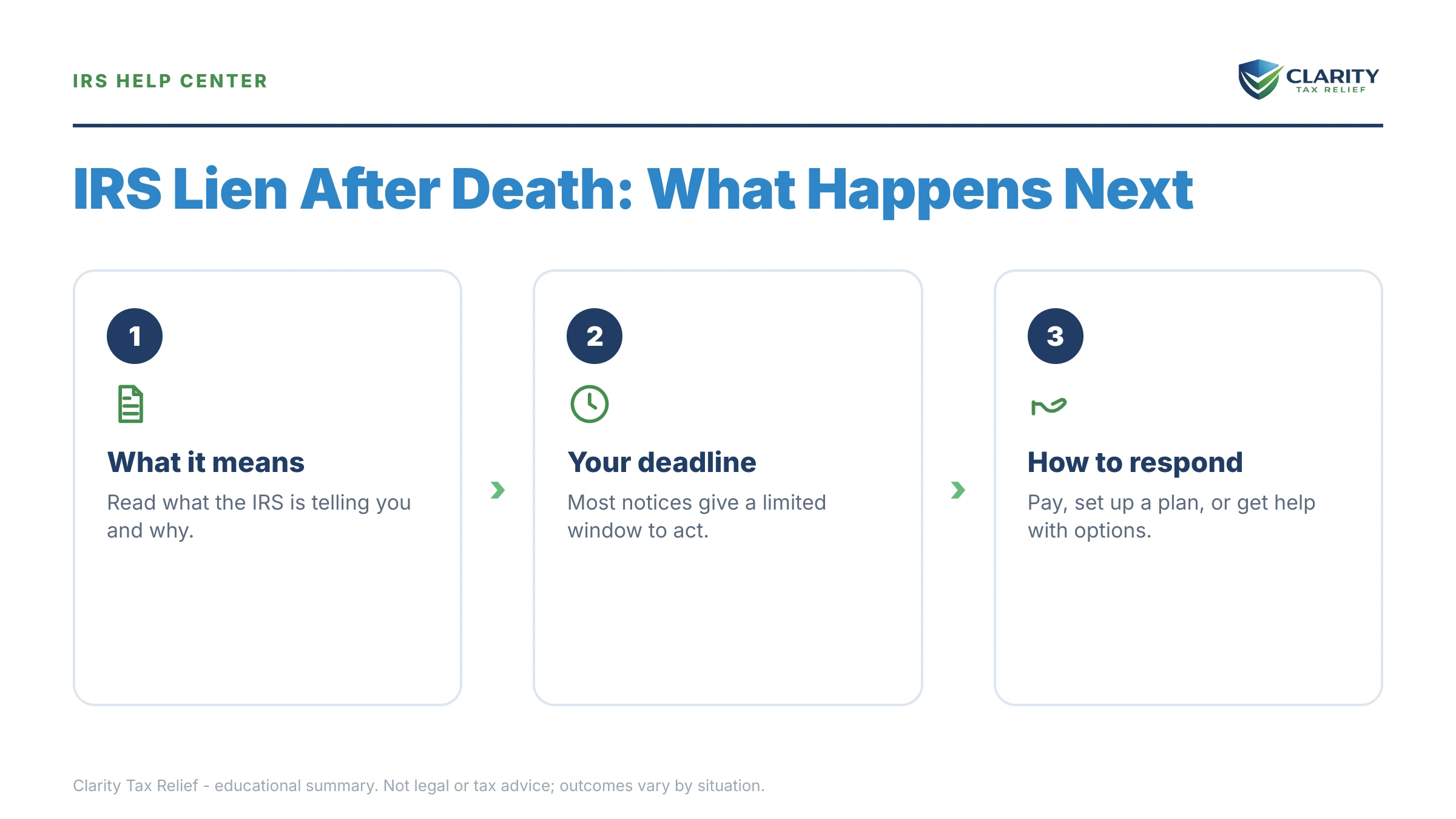
What happens if the estate ignores the lien
Ignoring an IRS lien after death doesn't make it fade — it puts the executor personally at risk and freezes the estate's ability to move assets. Here's the sequence when nothing is done:
- The lien stays attached. Every piece of encumbered property — real estate, bank accounts, business assets — carries the IRS claim. Nothing transfers with clean title.
- A sale or refinance stalls. Title companies won't close, and lenders won't fund, while a federal lien clouds the property. The deal sits until the lien is paid or discharged.
- The executor pays other people first — and becomes liable. Under the federal priority statute (31 U.S.C. §3713), if the executor distributes assets or pays lower-priority creditors while a known federal tax debt goes unpaid, the executor can be held personally liable up to the amount wrongly paid out.
- The IRS collects from estate assets. The IRS can levy estate bank accounts and pursue the property the lien attaches to. Interest keeps compounding the whole time.
- The lien continues until paid, discharged, or expired. It only ends when the debt is satisfied, the IRS issues a Certificate of Discharge for a specific property, or the 10-year collection statute runs out and the lien self-releases.
In 2026 the practical risk is real: the IRS workforce shrank sharply in 2025, but liens, levies, and refile notices come out of automated systems that never slowed down. A file with no human attention still escalates — so the estate's job is to act before an automated levy hits the assets you're trying to protect.
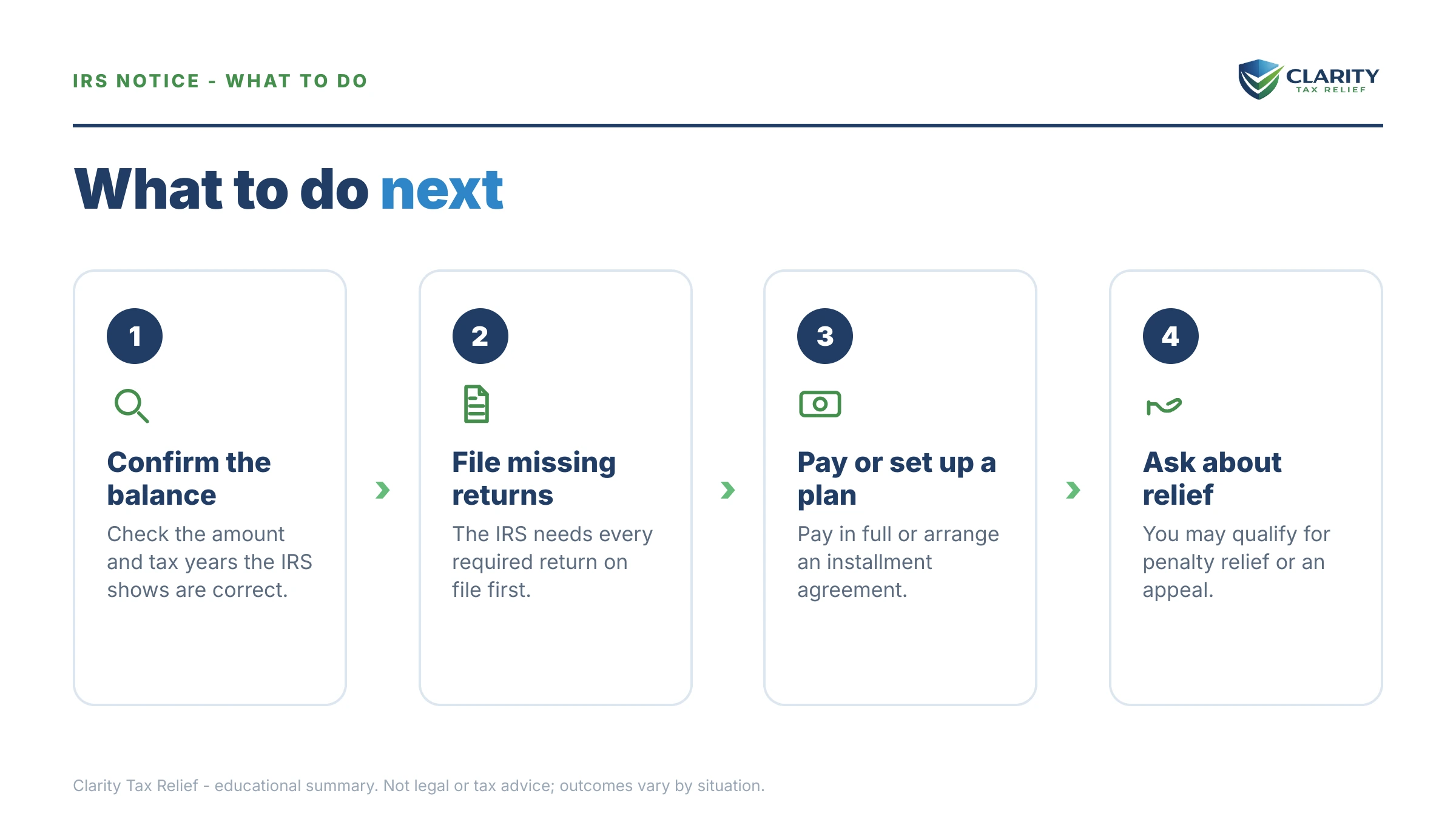
Settling an estate with an IRS lien on it?
Before you distribute a dime or list the house, have an experienced tax professional confirm the exact balance, the tax years, and whether the lien can be discharged — so the executor never triggers personal liability. It's a free, confidential review.
Your options for clearing an IRS lien after death
The right move depends on how much the estate owns versus how much it owes, and whether property needs to be sold. Here are the real paths, with what qualifies for each.
| Option | When it fits | Result |
|---|---|---|
| Pay the debt from estate funds | Estate has enough cash or equity to cover the balance | IRS issues a Certificate of Release, usually within ~30 days of payment |
| Certificate of Discharge (Form 14135) | You need to sell a specific property but can't pay the whole lien | Lien detaches from that property so the sale can close; IRS gets its share of proceeds |
| Subordination (Form 14134) | An heir or the estate needs to refinance rather than sell | IRS moves behind the new lender so the loan can fund; lien stays but ranks lower |
| Let the CSED expire | The 10-year collection statute is close to running out | Lien self-releases at the CSED — but the IRS can refile before it lapses |
| Estate installment agreement or offer | Estate can't pay in full and assets are limited | The estate resolves the balance over time or for what it can genuinely pay |
Discharge and subordination are the two tools families use most, because they let a sale or refinance close without waiting for the full balance to be paid. Our guide to a tax lien discharge walks through Form 14135 line by line, and refinancing with a tax lien covers the subordination route. For the mechanics of how any lien comes off after the debt is handled, the hub article on getting a lien released after payment is the place to start.
If the balance is old, run the numbers before you assume the estate has to pay. Death doesn't restart the clock, so a debt assessed years ago may be near its collection deadline — you can estimate the remaining window with our CSED calculator. See the 10-year collection statute for how the CSED is measured and what pauses it.
Deadlines and rights that shape the estate's choices
| Item | Timeframe | What it controls |
|---|---|---|
| Income tax lien (CSED) | 10 years from assessment (pausable) | When the lien self-releases if the debt is never paid |
| Estate tax lien (§6324) | 10 years from date of death | Automatic lien on estate assets for estate tax — no filing needed |
| Certificate of Release | ~30 days after full payment | Proof the lien is gone so title can transfer clean |
| Executor liability (§3713) | Any time assets are distributed with the debt unpaid | Personal liability for the executor, up to what was wrongly paid out |
A worked example: a self-employed sole proprietor's lien
Say a self-employed handyman dies owing $4,800 in income and self-employment tax from a return he filed but couldn't fully pay. The IRS assessed the balance and recorded a Notice of Federal Tax Lien. He owned a home worth $280,000 with a $150,000 mortgage recorded years earlier.
The lien attaches to the home. When the estate sells, the title company handles the debts in priority order:
- Sale price: $280,000
- Mortgage payoff (recorded first, higher priority): −$150,000
- IRS lien payoff (the $4,800 plus accrued interest, say ~$5,100): −$5,100
- Remaining equity to the estate/heirs: ≈ $124,900
Because the mortgage was recorded before the tax lien, the lender gets paid first; the IRS is paid from what's left, and there's plenty of equity to cover it. About 30 days after closing, the IRS issues a Certificate of Release and the sale transfers clean title.
Now flip one number. If the home were worth only $150,000 — barely covering the mortgage — there'd be nothing left for the IRS. The estate could still sell by filing Form 14135 for a Certificate of Discharge, showing the IRS that its lien has no equity to attach to. The lien detaches from that house, the sale closes, and the underlying debt is dealt with separately. Because this was income tax (not estate tax), no §6324 estate tax lien is in play at all.
When you can handle this yourself — and when to get help
Some lien-after-death situations are genuinely straightforward. If the estate has clear cash to pay a small balance, or the house is selling with obvious equity and a title company is already coordinating the payoff, you may not need anyone but the closing agent. Paying the debt and confirming the Certificate of Release recorded is something an organized executor can manage.
Experienced help changes the outcome when: the estate is insolvent or the lien exceeds the equity; property must be sold or refinanced before the debt can be paid (discharge and subordination filings have to be timed and documented correctly); there are multiple unfiled years for the decedent; the debt includes trust-fund or business tax from the person's sole proprietorship; or you're the executor worried about §3713 personal liability. In those cases the order you do things in — file the final return, verify the balance, then handle the lien — decides what the estate actually pays. For the broader picture of resolving a decedent's balance, see estate owes IRS and executor personally liable IRS.
How to clear an IRS lien after death, step by step
- Confirm the exact balance and lien status — order the decedent's account transcripts or check the IRS online account so you know the tax years, the assessed amount, and whether a Notice of Federal Tax Lien was recorded.
- Get authority to act — the executor or administrator files Form 56 to notify the IRS of the fiduciary relationship, and Form 2848 if a representative will speak to the IRS on the estate's behalf.
- Pay the debt before distributing assets — satisfy the federal tax debt from estate funds before paying most other creditors or giving anything to heirs, so the executor doesn't trigger personal liability under 31 U.S.C. §3713.
- Use a discharge or subordination if you must sell or refinance — if a specific property has to be sold or refinanced before the lien is paid, file Form 14135 for a Certificate of Discharge or Form 14134 for subordination so the transaction can close.
- Confirm the lien is released — after the debt is paid or discharged, verify the IRS issued a Certificate of Release and that it was recorded with the county so the property can transfer with clear title.
Terms on the notice, decoded
- Federal tax lien (IRC §6321): the government's legal claim against all of a taxpayer's property for unpaid tax; it arises automatically once tax is assessed and unpaid.
- Notice of Federal Tax Lien (NFTL): the public document the IRS records with the county to alert other creditors — this is what shows up in a title search.
- Lien vs. levy: a lien is a claim on property; a levy is the actual seizure. The difference between a lien and a levy matters because a lien alone doesn't take anything.
- CSED (Collection Statute Expiration Date): the 10-year deadline, measured from assessment, after which the IRS can no longer collect and the lien self-releases.
- Certificate of Discharge: IRS approval (Form 14135) to remove the lien from one specific property so it can be sold, without erasing the underlying debt.
- Fiduciary liability (§3713): the rule that can make an executor personally responsible for paying the federal debt if estate money went to others first.
Two related questions come up constantly for families: whether the tax debt itself dies with the person (see does IRS debt die with you) and how a lien behaves on jointly owned property when only one owner has died. Both interact with the lien rules above.
IRS lien after death: your questions, answered
Does an IRS lien go away when someone dies?
No. A federal tax lien does not die with the taxpayer. It stays attached to the property the person owned at death and follows that property into the estate — and, in most cases, into the hands of whoever inherits it. The lien continues until the debt is paid, the IRS issues a discharge, or the 10-year collection statute expires.
Are heirs personally responsible for the deceased's IRS lien?
Heirs are not personally on the hook for the decedent's income tax bill — you don't inherit the debt as your own. But the lien still encumbers the property you inherit. If Mom leaves you a house with a $12,000 lien attached, you don't owe the $12,000 out of your own pocket, but you can't get clear title until that lien is paid, discharged, or expired.
Can you sell a house with an IRS lien after the owner dies?
Yes, but the lien must be addressed at closing. In most sales the title company pays the IRS from the proceeds and the lien is released, usually within about 30 days. If there isn't enough equity to cover it, the estate can apply for a Certificate of Discharge on Form 14135 so the sale can close and the lien detaches from that specific property.
How long does an IRS lien last after death?
An income-tax lien follows the same 10-year Collection Statute Expiration Date (CSED) that applied before death — measured from the date the tax was assessed, not the date of death. The clock can be paused by things like a pending offer or bankruptcy. A separate estate tax lien under IRC 6324 runs for 10 years from the date of death and needs no recording to exist.
Does the IRS lien attach to property that passes outside probate?
Often, yes. A federal tax lien attaches to all property and rights to property the taxpayer held at death — which can reach a share of jointly owned real estate and, in some cases, assets that transfer by beneficiary designation. Joint tenancy and payable-on-death titling do not automatically wipe out an already-attached lien, so the survivor may take the asset subject to it.
Can the executor be held personally liable for the tax debt?
Yes, under the federal priority statute (31 U.S.C. 3713) an executor who pays other creditors or distributes assets to heirs while a known federal tax debt goes unpaid can become personally liable up to the amount wrongly paid out. That is why an executor should confirm the federal balance and satisfy or plan for the lien before writing checks to anyone else.
What's the difference between an estate tax lien and an income tax lien after death?
An income tax lien secures unpaid 1040 or self-employment tax the person owed while alive and is created under IRC 6321 (often recorded as a Notice of Federal Tax Lien). The estate tax lien under IRC 6324 is a separate, automatic 10-year lien on estate assets for any estate tax due — it exists without any filing. Most modest estates never trigger the estate tax lien because the debt is income tax, not estate tax.
Does the 10-year collection clock keep running after death?
Yes. Death does not reset or pause the Collection Statute Expiration Date. If the tax was assessed years before the person died, the remaining time keeps counting down, and the lien self-releases when the CSED passes. If the balance is close to expiring, waiting it out can sometimes be the estate's cheapest resolution — but the IRS can still refile a lien before the statute lapses in certain situations.
Your next 24 hours
- Find the tax years and amount. Locate the recorded Notice of Federal Tax Lien or pull the decedent's IRS account transcripts so you know exactly which years and how much the lien secures.
- Gather the estate's records. Pull the last filed return, the death certificate, the will or letters of administration, and a rough list of estate assets and their values — you'll need these to weigh paying versus discharging the lien.
- Get a free case review. Before you distribute anything or sign a purchase contract, have an experienced tax professional confirm your options and protect the executor from personal liability. Use the 2-minute form or call (888) 825-7779. Interest keeps accruing until the lien is resolved, so the sooner you know where you stand, the more you keep.
This guide is general information, not tax or legal advice for your specific situation. Eligibility for IRS programs depends on individual facts and circumstances; no outcome is guaranteed.