
Personal Liability
Is an Executor Personally Liable to the IRS? The §3713 Rule Explained (2026)
The short answer: an executor is personally liable to the IRS under 31 U.S.C. §3713 only when three things are all true: the estate couldn't cover its debts, other creditors or heirs got paid ahead of the IRS anyway, and the executor knew — or should have known — about the tax claim. Liability caps at the amount wrongly distributed.
You run your own 1099 work all week, and now you're also running your father's estate on nights and weekends. Somewhere in his mail you found IRS notices totaling $41,800 — and the question stopped being about his money. It became whether the IRS can reach yours.
Here's the map: your personal exposure is entirely within your control, because §3713 liability is triggered by what you pay out and in what order — not by the debt itself. Get the order right, and the debt stays the estate's problem. Get it wrong, and the IRS can bill you directly.
⏱ The clock on this problem: there is no response deadline printed on a probate file — but the decedent's balance grows every month (a 0.5% monthly failure-to-pay penalty plus daily-compounding interest), and every dollar you distribute before the IRS is paid can become your personal liability. Filing Form 5495 starts a 9-month clock: once the IRS states the amount due and it's paid, you're discharged from personal liability for those taxes.
When an executor is personally liable to the IRS: the §3713 test
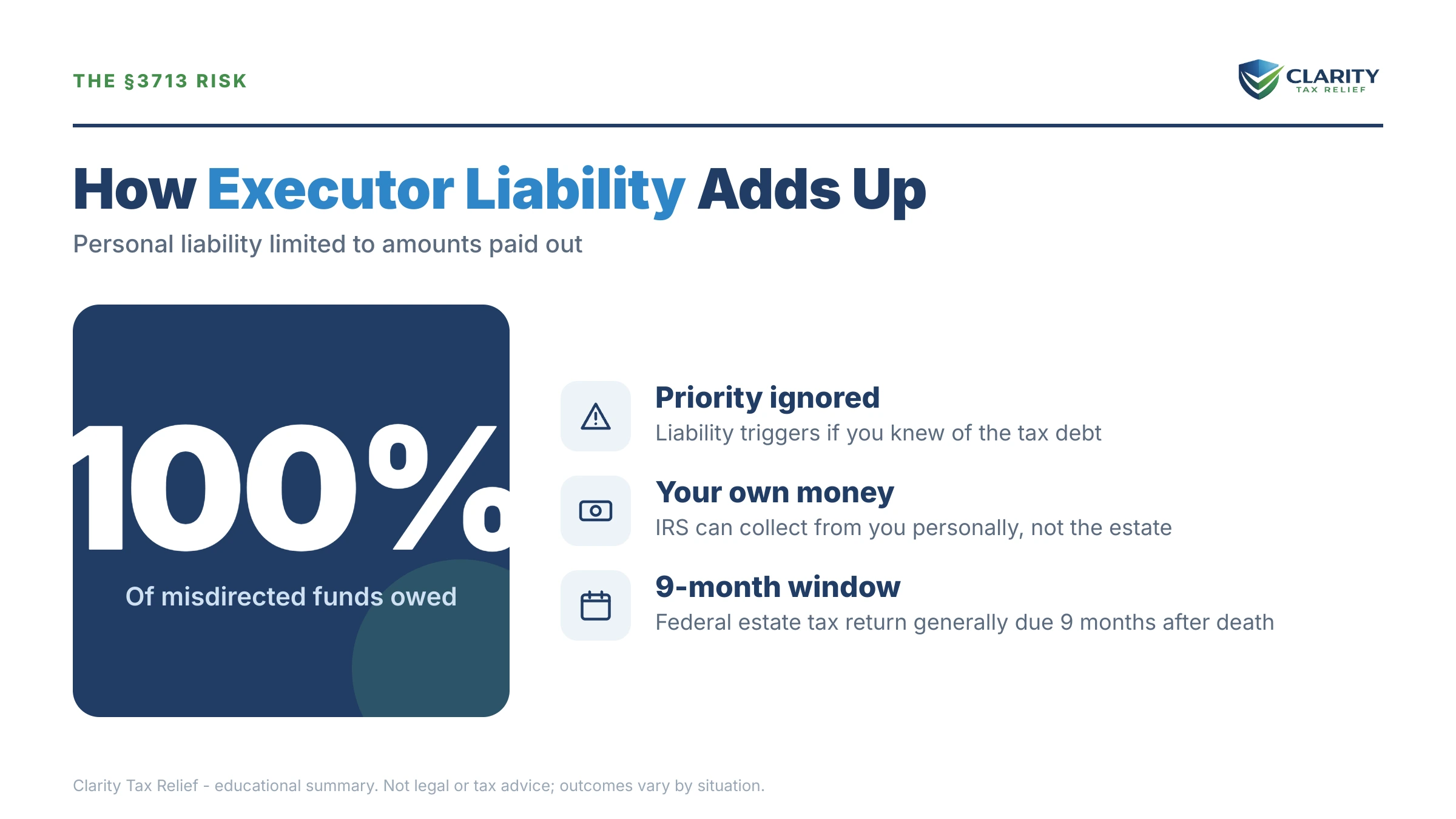
Under 31 U.S.C. §3713, federal claims come first when an estate can't pay everyone — and a fiduciary who pays anyone else first is personally liable for the shortfall, up to the amount paid out to others.
The IRS has to prove all three elements, and each one is a place your case can be won or lost:
- Insolvency. The estate's assets couldn't cover all of its debts, including the tax — or your distribution is what made it unable to pay.
- A distribution. You paid another creditor, or handed money or property to a beneficiary, before the federal claim was satisfied.
- Knowledge. You knew about the tax debt, or knew facts that would put a reasonably careful person on inquiry. A stack of unopened IRS envelopes counts. Years of 1099 income with no returns on file counts too.
Notice what's not on the list: simply being named executor. Accepting the role doesn't make you a co-debtor, and the IRS cannot bill you for your father's taxes just because you signed the probate papers. This is a different animal from the trust-fund rules that can make a bookkeeper personally liable to the IRS for a business's payroll taxes — here, liability flows only from distributions you choose to make.
The §3713 priority isn't absolute, though. Some payments are recognized as coming before the federal claim, and knowing which is which is the difference between administering an estate and personally underwriting one:
| Payment | Safe to pay before the IRS? | Why |
|---|---|---|
| Reasonable funeral costs | Generally yes | Courts have long treated a modest funeral as an expense of the estate, not a competing claim. |
| Estate administration costs (court fees, appraisals, executor and attorney fees) | Generally yes | These keep the estate itself running, so they're allowed ahead of creditors. |
| Mortgage or other secured lender on estate property | Yes, from that property's proceeds | A lien perfected before death generally keeps its priority over the federal claim. |
| State income or property taxes | Caution | Federal claims take priority in an insolvent estate; pay state balances only after the IRS is provided for. |
| Credit cards, medical bills, personal loans | No | Ordinary unsecured creditors wait behind the United States — paying them first is the classic §3713 trap. |
| Distributions to heirs and beneficiaries | No | Heirs are last in line; an early distribution from a short estate is personal liability in the making. |
How executor liability escalates if you distribute anyway
IRS collection does not stop at death — the account keeps accruing, and enforcement shifts targets from the decedent to the estate, then to the executor, then to the heirs. Here's the sequence when a known balance goes unpaid while money leaves the estate:
- The balance keeps growing. The 0.5% monthly failure-to-pay penalty and daily-compounding interest run against the decedent's account exactly as they would for a living taxpayer, and automated notices continue issuing to the estate.
- A federal tax lien attaches to estate property. The lien follows the house, the truck, the brokerage account — heirs inherit encumbered assets, not clean ones. Our guide to an IRS lien after death covers what that does to a probate sale.
- Unfiled years get quantified — badly. For a self-employed decedent with 1099s on file and no returns, the IRS can create substitute returns using the gross income with no business deductions, inflating the debt well past what a real return would show.
- Fiduciary liability is asserted against you. The IRS builds the §3713 case — insolvency, distribution, knowledge — and assesses the wrongly-distributed amount against you personally.
- Transferee liability reaches the heirs. Under IRC §6901, beneficiaries who received distributions can be pursued for what they got. Family members returning inheritance checks is exactly as ugly as it sounds.
- Your own assets become collectible. Once an amount is assessed against you, the ordinary IRS toolkit — lien, bank levy, wage levy — applies to your accounts and your income, not the estate's.
None of this requires a human to decide you deserve it. In 2026, with IRS staffing down roughly 27%, the humans are scarce — but the notice stream, lien filings, and levy programs are automated, and fiduciary cases are among the easiest for the IRS to win because the probate file documents every payment for them.
Administering an estate with an IRS balance?
Before another dollar leaves the estate account, get the transcripts and payment order reviewed free. An experienced tax professional will map exactly what the estate owes, what you may safely pay, and how to close the estate with zero personal exposure.
Paying a decedent's IRS debt: your options as executor
Every decedent's IRS debt resolves the same way: from estate assets, in priority order — the estate pays in priority order, and heirs are paid last. Which path fits depends almost entirely on whether the estate can cover the payoff. (The general resolution menu — plans, hardship status, offers — is covered in our guide to how to settle tax debt yourself; below is only what changes when the taxpayer is deceased.)
- Pay in full from estate funds. The clean path for a solvent estate. Pay from the estate account — never your own — using the methods in our comparison of the best way to pay the IRS, then confirm a zero balance on the transcript before distributing anything.
- Penalty relief can shrink the payoff. If the decedent's prior three years were clean, first-time penalty abatement can remove a year's penalties — and a final illness is one of the strongest reasonable-cause arguments there is for late filing or payment. Starting summer 2026, the IRS's new Automatic Exemption from Penalty (AEP) grants first-time-style relief automatically, with no request needed — but don't wait on it to quantify the estate's payoff. Interest is harder: it generally can't be removed except where the IRS itself caused delay, as explained in can IRS interest be waived.
- Insolvent estate: pay in order, exhaust, close. If the assets can't cover the payoff, your job isn't to find the money — it's to pay funeral and administration costs, send everything left to the IRS, distribute nothing, and document every step. The unpaid remainder generally goes uncollected, and none of it becomes yours.
- Installment agreements and offers exist, but are rare here. Estates usually resolve by liquidation, not monthly payments. The exception: an illiquid asset the heirs want to keep, such as the family home — a payment arrangement or borrowing against the property can bridge the gap. (Estate tax on Form 706 is a different problem with its own installment rules; see estate tax you can't pay.)
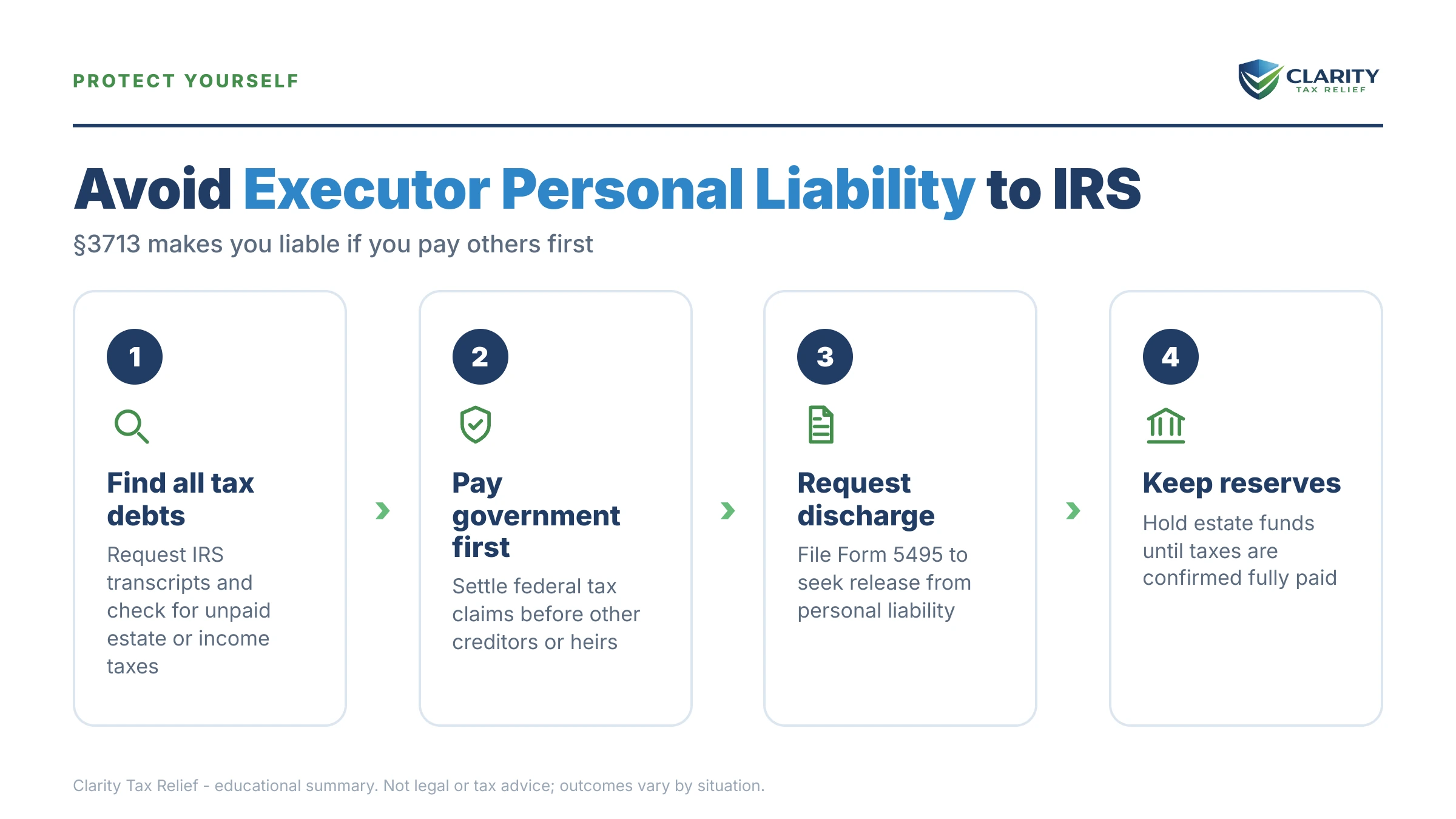
- Form 5495: your personal exit. After the returns are filed, request discharge from personal liability under IRC §6905. The IRS then has 9 months to state the amount due; pay it, and you're personally released for those income and gift taxes even if more surfaces later.
| Estate funds left after funeral & administration | Solvency | Your realistic move |
|---|---|---|
| Around $92,000 | Solvent | Pay the IRS in full, confirm a zero balance on the transcript, then distribute the rest. |
| $50,000–$60,000 | Solvent, but tight | Pay the IRS first; pursue penalty abatement to recover part of it before distributing what's left. |
| $17,000–$30,000 | Insolvent | Funeral and administration costs, then every remaining dollar to the IRS; heirs receive nothing, and you close clean. |
| Under $10,000 | Deeply insolvent | Funeral and administration may consume it all; document every payment and close — the unpaid balance is not yours. |
A worked example: $41,800 owed, two estate outcomes
Say your father, a self-employed 1099 contractor, died owing $41,800 across two assessed tax years. The failure-to-pay penalty adds 0.5% per month — about $209 a month on that balance — plus daily-compounding interest. Fourteen months after the original due dates, that's roughly $2,900 in penalty before interest, so call the real payoff about $46,000 by the time the house sells. (You can estimate the true payoff on any balance with our IRS penalty and interest calculator.)
Outcome A — solvent estate. The house nets $95,000 and his bank account holds $12,000: $107,000 total. You pay $9,000 for the funeral and $6,000 in probate costs, leaving $92,000. You pay the IRS its ~$46,000, get a transcript showing zero, and distribute the remaining ~$46,000 to the heirs. Your personal exposure: zero.
Outcome B — insolvent estate. No house — just $30,000 in accounts. After the $9,000 funeral and $4,000 in probate costs, $17,000 remains against a ~$46,000 payoff. The right move: send the full $17,000 to the IRS, distribute nothing, document everything, and close. Your exposure: zero, and the unpaid ~$29,000 generally goes uncollected.
The wrong move in Outcome B is what §3713 was written for: paying $10,000 of his credit cards and giving your sister $7,000 "to tide her over." Do that, and the IRS can assess $17,000 against you personally — every dollar that left the estate while the federal claim sat unpaid.
How to respond as an executor, step by step
The forms below are the paper trail that protects you; work through them in this order.
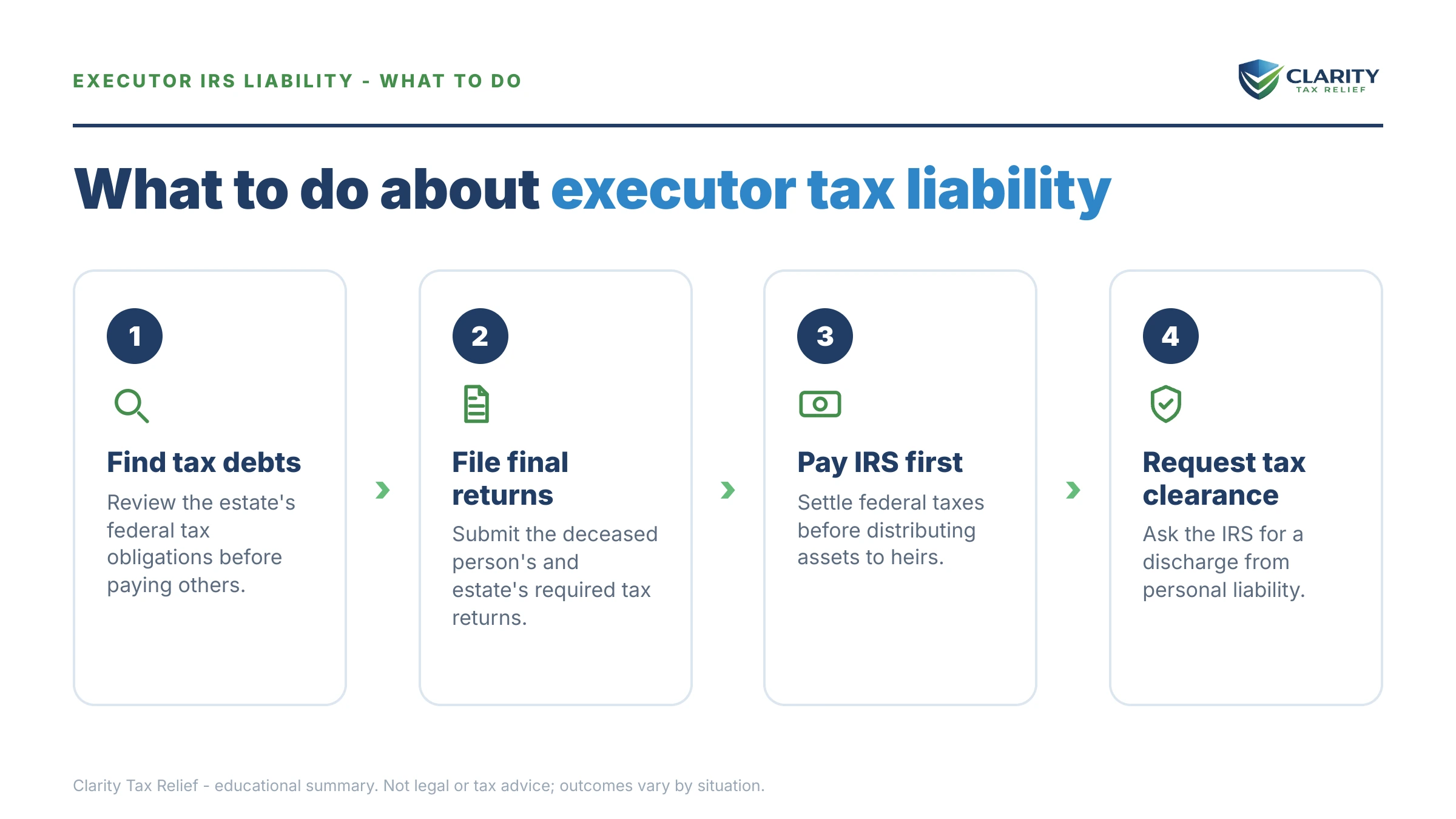
- File Form 56. Notify the IRS that you are the fiduciary so every notice about the estate comes to your address — you can't manage deadlines you never see.
- Pull the decedent's IRS transcripts. Request account transcripts and wage-and-income transcripts for at least the last six years to surface every assessed balance and every unfiled return.
- Freeze all distributions. Pay nothing to heirs or ordinary creditors until the federal claim is fully quantified — this single habit defeats §3713 liability.
- File the missing returns. The final Form 1040, any prior unfiled years, and a Form 1041 if the estate earns income after death — an unfiled year is an unquantified liability.
- Pay in priority order from estate funds only. Reasonable funeral and administration costs first, then the IRS balance in full or until the estate is exhausted — never from your own pocket.
- File Form 5495. Request discharge from personal liability; the IRS then has 9 months to state the amount due, and paying that amount releases you personally.
If the final return itself shows an unpaid balance, our guide to a deceased final tax return that owes walks through resolving that specific bill from estate funds.
| Form | What it does | When to file |
|---|---|---|
| Form 56 | Puts you on record as fiduciary so IRS notices come to you | As soon as you're appointed |
| Form 4506-T (or online transcripts) | Reveals every assessed balance and unfiled year | Before paying anyone |
| Final Form 1040 | Reports the decedent's last year of income | By the normal deadline for the year of death |
| Form 1041 | Reports income the estate earns after death | Annually while the estate stays open |
| Form 1310 | Claims any refund due the decedent | With the final return, if a refund exists |
| Form 5495 | Requests your discharge from personal liability; the IRS has 9 months to respond | After the returns are filed |
When you can handle this yourself — and when help changes the outcome
Most solvent, simple estates don't need professional help with the IRS. If the estate clearly covers the debt, the balance comes from a single assessed year, the transcripts match the notices, and there are no unfiled returns, you can pay from the estate account, keep your records, file Form 5495, and be done.
Experienced help changes the outcome in a handful of specific situations: multiple unfiled 1099 years that need income and expense reconstruction before the debt is even knowable; an insolvent estate with creditors competing for the same dollars; a federal tax lien already recorded against the house you need to sell; a revenue officer assigned to the account; business or payroll debt inside the estate; or — the hardest one — distributions you already made before discovering the debt, where the knowledge element and damage control need careful handling. If a sibling or parent situation is the real question — say a parent died owing taxes and you're deciding whether to even open probate — that decision deserves a review before you accept the appointment.
Terms on the estate's IRS file, decoded
- Fiduciary: anyone legally managing someone else's assets — an executor, administrator, or trustee. The §3713 rule applies to all of them.
- Insolvent estate: an estate whose assets can't cover all of its debts, including tax. Insolvency is what activates the federal payment priority.
- Federal priority (31 U.S.C. §3713(a)): the rule that claims of the United States are paid first when an estate can't pay everyone.
- Fiduciary liability (31 U.S.C. §3713(b)): the personal liability an executor takes on by paying others ahead of a known federal claim — capped at the amount distributed.
- Transferee liability (IRC §6901): the IRS's power to collect from beneficiaries who received estate assets, up to the value received.
- Discharge from personal liability (IRC §6905 / Form 5495): the formal release an executor can request; the IRS has 9 months to state the amount due, and paying it ends your personal exposure for those taxes.
- CSED: the Collection Statute Expiration Date — the end of the 10-year collection statute that keeps running against the estate exactly as it did against the decedent.
Executor liability questions, answered
Can the IRS take my personal money because I'm the executor?
Only if you distributed estate money while the IRS went unpaid. Under 31 U.S.C. §3713, an executor who pays other creditors or heirs from an estate that can't cover a known federal tax claim is personally liable — but only up to the amount wrongly paid out. If you keep estate funds intact until the tax debt is quantified and paid, your own accounts, home, and wages are not at risk.
Am I responsible for my parent's tax debt if the estate has no money?
No. If the estate is genuinely empty — no bank accounts, no property, nothing passing through probate — the balance generally goes uncollected, and children do not inherit it. Executor liability arises only from mishandling assets that actually existed. Document that there was nothing to distribute and keep those records with the probate file.
Does IRS debt die with the person who owed it?
No — the debt survives against the estate and attaches to the assets the person left behind. The IRS's normal 10-year collection statute keeps running from each original assessment date, and a federal tax lien can follow property into the hands of heirs. What does not happen is automatic transfer to family: relatives owe nothing personally unless they received estate assets or were jointly liable on the return.
What is Form 5495 and should I file it?
Form 5495 is a request for discharge from personal liability for the decedent's income and gift taxes. Once the IRS receives it, the agency has 9 months to tell you the amount due; pay that amount and you are personally discharged, even if the IRS finds more later. Any executor handling an estate with real assets — especially one with self-employment income or unfiled years — should file it after the returns are in.
Can I pay funeral and probate costs before the IRS?
Generally yes. Courts have long allowed reasonable funeral expenses and the costs of administering the estate — court fees, appraisals, executor and attorney fees — ahead of the federal claim. What you cannot safely pay first are ordinary creditors like credit cards, medical bills, and personal loans, or distributions to beneficiaries. Keep receipts and keep the spending reasonable; lavish costs invite a challenge.
What if I already distributed money before I found out about the tax debt?
Knowledge is a required element of §3713 liability, so distributions made before you knew — and before a reasonable inquiry would have revealed the debt — are much harder for the IRS to charge to you personally. The catch is the phrase should have known: unopened IRS mail, an obvious pattern of unfiled returns, or skipping a transcript check can count as notice. Stop all further distributions now and get the transcripts pulled.
Can the IRS go after the beneficiaries instead of the executor?
Yes. Under the transferee-liability rules of IRC §6901, the IRS can pursue people who received estate assets, up to the value of what they received. In practice the IRS often has both paths available — fiduciary liability against the executor and transferee liability against the heirs — and pursues whichever is easiest to collect. Clawing money back from family is painful, which is why quantifying the debt before distributing is the whole game.
How long can the IRS collect a dead person's tax debt?
Ten years from the date each balance was assessed — the same collection statute that applies to living taxpayers — for taxes already on the books. For unfiled years there is no assessment yet, so that clock has not even started until returns are filed or the IRS creates substitute returns. Death does not pause, shorten, or restart the collection statute.
Your next 24 hours
- Find the numbers. Pull the most recent IRS notice from the decedent's mail and write down each tax year, the assessed amount, and the notice date — that's the skeleton of the whole case.
- Gather the solvency file. The probate inventory or a list of every account and asset, the decedent's last two tax returns, and any 1099s you can find. Solvent vs. insolvent decides everything, and this is the math it's made of.
- Get a free executor case review — the 2-minute form at claritytaxrelief.com/#consult or (888) 825-7779 — before any further money leaves the estate account. Penalties and interest are accruing on the balance every month either way; your personal exposure doesn't have to grow with it.
The IRS's own resources for this process: About Form 56, Notice Concerning Fiduciary Relationship, About Form 5495, Request for Discharge from Personal Liability, and IRS.gov/payments for paying from the estate account.
This guide is general information, not tax or legal advice for your specific situation. Eligibility for IRS programs depends on individual facts and circumstances; no outcome is guaranteed.