
Back Taxes & Estates
Deceased Final Tax Return Owes: Who Pays the Balance and What to Do (2026)
The short answer: when a deceased final tax return owes the IRS, the balance is paid from the estate's assets — the money and property the person left behind. Family members don't pay it from their own pockets. The main exception: a surviving spouse who signs a joint final return shares liability for that year's balance.
You finished the last piece of paperwork you'll ever file for someone you lost — and the bottom line of their final Form 1040 says money is owed. Now you're wondering whether that bill somehow becomes yours. In almost every case it doesn't. It becomes the estate's, and there's a clear order of operations for handling it — including how to protect yourself if you're the one signing.
Filing itself has its own quirks: the return is marked in a specific way, signed by a specific person, and paid from a specific pot of money. The image below shows you exactly what a properly prepared final return looks like and where the balance due appears, so you can check your own paperwork against it.
⏱ Your deadline: the final Form 1040 is due by the normal filing deadline — April 15 of the year after the year of death (an extension moves the filing date to October 15, but not the payment date). File on time even if the estate can't pay: the failure-to-file penalty runs 5% per month — ten times the 0.5% monthly late-payment penalty. See failure-to-file vs. failure-to-pay penalties for the full math.
Why a final return shows a balance due
A final Form 1040 usually owes money for one reason: income arrived all year with nothing withheld against it. That's the classic pattern when the person who died worked for themselves — rideshare, delivery apps, contracting, freelancing — because no employer ever withheld a dollar against 1099 income, and self-employment tax alone runs about 15.3% of net earnings.
Other common causes stack on top: retirement account distributions taken during the final year, a home or investments sold before death, cancelled debt reported on a 1099-C, or estimated tax payments the person simply stopped making as their health declined. The final return covers January 1 through the date of death, so even a partial year of untaxed income can produce a real balance.
One thing the balance is not: an audit or an accusation. It's a bill against the estate, and it's cheapest to resolve now, while it's only tax plus modest additions.
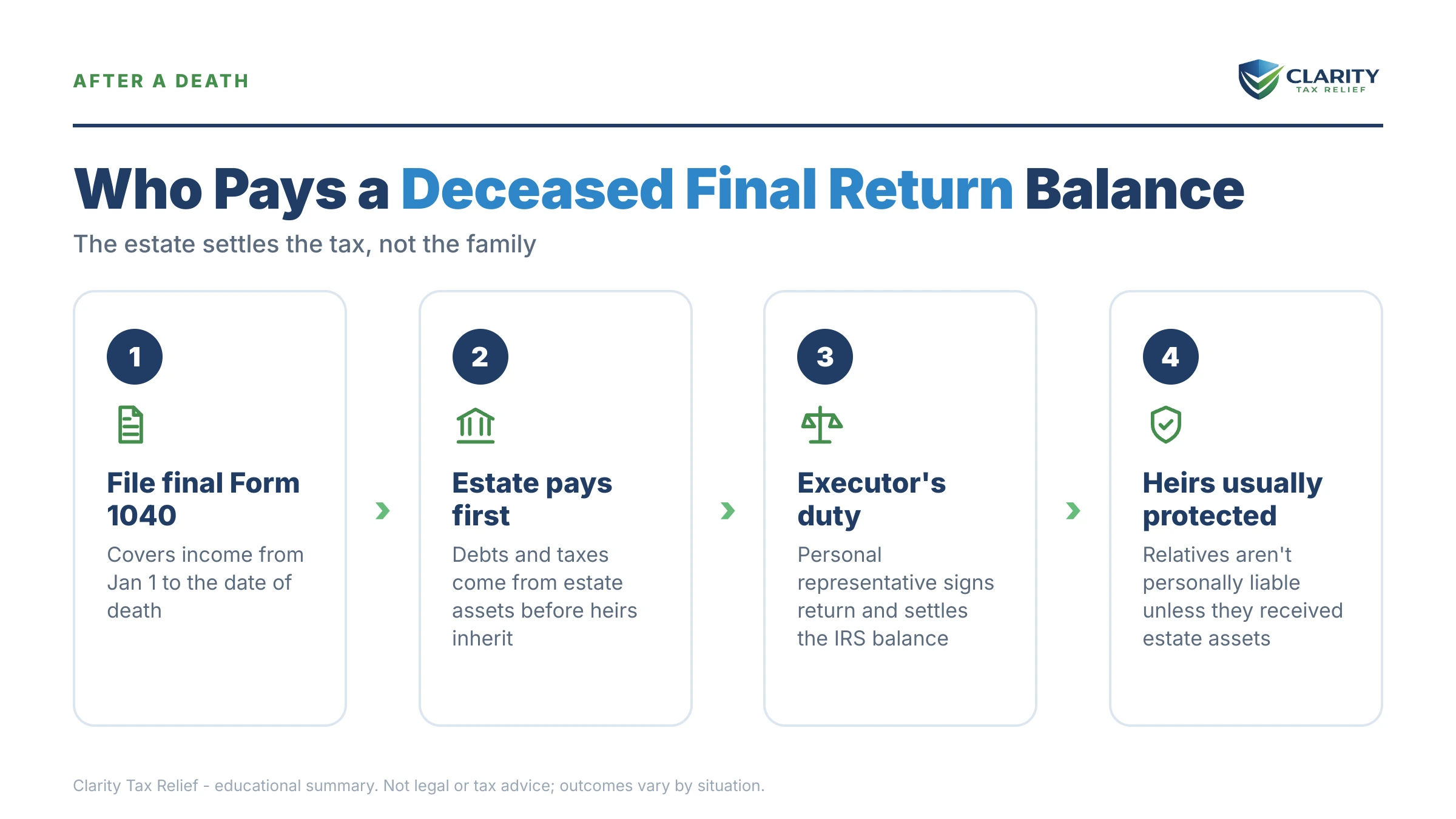
Who pays when a deceased final tax return owes money
The estate pays the balance on a deceased person's final tax return — family members are not personally liable for it. The personal representative (executor or administrator) pays the IRS from estate funds before distributing anything to heirs, and heirs are never liable beyond the value of what they actually inherited.
| Who you are | Are you personally liable? | What actually happens |
|---|---|---|
| The estate | Yes — the primary payer | The balance is a claim against estate assets: bank accounts, vehicles, real property, and anything else in probate. |
| Surviving spouse who signs a joint final return | Yes, for that joint year | Signing jointly creates joint liability for the final year's balance — the IRS can collect it from the survivor. |
| Surviving spouse filing separately (or unmarried decedent's family) | No | The balance stays with the estate. Community-property states can complicate how income is split — get state-specific advice there. |
| Executor / personal representative | Not for the tax itself — but yes under 31 U.S.C. § 3713 if assets are distributed before the IRS is paid | Pay federal debts before heirs and lower-priority creditors, or the shortfall can become your personal debt up to the amount distributed. |
| Children and other heirs | No personal liability | The IRS can pursue what an heir actually received from the estate, up to its value — never the heir's own money or wages. |
Assets that pass by beneficiary designation — life insurance payable to a named person, retirement accounts with beneficiaries — usually bypass probate and aren't part of the pool the executor uses to pay this bill. In limited situations the IRS can reach what a recipient got, but again only up to the value received.
If your situation is really "am I on the hook for my spouse's or parent's whole tax history," those are broader questions than the final return — see deceased spouse tax debt: am I responsible and parent died owing taxes.
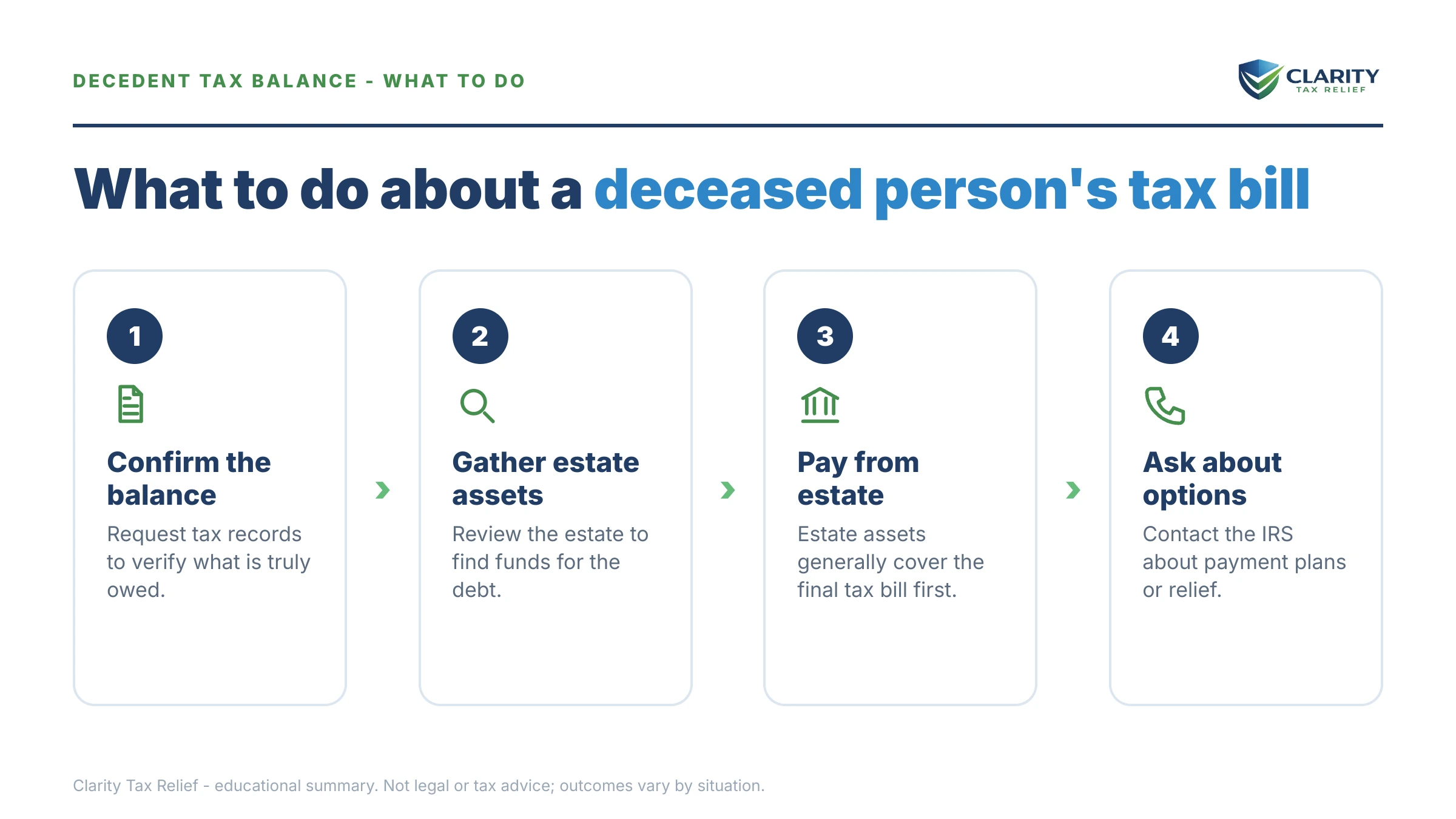
What happens if the balance is ignored
An unpaid balance on a decedent's final return rides the same automated collection track as any living taxpayer's debt — the IRS's notice system does not pause for probate, and the notices simply arrive addressed to someone who can no longer answer them. The sequence escalates in stages:
- CP14 — the first bill. Addressed to the decedent (often marked "DECD"). Typically about 21 days before the sequence continues (10 business days when the balance is $100,000 or more). No enforcement yet.
- CP501 / CP503 reminders. Still just bills, but the balance grows every month: the 0.5% late-payment penalty plus interest that compounds daily.
- CP504 — intent to levy the state refund. If the decedent's final state return had a refund coming, the IRS can now take it.
- Federal tax lien against estate property. A lien can attach to the house or land sitting in probate, clouding title and stalling any sale until it's addressed — see IRS lien after death.
- Executor exposure. If estate assets get distributed to heirs while the tax sits unpaid, the federal priority statute can convert the shortfall into the executor's personal debt — the trap covered in executor personally liable to the IRS.
The stage most families underestimate is the last one. The IRS may take months to work a decedent's account in 2026 — staffing is down sharply — but the automated notices, liens, and offsets never stopped, and a distribution made in month two can't be undone when the lien lands in month ten.
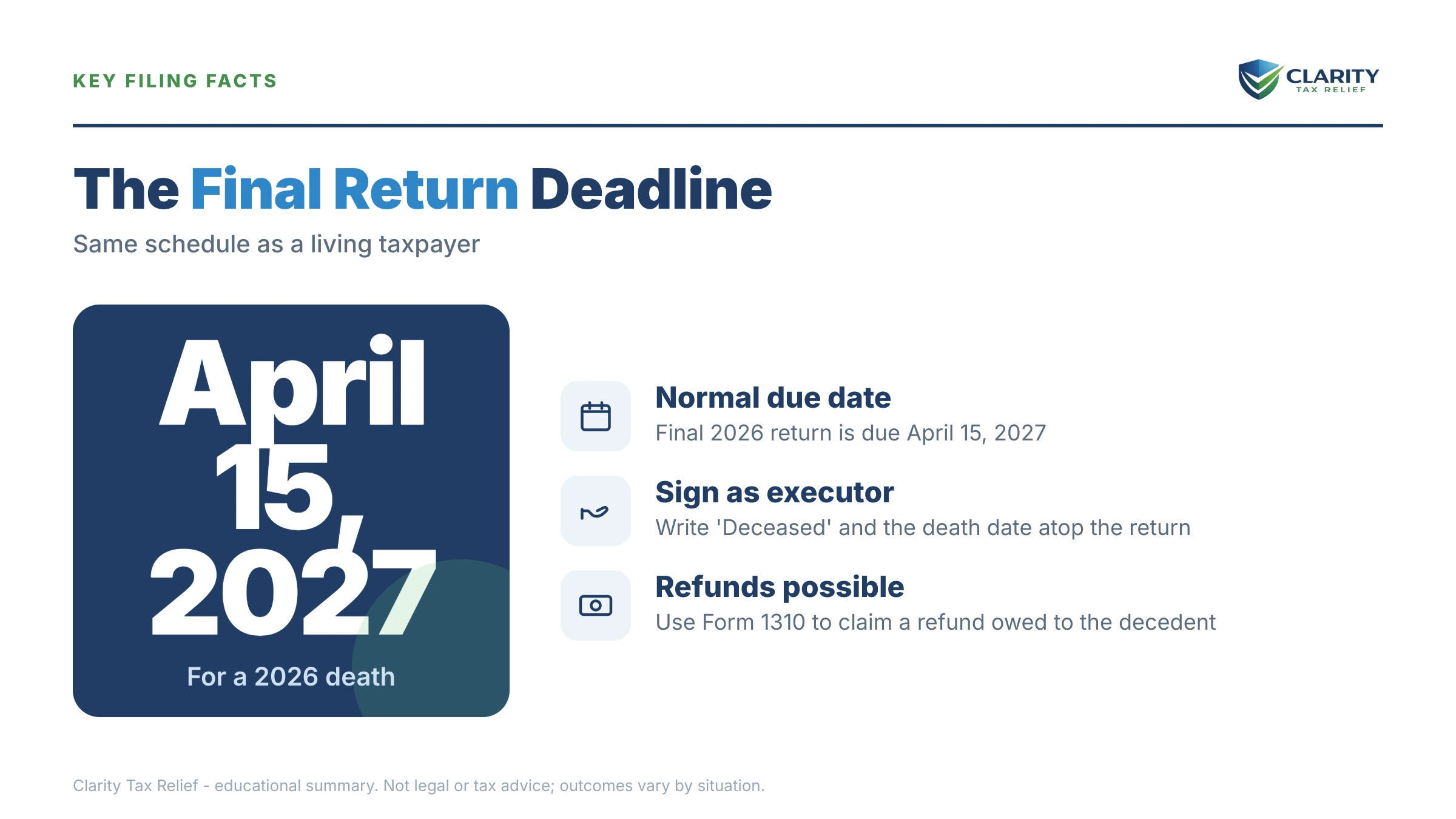
Handling a final return that owes the IRS?
Before you pay anything — or distribute anything — get the return and the estate's numbers reviewed free. An experienced tax professional will confirm who's actually liable, what the estate really owes with penalties, and the payoff order that protects you as executor. Interest and the monthly late-payment penalty keep accruing against the estate until it's resolved.
Your options when the estate can't pay in full
An estate that can't cover a final-return balance has the same core resolution options as a living taxpayer — exercised by the personal representative, with fiduciary paperwork attached. The general playbook lives in our guide to how to settle tax debt yourself; here's how each option applies to a decedent's account:
| Option | Works when | Cost & timeline notes |
|---|---|---|
| Pay in full from estate funds | The estate has liquid assets covering the balance | Stops the 0.5% monthly penalty and daily interest immediately; the cheapest outcome by far. |
| Short-term payment plan (up to 180 days) | Money is coming — a house sale, an account release — but not yet | $0 setup fee; interest and penalties continue but enforcement pauses. |
| Installment agreement (Form 9465, filed by the fiduciary) | Balance under $50,000 generally qualifies for streamlined terms up to 72 months | Modest setup fee; interest and the monthly penalty keep accruing across the life of the plan. |
| Offer in Compromise (doubt as to collectibility) | The estate's total assets are genuinely worth less than the debt | $205 application fee; the IRS accepted roughly 1 in 5 offers in FY2024, so it's a math case, not a request for mercy. |
| Documented insolvent estate | The estate holds essentially nothing after higher-priority claims | No fee — provide the death certificate, inventory, and claims list; the balance typically goes uncollected and heirs owe nothing personally. |
| Penalty relief | Late-filing or late-payment penalties were added, especially on prior unfiled years | First-Time Abatement applies with a clean prior three years; starting summer 2026, the IRS's Automatic Exemption from Penalty (AEP) grants similar relief automatically. Reduces additions, not the tax itself. |
Two decedent-specific notes. First, the IRS deals only with someone who has authority — a surviving spouse on a joint return, or a representative who has filed Form 56 — so none of these options can even be requested until that's in place. Second, penalty relief on a final year is often stronger than people expect: serious illness before death is a textbook reasonable-cause argument for why filings and payments slipped.
For the estate-wide picture — prior-year debts, liens, and the probate claim process rather than just the final 1040 — see estate owes the IRS.
Unfiled years before death: fix those too
The final return is rarely the whole story when the person who died was self-employed — the personal representative is also responsible for any unfiled prior years. Start by pulling the decedent's IRS wage and income transcript for each open year; it lists every 1099-NEC, 1099-K, and W-2 reported under their Social Security number, which solves the "I have no idea what they earned" problem.
Check whether the IRS filed a substitute return for any missing year. An SFR allows zero business deductions — no mileage, no expenses — so it nearly always overstates what a gig worker truly owed. Filing the real return, or amending a return to reduce the tax debt where a bad assessment already posted, can shrink the estate's total liability substantially before you negotiate anything.
File before you negotiate. The IRS won't finalize a payment plan or an offer on an account with known missing returns, and any refund year still inside the 3-year claim window is money the estate forfeits by waiting.
A worked example: $6,200 due on the final return
Say your father drove for delivery apps and died in November 2025 with three years unfiled — 2023, 2024, and the final 2025 return you now have to file as his executor. This is hypothetical, but the math is how it actually works:
- You pull his transcripts and prepare all three returns, deducting his mileage. Results: 2023 owes $2,900, 2024 owes $3,400, and the final 2025 return owes $6,200 — roughly $4,700 in self-employment tax plus about $1,500 in income tax, because nothing was ever withheld from his app income.
- The final return goes in by April 15, 2026 — on time. No failure-to-file penalty on the $6,200; just interest and the 0.5% monthly late-payment penalty until it's paid.
- The old years carry real additions. Both 2023 and 2024 are past the failure-to-file penalty's 25% cap: about $725 on 2023 and $850 on 2024, plus late-payment penalties and interest on top. Total debt lands around $14,500. If his 2022-and-earlier history was clean, first-time penalty abatement may remove the earliest year's penalty; you can estimate each year's additions with our IRS penalty and interest calculator.
- The estate holds $11,800 in checking plus a car that sells for $4,200 — $16,000. You pay the IRS first, and what remains after final expenses goes to heirs. Had you handed the $16,000 to family first, § 3713 could make the unpaid $14,500 your personal debt.
How to respond when a deceased person's final return owes: step by step
- Confirm your authority. Get letters testamentary from the probate court if you're the executor, or gather proof you're the surviving spouse. Then file Form 56 so the IRS sends the account's notices to you instead of to the decedent's last address.
- Pull the decedent's IRS transcripts. Request the account transcript and wage and income transcript for the last several years. They show what income was reported to the IRS, which returns were filed, and what the IRS has already assessed.
- File everything that's missing. Prepare the final Form 1040 — marked "Deceased" with the name and date of death across the top — plus any unfiled prior years, before you negotiate payment terms. The IRS won't finalize a resolution over an incomplete filing record.
- Pay what the estate can from estate funds. Pay the IRS at IRS.gov/payments from estate money before any distributions to heirs. Even a partial payment shrinks the base that the monthly penalty and daily interest run against.
- Set up a resolution for the rest. Choose the fit from the options table: a short-term plan while an asset sells, an installment agreement, an offer, or documented insolvency if the estate genuinely has nothing.
- Document everything. Keep copies of every payment, the estate inventory, and every distribution. Those records are what protect you if the IRS or the probate court later questions the order in which the estate was paid out.
The IRS's own instructions for marking, signing, and submitting a decedent's return are at File the final income tax return of a deceased person. If the account gets stuck — misapplied payments, notices to the wrong address, months of silence — the Taxpayer Advocate Service exists for exactly that.
When you can handle this yourself
Much of the time, you don't need professional help for this. If the final return is the only open year, the numbers match the decedent's records, and the estate has cash to pay the balance — pay it, keep the confirmation with the estate records, and you're done. A surviving spouse filing a routine joint final return with funds available is in the same boat. Even a simple payment plan on a modest balance is a fair DIY project.
Experienced help changes the outcome in specific situations: multiple unfiled years where transcripts and reconstructed deductions determine the debt; a substitute-return assessment that overstates what was really owed; a lien attaching to estate property mid-probate; an estate whose assets fall short of the debt (the OIC and insolvency math is unforgiving); or any case where you, as executor, would be personally exposed by getting the payoff order wrong. Those are the cases where a professional's fee is small next to the mistake it prevents.
Terms on the decedent's tax paperwork, decoded
- Personal representative — the executor or administrator legally in charge of the estate; the person the IRS deals with about the final return.
- Letters testamentary — the probate court's document proving your authority to act for the estate; the IRS will ask for it.
- Form 56 — a one-page notice telling the IRS a fiduciary relationship exists, so notices on the decedent's account come to you.
- Form 1310 — used only to claim a refund on a decedent's behalf; not needed when the return owes.
- Form 1041 — the estate's own income tax return, for income earned after death. The final 1040 covers January 1 through the date of death only.
- Federal priority statute (31 U.S.C. § 3713) — the rule that makes an executor personally liable for paying heirs or lower-priority creditors before the government when the estate can't cover everything.
Deceased final return questions, answered
Do I have to pay a deceased parent's final tax bill out of my own pocket?
No. The IRS collects a decedent's final income tax from the estate, not from children or other relatives. If you're the executor, you pay it from estate funds before distributing anything to heirs; if you're only an heir, your exposure is capped at the value of what you actually inherited. The real trap is distributing estate assets before the tax is paid — that can make the executor personally liable under 31 U.S.C. § 3713.
Who files and signs the final tax return when someone dies owing taxes?
The surviving spouse (on a joint return) or the court-appointed personal representative files it. Write "Deceased," the person's name, and the date of death across the top of the Form 1040. A spouse signs and writes "filing as surviving spouse"; a representative signs in their fiduciary capacity. If no one was appointed and there is no spouse, the person in charge of the decedent's property files and signs.
What if the estate has no money to pay the balance on the final return?
The IRS can only collect what the estate actually holds — an insolvent or empty estate usually means the balance goes unpaid, and heirs do not inherit the debt personally. Document it: the death certificate, an inventory showing no assets, and the list of higher-priority claims like funeral and administration costs. What you cannot do is quietly move assets to family first; the IRS can pursue what heirs received, up to its value.
Is a surviving spouse responsible for a balance on a joint final return?
Yes — signing a joint return creates joint and several liability, so the IRS can collect that year's full balance from the surviving spouse even after the other spouse's death. Filing separately avoids that for the final year, though community-property states can complicate the split. If the balance came entirely from income the survivor knew nothing about, innocent-spouse relief may reduce or remove their share.
Can the executor set up an IRS payment plan for a deceased person's taxes?
Yes. File Form 56 to establish your fiduciary authority, then request an installment agreement — Form 9465 works for a decedent's account. Balances under $50,000 generally qualify for a streamlined agreement of up to 72 months, and a short-term plan of up to 180 days has no setup fee. Interest and the 0.5% monthly late-payment penalty keep accruing until the balance is paid.
Does IRS debt die with the person who owed it?
No — the debt survives as a claim against the estate, and the IRS's normal 10-year collection statute keeps running on it. What death changes is the source of payment: the estate's assets, not the family's. If the estate genuinely has nothing, the balance typically becomes uncollectible, because the IRS cannot reach into heirs' own wallets for it.
Do I need Form 1310 if the final return owes money?
No. Form 1310 exists only to claim a refund on behalf of a deceased person. When the final return shows a balance due, you skip Form 1310 entirely — mark the return with the decedent's name and date of death, sign in the correct capacity, and pay from estate funds. Many filers attach it unnecessarily, which can slow processing.
Do I also have to file the years before death that were never filed?
Yes — a person's filing obligations survive them, and the personal representative is responsible for any unfiled prior years, not just the final return. The IRS generally looks for the last six years of returns. Filing them yourself usually beats waiting: if the IRS prepares a substitute return, it allows no deductions, and any refund from a year within the 3-year claim window is lost if you don't file for it.
Your next 24 hours
- Find the exact number. Pull the "Amount you owe" line from the final Form 1040 — or the amount box on any IRS notice that has arrived — and note the tax year it covers.
- Gather the file. Death certificate, the will or court appointment, the decedent's last filed return, any 1099s or IRS mail from the past year, and a rough list of what the estate holds.
- Get the free case review. Send us what you have through the 2-minute form or call (888) 825-7779. We'll map who's liable, what the estate truly owes, and the payoff order that keeps you protected — while interest and the monthly penalty are still small.
This guide is general information, not tax or legal advice for your specific situation. Eligibility for IRS programs depends on individual facts and circumstances; no outcome is guaranteed.