
Tax Debt & Family
Deceased Spouse Tax Debt: Am I Responsible? (2026 Guide)
Deceased spouse tax debt — am I responsible? Only for years you filed jointly. Signing a joint return makes you personally liable, and that liability survives your spouse's death. Debt from your spouse's separate returns belongs to their estate, not you — with two main exceptions: community property states and distributing estate assets before the IRS is paid.
You're still working through your spouse's mail, and the IRS envelopes keep coming — some addressed to both of you, some to just their name, maybe one to "the Estate of." Whether each balance is legally yours isn't a judgment call the IRS gets to make later. It was decided by the filing-status box checked on each old return, and that's good news: you can sort this stack into "mine" and "not mine" today.
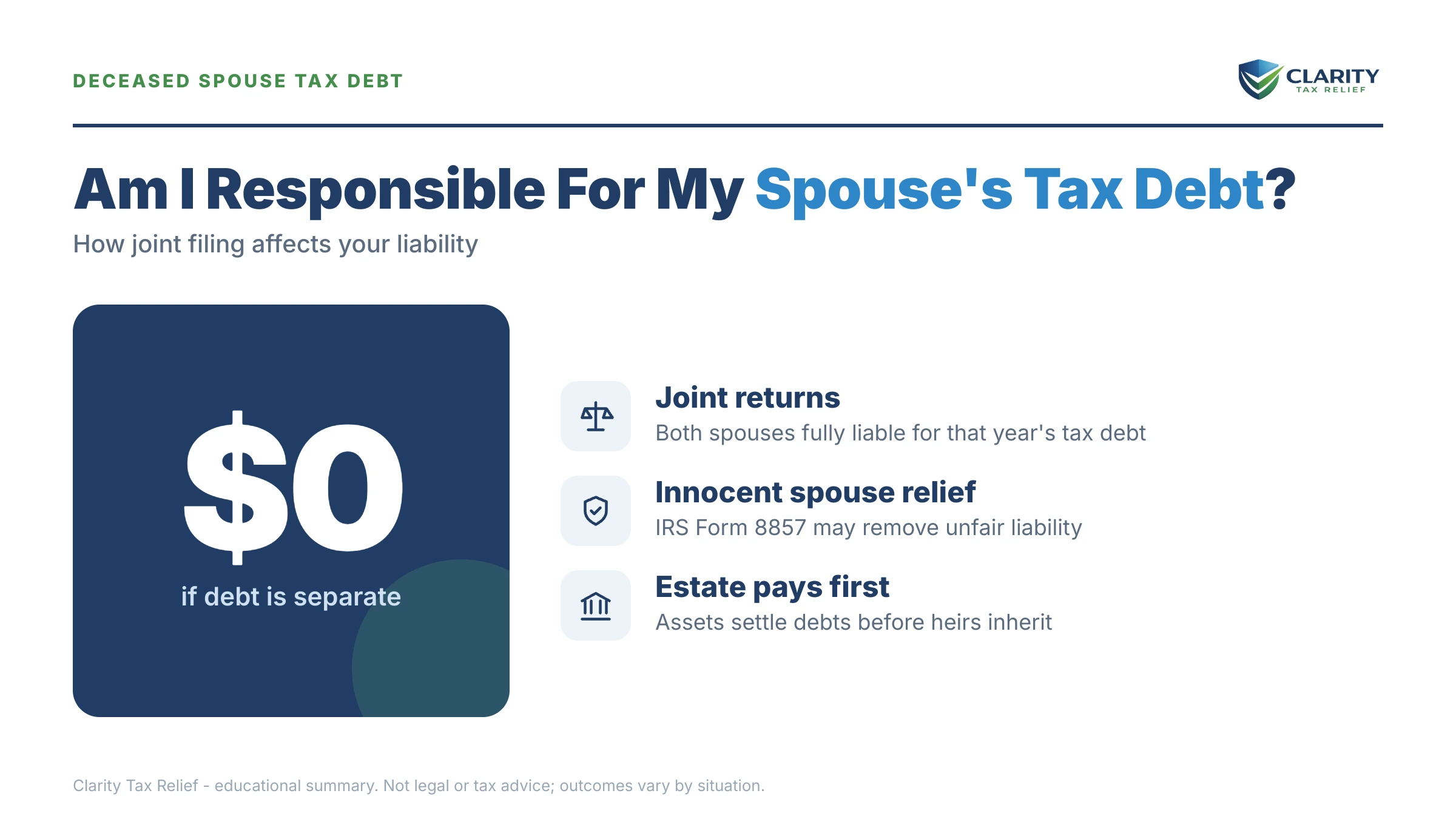
This guide covers exactly which debts follow you, which stop at the estate, the community property exception, and what someone living on Social Security can realistically do about the balances that are theirs. The image below maps which debts follow you personally and which stay with the estate — worth keeping open as you sort the pile.
⏱ The real clock: there's no single response deadline for this situation, but on any joint-year balance the 0.5% monthly failure-to-pay penalty and daily interest keep accruing — and the IRS's 10-year collection window runs from each year's assessment date, not from the date of death.
Deceased spouse tax debt: am I responsible? Start with how each year was filed
A joint tax return makes both spouses fully liable for the entire balance, and that liability survives death. The rule is called joint and several liability (IRC §6013(d)(3)): the IRS can collect 100% of a joint-year debt from either spouse — including the surviving one, alone. Your spouse's death doesn't erase, reduce, or transfer that debt. It was already yours the day you signed.
Debt from your spouse's separate returns works completely differently. Years they filed single (before you married) or married-filing-separately are their debt alone. When they died, it became a claim against their estate — paid from estate assets, in probate, before heirs receive anything. You are not personally liable for it, and the IRS cannot levy your income or accounts to collect it. If the estate is formally handling those years, our guide to when an estate owes IRS back taxes walks through that process, and the balance on your spouse's last return has its own path — see deceased final tax return owes.
Here's how the most common situations break down:
| Situation | Who the IRS can collect from | Your first move |
|---|---|---|
| Joint return years | You, personally — the full balance | Verify the amount, then pick a resolution (table below) |
| Spouse's separate or MFS returns | The estate only | Respond as the estate; don't pay from your own funds |
| Debt from before your marriage | The estate (your property protected in most states) | Check assessment dates — it may be near the 10-year expiration |
| Community property state | Possibly you, through community income and assets | Get state-specific advice; §66 relief may apply |
| You're the executor and distributed assets early | You, up to the value you distributed | Pause distributions until IRS claims are addressed |
| Spouse's personal business penalties (e.g., trust-fund penalty) | Their estate — the assessment was personal to them | Confirm the assessment names only your spouse |
One more wrinkle worth knowing: if the joint-year debt exists because of an IRS error or a mistake on the return itself — a missed deduction, income reported twice — the balance may be reducible before you ever negotiate it. That's covered in amend return to reduce tax debt.
The community property exception (nine states)
In community property states, a spouse's separate tax debt can sometimes reach assets you thought were safe. Arizona, California, Idaho, Louisiana, Nevada, New Mexico, Texas, Washington, and Wisconsin treat most income earned during the marriage as belonging to both spouses — so the IRS may have been able to reach community income and community assets even for a debt on your spouse's separate return.
Your own separate property — what you owned before the marriage, or received by gift or inheritance — is generally protected. And the tax code has its own escape hatch: Section 66 relief can excuse you from tax on community income you didn't benefit from or know about. The rules differ state to state, so if you're in one of the nine, read community property tax relief before assuming either the best or the worst.
What happens if you ignore joint-year debt
The IRS collection system is automated, and it does not pause because the account's other name belongs to someone who died. On a joint balance you personally owe, ignoring the notices triggers the same escalation any taxpayer faces:
- Balance-due bills and reminders (CP14, CP501, CP503) — no enforcement yet, but the failure-to-pay penalty (0.5% per month) and daily interest compound the balance with each notice.
- Refund offsets — any refund on your own future returns is taken automatically and applied to the joint debt.
- CP504 — Notice of Intent to Levy — the IRS can now seize your state tax refund.
- LT11 / Letter 1058 — Final Notice of Intent to Levy — starts a 30-day clock and your Collection Due Process appeal rights. After it passes, bank levies begin, and the Federal Payment Levy Program can take up to 15% of every Social Security payment. More on that in can the IRS garnish Social Security.
- Federal tax lien — can attach to your home, complicating any sale, refinance, or reverse mortgage until it's resolved.
In 2026, with the IRS workforce cut roughly 27%, reaching a human to explain "my spouse died" takes longer than ever — but the notice-and-levy machinery is automated and never stopped. Waiting for the IRS to sort it out on its own is not a strategy.
For estate-only debt, the escalation looks different: the IRS files its claim against the estate, a lien can attach to estate property, and — if you're the personal representative — paying heirs before the IRS can make you personally liable under 31 U.S.C. §3713. That trap is covered in detail in executor personally liable IRS.
Sorting a late spouse's IRS mail right now?
Send us photos of the notices. An experienced tax professional will separate what's legally yours from what belongs to the estate — and map your options on the part that's yours — free, confidential, no pressure. Interest is accruing on any joint balance while you wait.
Your options as a surviving spouse on a fixed income
Every IRS resolution program remains available to a surviving spouse — and one, innocent spouse relief, exists almost exactly for this situation. Which fits depends on the size of the balance, your income, and where the debt came from. (The general mechanics of each program live in our DIY pillar, how to settle tax debt yourself — here's how they apply to you.)
| Option | Who qualifies | Cost and key facts |
|---|---|---|
| Pay in full / short-term plan | Can raise the money within 180 days | $0 setup; interest accrues until paid |
| Streamlined installment agreement | Balance $50,000 or less | Up to 72 months, set up online; interest and penalties continue |
| Non-streamlined installment agreement | Balance over $50,000 | Requires Form 433-F financials; payment set by ability to pay |
| Currently Not Collectible (CNC) | Allowable living expenses equal or exceed income | $0; collection and levies stop; 10-year clock keeps running |
| Offer in compromise (OIC) | Assets + future income can't cover the debt | $205 fee + 20% down — both waived with low-income certification; roughly 1 in 5 accepted in FY2024 |
| Innocent spouse relief (Form 8857) | Understatement traceable to your spouse's income or errors | $0 to request; can remove your liability entirely |
| Penalty abatement | Clean 3-year history (First-Time Abate) or reasonable cause | Removes penalties, not tax; from summer 2026, AEP applies some relief automatically |
Check innocent spouse relief before anything else. If the joint-year balance exists because your spouse underreported income — a pension distribution you never saw, side income, gambling winnings — or claimed deductions that weren't real, and you didn't know when you signed, innocent spouse relief can remove your liability for that portion entirely. Death doesn't close that door; a surviving spouse can still file Form 8857. If gambling was the source, the fact pattern has its own playbook — see spouse gambling tax debt. Requests generally must be made while the IRS can still collect, so don't shelve this for later.
Note the honest limits, too: an offer in compromise is means-tested math, not a discount program, and nothing here makes a legitimate joint debt "disappear" — CNC pauses collection but the balance keeps growing until the collection statute runs out.
A worked example: $68,500 in joint debt on Social Security income
Say you're 71, your only income is $2,300 a month in Social Security, and the IRS says you owe $68,500 from two joint years — tax your late spouse's IRA withdrawals generated but that never got paid. Clearly hypothetical, but the math is what matters:
- An installment agreement doesn't fit. At $68,500 the balance is over the $50,000 streamlined ceiling, so the IRS would want Form 433-F financials — and even ignoring that, $68,500 ÷ 72 months ≈ $951 a month before accruing interest. That's over 40% of your income. Not realistic.
- Currently Not Collectible probably does fit. The IRS compares your income to its allowable living expense standards. For one person, allowed housing, food, health care, and transportation costs will typically meet or exceed $2,300 a month — leaving $0 in monthly disposable income. In CNC, collection and any Social Security levy stop while the 10-year clock keeps running. See IRS hardship Social Security for how fixed-income CNC works.
- An offer in compromise may fit if your assets are modest. The IRS calculates your Reasonable Collection Potential: monthly disposable income × 12 (for a lump-sum offer) plus net asset equity. Suppose the home is worth $180,000 with a $130,000 mortgage: quick-sale value is 80% × $180,000 = $144,000, minus $130,000 = $14,000 in countable equity. RCP = ($0 × 12) + $14,000 = $14,000 — meaning an offer near $14,000 could be defensible on a $68,500 debt. You can rough out your own numbers with our Offer in Compromise Calculator, which estimates — never promises — an offer range.
- Low-income certification likely applies. At about $27,600 a year, a single filer is under 250% of the poverty level, which waives the $205 fee, the 20% down payment, and payments while the offer is reviewed. Remember the IRS accepted only about 1 in 5 offers in FY2024 — the math has to genuinely hold up.
And if that $68,500 traces to income you never knew about? Innocent spouse relief could remove your liability without paying $14,000 — which is exactly why the screening order in the next section matters.
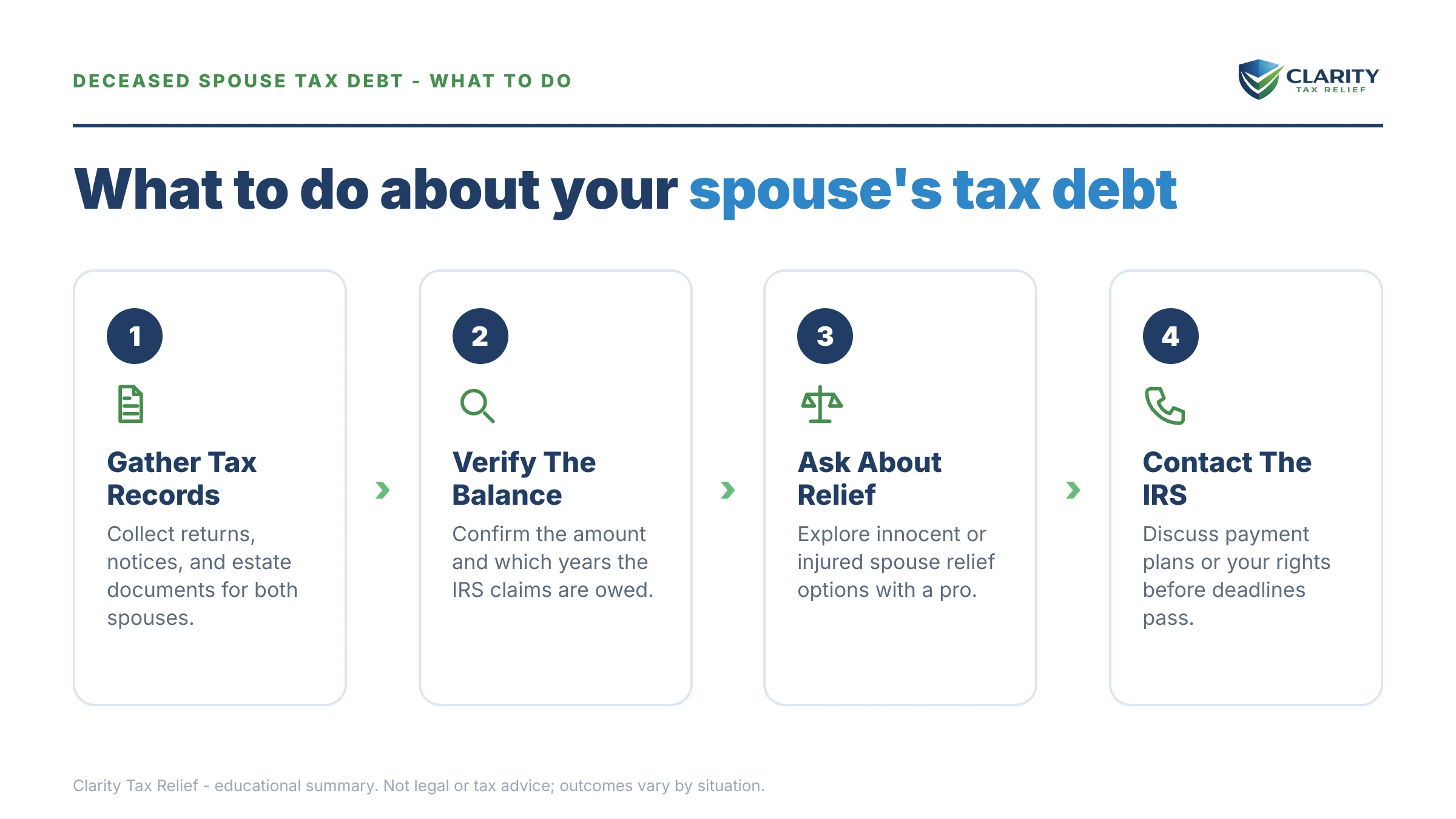
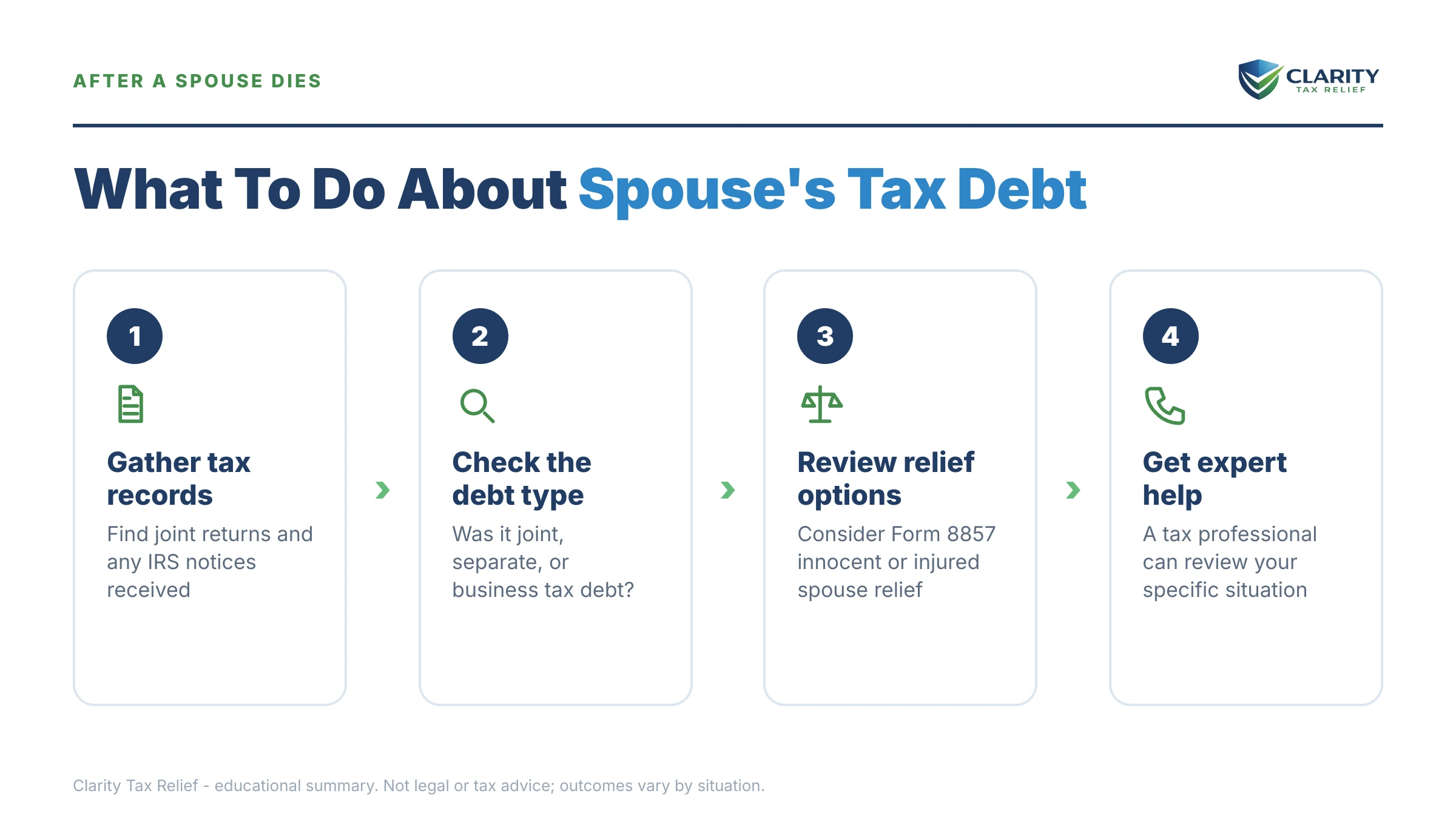
How to respond to a deceased spouse's tax debt, step by step
- Sort every notice by tax year and filing status — joint years are legally yours; your spouse's separate (single or married-filing-separately) years belong to the estate.
- Pull account transcripts for every year with a balance — they confirm the exact amounts, the assessment dates that start each 10-year collection clock, and any liens or levies already on file.
- Answer estate-only notices as the estate, in writing — the personal representative responds on the estate's behalf; do not pay those balances from your personal funds.
- Screen for innocent spouse relief before choosing any payment option — if the joint-year debt traces to your spouse's unreported income or errors you didn't know about, Form 8857 could remove your liability entirely.
- Set up the right resolution for the joint-year balance — a payment plan if you can afford one, Currently Not Collectible if your income only covers living expenses, or an offer in compromise if the math supports it.
When you can handle this yourself — and when help changes the outcome
You don't need professional help for every piece of this. Handle it yourself when the joint balance is small and undisputed and you can pay within 180 days (set up the short-term plan free at IRS.gov/payments), when a probate attorney is already managing the estate-only years, or when a single joint year fits a simple online installment agreement.
Experienced help changes outcomes in specific situations: a levy already hitting your Social Security, a balance like $68,500 where CNC-versus-OIC math decides whether you pay $0 a month or hand over home equity, an innocent spouse case that needs evidence assembled and argued, executor exposure where distributions have already gone out, or several unfiled years mixed into the stack. Those are the cases where the order you do things in — relief request first, financials second, resolution third — changes the dollar outcome. If you're stuck in IRS processing limbo along the way, the Taxpayer Advocate Service is a free, independent escalation path.
Terms on your notices, decoded
- Joint and several liability — each spouse on a joint return owes 100% of the tax, so the IRS can collect the whole balance from whichever spouse it can reach.
- Personal representative (executor) — the person legally handling the estate, who answers the IRS for the deceased's separate debts and can become personally liable for distributing assets before taxes are paid.
- CSED — the Collection Statute Expiration Date: 10 years from assessment, after which the IRS can no longer collect that year's debt (certain events, like an offer or bankruptcy, pause the clock) — full detail in how long can the IRS collect back taxes.
- FPLP — the Federal Payment Levy Program, which can take up to 15% of Social Security payments for a debt you personally owe.
- Federal tax lien — the government's legal claim against property, which can attach to estate assets or, for joint debt, to your own home.
- Innocent spouse relief — relief under IRC §6015, requested on Form 8857, that can remove your liability for understatements attributable to your spouse.
Deceased spouse tax debt questions, answered
Am I responsible for my deceased spouse's tax debt if we filed jointly?
Yes. Signing a joint return makes you jointly and severally liable, and that liability survives your spouse's death — the IRS can collect the full joint balance from you alone. Collection generally runs 10 years from the date each year's tax was assessed. Innocent spouse relief on Form 8857 may remove your liability for understatements caused by your spouse's income or errors.
Does my spouse's IRS debt die with them?
No — the debt survives, but who owes it depends on the return. Debt from your spouse's separate returns becomes a claim against their estate, paid from estate assets before heirs receive anything. Debt from joint returns is also your personal debt. The IRS only stops pursuing it when the 10-year collection statute expires or there is genuinely nothing and no one left to collect from.
Can the IRS take my Social Security for my deceased spouse's taxes?
Only if you personally owe the debt — meaning it comes from a joint return or, in some cases, a community property state. For debt you owe, the Federal Payment Levy Program can take up to 15% of each Social Security payment. If the debt is from your spouse's separate returns only, your Social Security cannot be levied for it; the IRS must look to the estate.
Can the IRS take the house I inherited from my spouse?
Possibly, if a federal tax lien attached before the property transferred to you, or if the debt is from joint years so the lien reaches your interest too. Actual home seizures are rare, but a lien makes selling, refinancing, or taking a reverse mortgage difficult until it's addressed. Get the lien question answered before you make any decision about the house.
What about tax debt from before we were married?
In most states, premarital tax debt belongs only to your spouse, and after their death it becomes a claim against the estate — you are not personally liable for it. In community property states, the IRS may have been able to reach community income during the marriage, but your own separate property is generally protected. Check the assessment dates: premarital debt is often old enough to be near the 10-year collection expiration.
Can I get innocent spouse relief after my spouse has died?
Yes. Death does not bar a surviving spouse from filing Form 8857, and relief can remove your liability for understatements attributable to your spouse's unreported income or erroneous deductions. You generally must request it while the IRS can still collect — within the 10-year collection window for most relief types. Equitable relief under Section 6015(f) covers some situations the other categories miss.
Do I have to use life insurance money to pay my spouse's IRS debt?
Generally no. Life insurance paid to you as a named beneficiary passes outside the estate and is not reachable for your spouse's separate tax debt. But if the debt is from joint years, it is your debt — and once the proceeds sit in your bank account, they are an asset the IRS can count in an offer or reach with a levy. Get advice before moving large sums.
How long can the IRS collect a deceased spouse's tax debt?
Ten years from the date each year's tax was assessed — the same collection statute (CSED) that applies to living taxpayers. Death neither shortens nor extends the clock, though an offer in compromise, bankruptcy, or a collection due process appeal can pause it. Pull the account transcripts and check each assessment date; older years may be close to expiring on their own.
Your next 24 hours
- Sort the stack by filing status. On each notice or return, find the tax year and how it was filed — joint years go in one pile (yours), your spouse's separate years in another (the estate's).
- Gather your documents. The notices, your last three tax returns, your Social Security benefit statement and any other income records, and whatever probate or estate paperwork exists.
- Get the free case review. Call (888) 825-7779 or use the 2-minute form. Interest and the monthly late-payment penalty are compounding on any joint balance right now — and an innocent spouse request only works while the IRS can still collect, so the screening is worth doing this week, not someday.
This guide is general information, not tax or legal advice for your specific situation. Eligibility for IRS programs depends on individual facts and circumstances; no outcome is guaranteed.