
Innocent Spouse Relief
Community Property Tax Relief: Section 66 Innocent Spouse Rules in 2026
The short answer: community property tax relief — IRC Section 66 — removes tax on your spouse's income from your bill when community property rules put half of it on your separate return. It applies in nine states, is requested on Form 8857, and equitable relief stays open until the 10-year collection statute expires.
You filed your own return, reported your own income, and the IRS still sent you a bill built on money your spouse earned — money you may never have seen. That's not a mistake in most cases; it's community property law working against you. And Congress built an escape hatch for exactly this situation.
The request goes on Form 8857 — the image below shows exactly what the form looks like and where the community property questions sit, so you'll know what the IRS is going to ask before you start writing.
⏱ The real clocks: equitable relief under Section 66(c) can be requested any time before the IRS's 10-year collection statute expires on the balance (or within the refund window — generally three years from filing or two years from payment — if you want money back). Traditional Section 66(c) relief has a tighter window: it must generally be requested while the IRS still has at least six months left to assess the tax against your spouse. Interest and the monthly late-payment penalty accrue the whole time you wait.
Why the IRS is billing you for income your spouse earned
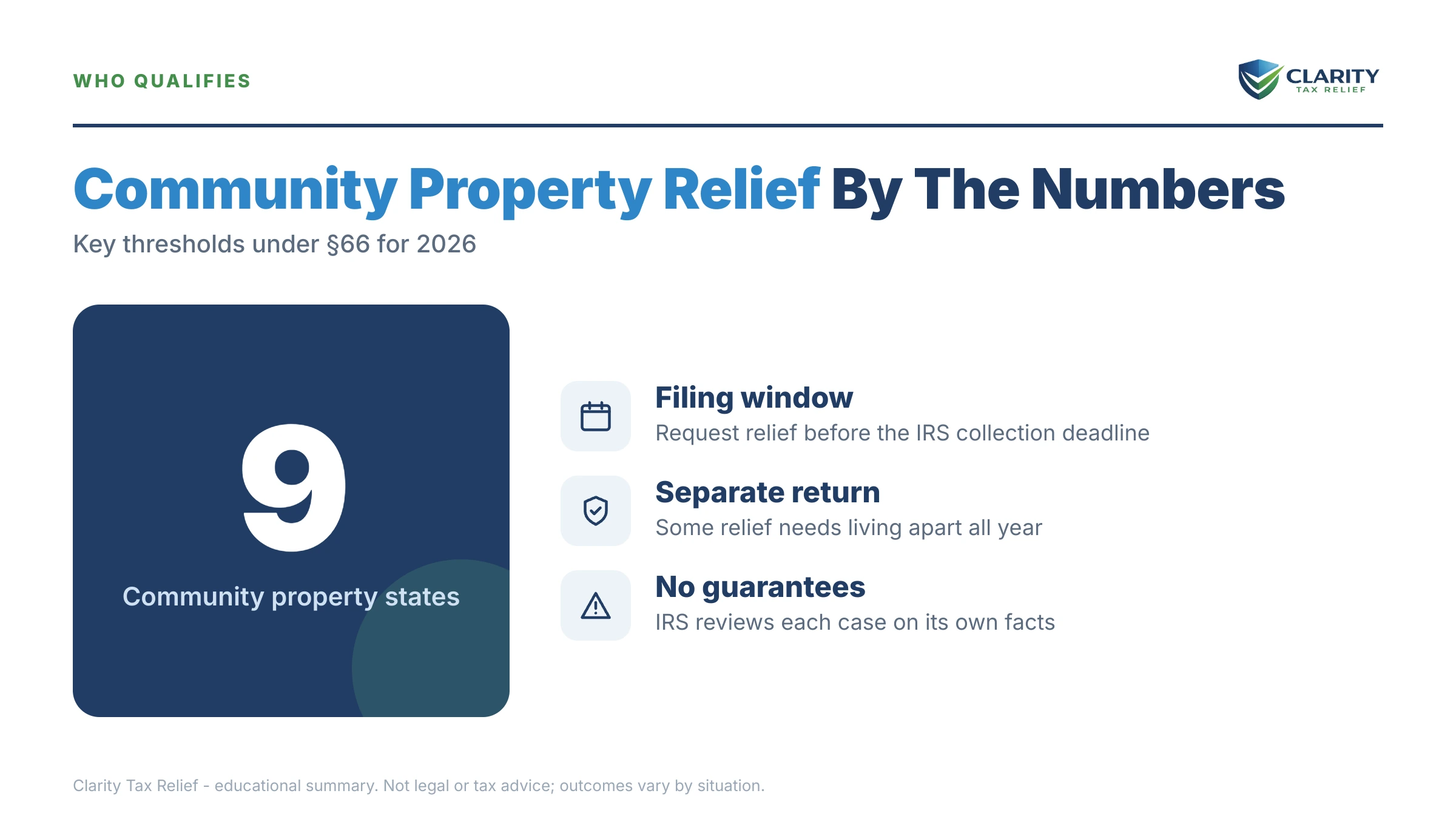
In the nine community property states, income earned by either spouse during the marriage legally belongs half to each spouse — even on separate tax returns. So if you filed married filing separately in Texas or California, the IRS expects your return to show half of the combined community income, not just your own earnings. When your spouse's income surfaces later — a 1099 they never mentioned, a business the IRS reconstructs, a retirement withdrawal — the IRS's matching systems allocate half of that income to you and bill you for the tax on it.
The bill usually arrives one of three ways: a CP2000 notice proposing tax on unreported income, an audit adjustment, or — if you never filed — a substitute return the IRS computes the community property way. In every version, the liability is assessed against you, in your name, collectible from your assets.
This is where Section 66 differs from every other innocent spouse article on this site: the familiar rules under innocent spouse relief (IRC §6015) only work if you signed a joint return. Section 66 is the parallel track for people who filed separately — or didn't file at all — in a community property state. If you're being told you "can't qualify" because there's no joint return, that's the §6015 answer, not the §66 answer.
| State | State income tax? | What it means for you |
|---|---|---|
| Arizona | Yes | Federal §66 request plus a separate request to the AZ Department of Revenue if the state billed you too |
| California | Yes | The FTB runs its own program — see FTB innocent spouse; a federal grant does not automatically bind the FTB |
| Idaho | Yes | Federal §66 request; contact the Idaho State Tax Commission about any state balance |
| Louisiana | Yes | Federal §66 request; Louisiana's civil-law community rules are the oldest in the country — allocation disputes are common |
| Nevada | No | IRS side only — one request covers your whole problem |
| New Mexico | Yes | Federal §66 request; contact NM Taxation & Revenue about any state balance |
| Texas | No | IRS side only — one request covers your whole problem |
| Washington | No | IRS side only for income tax; the state has no personal income tax |
| Wisconsin | Yes | Calls it "marital property," but the IRS treats it as community property; contact the WI DOR about any state balance |
Alaska and a small number of other states allow couples to opt in to community property by written agreement. If you signed one, the same federal rules — and the same relief — can apply to you.
What happens if you ignore a community income tax bill
A Section 66 liability collects exactly like any other assessed tax debt — the IRS's automated system doesn't know or care that the underlying income was your spouse's. Once assessed against you, the sequence runs:
- Proposed assessment — a CP2000 or audit report gives you a window to dispute the community property allocation itself. This is the cheapest stage to raise §66.
- Assessment and first bill (CP14) — the balance is now legally yours, with roughly 21 days to pay (10 business days when the balance is $100,000 or more) before the reminder sequence starts. Interest and the 0.5%-per-month failure-to-pay penalty are running.
- CP501 / CP503 reminders — still just bills, but the balance grows every month, and any tax refund you're owed gets offset automatically.
- CP504 — the IRS can now seize your state tax refund, and a federal tax lien becomes a live possibility against property you own — including community property.
- LT11 / Letter 1058 — final notice. A 30-day clock starts, with Collection Due Process rights via Form 12153. Innocent spouse and §66 issues can be raised in a CDP hearing — this is often the last structured chance to do it.
- Levy stage — bank accounts (with a 21-day hold before funds leave), wages, and up to 15% of Social Security through the Federal Payment Levy Program. For a retiree, this is where a paper problem becomes a grocery-money problem.
One more community-property twist: collection cuts both ways. Just as the IRS can bill you for your spouse's income, it can often reach community assets — including a non-liable spouse's wages — for the other spouse's tax debt. If that's your situation, see can the IRS take my spouse's bank account.
Being billed for income your spouse earned?
Before the balance grows another month, find out whether Section 66 fits your facts. An experienced tax professional will review your notice free, map which relief type and which deadline controls your case, and tell you honestly if a simpler fix applies.
Community property tax relief options: every path compared
Section 66 contains three distinct escape routes, and two other tools get confused with them constantly. Here is the full map:
| Option | When it fits | Key requirement |
|---|---|---|
| §66(a) — spouses living apart | You lived apart the entire calendar year | Separate returns, earned community income, and no transfers of that income between you — each spouse then reports only their own earnings |
| §66(c) — traditional relief | The bill comes from omitted community income your spouse earned | No joint return; you didn't know and had no reason to know of the income; holding you liable would be inequitable |
| §66(c) — equitable relief | You miss a traditional requirement (often the knowledge test), or the tax was reported but unpaid | Facts-and-circumstances test under Rev. Proc. 2013-34 — hardship, abuse, and who benefited all weigh in |
| §6015 innocent spouse relief | You signed a joint return | Wrong tool for separate-return cases — see how to qualify for innocent spouse relief |
| Form 8379 injured spouse | Your joint refund was taken for your spouse's separate debt | Recovers your refund share; does not remove any liability — see Form 8379 injured spouse |
| Currently Not Collectible / payment plan | Relief is denied or doesn't cover everything, and you can't pay | Financial disclosure; a guaranteed installment agreement is available to individuals with an income-tax balance of $10,000 or less (excluding penalties and interest) who have filed all returns, filed and paid on time for the past 5 years with no installment agreement in that period, and can pay in full within 3 years; balances under $50,000 qualify for streamlined terms |
Traditional §66(c) has four tests, and all four must pass: (1) you did not file a joint return for the year; (2) the bill comes from an item of community income attributable to your spouse — their wages, their business, their property; (3) you did not know, and had no reason to know, of that income; and (4) it would be inequitable to tax you on it. "No reason to know" is where cases are won or lost — the IRS looks at your household's lifestyle, your involvement in the finances, and whether the money visibly improved your life. If your spouse deposited the income into an account you never touched, say so and prove it. If it paid the mortgage on the house you live in, expect a fight on the "inequitable" test.
Equitable relief under §66(c) is the backstop when traditional relief fails — most often because you knew something. The IRS weighs the Rev. Proc. 2013-34 factors: your marital status now, whether paying would cause economic hardship, what you actually knew, who benefited, your compliance since, your health, and — heavily — any abuse or financial control in the relationship. It can also cover tax that was reported but never paid, which traditional relief cannot. The factor-by-factor breakdown lives in our guide to equitable relief; what matters here is that equitable relief is the only §66 path with no assessment-statute pressure — it stays open for the life of the collection statute.
§66(a) isn't relief at all — it's a reporting rule that prevents the problem. Live apart the entire year, file separately, keep earned community income separate, and each spouse is taxed on their own earnings. If the IRS computed your bill the community property way but your facts fit §66(a), the allocation itself is wrong and can be challenged directly.
There's also a §66(b) worth knowing about: it lets the IRS deny community property benefits to a spouse who treated income as solely their own and hid it. In practice it's the flip side of your case — the IRS can use it to put the full tax on the earner instead of splitting it with you.
And if the debt began during a marriage that's now over, know that a divorce decree assigning the tax bill to your ex does not bind the IRS — see spouse hid income from me for building the evidence file, and remember the IRS collects from whoever is legally assessed, decree or not.
Deadlines and rights: the clocks that control Section 66 relief
Section 66 has no notice-printed deadline — the clocks come from the statutes, and each relief type answers to a different one.
| Action | The clock | What you lose if it passes |
|---|---|---|
| Traditional §66(c) request | Generally must be filed while the IRS still has at least six months to assess your spouse | The traditional path — you'd be limited to equitable relief |
| Equitable §66(c) — balance due | Any time before the 10-year collection statute (CSED) expires | Relief on whatever balance remains |
| Equitable §66(c) — refund | Generally 3 years from filing or 2 years from payment, whichever is later | Any money back for amounts already collected from you |
| Disputing the allocation (CP2000/audit stage) | The response date printed on your notice | The cheapest chance to stop the assessment before it exists |
| Appealing a denial | The window printed on your preliminary determination letter | Administrative review — your strongest second chance |
Because equitable relief lives and dies by the collection statute, it's worth knowing how much time the IRS actually has left on your balance — assessments from different years expire at different times, and events like bankruptcy or a prior offer pause the clock. You can estimate your remaining window with our CSED Calculator.
A worked example: a $6,200 bill on a Social Security budget
Say you're retired in Texas, living mainly on $1,900 a month in Social Security plus a small pension. Your husband did contract hauling in 2023 and never told you about the $31,000 on his 1099s. You filed married filing separately, reporting only your pension. Two years later, a CP2000 arrives — addressed to you.
Here's the math the IRS ran. Under Texas community property law, half of his $31,000 — $15,500 — is legally your income. Adding it to your return produces roughly $4,700 in extra tax (the new income also made more of your Social Security taxable), a 20% accuracy-related penalty of about $940, and roughly $560 in interest: $4,700 + $940 + $560 = $6,200, and growing monthly.
Your realistic paths, clearly hypothetical numbers throughout:
- Section 66(c) relief: if you can show you didn't know about the hauling income, never saw the money, and it never benefited you, a granted request removes the entire $6,200 — tax, penalty, and interest — because none of it was ever properly yours. The self-employment tax, notably, was never your problem: SE tax follows the spouse who ran the business.
- Installment agreement fallback: $6,200 over 72 months is about $86 a month before accruing interest and penalties — and a guaranteed installment agreement is available if you meet its conditions: individuals only, an income-tax balance of $10,000 or less excluding penalties and interest, all returns filed, on-time filing and payment for the past 5 years with no installment agreement in that period, and full payment within 3 years. Payable, but it's $86 a month of grocery money for tax on income you never touched.
- Currently Not Collectible: if $86 a month genuinely doesn't fit a Social Security budget, collection can be paused — see IRS hardship on Social Security. The debt survives, but levies stop.
- Do nothing: the escalation sequence above runs to its end, and the Federal Payment Levy Program can take 15% of your benefit — $285 of your $1,900 check, every month — until the debt or the collection statute runs out. More on that in the 15% Social Security levy.
Notice the asymmetry: the relief path can zero the debt; every other path just manages it. That's why §66 gets requested first and the fallbacks get held in reserve.
How to request community property tax relief, step by step
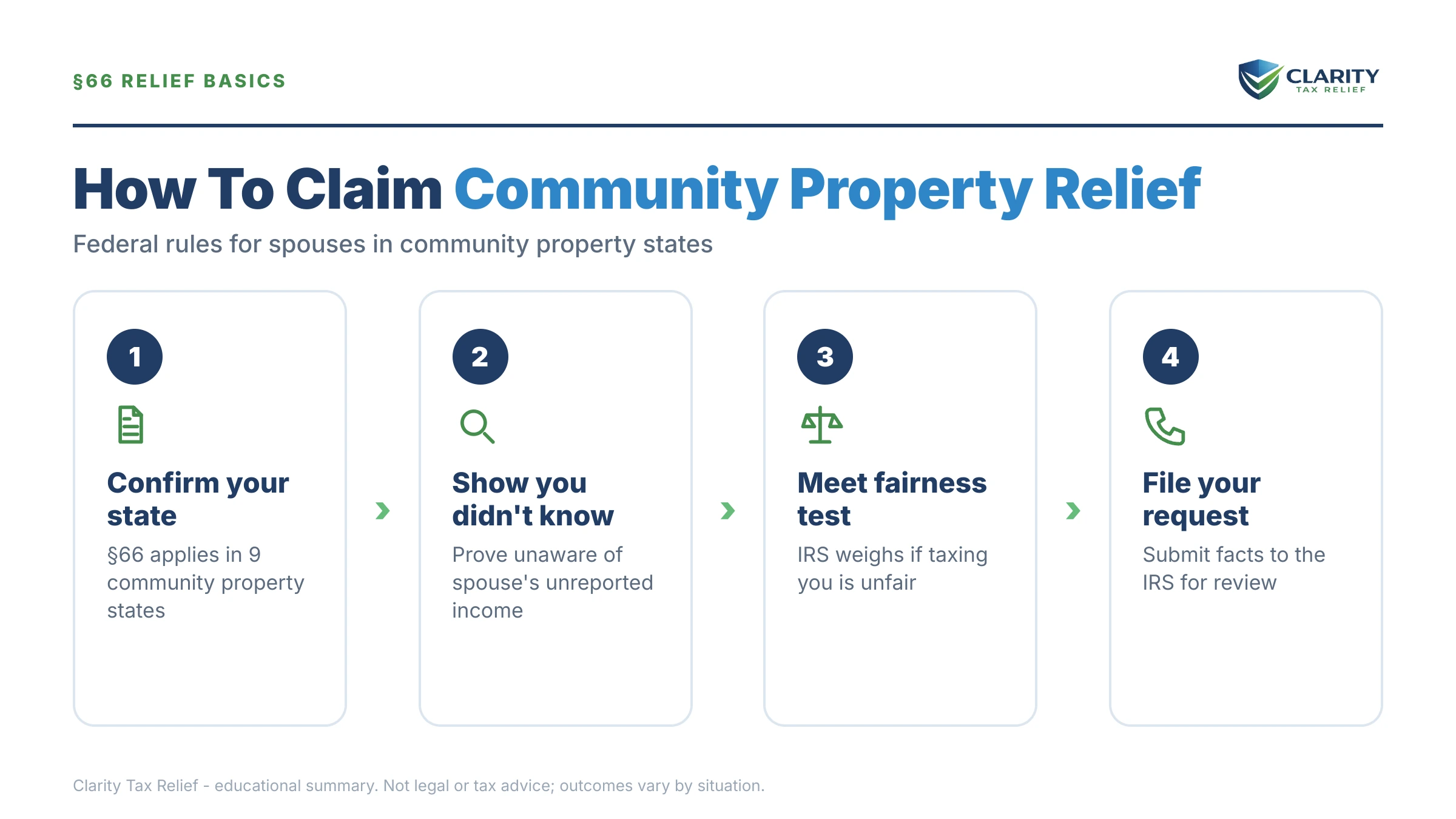
- Confirm the tax comes from community income. Pull the notice and your IRS account transcript, and verify the added income is your spouse's earnings allocated to you under community property rules — not income of your own.
- Gather proof you didn't know and didn't benefit. Collect separate bank statements, proof of where each of you lived, and anything showing the money never reached you or your household.
- File Form 8857 with a written statement. Answer the community property questions, identify each income item and the tax year, and explain when and how you first learned about the income.
- Respond to every IRS follow-up quickly. The IRS will send a questionnaire and must contact your spouse; answer each request by its stated date so your file keeps moving.
- Confirm collection is on hold while it's pending. Ask the IRS to note the pending Form 8857 on your account, and speak up immediately if a levy notice arrives anyway.
- Appeal a denial before the letter's deadline. The preliminary determination letter states your window to protest to Appeals — calendar it the day the letter arrives.
Form 8857 is only three-plus pages, but the answers about knowledge, benefit, and household finances decide the case — the annotated look at the form on this page shows where those questions live, and our Form 8857 walkthrough covers every line. Note two things the form does not do: it costs nothing to file, and filing it generally pauses active collection against you while the IRS decides. Interest, however, keeps accruing on any portion you ultimately still owe.
One warning about the spousal notification: the IRS is required by law to tell your spouse or ex-spouse that you filed, and to let them respond. The IRS will not share your current address or employer. If there was abuse or financial control in the relationship, document it on the form — under Rev. Proc. 2013-34, abuse can outweigh factors that would otherwise sink a request, including some knowledge of the income.
When you can handle this yourself — and when help changes the outcome
Plenty of §66 situations are genuinely DIY. You can reasonably handle this alone if the facts are clean and undisputed: you lived apart all year and simply need the §66(a) allocation applied; the income item is small, clearly your spouse's, and clearly never touched your accounts; or you agree with the balance and just need a payment plan you can set up online. Our guide to settling tax debt yourself covers the plan-setup mechanics so this page doesn't have to.
Experienced help earns its cost when the case has friction: the IRS says you "had reason to know" and you need the lifestyle-and-benefit argument built properly; a levy or Social Security offset is already in motion while the request is pending; multiple years and both federal and state balances are stacked (California cases in particular run on two tracks — IRS and FTB — with different rules); your spouse is contesting the request; or a denial has already landed and the appeal window is running — see innocent spouse relief denied for what that fight looks like. In those cases the difference between a granted and denied request is usually the evidence file, not the law.
Terms on your notice, decoded
- Community income: income earned by either spouse during the marriage in a community property state — the law treats each half as belonging to each spouse, regardless of whose name is on the paycheck.
- Separate property: assets owned before the marriage, or received by gift or inheritance during it — its income usually stays with one spouse and is outside the §66 fight.
- Nonrequesting spouse: the IRS's term for your spouse or ex-spouse once you file Form 8857 — the person the IRS must notify and who may contest your request.
- Understatement vs. underpayment: an understatement is tax that never appeared on the return (traditional relief territory); an underpayment is tax reported but not paid (equitable relief only).
- Allocation: how the IRS splits community income between spouses on separate returns — the 50/50 split that put your spouse's income on your bill in the first place.
- CSED: the Collection Statute Expiration Date — 10 years from assessment, pausable by certain events — which doubles as the outer deadline for equitable relief on a balance due.
The primary sources, if you want them: the IRS's About Form 8857 page, Publication 555, Community Property, payment options at IRS.gov/payments, and — if your case is stuck or a levy is causing hardship — the Taxpayer Advocate Service.
Not sure whether your facts fit traditional relief, equitable relief, or neither? Send us the notice — a free community property case review with an experienced tax professional at the 2-minute form or (888) 825-7779 sorts it in one call.
Community property tax relief: questions people ask
Can I get innocent spouse relief if we didn't file a joint return?
Yes — that is exactly what IRC Section 66(c) exists for. The better-known innocent spouse rules under Section 6015 require a joint return, but Section 66(c) relieves you of tax on your spouse's community income when you filed separately, or didn't file at all, in a community property state. You request it on the same form — Form 8857 — and the IRS evaluates what you knew and whether holding you liable would be unfair.
Which states are community property states in 2026?
Nine states: Arizona, California, Idaho, Louisiana, Nevada, New Mexico, Texas, Washington, and Wisconsin. Wisconsin technically calls its system 'marital property,' but the IRS treats it as community property. Alaska and a few other states let couples opt in by written agreement. If you lived in one of these states while married, income either spouse earned is generally half yours for federal tax purposes — even on separate returns.
What form do I use to request community property tax relief?
Form 8857, Request for Innocent Spouse Relief — the same form used for joint-return cases. There is no filing fee. The form asks where you lived, what you knew about your spouse's income, and about your current finances. Attach a written statement identifying each item of community income you want relief from and explaining why you didn't know about it and never benefited from it.
Is there a deadline to request Section 66 relief?
It depends on which type you need. Equitable relief stays open until the IRS's 10-year collection statute expires on the balance — or, if you're seeking a refund, generally within three years of filing or two years of paying. Traditional Section 66(c) relief has a tighter window tied to the IRS's remaining time to assess your spouse, so file Form 8857 as soon as the first notice arrives.
Will the IRS contact my spouse or ex-spouse if I file Form 8857?
Yes — the law requires the IRS to notify the nonrequesting spouse and allow them to submit information. The IRS will not share your current address, phone number, or employer details with them. If there was abuse or fear of retaliation in the relationship, say so on the form: abuse is a factor that weighs heavily in your favor in equitable-relief decisions.
What if my spouse and I lived apart all year?
Section 66(a) may solve the problem at the return level, with no relief request needed. If you were married but lived apart for the entire calendar year, filed separate returns, and didn't transfer earned community income between you, each spouse reports their own earnings instead of half the combined total. If you already got a bill computed the community property way, that allocation can be challenged with these facts.
Can the IRS take my Social Security to collect tax on my spouse's income?
Yes, once the tax is assessed against you personally. Through the Federal Payment Levy Program the IRS can take up to 15% of your monthly Social Security benefit, and the levy continues until the debt is resolved. That is exactly why fixed-income retirees should request Section 66 relief early — a granted request removes the liability the levy would collect.
What's the difference between injured spouse and innocent spouse relief?
Injured spouse relief (Form 8379) gets back your share of a joint refund the IRS took for your spouse's separate debt — you were never liable, just shortchanged. Innocent spouse and Section 66 relief remove your legal liability for tax caused by your spouse's income. If the IRS is billing you for tax on income your spouse earned, you need Section 66 or Section 6015, not Form 8379.
What happens if my community property relief request is denied?
You can appeal. The IRS sends a preliminary determination first, and the letter states your exact window to protest to the IRS Independent Office of Appeals — don't miss the date printed on it. Appeals reverses or modifies a meaningful share of innocent spouse denials, especially where new documentation answers the examiner's doubts. The court-review path for separate-return cases differs from joint-return cases, so get experienced help before the appeal window closes.
Still untangling which category you're in? The plain-English comparison in injured spouse vs. innocent spouse settles the most common mix-up in two minutes.
Your next 24 hours
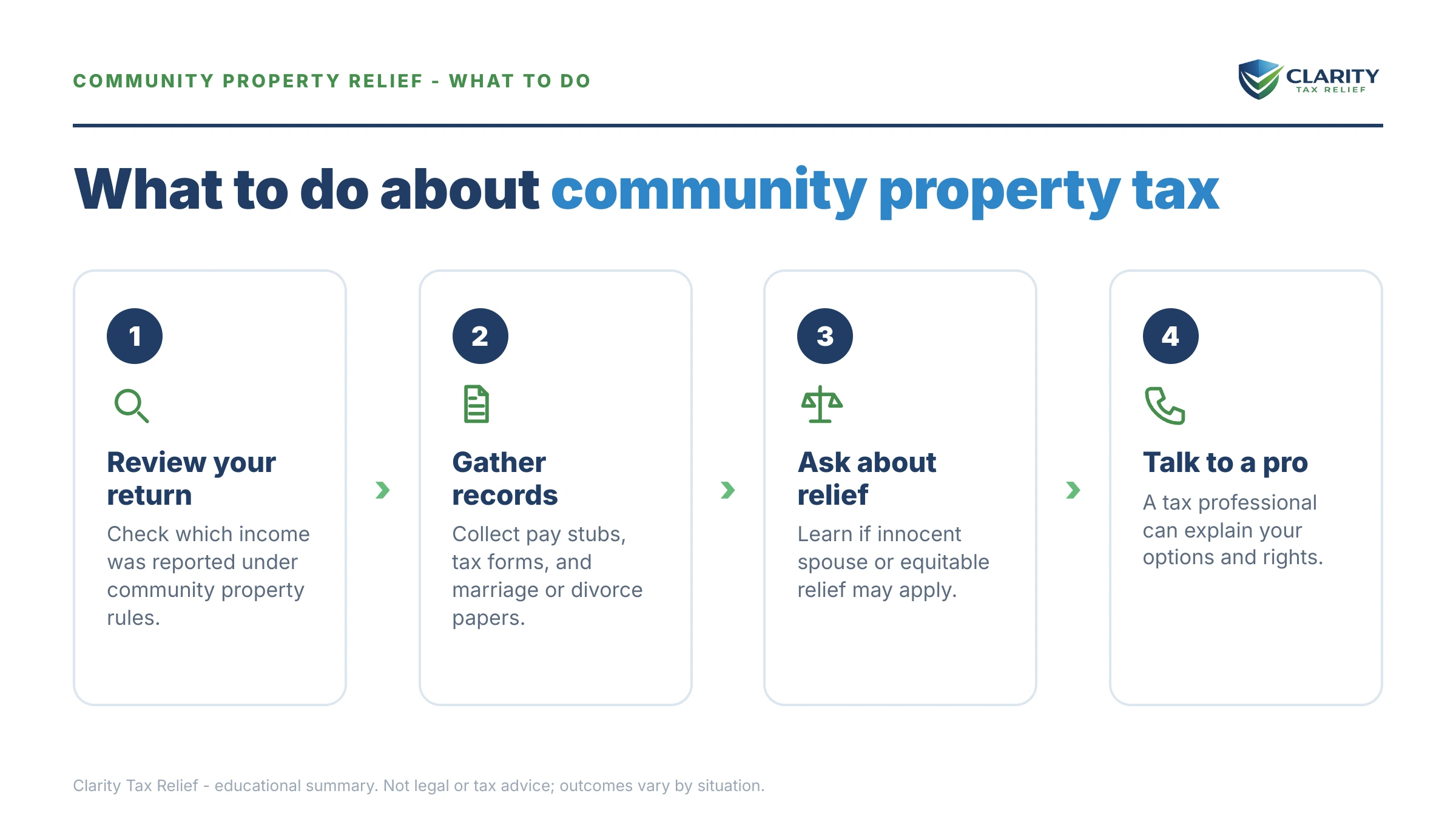
- Find the income items on your notice. Look at the tax year and the listed income sources, and confirm they are your spouse's earnings — not yours — allocated to you under community property rules. That single fact determines whether Section 66 applies.
- Gather three things: the notice, your separate return for that year (or proof you didn't file), and bank statements showing the money never reached your accounts. That's the core of the evidence file.
- Get a free case review. Interest and the monthly late-payment penalty are accruing on a balance that may never have been properly yours — and the traditional relief window is tied to a statute that runs whether you act or not. Use the form at claritytaxrelief.com/#consult or call (888) 825-7779 and an experienced tax professional will map your Section 66 options in one conversation.
This guide is general information, not tax or legal advice for your specific situation. Eligibility for IRS programs depends on individual facts and circumstances; no outcome is guaranteed.