
California FTB
FTB Innocent Spouse Relief: Qualifying for California's Innocent Joint Filer Program (2026)
The short answer: FTB innocent spouse relief — officially called Innocent Joint Filer Relief — can remove your responsibility for a joint California tax debt your spouse or ex-spouse caused. You request it on Form FTB 705 under Revenue and Taxation Code §18533. IRS innocent spouse approval does not transfer automatically; you must ask the FTB separately.
The marriage ended years ago. You're a W-2 employee, you file single now, your own taxes are clean — and the Franchise Tax Board just billed you for a joint-year debt your ex created. That bill is legally collectible from you alone, but California built a specific escape hatch for exactly this situation, and this guide walks you through it.
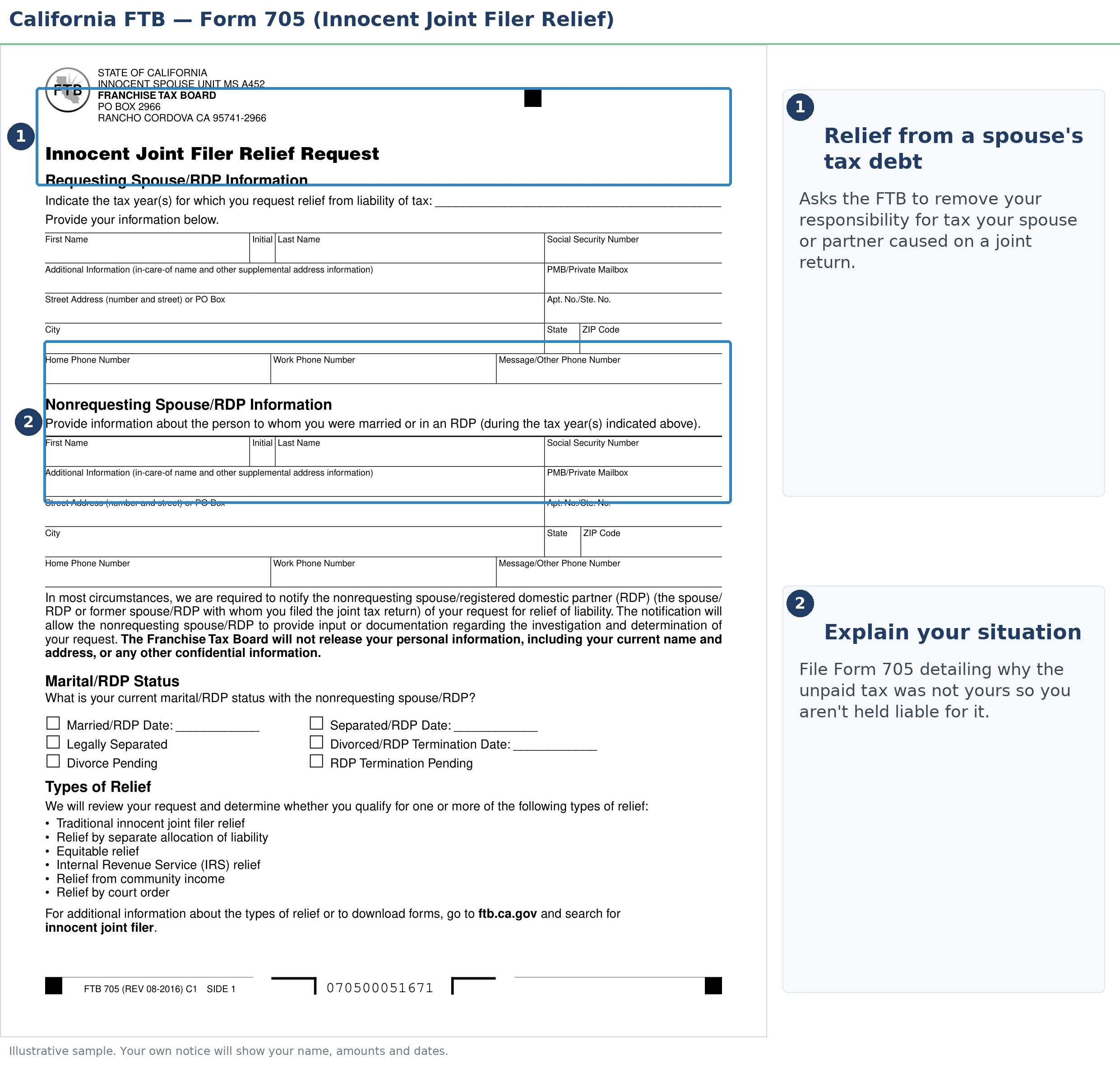
Everything runs through one document — Form FTB 705, the Innocent Joint Filer Relief Request. The image below shows you exactly what that request looks like and where the questions that decide your case sit, so keep reading before you start filling anything out.
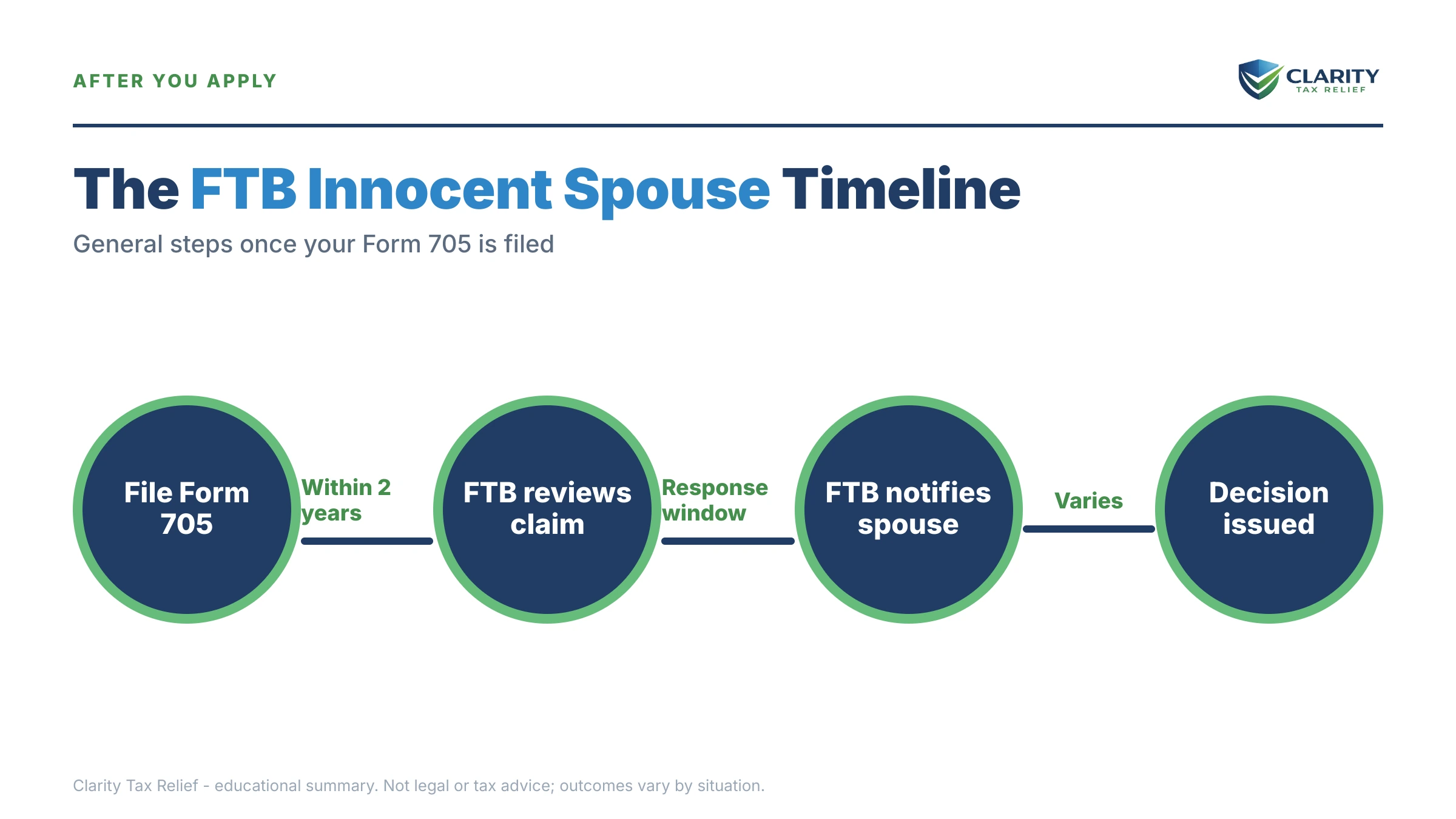
⏱ Your real clock: the FTB can collect a California tax debt for up to 20 years under R&TC §19255 — twice the IRS window. And California's traditional and separation-of-liability relief rules are modeled on federal law, which closes those relief types two years after the first collection action against you. Treat the first FTB collection notice as the start of your clock and file promptly.
Why the FTB says you owe your spouse's tax debt
A joint California return makes both signers liable for 100% of the tax — the FTB can collect the entire balance from either spouse, regardless of who earned the income. That rule is called joint and several liability, and it survives divorce, separation, and even a decree that assigns the debt to your ex.
Most FTB innocent spouse cases start one of four ways: your spouse underreported business or self-employment income on a joint return; a joint return was filed with a balance due that was never paid; an audit disallowed deductions on your spouse's side of the return; or the IRS adjusted your joint federal return and the change flowed downstream to California.
That last one catches people off guard. When the IRS changes a joint federal return, California law requires the change to be reported to the FTB, which then assesses matching state tax — often years after the federal case closed. That's why an FTB bill for a marriage that ended long ago can arrive when the IRS side is already resolved.
California's community property system adds a second layer. Income earned during the marriage generally belongs to both spouses on paper, which complicates who "caused" a debt and lets the FTB reach community assets — sometimes even for a debt in your spouse's name alone. The community property rules have their own federal relief path too; see our guide to community property tax relief and what happens when the IRS takes a spouse's bank account for how both systems treat shared assets.
The four types of FTB innocent spouse relief
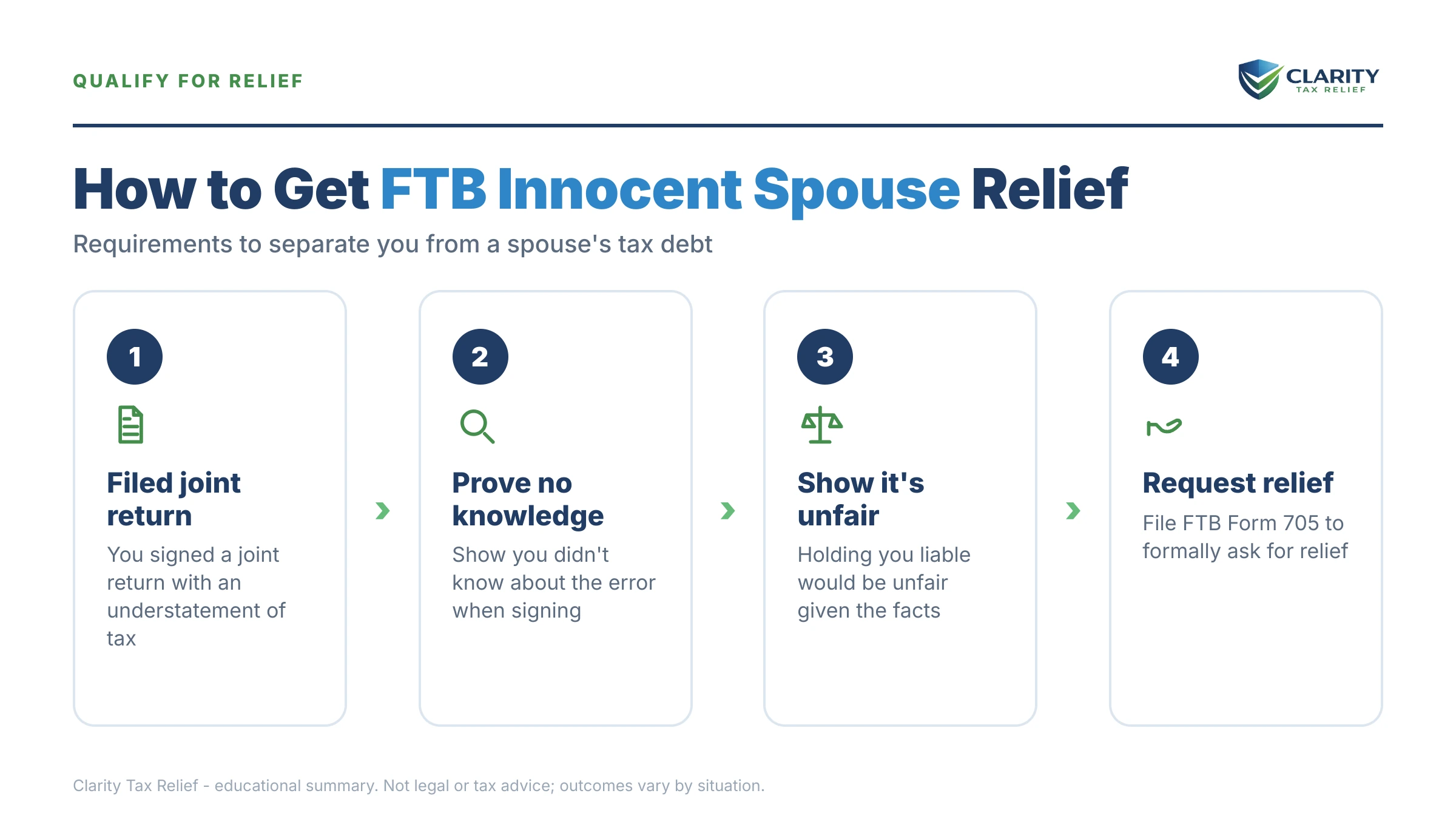
California offers four distinct paths to relief from a joint tax debt — three under R&TC §18533, plus a court-order path under §19006 that has no federal equivalent. The first three are all requested on Form FTB 705, and the FTB decides which apply; check every type your facts could support rather than betting on one.
| Relief type | Best fit | Core requirements |
|---|---|---|
| Traditional relief (§18533(b)) | The debt comes from your spouse's understated income or bogus deductions | You didn't know and had no reason to know of the understatement when you signed, and it would be unfair to hold you liable. Still-married filers can apply. |
| Separation of liability (§18533(c)) | You're divorced, legally separated, widowed, or have lived apart 12+ months | The debt is split by whose items caused it. Actual knowledge of a specific item defeats relief for that item. |
| Equitable relief (§18533(f)) | You miss the first two — including debts from a correct return that simply wasn't paid | Facts-and-circumstances test: economic hardship, abuse or financial control, who benefited, and your current compliance all weigh in. |
| Relief by court order (§19006) | Divorcing spouses whose tax liability is addressed in the court proceeding | California-only path. A state court can revise joint liability, but strict statutory conditions must be met before the order binds the FTB. |
Traditional relief is the classic case: your spouse hid income or invented deductions, you signed the return without knowing, and you didn't meaningfully benefit from the unpaid tax. The FTB probes the "reason to know" element hard — lifestyle upgrades you enjoyed, bank accounts you could see, and your involvement in the household finances all get examined.
Separation of liability is usually the strongest path after a divorce because it doesn't require proving total innocence — it allocates the debt to whoever's items created it. The catch is item-by-item knowledge: if the FTB can show you actually knew about a specific unreported income stream, that item stays on your side of the ledger.
Equitable relief is the safety net, and it's the only type that covers a return that was accurate but never paid — for example, your ex drained the account that was supposed to cover the balance due. The federal version of this test is covered in depth in our guide to equitable relief irs; California weighs similar factors.
Relief by court order exists only in California. A family court handling your divorce can revise joint state tax liability, and the FTB honors qualifying orders — but the statutory conditions are specific and easy to miss, so never assume a decree paragraph did the job. Confirm with an experienced tax professional before relying on it.
One distinction worth settling early: if your problem is that your refund was taken for a debt that is solely your spouse's, that's an injured spouse issue, not an innocent spouse issue. Our comparison of injured spouse vs innocent spouse sorts out which claim you actually have.
FTB vs. IRS innocent spouse relief: what's different in California
The biggest difference is time: the FTB can collect for up to 20 years under R&TC §19255 — twice the IRS's 10-year window. A joint debt you could simply outlast federally can follow you for two decades in California, which makes actually resolving the state side far more important. The full state clock is covered in our guide to ftb statute of limitations collections.
| Feature | IRS | California FTB |
|---|---|---|
| Program name | Innocent Spouse Relief (IRC §6015) | Innocent Joint Filer Relief (R&TC §18533) |
| Request form | Form 8857 | Form FTB 705 |
| Collection window | 10 years from assessment (extendable by tolling) | Up to 20 years (R&TC §19255) |
| If denied | IRS Appeals, then U.S. Tax Court | Independent appeal to California's Office of Tax Appeals |
| Court-order relief in divorce | Not available | Available under R&TC §19006, with strict conditions |
| Does the other agency's approval carry over? | Not applicable | No — separate request required, though the FTB generally follows a matching federal grant |
The qualification standards themselves track closely, because §18533 was written to mirror IRC §6015. If you're building the underlying case — proving what you knew, what you benefited from, and whose items caused the debt — the evidence framework in our guide to innocent spouse relief how to qualify applies to both agencies. Where they diverge is procedure: different form, different reviewers, different appeal body, and a collection arm that many practitioners consider more aggressive than the IRS's.
Does IRS innocent spouse relief apply to your California taxes?
An IRS innocent spouse approval does not automatically erase the matching California debt — you must file a separate request with the FTB. This is the single most common mistake in these cases: the taxpayer wins the federal fight, assumes it's over, and gets an FTB garnishment two years later.
The good news: when the IRS has already granted relief for the same tax years on the same facts, attaching the federal determination letter to your Form FTB 705 usually makes the state request straightforward, because the FTB generally follows the federal outcome when the facts match. If the state debt has California-only components — a state audit adjustment, a residency issue, community property income splitting — the FTB decides those independently.
The reverse order works too. If you owe both agencies and haven't filed anywhere yet, most practitioners run the federal request first (our form 8857 instructions walk through it), then use the federal grant as the anchor for the FTB 705. If there is no federal debt at all — the problem is purely a California return — you go straight to the FTB with a fully self-contained case.
A worked example: allocating a $92,700 joint FTB debt
Say you're a W-2 employee who now files single, and the FTB says you owe $92,700 across three joint years filed during your marriage. This is hypothetical, but the mechanics are exactly how separation of liability works. You pull the notices apart and the balance breaks down like this:
- $71,400 — tax, penalties, and interest on consulting income your ex earned and never reported. The money went to an account in their name that you never saw.
- $14,800 — from deductions on your ex's side business that an audit disallowed.
- $6,500 — tax on your own W-2 wages that was under-withheld.
Under separation of liability, the debt is split by whose items created it. The unreported consulting income and the disallowed deductions are your ex's erroneous items: $71,400 + $14,800 = $86,200 shifts to your ex. You remain responsible for the $6,500 attributable to your own wages — roughly 7% of the original bill — plus interest on that share until it's paid.
Two caveats keep this honest. First, relief is decided item by item: if the FTB can show you had actual knowledge of the consulting income — you deposited the checks, you discussed the clients — that item stays on you no matter how the rest allocates. Second, nothing is automatic: you have to document the allocation on Form FTB 705 and prove the facts, which is why the returns, bank statements, and audit workpapers matter more than the story.
What happens if you ignore the FTB bill
An unresolved joint FTB debt escalates from a demand for payment to wage garnishment and bank levies — and the FTB's automated collection is famously less patient than the IRS's. Waiting to "see if they pursue my ex instead" is not a strategy; the FTB collects from whichever spouse is easier to find, and a W-2 employee with a steady paycheck is the easy target. The sequence runs like this:
- Balance-due notice and Demand for Payment — the debt is formally due, interest is accruing, and the FTB adds its own collection fees to the balance.
- Final Notice Before Levy — the FTB's pre-levy warning. Our guide to the ftb intent to levy notice covers what it unlocks. This is the last cheap moment to act.
- Earnings Withholding Order and bank levies — an ftb wage garnishment takes a share of every paycheck continuously, and an Order to Withhold can empty a bank account. Both routinely hit the "innocent" spouse first because W-2 wages are the easiest asset to find.
- State tax lien — recorded against your property, complicating any sale or refinance while the debt stands.
- The long tail — state refund intercepts every year, and a collection window that runs up to 20 years. A debt from a marriage that ended in your thirties can still be garnishing you in your fifties.
Here's the part that matters for relief specifically: California's traditional and separation-of-liability rules are modeled on federal law, which cuts off those relief types two years after the first collection action against you. Every notice you set aside isn't just growing the balance — it may be burning the strongest relief paths you have.
The FTB is collecting a debt your ex created?
Get your FTB notices and your Form FTB 705 case reviewed free before a garnishment starts. Interest and collection fees are accruing on the full balance either way — an experienced tax professional can tell you in one call which relief type fits your facts.
If relief is denied or doesn't fit: your fallback options
A denied FTB 705 is not the end of the road — the Office of Tax Appeals independently reviews innocent spouse denials, and collection alternatives can protect your paycheck while you regroup. Which fallback fits depends on your finances, not your preference:
| Option | Best for | Key point |
|---|---|---|
| Appeal to the Office of Tax Appeals | Denials built on a thin factual record | The deadline is printed on your denial letter — treat it as strict. New documentation can change the outcome. |
| FTB payment plan | You can afford steady monthly payments | Stops levies while you pay; interest continues on the balance. |
| FTB Offer in Compromise | The debt genuinely exceeds what you could ever pay | The FTB runs its own means test — separate from any IRS offer, and never a marketing promise. |
| FTB hardship status | Paying anything would prevent basic living expenses | Pauses active collection; the 20-year clock and interest keep running. |
The Office of Tax Appeals (ota.ca.gov) is genuinely independent of the FTB, and innocent spouse appeals there often turn on evidence the original request never included — the decree, the bank records, proof the unreported income never touched your household. The appeal playbook, including what a strong supplemental record looks like, is in our guide to what to do when innocent spouse denied.
If relief fails outright, the debt is still resolvable — an ftb payment plan keeps the garnishment machinery off, and in genuine can't-ever-pay situations an ftb offer in compromise may apply if your income and assets truly can't cover the balance. For the full menu of state options, start with our california ftb back taxes hub; for the general DIY framework that applies to any tax debt, see how to settle tax debt yourself.
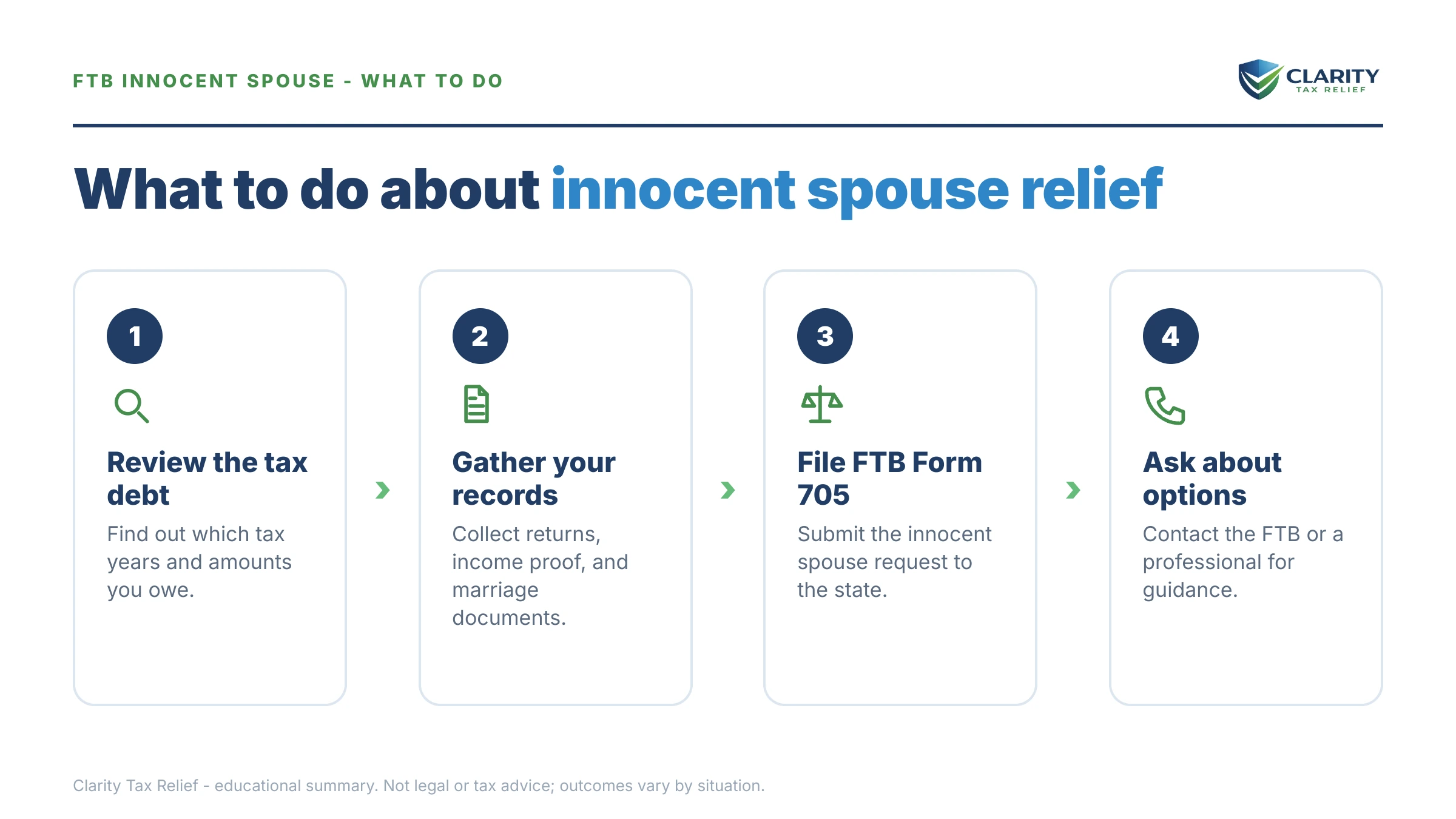
How to request FTB innocent spouse relief, step by step
The request itself is one form plus evidence — the work is in the evidence. The form and its instructions are available from the Franchise Tax Board at ftb.ca.gov.
- Verify which years are joint: log in to MyFTB or call the FTB to confirm the tax years, the balances, and whether each debt actually comes from a joint return.
- Gather your evidence: collect the joint returns, your divorce or separation papers, proof of what you knew and whether you benefited, and any IRS determination letter.
- Choose your relief type: match your facts to traditional, separation of liability, equitable, or court-ordered relief before you write a word of the request.
- File Form FTB 705: complete the Innocent Joint Filer Relief Request, attach your documentation, and keep a full copy of everything you send.
- Ask the FTB to hold collection: request a collection hold while your case is reviewed, and answer every FTB follow-up letter by its stated date.
- Appeal a denial to the Office of Tax Appeals: if the FTB denies relief, file your OTA appeal by the deadline printed on the denial letter — that window is strict.
One drafting rule carries most of the weight: answer the knowledge questions with documents, not adjectives. "I didn't know about the income" is a claim; a bank statement showing the account was in your ex's name only, opened at a branch you never visited, is a case.
When you can file Form FTB 705 yourself — and when to get help
You can handle an FTB innocent spouse request yourself when the facts are simple and the paper trail is clean. Three situations are genuinely DIY-friendly: the IRS already granted you relief for the same years and facts, so your FTB 705 is mostly the federal determination letter with a cover form; the debt is small enough that a payment plan would be cheaper than the fight; or a single erroneous item with obvious documentation — one 1099 in your ex's name — created the whole balance. The federal program's own overview at IRS.gov: Innocent Spouse Relief is a solid grounding before you start.
Experienced help changes outcomes in the harder fact patterns: a separation-of-liability allocation across multiple years and income sources, community property income splitting that muddies whose items are whose, abuse or financial-control facts that have to be presented carefully for equitable relief, an active wage garnishment that needs a hold while the request pends, or an OTA appeal after a denial. In those cases the difference between a granted and denied request is usually the record — how the evidence is assembled and framed — not the underlying facts.
Not sure which side of that line you're on? A free review of your FTB notices with an experienced tax professional will tell you before you commit to anything — request yours here.
Terms on your FTB notice, decoded
- Joint and several liability — each signer of a joint return owes 100% of the balance, not half; the FTB chooses whom to collect from.
- Innocent Joint Filer Relief — the FTB's official name for its innocent spouse program, requested on Form FTB 705.
- Erroneous item — the specific income, deduction, or credit that caused the understatement; relief is decided item by item.
- Community property — California's marital-property system: most income earned during marriage belongs to both spouses, affecting both who owes and what the FTB can reach.
- Office of Tax Appeals (OTA) — the independent California body that hears appeals when the FTB denies relief.
- R&TC §19255 — the statute giving the FTB up to 20 years to collect a tax debt, twice the IRS's window.
FTB innocent spouse questions, answered
What is FTB innocent spouse relief?
FTB innocent spouse relief — officially called Innocent Joint Filer Relief — removes your responsibility for part or all of a joint California income tax debt that your spouse or former spouse caused. It is authorized by Revenue and Taxation Code section 18533 and requested on Form FTB 705. Relief is facts-tested: the FTB looks at who created the debt, what you knew when you signed, and whether holding you liable would be unfair.
Does IRS innocent spouse relief automatically apply to my California taxes?
No — the FTB is a separate agency and requires its own request. If the IRS already granted you relief under IRC section 6015 for the same years and the same facts, send the federal determination letter with your Form FTB 705; the FTB generally follows the federal outcome when the facts match. If the state debt involves California-only issues, the FTB decides independently.
How long do I have to request innocent spouse relief from the FTB?
File as soon as the FTB starts collecting from you. California's traditional and separation-of-liability rules are modeled on the federal statute, which closes those relief types two years after the first collection action against the requesting spouse. Equitable relief has more flexible timing, but the FTB can pursue the debt for up to 20 years — waiting only adds interest and collection fees.
What form do I use for FTB innocent spouse relief?
Form FTB 705, Innocent Joint Filer Relief Request. One form covers the state relief types — traditional, separation of liability, and equitable relief — and asks about your marriage, finances, and what you knew when the return was filed. Attach your divorce decree if you have one, plus any IRS determination letter. If you also owe the IRS for the same years, you must file Form 8857 with the IRS separately.
Will my ex-spouse be notified if I request FTB innocent spouse relief?
Generally yes. Like the IRS, the FTB notifies the other person on the joint return and lets them submit information, because granting you relief shifts the debt to them. If you are a domestic-violence survivor, say so prominently on your Form FTB 705 — abuse and financial control are directly relevant to equitable relief and to how your case is handled.
My divorce decree says my ex pays the taxes — why is the FTB coming after me?
Because a divorce decree binds you and your ex, not the tax agencies. A joint return makes both signers fully liable, and the FTB can collect the entire balance from whichever spouse is easier to reach. California does have a unique court-order relief path under Revenue and Taxation Code section 19006, but it requires specific statutory conditions — an ordinary 'he pays the taxes' clause is not enough. The decree still helps as evidence in an innocent spouse request.
Can the FTB garnish my wages for my spouse's tax debt?
Yes, if you signed a joint return — joint and several liability means your wages, bank accounts, and state refunds are all reachable for the full balance. Because California is a community property state, the FTB may also reach community assets for some debts in your spouse's name alone. An earnings withholding order takes a share of every paycheck until the debt is resolved, which is exactly what a granted relief request prevents.
What happens if the FTB denies my innocent spouse request?
You can appeal the denial to California's Office of Tax Appeals, an independent body that reviews FTB decisions. Your denial letter states the exact appeal deadline — treat it as strict, because a missed window usually ends the case. Denials are often built on thin factual records, so an appeal that adds documentation — bank statements, the decree, proof you did not benefit from the unreported income — can change the outcome.
Can I get FTB innocent spouse relief if I'm still married?
Yes, for two of the three main types. Traditional relief and equitable relief do not require a divorce. Separation of liability, which splits the debt by who caused it, is limited to people who are divorced, legally separated, widowed, or who have lived apart from their spouse for at least 12 months. If you are still living together, equitable relief is usually the path your facts have to fit.
Your next 24 hours
- Find the joint years on your notices. Check the top of each FTB notice for the tax year and both names — list every year and amount that traces to a joint return, because your relief request covers them year by year.
- Gather three things: the joint returns for those years, your divorce or separation papers, and any IRS innocent spouse determination letter. Those three documents decide most FTB 705 cases.
- Get a free case review. Interest and FTB collection fees are accruing on the full balance while you're the easiest spouse to collect from — call (888) 825-7779 or use the 2-minute form and an experienced tax professional will map which relief type fits your facts.
This guide is general information, not tax or legal advice for your specific situation. Eligibility for IRS programs depends on individual facts and circumstances; no outcome is guaranteed.