
California FTB
FTB Offer in Compromise: How California's Tax Settlement Program Really Works (2026)
The short answer: an FTB offer in compromise lets you settle California Franchise Tax Board debt for less than you owe — but only if your assets and income genuinely can't cover the balance before the state's 20-year collection window closes. There's no application fee; individuals apply with the Form FTB 4905 PIT booklet.
You've heard the ads about settling IRS debt, and now you're wondering whether the same door exists for the balance the Franchise Tax Board keeps billing. It does — the program is real — but the FTB's version is quieter, stricter, and built on math most applicants never run before applying. Run that math first, and you'll know within an hour whether an offer is worth your time or whether a different tool fits better.
Farther down this page, the image shows you exactly what the FTB's offer application looks like and where the ability-to-pay questions sit — the section that decides most applications before an evaluator reads anything else.
⏱ The clock that matters: there is no filing deadline for an FTB offer in compromise — the clock working against you is California's 20-year collection statute (R&TC §19255) plus interest that accrues until the balance is resolved. Unlike IRS debt, FTB debt almost never expires soon enough to wait out.
What an FTB offer in compromise is — and who it's actually for
An FTB offer in compromise is the Franchise Tax Board's program for settling a final California tax liability for less than the full balance when you have no realistic way to ever pay it. The general mechanics of settlement offers — collection value, disclosure, acceptance terms — are covered in our guide to how an offer in compromise actually works; this page covers what's different when the creditor is Sacramento instead of the IRS.
The first difference is independence. The FTB program is entirely separate from the IRS program — an accepted federal offer does not settle your California balance, and vice versa. If you owe both, you file both, and each agency runs its own numbers. (Which agency to tackle first is its own strategic question — see FTB vs IRS which first.)
The second difference is who fits. The FTB accepts offers when it concludes your offer is the most it could ever collect. In practice, that profile is narrow: fixed or limited income, little to no asset equity, and no realistic prospect that your finances improve. A healthy W-2 earner with decades of paychecks ahead is a hard sell — and later on this page we'll show, with real arithmetic, why.
How the FTB decides your ability to pay — the 20-year problem
The FTB measures your offer against everything it could collect from you over California's 20-year collection statute — twice the horizon the IRS gets. That single fact explains why California settlement math is harsher than federal math for the same person with the same debt.
The evaluation looks at four things: the equity in your assets, your current income and expenses, your future earning potential, and whether your circumstances are likely to change. Roughly, your collection value is your net asset equity plus your monthly disposable income projected across the years the state has left to collect. The IRS caps that projection at its 10-year statute; the FTB's window runs up to 20 years under R&TC §19255 — the full mechanics are in our guide to California's 20-year collection statute.
Two more features tighten the screws. First, the FTB generally expects a lump-sum payment: it wants to see that the offered amount is actually available, not promised from future paychecks. Second, when your future income is uncertain — you're young, employable, or your hardship looks temporary — the FTB can condition acceptance on a collateral agreement, requiring extra payments if your income rises in the years after acceptance.
If you also owe the IRS, the federal side of this math is called Reasonable Collection Potential, and you can estimate your own federal offer with our Offer in Compromise Calculator. Just remember the FTB version of the same calculation stretches the income projection much further.
FTB offer in compromise vs. IRS offer in compromise
The FTB charges no application fee and requires no deposit — but it gives you no appeal, no automatic-acceptance deadline, and no periodic-payment track. Here's the side-by-side most readers came for:
| Feature | FTB offer in compromise | IRS offer in compromise |
|---|---|---|
| Application | Form FTB 4905 PIT booklet (individuals) | Form 656 plus Form 433-A (OIC) |
| Application fee | $0 | $205 (waived with low-income certification) |
| Deposit with application | None | 20% of a lump-sum offer (waived for low-income) |
| Payment structure | Lump sum generally expected on acceptance | Lump sum, or periodic payments up to 24 months |
| Collection window behind the math | Up to 20 years (R&TC §19255) | 10 years (CSED) |
| Decision deadline | None — no automatic acceptance | Deemed accepted if no decision within 2 years, with narrow exceptions — a returned or rejected offer stops the clock, and time during court disputes does not count |
| If rejected | No formal appeal — revise and reapply | Appeal within 30 days via Form 13711 |
| Extra conditions | Collateral agreement possible if income may rise | 5-year compliance period after acceptance |
Notice what's missing on the FTB side. Per IRS data, the IRS accepted roughly 1 in 5 offers in FY2024, and even rejected federal applicants get a formal appeal. At the FTB, a rejection is generally final for that application — which is exactly why the ability-to-pay math belongs before the paperwork, not after.
One helpful overlap: if the IRS already accepted your offer, tell the FTB. It doesn't bind California, but the same documented hardship that persuaded a federal evaluator carries real weight with a state one.
A worked example: say you owe the FTB $6,200
Here's a hypothetical to make the math concrete. Say you're a single W-2 employee who owes the FTB $6,200 from a prior-year balance. Your take-home pay is $4,100 a month; rent, food, transportation, and other essentials run $3,900. That leaves $200 a month of disposable income. You have $1,500 in savings and a car with almost no equity after the loan.
Run the FTB's math: $200 a month full-pays $6,200 in about 31 months ($6,200 ÷ $200 = 31). Against a collection window that can run 20 years, the state sees a debt it can collect in full several times over — so an offer in compromise is a long shot, and the honest play is an FTB payment plan at roughly $200 a month, plus a look at FTB penalty abatement to shrink the balance interest is compounding on.
Now flip one variable. Same $6,200 balance, but the debtor is on fixed disability income of $1,450 a month, expenses consume all of it, and there are no assets beyond a modest checking account. Disposable income: $0. Asset equity: near zero. Prospect of change: none the state can document. In that picture, a lump-sum offer of a few hundred dollars — borrowed from family, say — can genuinely represent the most the FTB could ever collect, and the offer becomes credible.
That's the whole program in two paragraphs: the FTB isn't rewarding hardship stories, it's buying out a collection file it doesn't believe it can monetize. Your job is to prove, with documents, which of those two pictures you're in.
What happens if you do nothing about FTB debt
The FTB can garnish wages and levy bank accounts without going to court, and California gives it 20 years to keep trying. The sequence below is largely automated, and it doesn't pause because you're deciding whether to apply for an offer:
- Billing and demand notices — the balance grows as penalties and interest post, and the account moves toward involuntary collection.
- Collection fees added — the FTB tacks its own cost-recovery fees onto the debt once enforcement begins.
- State tax lien — an FTB tax lien is recorded, attaching to your real estate and surfacing in title and credit checks by lenders.
- Wage garnishment and bank levy — the FTB issues an earnings withholding order to your employer (see FTB wage garnishment) or takes funds directly from your bank account, no court order required.
- Everything else the state can reach — tax refund intercepts, and for the largest debts, professional or driver's license suspension and publication on the state's top-delinquents list.
Because the FTB pulls employer and bank data from other state systems, it usually knows where you work and bank before you tell it. Waiting doesn't hide you; it just decides which of these stages you respond from — and every stage after the first is a worse negotiating position.
Owe the FTB and wondering if an offer is realistic?
Don't spend months on an application the numbers can't support. An experienced tax professional will run your ability-to-pay math free, tell you honestly whether an FTB offer in compromise, a payment plan, or hardship status fits — and interest accrues daily until you pick one.
Your options beyond an offer: costs and timelines compared
Most Californians who research the FTB offer in compromise end up using a different tool — and that's usually the right outcome, not a failure. Here's the full menu:
| Option | Upfront cost | Typical timeline | Best for |
|---|---|---|---|
| FTB offer in compromise | $0 application fee; offer funds due on acceptance | Several months of review, varies by case | No assets, no disposable income, no prospect of change |
| FTB payment plan | Small setup fee may apply; interest continues | Often set up within days | Steady income that can retire the balance over time |
| FTB hardship status | $0 — requires financial disclosure on FTB Form 3561 | Weeks, typically | Real hardship now that may improve later |
| FTB penalty abatement | $0 to request | Weeks to months | Shrinking the balance before choosing another option |
| Bankruptcy | Court filing fees plus counsel | Months | Debt problems that go well beyond taxes |
Two of these pairings deserve special attention. If your hardship is real but possibly temporary, compare hardship status against settlement in CNC vs offer in compromise — hardship pauses collection but the 20-year clock and interest keep running, while an accepted offer ends the debt. And if the tax debt sits inside a larger financial collapse, the decision framework in bankruptcy or offer in compromise applies to state debt too, with California-specific wrinkles worth professional eyes.
FTB offer in compromise eligibility: the checklist the state applies
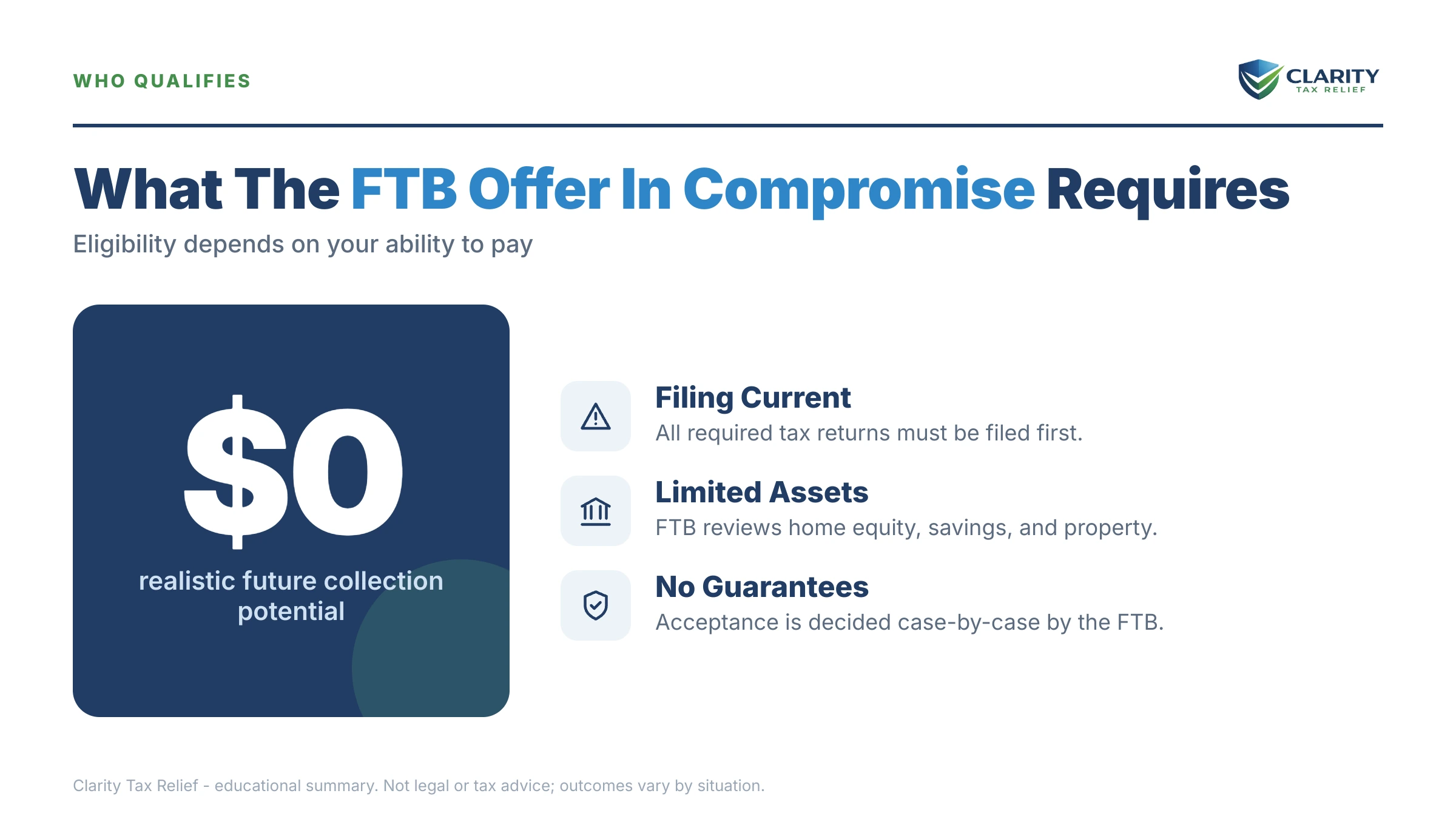
Before an evaluator ever weighs your numbers, your application has to clear a gate of threshold requirements — and most rejections happen right here, not on the math:
| Requirement | What the FTB is checking | What sinks the application |
|---|---|---|
| All required California returns filed | You're in filing compliance for every year | Even one unfiled year |
| The liability is final | No open protest, appeal, or litigation on the balance | Trying to settle an amount you're still disputing |
| You agree with the amount owed | The offer compromises collectibility, not correctness | Arguing the assessment is wrong inside the offer |
| Complete financial disclosure | Every account, asset, income source, and household detail | Omissions, undisclosed transfers, or stale documents |
| No realistic full-pay ability | Assets plus income over the remaining collection window | Disposable income that full-pays within the statute |
| Offer funds available | You can actually pay promptly if accepted | An offer you'd need years of paychecks to fund |
A few situations change how this checklist plays out:
Married in California. California is a community-property state, so expect the FTB to ask about household income even when only one spouse owes. A non-liable spouse's earnings can enter the ability-to-pay picture, which surprises many couples — get advice on how the liability and the household finances are presented before you disclose.
Self-employed or business debt. Business income makes the future-earnings projection murkier and the disclosure heavier. Operating businesses face additional scrutiny — our guide to the business offer in compromise covers how agencies weigh a going concern's earning power.
You owe more than one California agency. If the CDTFA (sales tax) or EDD (payroll tax) is also billing you, the DE 999CA multi-agency form lets you propose offers to all three agencies in one package. Each still decides independently.
You dispute the amount. Stop — an offer in compromise is the wrong tool. The FTB requires the liability to be final, so a disputed assessment goes through protest and appeal channels first. Settle only what you agree you owe.
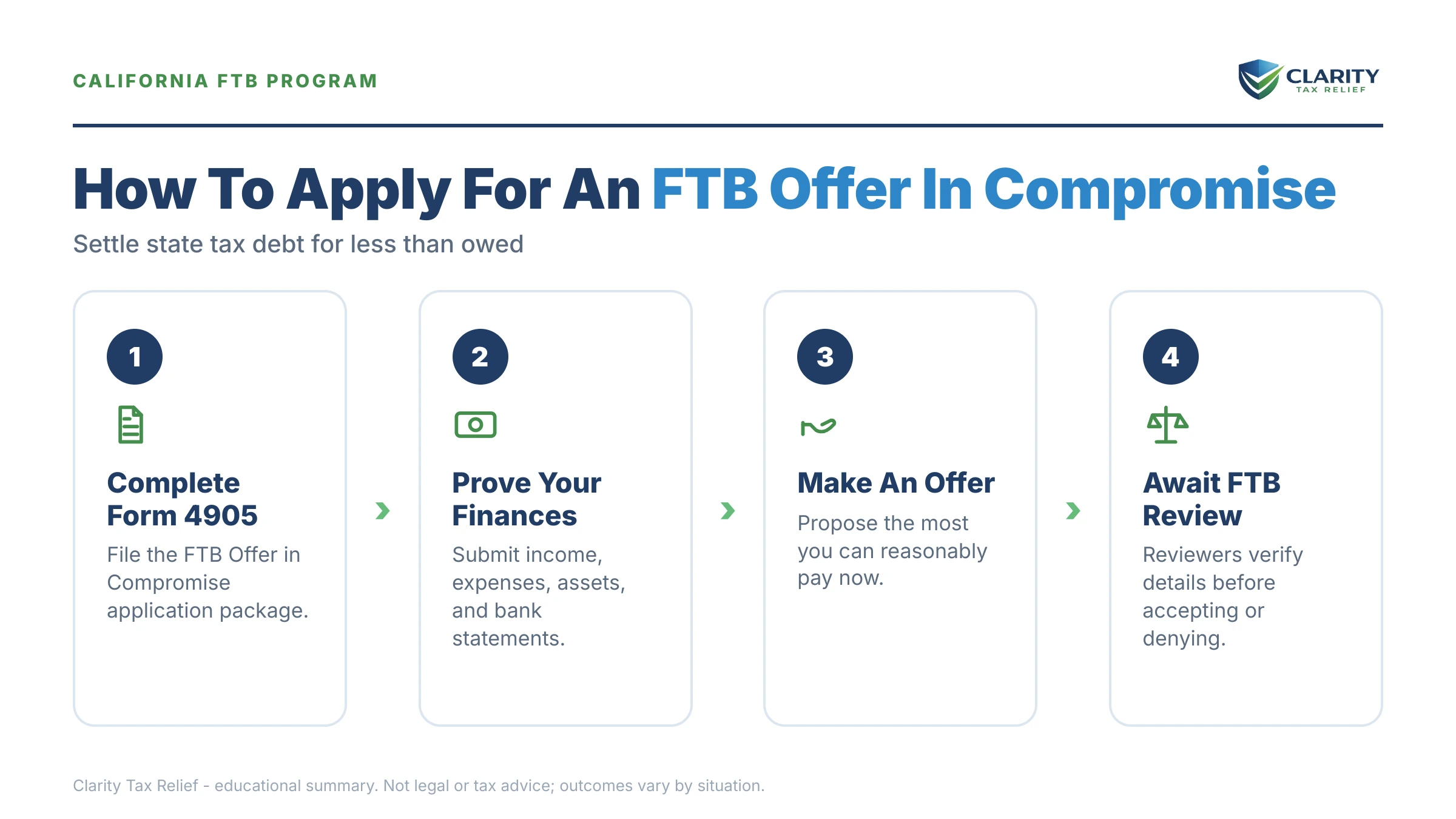
How to apply for an FTB offer in compromise, step by step
The application image on this page shows what the booklet looks like — note how much of it is financial disclosure. That's where offers are won or lost, and it's what these steps are built around:
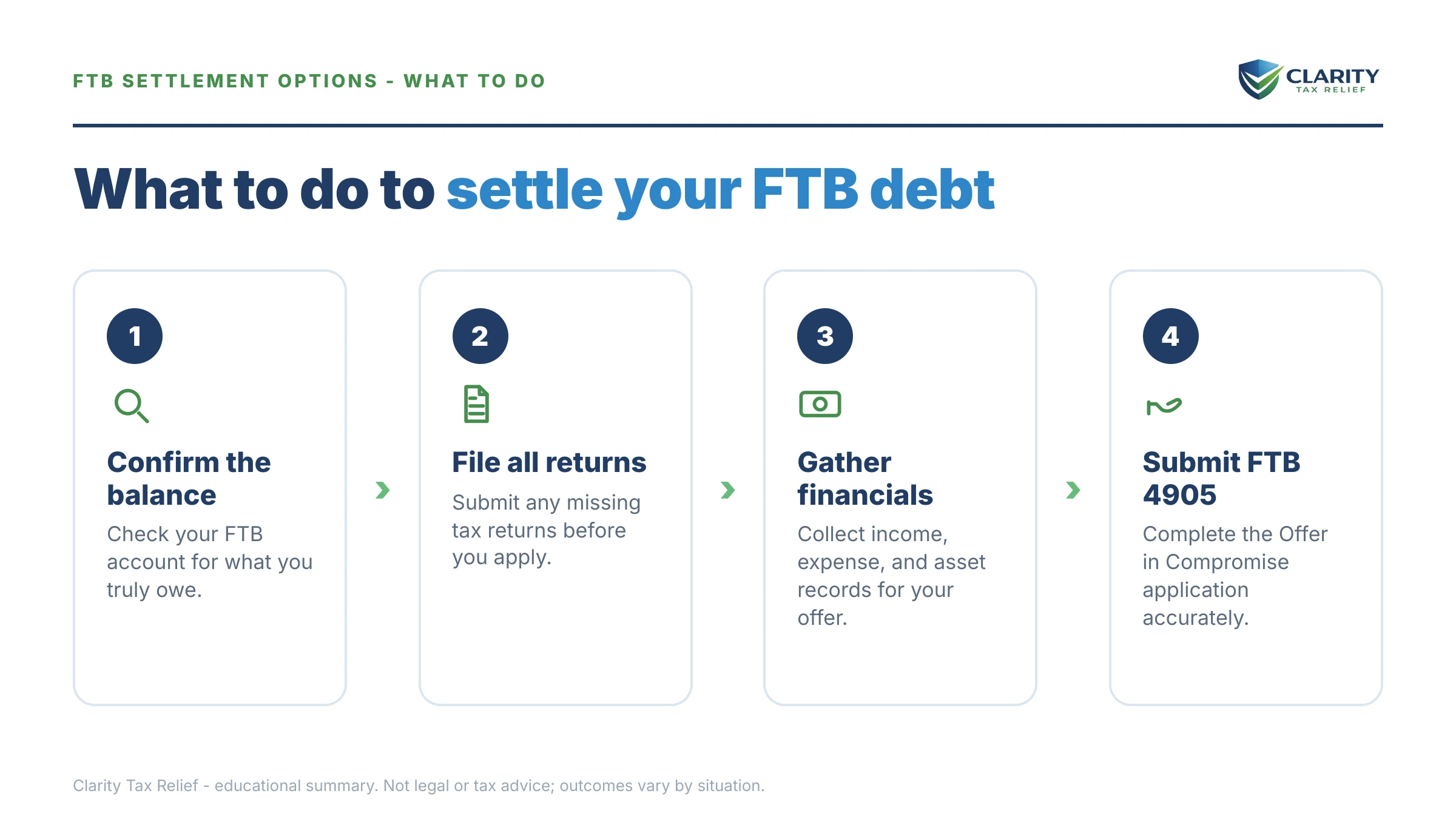
- Confirm your balance is final. Pull your latest FTB notice or MyFTB account and verify the amount, the tax years, and that nothing is still under protest or appeal. An offer in compromise is for debts you agree you owe — disputes go through a different door.
- Run the ability-to-pay math honestly. Add your net asset equity to your monthly disposable income multiplied over the remaining collection window. If that total clearly exceeds your balance, stop and set up a payment plan instead — the FTB will run the same math.
- Choose the right application. Individuals use the Form FTB 4905 PIT booklet; if you also owe the CDTFA or EDD, the DE 999CA multi-agency form covers all three agencies in one package.
- Assemble complete documentation. Attach bank statements, pay stubs, benefit letters, bills, and records for every asset and account. Omissions are the fastest route to rejection — the FTB cross-checks what you report against the data it already holds.
- Set a defensible offer amount and identify your funding source. Offer what the math shows the FTB could realistically collect, and be ready to show where the money comes from — savings, a borrowed lump sum, or help from family.
- Submit, stay compliant, and respond fast. File and pay every current-year obligation on time while the offer is pending, and answer FTB information requests promptly. New balances or slow responses can sink an otherwise solid offer.
On timing: the FTB publishes no guaranteed review schedule, and evaluations commonly run months. For a feel of what settlement timelines look like start to finish, see how long an offer in compromise takes — then assume the state side offers you less visibility along the way, and no two-year automatic acceptance if the file stalls.
If the FTB rejects your offer
An FTB rejection carries no formal appeal comparable to the IRS's offer appeal, so the response is tactical, not procedural. Ask the evaluator what number or documentation would have changed the outcome — sometimes the gap is one asset valuation or one expense the state disallowed. You can reapply when your circumstances genuinely change: a job loss, a medical event, retirement onto fixed income.
In the meantime, protect your paycheck. A rejected offer leaves the debt fully collectible, so most people pivot immediately to a payment plan or hardship status rather than leaving the account exposed to garnishment. The broader landscape of California state collections — every notice, every program — lives in our California FTB back taxes hub.
When you can handle this yourself — and when help changes the outcome
You don't need professional help to resolve every FTB balance. If you owe a few thousand dollars with steady W-2 income — like the $6,200 example above — the right move is usually a payment plan you can set up yourself through the FTB, plus a penalty-relief request. If your own math shows disposable income that full-pays the debt within a few years, skip the offer entirely; no professional can change arithmetic the state will run identically.
Experienced help earns its cost in the harder fact patterns: a garnishment or bank levy already in motion, community-property income questions, self-employment or business debt, balances owed to multiple California agencies, unfiled years blocking eligibility, or a genuine offer candidacy where the presentation of assets, expenses, and future income decides tens of thousands of dollars. And be wary of anyone promising to settle your FTB debt for "pennies on the dollar" — that pitch is a sales script, not an analysis, and the FTB's means test doesn't care about scripts.
Not sure which side of that line you're on? An experienced tax professional can run your FTB numbers free in one call — request a review or dial (888) 825-7779 before the next notice adds another fee to the balance.
Terms on the FTB paperwork, decoded
- Ability to pay — the FTB's estimate of everything it could collect from your assets and income over the time it has left to collect.
- Final liability — a balance no longer subject to protest, appeal, or litigation; only final liabilities can be compromised.
- Collateral agreement — a condition attached to an acceptance requiring extra payments if your income rises in later years.
- R&TC §19255 — the California statute giving the FTB up to 20 years to collect a tax debt, double the IRS's window.
- Earnings withholding order (EWOT) — the FTB's wage garnishment order, sent straight to your employer without a court judgment.
- DE 999CA — the multi-agency application that proposes an offer to the FTB, CDTFA, and EDD in one package.
FTB offer in compromise questions, answered
Does the California FTB have an offer in compromise program?
Yes — the Franchise Tax Board runs its own offer in compromise program, entirely separate from the IRS version. It settles a final California tax liability for less than the full balance when the FTB concludes your offer is the most it could ever collect from you. Acceptance by one agency has no effect on the other, so owing both means filing two applications.
How much does it cost to apply for an FTB offer in compromise?
There is no application fee for an FTB offer in compromise, and no deposit is due with the application. Compare that to the IRS, which charges $205 and generally requires 20% down on a lump-sum offer unless you qualify for low-income certification. The FTB does expect you to have the offered amount available to pay promptly if it accepts.
Will the FTB stop collecting while my offer is under review?
Not automatically. Submitting an offer does not guarantee a collection hold, and a wage garnishment or bank levy already in motion may continue while the FTB evaluates your application. Ask the FTB directly about pausing collection when you submit, and get any agreement documented — never assume the paycheck deductions stop on their own.
Can the FTB accept my offer if the IRS already accepted one?
An accepted IRS offer in compromise helps your case but does not bind the FTB. The FTB runs its own ability-to-pay analysis under California rules, including the 20-year collection statute, and issues its own decision. In practice, the hardship facts that persuaded the IRS often persuade the FTB too — but you must apply separately and document everything again.
What is the DE 999CA multi-agency offer in compromise form?
DE 999CA is California's multi-agency application that proposes an offer in compromise to the FTB, the CDTFA (sales and use tax), and the EDD (payroll tax) in a single package. It exists for people who owe more than one California agency at once. Each agency still evaluates and decides independently, so one acceptance does not guarantee the others.
What happens if the FTB rejects my offer in compromise?
A rejection generally ends that application — the FTB has no formal appeal route comparable to the IRS offer appeal on Form 13711. You can ask the evaluator what amount or documentation would change the result, and you can reapply when your circumstances genuinely change. Most rejected applicants pivot to an FTB payment plan or hardship status to keep collection off their wages.
Does an accepted FTB offer in compromise release the state tax lien?
Generally yes, once you pay the accepted offer amount in full and satisfy every term of the agreement, including any collateral agreement. The release follows full payment — it is not triggered by acceptance alone. Until the lien is released, it continues to attach to real estate and shows up in title searches, so factor that timing into any plans to sell or refinance.
Can I just wait out FTB tax debt instead of settling?
Almost never. California law gives the FTB 20 years to collect under R&TC Section 19255 — double the IRS's 10-year window — and during that time it can garnish wages, levy bank accounts, and intercept refunds repeatedly. Unless you are near the end of that window with no collectible income or assets, waiting typically costs far more than resolving the debt.
What is a collateral agreement in an FTB offer in compromise?
A collateral agreement is a condition the FTB can attach to an acceptance that requires additional payments if your income rises during the years after your offer. It protects the state when your hardship might be temporary — common for younger applicants or anyone with earning potential. Declining a requested collateral agreement usually means the offer will not be accepted.
Your next 24 hours
- Find your exact balance and tax years. Pull your most recent FTB notice or log into your MyFTB account — you need the real number, including penalties, fees, and interest, before any option can be evaluated.
- Gather your financial snapshot. Last year's tax return, two months of pay stubs or benefit letters, two months of bank statements, and a list of your monthly bills — that's everything the ability-to-pay math requires.
- Get the math run free. Call (888) 825-7779 or use the 2-minute form, and an experienced tax professional will tell you whether an FTB offer in compromise, a payment plan, or hardship status fits your numbers — interest and collection fees keep accruing until one of them is in place.
Primary sources: the Franchise Tax Board publishes its offer in compromise materials and forms at ftb.ca.gov; the federal program is documented at IRS.gov's Offer in Compromise page; and the EDD, one of the DE 999CA agencies, is at edd.ca.gov.
This guide is general information, not tax or legal advice for your specific situation. Eligibility for IRS programs depends on individual facts and circumstances; no outcome is guaranteed.