
California FTB
FTB Penalty Abatement in 2026: One-Time Abatement, Reasonable Cause, and How to Request It
The short answer: FTB penalty abatement removes California late-filing and late-payment penalties in one of two ways: a once-per-lifetime one-time abatement for individuals (tax years 2022 and later — Form FTB 2918 or a phone call), or reasonable-cause relief (Form FTB 2917 for individuals, FTB 2924 for businesses). Interest itself is almost never waived.
The FTB notice arrived and the penalty lines add up to nearly a third of the tax itself — money stacked on top of a California balance you were already straining to cover. That math feels punitive because it is; California's penalties are designed to sting. But the state also wrote two formal exits into its own code, and most people reading this can at least make a credible request under one of them.
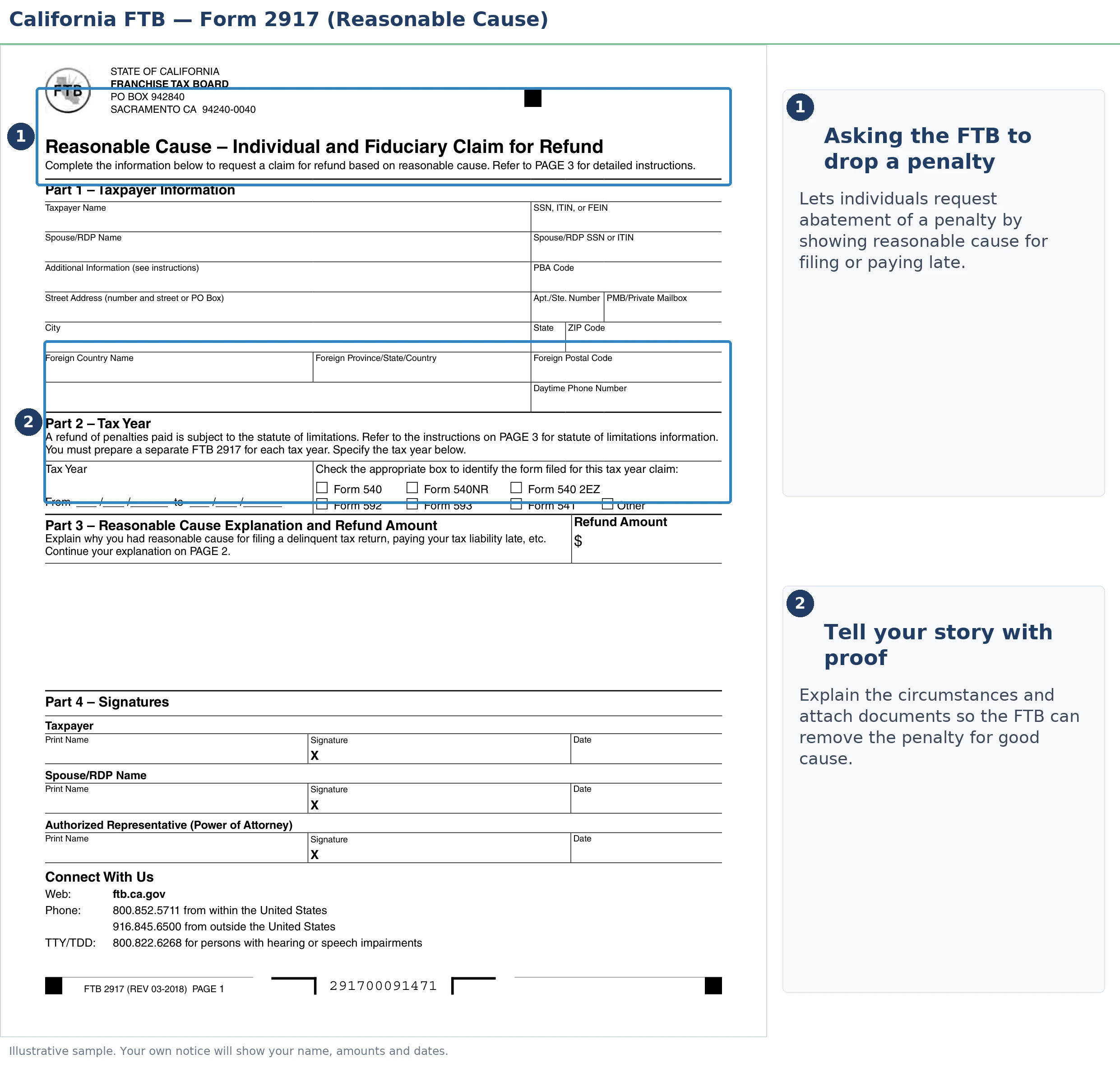
Before you write a single word to Sacramento, you need to know which penalty is which — they have different relief paths, and asking for the wrong one wastes your strongest card. The image below shows exactly what the penalty section of an FTB balance-due notice looks like and where each charge is listed.
⏱ Your clock: there is no fixed deadline to request abatement of an unpaid FTB penalty — but interest accrues on the whole balance every day it sits. If you already paid the penalty, a refund clock is running: you generally have the later of four years from filing (or the return's original due date) or one year from the date of payment to claim that money back.
Why the FTB charged you these penalties
California's late-filing penalty runs 5% of the unpaid tax per month, capped at 25% — and because California grants every filer an automatic extension to mid-October with no form required, that penalty means the return missed even the extended deadline. The late-payment penalty is separate: 5% of the unpaid tax up front, plus 0.5% per month, also capped at 25%.
Those two — the "timeliness penalties" — are what most FTB notices carry, and they are the only two that every abatement path in this guide can reach. Other charges on your notice follow different rules entirely:
- Demand penalty: a flat 25% of the assessed tax, added when you ignore an FTB demand to file. One-time abatement never touches it; reasonable cause can.
- Estimated-tax penalty: computed like interest on each underpaid quarterly installment. Reasonable cause does not apply — only narrow statutory exceptions do, covered in our FTB estimated tax penalty guide.
- Accuracy-related penalty: 20% of an understatement, with its own defenses — substantial authority, adequate disclosure — not abatement.
- Interest: not a penalty at all. It is statutory, it accrues on tax and penalties, and no amount of good cause removes it.
The penalties sit on top of the underlying balance, and fixing one without a plan for the other rarely ends well — our guide to California FTB back taxes maps the full picture.
| Penalty | How it's computed | One-time abatement? | Reasonable cause? |
|---|---|---|---|
| Late filing (§19131) | 5% of unpaid tax per month, max 25% | Yes | Yes |
| Late payment (§19132) | 5% of unpaid tax, plus 0.5%/month, max 25% | Yes | Yes |
| Demand penalty (§19133) | Flat 25% of the assessed tax | No | Yes — for failing to respond |
| Estimated tax (§19136) | Interest-style charge per underpaid installment | No | No — narrow statutory exceptions only |
| Accuracy-related | 20% of the understatement | No | No — has its own defenses |
| Interest | Accrues on tax and penalties until paid | No | No — FTB error/delay or disaster relief only |
What happens if you ignore FTB penalties
FTB penalties stop growing when they hit their 25% caps — but interest on the entire balance, penalties included, never stops, and California's collection system escalates in stages without a human ever reviewing your file:
- Penalties cap, interest compounds on. Late-filing tops out at 25% and late-payment at 25%, but interest keeps accruing on tax and penalties until the account hits zero. Waiting has a daily price.
- Collection fees get bolted on. Once the FTB moves your account to active collection, it adds FTB collection fees — several hundred dollars that no abatement program removes.
- A pre-levy warning arrives. The FTB intent to levy notice is the last stop before enforcement — and the FTB moves to this stage faster than the IRS does.
- A state tax lien is recorded. It attaches to your property, appears in public records, and complicates any refinance or sale.
- Wages and accounts get taken. The FTB issues earnings withholding orders and bank orders to withhold — see how much an FTB wage garnishment actually takes from each check.
- The clock runs for decades. Under R&TC §19255, California's 20-year collection statute gives the FTB double the IRS's collection window. Outlasting this debt is not a strategy.
One more trap: filing an abatement request does not pause collection on the underlying tax. Keep your payment or payment plan running while the request is pending, or you can lose the very compliance that makes you eligible.
Staring at an FTB notice full of penalties?
Send us a photo of it. An experienced tax professional will identify which penalties are removable, which path preserves your once-per-lifetime abatement, and what the interest is costing you each month — free and confidential.
Your FTB penalty abatement options in 2026
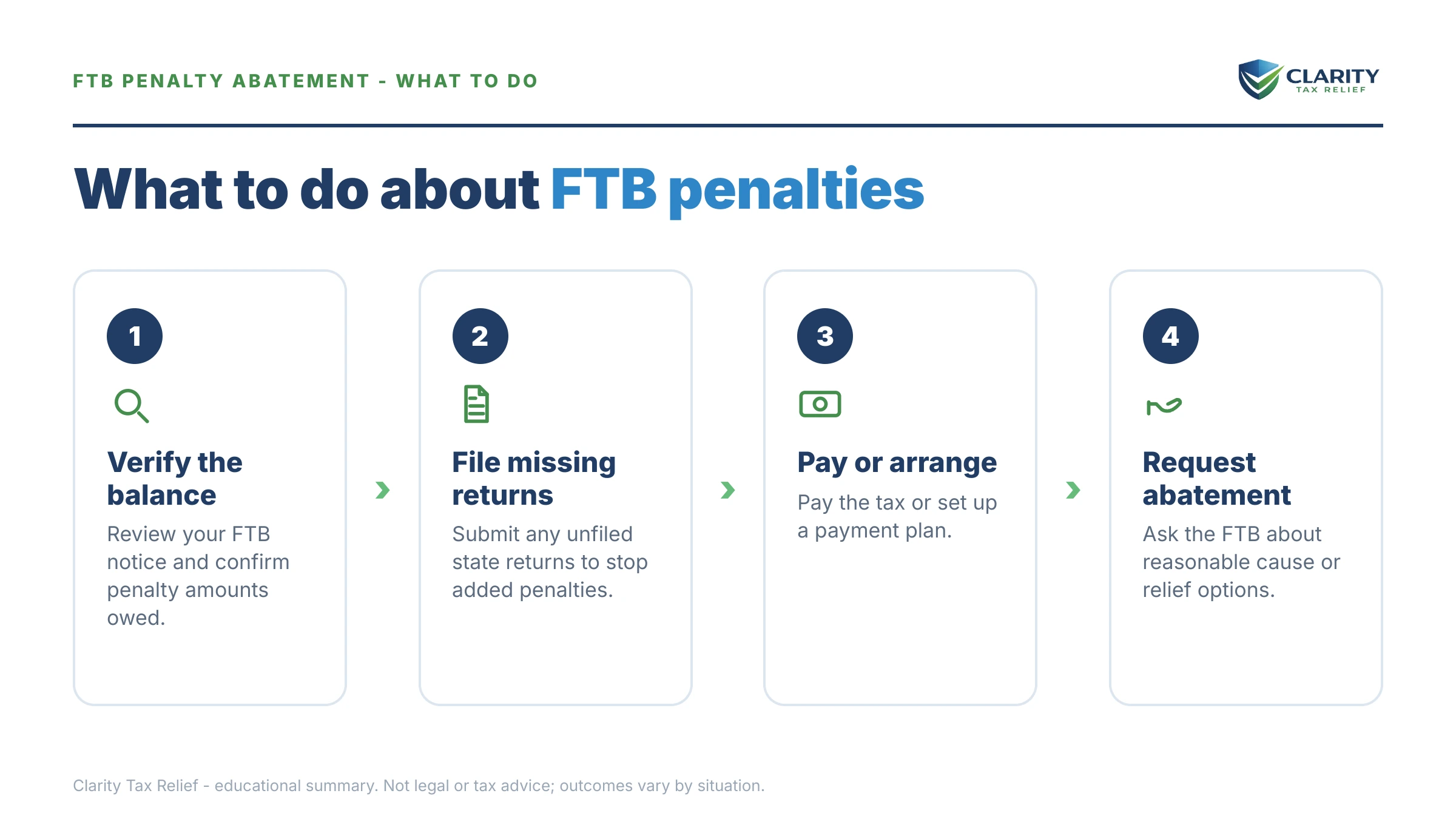
California offers exactly two formal abatement paths — a once-per-lifetime one-time abatement and reasonable cause — plus two narrow escape hatches for interest and declared disasters.
1. One-time penalty abatement (R&TC §19132.5)
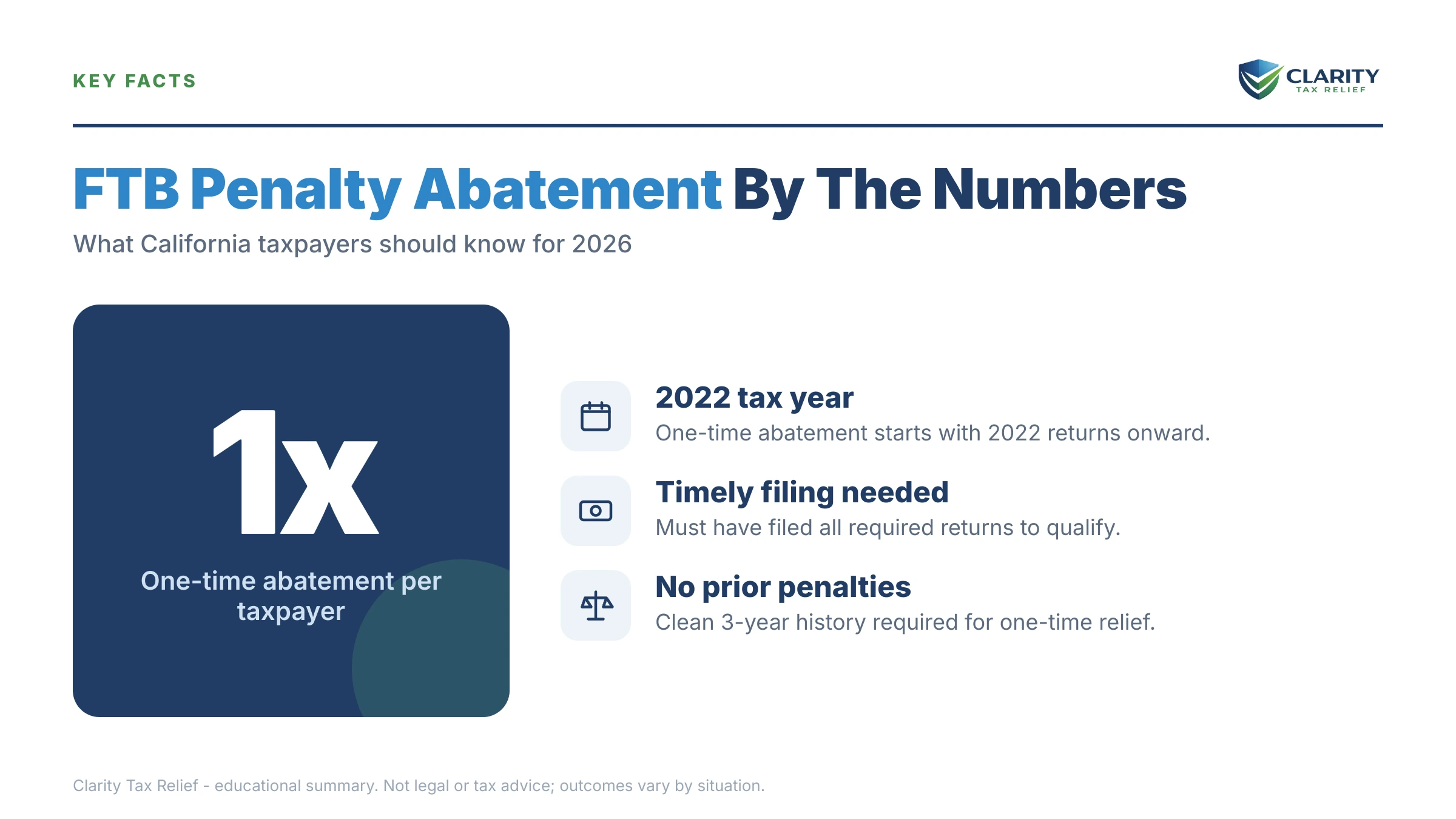
This is California's answer to the IRS's first-time abatement, added by the Legislature for tax years beginning on or after January 1, 2022. You may qualify if all of the following are true:
- You're an individual filer (Form 540 filers, including registered domestic partners and married couples filing jointly) — corporations, LLCs, and partnerships are excluded.
- The penalty is a timeliness penalty — late filing (§19131) or late payment (§19132) — on a tax year 2022 or later.
- You've filed every required return (or have a valid extension pending).
- You've paid the tax, or you're current on an approved arrangement to pay it — an FTB payment plan in good standing satisfies this.
- You've never used one-time abatement before. It does not reset. Ever.
Request it with Form FTB 2918, by calling the FTB at 800-689-4776, or in writing. No hardship story required — if you meet the criteria, the reason you filed late is irrelevant. That's also why it's precious: it works when your excuse wouldn't.
On a joint return, both spouses are jointly liable for the penalties, and one request addresses the joint account. Because the relief is once per lifetime, a couple should treat it as a shared card — not one to burn on a small penalty when a bigger year might be lurking behind an unfiled return.
2. Reasonable cause (Forms FTB 2917 and FTB 2924)
Reasonable cause asks a single question: could an ordinarily prudent person in your circumstances have filed or paid on time? If the honest answer is no — and you can prove why — the FTB can remove the penalty regardless of how many times you've asked before.
What tends to succeed, with documentation: a serious illness or hospitalization, a death in the immediate family near the deadline, a disaster that destroyed records, or records genuinely unobtainable despite real effort. What tends to fail: being busy, being short on cash, forgetting, or relying on a preparer to meet the filing deadline — California, like the IRS, treats the filing deadline as personally non-delegable.
Individuals file Form FTB 2917; business entities file Form FTB 2924 (entities get no one-time option, so this is their only abatement route — the federal side works differently, as our business penalty abatement guide explains). Both forms double as a claim for refund if the penalty is already paid, which matters later when appeal rights come into play.
The evidence does the work. A two-sentence request loses; a one-page timeline with hospital records, death certificates, insurance claims, or dated correspondence attached wins far more often. Match each document to a date, and match each date to the deadline you missed.
3. Interest abatement — the narrowest door
Interest cannot be removed for reasonable cause, period. The FTB will abate interest only when it was caused by an unreasonable error or delay by the FTB itself — requested on Form FTB 3701 — or under specific declared-disaster relief. There is a consolation prize, though: when a penalty is abated, the interest that accrued on that penalty comes off with it.
4. Disaster relief
When a disaster declaration covers your county, the FTB typically postpones deadlines and waives the associated penalties for affected taxpayers, often automatically. If your late filing traces to a declared wildfire, flood, or storm, check the FTB's disaster announcements before spending your one-time abatement on a penalty the state may remove anyway.
| Option | How to request | Cost | Key limits |
|---|---|---|---|
| One-time penalty abatement | Form FTB 2918, or call 800-689-4776 | Free | Individuals only; tax years 2022+; once per lifetime; must be filing-compliant and paid or on a plan |
| Reasonable cause — individual | Form FTB 2917 with documentation | Free | Ordinary-care standard; doubles as a refund claim if the penalty is paid |
| Reasonable cause — business | Form FTB 2924 with documentation | Free | Entities have no one-time option; same evidence standard applies |
| Interest abatement | Form FTB 3701 | Free | Only for unreasonable FTB error or delay — not hardship, not good cause |
| Disaster relief | Often automatic for declared disasters | Free | Tied to official declarations covering your county and dates |
The order-of-operations rule most people miss: if your facts genuinely support reasonable cause, request reasonable cause first and keep the once-per-lifetime abatement in reserve. Reasonable cause is reusable; one-time abatement isn't. Spending the lifetime card on a penalty a medical record would have removed anyway is the single most common self-inflicted mistake on these requests.
Say you owe $48,300: the FTB penalty math for a married couple
Say you and your spouse owe $48,300 on a joint California return filed ten months after the April deadline — a health crisis in the family pushed everything aside, and even the automatic October extension came and went. Here's what the account looks like, hypothetically:
- Late-filing penalty: 5% per month caps after month five at 25% — 0.25 × $48,300 = $12,075.
- Late-payment penalty: computed as 5% of $48,300 = $2,415, plus 0.5% × 10 months = 5% = $2,415 more — $4,830. But under R&TC §19132(b), the late-payment penalty is not assessed when the late-filing penalty for the same year equals or exceeds it — as it does here.
- Total penalty exposure: $12,075 — the 25% late-filing penalty — before interest, which accrues on the tax and on the penalties.
Now the two paths. One-time abatement could remove both timeliness penalties in a single request if the couple has filed everything, paid the $48,300 or put it on an approved FTB payment plan, and never used the relief before — no explanation needed. But a documented health crisis is classic reasonable cause. The smarter sequence: file Form FTB 2917 with the medical timeline attached, and hold the once-per-lifetime abatement for a future year when there is no story to tell. If the reasonable-cause request is denied, the one-time option is still on the table.
Either way, the interest on the $48,300 in tax stays. Abatement in this example is worth up to $12,075 plus the interest that accrued on that penalty — real money, but not the whole notice.
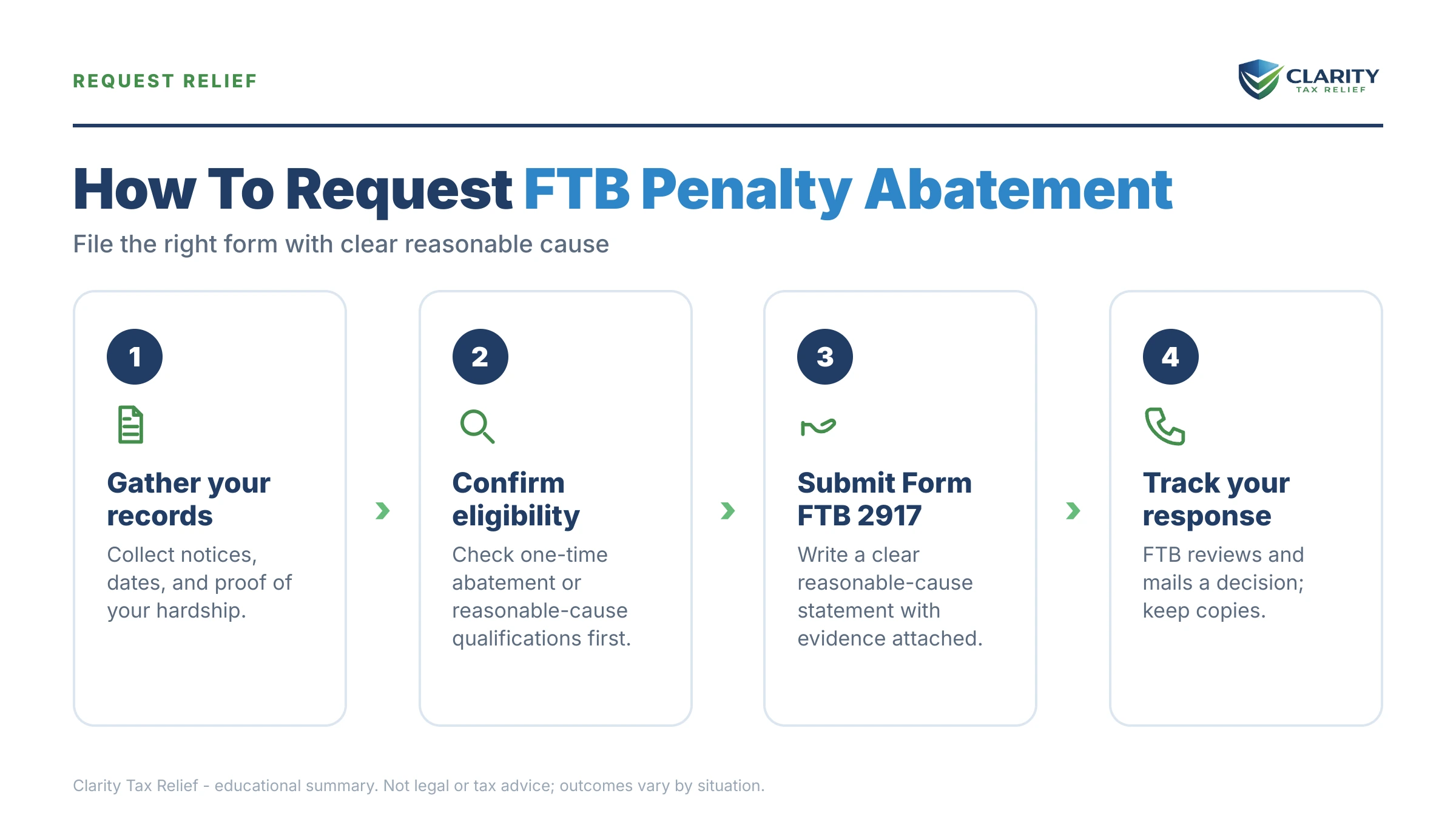
How to request FTB penalty abatement, step by step
- Read your FTB notice line by line. Identify each penalty by name and amount — late filing, late payment, demand, estimated tax — because each one has a different relief path.
- File every missing return and address the tax. Pay the balance or set up an FTB payment plan first; both one-time abatement and most reasonable-cause grants require full filing compliance and a payment arrangement.
- Choose your relief path deliberately. If your facts support reasonable cause, request it first and preserve your once-per-lifetime abatement; otherwise use one-time abatement for 2022-or-later timeliness penalties.
- Submit the request with documentation. File Form FTB 2918 or call 800-689-4776 for one-time abatement; for reasonable cause, file Form FTB 2917 (individuals) or FTB 2924 (businesses) with medical records, disaster documentation, or correspondence that proves your timeline.
- Calendar the decision and your appeal window. Watch your FTB account for the determination, and if a refund claim is denied, note the Office of Tax Appeals deadline printed on the letter — typically 90 days.
Deadlines and appeal rights if the FTB says no
A denied FTB abatement request is not the end of the road — but the appeal rights depend on whether the penalty was paid, and each right expires on its own clock.
| Situation | Your deadline | What's at stake if it passes |
|---|---|---|
| Penalty assessed, still unpaid | No fixed deadline to request abatement | Nothing procedurally — but interest accrues and collection keeps escalating |
| Penalty already paid | Later of 4 years from filing (or original due date) or 1 year from payment | The right to a refund of the penalty — gone permanently |
| Refund claim denied | Date on the FTB's denial letter — typically 90 days | The right to appeal to the Office of Tax Appeals |
| Balance in active collection | The FTB can collect for up to 20 years (R&TC §19255) | Time is on the state's side — double the IRS's window |
The paid-versus-unpaid distinction is the strategic lever. A denial of an unpaid-penalty request carries no formal appeal — you can resubmit with better evidence, but that's it. Paying the penalty and filing the reasonable-cause form as a claim for refund converts a dead end into a case the independent California Office of Tax Appeals can hear. For larger penalties, that appeal right is often worth the upfront payment. Forms, account access, and current mailing instructions live at the Franchise Tax Board's website.
FTB penalty abatement vs. IRS first-time abatement (and the new AEP)
California's one-time abatement is available once per lifetime; the IRS's first-time abatement resets after three clean years — and that difference should drive which agency you approach first and how.
The federal program, covered in full in our first-time penalty abatement guide, requires a clean compliance history for the prior three years but can be used again once you rebuild one. And starting in summer 2026, the IRS is replacing it with the Automatic Exemption from Penalty (AEP) — relief applied automatically, with no request needed. California has announced no automatic equivalent. With the FTB, in 2026 and for the foreseeable future, you get nothing unless you ask.
The agencies also decide independently. An IRS grant does not touch your FTB account, and vice versa — though if the IRS accepted your reasonable cause for the same event, attach that determination to your FTB 2917; it's persuasive evidence even if it isn't binding. If you owe both governments for the same year, the federal side compounds differently — see how big IRS penalties get, run the federal numbers with our IRS Penalty & Interest Calculator, and use our IRS penalty abatement letter guide for that request. Two agencies, two requests, two sets of evidence — one underlying story.
When you can handle FTB penalty abatement yourself
One-time abatement is genuinely a do-it-yourself request — a one-page form or a phone call with no story to argue. Handle it on your own when:
- The penalties are timeliness penalties on a 2022-or-later year, you're filing-compliant, and the tax is paid or on a plan — you meet the criteria or you don't; there's nothing to persuade.
- Your reasonable-cause facts are simple and self-documenting: one hospitalization, one deadline, records in hand.
- The penalty is small enough that even a denial costs you little beyond the stamp.
Experienced help changes outcomes in the messier cases: penalties stacked across multiple years (where the once-per-lifetime card must be placed precisely), a 25% demand penalty layered on top, business-entity penalties with no one-time option, a denial you want to take to the Office of Tax Appeals, or parallel IRS and FTB penalties from the same event, where the sequencing of the two requests matters. The judgment call isn't filling out the form — it's which form, for which year, in which order.
Not sure which case yours is? Have an experienced tax professional map both agencies' penalties in one free case review before you spend your one-time abatement.
Terms on your FTB notice, decoded
- One-time penalty abatement: California's once-per-lifetime removal of late-filing and late-payment penalties for individuals, no excuse required (R&TC §19132.5).
- Reasonable cause: the legal standard that excuses a penalty when an ordinarily prudent person in your circumstances could not have complied on time.
- Demand penalty: a flat 25% charge for failing to file after the FTB formally demands a return — separate from, and stackable on, the late-filing penalty.
- Claim for refund: the formal request to get back money already paid; it's what unlocks your right to appeal a denial.
- Office of Tax Appeals (OTA): the independent California body that hears appeals when the FTB denies a claim for refund.
- Collection cost recovery fee: a fee the FTB adds when your account moves to enforced collection — no abatement program removes it.
FTB penalty abatement questions, answered
Does California have first-time penalty abatement like the IRS?
Yes. Since tax year 2022, California offers one-time penalty abatement under Revenue and Taxation Code §19132.5. It removes late-filing and late-payment penalties for individuals who are current on filings and have paid or arranged to pay their tax. Unlike IRS first-time abatement, which resets after three clean years, California's version is available once per lifetime.
What penalties does FTB one-time abatement cover?
It covers only the two timeliness penalties: the late-filing penalty under §19131 and the late-payment penalty under §19132. It does not cover the 25% demand penalty, the estimated-tax penalty, accuracy-related penalties, or interest. For those, you need reasonable cause, a statutory exception, or — for interest — proof of an unreasonable FTB error or delay.
How do I request FTB penalty abatement?
For one-time abatement, file Form FTB 2918 or call the FTB at 800-689-4776. For reasonable cause, individuals file Form FTB 2917 and businesses file Form FTB 2924, attaching documentation of what prevented on-time filing or payment. Before requesting either, make sure every required return is filed and the tax is paid or on an approved payment plan — noncompliance is the most common reason requests fail.
Can the FTB waive interest?
Almost never. Interest is statutory, and reasonable cause does not remove it. The narrow exceptions are an unreasonable error or delay by the FTB itself — requested on Form FTB 3701 — and certain declared-disaster relief. Removing the underlying penalty helps indirectly, because interest charged on an abated penalty is removed along with it.
What counts as reasonable cause with the FTB?
The standard is whether an ordinarily prudent person in your situation could have filed or paid on time. Serious illness, a death in the immediate family, a natural disaster, or records you genuinely could not obtain tend to qualify with documentation. Being busy, short on cash, or relying on a preparer to meet the filing deadline usually does not.
Can a business get FTB penalty abatement?
Corporations, LLCs, and partnerships cannot use California's one-time abatement — it is limited to individual filers. Businesses can still request reasonable-cause relief on Form FTB 2924, which also works as a refund claim for penalties already paid. The documentation standard is the same ordinary-care test, applied to the entity and the people responsible for its filings.
I already paid the FTB penalty — can I get it back?
Yes, if you act within the refund window. A reasonable-cause request on Form FTB 2917 or 2924 doubles as a claim for refund, and one-time abatement can also be applied to a paid penalty. California's deadline is generally the later of four years from the date you filed (or the return's original due date) or one year from the date of the overpayment.
What happens if the FTB denies my abatement request?
If the denial was on a claim for refund, you can appeal to California's Office of Tax Appeals by the deadline printed on the denial letter — typically 90 days. If the penalty is still unpaid, you can pay it and file a formal refund claim to preserve appeal rights, or resubmit with stronger documentation. A denial of one path does not block the other.
Does IRS penalty abatement apply to my California penalties?
No. The IRS and the FTB are separate agencies, and each must be asked separately — an IRS first-time abatement does nothing to your California account. If the IRS granted relief for the same event, include that determination with your FTB reasonable-cause request; it is persuasive evidence, but the FTB decides independently.
Your next 24 hours
- Find the penalty section of your FTB notice and write down each penalty's name and dollar amount — that list determines which abatement path can reach which charge.
- Gather your paper trail: the notice itself, the California return for that year, proof of any payments, and — if a life event caused the lateness — dated documentation like medical records or a death certificate.
- Get a free case review before you spend your once-per-lifetime abatement: call (888) 825-7779 or use the 2-minute form. There's no statutory deadline to ask — but interest is accruing on the penalties every day they stay on the account.
This guide is general information, not tax or legal advice for your specific situation. Eligibility for IRS programs depends on individual facts and circumstances; no outcome is guaranteed. Eligibility for California FTB relief programs likewise depends on your individual facts.