
Penalty Relief
IRS Penalty Abatement Letter: How to Write One That Actually Works (2026)
The short answer: an IRS penalty abatement letter is a written request asking the IRS to remove failure-to-file, failure-to-pay, or deposit penalties based on first-time abatement or reasonable cause. It costs nothing to send, must identify the notice, tax year, and penalty, and — when granted — also removes the interest charged on those penalties.
You've done the math on your notice, and it stings: of the $48,300 the IRS says you owe, nearly a third isn't tax at all — it's penalties, plus interest charged on those penalties. You rent, so there's no home equity to tap; the balance has to come down some other way. That's exactly what an IRS penalty abatement letter does, and the IRS grants these requests every day when they're built correctly.
Farther down, the image below shows you exactly what a strong abatement letter looks like and where every element belongs — keep it in mind as we build yours piece by piece. First, the clocks you're actually on.
⏱ Your real clocks: there is no deadline to request abatement of an unpaid penalty — but the failure-to-pay penalty adds 0.5% of the tax every month until it caps at 25%. And if you already paid a penalty, a refund claim on Form 843 must generally be filed within 3 years of the return or 2 years of the payment, whichever is later.
Why the IRS penalized you — and how big the numbers get
The failure-to-file penalty runs 5% of the unpaid tax per month — ten times the 0.5% monthly failure-to-pay rate — and each caps at 25% of the tax. Both are assessed by computer the moment your account shows a late return or an unpaid balance. No human weighed your circumstances when the penalty posted.
That's the entire logic of the abatement letter: the assessment was automatic, but the removal is discretionary. Your letter is the first time a human — or the IRS's screening software — actually considers why you filed or paid late.
If you want the full penalty math, including how the two penalties overlap and compound, see our guide to how much IRS penalties on back taxes really cost. Here, we'll stay focused on the letter that takes them off.
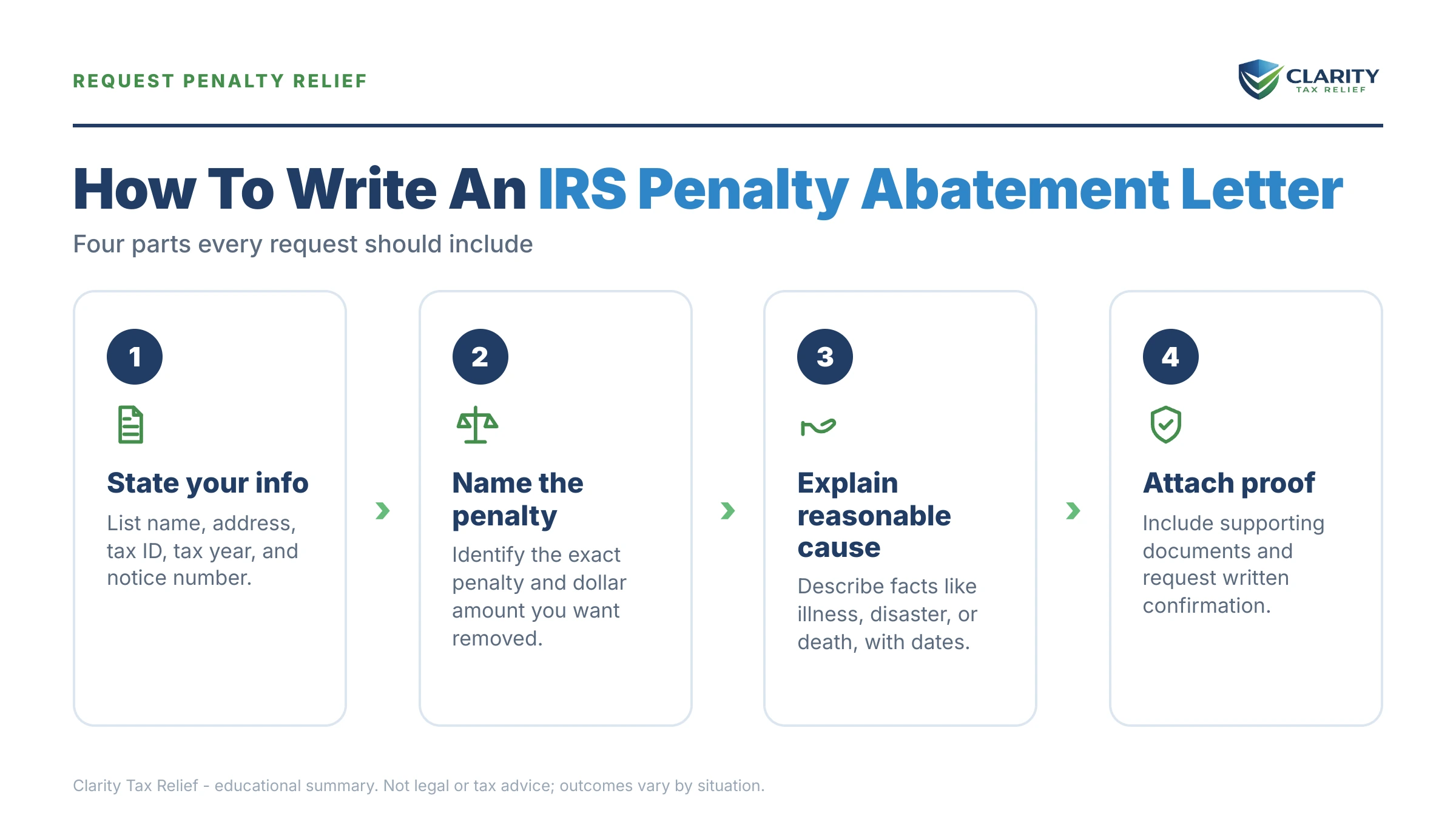
What an IRS penalty abatement letter must include
A working IRS penalty abatement letter needs seven specific elements, and most denials trace back to a missing one. The IRS reviewer — often software before any person — is checking boxes, so give them boxes to check:
- Your identifying information: full name, address, and taxpayer identification number, exactly as they appear on the notice.
- The notice number and date you're responding to (CP14, CP504, CP161 — whatever is printed in the corner).
- The tax year and form (for example, "Form 1040, tax year 2023").
- Each penalty by name, code section, and amount: failure-to-file under IRC §6651(a)(1), failure-to-pay under IRC §6651(a)(2). Naming the section signals you know exactly what you're asking to remove.
- Your legal basis: first-time abatement, reasonable cause, or both (argued in the alternative — more on that below).
- The facts, in date order: what happened, when it started, when it ended, and what you did to comply as soon as you could. This is where "ordinary business care and prudence" is proven, not claimed.
- A specific request and enclosure list: "I respectfully request abatement of the $7,650 failure-to-file penalty and $4,080 failure-to-pay penalty for tax year 2023," followed by a list of every document attached.
Keep it to one or two pages. Emotional appeals don't score points; dated facts with matching documents do. If you want a proven starting structure, our first time penalty abatement letter sample covers the individual version, and the business penalty abatement letter template adapts it for 1120, 1065, and payroll penalties.
First-time abatement or reasonable cause: choose your basis before you write
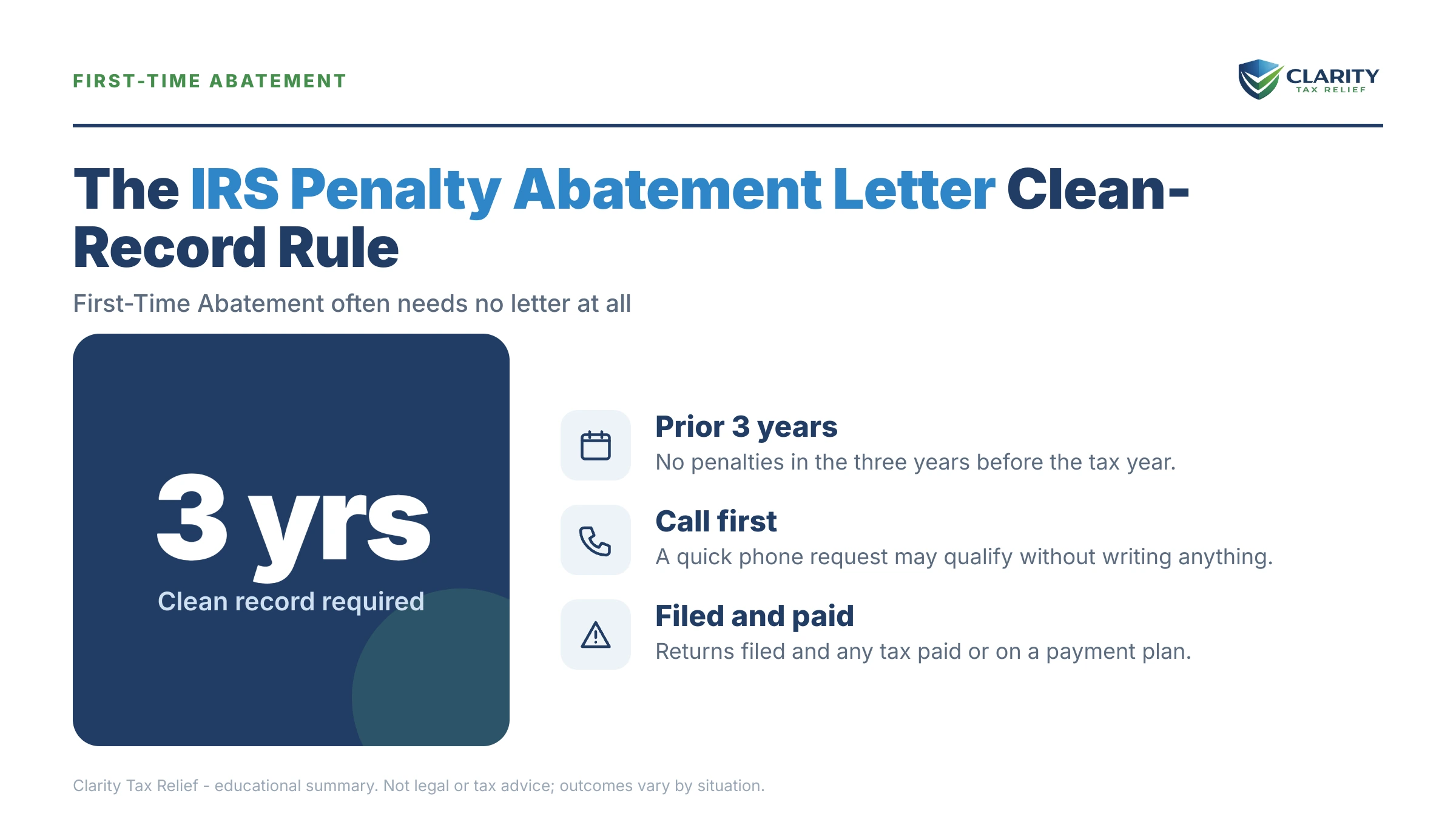
First-time abatement requires a clean penalty record for the three tax years before the penalty year — nothing more about your story matters. The three criteria: no penalties (other than an estimated-tax penalty) in the prior three years, all currently required returns filed or on extension, and the current tax paid or under a payment arrangement. If you meet them, ask for first-time penalty abatement before you draft anything — a phone call to the number on your notice can often settle it on the spot, though larger penalty amounts typically get routed to written review.
One important 2026 update: FTA is being replaced by the Automatic Exemption from Penalty (AEP), rolling out starting this summer. Qualifying first-time penalties are removed automatically, with no request at all. Practical takeaway: check your account transcript before you write — the penalty may already be gone, or queued to come off without your help.
Reasonable cause is the path for everything FTA and AEP can't reach: a second penalty year, a disqualified prior record, or penalties FTA never covered. The standard is circumstances beyond your control despite ordinary business care — serious illness or hospitalization, a death in the immediate family, natural disaster, destroyed or unavailable records, or reliance on bad professional advice. Inability to pay, on its own, usually isn't enough; the IRS wants to see what you did to try to comply anyway. Our rundown of reasonable cause examples shows which fact patterns actually succeed and which get screened out.
If you qualify for both, argue both: FTA as the primary basis, reasonable cause in the alternative. The reviewer takes whichever path clears first, and you've lost nothing by stacking them.
What happens if you never ask for abatement
Penalties can add close to 50% to a tax debt before interest, and every IRS collection notice escalates on that inflated total — not just the tax. Here is the sequence a penalized balance follows when nobody contests it:
- The failure-to-pay penalty keeps posting monthly (transaction code 276 on your transcript) until it reaches its 25% cap.
- Interest compounds daily on the tax and on the penalties — you're paying interest on money that a letter could have removed.
- The notice stream continues: CP501 and CP503 reminders, then CP504 (the IRS can take your state refund), each calculated on the penalty-inflated balance.
- The LT11 or Letter 1058 arrives — the final notice of intent to levy, opening a 30-day window before wage and bank levies become legal.
- The levy collects the penalty portion too. A wage levy is continuous until released; a bank levy freezes funds for 21 days before they leave. Every dollar of unabated penalty is a dollar the levy will chase.
- If you pay just to make it stop, the 2-year refund-claim clock starts running on penalties you could have contested for free while they were unpaid.
One thing an abatement letter does not do: pause collection. If a final notice is in your stack, your levy defense — a Collection Due Process hearing on Form 12153 or a payment arrangement — runs in parallel with the letter, on its own 30-day clock.
Penalties inflating a balance the IRS is about to levy?
Send us your notice and penalty breakdown. An experienced tax professional will map which penalties are removable and what protects your paycheck and bank account — free and confidential. If an LT11 or Letter 1058 is in the stack, the 30-day Collection Due Process window is already running.
Every penalty relief path compared: cost and timeline
Every penalty relief path costs $0 in IRS fees — the differences are speed, paperwork, and which situations each can reach. Anyone charging you a fee is charging for the work, not for access; the IRS never charges to consider abatement.
| Relief path | What it costs | Typical timeline | Best when |
|---|---|---|---|
| First-time abatement by phone | $0 | Often decided on the call; larger amounts routed to written review | One penalty year, clean prior three years |
| Abatement letter (FTA and/or reasonable cause) | $0 plus certified postage | Commonly a few months; longer during 2026 staffing backlogs | Documented hardship facts, larger amounts, multiple penalties |
| Automatic Exemption from Penalty (AEP) | $0 — no request needed | Applied by the IRS automatically, rolling out from summer 2026 | Qualifying first-time penalties; verify on your transcript |
| Form 843 refund claim | $0 | Often several months for a written determination | Penalty already paid; within the 3-year/2-year claim window |
| Appeal after a denial | $0 | Varies; adds months but gets a fresh, independent reviewer | Strong facts that the first reviewer dismissed |
If you already paid the penalties — say, to release a levy — the letter becomes a refund claim instead. Our guide to penalty abatement after paying walks through that version, including the claim-window math.
Which penalties a letter can remove — and which it can't
First-time abatement reaches only three penalties: failure to file, failure to pay, and failure to deposit. Everything else needs reasonable cause or a penalty-specific defense, which is why identifying your exact penalty before writing matters so much:
| Penalty | FTA / AEP eligible? | Reasonable cause? | Notes |
|---|---|---|---|
| Failure to file (5%/month, 25% cap) | Yes | Yes | Usually the biggest dollar target on the notice |
| Failure to pay (0.5%/month, 25% cap) | Yes | Yes | Keeps accruing until paid or arranged — abate it late and you abate more |
| Failure to deposit (payroll) | Yes | Yes | Business-side rules differ — see 941 penalty abatement |
| Accuracy-related (20%) | No | Yes, plus other defenses | Needs a different argument — see the accuracy related penalty guide |
| Estimated-tax penalty | No | Generally no | Use the Form 2210 exceptions — see the estimated tax penalty waiver guide |
| Interest | No | No — narrow IRS-error/delay claims only | Falls automatically with abated penalties; see can IRS interest be waived |
Notice the interest row: you can't ask the IRS to waive interest just because money is tight, but you don't have to. When a penalty comes off, the interest that was charged on that penalty comes off with it — automatically.
What abatement is worth on a $48,300 balance: a worked example
Say you owe $48,300 for tax year 2023, and the notice breaks down like this — a hypothetical, but a common shape:
- $34,000 in tax, from a return filed about ten months late and never paid;
- $7,650 in failure-to-file penalty (the 25% cap, reduced slightly for the months it overlapped with failure-to-pay);
- $4,080 in failure-to-pay penalty (0.5% × 24 months = 12% of $34,000);
- roughly $2,570 in interest, compounding daily on all of it.
Now say a hospitalization covered the filing season and the months after — documented with admission and discharge records. If the IRS grants reasonable cause for both penalties, $11,730 comes off the account. So does the slice of interest that accrued on those penalties — call it roughly $600 more in this example. The balance drops to about $35,970 without settling anything, negotiating anything, or qualifying for any means-tested program.
For a renter with no asset to borrow against, that matters twice. The debt is a quarter smaller, and every downstream number improves with it: a 72-month installment agreement runs roughly $500 a month instead of about $670, and if a levy is in motion, the amount the IRS is trying to collect just shrank by nearly $12,300.
Want your own version of this math? Estimate how your penalties and interest have stacked up with our IRS penalty and interest calculator before you draft anything — knowing the exact dollar target sharpens the letter.
How to write and send your IRS penalty abatement letter, step by step
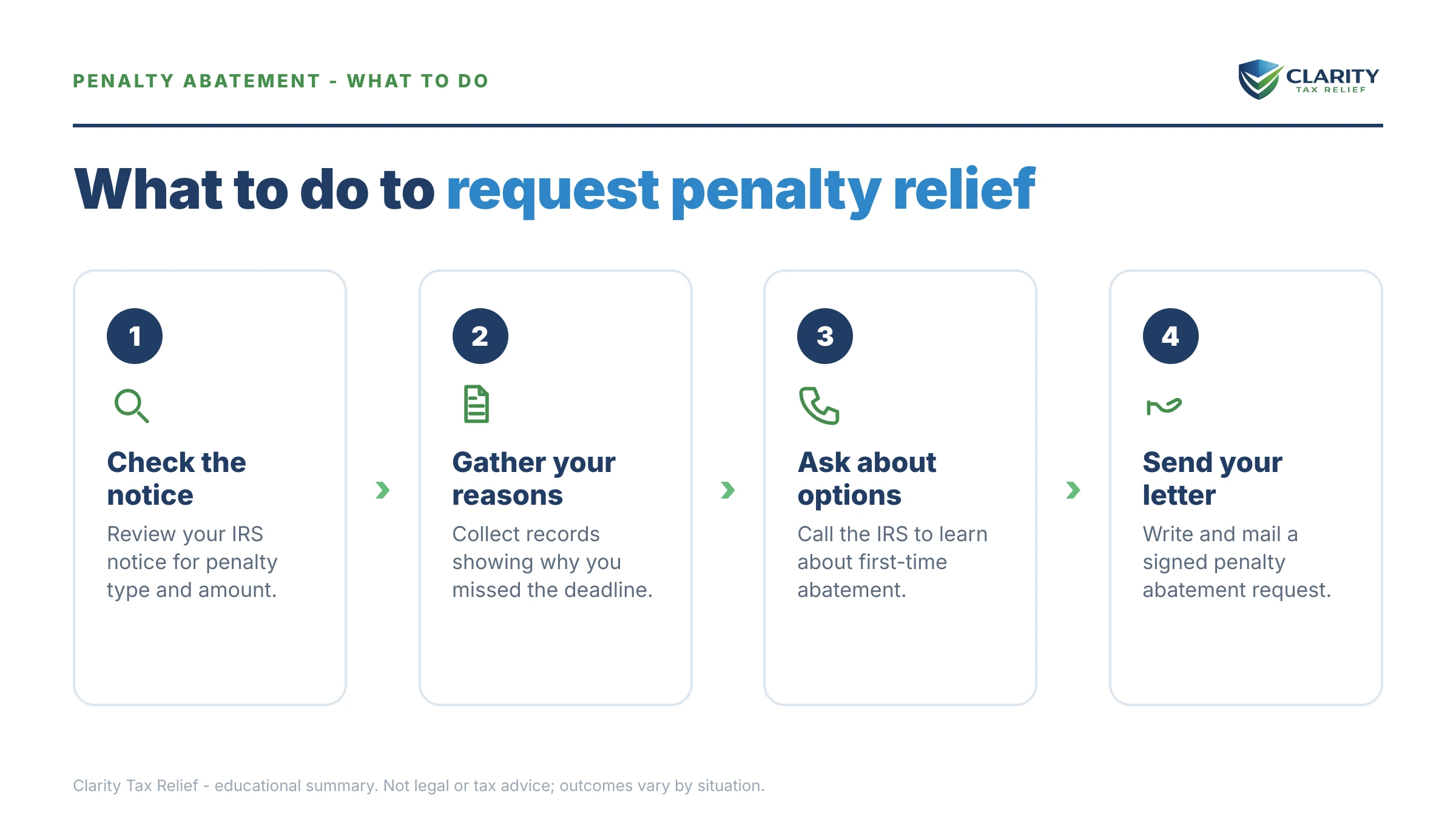
A complete abatement request takes six steps, and the first two happen before you write a word:
- Pull your account transcript. Log into your IRS online account and write down each penalty line — code 166 for failure-to-file, code 276 for failure-to-pay — with the tax year and dollar amount.
- Check first-time abatement before writing. If the three years before the penalty year are clean, call the number on your notice and ask for FTA — the call may make the letter unnecessary.
- Choose your reasonable cause grounds. Match your facts — hospitalization, disaster, destroyed records, bad professional advice — to the ordinary-business-care standard the IRS applies.
- Draft the letter. Identify the notice, tax year, and each penalty by name and amount; state your basis; tell the facts in date order; and request abatement specifically.
- Attach proof and mail it certified. Send copies, never originals, to the address printed on your notice, and keep the certified-mail receipt with your file.
- Track the result on your transcript. Watch for penalty-reversal codes to post, and follow up in writing if nothing changes after a few months.
If the penalty is already paid, replace the letter with a claim on Form 843, the penalty abatement request form — same arguments, same evidence, filed as a refund claim instead of a balance reduction.
Reading your transcript after you mail the letter
Your account transcript shows every penalty as a three-digit transaction code, and it's where your abatement decision posts first — usually before any letter reaches your mailbox. Here's the decoder:
| Transcript code | What it means | What to do |
|---|---|---|
| 166 | Failure-to-file penalty assessed | Confirm the amount matches your notice; name it in your letter |
| 276 | Failure-to-pay penalty posted (repeats monthly) | Include it in the request; it grows until paid or arranged |
| 196 | Interest assessed | Can't be abated directly, but falls with the penalties it rode on |
| 167 / 277 | Penalty reduced or removed | Your abatement posted — verify the dollar amount matches the request |
| 971 | Notice issued | The IRS sent a response to your request; watch the mail |
Check the transcript every few weeks after mailing. A reversal code posting is your yes; a code 971 with no reversal usually means a written determination — approval or denial — is on its way.
If the IRS denies your abatement letter
A denied abatement request carries appeal rights — the first "no" is a screening decision, not the final answer. Denials arrive as a disallowance letter explaining how to protest, and a fresh reviewer in the IRS Independent Office of Appeals sees your facts with none of the first reviewer's assumptions. Many reasonable-cause requests that automated screening rejects succeed once a human weighs the full timeline, so a denial with strong facts is a reason to escalate, not to quit. The full playbook, including how to frame the protest, is in our guide to the penalty abatement appeal.
Two other pressure valves if the process stalls: the Taxpayer Advocate Service can intervene when IRS delay is causing you harm, and a well-documented resubmission is always allowed — there's no limit on asking again with better evidence.
When you can write this letter yourself — and when help changes the outcome
Be honest with yourself about which case you have, because many people genuinely don't need to hire anyone for this. Write it yourself when: it's one tax year, your prior three years are clean (a phone call may beat the letter entirely), the penalty is a few hundred to a few thousand dollars, and your reasonable-cause story is simple and documented — one hospitalization, one disaster, one clear event with paper behind it.
Experienced help tends to change outcomes when the stakes and moving parts multiply: a levy already in motion while the letter waits in a queue, multiple penalty years that need FTA and reasonable cause layered in the right order, business or payroll penalties where the deposit rules have their own logic — the broader business penalty abatement rules differ meaningfully from the individual side — accuracy-related penalties that require a legal defense rather than a hardship story, or five-figure penalty totals where a weak first request burns your cleanest shot. In those cases the letter is one move in a bigger sequence: protect the paycheck first, shrink the debt second, resolve the balance third — and the order changes what you end up paying.
If your stack includes a final notice, multiple years, or a penalty total north of $10,000, it's worth a free review before you mail anything — call (888) 825-7779 and have your notice in hand; penalties and interest are still accruing while the letter sits unwritten.
Terms on your notice, decoded
- Abatement: the IRS's word for removing an assessed penalty from your account — it erases the penalty, not the underlying tax.
- Reasonable cause: the legal standard for discretionary relief — circumstances beyond your control that prevented compliance despite genuine effort.
- Ordinary business care and prudence: the yardstick the IRS measures your story against — what a careful person in your situation would have done, and whether you did it.
- First-Time Abate (FTA): an administrative waiver that removes filing, payment, and deposit penalties for one year when the prior three years are clean.
- Automatic Exemption from Penalty (AEP): FTA's successor, rolling out from summer 2026 — the same relief applied automatically, with no request required.
- Reasonable Cause Assistant (RCA): the IRS software that scores many abatement requests before a human reads them — one reason dated facts and documents beat narrative.
The IRS's own overview of these programs lives at its penalty relief page, and the refund-claim form and instructions are at About Form 843.
IRS penalty abatement letter FAQs
How do I write a letter to the IRS to remove penalties?
Identify the notice number, tax year, and each penalty by name and amount, state your basis (first-time abatement or reasonable cause), lay out the facts in date order, attach proof, and specifically request abatement. Mail it certified to the address on your notice. Keep it to one or two pages — the reviewer needs facts, not apologies.
Does the IRS actually approve penalty abatement requests?
Yes — penalty abatement is granted routinely when the request matches the rules. First-time abatement is close to mechanical if your prior three years are clean, and reasonable cause succeeds when the facts show circumstances beyond your control, backed by documentation. Vague hardship stories without proof are what get denied.
Can I request penalty abatement over the phone instead of a letter?
Often, yes — first-time abatement can frequently be granted during a single call to the number on your notice. Larger penalty amounts usually get routed to a written review, and reasonable cause requests almost always need a letter with documentation. Call first: if the phone works, you skip the letter entirely.
Does penalty abatement remove interest too?
Only partially. Interest charged on the underlying tax stays, because the law only lets the IRS remove it in narrow cases such as IRS error or delay. But interest that accrued on an abated penalty comes off automatically when the penalty is removed — on large, old penalties that slice can be meaningful.
How long does the IRS take to respond to a penalty abatement letter?
Written requests commonly take a few months, and 2026 staffing cuts have stretched response times further. Phone-based first-time abatement can be decided on the call. If nothing posts to your transcript after several months, follow up in writing or through the Taxpayer Advocate Service — silence is not a denial.
What counts as reasonable cause for IRS penalty abatement?
Circumstances beyond your control that kept you from filing or paying despite ordinary business care: serious illness or hospitalization, death in the immediate family, natural disaster, records destroyed, or reliance on bad professional advice. Inability to pay by itself usually is not enough — the IRS looks at what you did to try to comply.
Can I get penalties back that I already paid?
Yes, through a refund claim on Form 843. You must generally file within 3 years of the return's filing date or 2 years of paying the penalty, whichever is later. The same first-time abatement and reasonable cause standards apply — the only difference is the money comes back instead of coming off the balance.
Will a penalty abatement letter stop an IRS levy?
No. Abatement shrinks the balance but does not pause collection, so a levy in motion keeps moving while your letter waits in a queue. If you received an LT11 or Letter 1058, you have 30 days to request a Collection Due Process hearing on Form 12153 — do that, or set up a payment arrangement, in parallel with the letter.
What is the new Automatic Exemption from Penalty (AEP)?
AEP is the IRS's replacement for first-time abatement, rolling out starting in summer 2026. Qualifying first-time penalties are removed automatically, with no request needed. Check your account transcript before writing — the penalty may already be gone. Reasonable cause relief still requires a written request, so AEP does not replace the abatement letter for tougher facts.
Can I use first-time abatement for more than one tax year?
No — first-time abatement applies to a single tax year, because it requires a clean record in the three years before the penalty. With multiple penalty years, the usual play is FTA on the earliest year and reasonable cause on the rest, if your facts support it. Each year is decided on its own.
Your next 24 hours
- Find the penalty lines. On your notice — or your account transcript — write down each penalty's name, tax year, and dollar amount (codes 166 and 276 on the transcript). That's your target list.
- Gather your proof. The notice itself, your last three years of returns, and documentation of what went wrong: hospital records, insurance or disaster claims, a death certificate, correspondence with your preparer.
- Get a free case review. Use the 2-minute form or call (888) 825-7779. Penalties and interest are accruing monthly while the letter goes unwritten — and if a final levy notice is in your stack, the 30-day Collection Due Process clock started on the date printed on it.
This guide is general information, not tax or legal advice for your specific situation. Eligibility for IRS programs depends on individual facts and circumstances; no outcome is guaranteed.