
Penalty Relief
Penalty Abatement Appeal: How to Fight a Denied Penalty Relief Request (2026)
The short answer: a penalty abatement appeal asks the IRS Independent Office of Appeals to overturn a denied penalty relief request. File a written protest — or Form 12203 for individuals and most sole proprietors with penalties of $25,000 or less per tax period — by the deadline on your denial letter, typically 60 days. Appeals can reverse the denial or settle part of it.
You wrote the reasonable-cause letter, waited months, and the answer came back a form-letter no — usually a Letter 854C that spends two pages restating the penalty and two sentences explaining your rights. Here's what that letter doesn't make obvious: the office that denied you is not the office that hears your appeal, and Appeals has settlement authority the first reviewer never had.
If you're not sure which letter you're holding, the image below shows exactly what a penalty abatement denial letter looks like and where to look for your deadline and the address your appeal must go to.
⏱ Your deadline: you typically have 60 days from the date on your denial letter to file a penalty abatement appeal. The exact response date is printed in the letter itself — that date controls, not this article. Miss it and the direct appeal path closes, though the pay-and-claim-a-refund route remains open.
Why the IRS denied your penalty abatement request
Most first-round penalty abatement denials are produced with the help of software — the IRS's Reasonable Cause Assistant (RCA) screens requests against a rigid decision tree before any human weighs your story. That's why so many denial letters feel like they didn't actually read what you wrote. Common denial triggers:
- A blown first-time abatement lookback. For first-time penalty abatement, any penalty in the prior three years — even a small estimated-tax penalty you barely noticed — disqualifies you automatically. The denial doesn't always tell you which year tripped it; your account transcripts will.
- A story without third-party proof. "I was seriously ill" is a claim; hospital admission records covering the missed deadlines are evidence. RCA and first-line reviewers deny narratives that arrive without documentation.
- The wrong legal standard. Financial hardship almost never excuses filing late, and "my payroll company was supposed to handle it" is routinely rejected for late filing because the duty to file can't be delegated. Reliance arguments only work in narrower forms — like reliance on written professional advice — and most DIY requests don't frame them that way. See reasonable cause examples for what actually qualifies.
- Mismatched periods or penalty types. A request that names 2023 when the failure-to-deposit penalties sit on your 2024 quarters gets denied on scope alone. Payroll penalty stacks — 941 penalty abatement cases especially — are the most common place this happens, because one bad year can generate four quarterly penalty assessments across two forms.
- A phone request that left no record. Oral requests get oral denials. If you never put the request in writing, the appeal effectively starts your paper trail from zero.
The denial letter names the reason the IRS relied on. That sentence is the single most important input to your appeal, because Appeals will ask whether the denial reason survives your evidence. (For background on how the underlying penalties themselves stack up, our guide to how much IRS penalties on back taxes grow covers the math this page assumes.)
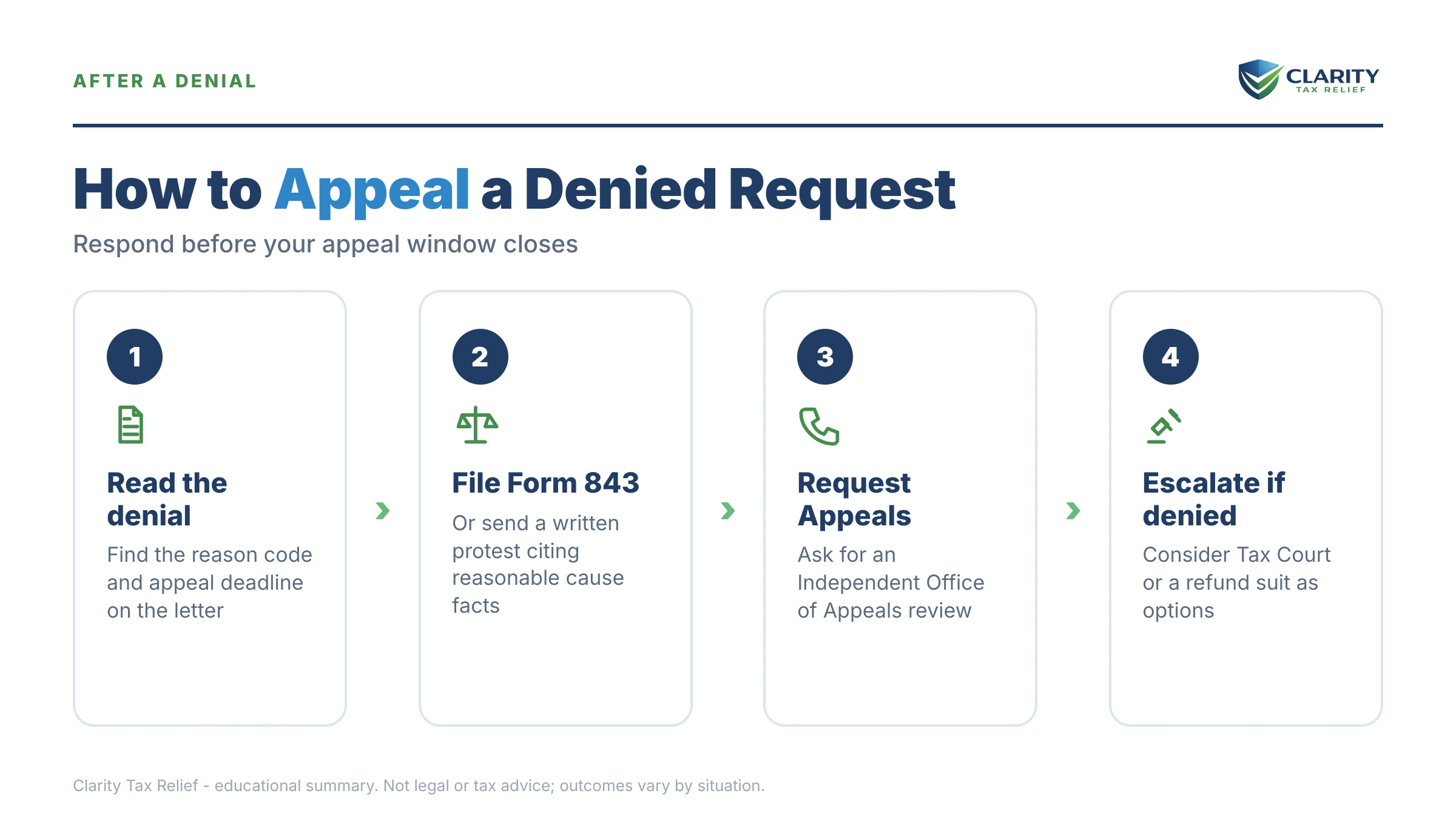
What happens if you ignore the denial
An unappealed penalty abatement denial becomes final for that request, and the full penalty balance flows straight into the IRS's automated collection stream. Nothing pauses while you decide. The stages run in order:
- The appeal window closes. Once the response date on your denial letter passes, the only fresh, independent review you were entitled to for free is gone for that request.
- The balance keeps compounding. The failure-to-pay penalty accrues at 0.5% per month while interest compounds daily on the tax, the penalties, and the interest already charged.
- Balance-due notices resume. CP14 on a personal balance, CP161 on a business balance, then the reminder notices — each with its own pay-by date printed on it.
- CP504 — intent to levy your state refund. The IRS can take your state tax refund at this stage, and a federal tax lien becomes a live possibility.
- LT11 / Letter 1058 — final notice. This starts a 30-day clock and your Collection Due Process rights (Form 12153). After that window, levies can begin.
- Levy. A bank levy comes with a 21-day hold before funds leave; a wage levy is continuous until released. For a business, accounts-receivable levies can cut off cash flow entirely.
| Stage | What arrives | Your window |
|---|---|---|
| Denial issued | Letter 854C (or similar) stating the reason and your appeal rights | Printed on the letter — typically 60 days |
| Window closes | Penalty stands; failure-to-pay and interest keep accruing | Re-request with new evidence, or pay and claim a refund |
| Balance-due notices | CP14 (individual) or CP161 (business), then reminders | Pay-by date on each notice |
| CP504 | Intent to levy your state tax refund | Date printed on the notice |
| LT11 / Letter 1058 | Final notice of intent to levy | 30 days to request a CDP hearing (Form 12153) |
| Levy | Bank levy (21-day hold) or continuous wage levy | Release paths exist but narrow |
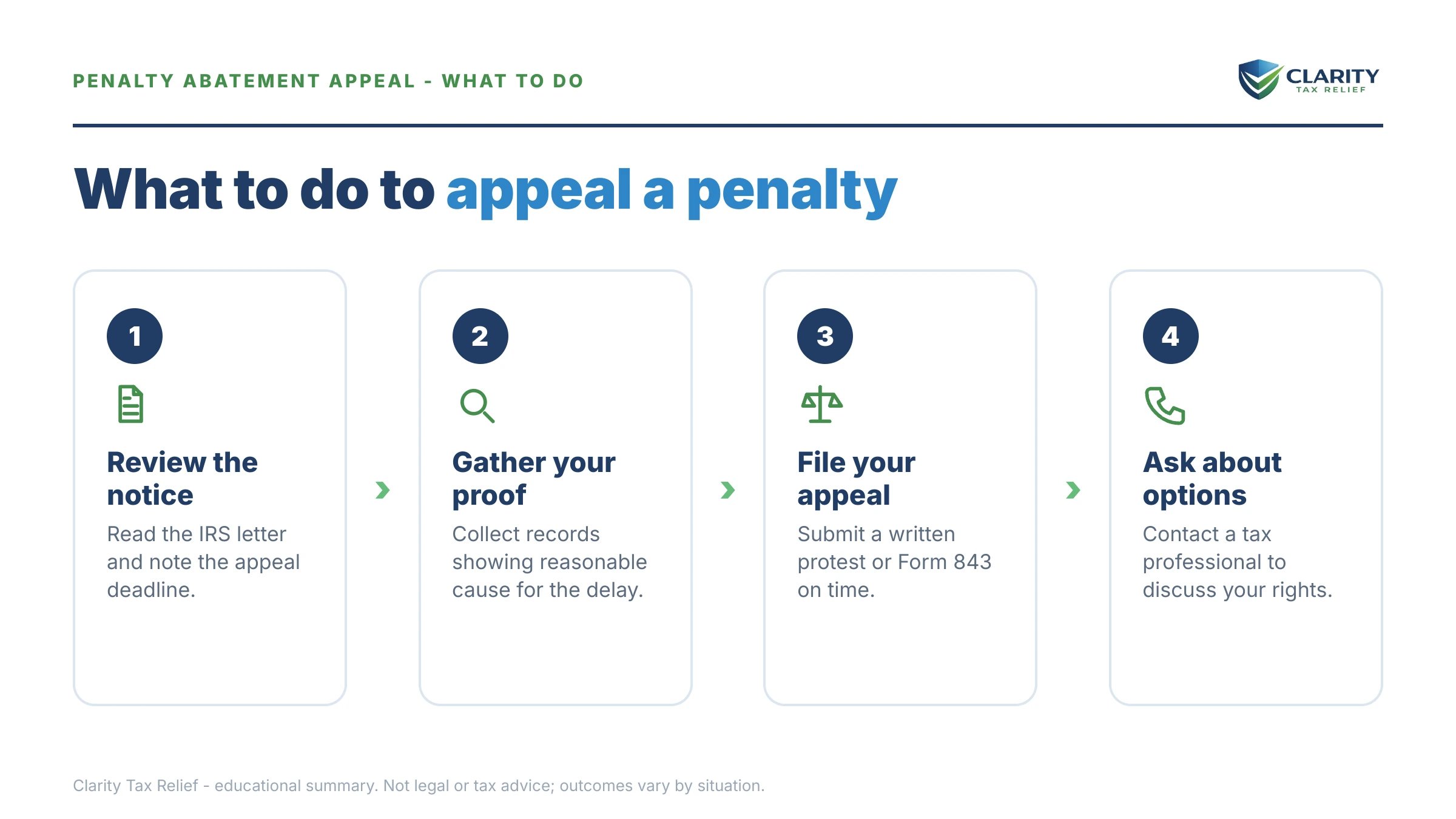
Holding a penalty denial letter right now?
Your appeal window is printed on that letter — and it's the only stage where an independent reviewer must take a fresh look for free. Get your denial letter and penalty transcripts reviewed before the response date passes: an experienced tax professional will tell you honestly whether the appeal is worth filing and what it needs to say.
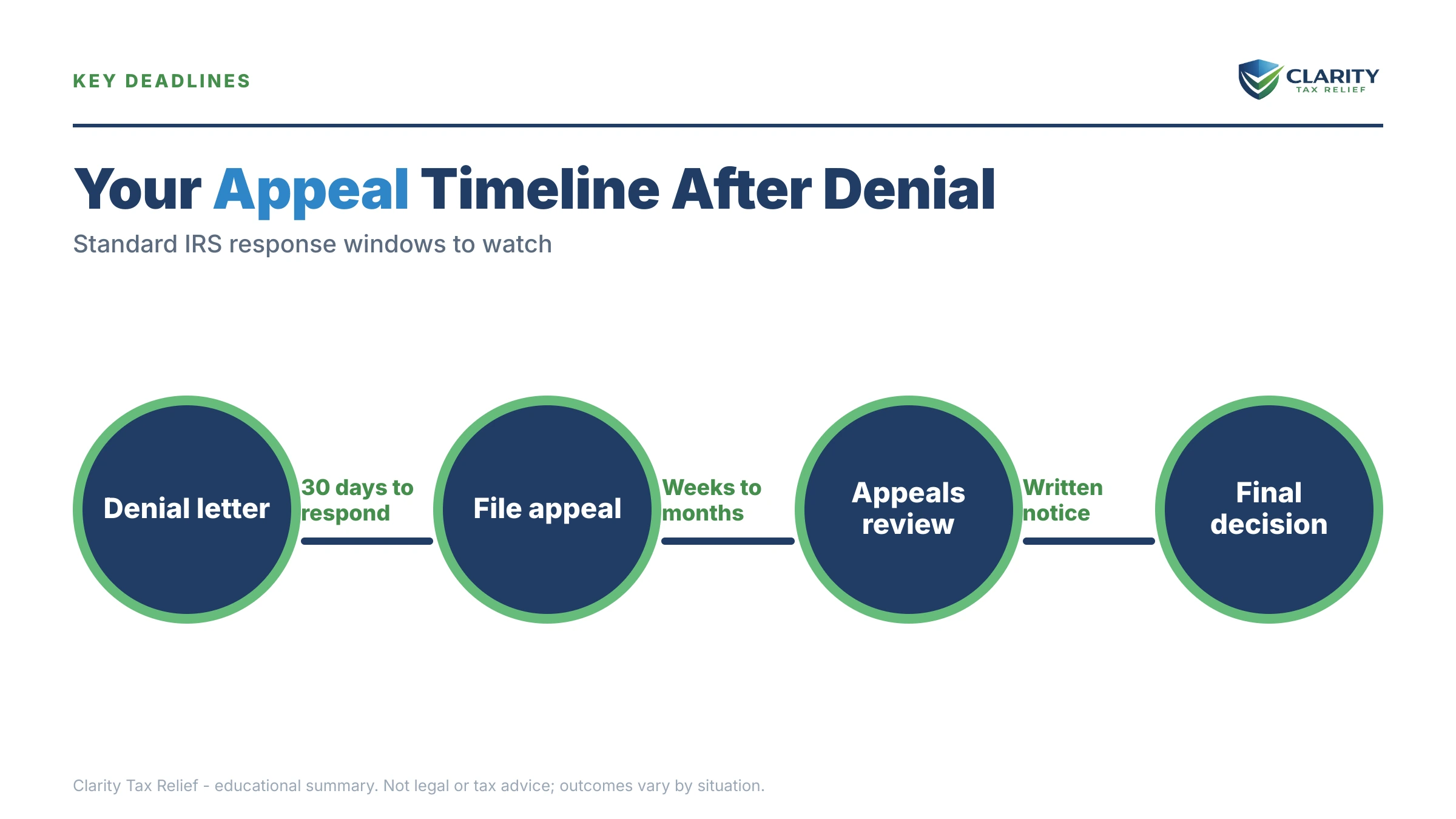
Your penalty abatement appeal options
A denied abatement leaves five real routes, and which one fits depends on the penalty size, whether the window is still open, and whether collection has already escalated:
- Small case request — Form 12203. Available to individuals and most sole proprietors when the disputed amount is $25,000 or less per tax period — S corporations, partnerships, and employee-plan/exempt-organization cases must file a formal written protest no matter the amount. One page, no legal brief, free to file.
- Formal written protest. Required above $25,000 per period — and for S corporations, partnerships, and employee-plan/exempt-organization cases at any amount — which covers most business penalty abatement denials. The protest states the facts, the penalties and periods disputed, the authority you rely on, and a penalties-of-perjury declaration.
- Re-request with new evidence. If the window closed or new documents surfaced, a rebuilt IRS penalty abatement letter restarts the decision cycle. A denial of the new request carries fresh appeal rights.
- Pay, then claim a refund. Pay the penalty, file Form 843, and pursue penalty abatement after paying. Paying stops interest on the disputed amount, and this is the required on-ramp to court. Our Form 843 penalty abatement request walkthrough covers the mechanics.
- CDP hearing. If an LT11 or Letter 1058 has already landed, Form 12153 within its 30-day window gets you before Appeals with the penalty dispute as part of the hearing — and levies generally hold off while the hearing is pending.
Three scope notes before you pick. First, the trust fund recovery penalty defense runs on a different track — a Letter 1153 proposal with its own protest deadline — so don't route a TFRP through this process. Second, state penalties are a separate system entirely; California's rules live in our FTB penalty abatement guide. Third, interest itself isn't abatable through this appeal except in narrow cases of IRS error or delay — see IRS interest abatement — though interest charged on an abated penalty comes off automatically.
One 2026 wrinkle worth knowing: the Automatic Exemption from Penalty (AEP) begins replacing first-time abatement this summer, applying qualifying relief automatically with no request. If your denial was an FTA denial, check whether AEP moots the fight before you spend effort appealing.
| Route | Best when | Cost | Timeline |
|---|---|---|---|
| Form 12203 small case request | Individuals and most sole proprietors; disputed penalty is $25,000 or less per tax period | Free to file | Often several months to an Appeals conference; varies with backlog |
| Formal written protest | Over $25,000 per period, multi-period payroll penalty stacks, or S corporation, partnership, and employee-plan/exempt-organization cases at any amount | Free to file; professional preparation optional | Similar; complex business cases run longer |
| Re-request with new evidence | Window missed, or documentation has materially improved | Free | Restarts a full decision cycle before any appeal |
| Pay + Form 843 refund claim | You want interest stopped, or you're heading to court | Full payment of the disputed penalty up front | Suit possible after denial or six months of no action; generally within two years of disallowance |
| CDP hearing (Form 12153) | LT11 / Letter 1058 already issued | Free | Must be requested within the 30-day window on the final notice |
How the IRS Independent Office of Appeals reviews your case
Appeals is structurally separate from the campus unit that denied you, and its officers hold a power that unit never had: settlement based on hazards of litigation — the realistic risk the IRS would lose if your case went to court. That single difference is why appealing a denial is not just asking the same question twice.
In practice, that means an Appeals officer can split a case the first reviewer had to decide all-or-nothing. If your documentation firmly covers some penalty periods and thinly covers others, Appeals can abate the strong quarters and sustain the weak ones. RCA software can't do that; a human with settlement authority can.
The conference itself is usually a phone call, months after you file. What moves it is not emotion but correspondence between your evidence and the penalty periods — a document dated inside the quarter beats a paragraph explaining the quarter:
| Reasonable-cause factor | Documents that prove it |
|---|---|
| Serious illness or hospitalization | Admission and discharge records, physician letters spanning the missed deadlines |
| Disaster or casualty | FEMA declaration, insurance claims, repair invoices, dated photos |
| Payroll-provider or preparer failure | Engagement letter, correspondence, proof you supplied funds and information on time |
| Records unavailable | Police or theft reports, court orders, third-party confirmations of loss |
| Clean compliance history (FTA) | Account transcripts showing three penalty-free prior years |
| Incapacity of the responsible person | Guardianship, conservatorship, or care documentation for the person who handled the taxes |
Two conduct rules while the appeal is pending. Stay current — new missed deposits or filings during the appeal undercut the "ordinary business care" story you're telling. And answer every information request by its date; Appeals closes unresponsive cases and the denial stands.
A worked example: appealing $92,700 in payroll penalties
Say your S corporation fell behind on payroll deposits for four quarters of 2024 while you were in and out of the hospital, and the IRS has now assessed $92,700 in penalties across the account:
- $52,000 in failure-to-deposit penalties — the 10% tier of the federal tax deposit penalty on $520,000 of deposits made more than 15 days late;
- $22,000 in failure-to-file penalties on two unfiled 941s — 5% per month capped at 25% on $88,000 of reported tax;
- $18,700 in failure-to-pay penalty accrued at 0.5% per month across the open balances.
Your first request cited the hospitalization but attached nothing, and the denial came back on the standard ground that hardship doesn't excuse late filing. On appeal — filed as a formal written protest, since S corporations can't use the Form 12203 small case route — you attach admission records covering Q2 and Q3, physician letters, and payroll-provider emails showing you funded Q4 deposits on time before the provider mis-transmitted them.
In this hypothetical, Appeals could concede the periods the records squarely cover — the $52,000 in deposit penalties and half the filing penalties ($11,000) — abating $63,000 and leaving $29,700 to resolve. The interest that was charged on the abated $63,000 would come off automatically with it. That outcome is illustrative, not predictive: the split depends entirely on how tightly your documents map to your penalty periods, and a weaker file produces a smaller number or none at all.
Before deciding whether the appeal is worth the effort, it helps to know how much of your balance is penalty versus interest versus tax — you can estimate that split with our IRS Penalty & Interest Calculator, since only the penalty portion (and its interest) is on the table in this appeal.
How to file a penalty abatement appeal, step by step
- Find your appeal deadline. Pull your denial letter and locate the response deadline and mailing address — the letter controls both. Calendar the date today; the window is typically 60 days from the letter date.
- Pick your appeal route. Use Form 12203 if you're an individual or sole proprietor and the penalty is $25,000 or less per tax period; write a formal protest if it is more — S corporations, partnerships, and employee-plan/exempt-organization cases must use a formal protest no matter the amount. Your protest must state the facts, the penalties and periods disputed, and the authority you rely on.
- Rebuild your evidence file. Collect third-party documentation that covers the exact penalty periods — medical records, disaster declarations, payroll-provider correspondence, account transcripts. Match each document to a date on your compliance timeline.
- Answer the denial's stated reason head-on. Your Letter 854C names why you were denied. Address that reason directly with evidence, then request a conference with the Independent Office of Appeals in your written appeal.
- Mail it certified and keep proof. Send the appeal to the address on the denial letter by certified mail before the deadline, keep complete copies, and stay current on all filings and deposits while it is pending.
- Prepare a one-page case summary for the conference. Appeals conferences are usually by phone. Distill your case to a one-page timeline with exhibits, and know your acceptable settlement range before the call.
When you can handle the appeal yourself — and when help changes the outcome
You can reasonably file this appeal yourself when the dispute is small and the fix is factual. A single penalty of a few thousand dollars, an FTA denial where your transcripts show the lookback record is simply wrong, or one missed deadline covered by one dated document — Form 12203, the document, and certified mail will carry that case. You never need to pay first to get an administrative appeal, and you never need representation to be heard.
Experienced help changes outcomes in a different class of case: multi-quarter payroll penalty stacks like the $92,700 example, where the protest has to allocate evidence period by period; formal protests over $25,000 that require framing the legal standard, not just the story; appeals running in parallel with active collection, where a CDP hearing and the abatement fight have to be sequenced; and anything adjacent to a trust fund recovery penalty, where a badly worded statement can create personal liability that didn't exist before. Appeals officers settle against the strength of the file in front of them — building that file is the craft.
If your case sits in that second class, get your denial letter and transcripts in front of an experienced tax professional before the response date — or call (888) 825-7779 — so the protest is built once, correctly.
Terms on your denial letter, decoded
- Letter 854C — the IRS letter denying a penalty abatement request or refund claim, in whole or in part; it states the reason and your appeal window.
- Independent Office of Appeals — a separate IRS office whose mission is resolving disputes without litigation; the people who denied you don't work there.
- Reasonable cause — the legal standard for most penalty relief: facts showing you exercised ordinary business care and prudence but still couldn't comply.
- Hazards of litigation — Appeals' authority to settle based on the risk the IRS would lose in court; the first reviewer had no such authority.
- RCA (Reasonable Cause Assistant) — the IRS software that screens abatement requests; many first-round denials trace to its rigid decision tree, not a human judgment.
- Form 843 — the claim form for requesting abatement or a refund of penalties already paid; a denied 843 carries its own appeal rights.
For the IRS's own framing of these programs, see the official pages on penalty relief and the Independent Office of Appeals.
Penalty abatement appeal FAQs
How do I appeal a denied penalty abatement request?
Send a written appeal to the address on your denial letter before the deadline printed on it. If you're an individual or sole proprietor and the penalty is $25,000 or less per tax period, Form 12203 works; otherwise — including for S corporations, partnerships, and employee-plan/exempt-organization cases at any amount — you need a formal written protest stating the facts, the penalties disputed, and why the denial was wrong. The case then transfers to the IRS Independent Office of Appeals — a separate office from the one that denied you.
What is Letter 854C?
Letter 854C is the IRS letter that denies — in whole or in part — a penalty abatement request or refund claim and explains your appeal rights. It states why the IRS said no and how long you have to appeal, typically 60 days from the letter date. Keep it: the denial reason it names is the exact argument your appeal needs to answer.
How long does a penalty abatement appeal take?
There is no fixed timeline; simple cases can resolve in a few months, while complex business cases often take longer, especially with Appeals staffing thinned by the 2025 IRS workforce cuts. Interest keeps accruing on any unpaid balance the whole time. If the appeal succeeds, the interest charged on the abated penalties is removed along with them.
Can I appeal a first-time abatement denial?
Yes. FTA denials are often mechanical — a small penalty somewhere in the three-year lookback window, sometimes one you never noticed, disqualifies you automatically. Pull your account transcripts, and if the lookback record is wrong, an appeal or even a phone call can fix it. Starting summer 2026, the Automatic Exemption from Penalty (AEP) begins replacing FTA with relief applied automatically, no request needed.
Do I have to pay the penalty before I can appeal?
No — the administrative appeal to the IRS Independent Office of Appeals does not require payment. You only must pay first if you take the court route: pay in full, file a Form 843 refund claim, and sue in federal district court or the Court of Federal Claims if the claim is denied. Keep in mind the balance keeps growing during an unpaid appeal.
Does interest stop while my penalty abatement appeal is pending?
No. Interest continues to accrue on the unpaid penalty and the underlying tax throughout the appeal. The upside: if Appeals abates a penalty, the interest that was charged on that penalty comes off automatically. Some taxpayers pay the disputed amount to stop interest and pursue the refund route instead — the right choice depends on your cash flow and how strong the case is.
What are the chances of winning a penalty abatement appeal?
Outcomes depend almost entirely on documentation and whether your facts fit an established reasonable-cause category. Appeals officers can settle based on hazards of litigation — the risk the IRS would lose in court — so even imperfect cases can resolve partially rather than all-or-nothing. Cases with third-party proof, like hospital records or disaster declarations covering the exact penalty periods, fare best.
Can I go to court if my penalty abatement appeal is denied?
Yes, but for most standalone penalties you must pay first. Pay the penalty, file Form 843 as a refund claim, and if the IRS denies it or sits on it for six months, you can sue in federal district court or the Court of Federal Claims — generally within two years of the disallowance notice. Penalties tied to a deficiency case can sometimes reach Tax Court without payment.
What if I missed the deadline on my denial letter?
You have not lost everything. You can submit a new abatement request with stronger evidence and start a fresh decision cycle, or pay the penalty and file Form 843 to claim a refund, which carries its own appeal rights if denied. What you lose is the direct appeal of the original denial — so act on the new route promptly, because interest is still accruing.
Your next 24 hours
- Find your response date. It's in the closing paragraphs of your denial letter, along with the mailing address your appeal must go to. Write both down before the letter gets buried in a drawer.
- Gather the file. The denial letter, your original abatement request, account transcripts for every penalty year, and any third-party document — medical, disaster, provider correspondence — that touches the penalty periods.
- Get the free case review before the response date passes. Call (888) 825-7779 or use the 2-minute form. An experienced tax professional will tell you whether the appeal is worth filing, which route fits your numbers, and what the protest has to say to give Appeals room to settle. If the numbers say the appeal isn't worth it, we'll tell you that too. Independent guidance is also available from the Taxpayer Advocate Service.
This guide is general information, not tax or legal advice for your specific situation. Eligibility for IRS programs depends on individual facts and circumstances; no outcome is guaranteed.