
IRS Penalties & Appeals
Trust Fund Recovery Penalty Defense: How to Fight the TFRP in 2026
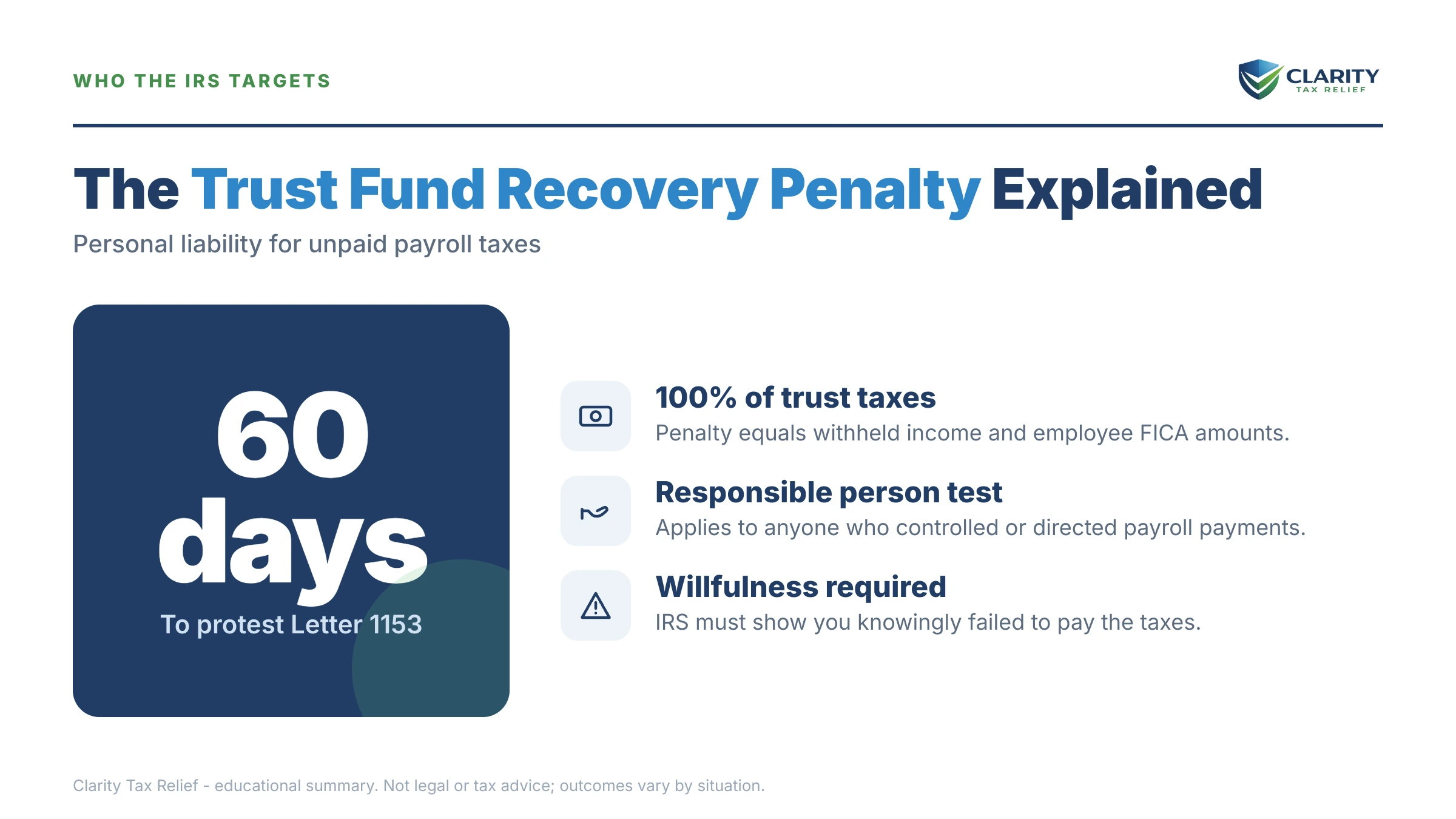
The short answer: trust fund recovery penalty defense means proving one of three things — you weren't a "responsible person," you didn't act "willfully," or the IRS's number is wrong. Your strongest window is the 60 days after Letter 1153: a written protest to IRS Appeals can remove the penalty before it's ever assessed.
The letter isn't addressed to the business. It's addressed to you — and it proposes making a company's payroll tax debt your personal debt, collectible from your paycheck, your bank account, and the house you own with your spouse. That's what makes trust fund recovery penalty defense different from every other tax fight: the business's problem is trying to follow you home, and the law gives you a real, structured way to stop it.
The proposal usually arrives as Letter 1153 with Form 2751 stapled behind it. The image below shows you exactly what this package looks like and where to find the date that starts your 60-day clock — because that date, not the day you opened the envelope, controls everything.
⏱ Your deadline: you have 60 days from the date printed on Letter 1153 to file a written protest with IRS Appeals (75 days if the letter was addressed to you outside the U.S.). After day 60, the IRS assesses the penalty against your Social Security number and your fight moves from Appeals into personal collections.
Why the IRS is proposing this penalty against you personally
The trust fund recovery penalty under IRC §6672 equals 100% of the withheld income tax and the employees' share of Social Security and Medicare that a business failed to pay over. Those dollars were taken out of workers' paychecks and held "in trust" for the government — and when they don't arrive, the IRS is allowed to collect them from the individuals who controlled the money, not just the company. Our companion guide to the trust fund recovery penalty covers who lands in the crosshairs; this page is about how to fight your way out.
Before Letter 1153 arrives, a revenue officer typically opens an investigation — often announced by Letter 3164 — and conducts the Form 4180 interview, a structured questionnaire about who signed checks, who decided which bills got paid, and who knew the 941s were behind. Letter 1153 means the officer has concluded you meet both legal tests: you were "responsible," and you acted "willfully." The IRS must prove both. Defeating either one defeats the penalty.
One structural point that shapes strategy: the IRS proposes the full penalty against every person it believes is responsible — the owner, the CFO, sometimes a check-signing office manager. It collects the money only once, but it doesn't have to collect it evenly, and it will collect from whoever is easiest to reach. Your defense file is about making sure that person isn't you when the facts say it shouldn't be.
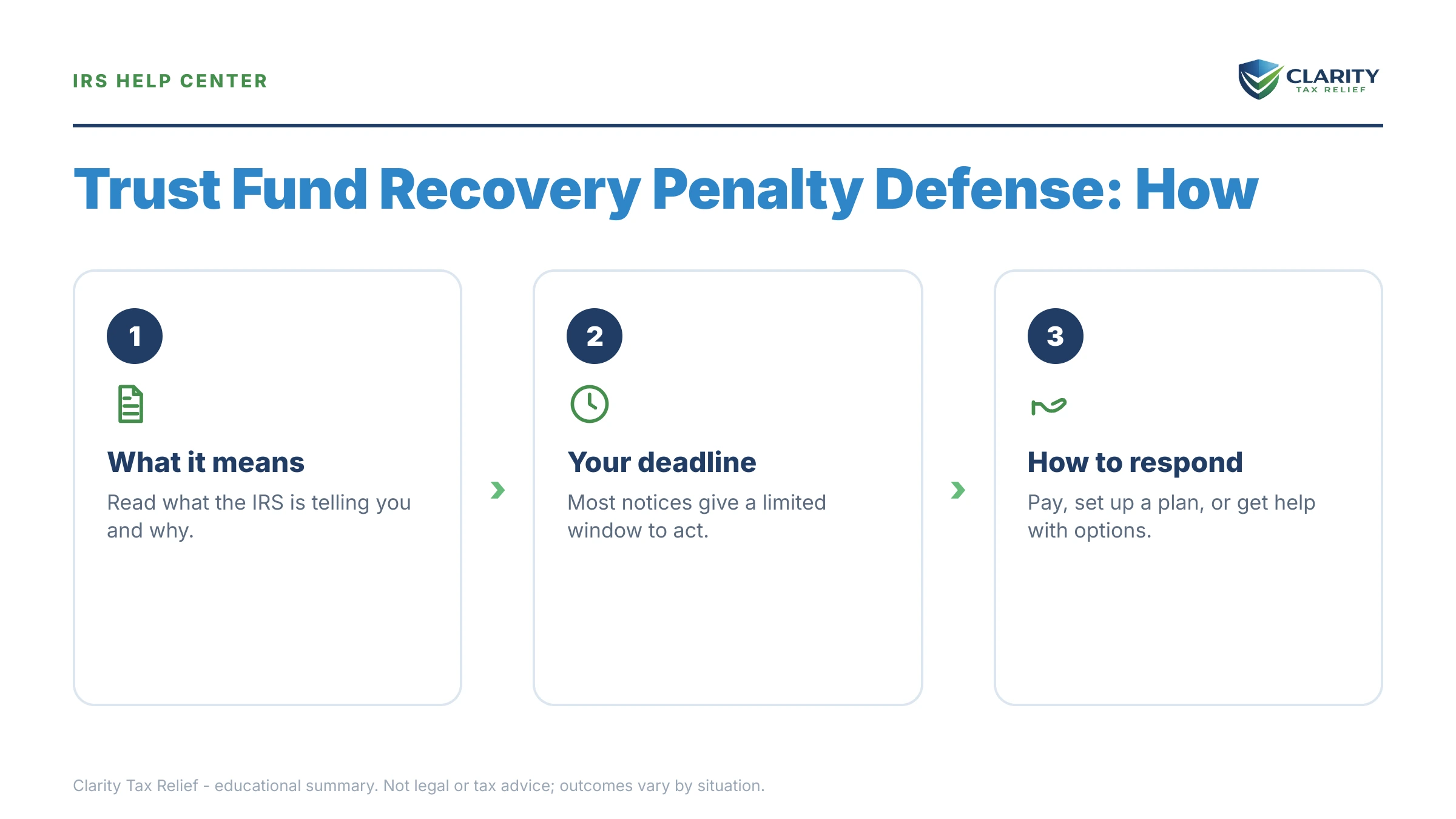
Trust fund recovery penalty defense: the three arguments that actually work
Every successful TFRP defense attacks responsibility, willfulness, or the math — usually in that order. Vague fairness arguments ("the business failed, I lost everything too") don't move Appeals. Evidence tied to one of these three elements does.
1. You weren't a responsible person. Responsibility is about actual control over which creditors got paid — not job titles, not being listed on corporate filings, not even having your name on the bank account if someone else truly directed the money. A minority investor with a vice-president title who never touched the checkbook has a real defense. So does a bookkeeper who cut checks only as instructed; our guide on whether a bookkeeper is personally liable to the IRS walks through that specific fact pattern, and the broader personally liable for payroll taxes guide maps every role.
2. You weren't willful. Willfulness doesn't require bad intent — it means you knew the withheld taxes were unpaid and paid other creditors anyway, or recklessly ignored red flags. That's why "I was going to catch up next quarter" fails: paying rent and suppliers while 941 money sat unpaid is willfulness once you knew. The defense works when you genuinely didn't know and had no reason to: an owner who was shown falsified deposit confirmations, or an employer whose payroll company didn't pay the taxes it collected. The critical timeline question is always: when did you learn, and what did you do the day after?
3. The number is wrong. The TFRP can only include trust fund amounts — withheld income tax plus the employees' share of FICA. It cannot include the employer's matching FICA, failure-to-deposit penalties, or interest on the business account. Proposals also routinely include quarters when you had no authority (you hadn't bought in yet, or you'd already resigned) or ignore payments the business designated to the trust fund portion. Even when full removal isn't realistic, cutting quarters and correcting the math regularly shrinks the exposure substantially.
| Defense | What you must show | Evidence that carries weight |
|---|---|---|
| Not a responsible person | No real authority over which bills were paid | Bank signature cards, corporate minutes, org charts, statements showing an owner controlled all payments |
| Not willful | You didn't know taxes were unpaid and didn't ignore red flags | Falsified records you were shown, payroll-provider fraud evidence, proof of action once you learned |
| Wrong amount | Proposal includes non-trust-fund amounts or misses payments | Filed 941s, deposit records, letters designating payments to the trust fund portion |
| Wrong quarters | No authority during some of the periods proposed | Hire/resignation dates, stock purchase or sale documents, signature-card change dates |
| You were overruled | Someone with superior authority ordered the taxes unpaid | Emails and directives showing an owner or officer blocked payment despite your objection |
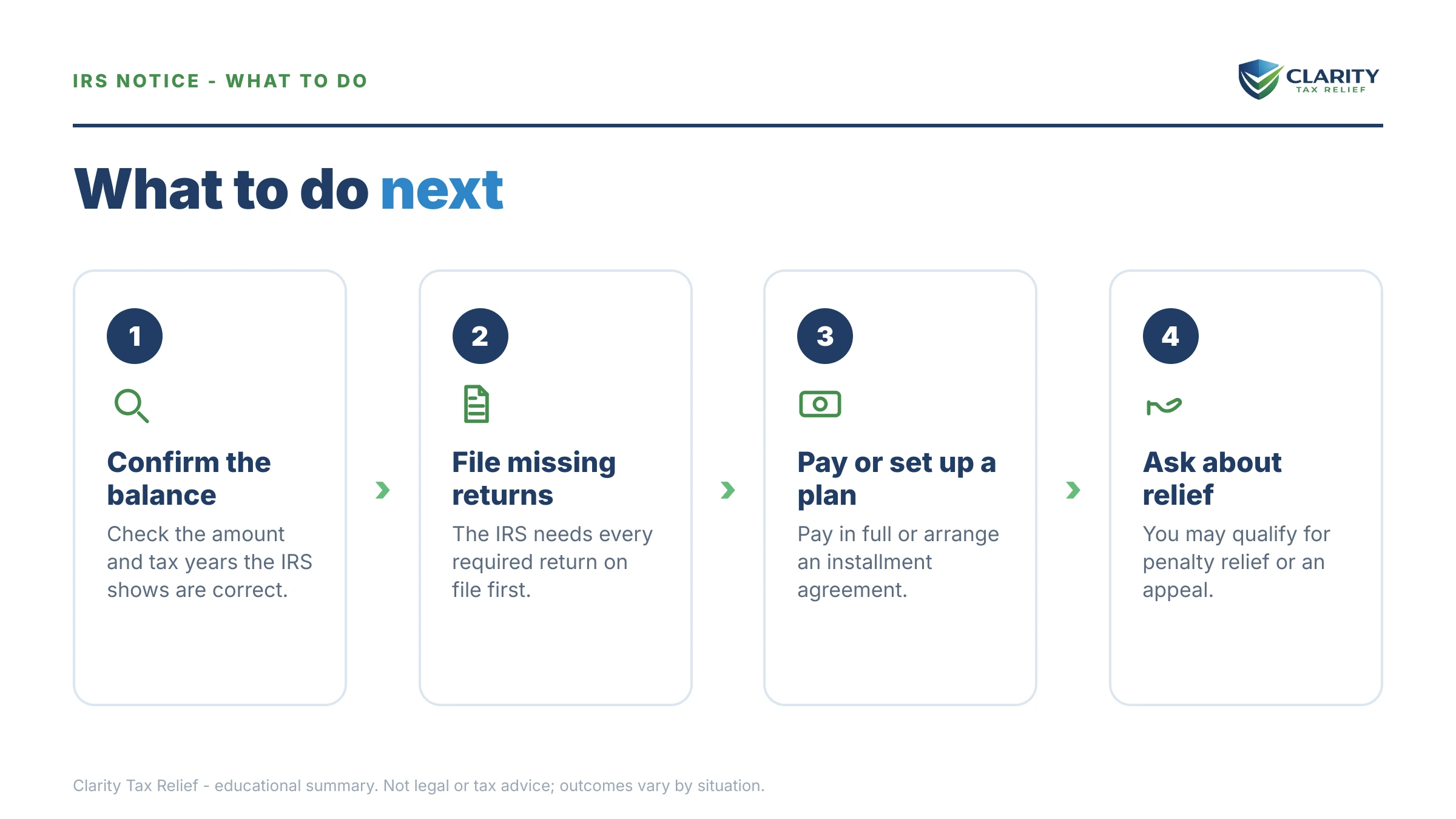
What happens if you miss the 60-day window
After day 60 with no protest, the IRS assesses the full proposed penalty against your Social Security number — and personal collection begins. The sequence is mechanical:
- Day 60 passes — the proposal becomes an assessment on your personal account, as a civil penalty. Interest starts running on the assessed amount from that point.
- Notice and demand — you receive a bill in your own name, followed by the standard collection notice stream if unpaid.
- Federal tax lien — the IRS can file a lien against your personal assets, including a home you own jointly with your spouse.
- Final notice of intent to levy — an LT11 or Letter 1058 opens a 30-day window, after which the IRS can levy your wages and personal bank accounts.
- A fresh 10-year collection clock begins — the TFRP assessment gets its own Collection Statute Expiration Date, separate from the business's clock. You can estimate where any assessment stands with our CSED Calculator.
Two more consequences make missed windows expensive. First, the TFRP is not dischargeable in bankruptcy — trust fund taxes survive Chapter 7 and Chapter 13 no matter how old they are. Second, every other responsible person is assessed the same 100%, and the IRS pursues whoever has reachable assets first. If you pay more than your share, your remedy is a contribution claim against the other responsible persons under §6672(d) — a lawsuit you have to bring yourself, in court, at your own expense. It is far cheaper to win the allocation fight at Appeals than to fund it later in litigation.
One timing wrinkle worth knowing: the IRS generally must assess the TFRP within three years of the April 15 following the year the quarterly returns were due. When that assessment deadline is close, the revenue officer may ask you to sign Form 2750 to extend it. Whether signing helps you (buying time for Appeals) or hurts you (extending the IRS's reach) is a genuinely strategic call — don't sign it reflexively in either direction.
Holding Letter 1153 right now?
Get it reviewed free before your 60-day protest window closes. An experienced tax professional will assess your responsibility and willfulness exposure, check the IRS's math against the 941s, and tell you honestly whether a protest can win — before anything is assessed against you personally.
Your defense options at every stage of a TFRP case
There are seven distinct ways to fight or resolve a TFRP, and which ones are open depends entirely on where you are in the process. Pre-assessment routes attack the penalty before it exists; post-assessment routes are slower and cost more, but they're real.
| Option | Who's eligible | What it can win |
|---|---|---|
| Respond during the investigation (Letter 3164 / Form 4180 stage) | Anyone contacted before Letter 1153 issues | Persuade the revenue officer not to propose the penalty against you at all |
| Written protest to Appeals | Within 60 days of Letter 1153 (75 outside U.S.) | Full or partial removal before assessment — periods, amounts, or the whole penalty |
| Small case request | Disputed amount of $25,000 or less per tax period | Same Appeals review with a simpler, shorter filing |
| Doubt-as-to-liability offer (Form 656-L) | Already assessed; you dispute that you owe it | Re-examination of the merits — no application fee, no financial disclosure |
| Refund-claim route (Form 843 + federal court) | Already assessed; pay one employee's trust fund portion for one quarter first | Court review of the entire liability; refund if you win |
| CDP hearing (Form 12153) | Final levy notice received AND you never got Letter 1153 | Liability challenge plus collection alternatives, with Tax Court review rights |
| Payment resolution (installment agreement, CNC, collectibility OIC) | Liability stands after the fight | Affordable collection terms — manages the debt rather than removing it |
Three of these deserve unpacking, because they're the ones people don't know exist:
The doubt-as-to-liability offer. Unlike a regular offer in compromise, a doubt as to liability offer on Form 656-L argues you don't owe the penalty — not that you can't pay it. It has no application fee and requires no financial disclosure. It's the main second chance for people who let the 60-day window pass.
The refund-claim route. Payroll taxes are "divisible," which creates a rare door into federal court: you pay only the trust fund portion attributable to one employee for one quarter — often a modest amount — then file a refund claim. Our Form 843 walkthrough covers the mechanics. If the IRS denies the claim or sits on it for six months, you can sue in district court or the Court of Federal Claims and have a judge decide responsibility and willfulness from scratch.
The CDP hearing. If you genuinely never received Letter 1153 — it went to an old address, for instance — you can challenge the underlying liability in a CDP hearing via Form 12153 when the final levy notice arrives. If you did receive Letter 1153 and skipped the protest, CDP still pauses levies and opens collection alternatives, but the liability itself is off the table there. For narrower collection-action disputes on a faster track, a CAP appeal is the sibling tool — quicker, but with no court review and no liability challenge.
| Route | Out-of-pocket cost | Typical timeline |
|---|---|---|
| Appeals protest of Letter 1153 | $0 to file (professional fees if represented) | Often several months to a year to conference and decision |
| Form 656-L doubt-as-to-liability offer | $0 — no application fee, no deposit | Commonly many months; collection generally pauses while pending |
| Refund claim + federal court suit | One employee's trust fund portion for one quarter, plus litigation costs | 6-month claim period before suit; litigation adds a year or more |
| CDP hearing | $0 to request | Scheduling varies; levy action on the covered periods pauses while pending |
| Installment agreement on an assessed TFRP | Setup fee varies by method; interest continues | Can be in place within weeks; payments run until paid or the CSED expires |
A worked example: $31,200 proposed against one spouse
Say a married couple filing jointly gets Letter 1153 addressed to one spouse, who ran a small LLC that fell four quarters behind on payroll taxes. This is hypothetical, with the math shown:
- The business's total 941 debt is $47,900: withheld federal income tax of $18,480, employees' share of Social Security and Medicare of $12,720, the employer's matching FICA of $12,720, and about $3,980 in deposit penalties and interest.
- The trust fund portion — the only part assessable personally — is $18,480 + $12,720 = $31,200. The remaining $16,700 stays with the business alone. If the proposal on Form 2751 is higher than the true trust fund number, that alone is grounds to protest.
- Now suppose the spouse bought into the business mid-year and had no check-signing authority for the first two quarters, which carry $15,900 of the trust fund total. A protest documenting the buy-in date and signature-card change could cut personal exposure to $15,300 before the willfulness fight even starts.
- If the business is still operating, every dollar it pays with a written designation to the trust fund portion reduces the personal exposure dollar-for-dollar. A $10,000 designated payment drops the remaining exposure to $5,300 — while an undesignated $10,000 payment lets the IRS apply it to the employer-share balance first, reducing the personal exposure by nothing.
That last bullet is the most commonly missed move in TFRP defense: voluntary business payments should be designated in writing to the trust fund portion, oldest quarter first, every single time.
Married filing jointly? What the TFRP reaches — and what it doesn't
A joint tax return does not make your spouse liable for your trust fund recovery penalty. The TFRP attaches to each responsible person individually — a spouse is on the hook only if they independently controlled payments and knew the taxes went unpaid. But "not liable" and "not affected" are different things for a married couple:
- Joint refunds are exposed. Once the TFRP is assessed against one spouse, the IRS can offset the couple's joint refund. The uninvolved spouse can recover their share by filing an injured spouse Form 8379 with (or after) the return.
- Joint bank accounts can be levied to the extent of the liable spouse's funds. Keeping the uninvolved spouse's income clearly traceable — ideally in a separate account — matters once assessment is on the table.
- A lien clouds jointly owned property. A federal tax lien against one spouse attaches to that spouse's interest in the home, which complicates refinancing or selling even though the other spouse's interest is protected.
- Community property states are different. Where community property law applies, the IRS may reach community assets and income for one spouse's TFRP — get advice specific to your state before assuming anything is out of reach.
- Don't volunteer the spouse into liability. If the uninvolved spouse occasionally signed checks as a convenience, the Form 4180 interview can turn that into a second responsible-person case. Both spouses should understand the interview's purpose before either sits for it.
How to respond to a proposed trust fund recovery penalty, step by step
- Find the date on Letter 1153 and calendar day 60 — your protest deadline runs from the letter date, not the day you opened it; count 60 days and write it down.
- Do not sign Form 2751 — signing consents to the assessment and generally waives your Appeals protest; get advice before agreeing to anything.
- Pull the evidence that maps to your defense — gather bank signature cards, corporate records, payroll files, emails about who directed payments, and your Form 4180 answers.
- Verify the IRS's trust-fund math — check the proposed amount against the 941s; it should exclude the employer's matching FICA, deposit penalties, and interest.
- File your written protest before day 60 — send it to the address on Letter 1153, stating each period, each fact you dispute, and the law supporting your position, signed under penalties of perjury.
- Prepare for the Appeals conference — organize exhibits around responsibility, willfulness, and the math, and be ready to negotiate periods and amounts; partial wins are common.
If your dispute is $25,000 or less per period, a small case request substitutes for the formal protest — same Appeals review, lighter paperwork. The deep dive on the letter itself lives in our IRS Letter 1153 guide; the Appeals protest playbook works much the same way in an ERC disallowance appeal, if you're fighting on that front too.
When you can handle this yourself — and when help changes the outcome
Some TFRP situations are genuinely manageable alone. If you agree you were responsible and willful, the proposed amount matches the trust fund math, and the number is one you can realistically pay, you may not need representation — your task is a payment resolution, and the general playbook in how to settle tax debt yourself covers the mechanics of setting one up. Likewise, if the IRS proposed clearly wrong quarters (you provably weren't there), a short, well-documented protest can succeed on its own.
Experienced help tends to change the outcome when the case turns on judgment calls: willfulness disputes where the timeline of what-you-knew-when decides everything, multi-person cases where the IRS is choosing whom to pursue and allocation is negotiable, a Form 4180 interview that hasn't happened yet (what you say there becomes the government's evidence), a business still operating whose payments need designating, or any post-assessment fight — the 656-L and refund-claim routes are procedural minefields where a misstep forfeits the claim. And because the TFRP survives bankruptcy, there's rarely a backstop if the defense is botched.
If the business behind the penalty is still open and behind on deposits, stopping the bleeding matters as much as the defense — our 941 back taxes guide covers getting current so new quarters don't pile onto the exposure. If your best argument isn't liability but circumstances, see trust fund penalty abatement for the narrow reasonable-cause terrain.
Not sure which bucket you're in? A free case review of your Letter 1153 will tell you within a day whether your facts support a protest worth filing — start with the 2-minute form or call (888) 825-7779.
Terms on your Letter 1153, decoded
- Trust fund taxes — the withheld income tax and employees' share of FICA a business holds "in trust" for the government; the only amounts the TFRP can include.
- Responsible person — anyone with actual authority to decide which creditors got paid; determined by function, not title.
- Willfulness — knowing the taxes were unpaid and paying other creditors anyway, or recklessly ignoring the signs; bad intent is not required.
- Form 2751 — the "Proposed Assessment" agreement attached to Letter 1153; signing it consents to the penalty and generally waives your protest.
- Divisible tax — a tax you can contest in court after paying only a divisible slice (one employee, one quarter) instead of the whole balance.
- CSED — the Collection Statute Expiration Date; a TFRP assessment starts its own 10-year collection clock, separate from the business's.
Trust fund recovery penalty defense questions, answered
Can you fight a trust fund recovery penalty?
Yes — the TFRP requires the IRS to prove both that you were a responsible person and that you acted willfully, and defeating either element defeats the penalty. Your strongest window is the 60 days after Letter 1153, when a written protest goes to the IRS Independent Office of Appeals before anything is assessed. Even after assessment, the doubt-as-to-liability offer and the refund-claim route can still reverse it.
How long do I have to appeal Letter 1153?
You have 60 days from the date printed on Letter 1153 to file a written protest — 75 days if the letter was addressed to you outside the United States. Miss that window and the IRS assesses the penalty against your Social Security number, which moves your fight from Appeals into collections. The clock runs from the letter date, not the day you opened the envelope, so calendar it immediately.
Can my spouse be held liable for my trust fund recovery penalty?
Not automatically — the TFRP is personal to each responsible person, and filing a joint tax return does not spread it to your spouse. A spouse is only liable if they independently meet the responsibility and willfulness tests, such as signing payroll checks and deciding which bills got paid. That said, a joint refund can be offset for one spouse's TFRP, and in community property states community assets may be reachable, so the uninvolved spouse should consider an injured spouse claim.
What makes someone a responsible person for the TFRP?
A responsible person is someone with real authority to decide which creditors got paid — not just someone with an officer title or a name on the bank account. The IRS looks at check-signing authority, hiring and firing power, control over the books, and who actually directed payments. Titles alone do not decide it: a figurehead vice president may escape liability while a non-owner office manager who controlled the checkbook may not.
What does willful mean for the trust fund recovery penalty?
Willful means you knew the withheld payroll taxes were unpaid and paid other creditors anyway, or recklessly ignored obvious warning signs. It does not require bad intent — paying rent, suppliers, or net wages while 941 taxes sat unpaid is enough once you knew. The strongest non-willfulness cases involve people who were genuinely misled, such as by falsified records or a payroll provider that pocketed the deposits.
Should I sign Form 2751?
Not before you understand what it does — Form 2751 is your written consent to the assessment, and signing it generally gives up your right to protest to Appeals. It arrives stapled to Letter 1153 and looks like routine paperwork, which is exactly why people sign it at the Form 4180 interview and regret it. If you dispute responsibility, willfulness, or the amount, get the letter reviewed before you sign anything.
Can I fight the TFRP after it has already been assessed?
Yes, three routes remain after assessment. A doubt-as-to-liability offer on Form 656-L asks the IRS to re-examine the merits and has no application fee. The refund-claim route lets you pay only the trust fund portion for one employee for one quarter, file Form 843, and sue in federal court if the claim is denied. And if you never actually received Letter 1153, you can raise liability in a Collection Due Process hearing when the final levy notice arrives.
Can the trust fund recovery penalty be included in an offer in compromise?
Yes — once assessed against you personally, the TFRP can be compromised based on doubt as to collectibility like any other personal tax debt, if your assets and income genuinely cannot cover it. The IRS accepted roughly 1 in 5 offers in FY2024, so it is a real but means-tested path, never a guarantee. If your dispute is about whether you owe it at all, the doubt-as-to-liability offer is the better-fitting tool.
Does the trust fund recovery penalty go away in bankruptcy?
No — trust fund taxes are priority debts that survive both Chapter 7 and Chapter 13, no matter how old they are. Bankruptcy can pause collection while the case is open and a Chapter 13 plan can structure repayment, but the TFRP itself is not discharged. That makes fighting the liability on the merits, or resolving it through IRS programs, the realistic path.
Does first-time penalty abatement apply to the TFRP?
No — first-time abatement covers failure-to-file, failure-to-pay, and failure-to-deposit penalties, not the Section 6672 trust fund recovery penalty. The TFRP is really a collection device for the withheld tax itself, so it comes off only by defeating responsibility or willfulness, correcting the math, or winning a post-assessment claim. Reasonable-cause arguments against the TFRP exist but succeed only in narrow circumstances.
Your next 24 hours
- Find the date on Letter 1153 — it's printed near the top of the first page — and count 60 days forward. Write that deadline where you'll see it; it controls every option you have.
- Gather your control evidence: bank signature cards, the filed 941s, payroll records, corporate documents, and any emails showing who actually directed which bills got paid — and set Form 2751 aside unsigned.
- Get a free case review before the window closes: use the 2-minute form or call (888) 825-7779. An experienced tax professional will tell you whether your facts support a protest — and if the deadline is days away, how to preserve your rights in time.
Primary sources: the IRS's overview of employment taxes and the trust fund recovery penalty, the IRS Independent Office of Appeals, and the Taxpayer Advocate Service for cases stuck in the system.
This guide is general information, not tax or legal advice for your specific situation. Eligibility for IRS programs depends on individual facts and circumstances; no outcome is guaranteed.