
IRS Penalties
Trust Fund Penalty Abatement: How to Remove or Reduce the TFRP in 2026
The short answer: trust fund penalty abatement works differently from ordinary penalty relief — first-time abatement does not apply to the Trust Fund Recovery Penalty. The paths that actually work are a 60-day Letter 1153 protest, a Form 843 claim attacking responsibility or willfulness, the divisible-tax refund route, and an Offer in Compromise.
The business's payroll tax problem just became your personal problem. The IRS has assessed the Trust Fund Recovery Penalty against you by name — not the company — and the collection letters now threaten your paycheck and your bank account, not a corporate one. When you rent and live on your income, a levy isn't an abstraction; it's next month's rent.
Here's the part almost nobody tells you before you start Googling: the abatement playbook that works on ordinary IRS penalties mostly does not work on this one. But the TFRP has its own set of challenge paths — some of them stronger than anything available for regular penalties. The image below shows how those paths fit together and where your situation sits in the sequence.
⏱ The clocks that matter: you have 60 days from the date on Letter 1153 to protest the trust fund penalty before it is assessed. If you're past assessment and holding an LT11 final notice of intent to levy, you have 30 days to request a Collection Due Process hearing. Both dates are printed on the letters — check yours today.
Why the IRS assessed the trust fund penalty against you personally
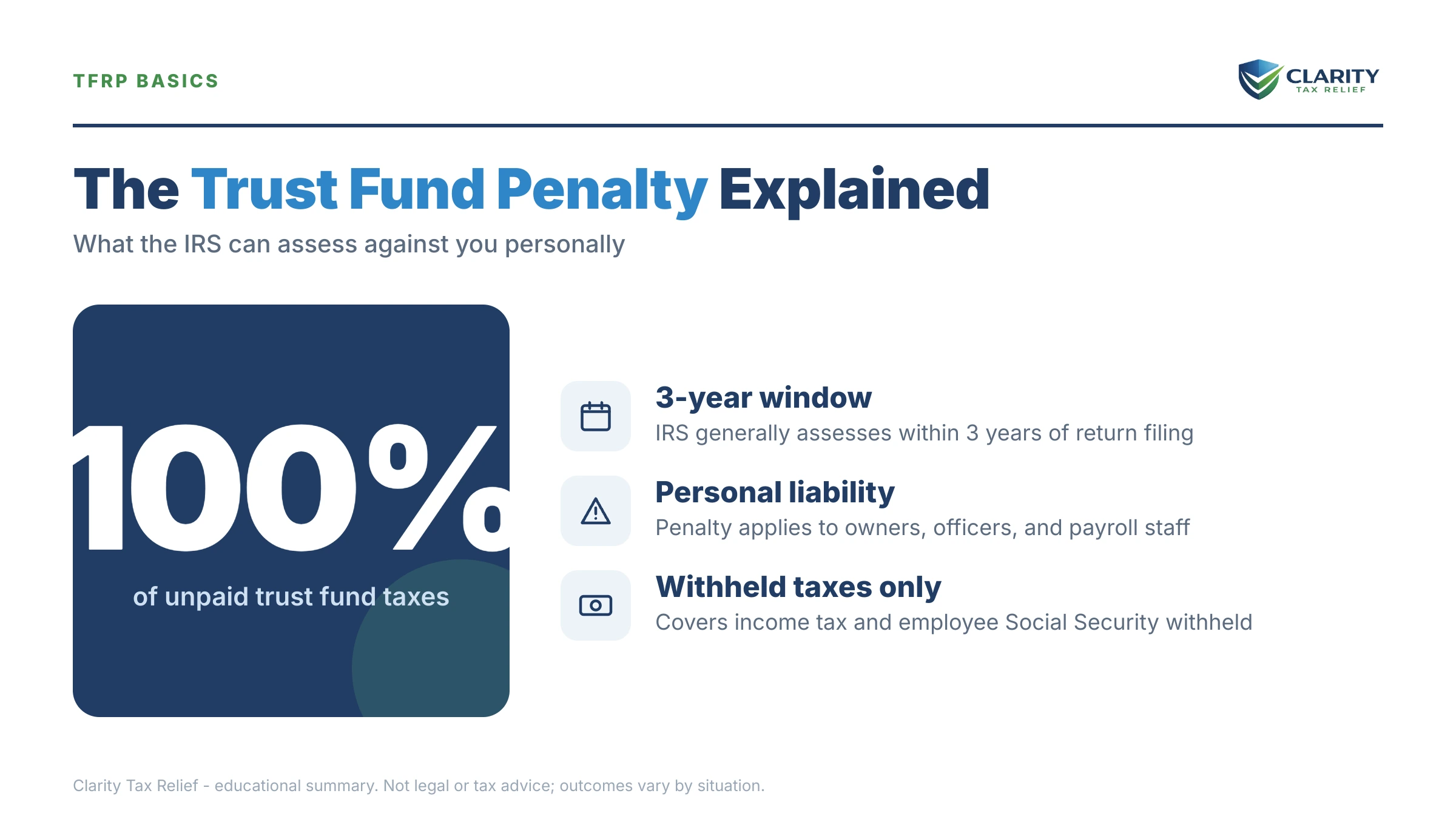
The Trust Fund Recovery Penalty under IRC §6672 equals 100% of the withheld income tax and employee FICA that a business collected from paychecks but never sent to the IRS. It isn't a percentage added on top of a tax — the penalty is the trust fund money, moved from the business's account to yours.
To assess it, the IRS had to conclude two things about you. First, that you were a responsible person — someone with the status, duty, and authority to decide which bills got paid. Second, that you acted willfully — you knew (or recklessly ignored) that the withholding wasn't being deposited, and money went to other creditors anyway. Owners, officers, bookkeepers, and check-signers all get swept in; the full liability map is in our trust fund recovery penalty guide, and the non-owner angle is covered under personally liable payroll taxes.
Usually the case was built through a Form 4180 interview with a revenue officer — how you answered those questions often decides how winnable your abatement case is now (see our form 4180 interview guide). The corporate veil doesn't help: LLCs and corporations do not shield responsible persons from §6672.
One structural point matters for everything below: the IRS can assess the same 100% against every responsible person at once, but it may only collect the total once. Any payment the business or a co-assessed person makes toward the trust fund portion reduces your balance too.
Why first-time abatement won't remove a trust fund penalty
First-time abatement does not apply to the Trust Fund Recovery Penalty — it covers failure-to-file, failure-to-pay, and failure-to-deposit penalties, and §6672 is not on the list. If you've read about first time penalty abatement and hoped a clean three-year history would wipe this out, that door is closed here. The same goes for the Automatic Exemption from Penalty (AEP) rolling out in summer 2026: it replaces FTA for routine penalties, and the TFRP has never been in that family.
Reasonable cause — the other standard relief lane — is nearly as narrow. Willfulness is a required element of the TFRP, and the IRS's position is that a genuinely willful failure can't usually be excused by a sympathetic story. The winning move is almost always to attack the elements themselves: prove you weren't responsible, or prove you weren't willful. That's a dispute, not a mercy request.
Don't confuse this with the penalties still sitting on the business's account. The company's failure-to-deposit and late-filing penalties on its 941s absolutely can be abated for reasonable cause — that's a separate fight covered in 941 penalty abatement and business penalty abatement. Winning that fight shrinks the total payroll debt, but it does not remove your personal §6672 assessment. For how IRS penalties stack in general, see our hub on how much are irs penalties on back taxes.
What happens if you ignore an assessed TFRP
An assessed trust fund penalty is collected exactly like a personal tax debt — lien, levy, refund offsets — and interest starts accruing on your personal balance from the date of assessment. Because the amount was already "the government's money" in the IRS's eyes, collection tends to move with less patience than an ordinary income-tax balance. The sequence runs in stages:
- Assessment and first bill. The balance posts to your personal account with interest running. Your tax refunds start getting taken automatically every year.
- Escalating collection notices. A CP504-type intent-to-levy notice authorizes the IRS to seize your state tax refund, and a Notice of Federal Tax Lien becomes likely — as a renter you have no house for it to attach to, which is exactly why the IRS shifts its attention to your wages and bank account instead.
- Final notice — LT11 notice or Letter 1058. This starts a 30-day clock and your Collection Due Process rights. It is the last exit before enforcement.
- Levy. A bank levy freezes funds with a 21-day hold before the money leaves (details in irs bank levy 21 days); a wage levy is continuous — it repeats every payday until released.
- Long-tail consequences. If your combined assessed federal tax debt reaches $66,000 (the 2026 threshold), passport certification enters the picture. The collection clock runs 10 years from your assessment date — see how long can the irs collect back taxes.
One 2026 reality check: IRS staffing fell roughly 27% in 2025, so reaching a human is harder than ever — but levies are issued by automated systems that never took a day off. Silence doesn't slow this down; it just removes your input.
Assessed a trust fund penalty with a levy coming?
Send us your assessment letter and the most recent collection notice. An experienced tax professional will map which challenge path fits your facts — free and confidential. If you're holding an LT11, the 30-day window to demand a hearing is already running.
Your trust fund penalty abatement options, compared
Every real TFRP relief path fits one of two strategies: prove the assessment is wrong, or prove it can't be collected. Which one applies — and what it costs — depends on where you are in the process:
| Path | Out-of-pocket cost | Typical timeline | Best when |
|---|---|---|---|
| Letter 1153 protest to Appeals | $0 | Often several months to a year in Appeals | You're still inside the 60-day window — the strongest position you'll ever have |
| Form 843 abatement claim | $0 to file | Commonly months for IRS review | Already assessed and you can document non-responsibility or non-willfulness |
| Divisible-tax refund route (partial payment + Form 843, then court) | One employee's trust fund share for one quarter, plus litigation costs if it goes that far | Six months minimum before suit is possible | The IRS won't budge administratively and your facts are strong |
| OIC — doubt as to liability (Form 656-L) | No application fee | Typically many months of review | You dispute the assessment but missed the protest window |
| OIC — doubt as to collectibility | $205 fee + 20% down on lump-sum offers (both waived with low-income certification) | Often 6–24 months; auto-accepted if no decision within 2 years, with narrow exceptions - a returned or rejected offer stops the clock, and time during court disputes does not count | The penalty is legally correct but your income and assets can't cover it |
| Installment agreement / CNC | Setup fee varies by method; $0 for CNC | Can be in place within weeks | You need enforcement stopped while you pay, dispute, or ride out hardship |
Path 1: Protest Letter 1153 within 60 days
If the penalty hasn't been assessed yet, the protest is your best weapon. Letter 1153 is the formal proposal, and a written protest filed within 60 days sends the whole case to the IRS Independent Office of Appeals before a dollar hits your account. Appeals weighs hazards of litigation — shaky willfulness evidence, disputed check-signing authority, quarters where you'd already left the company — and can knock out some quarters even when it sustains others. Our trust fund recovery penalty defense guide covers the protest itself in detail.
Path 2: File a Form 843 claim after assessment
Assessment doesn't end the argument. A Form 843 claim asks the IRS to abate the penalty because one of the two legal elements fails. The claims that win are built quarter by quarter: hire and termination dates, who held check-signing authority when, bank records showing who actually released payments, and when you first learned deposits were missed. "I trusted my partner to handle payroll" is an argument; a signature card showing your name was never on the account is evidence.
Path 3: The divisible-tax refund route
Unlike income tax, employment taxes are divisible — you do not have to pay the full assessment to get into court. Pay just the trust fund portion attributable to one employee for one quarter, file Form 843 as a refund claim, and if the IRS denies it or sits on it for six months, you can sue for a refund in federal court. The suit puts the entire assessment in front of a judge for a fraction of the balance. This is the standard litigation on-ramp for TFRP cases, and it's why a stubborn administrative denial isn't the end of the road.
Path 4: Offer in Compromise — two different doors
A doubt as to liability offer (Form 656-L, no application fee, no financial disclosure) is essentially another way to relitigate whether you owe the penalty at all. A doubt-as-to-collectibility offer concedes the penalty but argues the IRS can never collect it from your finances — for a renter with no equity, that math can be surprisingly favorable, as the worked example below shows. Neither is a shortcut: the IRS accepted roughly 1 in 5 offers in FY2024, and every acceptance came down to documentation.
Path 5: Reasonable cause — the narrow honest lane
Reasonable cause arguments occasionally succeed against the TFRP, but only where they really attack willfulness: you were hospitalized during the quarters in question, a payroll provider stole the deposits and hid it (see payroll company didn't pay taxes), or someone actively concealed the delinquency from you. If money knowingly went to rent, vendors, or your own salary while withholding sat unpaid, a reasonable-cause letter will not save you — plan around the other paths instead.
Path 6: When the penalty is correct — reduce what it costs you
If you genuinely were responsible and willful, abatement isn't your fight; damage control is. A payment plan or Currently Not Collectible status stops levies while interest runs. If the business still operates, keeping it current on new deposits and designating its voluntary payments to the trust fund quarters shrinks your personal balance dollar for dollar — the in-business mechanics live in business payroll tax payment plan. And if a co-owner was equally responsible, §6672(d) gives you a federal contribution claim against them for their share of anything you pay beyond yours.
| Your TFRP balance | Payment reality | Abatement & settlement angle |
|---|---|---|
| Under $10,000 | Short-term plan (up to 180 days, $0 setup) or a small monthly plan usually resolves it | Dispute costs can approach the balance — challenge only if your non-responsibility evidence is clean |
| $10,000–$25,000 | Monthly plan set up online without financial disclosure in most cases | Form 843 challenge is cheap relative to the stakes; divisible-tax route becomes worth pricing |
| $25,000–$50,000 | Online plans typically run up to 72 months at ≤ $50,000 — about $513/month at $36,900 | Full toolkit in play: Appeals, Form 843, 656-L, or collectibility offer if your finances are thin |
| Over $50,000 | Financial disclosure (Form 433 series) required; a revenue officer likely manages the case | Litigation-track defenses and professional representation usually pay for themselves; the $66,000 passport threshold is close |
Say you owe a $36,900 trust fund penalty: the math, worked
Here's a clearly hypothetical scenario. Say you were assessed $36,900 — the trust fund portion of five unpaid quarters at a small company where you signed checks — you rent your apartment, and an LT11 just arrived. Three paths, with the arithmetic:
Payment plan. At $36,900 you're under the $50,000 line, so a plan of up to 72 months is available online: $36,900 ÷ 72 ≈ $513 per month, before the interest that keeps accruing on the unpaid balance (so the real payoff runs somewhat higher or the payment is set above the minimum). You can estimate how the accruals compound with our Penalty & Interest Calculator.
Divisible-tax dispute. Five quarters and four employees means roughly 20 employee-quarters, so one employee's trust fund share for one quarter is about $36,900 ÷ 20 ≈ $1,845. Pay that, file Form 843 for a refund, and you've bought the right to contest the entire $36,900 in court for about 5% of the balance — if your responsibility or willfulness facts are genuinely strong.
Doubt-as-to-collectibility offer. You rent, so there's no home equity. Say your car is worth $7,000 with a $6,200 loan — at the IRS's 80% quick-sale value ($5,600), equity is zero. Bank cushion: $400 counted. Income of $4,300/month against $4,200 in allowable expenses leaves $100/month, and a lump-sum offer multiplies that by 12: $1,200 + $400 ≈ a reasonable collection potential near $1,600 against a $36,900 debt. That's the kind of gap that makes an offer worth pricing — but it's means-tested, the IRS runs the math on its own expense standards, and only about 1 in 5 offers were accepted in FY2024.
How to respond to the trust fund penalty, step by step
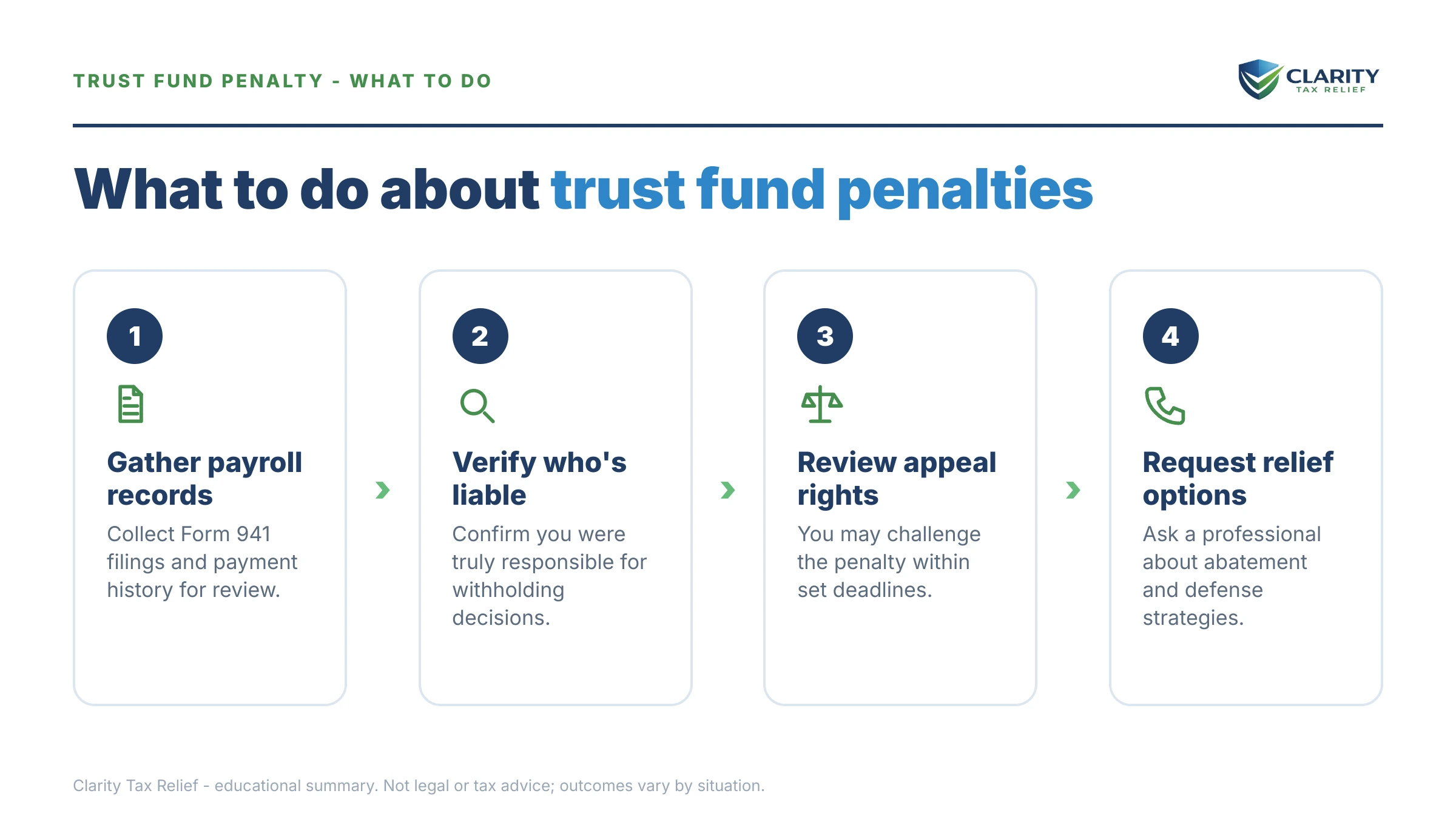
- Locate your stage in the process. Pull out every IRS letter and find the most recent one: Letter 1153 means you are pre-assessment with a 60-day protest window; a CP504 or LT11 means the penalty is assessed and collection is moving.
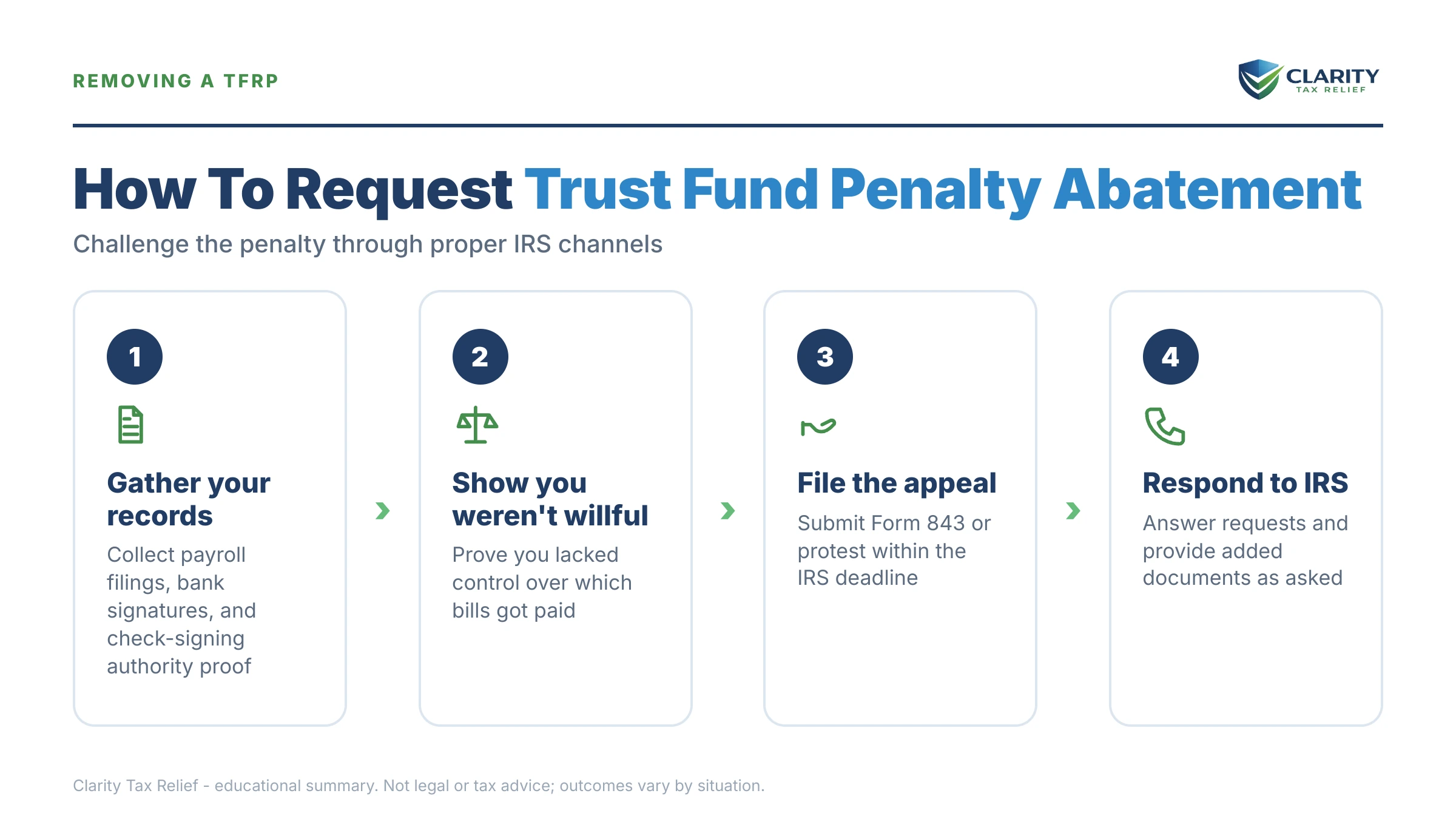
- Gather the control evidence. Collect bank signature cards, corporate minutes, payroll records, and emails showing who actually decided which bills got paid — responsibility and willfulness are proven with documents, not job titles.
- Stop the levy first. If an LT11 clock is running, file Form 12153 within 30 days to hold collection while you fight; if a levy has already hit, request a release based on the pending dispute or economic hardship.
- File the right challenge. Protest Letter 1153 within 60 days, or file Form 843 or Form 656-L after assessment, laying out the specific facts that defeat responsibility or willfulness for each quarter assessed.
- Set a payment backstop. Even while disputing, line up an installment agreement or hardship status so a missed deadline never converts into a wage levy you didn't see coming.
- Get experienced review on any five-figure assessment. TFRP defenses are fact cases; an experienced tax professional can usually tell you in one review whether your facts defeat the assessment or your money is better spent on settlement.
The Collection Due Process request in step 3 deserves emphasis: a timely form 12153 cdp hearing request generally holds levy action on those periods while Appeals reviews your case — for someone whose paycheck covers the rent, that pause is the whole ballgame.
When you can handle this yourself — and when you shouldn't
Not every TFRP case needs professional help, and it would be dishonest to pretend otherwise. You can reasonably go it alone when the assessed amount is small enough to pay within 180 days, when you agree you were the responsible person and just need a straightforward payment plan, or when your non-involvement is so clean — you'd left the company before the quarters at issue, and payroll records prove it — that a short protest with documents attached tells the whole story.
Experienced help tends to change the outcome in four situations. A levy is in motion — the CDP request, hardship release, and dispute have to be sequenced correctly under a deadline. Multiple people are pointing fingers — co-owner and bookkeeper cases turn on evidence strategy, and what you say about others' roles shapes your own exposure. The divisible-tax litigation route is on the table — the payment designation, refund claim wording, and timing rules are unforgiving. And any offer in compromise — the difference between an accepted and rejected offer is usually how the financial package is built, not the underlying facts. If your case is in that second group, a free review costs you nothing but twenty minutes: request one here or call (888) 825-7779.
Terms on your TFRP paperwork, decoded
- Responsible person — anyone with the real-world authority to decide which creditors got paid, regardless of title.
- Willfulness — knowing the trust fund taxes were unpaid and paying anyone else anyway; no bad intent required, and reckless disregard counts.
- Trust fund portion — the withheld income tax plus the employees' share of Social Security and Medicare; the employer's matching share is not part of your personal penalty.
- Divisible tax — a tax you can contest in court after paying only a representative slice (one employee, one quarter) instead of the whole assessment.
- Letter 1153 — the formal TFRP proposal that opens your one 60-day pre-assessment protest window.
- CSED — the Collection Statute Expiration Date: 10 years from your personal assessment, pausable by offers, hearings, and bankruptcy.
Trust fund penalty abatement questions, answered
Can the trust fund recovery penalty be abated?
Yes, but not through the standard penalty-relief programs. The TFRP is removed by proving you were not a responsible person, proving you did not act willfully, or settling it through an Offer in Compromise. Those challenges run through a Letter 1153 protest before assessment, a Form 843 claim after assessment, or Appeals — not through first-time abatement.
Does first-time penalty abatement apply to the trust fund penalty?
No. First-time abatement covers failure-to-file, failure-to-pay, and failure-to-deposit penalties — the TFRP is not on that list, and it is not expected to fall under the Automatic Exemption from Penalty rolling out in summer 2026 either. A clean three-year compliance history helps your credibility in a TFRP appeal, but it does not remove the penalty by itself.
Can I get the TFRP removed for reasonable cause?
Rarely. Because willfulness is a required element of the penalty, the IRS position is that a truly willful failure usually cannot be excused by reasonable cause. The stronger move is to attack willfulness itself — showing you did not know the trust fund taxes were unpaid, or had no power to pay them once you knew. Illness or reliance arguments occasionally succeed, but they are the exception.
Do I have to pay the full TFRP before I can dispute it in court?
No. Employment taxes are divisible, so you can pay only the trust fund portion for one employee for one quarter — often a few hundred to a couple thousand dollars — then file Form 843 for a refund. If the IRS denies the claim or sits on it for six months, you can sue in federal court and put the entire assessment in play.
How long do I have to protest Letter 1153?
60 days from the date on the letter. This pre-assessment protest is the single best window to fight the TFRP, because Appeals reviews the case before the penalty ever hits your account. Miss it and the IRS assesses the full amount, interest starts running, and your remaining challenge options get slower and more expensive.
Can the IRS collect the trust fund penalty from more than one person?
Yes. Every responsible person can be assessed 100% of the same trust fund amount — owners, officers, bookkeepers, even outside check-signers. The IRS can pursue all of them at once but only collects the total once; any dollar the business or a co-assessed person pays toward the trust fund portion reduces everyone's balance. You also have a federal right to sue co-responsible persons for contribution if you pay more than your share.
Does bankruptcy wipe out the trust fund recovery penalty?
No. The TFRP is a priority tax claim that survives Chapter 7 and must generally be paid in full through a Chapter 13 plan, no matter how old it is. Bankruptcy's automatic stay can pause a levy temporarily, but the debt itself comes out the other side intact — which is why challenge, settlement, and payment strategy matter more here than in ordinary tax-debt cases.
Will paying the business's 941 debt remove my personal TFRP?
It can reduce or eliminate it. If the business makes voluntary payments and designates them to the trust fund portion of its 941 debt, your personal assessment shrinks dollar for dollar. This is a common strategy when the business is still operating: keep it current on new deposits, and aim its payments at the trust fund quarters first.
How long can the IRS collect a TFRP after it's assessed?
10 years from the date of assessment — the same collection statute that applies to other federal tax debts. Your personal clock is separate from the business's 941 assessments, and it can be paused by an Offer in Compromise, a Collection Due Process hearing, or bankruptcy. Interest accrues on your balance the entire time.
Can I settle a trust fund penalty with an offer in compromise?
Yes, two ways. A doubt-as-to-liability offer (Form 656-L, no application fee) argues the penalty should never have been assessed against you. A doubt-as-to-collectibility offer argues the IRS can never collect the full amount from your income and assets; it carries a $205 fee unless you qualify for low-income certification. The IRS accepted roughly 1 in 5 offers in FY2024, so the numbers have to genuinely work.
Your next 24 hours
- Find your controlling date. Pull the newest IRS letter and locate the printed date: on Letter 1153 it starts your 60-day protest window; on an LT11 it starts your 30-day hearing window. Write the deadline on the envelope.
- Gather your proof of who controlled the money. Bank signature cards, payroll records for the assessed quarters, your dates of employment or ownership, and every IRS letter you've received — that stack decides which path you're on.
- Get the assessment reviewed free before your window closes. Use the 2-minute form or call (888) 825-7779 — an experienced tax professional will tell you whether your facts support abatement, settlement, or a payment strategy, before a levy makes the choice for you.
Primary sources: the IRS overview of the Trust Fund Recovery Penalty, the official About Form 843 page, IRS payment options, and the Taxpayer Advocate Service if collection is causing hardship the normal channels won't fix.
This guide is general information, not tax or legal advice for your specific situation. Eligibility for IRS programs depends on individual facts and circumstances; no outcome is guaranteed.