
Business Tax Relief
Business Penalty Abatement in 2026: How to Remove IRS Penalties on 941, 1120 & 1065 Returns
The short answer: business penalty abatement removes IRS penalties charged to your business — on 941 payroll returns, 1120 corporate returns, and 1065 or 1120-S pass-through returns. The two main paths are First-Time Abate (clean prior three years) and reasonable cause. Requests are free, often handled by phone, and interest on abated penalties comes off with them.
You run a business, you're mid-refinance on your house, and the IRS balance on the business account is bigger than the tax you actually missed — because penalties and interest have been stacking on top of it every month. That gap between what you owed and what they're billing is the part you can fight. Unlike the tax itself, business penalties come off IRS accounts every day, through requests that cost nothing to make.
This guide covers the three penalties businesses actually get hit with, which relief path fits each one, and the exact order to request them in — plus the math on a $27,500 balance. The image below shows you exactly where penalty charges appear on a business account and how to spot the lines you can challenge.
⏱ The clocks that matter: there is no filing deadline to request abatement of an unpaid penalty — but two real clocks are running. The failure-to-pay penalty adds 0.5% of the unpaid tax every month, and if you already paid a penalty, you generally have 2 years from the payment date (or 3 years from filing) to claim it back on Form 843.
Why your business got hit with penalties
The IRS assesses business penalties automatically the moment a return, payment, or payroll deposit posts late — and the most common ones can add 25% or more to what a business owes. No human decided to penalize you. A computer matched a due date against a posting date and generated a charge, usually announced on a CP161, CP162, or CP215 notice.
Which penalty you're holding depends on which return slipped:
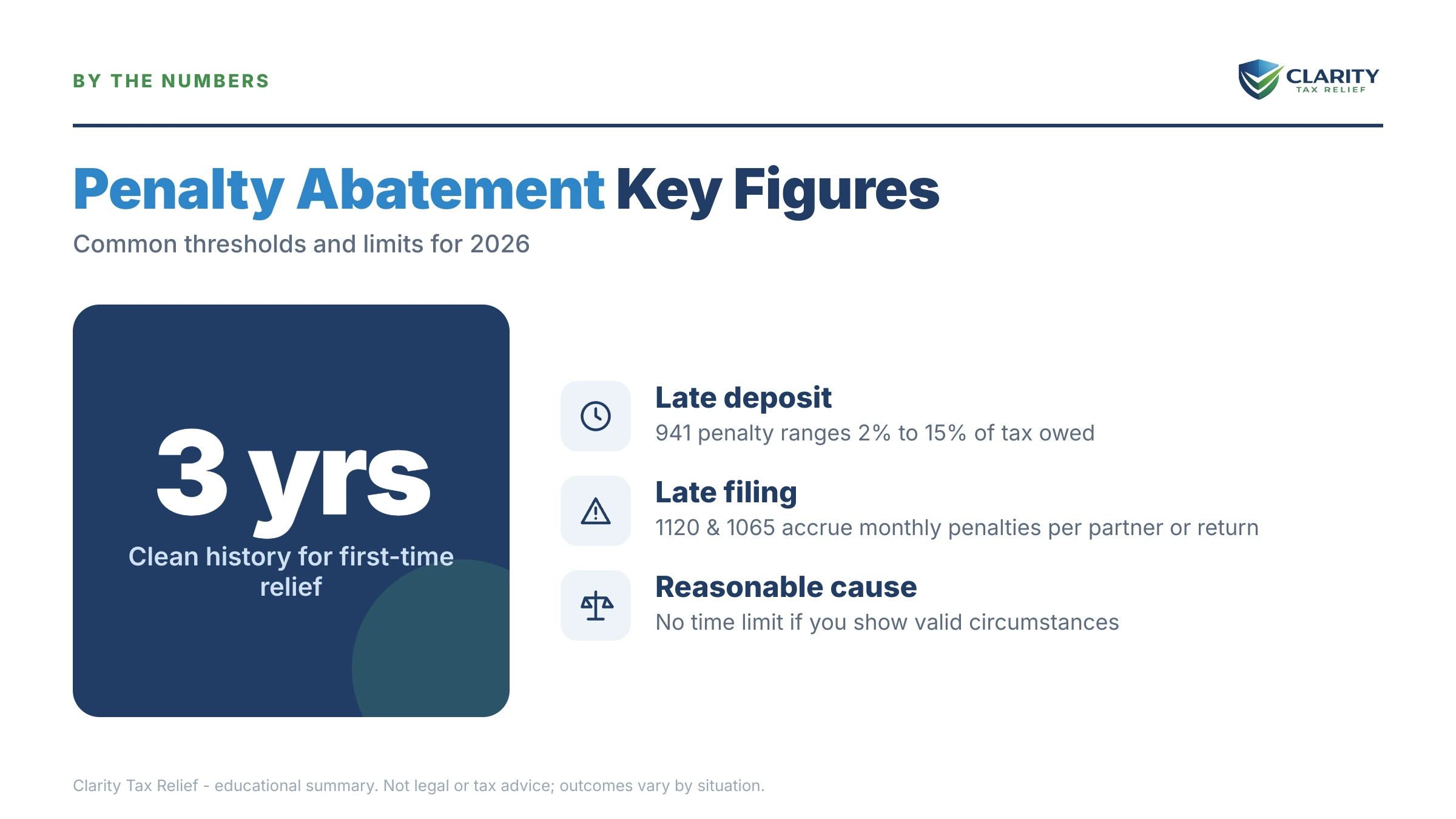
- 941 payroll returns generate the federal tax deposit penalty — tiered at 2% (deposits 1–5 days late), 5% (6–15 days), 10% (more than 15 days), and 15% after an IRS demand. Because it's charged per deposit, one bad quarter can produce a four-figure penalty fast.
- 1065 partnership and 1120-S returns generate the per-owner late-filing penalty on a CP162 — charged per partner or shareholder, per month late, up to 12 months, even when the entity owes no tax at all. A three-partner LLC that files four months late gets twelve penalty units, not one.
- 1120 corporate returns with a balance due generate the classic pair: failure-to-file at 5% of the unpaid tax per month (capped at 25%) and failure-to-pay at 0.5% per month (also capped at 25%). The file penalty is ten times the pay penalty — which is why filing on time matters even when you can't pay.
- Information returns and civil penalties (W-2s, 1099s, and the assessments announced on CP215) run on their own rules — and they're generally outside First-Time Abate, so they need a documented reasonable-cause case.
For the full mechanics of how these charges compound — and how big they get if nothing changes — see our hub on how much IRS penalties on back taxes actually cost. Here's the quick reference for what you were charged and the relief path that fits:
| Penalty | Applies to | How it's computed | Main relief path |
|---|---|---|---|
| Failure to deposit (FTD) | Form 941 payroll deposits | 2% / 5% / 10% / 15% of the late deposit, by days late | First-Time Abate or reasonable cause |
| Late filing, pass-through (CP162) | Forms 1065 and 1120-S | Fixed dollar amount per owner, per month, up to 12 months | FTA; Rev. Proc. 84-35 for small partnerships; reasonable cause |
| Failure to file | Form 1120 with a balance due | 5% of unpaid tax per month, capped at 25% | First-Time Abate or reasonable cause |
| Failure to pay | Any business balance due | 0.5% of unpaid tax per month, capped at 25% | First-Time Abate or reasonable cause |
| Accuracy-related | Understated tax on any return | 20% of the underpayment | Reasonable cause only — no FTA |
| Information-return / civil (CP215) | W-2s, 1099s, other filings | Per-form dollar amounts, varies by lateness | Reasonable cause under §6724 |
What happens if you ignore business tax penalties
An unpaid penalty balance moves through the same automated collection sequence as unpaid tax — ending in a lien, a levy, and for payroll debt, personal liability. The penalties aren't a side note the IRS forgets about; they're folded into the balance the machine collects on. Here's the sequence, in order:
- The balance compounds. Failure-to-pay adds 0.5% of the unpaid tax each month, and interest compounds daily on the tax and on every penalty already assessed.
- Balance-due notices arrive. CP161, CP162, or CP215 states the charge; reminders follow if nothing changes.
- Intent-to-levy notice (CP504B). The business variant of the CP504 — the IRS can now take your state tax refund, and a lien filing becomes a live possibility.
- Notice of Federal Tax Lien. A public record attaches to everything the business owns — and if you're a sole proprietor or single-member LLC owner, it reaches your personal assets, including the house your lender is about to appraise. This is the step that quietly kills refinances.
- Final notice of intent to levy (LT11 or CP297/CP297A). A 30-day clock starts, with Collection Due Process appeal rights. After it runs, the IRS can levy business bank accounts (funds are held 21 days before they leave) and accounts receivable.
- For unpaid 941 debt: the Trust Fund Recovery Penalty. The IRS investigates who controlled the money and assesses the trust fund recovery penalty against owners and check-signers personally — debt that follows you even if the business closes.
One more 2026 reality: the IRS workforce shrank roughly 27% in 2025, so reaching a human takes longer — but every step above is generated by automated systems that never stopped. Waiting doesn't slow the sequence; it only grows the number at the top of it.
Penalties propping up your business balance?
Every month that passes adds another 0.5% failure-to-pay charge plus daily interest. Send us your notice or transcript — an experienced tax professional will identify exactly which penalties qualify for removal, free and confidential.
Your business penalty abatement options in 2026
Most business penalties can be removed through one of two free requests: First-Time Abate or reasonable cause — and starting summer 2026, a third path arrives that requires no request at all. Here's how each works on a business account, which is where the rules differ from the individual version.
First-Time Abate (FTA) — the fastest path
FTA removes failure-to-file, failure-to-pay, and failure-to-deposit penalties when the business has a clean compliance history for the prior three years on that form. "Clean" means no significant penalties in those years, all required returns filed, and any current balance paid or on an arrangement. For a 941 account, that means the prior twelve quarters.
Two business-specific catches. First, FTA is checked per form — a clean 1120 history doesn't rescue a penalized 941 account, and vice versa. Second, FTA applies to a single period: if three quarters were penalized, FTA clears the earliest one and the rest need reasonable cause. Our first-time penalty abatement guide covers the qualification test in detail; for the payroll-specific quarter-by-quarter strategy, see 941 penalty abatement.
Automatic Exemption from Penalty (AEP) — new for 2026
Starting summer 2026, the IRS is replacing FTA with the Automatic Exemption from Penalty — qualifying penalties come off automatically, with no request needed. That's genuinely good news, but don't let it become a reason to wait: while the rollout phases in, a request you make today still works, and interest keeps compounding on any penalty that sits on the account.
Reasonable cause — for everything FTA can't reach
Reasonable cause asks a different question: did the business exercise ordinary care and still fail to comply because of circumstances beyond its control? For businesses, the arguments that consistently work are a federally declared disaster, death or serious illness of the owner or the one person who ran the finances, destroyed or unobtainable records, and embezzlement or fraud discovered after the fact. The arguments that consistently fail: cash-flow problems, "my bookkeeper handled it," and not knowing the rule — the IRS treats delegation as your responsibility, not an excuse. See reasonable cause examples for what qualifies and what gets denied.
One nuance worth knowing for payroll deposits: reliance on a third-party payroll provider generally does not excuse a missed deposit, because the deposit duty stays with the employer — though provider fraud (the provider took your money and never paid the IRS) is a documented exception territory worth arguing with evidence.
Two special cases: small partnerships and the TFRP
Partnerships facing a CP162 have an extra argument: under the long-standing Rev. Proc. 84-35, a domestic partnership with 10 or fewer partners — all individuals or estates who reported their shares on time — can qualify for relief even without FTA. Raise it explicitly; the IRS won't volunteer it. At the other extreme, the Trust Fund Recovery Penalty is not abatable through FTA at all — it's a personal assessment of the business's withheld taxes, and fighting it means disputing responsibility and willfulness, not compliance history.
What abatement never removes
Interest on the underlying tax stays, with one narrow exception: §6404 abatement when IRS error or delay caused it. But interest that accrued on an abated penalty comes off automatically with the penalty — a detail that adds real dollars to every successful request.
| Relief path | Cost | Typical timeline | Best for |
|---|---|---|---|
| First-Time Abate by phone | $0 | Often decided on the call; confirmation letter by mail | One penalized period, clean prior 3 years on that form |
| Automatic Exemption from Penalty (AEP) | $0 | Automatic as it rolls out, starting summer 2026 | Clean-history taxpayers whose penalties qualify |
| Reasonable-cause letter | $0 | Typically several weeks to a few months in writing | Multiple periods, disasters, illness, records loss |
| Form 843 refund claim | $0 | Weeks to months; must be inside the 2-/3-year window | Penalties you already paid |
| Appeal of a denial | $0 | Adds months, but reverses many automated denials | Strong facts rejected by the computer |
| §6404 interest abatement | $0 | Rare; written claim required | Interest caused by IRS error or delay only |
A worked example: $27,500 with a refinance on the line
Abatement math is easiest to see on a real-shaped balance. Say your S-corporation owes $27,500 from one bad quarter, and your home refinance is sitting in underwriting. The transcript breaks the balance down like this:
- Unpaid 941 tax: $20,000
- Failure-to-deposit penalty at the 10% tier (deposits more than 15 days late): 10% × $20,000 = $2,000
- Failure-to-pay penalty (0.5% per month × 20 months = 10%): 10% × $20,000 = $2,000
- Interest on the tax and both penalties: roughly $3,500
If the prior three years of quarters are clean, one First-Time Abate request on that quarter can remove both penalties — $4,000 off in a single phone call — plus the slice of interest that accrued on those penalties, roughly another $450 in this scenario. The balance drops to about $23,050.
Why that matters for the refinance: at $23,050 with the account placed into a business IRS installment agreement before any lien is filed, there's no public lien record for your lender to find. If a Notice of Federal Tax Lien has already been filed, abatement alone won't lift it — you'd pair it with payoff, subordination, or withdrawal, covered in can I refinance with an IRS lien. Want to see your own tax-versus-penalty split before you call anyone? Estimate it with our Penalty & Interest Calculator.
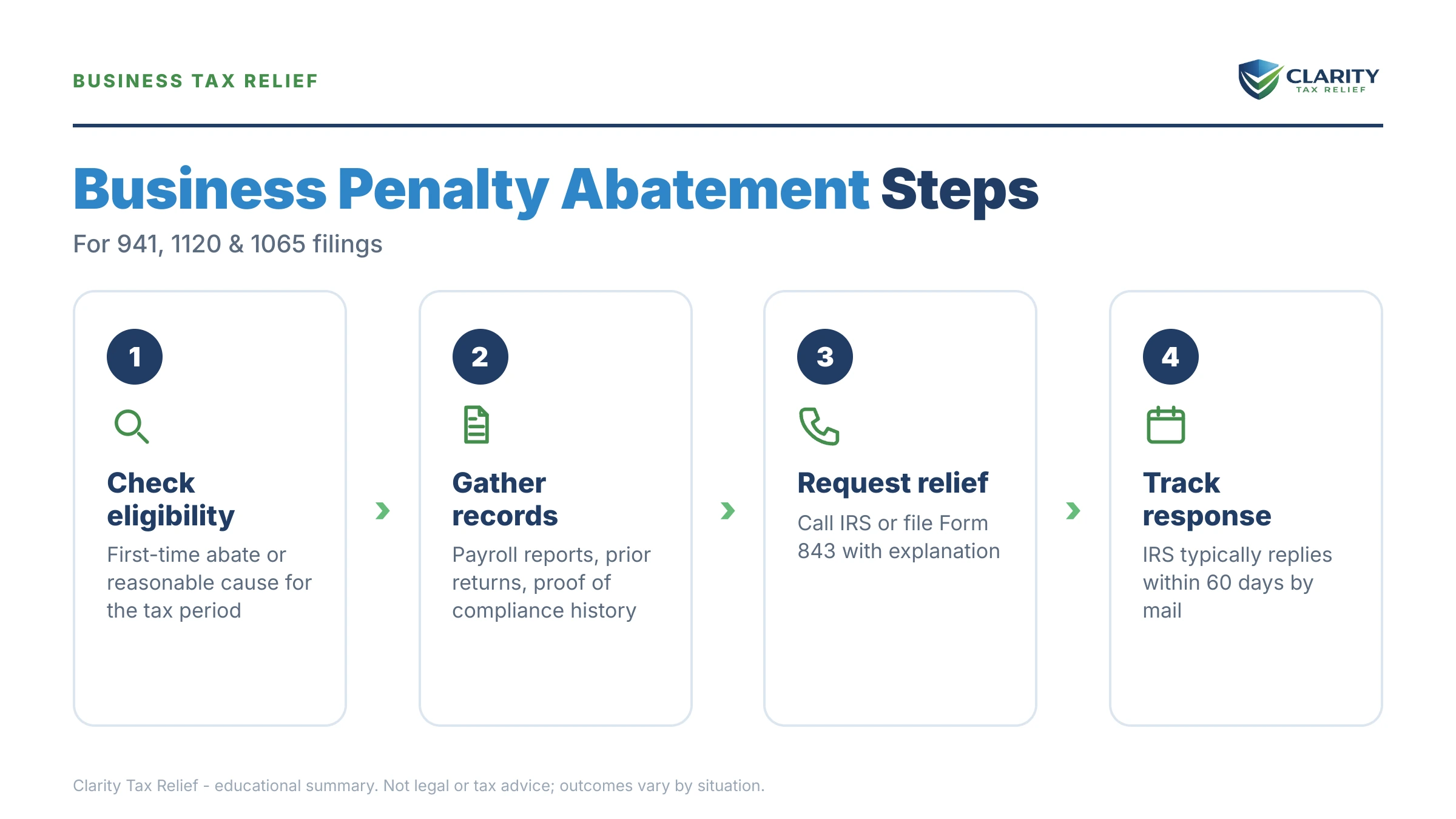
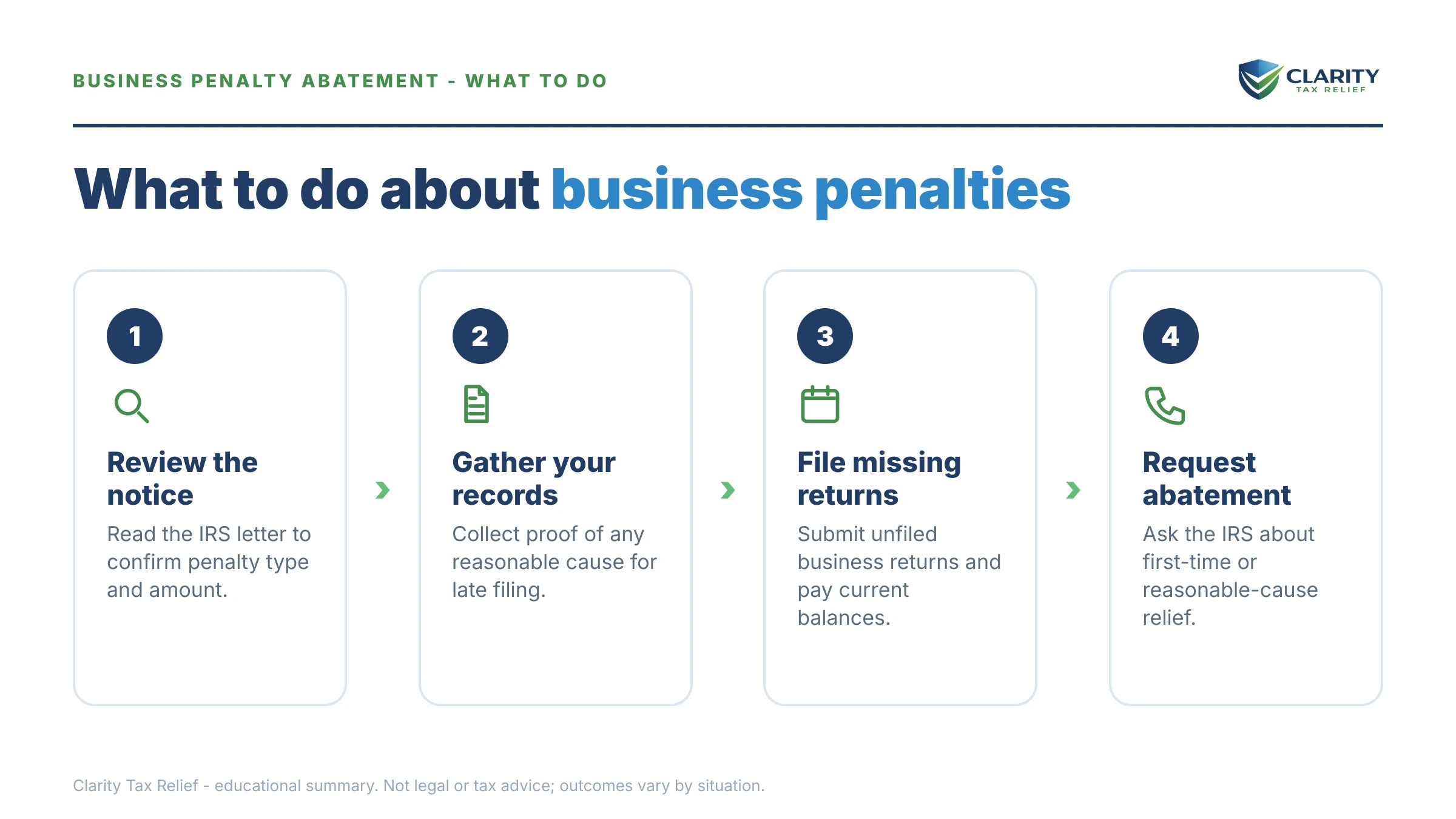
How to request business penalty abatement, step by step
A business penalty abatement request succeeds in a specific order: transcripts first, compliance second, FTA third, reasonable cause last. Out of order, requests get denied on technicalities that have nothing to do with your facts.
- Pull your business account transcripts. Request account transcripts for every penalized form and period — transaction codes 166, 186, and 276 show exactly which penalties were charged, on which dates, and for how much.
- Get compliant first. File every overdue return and get current on this year's deposits and estimates — the IRS denies penalty relief to businesses that are still out of compliance.
- Request First-Time Abate by phone. Call the number on your notice, ask for First-Time Abate on the earliest penalized period, confirm the prior three years are clean, and note the agent's name and badge number.
- Send a reasonable-cause request for what's left. Put the specific event, its dates, and why it prevented compliance in writing — with documentation — for any period FTA can't reach; use Form 843 for penalties you already paid.
- Appeal a denial in writing. Many first denials come from the IRS's automated Reasonable Cause Assistant; a written appeal to the IRS Independent Office of Appeals puts a human on your file.
For the written requests, start from our business penalty abatement letter template, and see the Form 843 penalty abatement request walkthrough for paid-penalty refund claims. If your request gets rejected, the penalty abatement appeal guide covers the protest process — a surprising share of computer denials reverse when a human reads the facts.
Reading your business transcript: penalty codes decoded
Every penalty on your business account appears as a three-digit transaction code on the account transcript — and the codes also confirm, in writing, when an abatement actually posts. Don't take a phone agent's word that a penalty was removed; watch for the reversal code. The key pairs:
| Code | What it means | What to do |
|---|---|---|
| 166 | Late-filing penalty assessed | Check FTA eligibility for that form and period |
| 167 | Late-filing penalty abated | Your request posted — verify the amount matches |
| 186 | Failure-to-deposit penalty assessed | Match deposit dates against the 2/5/10/15% tiers |
| 187 | Failure-to-deposit penalty abated | Confirm the interest on it reversed too (code 197) |
| 276 | Failure-to-pay penalty assessed | Note it keeps re-posting monthly until the tax is paid |
| 277 | Failure-to-pay penalty abated | Recheck the remaining balance before paying |
| 196 | Interest assessed | Interest on the tax stays; interest on abated penalties should reverse |
| 197 | Interest abated | Confirm it corresponds to the abated penalty amounts |
When you can handle this yourself — and when help changes the outcome
You can request First-Time Abate yourself with one phone call if your business has a single penalized period and a clean three-year history on that form. That's a same-day fix: pull the transcript, confirm the clean years, call the number on the notice, and ask. You also don't need help to file a simple Form 843 for one paid penalty with obvious reasonable cause and clear documentation.
Experienced help earns its cost in the messier versions: multiple penalized quarters or years where the order of requests determines how much comes off, a lien about to be filed while a refinance or loan is pending, a Trust Fund Recovery Penalty investigation where anything you say in a Form 4180 interview can be used to assess you personally, six-figure payroll penalty stacks, or a denial that needs a written appeal built on the right precedent. In those cases the question isn't whether relief exists — it's whether it gets sequenced and documented well enough to be granted.
If penalties across multiple quarters are propping up your balance while a refinance waits, have an experienced tax professional map the abatement order for free — (888) 825-7779 or the 2-minute form.
Terms on your penalty notice, decoded
- First-Time Abate (FTA): an administrative waiver that removes failure-to-file, failure-to-pay, and failure-to-deposit penalties for one period when the prior three years are clean.
- Reasonable cause: the legal standard for penalty relief — you exercised ordinary business care and prudence but couldn't comply due to circumstances beyond your control.
- Failure-to-deposit (FTD) penalty: the tiered 2/5/10/15% charge on payroll tax deposits made late, calculated per deposit by days of lateness.
- Trust Fund Recovery Penalty (TFRP): a personal assessment against "responsible persons" for the withheld portion of unpaid payroll taxes — not removable through FTA.
- Notice of Federal Tax Lien: the public filing that attaches the IRS's claim to business (and sometimes personal) assets — the record lenders find during a refinance.
- Reasonable Cause Assistant (RCA): the IRS software that scores many abatement requests automatically — the reason well-documented requests sometimes get denied first and won on appeal.
The IRS's own overviews are worth bookmarking: the IRS penalty relief page, the About Form 843 page, and — if your case stalls in IRS processing — the Taxpayer Advocate Service.
Business penalty abatement questions, answered
Does first-time penalty abatement apply to businesses?
Yes — First-Time Abate covers business returns including Forms 941, 1120, 1120-S, and 1065, and it applies to failure-to-file, failure-to-pay, and failure-to-deposit penalties. Your business needs a clean compliance history for the prior three years on that form, all required returns filed, and any balance paid or on a payment arrangement. FTA applies to a single period, so multi-period penalties need reasonable cause for the rest.
Can the CP162 partnership or S-corp late-filing penalty be abated?
Yes, and it is one of the most commonly abated business penalties. First-Time Abate works if the entity's prior three years are clean, even though the penalty is charged per partner or shareholder, per month. Small partnerships may also qualify under Rev. Proc. 84-35 when there are 10 or fewer partners and everyone reported their share on time — a separate argument worth raising if FTA is already used up.
Does penalty abatement remove interest too?
Partially. When a penalty is abated, the interest that accrued on that penalty comes off automatically with it. Interest on the underlying tax almost never goes away — the IRS can only abate that interest when its own error or delay caused it, under IRC §6404. So abatement shrinks the balance, but the tax and the interest on the tax remain due.
Can I get business penalties refunded after I already paid them?
Yes. If you paid a penalty that qualified for abatement, you can claim a refund on Form 843 — generally within 3 years of filing the return or 2 years of paying the penalty, whichever is later. Missing that window kills the claim no matter how strong your reasonable cause is, so check your payment dates before assuming it is too late.
Does FTA cover the failure-to-deposit penalty on 941s?
Yes — the failure-to-deposit penalty is one of the three penalties First-Time Abate can remove, alongside failure-to-file and failure-to-pay. The catch: FTA applies to the earliest penalized quarter only, and your prior three years of quarters must be clean. If several quarters were penalized, you will need reasonable cause arguments for the later ones.
Can the Trust Fund Recovery Penalty be abated?
Not through First-Time Abate — the TFRP is a personal assessment of the business's unpaid trust-fund taxes, not a conduct penalty, so FTA does not apply. Your realistic paths are proving you were not a responsible person who willfully failed to pay, appealing within the 60-day window after Letter 1153, or negotiating on the balance itself. TFRP defense is one situation where experienced representation consistently changes outcomes.
How long does business penalty abatement take?
A First-Time Abate request made by phone can be approved during the call, with a confirmation letter following by mail. Written reasonable-cause requests typically take longer — often several weeks to a few months depending on IRS workload, and 2026 staffing cuts have stretched written correspondence timelines. If a lien or levy deadline is looming, do not wait on the abatement decision; address the collection action separately.
What is the Automatic Exemption from Penalty (AEP) in 2026?
AEP is the IRS's replacement for First-Time Abate, rolling out starting summer 2026. Qualifying penalties will be removed automatically — no phone call or letter required — for taxpayers with clean compliance histories. Until it fully applies to your penalty and period, do not wait for automatic relief: an FTA or reasonable-cause request you make today still works, and penalties keep accruing while you wait.
Will penalty abatement help me refinance my house?
It can, in two ways. Abatement shrinks the balance, which can bring the debt low enough to pay off or put on a payment plan before the IRS files a Notice of Federal Tax Lien — the public record that derails most refinances. If a lien is already filed, abatement alone will not remove it; you would pair it with payoff, subordination, or withdrawal. Timing matters: resolve the account before your lender pulls records.
Your next 24 hours
- Find the penalty breakdown. On your CP161, CP162, or CP215, locate the box splitting the balance into tax, penalties, and interest — or pull the business account transcript and circle every 166, 186, and 276 line. That's your abatement target, in dollars.
- Gather the record. Pull the last three years of returns for the penalized form, your deposit or payment confirmations, and any documentation of the event behind the lateness — a disaster declaration, medical records, proof of provider fraud.
- Get the free case review. Send the notice or transcript through the 2-minute form or call (888) 825-7779. Penalties and interest post monthly on a business account — every month unresolved is another 0.5% failure-to-pay charge plus compounding interest on everything already there.
This guide is general information, not tax or legal advice for your specific situation. Eligibility for IRS programs depends on individual facts and circumstances; no outcome is guaranteed.