
IRS Business Notices
IRS CP162 Notice: The Partnership & S-Corp Late-Filing Penalty and How to Remove It (2026)
The short answer: a CP162 notice means the IRS penalized your partnership or S corporation for filing its return late, incomplete, or on paper when e-filing was required. The penalty runs per owner, per month late, for up to 12 months — even with zero tax due — and it is one of the most frequently abated penalties the IRS assesses.
Maybe the LLC's Form 1065 slipped while everyone waited on final numbers, or your accountant assumed the business deadline was April 15 like your personal return. Either way, the CP162 in your hand is billing a business that probably owes no income tax at all — right when you're trying to keep your finances spotless for a refinance. The good news: this specific penalty has more built-in escape hatches than almost any other IRS charge.
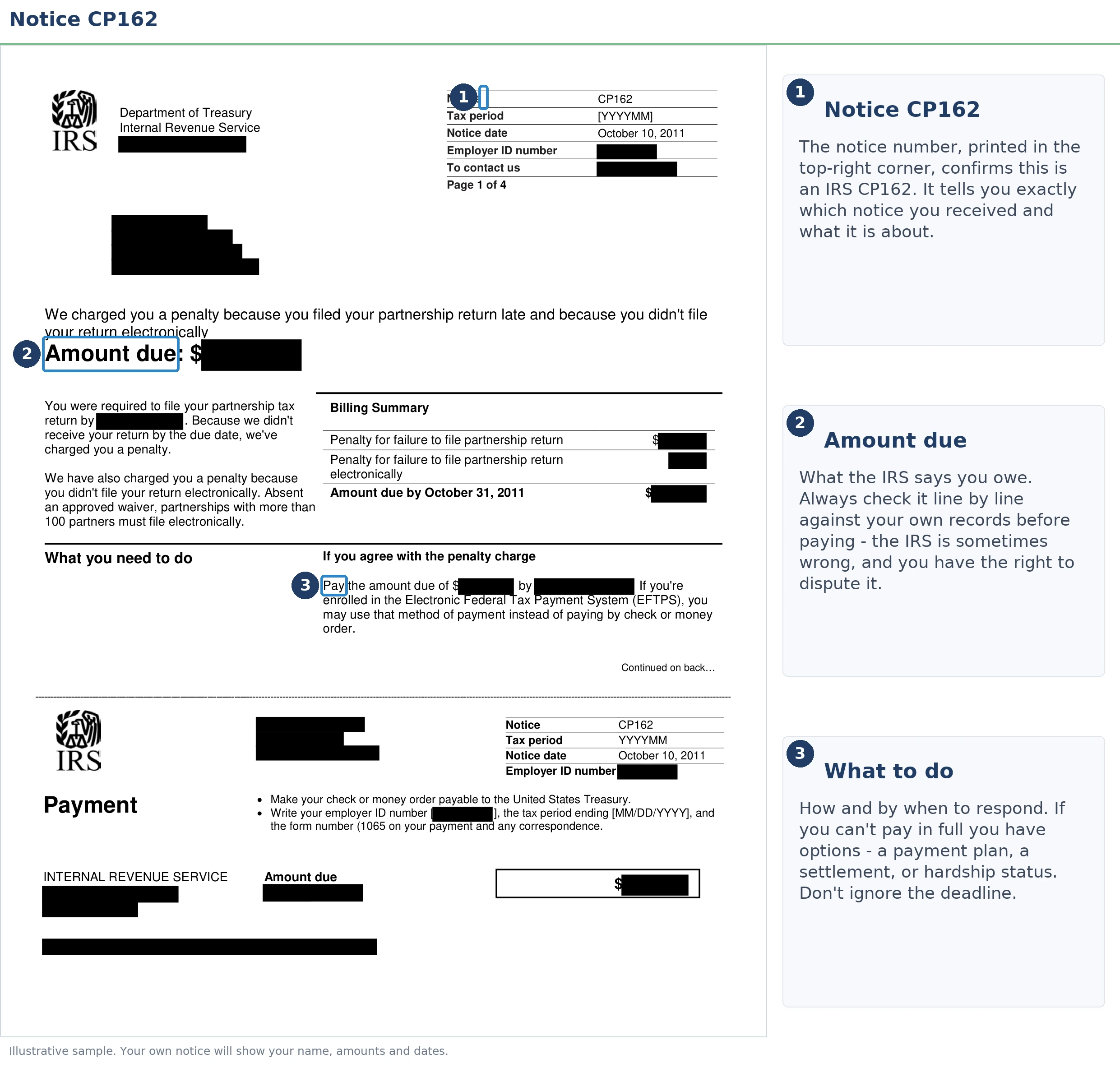
Everything you need to check — the form number, the tax year, the per-owner rate, and the month count the IRS multiplied together — sits in one calculation block on the notice. The image below shows you exactly what a CP162 looks like and where to find those figures.
⏱ Your deadline: the pay-by date printed on your CP162 controls. There is no fixed statutory response window for this notice, but interest accrues on the unpaid penalty from the assessment date, and abatement is far easier before the balance moves deeper into the collection sequence.
Why you got a CP162 notice
A CP162 is triggered by one thing: the IRS's records show your partnership or S-corporation return arrived late, arrived incomplete, or arrived on paper when electronic filing was required. It has three common causes:
- The return was filed after the deadline. Calendar-year partnerships (Form 1065) and S corporations (Form 1120-S) are due March 15 — a full month before personal returns — and this mismatch is the single biggest reason first-time business owners get hit. A Form 7004 extension moves the deadline to September 15.
- The return was incomplete. A 1065 or 1120-S missing required information — most often the Schedules K-1 for each owner — can be treated as not filed at all, triggering the same penalty even though you mailed something on time.
- The return was paper-filed when e-filing was required. Since 2024, most entities that file 10 or more returns of any type in a year must e-file. A paper 1065 or 1120-S from an entity covered by the mandate can draw this penalty even when it arrived by the deadline.
Unlike most scary IRS mail, this is not a bill for tax and it is not an audit — no one is questioning the numbers on the return. If you're still not sure why the IRS wrote to you at all, start with our guide to why did I get a letter from the IRS; this page covers only the CP162's specific penalty and how to unwind it.
One more thing that makes a CP162 unusual: because it's an "assessed" penalty, you will never receive a 90-day letter or a chance to contest it in Tax Court before it hits the account. The IRS charges first. Your remedy is abatement — asking for it to be removed — which, fortunately, works remarkably often for this penalty.
How the CP162 penalty is calculated (and why it gets so big)
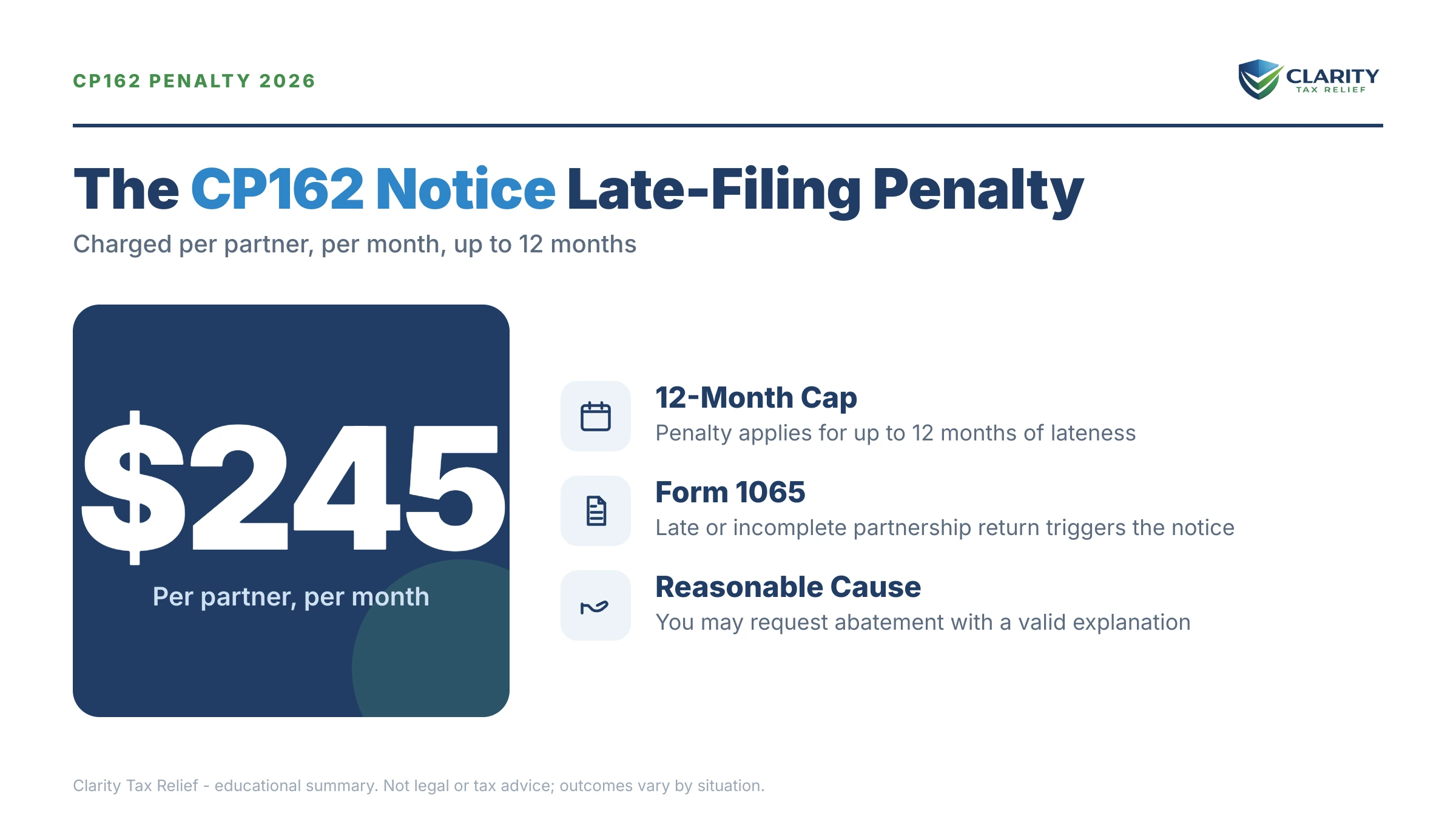
The CP162 penalty is charged per owner, per month or part of a month the return is late, capped at 12 months. The legal basis is IRC §6698 for partnerships and its mirror, §6699, for S corporations — identical math, different form numbers.
The per-owner monthly rate adjusts for inflation each year; for recent tax years it has run about $245 per owner, per month, and the exact rate the IRS applied is printed in the calculation block on your notice. Three details make the total balloon:
- Every owner counts. A 20-partner LLC accrues twenty times the monthly rate. The IRS pulls the owner count from the K-1s.
- Part of a month counts as a full month. File one day into month four and you're charged for four months.
- Zero tax due doesn't matter. Pass-through entities usually owe no entity-level income tax, so there's no "tax owed" for the penalty to be a percentage of — it accrues on a return that may show nothing due.
A worked example (hypothetical): say you're one of three members in an LLC taxed as a partnership. The 2024 Form 1065 was due March 17, 2025, nobody filed an extension, and the return finally went in twelve months later. At a $245 per-partner rate, the math is 3 partners × 12 months × $245 = $8,820. Add the interest that has accrued since assessment and the CP162 in your hand reads roughly $8,900 — on a business that owed the IRS nothing. You can model how a balance like this grows if left unpaid with our Penalty & Interest Calculator; it estimates accrual, it doesn't promise a result.
Check the notice's math before anything else. The IRS occasionally uses the wrong partner count (for example, counting a partner who left before the tax year) or the wrong month count when a return was mailed near a deadline. A miscount is the fastest correction you'll ever get.
What happens if you ignore a CP162
An unpaid CP162 penalty flows into the same automated IRS collection machine as unpaid tax — reminder notices, intent to levy, then a final notice that opens a 30-day appeal window before enforcement. The entity's EIN, not your SSN, carries the balance, but the escalation is just as real:
- CP162 — the penalty is assessed and interest starts running. You are here, and this is where abatement works best.
- Reminder notices — including the CP163 notice, a reminder of the business balance due. Still no enforcement, but the total keeps growing.
- CP504B notice — the business version of the intent-to-levy notice. The IRS can now take the entity's state tax refund and is one step from full levy authority.
- Final notice of intent to levy — such as a CP297A. This starts a 30-day clock to request a Collection Due Process hearing on Form 12153; miss it and the IRS may levy business bank accounts and receivables.
- Lien and levy — a Notice of Federal Tax Lien against the entity becomes a public record, and a bank levy holds funds for 21 days before they're sent to the IRS.
Two 2026 realities sharpen this. First, IRS staffing fell roughly 27% in 2025, so reaching a human to fix a simple penalty takes longer than it used to — but the notice stream is automated and never paused. Second, if the entity repeats the late filing next year, a second CP162 lands on top of the first, and a two-year penalty pattern kills your eligibility for the easiest relief path (First-Time Abate) going forward.
| Stage | What it means | Your best move at this stage |
|---|---|---|
| CP162 | Penalty assessed; interest begins accruing | Verify the math, then request abatement |
| CP163 / reminders | Balance-due reminders; no enforcement yet | Abatement still works; don't let it ride |
| CP504B | Intent to levy; state refund can be taken | Resolve or arrange payment before the final notice |
| Final notice (e.g., CP297A) | 30 days until levy authority is active | File Form 12153 to preserve hearing rights |
| Lien / levy | Public lien; bank funds held 21 days, then sent | Seek release, hardship relief, or a payment plan fast |
Holding a CP162 right now?
Send us a photo of it. An experienced tax professional will check whether First-Time Abate, small-partnership relief, or reasonable cause can remove the penalty entirely — free, confidential, before interest and the collection sequence add to it.
CP162 penalty abatement: every path to getting it removed
More relief paths exist for this penalty than for almost any other, and several require nothing but a phone call or a short letter. Here's the full menu:
| Relief path | Who it fits | How to request |
|---|---|---|
| First-Time Abate (FTA) | Entity with no penalties in the prior 3 years | Phone call to the number on the notice |
| Automatic Exemption from Penalty (AEP) | FTA-style relief, applied automatically starting summer 2026 | No request needed once live |
| Rev. Proc. 84-35 | Domestic partnerships with 10 or fewer individual partners (not S corps) | Written statement to the notice address |
| Reasonable cause | Late filing caused by illness, disaster, records destroyed, etc. | Letter or Form 843 with documentation |
| Assessed in error | Timely extension or timely filing the IRS missed | Send Form 7004 acknowledgment / e-file proof |
| Pay, then claim a refund | Relief denied but you believe it was wrong | Form 843 refund claim after payment |
First-Time Abate is the workhorse. If the entity filed (or validly extended) all required returns and had no penalties in the prior three years, the IRS can remove the entire CP162 penalty — often on a single phone call. Our guide to first-time penalty abatement covers the qualifying rules in depth. Note the timing shift for 2026: FTA is being replaced by the Automatic Exemption from Penalty (AEP) starting in summer 2026, which applies the same style of relief automatically. FTA/AEP is not your only path — so don't give up if your compliance history isn't clean.
Rev. Proc. 84-35 is the partnership-only escape hatch most owners have never heard of. If your partnership is domestic, has 10 or fewer partners, every partner is an individual (not a nonresident alien) or an estate, and every partner reported their share of income on a timely-filed personal return, the IRS treats the late 1065 as having reasonable cause. A short written statement asserting those facts is often enough. S corporations cannot use this provision — for an 1120-S, you're working with FTA/AEP or reasonable cause.
Reasonable cause covers late filings driven by circumstances outside your control: a serious illness of the person responsible for filing, a natural disaster, destroyed records, or a death in the family around the deadline. "My accountant dropped the ball" alone is a weak argument; the facts and documentation carry it. See reasonable cause penalty abatement for what actually persuades the IRS, and our Form 843 penalty abatement request walkthrough for the paperwork. If the CP162 is one of several penalties across your entity's account, the broader business penalty abatement playbook shows how the requests stack.
If the penalty was assessed in error — you extended on time or the return genuinely arrived by the deadline — don't request "relief" at all. Respond with proof: your Form 7004 acknowledgment, e-file acceptance confirmation, or certified-mail receipt. An erroneous assessment should be reversed, not forgiven.
If nothing removes it, the balance is collectible like any tax debt: pay it, or set up a payment arrangement so it never reaches levy notices. And if you pay first and win the argument later, Form 843 lets you claim the money back.
| Action | The window | What you lose if it passes |
|---|---|---|
| Pay or respond to the CP162 | Pay-by date printed on the notice | Nothing procedural — but interest compounds and reminders start |
| Request abatement | No fixed deadline while the balance is open | Leverage shrinks once the account is in active collections |
| Request a CDP hearing (Form 12153) | 30 days from a final notice of intent to levy | The pre-levy hearing and Tax Court review of it |
| Claim a refund of a paid penalty (Form 843) | Generally 2 years from the date you paid | The right to recover money already paid |
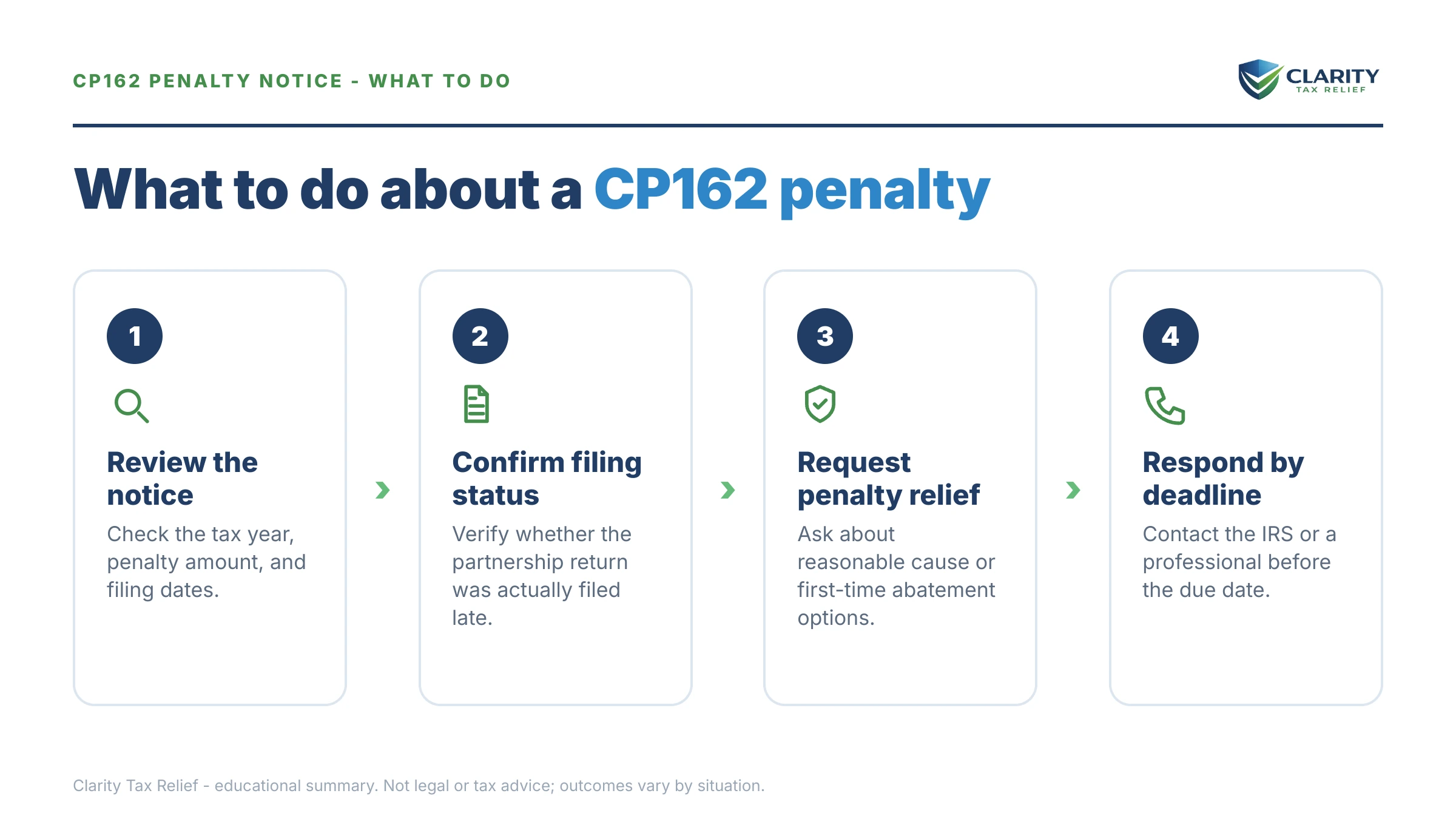
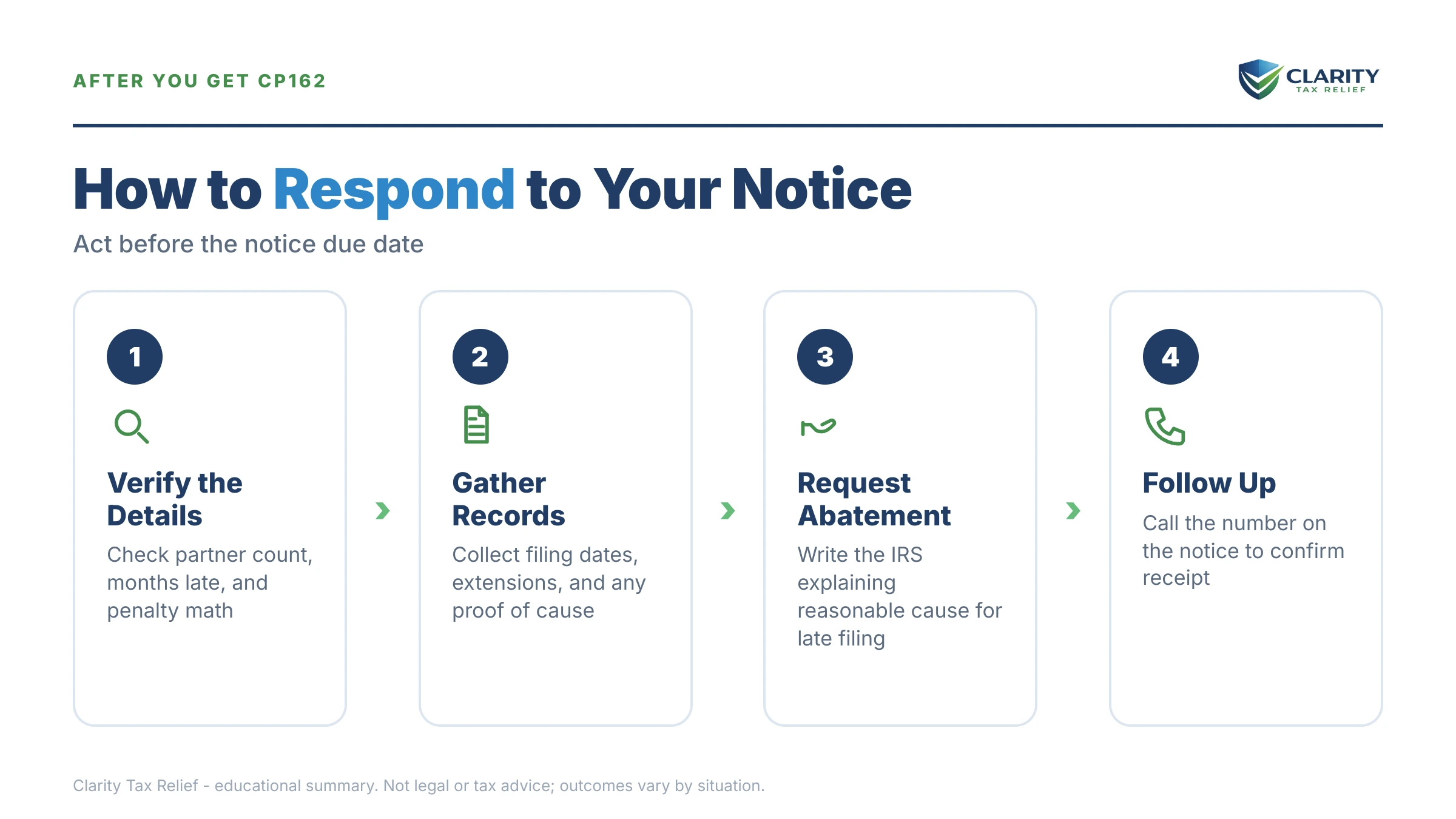
How to respond to a CP162 notice, step by step
- Confirm what triggered the penalty. Pull the notice's calculation block and check the form number, tax year, and month count against your filing records and any Form 7004 extension acknowledgment.
- Verify the math. Multiply your owner count by the months late and the per-owner rate printed on the notice — the IRS occasionally uses the wrong partner count or month count.
- Call for First-Time Abate if your history is clean. If the entity has no penalties in the prior three years, request First-Time Abate by phone using the number on the notice — it can be removed on the call.
- Send a written abatement request if FTA doesn't fit. Mail a Rev. Proc. 84-35 or reasonable-cause request (or Form 843) with supporting documents to the address on the notice, and keep copies of everything.
- Arrange payment if relief is denied. Pay or set up a payment arrangement so the balance doesn't roll into intent-to-levy notices, then consider appealing the abatement denial.
Will a CP162 affect your mortgage refinance?
An unresolved CP162 penalty won't touch your credit score, but it can surface in a refinance file two other ways. Since 2018, tax debts and even federal tax liens no longer appear on consumer credit reports — so the penalty itself is invisible to a credit pull.
The exposure comes through underwriting. If you're self-employed or your K-1 income supports the loan, the underwriter reviews the entity's returns and can ask about business tax balances. And if the penalty sits long enough for the IRS to file a Notice of Federal Tax Lien, that lien is a public record that title searches routinely catch — even a lien against the entity raises questions when the borrower owns the entity.
Who the lien can actually reach depends on your structure. For an LLC or S corporation, the penalty is the entity's liability, and a lien attaches to entity assets — not your home. Partners in a general partnership have less insulation, because state law can make general partners answerable for partnership debts. If a lien has already been filed and your closing is approaching, subordination and payoff routes exist — our guide to can I refinance with an IRS lien walks through them. The cleaner play, at $8,900, is resolving the penalty before your loan file ever opens.
When you can handle a CP162 yourself
Many CP162s never need professional help. You can confidently handle it yourself when:
- This is the entity's first penalty in years — one phone call requesting First-Time Abate, with your clean history in front of you, often ends it.
- You have proof of a timely extension or filing — mail the Form 7004 acknowledgment or e-file confirmation and ask for reversal.
- The math is wrong on its face — a wrong partner count or month count is a straightforward correction request.
Experienced help changes outcomes in the harder patterns: multiple years of CP162s stacked on the same entity (where FTA covers at most one year and the rest need reasonable-cause arguments), an S corporation with no Rev. Proc. 84-35 option and a weak first draft of the reasonable-cause story, penalties sitting alongside unfiled entity returns, or a balance that has already reached intent-to-levy notices while a refinance or business loan is in motion. In those cases, the order you fix things — returns first, then penalties, then the balance — often determines what you ultimately pay.
Terms on your CP162, decoded
- Form 1065 — the annual information return a partnership files to report income passed through to its partners.
- Form 1120-S — the S corporation's equivalent annual return; both are due March 15 for calendar-year entities.
- Schedule K-1 — the per-owner statement attached to the return; missing K-1s can make a return "incomplete" and trigger this penalty.
- IRC §6698 / §6699 — the statutes authorizing the per-partner and per-shareholder late-filing penalties behind every CP162.
- Assessed penalty — a penalty charged directly to the account without a pre-assessment hearing; your remedy is abatement, not Tax Court.
- Rev. Proc. 84-35 — an IRS procedure treating qualifying small partnerships (10 or fewer individual partners) as having reasonable cause for a late 1065.
- First-Time Abate (FTA) — administrative removal of a penalty for entities with a clean three-year compliance history; being replaced by automatic AEP relief starting summer 2026.
For the official mechanics, see the IRS pages for Form 843, Claim for Refund and Request for Abatement and Form 7004, the business extension, and pay any balance you do owe only through IRS.gov/payments. If your notice says CP215 rather than CP162, you're looking at the IRS's general business civil-penalty notice — related, but with different qualifying rules for relief.
CP162 questions, answered
How much is the CP162 penalty?
The penalty is charged per owner, per month the return is late, for up to 12 months. The per-owner monthly rate adjusts for inflation each year — about $245 for recent tax years — and the exact rate the IRS used is printed in the calculation block on your notice. A five-partner LLC that files six months late therefore owes roughly six times five times that rate, even if the partnership owes no tax.
Can a CP162 penalty be waived or abated?
Yes — CP162 penalties are among the most commonly abated penalties the IRS assesses. First-Time Abate can remove it with one phone call if the entity has a clean three-year compliance history, small partnerships may qualify for relief under Rev. Proc. 84-35, and reasonable cause covers events like serious illness or disaster. Starting summer 2026, the IRS's Automatic Exemption from Penalty (AEP) begins applying first-time-style relief automatically, with no request needed.
Why did I get a CP162 if I filed an extension?
A valid Form 7004 extension moves the deadline from March 15 to September 15, so a CP162 after a timely extension usually means the IRS never matched your extension to the return, the return still arrived after September 15, or the return was flagged as incomplete. Respond with your extension acknowledgment and e-file confirmation rather than paying. If the extension was valid and the return was on time, the IRS should reverse the penalty in full.
Does a CP162 notice mean my business owes tax?
No. Partnerships and S corporations are pass-through entities, so the entity itself usually owes no income tax — the CP162 is purely a penalty for filing the information return late, incomplete, or on paper when e-filing was required. That is why the number feels so disproportionate: you can owe thousands of dollars on a return that showed zero tax due.
Am I personally liable for a CP162 penalty?
It depends on the entity. The penalty is assessed against the partnership or S corporation, and for an LLC or corporation the IRS generally collects from entity assets. Partners in a general partnership, however, can be pursued personally for partnership debts under state law. Either way, ignoring it invites a federal tax lien against the entity, which creates problems if you are personally guaranteeing loans or refinancing.
What's the difference between a CP162 and a CP215?
A CP162 is specifically the late-filing (or e-file-failure) penalty for partnership and S-corporation returns. A CP215 is the IRS's general civil-penalty notice for businesses and covers other assessed penalties, such as information-return failures. The relief playbook overlaps, but the qualifying rules — like Rev. Proc. 84-35 — are specific to the penalty behind the CP162.
Will a CP162 penalty show up on my credit or affect my mortgage refinance?
Not directly — tax debts and even federal tax liens have not appeared on consumer credit reports since 2018. But a filed Notice of Federal Tax Lien is a public record that title searches catch, and refinance underwriters reviewing a self-employed borrower's business returns and transcripts can ask about unresolved business tax balances. Resolving the CP162 before underwriting starts is far cleaner than explaining it during.
Your next 24 hours
- Find the calculation block on your CP162. Note the tax year, the form number (1065 or 1120-S), the per-owner rate, and the month count the IRS multiplied — and check the owner count against your K-1s.
- Gather your proof. Pull the entity's filing confirmation or mailing receipt, any Form 7004 acknowledgment, and the last three years of entity returns — those three years decide whether one phone call can erase this penalty.
- Get a free case review. Interest is accruing on the penalty right now, and every month unresolved is a month closer to a lien surfacing in a title search. Use the 2-minute form or call (888) 825-7779 and we'll map the fastest removal path for your entity.
This guide is general information, not tax or legal advice for your specific situation. Eligibility for IRS programs depends on individual facts and circumstances; no outcome is guaranteed.