
IRS Business Notices
IRS CP163 Notice: Reminder of Business Balance Due — What to Do in 2026
The short answer: a CP163 notice is the IRS's annual reminder that your business still owes back taxes. It is not a new bill and not a levy threat — it usually means the IRS isn't actively collecting right now. But penalties and interest keep growing, and the account can return to active collection at any time.
You closed that chapter of the business years ago — or thought you had. The IRS went quiet for so long you'd half convinced yourself the file was closed, and now a CP163 arrives with a balance that's somehow bigger than you remembered. That's not a mistake, and it's not a new debt: it's an old one that has been compounding in the dark. The good news is that a CP163 arrives during a lull, which makes this the calmest possible moment to fix it on your terms.
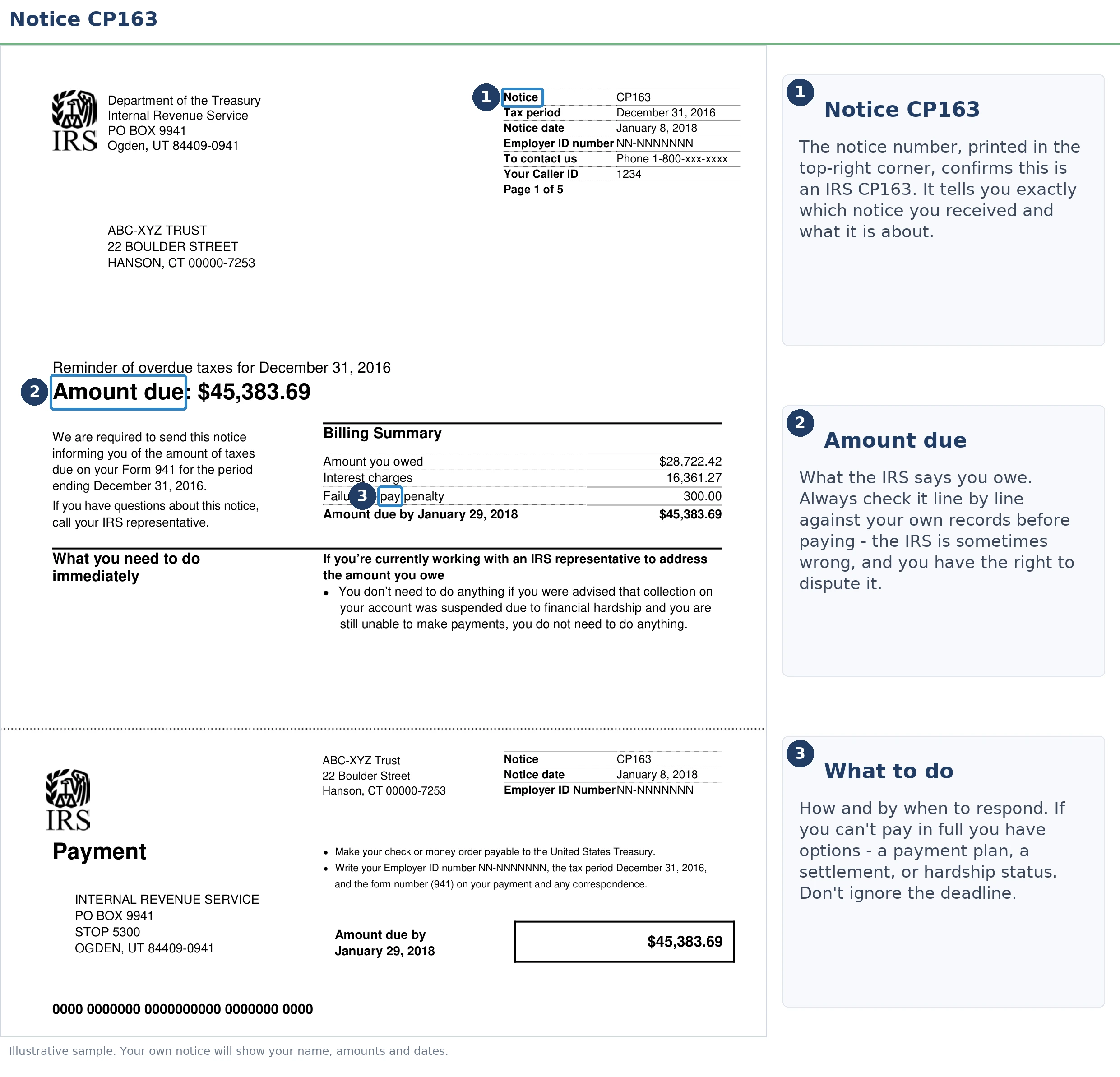
Three facts set the CP163 apart from every other IRS letter: it repeats annually, it prints no response deadline, and it usually signals your account is sitting in a non-active collection status rather than being worked by anyone. The image below shows exactly what a CP163 looks like and where to find the three things you'll need — the tax periods, the notice date, and the total balance — before you decide anything.
⏱ The real clock: a CP163 prints no response deadline. Instead, the failure-to-pay penalty adds 0.5% of the unpaid tax every month (until it caps at 25%), and interest compounds daily at the federal underpayment rate. On a dormant account, that growth — plus the risk of sudden reactivation — is the deadline.
Why you got a CP163 notice
The IRS sends a CP163 once a year when a business tax account carries a balance the agency is not actively collecting. Congress requires the IRS to remind debtors of what they owe at least annually — for individuals that's the CP71 annual reminder; for business accounts under an EIN, it's the CP163.
Getting one usually means one of three things happened upstream. Your account may be in Currently Not Collectible status because you or the business demonstrated hardship. It may be sitting in the IRS collection queue, unassigned to any collector. Or an earlier notice stream simply stalled — common when a business closes, moves, or stops filing. Whatever put the account on the shelf, the CP163 is the shelf's yearly inventory tag.
The balances behind a CP163 are typically employment taxes from Form 941, federal unemployment tax from Form 940, or civil penalties assessed against the business. If yours traces to unpaid payroll quarters, our guide to 941 back taxes covers why the IRS treats that category more seriously than any other. And if you're wondering why any IRS mail arrives when it does, the broader answer lives in our hub on why you got a letter from the IRS.
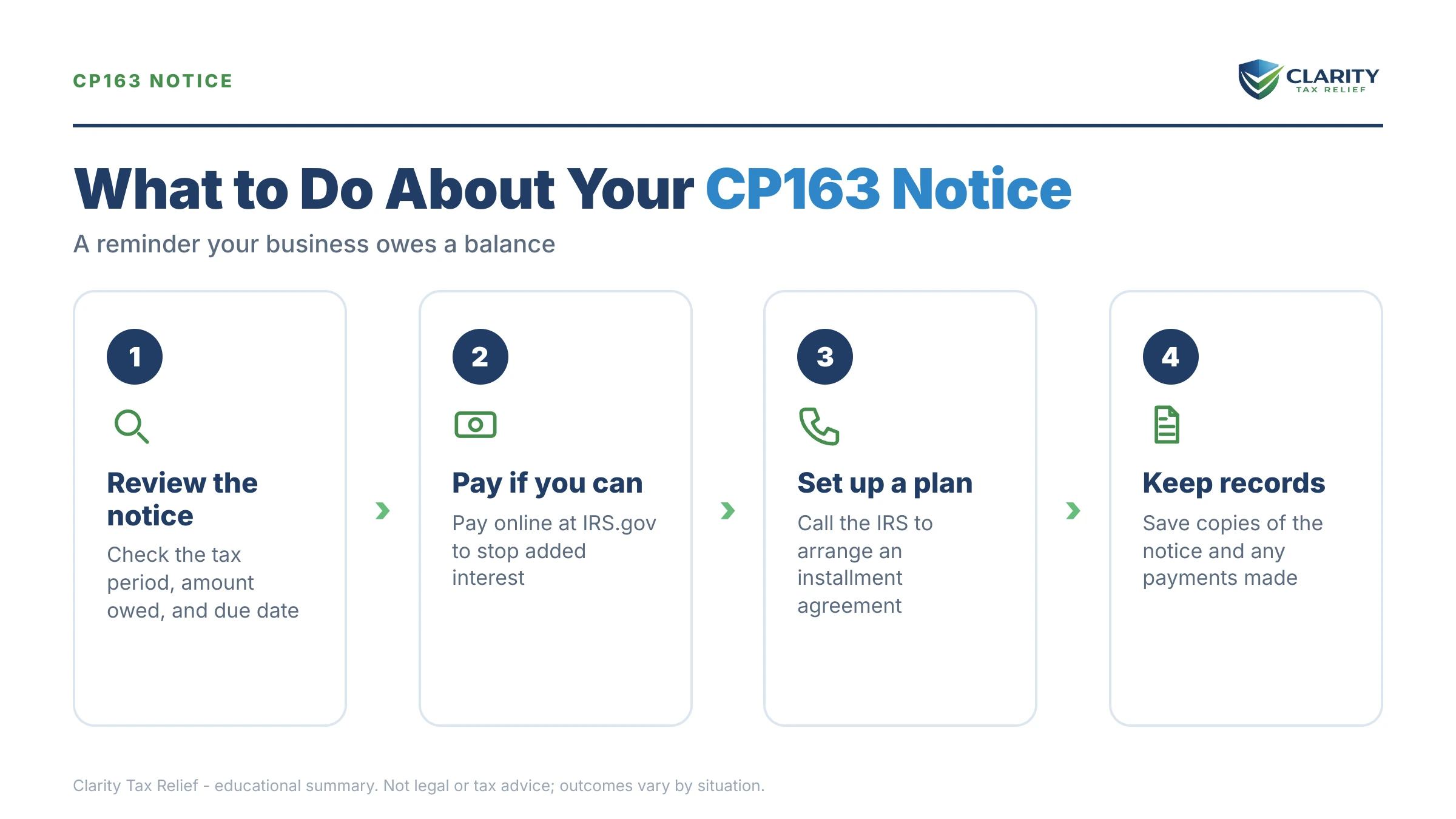
What a CP163 tells you about your account
A CP163 signals a dormant collection account — the debt is real and growing, but no one is actively pursuing it today. That's a meaningfully different position than someone holding a fresh bill or a final levy warning, and it changes your strategy in two ways.
First, time is on your side for once. There's no 21-day or 30-day window forcing a rushed decision. You can pull transcripts, run the numbers on each option, and approach the IRS from a position of preparation instead of panic.
Second, dormant is not the same as forgiven. The 10-year collection statute — the Collection Statute Expiration Date, or CSED — keeps running while the account sleeps, which cuts both ways. Some CP163 recipients are closer to legal expiration of the debt than they realize; others have most of a decade of exposure left. You can estimate where each tax period stands with our CSED Calculator. Which side of that line you're on should drive everything you do next.
One more thing worth knowing: because the CP163 shows the balance with accrued penalties and interest, the number will be higher than last year's reminder even if nothing else changed. That's not a new assessment — it's arithmetic.
What happens if you ignore a CP163 notice
Ignoring a CP163 costs money every single month even though no enforcement letter follows on a fixed schedule. Here's the sequence of what actually happens to a dormant business balance left alone:
- The balance compounds. The failure-to-pay penalty keeps adding 0.5% of the unpaid tax monthly until it hits its 25% cap, and interest compounds daily on the whole balance — tax, penalties, and prior interest. Rates adjust quarterly; see the current IRS interest rates for 2026.
- Your refunds disappear. Any federal refund connected to the account — including, for a sole proprietor, your personal 1040 refund — gets offset against the balance year after year. Many people's only "payments" for a decade are intercepted refunds.
- A federal tax lien can be filed — or already has been. A lien attaches the government's claim to business assets and, for sole proprietors, personal property. It complicates financing, selling equipment, or selling the business.
- The account reactivates. A new return showing income, fresh W-2/1099 data, a missed filing, or a routine review of hardship status can flip the account back to active collection. From there the business escalation path resumes: a CP504B notice of intent to levy, then a final notice, then actual levy of bank accounts and receivables.
One trap deserves its own paragraph: if the IRS already sent a final notice of intent to levy for these tax periods years ago — before the account went quiet — it generally does not have to send a new one before levying once collection resumes. Your notice history, not the CP163, determines how much warning you'd get.
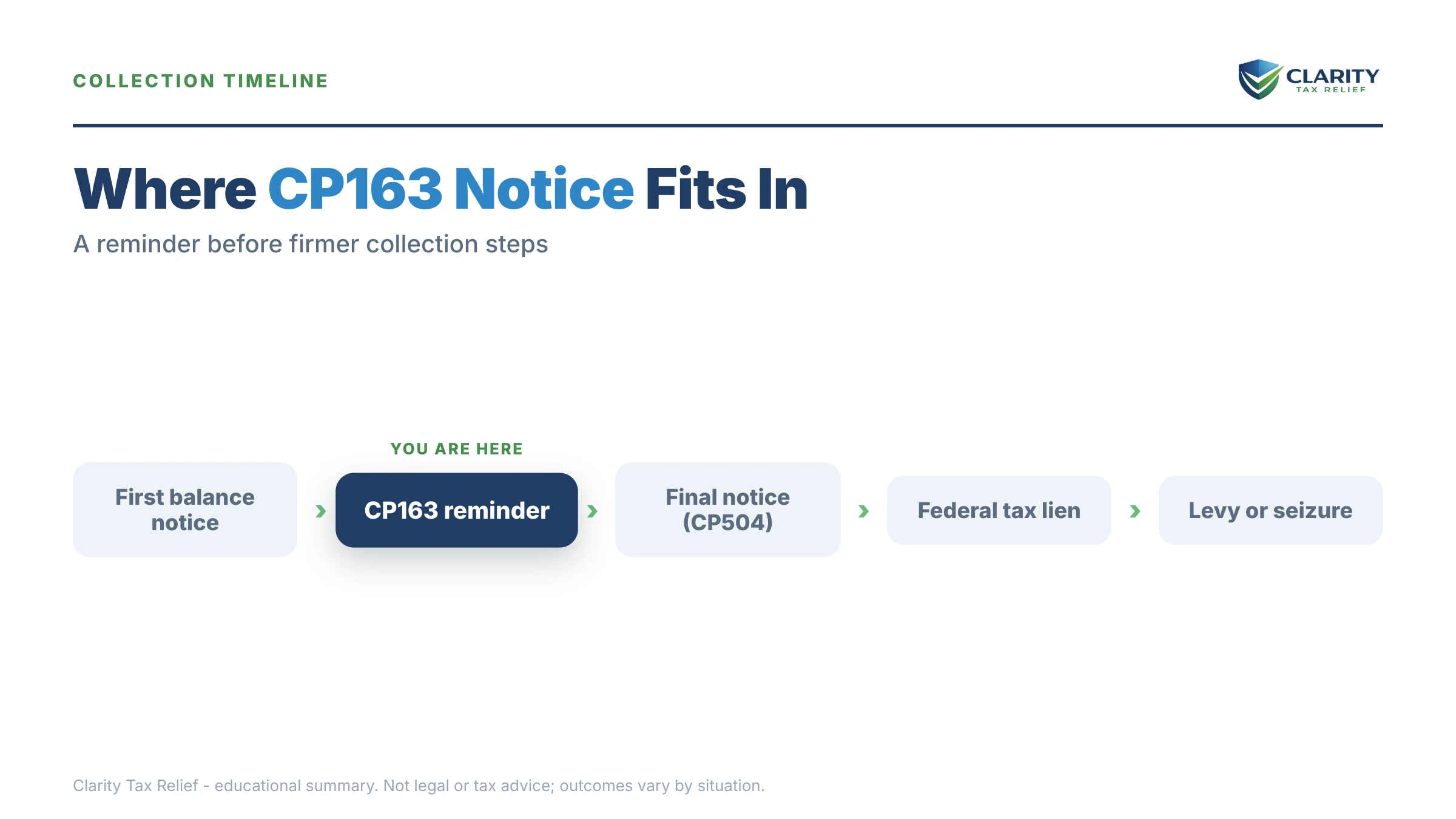
Here's where the CP163 sits relative to the notices that carry real enforcement power:
| Notice | What it means | Enforcement power |
|---|---|---|
| CP161 | First bill for a business balance due — the start of the sequence | None yet; pay-by date printed on the notice |
| CP504B | Notice of intent to levy under IRC §6331(d) | IRS can seize your state tax refund; lien filing becomes likely |
| Letter 1058 / CP297 | Final notice of intent to levy | 30-day appeal window (Form 12153); bank and receivables levies can follow |
| CP163 (you are here) | Annual reminder while the account is not in active collection | No new enforcement and no new deadline — but accruals continue and the account can reactivate |
Holding a CP163 with a balance you can't explain?
Send us a photo of it. An experienced tax professional will pull your account history, tell you how much of the 10-year collection clock has already run, and map your realistic options — free, confidential, no pressure. Every month of waiting adds penalty and interest to the total.
Your options for a CP163 balance in 2026
Every CP163 balance has at least four realistic resolution paths, and the right one depends on the amount, your cash flow, and how much of the collection statute remains.
- Pay it or pay it down. If you can clear the balance, paying at IRS.gov/payments stops all future accruals. Even a partial paydown can matter strategically — dropping under a plan threshold can unlock simpler options (see the table below).
- A payment plan. Businesses still operating typically need a business IRS installment agreement, with express-style plans available at lower balances and financial disclosure (Form 433-B) required above them. A sole proprietor whose business has closed is often handled more like an individual, which can open longer terms.
- Stay in — or apply for — hardship status. If the CP163 exists because you're in Currently Not Collectible status, sometimes the smartest move is to protect that status: stay compliant on current filings and deposits, and let the collection statute keep running. If you're not in CNC but genuinely can't pay, you may qualify by documenting hardship.
- An Offer in Compromise. When the business is closed and your assets and income genuinely can't cover the debt, the IRS can accept less than the full balance — it applies a $205 application fee and, for lump-sum offers, a 20% down payment (both waived with low-income certification, where AGI is at or below 250% of the poverty level). The IRS accepted roughly 1 in 5 offers in FY2024, so this is real but never automatic.
- Penalty relief. First-time abatement can remove penalties if the prior three years were clean, and reasonable cause covers illness, disaster, or reliance failures. Starting summer 2026, the IRS's Automatic Exemption from Penalty (AEP) begins applying qualifying relief automatically — worth checking before you pay assessed penalties on an old balance.
| Balance on your CP163 | Realistic options | What to know |
|---|---|---|
| Under $10,000 | Pay in full; short payoff plan; penalty abatement | Simplest tier — often resolvable in one or two phone calls, and penalty relief may shrink it further |
| $10,000 – $25,000 | Express-style business plan (direct debit typically required); penalty relief | In-business express plans generally require full payment within about 24 months |
| $25,001 – $50,000 | Plan with financial disclosure (Form 433-B); paydown below $25,000 to simplify; CNC if hardship | A strategic paydown can move you into the easier tier above — run the math before you call |
| Over $50,000 | Negotiated agreement with full financials; OIC or CNC analysis | Larger dormant balances are likelier to draw a revenue officer once reactivated; a lien is probable if not already filed |
What a $31,200 CP163 balance actually costs
A worked example makes the trade-offs concrete. Say you're a sole proprietor whose small crew disbanded in 2022, leaving $31,200 in unpaid payroll taxes on your EIN — roughly $25,500 of it tax, the rest penalties and interest already assessed. This is hypothetical, but the math is real:
- Doing nothing: the failure-to-pay penalty alone adds about $128 a month (0.5% × $25,500) until it reaches its 25% cap, and daily-compounding interest runs on the entire $31,200. A year of "waiting to deal with it" costs well over $2,500 before interest.
- Paying down to a simpler plan: pay $6,201 to bring the balance to $25,000, and an express-style 24-month plan becomes plausible — roughly $1,042 a month, done in two years.
- A longer plan: because a closed sole proprietorship's debt is personal, individual-style terms may apply — $31,200 spread over 72 months is about $434 a month of principal, though you'd realistically budget closer to $500 because interest and penalties continue during the plan.
- An Offer in Compromise: if the business is gone, your income is modest, and your assets are thin, the IRS's own formula might value what it could ever collect at well below $31,200 — but only your documented finances, not your hopes, decide that.
Notice what the example shows: on this balance, the order of moves — penalty relief first, paydown second, plan third — can change the total cost by thousands of dollars. Sole proprietors carrying mixed payroll and self-employment balances should also read our guide to sole proprietor payroll tax debt, because the two debt types resolve differently.
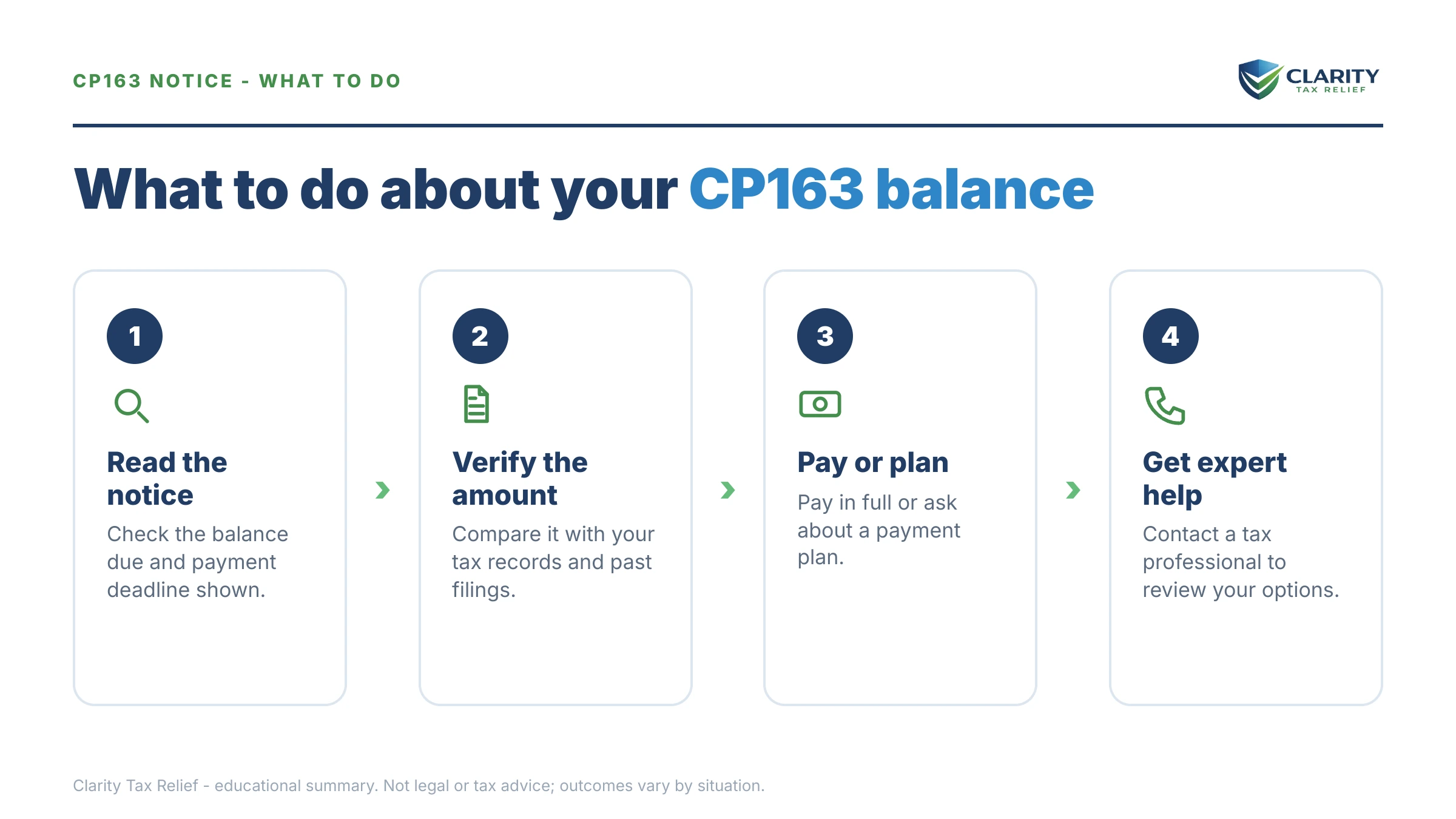
How to respond to a CP163, step by step
- Pull your business account transcripts — confirm the assessed balance, the tax periods involved, and every payment the IRS has on record before you trust the notice's number.
- Confirm every required return is filed — the IRS will not approve a payment plan, hardship status, or an offer while any required return is missing.
- Map your collection statute dates — work out how much of the 10-year collection clock has already run on each tax period, because it changes which option makes sense.
- Choose your resolution track — a payment plan, continued hardship status, penalty relief, or an Offer in Compromise, based on what your current finances actually support.
- Get a professional review before you call the IRS — a dormant account approached in the wrong order can wake up faster than you'd like, so know your position first.
Details on plan types, terms, and setup live on the IRS's payment plans and installment agreements page.
When you can handle a CP163 yourself — and when to get help
Plenty of CP163 situations don't need professional help. If the balance is small, your records match the notice, all your returns are filed, and you can pay it off or set up a simple plan, do exactly that — you'll save the cost of representation and close the file.
Experienced help changes outcomes in the harder versions of this notice: when the balance is payroll tax and the business is still operating (trust fund exposure raises the stakes), when the CP163 covers multiple tax periods with different statute expiration dates, when you suspect a final levy notice was issued years ago, when you're in CNC and any wrong move could trigger a financial re-review, or when the OIC math is genuinely in play. In those cases, the question isn't whether to respond — it's the sequence of moves, and sequencing is where professionals earn their fee.
If you can't get answers from the IRS itself — 2026 staffing cuts have made phone lines brutal — the Taxpayer Advocate Service is a free, independent option for accounts stuck in limbo.
Terms on your CP163, decoded
- Currently Not Collectible (CNC): a hardship status where the IRS shelves active collection — the debt survives and keeps accruing, but levies stop.
- CSED (Collection Statute Expiration Date): the date, generally 10 years after assessment, when the IRS legally loses the right to collect a tax period — pausable by offers, bankruptcy, and appeals.
- Accrued penalty and interest: charges added since the original assessment; the reason this year's CP163 is bigger than last year's even if nothing else happened.
- Trust fund taxes: the portion of payroll taxes withheld from employees' paychecks — the category the IRS pursues most aggressively, including against individuals personally.
- Federal tax lien: the government's recorded legal claim against your property; different from a levy, which is the actual taking. A lien may already exist on an old balance.
CP163 questions, answered
Is a CP163 notice serious?
A CP163 carries no enforcement action by itself — it's an annual reminder, not a levy threat. But it confirms a real, live debt that grows every month: the failure-to-pay penalty adds 0.5% of the unpaid tax monthly (up to a 25% cap) and interest compounds daily. The quiet period it represents can end any time the IRS's systems flag new income or a missed filing.
Why did I get a CP163 when the IRS hasn't contacted me in years?
The IRS sends CP163 as a required yearly reminder while a business balance sits without active collection — often because the account is in Currently Not Collectible status or waiting in the collection queue. Years of silence never mean the debt was forgiven; it means no one was actively working the file. The 10-year collection statute keeps running in the background either way.
Do I have to respond to a CP163?
No response deadline is printed on a CP163, and nothing bad happens on a specific day if you don't reply. What you should do is verify the balance against your account transcripts and decide deliberately: pay it down, set up a resolution, or confirm how close each tax period is to its collection expiration date. Doing nothing means the balance keeps compounding and the account can reactivate on the IRS's schedule, not yours.
Can the IRS levy my bank account after a CP163?
Not because of the CP163 itself — before levying, the IRS must generally issue a final notice of intent to levy with 30-day appeal rights, such as a Letter 1058 or CP297. The important exception: if the IRS already sent that final notice for these tax periods years ago, it generally does not have to send a new one before levying once your account returns to active collection. Check your notice history before assuming you'd get a fresh warning.
Does the debt on a CP163 ever expire?
Yes — the IRS generally has 10 years from the date each tax was assessed to collect it, after which the balance expires under the Collection Statute Expiration Date (CSED) rules. But the clock pauses during events like an Offer in Compromise, bankruptcy, or a collection appeal, so the real expiration date is often later than ten calendar years. A CP163 itself does not extend the statute; it's just a reminder while the clock runs.
I'm a sole proprietor — is the business balance on my CP163 separate from me personally?
No. A sole proprietorship is not a separate legal entity, so a balance on your business account — payroll taxes, federal unemployment tax, or business penalties under your EIN — is your personal debt. The IRS can offset your individual tax refunds against it every year and, after proper notice, reach personal bank accounts and other assets. There is no corporate shield to hide behind.
What if the amount on my CP163 doesn't match my records?
First, remember the notice shows the balance with accrued penalties and interest — so it will be higher than the original assessment and higher than last year's reminder even if you paid nothing new. If it still looks wrong, pull your business account transcripts and check for misapplied payments, especially payments posted to the wrong tax period or the wrong EIN. Respond with proof rather than paying a number you can't verify.
Your next 24 hours
- Find three things on your CP163: the tax period(s) listed, the notice date, and the total-balance box. Note whether the periods are 941 quarters, 940, or civil penalties — it changes your options.
- Gather your records: the notice itself, your last filed business and personal returns, any payment confirmations for those periods, and a rough picture of your current monthly income and expenses.
- Get a free case review: call (888) 825-7779 or use the 2-minute form. A dormant account is the cheapest moment to resolve a tax debt — every month you wait, penalties and interest quietly raise the price of every option on the table.
This guide is general information, not tax or legal advice for your specific situation. Eligibility for IRS programs depends on individual facts and circumstances; no outcome is guaranteed.