
IRS Business Notices
IRS CP161 Notice: What Your Business Owes and What to Do (2026)
The short answer: a CP161 notice is the IRS's bill to your business: the return you filed shows more tax than your deposits and payments cover. It is not a math error and not an audit. Pay or arrange payment by the date printed on the notice — typically about three weeks — before automated business collection escalates.
You filed the 941 on time. You thought a deposit went out with every payroll. Now a letter addressed to your business's EIN says the IRS wants $13,600 by a date about three weeks away — while you still have a crew to pay Friday. Take a breath: a CP161 is a bill, not an accusation, and at this stage every fix on the menu is still open.
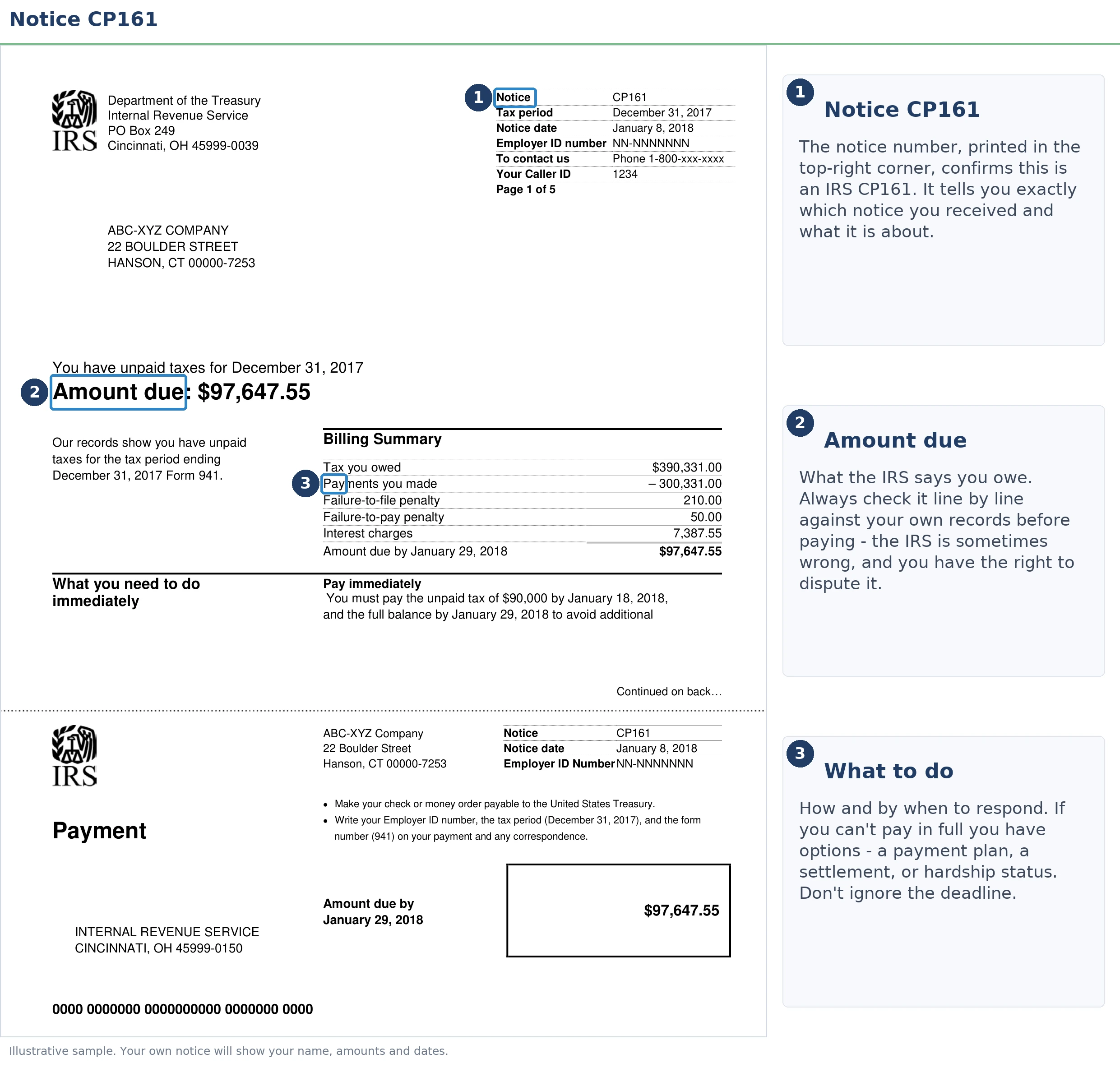
The image below shows exactly what a CP161 looks like and where to find the three items that control everything: the tax period, the breakdown of tax versus penalty versus interest, and the pay-by date.
⏱ Your deadline: the pay-by date printed on your CP161 — typically about three weeks from the notice date. After it passes, the failure-to-pay penalty keeps adding 0.5% per month, interest compounds daily, and the IRS's automated system queues the next business collection notice.
Why your business got a CP161
A CP161 means the IRS accepted your business return exactly as you filed it — and the payments on record don't cover the tax you reported. Nobody changed your numbers. If the IRS had adjusted the return, you'd be holding a CP210 or CP220 instead; if it were assessing a standalone penalty, you'd have a CP215 notice. The CP161 is simpler and, in a way, better news: the only dispute is whether the money arrived.
For a small business with payroll, the usual triggers are:
- A missed or late federal tax deposit on Form 941 — one payroll's deposit slipped, and the quarter closed short.
- A misapplied deposit — the payment posted to the wrong quarter, the wrong form (940 instead of 941), or a related entity's EIN. Your money exists; it's just sitting in the wrong bucket.
- A return filed with a balance you couldn't pay — a Form 1120 or Form 940 filed correctly, with the check never sent.
The notice covers ONE tax period. If you're behind on several quarters of payroll tax, this letter is one slice of a bigger problem — the full picture is in our guide to 941 back taxes. And if you're not sure why the IRS is writing to your business at all, start with why you got a letter from the IRS; this page covers only the CP161.
How a $13,600 CP161 adds up: a worked example
Say your business reported $38,400 in total tax on its first-quarter Form 941, but only $26,300 in deposits posted. Here's how the IRS turns that $12,100 shortfall into the number on the notice:
- Unpaid tax: $12,100
- Failure-to-deposit penalty at the 10% tier (deposits more than 15 days late): $1,210
- Failure-to-pay penalty, roughly two months at 0.5% per month: about $121
- Interest, compounding daily: roughly $170
- CP161 balance: about $13,600
Waiting makes each line worse. The failure-to-pay penalty keeps adding about $60 a month on this balance, interest compounds on top, and if the deposit portion isn't paid within 10 days of the IRS's notice demanding payment, the deposit penalty can climb to its top 15% tier — roughly another $605 here. The full tier schedule is in our guide to the federal tax deposit penalty, and you can estimate how your own balance grows with our IRS Penalty & Interest Calculator.
What happens if you ignore a CP161 notice
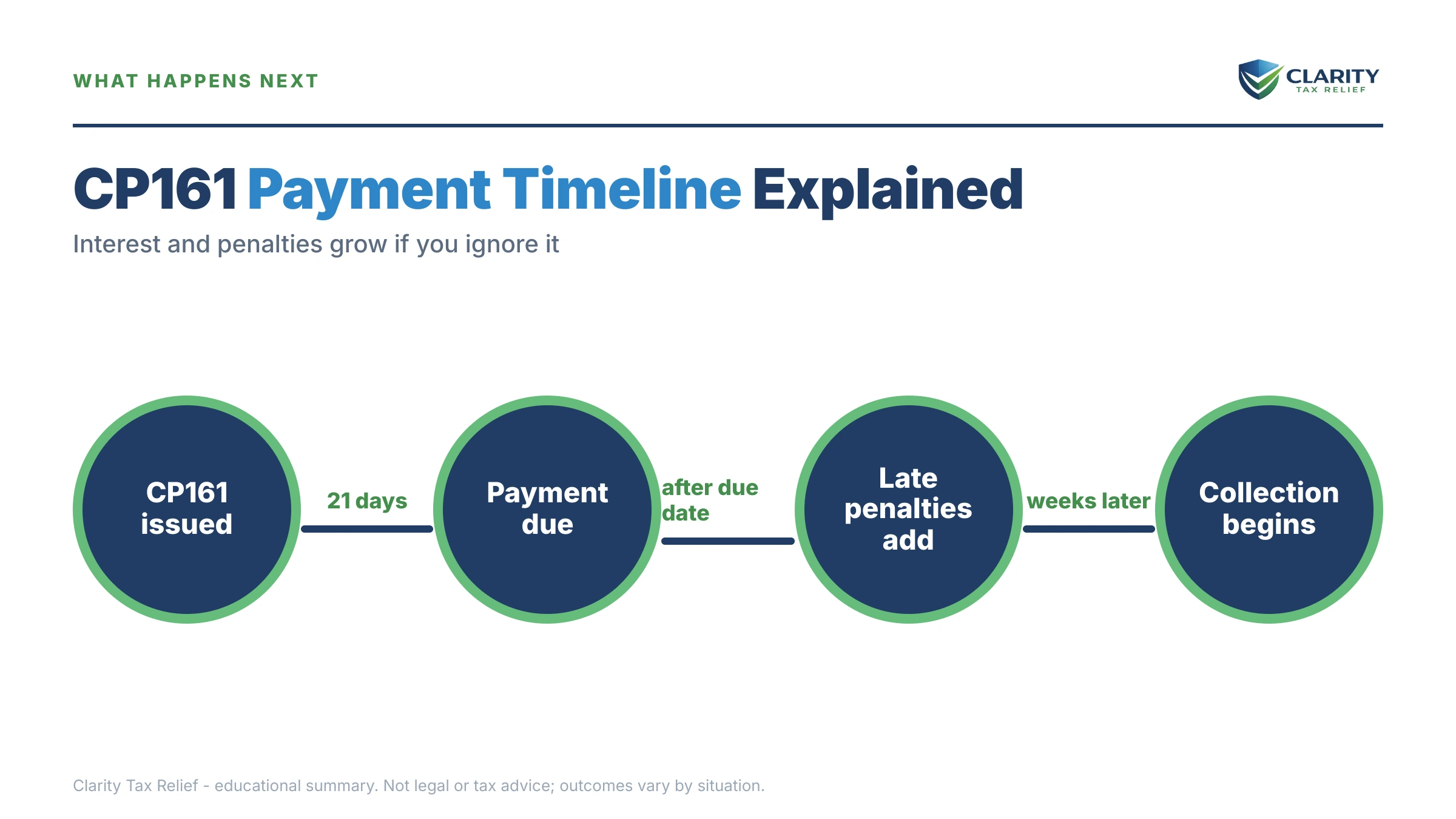
Ignoring a CP161 puts your business on an automated track that ends with levies on bank accounts and receivables — and, on payroll tax, a penalty assessed against you personally. The sequence runs on its own; in 2026, with the IRS workforce down roughly 27%, humans are harder to reach but the automated notices, liens, and levies never stopped.
- CP161 — the first bill on the business account. No enforcement yet. This is the cheapest moment this balance will ever have.
- CP163 — the reminder of the business balance due. Still just a bill, but penalties and interest have grown, and the account is moving toward enforcement status.
- CP504B — the business version of the intent-to-levy notice. The IRS can now take state tax refunds owed to the business, and a Notice of Federal Tax Lien — which attaches to business assets, inventory, and receivables — becomes likely.
- Final notice — CP297, LT11, or Letter 1058 — starts a 30-day clock and your Collection Due Process rights (requested on Form 12153). After the 30 days, the IRS can levy business bank accounts (a bank levy carries a 21-day hold before funds leave) and send levies directly to your customers for your receivables.
- The trust fund track (payroll balances only) — a revenue officer may be assigned, interview the people who ran payroll, and issue Letter 1153 proposing to assess the withheld portion of the taxes against owners and check-signers personally. Closing or dissolving the business does not erase this part.
| Notice or stage | Response window | What passes with the deadline |
|---|---|---|
| CP161 (first bill) | Pay-by date printed on the notice (typically about three weeks) | The cheapest resolution — after this, penalties climb and the reminder track begins |
| CP504B (intent to levy) | The date printed on the notice | State tax refunds owed to the business become seizable; a federal tax lien becomes likely |
| CP297 / LT11 / Letter 1058 (final notice) | 30 days | Your Collection Due Process hearing rights via Form 12153 — the strongest pre-levy appeal |
| Letter 1153 (payroll balances) | 60 days | Your chance to protest the Trust Fund Recovery Penalty before it is assessed against you personally |
| Bank levy served | 21-day hold | The window to get frozen funds released before the bank sends them to the IRS |
Holding a CP161 for payroll taxes?
Get it reviewed free before the pay-by date on your notice passes. An experienced tax professional will confirm whether the balance is even right, flag any trust fund exposure, and map the option that keeps your business running — no pressure, no obligation.
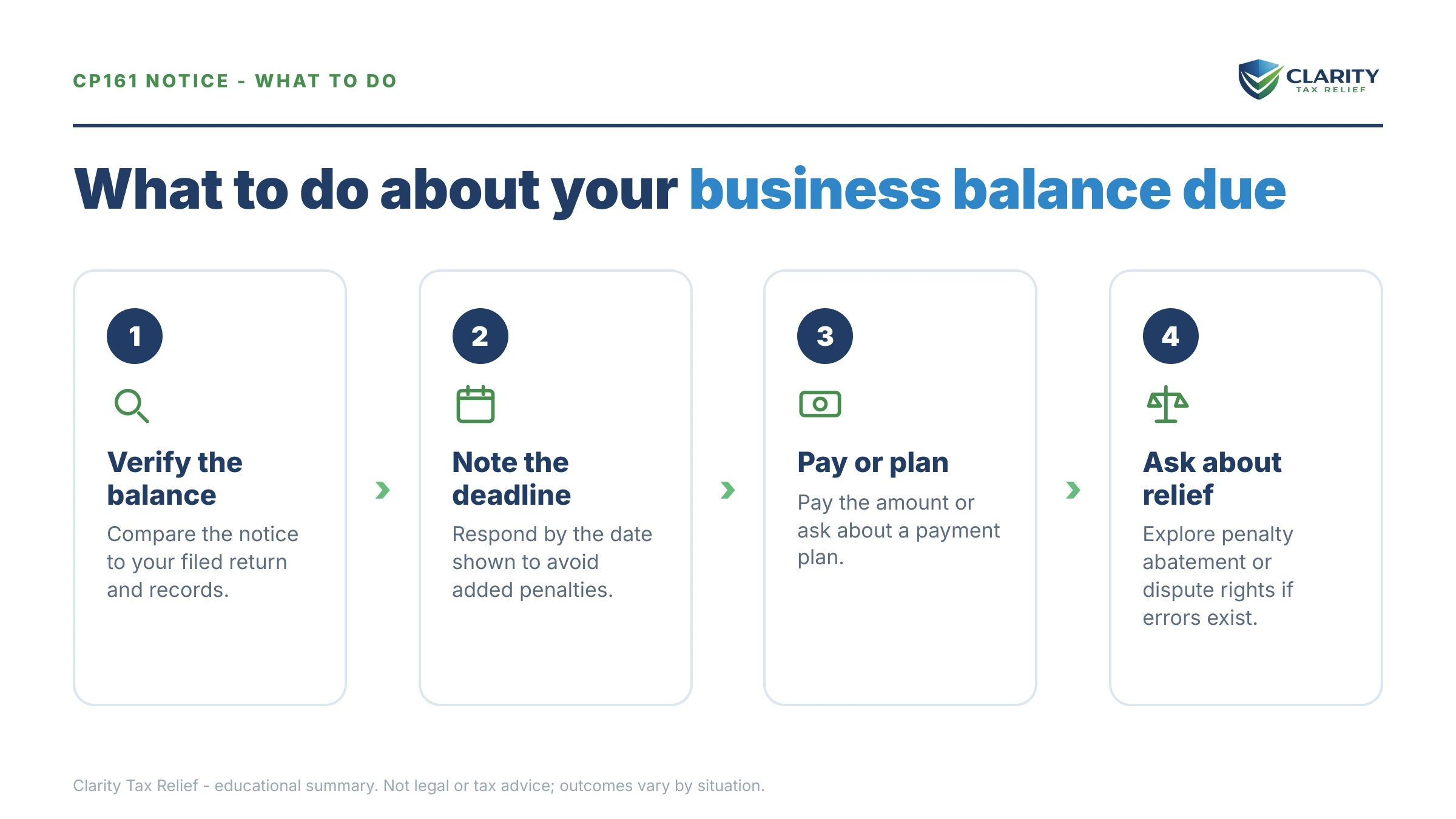
Your options when the business can't pay a CP161 in full
A business that can't pay a CP161 in full can usually stop escalation with a payment arrangement — and payroll balances of $25,000 or less, payable within 24 months, have a streamlined track that skips full financial disclosure. Business plans work differently from personal ones, so match the option to your balance type:
| Option | Typically fits when | Cost and key conditions |
|---|---|---|
| Pay in full by the notice date | Cash or a credit line covers it | Stops the failure-to-pay penalty and the notice track immediately; often cheaper than the interest the debt accrues |
| Fix a misapplied deposit | Your EFTPS records show the money went out | Free — ask the IRS to move the payment to the correct period instead of paying twice |
| In-business trust fund express installment agreement | Payroll balance of $25,000 or less, payable within 24 months | No full financial disclosure; direct debit required between $10,000 and $25,000; must stay current on new deposits |
| Regular business installment agreement | Larger balances or income-tax debt (Form 1120, Form 940) | Usually requires a Form 433-B financial statement; a setup fee applies; interest and the 0.5%/month penalty continue |
| Penalty abatement | Clean three-year compliance history, or genuine reasonable cause | Free to request; removing a penalty also removes the interest charged on it |
| Offer in Compromise (business) | The business genuinely can never pay the full debt | $205 application fee; strict review, and rare on payroll debt because trust fund taxes carry personal exposure |
Two details matter more than anything on this table. First, staying current is condition number one: no business resolution survives a missed current-quarter deposit, and a default puts you back on the escalation track with less goodwill. The mechanics of the streamlined payroll plan are in our business payroll tax payment plan guide, and larger or mixed balances are covered under business IRS installment agreement thresholds.
Second, on the $13,600 example above, roughly $1,500 of the balance is penalty. If this is your business's first slip in three years, first-time abatement could remove much of that — see 941 penalty abatement for what qualifies. And starting in summer 2026, the IRS's new Automatic Exemption from Penalty applies some relief automatically, with no request needed — so never assume a written abatement letter is the only path.
One caution: the trust fund portion of a payroll balance — the money withheld from employees' paychecks — follows the people who ran the business, not just the entity. Before choosing any option on a 941 balance, understand how the Trust Fund Recovery Penalty works, because the smartest payment strategy often targets that portion first.
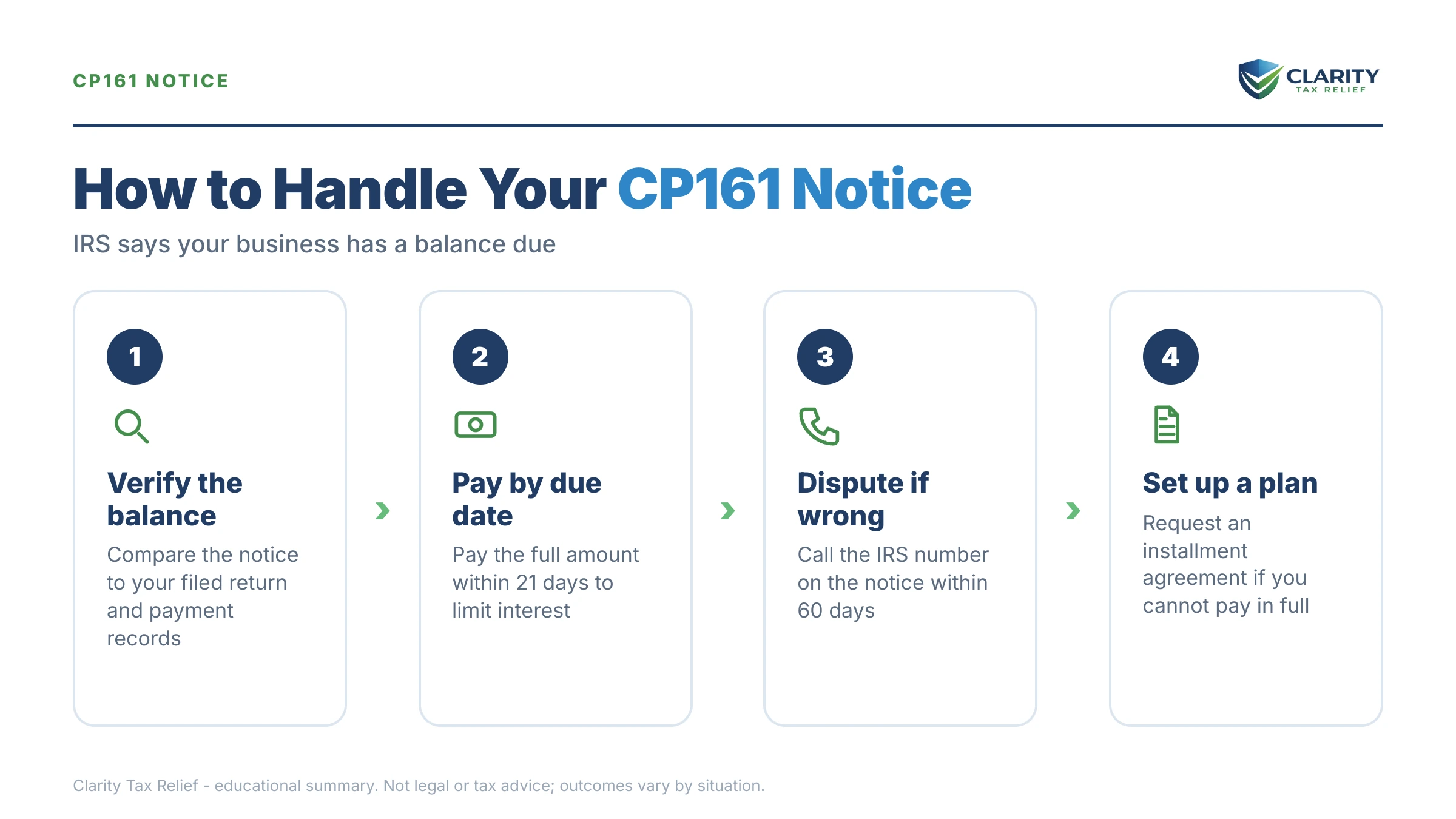
How to respond to a CP161 notice, step by step
- Verify the numbers — pull the filed return for the tax period on the notice and your EFTPS deposit history, and confirm the shortfall is real before you pay anything.
- Pay in full if you can — pay by the date on the notice at IRS.gov/payments or through EFTPS to stop the failure-to-pay penalty and the notice sequence.
- Set up a payment arrangement if you can't — request a business installment agreement before the pay-by date; even a plan started today halts escalation.
- Request penalty relief — ask for first-time abatement or reasonable-cause relief on the penalty portion; every dollar of penalty removed also removes the interest charged on it.
- Fix the deposit schedule — put the current quarter's federal tax deposits on autopilot so the next Form 941 doesn't generate a new CP161.
- Get a professional review for payroll balances — trust fund exposure changes the order of moves, and an experienced tax professional can map the sequence before you commit to a plan.
When you can handle a CP161 yourself
You don't need professional help for every CP161 — many are a one-call fix. Handle it yourself when:
- The balance is small, you agree with it, and the business can pay it in full by the notice date;
- Your EFTPS records show a deposit posted to the wrong period, and you just need it moved;
- It's a single quarter, under $25,000, and you can set up the express payment plan and keep current deposits going without strain.
Experienced help changes the outcome in a different set of situations: multiple quarters of payroll tax behind (the IRS treats repeat non-deposit — "pyramiding" — far more aggressively), a revenue officer already assigned or a Form 4180 interview scheduled, a business that can't both pay the plan and stay current, or any hint of the Trust Fund Recovery Penalty being proposed against you, your co-owner, or your bookkeeper. In those cases the order of moves — which quarter, which portion, which relief request first — genuinely changes the dollars, and a wrong first move is hard to unwind.
Terms on your CP161, decoded
- Tax period — the specific quarter or year this bill covers; every payment and every dispute must reference it exactly.
- Federal tax deposit (FTD) — the scheduled payroll tax payments a business makes through EFTPS during the quarter, before the return is even filed.
- Trust fund taxes — the money withheld from employees' paychecks (income tax plus their share of Social Security and Medicare), which the IRS treats as its money held in trust by you.
- Failure-to-deposit penalty — the tiered penalty (2%, 5%, 10%, or 15%) for deposits made late, short, or not at all.
- Assessment — the formal recording of the debt on your business account; it also starts the IRS's 10-year collection clock.
- Collection Due Process (CDP) — the formal hearing right that arrives with a final levy notice, requested on Form 12153 within 30 days.
The IRS's own plain-language page for this letter is at Understanding your CP161 notice, and its payment-plan terms are laid out on the IRS payment plans page.
CP161 notice questions, answered
Is a CP161 notice serious?
Yes, but it is the earliest and cheapest stage of business collection — nothing is being levied yet. The real risk is the sequence behind it: a reminder, an intent-to-levy notice, and, on payroll balances, a proposal to assess the trust fund portion against you personally. Respond by the pay-by date printed on the notice and that escalation never starts.
What is the difference between a CP161 and a CP14?
They carry the same message on different accounts. A CP14 bills an individual taxpayer on a Social Security number; a CP161 bills a business on its EIN, usually for Form 941, 940, or 1120 balances. The business track escalates through CP163 and CP504B instead of CP501 and CP504, and payroll balances add personal-liability risk that individual bills never carry.
Why did I get a CP161 if I made every payroll deposit?
The most common reason is a misapplied deposit — one that posted to the wrong quarter, the wrong form, or a related entity's EIN. Pull your EFTPS history and compare each deposit's tax period against the quarter printed on the notice. If a payment landed in the wrong period, ask the IRS to move it rather than paying the balance twice.
Can the IRS hold me personally responsible for my business's CP161 balance?
If the balance is payroll tax, yes. The trust fund portion — withheld income tax and the employee share of Social Security and Medicare — can be assessed personally against anyone responsible for collecting and paying it, through the Trust Fund Recovery Penalty. Corporate income tax on Form 1120 generally stays with the corporation, while sole proprietors and single-member LLC owners are personally liable from the start.
Can my business get a payment plan for a CP161 balance?
Yes. A business that owes $25,000 or less in payroll tax and can pay within 24 months may qualify for an in-business trust fund express agreement without full financial disclosure; direct debit is required between $10,000 and $25,000. Larger or income-tax balances typically require a Form 433-B financial statement, and every business plan requires staying current on new deposits — one missed deposit can default it.
Can the penalties on a CP161 be removed?
Often, yes. If the business has a clean compliance history for the prior three years, first-time abatement can remove qualifying failure-to-pay and failure-to-deposit penalties, and starting in summer 2026 the IRS's Automatic Exemption from Penalty applies some relief with no request needed. Reasonable cause — a disaster, serious illness, or a payroll provider's failure — is a separate path with no clean-history requirement.
If I can only pay part of my CP161, which part should I pay first?
On a payroll balance, designate a voluntary payment in writing to the trust fund portion of the specific tax period. That shrinks the amount that could ever be assessed against you personally through the Trust Fund Recovery Penalty. If you don't designate, the IRS applies the payment in the order that benefits the government — usually the non-trust-fund tax and penalties first.
Your next 24 hours
- Find the tax period and pay-by date on your CP161 — near the top of the first page — and note how the balance splits between tax, penalty, and interest. Those three lines decide your strategy.
- Gather three things: the filed return for that period, your EFTPS deposit confirmations for the quarter, and a realistic number for what the business can pay monthly without missing current deposits.
- Get a free case review — the 2-minute form or (888) 825-7779 — before the pay-by date on your notice passes. That date is the cheapest this balance will ever be; every stage after it adds cost and takes options off the table.
This guide is general information, not tax or legal advice for your specific situation. Eligibility for IRS programs depends on individual facts and circumstances; no outcome is guaranteed.