
Penalty Relief
941 Penalty Abatement: How to Remove IRS Payroll Tax Penalties in 2026
The short answer: 941 penalty abatement is real — failure-to-deposit, failure-to-file, and failure-to-pay penalties on payroll returns can all be removed. The four paths are first-time abatement (12 clean prior quarters), documented reasonable cause, a statutory exception, and the 90-day deposit-designation election. The underlying payroll tax itself stays owed.
You're staring at a penalty notice for your business's Form 941 — and the penalty section is nearly as big as the tax itself, for quarters when the person who used to run payroll isn't in the picture anymore. That's exactly the situation 941 penalty abatement exists for, and the order you make your requests in changes how much comes off. Here's the full map.
First, know which penalty you're actually fighting — a single bad quarter usually carries two or three different ones stacked together, and each has its own abatement rules. If you're not sure which notice you're holding, the image below shows exactly what an IRS 941 penalty notice looks like and where to find the penalty type, the quarter, and the computation.
⏱ Your real clocks: you have 90 days from the date on a failure-to-deposit penalty notice to designate how your deposits are applied — after that, the IRS's default oldest-first ordering stands. And the failure-to-pay penalty plus interest keep accruing monthly on any unpaid balance while you decide.
Why you got 941 penalties — and which ones are stacking
One late payroll quarter typically triggers three separate IRS penalties on the same money: failure to deposit, failure to file, and failure to pay. That stacking is why 941 penalties feel so much harsher than income-tax penalties — payroll taxes are due in deposits throughout the quarter, not just when the return is filed.
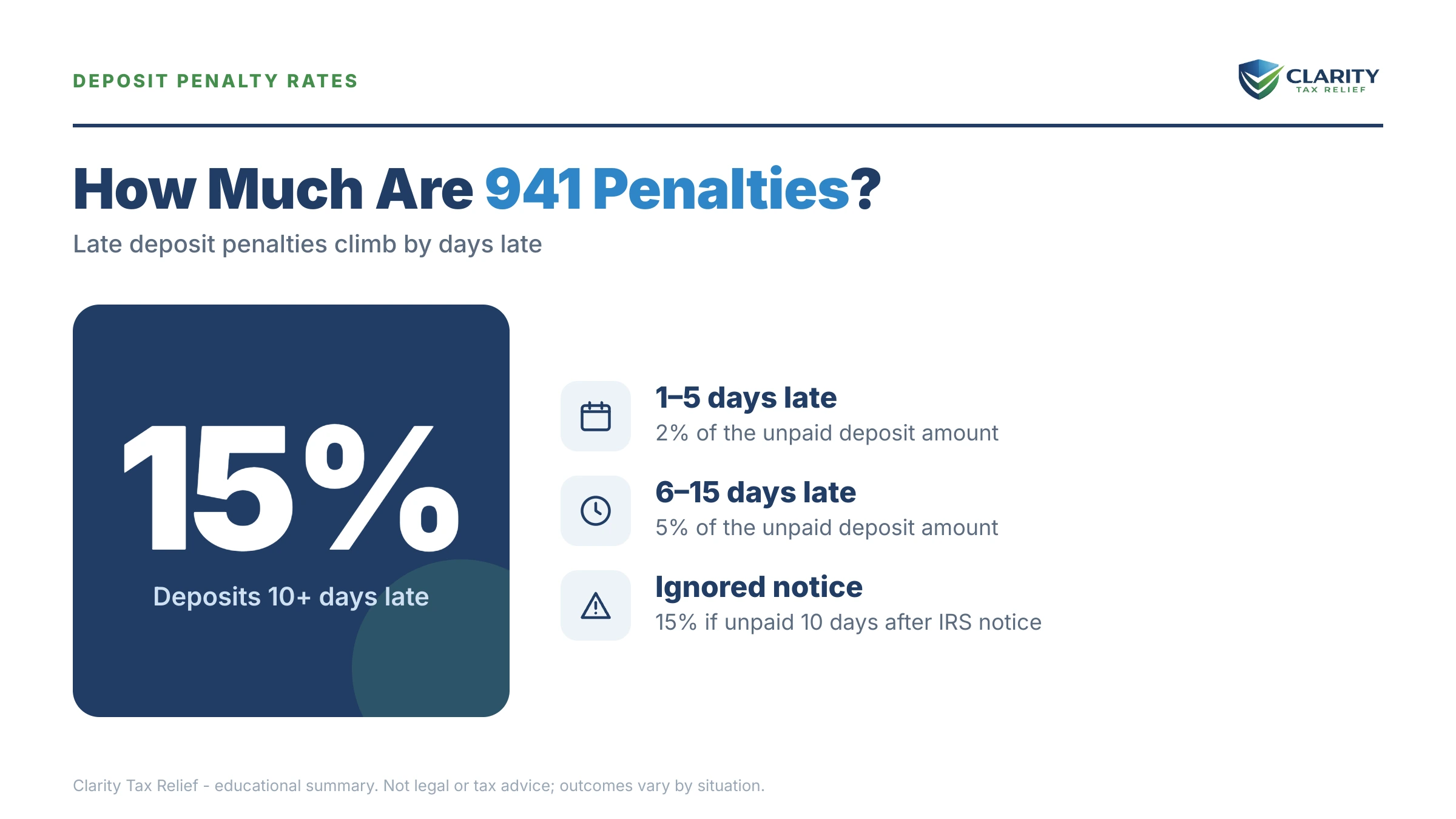
The federal tax deposit penalty is the one unique to payroll. It's tiered by how late each deposit is: 2% for deposits 1–5 days late, 5% for 6–15 days, 10% beyond 15 days, and 15% if the tax still isn't paid within 10 days of the IRS's first demand notice. If you never filed the quarter's return at all, the failure-to-file penalty adds 5% per month up to 25%, reduced to 4.5% in any month the failure-to-pay penalty also applies (combined 5%/month) — file every missing quarter before requesting anything, because abatement requests on unfiled quarters go nowhere. Our guide to 941 back taxes walks through that cleanup.
For what these penalties do to a balance over time across all tax types, the math lives in our hub on how much IRS penalties on back taxes really grow. This page stays on what's specific to payroll.
| Penalty | Rate | When it applies | Abatement path |
|---|---|---|---|
| Failure to deposit (FTD) | 2% / 5% / 10% / 15% tiers | Deposits made late, short, or by the wrong method during the quarter | FTA, reasonable cause, or 90-day deposit designation |
| Failure to file (FTF) | 5% per month (4.5% in months the FTP penalty also applies), max 25% | The quarterly 941 itself was filed late or not at all | FTA or reasonable cause |
| Failure to pay (FTP) | 0.5% per month, max 25% | Balance shown on the return went unpaid — keeps accruing monthly | FTA or reasonable cause |
| Trust Fund Recovery Penalty (TFRP) | 100% of the withheld (trust fund) portion | Assessed personally against "responsible persons" — not the business | Not FTA-eligible; separate Letter 1153 protest |
The deposit penalty compounds in a sneaky way. The IRS applies each deposit you make to the oldest liability in the quarter first — so a single missed deposit early in the quarter can make every later deposit look late on paper, cascading one mistake into a penalty on the whole quarter. Hold that thought; the 90-day fix for it is below. If the deposits are still slipping right now, start with our guide to a missed payroll tax deposit — stopping new penalties matters more than abating old ones.
What happens if you ignore 941 penalties
Unpaid 941 penalties ride the same automated collection track as the tax itself — a track that ends at business bank levies and a personal assessment against you. The penalties don't sit in a separate bucket; every collection notice that follows demands the combined balance, and the failure-to-pay penalty and interest grow it monthly. Here's the sequence:
- Penalty notice posts — a CP215 civil-penalty notice or CP276B deposit-penalty notice puts the penalty on your business account. Your 90-day designation window starts on this date.
- Business balance-due notices — CP161-series bills and reminders demand tax plus penalties plus interest, each one showing a bigger number than the last.
- CP504B notice — the business intent-to-levy notice. The IRS can now take your state refund, and a federal tax lien against business assets becomes a live possibility.
- Final notice of intent to levy — after its 30-day window, the IRS can levy business bank accounts and accounts receivable. You can demand a Collection Due Process hearing with Form 12153 inside those 30 days — a right that expires with the window.
- The personal turn — a revenue officer investigates who "willfully" let withheld taxes go unpaid, and the trust fund recovery penalty gets proposed against owners, officers, and check-signers personally. That liability follows you even if the business closes.
In 2026 the IRS workforce is roughly 27% smaller than it was — but the notice stream, lien filings, and levies are generated by systems that never got cut. Waiting for a human to notice your situation is not a strategy; the machine escalates on schedule either way.
Holding a 941 penalty notice right now?
Send us a photo of it before the 90-day deposit-designation window on your notice closes. An experienced tax professional will identify every penalty on your account and which abatement path fits each quarter — free, confidential, no pressure.
941 penalty abatement: your four paths to relief
There are four distinct ways to remove 941 penalties, and each costs $0 to request. Which one fits depends on how many quarters are penalized, whether your compliance history is clean, and whether you can document what went wrong. Most businesses with multiple bad quarters end up using two or three of these in combination — and the sequencing matters, because first-time abatement can only be spent once.
| Option | Cost to request | What it can remove | Typical timeline |
|---|---|---|---|
| First-time abatement (FTA) | $0 — often a phone call | FTF, FTP, and FTD penalties on one quarter, if the prior 12 quarters are clean | Often approved on the call; letter follows |
| Reasonable cause | $0 — written statement or Form 843 | Any or all penalized quarters covered by documented circumstances | Commonly several months at 2026 staffing levels |
| 90-day deposit designation | $0 — request re-application of deposits | The cascaded portion of an FTD penalty | Must be made within 90 days of the penalty notice |
| Form 843 refund claim | $0 — one form per quarter | Penalties you already paid | Months; hard statute-of-limitations deadline applies |
| Appeal after denial | $0 — written protest | Anything denied on first request | Adds months, but gets human review |
| Automatic Exemption from Penalty (AEP) | $0 — no request needed | Qualifying penalties, applied automatically starting summer 2026 | Applied by the IRS; don't rely on it for existing quarters |
First-time abatement on Form 941: the 12-quarter rule
First-time abatement clears the penalties on one 941 quarter if your business had no penalties in the prior 12 quarters and all required returns are filed. Because 941s file quarterly, the "clean three years" test that individual filers know translates to 12 consecutive penalty-free quarters — a stricter hurdle than one clean annual return, since a business gets twelve chances to slip instead of three.
Two strategy points that matter specifically for payroll accounts. First, FTA attaches to a single return, so if three quarters are penalized, FTA clears one — and the IRS applies it to the earliest qualifying period, not necessarily the biggest one. Have your dollar figures per quarter in front of you before you call. Second, if you have a credible reasonable-cause argument, make that argument first and hold FTA in reserve; a granted reasonable-cause request doesn't burn your clean history the way spending FTA does. The full mechanics, including the exact phone script, are in our complete guide to first time penalty abatement.
One 2026 change worth knowing: the IRS is replacing FTA with the Automatic Exemption from Penalty (AEP) starting in summer 2026, which applies qualifying relief automatically with no request. Don't wait on it for quarters already penalized — request relief affirmatively now, and treat AEP as a backstop, not a plan.
Reasonable cause for payroll penalties: what the IRS actually accepts
Reasonable cause means events outside your control prevented compliance despite ordinary business care — and for payroll penalties, the bar is deliberately high. The IRS's view is blunt: the money in question was withheld from your employees' paychecks, so it was never yours to spend. "Cash was tight" is not reasonable cause. What does work, when documented:
- Loss of the person who ran payroll. Death, serious illness, or — very commonly — a divorce in which the spouse who handled the books left, took records, or froze access to accounts. The argument isn't "I was divorcing"; it's "the sole person with payroll knowledge and system access abruptly exited, and here's the timeline of how fast I restored compliance."
- Embezzlement or provider failure. A bookkeeper who diverted funds, or a payroll service that collected your tax money and never deposited it. If that's your fact pattern, read our guide to personal liability for payroll taxes — you're still liable for the tax, but the penalties are strongly abatable.
- Disaster or records destruction. Fire, flood, federally declared disaster, ransomware that locked your payroll system — with dates that line up with the missed deposits.
- Bad written advice from a tax professional on a deposit-schedule question, where you gave them complete facts.
One caution: courts apply a hard rule (from the Supreme Court's Boyle decision) that relying on someone else to file a return is generally not reasonable cause by itself — you're expected to know deadlines exist. What wins payroll cases is the surrounding facts: incapacity, concealment, lost access, and a fast, documented cleanup. Show the IRS three things in writing: what happened (with dates), why it prevented deposits for those specific quarters, and what you did to fix it the moment you could. Our guide to writing an IRS penalty abatement letter shows the structure, paragraph by paragraph.
Attach evidence, not adjectives: the divorce filing and temporary orders, hospital records, the police report or provider complaint, bank statements showing you funded deposits as soon as access was restored. A two-page statement with six exhibits beats ten pages of narrative every time.
The 90-day deposit designation: the relief most employers miss
Under IRC §6656(e), you have 90 days from the date on a failure-to-deposit penalty notice to designate how your deposits are applied within the quarter. This isn't abatement — it's a re-computation, and it exists precisely because of the cascade problem: the IRS's default oldest-first ordering can turn one genuinely late deposit into a paper trail where every subsequent on-time deposit looks late too.
By designating each later deposit to its own due date, you confine the penalty to the deposit that was actually late. On a quarter with, say, six deposits where only the first was missed, that can cut the FTD penalty by well over half — with no reasonable-cause argument required and nothing "spent." Check the notice date on every FTD penalty before you do anything else; if you're inside 90 days, make the designation first, then pursue abatement on whatever penalty remains.
What 941 penalty abatement can't fix: the trust fund recovery penalty
Abating the business's 941 penalties does nothing to the trust fund recovery penalty, because the TFRP isn't a penalty in the ordinary sense — it's the withheld tax itself, assessed personally against you. First-time abatement doesn't apply to it, and a granted reasonable-cause request on the business account doesn't ripple over. The TFRP has its own battlefield: the IRS proposes it with Letter 1153, and you have 60 days to protest before it's assessed against your personal name — disputing whether you were a "responsible person" and whether the non-payment was "willful."
Why this matters for sequencing: every dollar of business-side penalty you abate, and every dollar of tax you pay down, shrinks what's available to assess personally. If a revenue officer has already scheduled interviews about who signed checks, the penalty-abatement question and the personal-liability question are now one case, and they need to be handled together — not by two separate letters months apart.
A worked example: shrinking an $82,560 payroll balance
Say you own a small design-build firm and your ex-spouse ran payroll until the separation last spring. Two quarters went sideways — deposits missed while account access was tangled in the divorce, and one return filed three months late once you took over the books. The IRS balance now reads $82,560. Here's a realistic breakdown:
- Underlying 941 tax for the two quarters: $68,000
- Failure-to-deposit penalty (deposits more than 15 days late → 10% tier): 10% × $68,000 = $6,800
- Failure-to-file penalty on the late quarter (4.5%/month × 3 months on its $36,000 unpaid tax — reduced from 5% because the failure-to-pay penalty also applied in those months): $4,860
- Failure-to-pay penalty accrued so far at 0.5%/month: roughly $2,200
- Interest to date: roughly $700
Total: $68,000 + $6,800 + $4,860 + $2,200 + $700 = $82,560. Of that, about $13,860 is penalty — money a reasonable-cause request built on the divorce timeline (temporary orders, frozen accounts, proof you restored deposits within weeks of regaining access) directly targets. If reasonable cause is granted for both quarters, the $6,800 FTD, $4,860 FTF, and $2,200 FTP come off, along with the interest that was charged on those penalties. If the IRS accepts the cause for one quarter but not the other, first-time abatement — assuming the prior 12 quarters were clean — can clear the second. Either way, the $68,000 of tax remains and needs a payment arrangement, which is a 941 back taxes problem with its own playbook. To rough out your own penalty stack before you call anyone, run the numbers through our IRS penalty and interest calculator — it estimates, not promises, but it tells you what's worth fighting first.
Every 941 deadline that protects a right
Each stage of a 941 penalty case has a window, and each window guards a specific right that disappears when it closes. Pin the dates from your notices against this table before you plan anything:
| Trigger | Your window | The right you lose if it passes |
|---|---|---|
| FTD penalty notice (CP276B/CP215) issued | 90 days from the notice date | Designating how deposits apply — the anti-cascade recomputation |
| Abatement request denied | Deadline printed on the denial letter (typically 30 days) | Independent review by the IRS Office of Appeals |
| Letter 1153 (TFRP proposal) received | 60 days | Protesting personal liability before the TFRP is assessed against you |
| Penalty already paid | 3 years from filing or 2 years from payment, whichever is later | Claiming the paid penalty back via Form 843 |
| Final notice of intent to levy (LT11/Letter 1058) | 30 days | Collection Due Process hearing rights (Form 12153) before levy |
How to request 941 penalty abatement, step by step
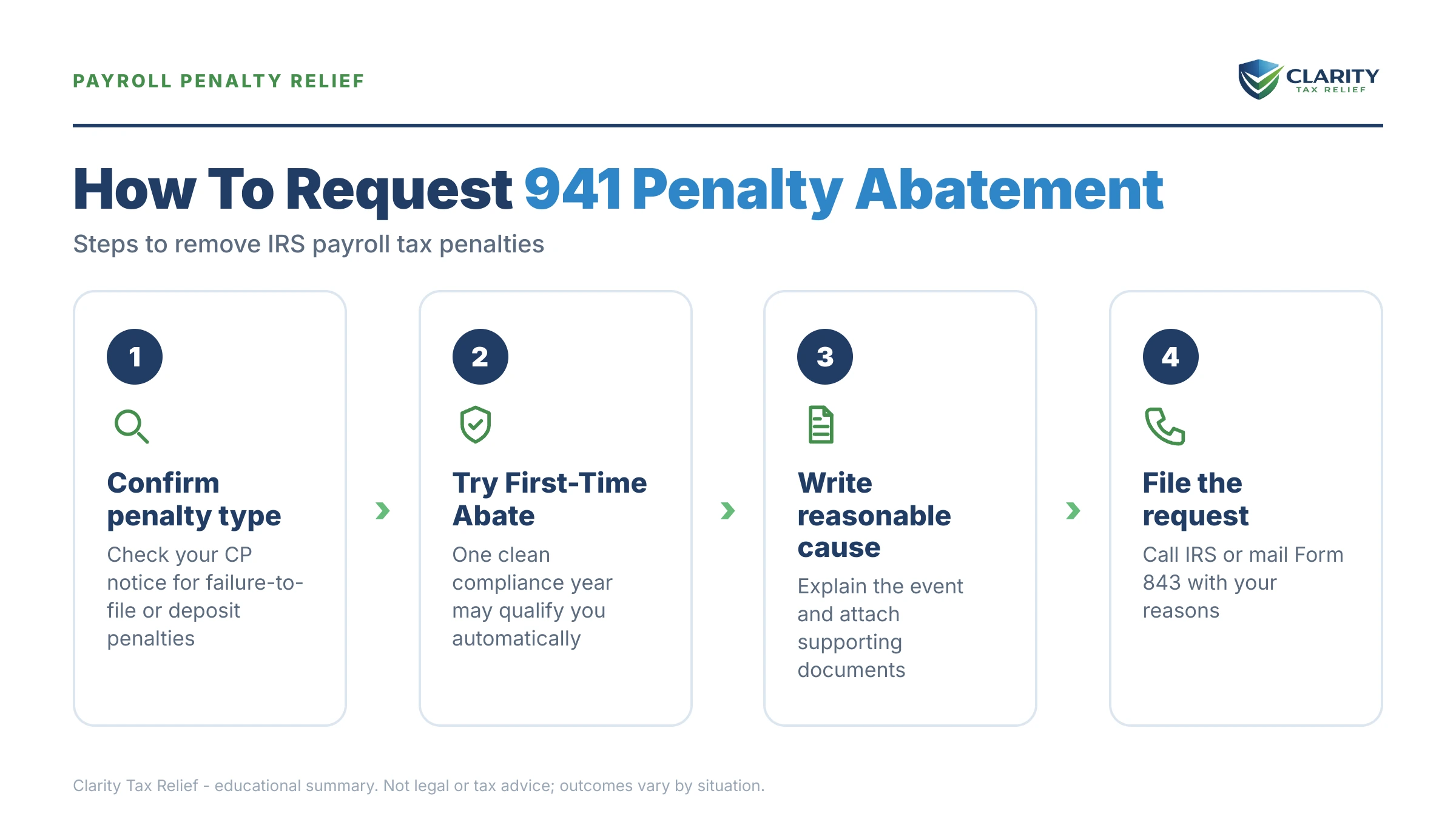
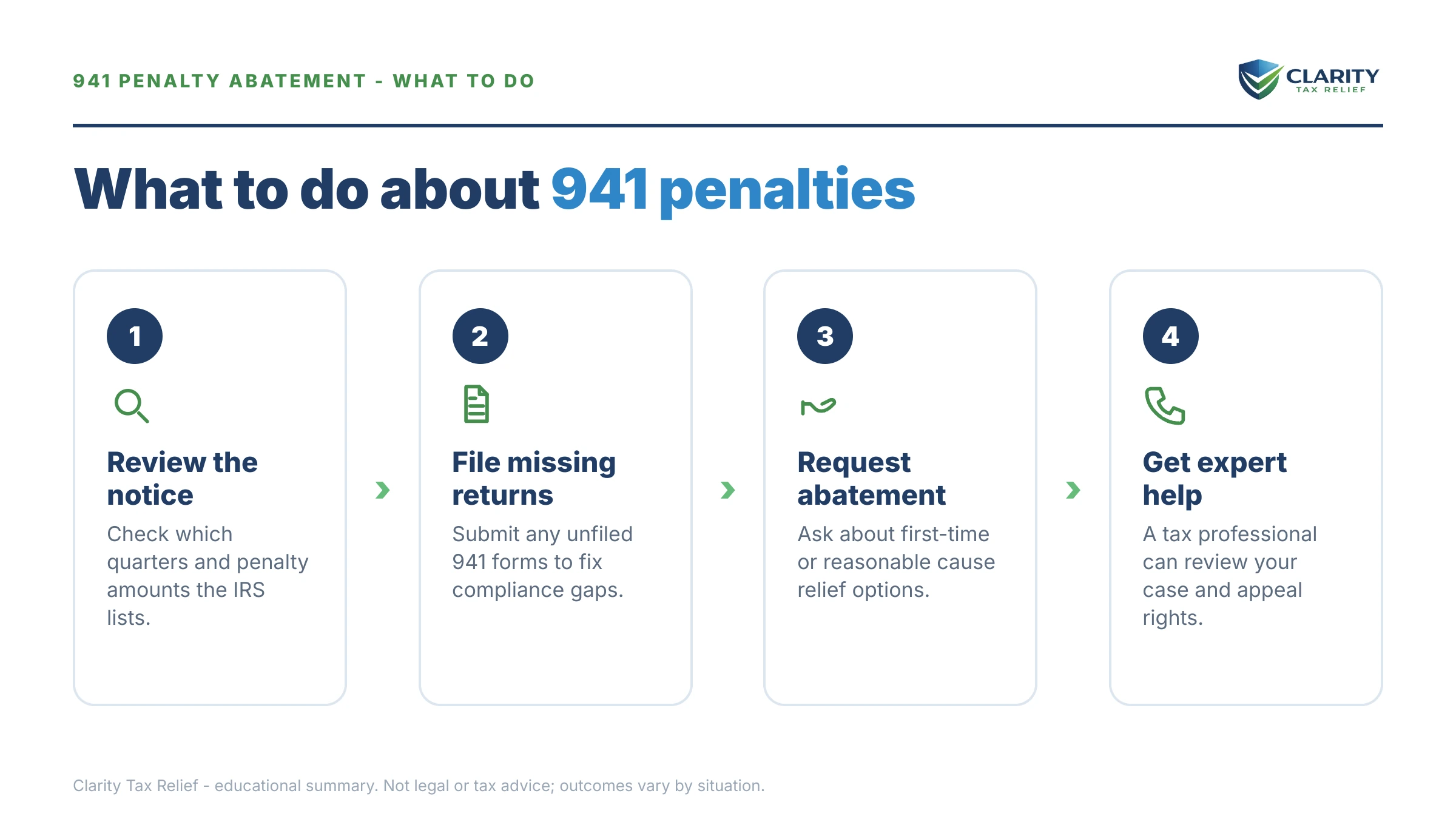
- Identify every penalty by quarter and type. Pull your business account transcripts or gather the notices themselves and list each penalty — failure to deposit, failure to file, failure to pay — by quarter and dollar amount.
- Check the 90-day designation window. If any failure-to-deposit penalty notice is less than 90 days old, ask the IRS to re-apply your deposits in the order that minimizes the penalty before you argue anything else.
- Get compliant first. File any unfiled 941s and start making current-quarter deposits on time — the IRS rarely grants abatement while new penalties are still accruing.
- Request first-time abatement for one qualifying quarter. Call the number on your notice; if the prior 12 quarters are penalty-free with all returns filed, FTA can often be approved during the call.
- Submit a reasonable-cause request for the remaining quarters. Send a written statement with supporting documentation, or Form 843, one request per quarter, to the address on your notice.
- Appeal any denial by the letter's deadline. Respond in writing within the window printed on the denial letter (typically 30 days) to get an independent Appeals review of your facts.
For the paperwork itself, our Form 843 penalty abatement request walkthrough covers the form line by line, and if a first request comes back denied, the penalty abatement appeal guide shows how to build the protest.
When you can handle 941 penalty abatement yourself
Plenty of 941 penalty situations don't need professional help. If one quarter is penalized, your prior 12 quarters are clean, and you can pay or plan the underlying tax, a single phone call requesting first-time abatement will likely resolve it — no letter, no fee, no firm. Likewise, a straightforward 90-day deposit designation on a single cascaded quarter is something an organized owner can request directly. The primary sources are genuinely usable: the IRS's penalty relief overview explains each ground in its own words, and the official About Form 843 page has the current form and instructions.
Experienced help changes outcomes in four specific situations. Multiple penalized quarters, where the sequencing of designation, reasonable cause, and FTA determines how much actually comes off. A reasonable-cause story that spans a divorce, illness, or embezzlement, where the evidence package — not the narrative — decides the case. Any file where a revenue officer is asking who signed checks, because the TFRP investigation and the abatement request are now the same chess game. And any business still missing current deposits, because no abatement holds while the pattern continues — the compliance fix has to come first, and it has to be structured so the business survives it.
Note that if your penalties are on an 1120 or 1065 rather than a payroll return, the rules shift — that's covered in our broader guide to business penalty abatement. And if California's Franchise Tax Board is also penalizing you, its relief rules are different from the IRS's; see FTB penalty abatement rather than assuming federal standards carry over.
Terms on your penalty notice, decoded
- Failure-to-deposit (FTD) penalty: the tiered 2/5/10/15% penalty for payroll tax deposits made late, short, or by the wrong method during the quarter.
- Trust fund taxes: the income tax and employee-side FICA withheld from paychecks — money the law treats as held in trust for the government, never the business's to spend.
- Trust Fund Recovery Penalty (TFRP): the unpaid trust-fund portion assessed personally against individuals who were responsible for paying it and willfully didn't.
- Reasonable cause: the legal standard for penalty relief — circumstances beyond your control despite exercising ordinary business care and prudence.
- First-Time Abate (FTA): the administrative waiver that removes one period's penalties based on a clean prior compliance history, no excuse required.
- Deposit designation: your §6656(e) right, for 90 days after an FTD penalty notice, to choose which liabilities your deposits apply to instead of the IRS's oldest-first default.
If several quarters are penalized and the IRS is already asking who had check-signing authority, get your 941 penalty file reviewed free before the trust-fund interview stage — call (888) 825-7779 or use the two-minute form.
941 penalty abatement questions, answered
Can IRS 941 penalties be abated?
Yes. All three penalties that attach to a problem quarter — failure to deposit, failure to file, and failure to pay — are eligible for abatement through first-time abatement, reasonable cause, or a statutory exception. Abatement removes the penalty and the interest that was charged on that penalty, but the underlying payroll tax remains due and still needs to be paid or put on a payment plan.
Does first-time penalty abatement apply to Form 941?
Yes — first-time abatement covers 941 failure-to-file, failure-to-pay, and failure-to-deposit penalties. Because 941s are quarterly, a clean history means no penalties in the prior 12 quarters, with all required returns filed. FTA applies to a single return, so it clears one quarter; if several quarters are penalized, pair it with a reasonable-cause request for the others.
What counts as reasonable cause for payroll tax penalties?
Documented circumstances beyond your control: serious illness or death of the person who ran payroll, a divorce that abruptly removed the spouse who handled the books, embezzlement, a natural disaster, or a payroll provider that took your money and never deposited it. Because payroll taxes are your employees' withheld money, the IRS holds employers to a high standard — you must show ordinary business care and prompt correction once you discovered the problem.
Can the trust fund recovery penalty be abated the same way?
No. The trust fund recovery penalty is not really a penalty on the business — it is the unpaid withheld taxes assessed personally against responsible individuals, so first-time abatement does not apply to it. Fighting the TFRP means protesting Letter 1153 within its 60-day window, disputing responsibility or willfulness. Abating the business's 941 penalties does not reduce TFRP exposure.
How do I request 941 penalty abatement — by phone, letter, or Form 843?
For first-time abatement, calling the number on your notice is usually fastest — the agent can often approve it during the call. For reasonable cause, submit a written statement with supporting documents, or Form 843, one request per quarter, to the address on the notice. If you already paid the penalty, Form 843 doubles as your refund claim.
How long does 941 penalty abatement take?
Phone-based first-time abatement can be approved on the call, with a confirming letter to follow. Written reasonable-cause requests commonly take several months to decide, and 2026 IRS staffing cuts have stretched response times further. Interest keeps accruing on the unpaid tax the whole time, so set up payment on the tax in parallel rather than waiting for the abatement decision.
Can I get 941 penalties refunded if I already paid them?
Yes. File Form 843 as a refund claim for each quarter, citing first-time abatement or reasonable cause, within 3 years of when the return was filed or 2 years of when you paid the penalty, whichever is later. Miss that window and the money is unrecoverable even if your cause was airtight, so date-check paid penalties before anything else.
Does 941 penalty abatement remove interest too?
Partially. Interest that was charged on an abated penalty comes off automatically with the penalty. Interest on the underlying payroll tax almost never gets waived — the law only allows it when the interest resulted from IRS error or delay. So abatement shrinks the balance meaningfully but does not stop the interest clock on the tax itself.
What is the 90-day deposit designation rule?
Under IRC §6656(e), you have 90 days from the date on a failure-to-deposit penalty notice to tell the IRS how to apply your deposits within the quarter. By default the IRS applies each deposit to the oldest liability first, which can cascade one late deposit into a string of penalized ones. A smart designation can cut the penalty before you argue reasonable cause at all.
What if my 941 abatement request is denied?
Appeal in writing by the deadline printed on the denial letter — typically 30 days. Many reasonable-cause denials come from automated screening tools that never weighed your documentation, and an appeal puts the facts in front of an independent Appeals officer with authority to reverse. Include your original statement, your evidence, and anything new; a denial is a stage, not the final answer.
Your next 24 hours
- Find the notice date and penalty breakdown on each 941 penalty notice you've received — the date starts your 90-day deposit-designation clock, and the breakdown tells you which penalty types you're fighting, quarter by quarter.
- Gather your evidence: the penalized quarters' 941s, deposit confirmations, bank statements for those months, and the documents behind your story — divorce filings, medical records, provider correspondence — with dates you can line up against the missed deposits.
- Get a free penalty review before any 90-day window on your notices closes: use the two-minute form or call (888) 825-7779, and an experienced tax professional will map which abatement path fits each quarter.
Primary sources for everything above: the IRS's payments and balance-due hub, its penalty relief pages, and the Form 843 instructions.
This guide is general information, not tax or legal advice for your specific situation. Eligibility for IRS programs depends on individual facts and circumstances; no outcome is guaranteed.