
Business & Payroll Tax
Missed Payroll Tax Deposit: The Penalty Ladder, Personal Liability & Every Fix (2026)
The short answer: after a missed payroll tax deposit, send whatever you can through EFTPS today. The failure-to-deposit penalty is 2% of the shortfall if you're 1–5 days late, 5% at 6–15 days, and 10% from day 16 — and withheld taxes are trust-fund money the IRS can pursue from owners personally.
Payroll cleared on Friday because you and your spouse chose your crew over the IRS — the EFTPS deposit that was due this week never went out, and now you're both doing the math on what one skipped deposit costs. Here's the honest version: a missed payroll tax deposit is the fastest-compounding tax debt there is, but caught in its first days or weeks, it's also one of the most fixable. What matters now is speed, not panic.
This guide walks the exact ladder: how the federal tax deposit penalty tiers work, what the IRS's business notice sequence looks like, when the debt jumps from the company to you personally, and every arrangement that stops the climb. The image below shows the full penalty ladder and escalation path at a glance, so you can see exactly where you stand right now.
⏱ Your real clock: deposit within 5 days of the due date and the failure-to-deposit penalty is 2% of the shortfall. On day 6 it becomes 5%. On day 16 it becomes 10%. And if the balance is still unpaid more than 10 days after the IRS's first demand notice, it hits 15%. Every day you wait is measured.
Why one missed payroll tax deposit escalates so fast
The IRS treats a missed payroll tax deposit as spending your employees' money, because most of a Form 941 deposit is tax withheld from their paychecks — not yours. Federal income tax withholding and the employees' half of Social Security and Medicare are "trust fund" taxes: the law says you held that money in trust for the government the moment you ran payroll. That's why deposit enforcement moves faster and hits harder than ordinary income-tax collection.
Your deposit deadline depends on your schedule. Monthly depositors — generally businesses that reported $50,000 or less in payroll tax during the lookback period (the four quarters ending the prior June 30) — deposit by the 15th of the following month. Larger employers are semiweekly depositors, with deposits due the Wednesday or Friday after payday. And one rule overrides both: accumulate $100,000 or more in liability on any single day, and that deposit is due the next business day. (If your total liability for the quarter is under $2,500, you can simply pay it with the 941 itself.)
How you got here changes the fix. A cash crunch that forced a choice between net payroll and the deposit is the most common story — and the most repairable. If a payroll company didn't pay taxes it collected from you, you're still liable, but provider failure is strong ground for penalty relief. And if you run payroll as a Schedule C business, the deposit problem usually rides alongside your own self-employment tax, which changes the resolution order.
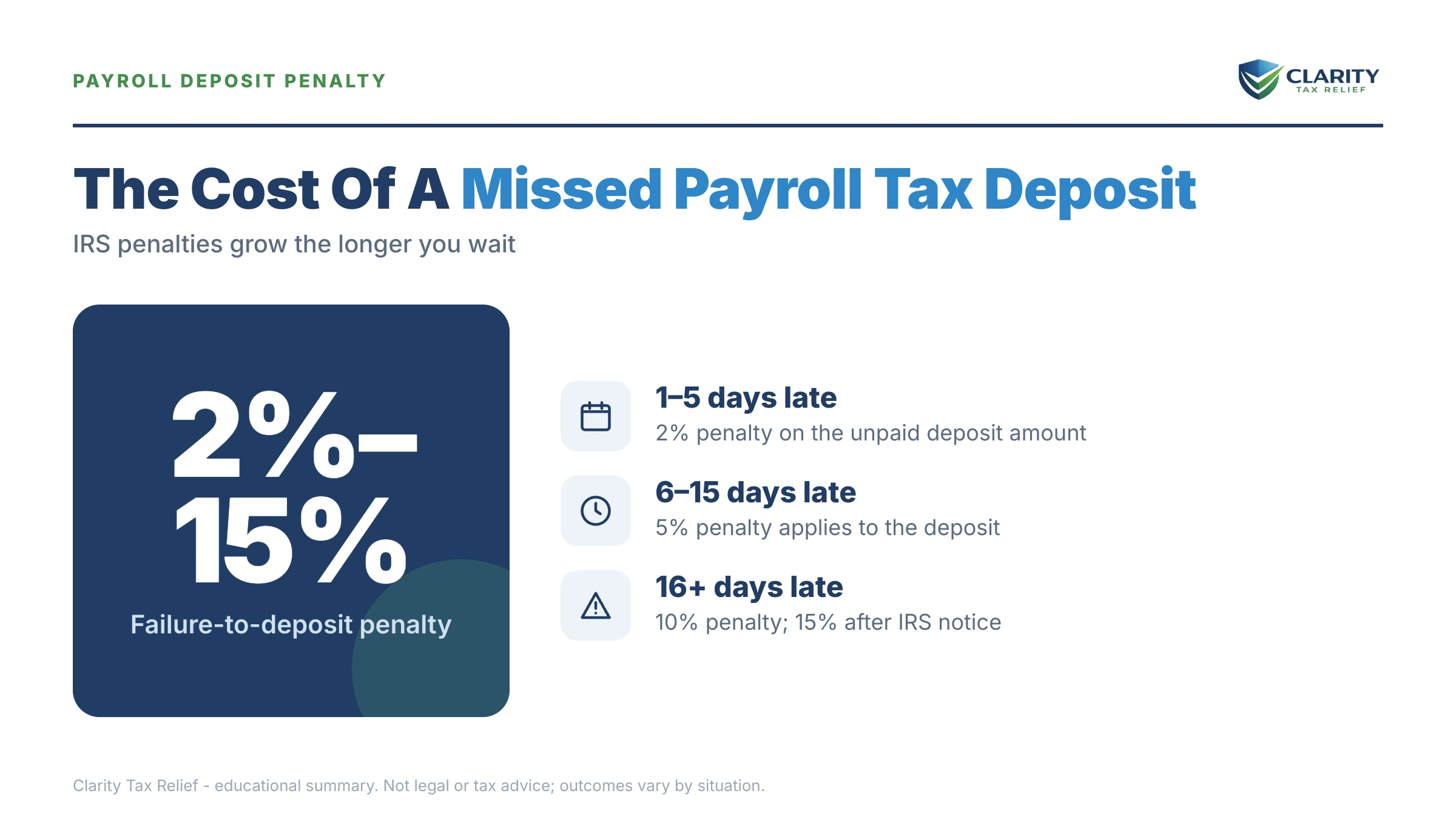
The failure-to-deposit penalty: how the 2%–15% ladder works
The failure-to-deposit penalty under IRC §6656 starts at 2% of the late amount and tops out at 15% — and the rate is set by how late the deposit is, not how large. It's charged per deposit, on the portion not deposited on time, which is why a partial deposit today genuinely helps: every dollar you send stops climbing the ladder.
| How late the deposit is | Penalty rate | Cost on a $92,700 shortfall |
|---|---|---|
| 1–5 days late | 2% | $1,854 |
| 6–15 days late | 5% | $4,635 |
| 16 or more days late | 10% | $9,270 |
| Still unpaid more than 10 days after the IRS's first demand notice | 15% | $13,905 |
The deposit penalty doesn't travel alone. Once the quarter's 941 is assessed, the 0.5%-per-month failure-to-pay penalty runs on any unpaid balance, and interest compounds daily on top of everything. If the 941 itself isn't filed, the failure-to-file penalty adds 5% per month — ten times the pay penalty. You can estimate your combined exposure with our Penalty & Interest Calculator.
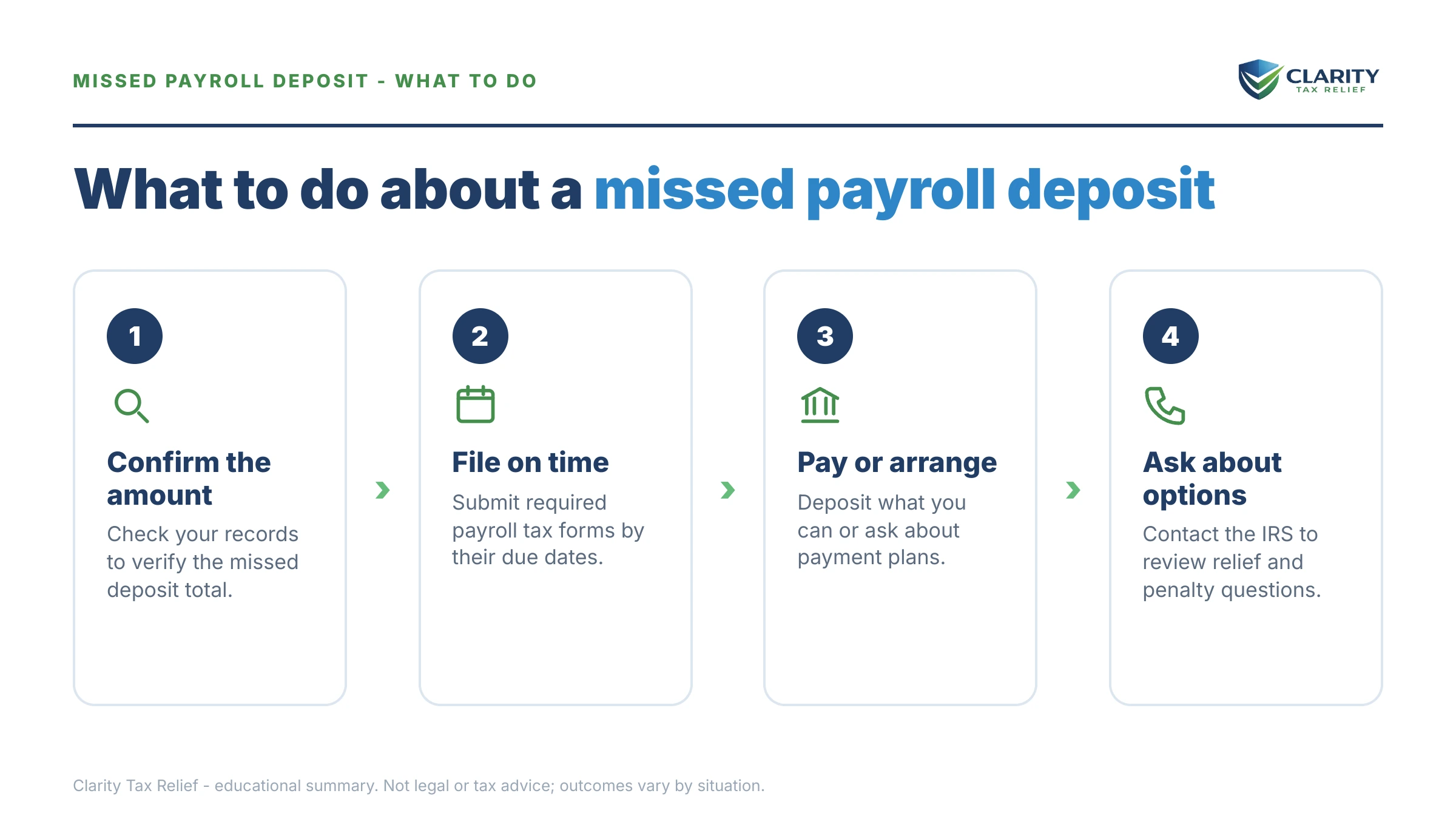
What a $92,700 missed deposit actually costs
Say you and your spouse co-own an S-corporation with eight employees, and a slow-paying customer forced you to skip deposits across two months — $92,700 in all, now more than 16 days late. Here's the arithmetic, clearly hypothetical but built on the real rates:
- Failure-to-deposit penalty at the 10% tier: $92,700 × 10% = $9,270. Had you caught it within 5 days, that number would have been $1,854 — acting one tier earlier is worth $7,416.
- Failure-to-pay penalty once assessed: roughly $464 per month (0.5% of $92,700), accruing until paid, capped at 25%.
- Interest: compounds daily at the federal underpayment rate on tax, penalties, and prior interest.
- The trust-fund exposure: suppose about $63,000 of the $92,700 is withheld income tax plus the employees' share of FICA. If the business can't pay, the IRS can assess that $63,000 against each of you personally through the Trust Fund Recovery Penalty — it collects the money once, but it can pursue either spouse's assets to get it. Because you file jointly, that also puts your joint refunds and shared accounts in the collection path.
Notice what's not on that list: seizure, padlocks, criminal charges. A first missed deposit is a money problem with a meter running — the goal is to stop the meter before it becomes a liability problem with your names on it.
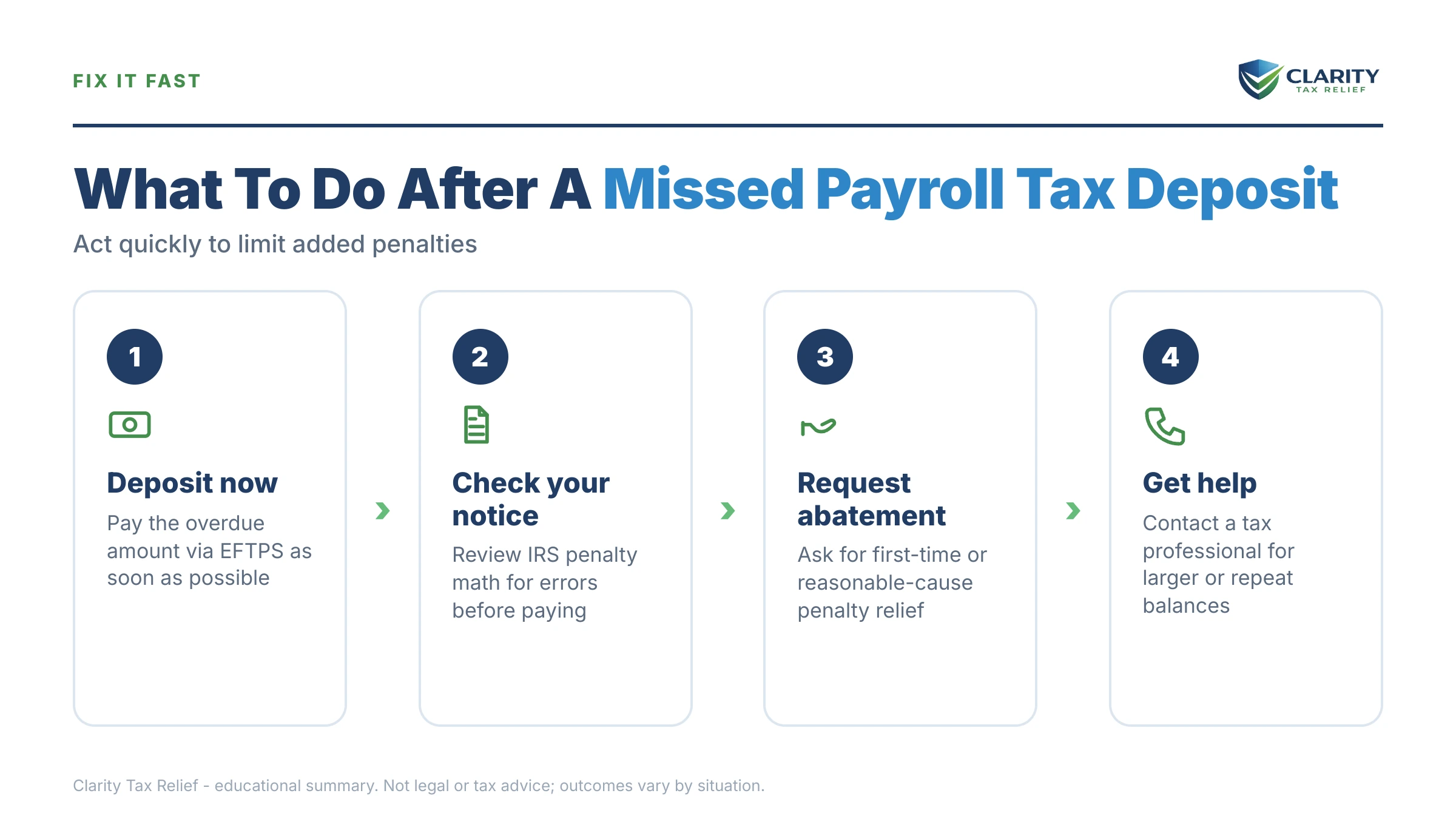
What happens if you ignore a missed payroll tax deposit
Payroll tax debt moves through the IRS's business collection stream, and unpaid trust-fund balances are a field-collection priority. Ignored, the sequence runs like this:
- Penalty assessment and first bill. When the quarter's 941 posts, the IRS assesses the deposit penalty and bills the business — typically a CP276B (deposit penalty) or CP161 (balance due). You are here, or close to it.
- CP504B — intent to levy. The business version of the intent-to-levy notice. The IRS can seize the company's state refund, and a federal tax lien against business assets becomes a live possibility. See our CP504B notice guide if this one has arrived.
- Final notice of intent to levy (CP297). This starts a 30-day clock and your Collection Due Process rights. After it runs, the IRS can levy business bank accounts and accounts receivable.
- Revenue officer assignment. Payroll cases get human attention faster than income-tax cases. The officer's first questions establish who controlled the money — often through Form 4180 interviews with owners, officers, and check-signers.
- Letter 1153 — the Trust Fund Recovery Penalty proposal. The IRS names the people it intends to assess personally for the trust-fund portion. You have 60 days to protest; our Letter 1153 guide covers that window.
- Personal assessment and collection. The trust-fund debt attaches to each responsible person individually — it survives the business, and continuing to skip deposits quarter after quarter (pyramiding payroll taxes) is what turns a civil case into potential criminal exposure.
One 2026 reality worth naming: the IRS workforce shrank roughly 27% in 2025, so reaching a human is harder — but the penalty assessments, notices, and levies in this sequence are automated. Understaffing delays your help, not your escalation.
| Notice | What it tells you | Your window |
|---|---|---|
| CP276B / CP161 | Deposit penalty assessed / business balance due | The pay-by date printed on the notice |
| CP504B | Intent to levy — state refund at risk, lien likely next | The deadline printed on the notice |
| CP297 (final notice) | IRS can levy bank accounts and receivables next | 30 days to request a Collection Due Process hearing |
| Letter 1153 | IRS proposes to assess you personally for the trust-fund portion | 60 days to protest |
Missed a deposit and watching the days count up?
The penalty tier jumps at day 6 and again at day 16 — and every notice after that carries its own printed deadline. Get your missed deposit and 941 balance reviewed free before the next tier hits: an experienced tax professional will map your exact position and the cheapest way out.
Your options after a missed payroll tax deposit
An operating business that owes $25,000 or less in payroll tax can usually get an IBTF-Express installment agreement without filing financial statements. That's the headline option, but the full menu depends on your balance, whether the business is still running, and how clean your compliance history is. (For the general step-by-step on negotiating with the IRS yourself, see our guide on how to settle tax debt yourself — everything below is what's specific to payroll.)
| Option | Typically fits when | What to know |
|---|---|---|
| Deposit / pay in full now | You can cover the shortfall within days | Freezes the penalty at the current tier; even partial deposits reduce the base |
| IBTF-Express installment agreement | Operating business, total balance ≤ $25,000, payable within 24 months | Typically no financial statements; direct debit required above $10,000 — see business payroll tax payment plan |
| Regular in-business installment agreement | Balance over $25,000 | Form 433-B financials required, usually negotiated with a revenue officer; current deposits must be on time first |
| Penalty abatement | Clean prior 3 years (first-time abate) or reasonable cause — provider failure, disaster, serious illness | Can remove the deposit penalty entirely; AEP begins automating some relief in summer 2026 — see 941 penalty abatement |
| Currently Not Collectible | Genuine hardship; rare for an operating business with payroll | Pauses collection but the debt, interest, and trust-fund exposure remain |
| Offer in Compromise | Rare on payroll debt; strict scrutiny of the trust-fund portion | $205 fee, real financial disclosure; the IRS accepted roughly 1 in 5 offers in FY2024 — never a quick fix |
Two payroll-specific tactics matter here. First, voluntary payments can be designated — when the business pays outside a levy, you can direct the money to the trust-fund portion first, which shrinks the amount that could ever be assessed against you personally. The IRS won't do that for you. Second, whatever arrangement you pick, current-quarter deposits must be on time before the IRS approves it — resolution always starts with staying current, not catching up.
How to respond to a missed payroll tax deposit, step by step
- Deposit what you can today. Even a partial deposit through EFTPS stops the penalty tier from climbing on every dollar you send.
- File Form 941 on time no matter what. The failure-to-file penalty runs 5% per month — ten times the 0.5% failure-to-pay rate — and it stacks on top of the deposit penalty.
- Get current before you negotiate. The IRS will not approve any payroll resolution until this quarter's deposits are going out on time.
- Request penalty relief. A clean three-year compliance history may qualify the business for first-time abatement of the deposit penalty.
- Set up a payment arrangement for the rest. Balances of $25,000 or less may fit an IBTF-Express agreement with no financial statements required.
- Talk to an experienced tax professional before any trust-fund interview. What you say in a Form 4180 interview helps decide who gets assessed personally — prepare before you sit down.
When you can handle this yourself — and when help changes the outcome
A single late deposit with a clean history is usually a do-it-yourself fix. If you can cover the shortfall within days, deposit it through EFTPS, file the 941 on time, and when the penalty notice arrives, request first-time abatement by phone or letter. If the business owes under $25,000 total and can retire it inside 24 months, the IBTF-Express agreement is a form-driven process you can complete without representation. Payment options for any assessed balance live at IRS.gov/payments.
Experienced help changes outcomes in specific situations: a revenue officer has been assigned or a Form 4180 interview is scheduled; more than one quarter is unpaid or 941s are unfiled; the balance exceeds $25,000 and the IRS wants Form 433-B financials; a Letter 1153 has arrived with its 60-day protest window; you and your spouse could both be named responsible persons and need the liability allocated correctly; or the business is closing and you need the wind-down sequenced to limit what follows you. In those cases, the difference between a prepared response and an improvised one is often the difference between a business debt and a personal one. If you're on the fence, dedicated help is also available through the Taxpayer Advocate Service when IRS delays or hardship are part of the picture.
Terms on your notices, decoded
- Trust fund taxes: the withheld income tax and employee share of Social Security/Medicare — money the law treats as held in trust for the government from the moment payroll runs.
- Failure-to-deposit (FTD) penalty: the 2%/5%/10%/15% penalty under IRC §6656 for deposits made late, in the wrong amount, or by the wrong method.
- Trust Fund Recovery Penalty (TFRP): a personal assessment of the trust-fund portion against individuals who were responsible for paying it and willfully didn't — explained in full in our trust fund recovery penalty guide.
- Responsible person: anyone with the authority and duty to decide which bills get paid — owners, officers, and sometimes bookkeepers or check-signers.
- EFTPS: the Electronic Federal Tax Payment System, the required channel for federal payroll deposits.
- Pyramiding: accruing new unpaid payroll tax quarter after quarter — the pattern that converts a civil collection case into enforcement and potential criminal referral.
Missed deposit questions, answered
What is the penalty for a missed payroll tax deposit?
The failure-to-deposit penalty is 2% of the late amount if you deposit within 5 days of the due date, 5% at 6–15 days, and 10% once you're 16 or more days late. It rises to 15% if the balance is still unpaid more than 10 days after the IRS's first demand notice. Failure-to-pay penalties and daily-compounding interest stack on top, so the true cost keeps growing until the deposit is made.
Can I be personally liable for a missed payroll tax deposit?
Yes — through the Trust Fund Recovery Penalty, the IRS can assess the withheld-tax portion of the debt against any "responsible person" who willfully failed to pay it over. That includes owners, officers, and sometimes bookkeepers or check-signers, regardless of the business's legal structure. An LLC or corporation does not shield you from this specific debt, and the IRS can assess multiple people for the same amount.
Should I still file Form 941 if I can't pay the deposits?
Yes — always file on time. The failure-to-file penalty runs 5% of the unpaid tax per month, ten times the 0.5% failure-to-pay rate, and it's charged on top of the deposit penalty. Filing on time also keeps the business eligible for payment arrangements, because the IRS won't approve a resolution for a business with missing returns.
Can the failure-to-deposit penalty be removed?
Often, yes. If the business has a clean compliance history for the prior three years, first-time abatement can remove the penalty on request, and starting in summer 2026 the IRS's Automatic Exemption from Penalty (AEP) begins applying similar relief automatically. Beyond that, reasonable cause — a payroll provider's failure, a natural disaster, a serious illness — can support abatement even with a spotty history.
Will the IRS shut down my business over one missed deposit?
No — one late deposit triggers a penalty, not a seizure. The serious danger is "pyramiding": continuing to run payroll quarter after quarter without depositing the withheld taxes. That pattern is what draws a revenue officer, personal trust-fund assessments, and in willful repeat cases, criminal referral. One slip that you fix quickly stays a civil, financial problem.
How do I know my payroll deposit schedule?
Your schedule depends on your lookback period — the four quarters ending the previous June 30. If you reported $50,000 or less in payroll tax in that window, you deposit monthly, by the 15th of the following month; more than $50,000 makes you a semiweekly depositor. One exception overrides both: accumulate $100,000 or more in liability on any day and that deposit is due the next business day.
Can I get a payment plan for payroll taxes?
Yes. An operating business owing $25,000 or less can usually qualify for an IBTF-Express installment agreement — full payment within 24 months, direct debit required above $10,000, and typically no financial statements. Larger balances need a regular in-business agreement with Form 433-B financials, usually negotiated with a revenue officer, and current-quarter deposits must be on time before anything is approved.
Is missing a payroll tax deposit a crime?
By itself, no — a late or missed deposit is a civil matter handled with penalties and interest. Criminal exposure arises when the IRS sees willfulness: repeatedly collecting taxes from employee paychecks and using the money elsewhere, especially across multiple quarters or businesses. If you're catching the problem in its first quarter and moving to fix it, you're squarely in civil territory.
Your next 24 hours
- Count the days. Pull your deposit schedule and the exact due date of the missed deposit, then count how late you are — that number sets your penalty tier and tells you whether depositing this week saves you a jump.
- Gather the file. This quarter's payroll registers, the last four filed 941s, your EFTPS history, and the business bank balance — enough to see the shortfall and the trust-fund portion clearly.
- Get the deposit reviewed free. Before the tier jumps again at day 6 or day 16, call (888) 825-7779 or use the 2-minute form — an experienced tax professional will map the penalty exposure, the abatement angle, and the arrangement that keeps this a business debt instead of a personal one.
This guide is general information, not tax or legal advice for your specific situation. Eligibility for IRS programs depends on individual facts and circumstances; no outcome is guaranteed.