
Business Tax Problems
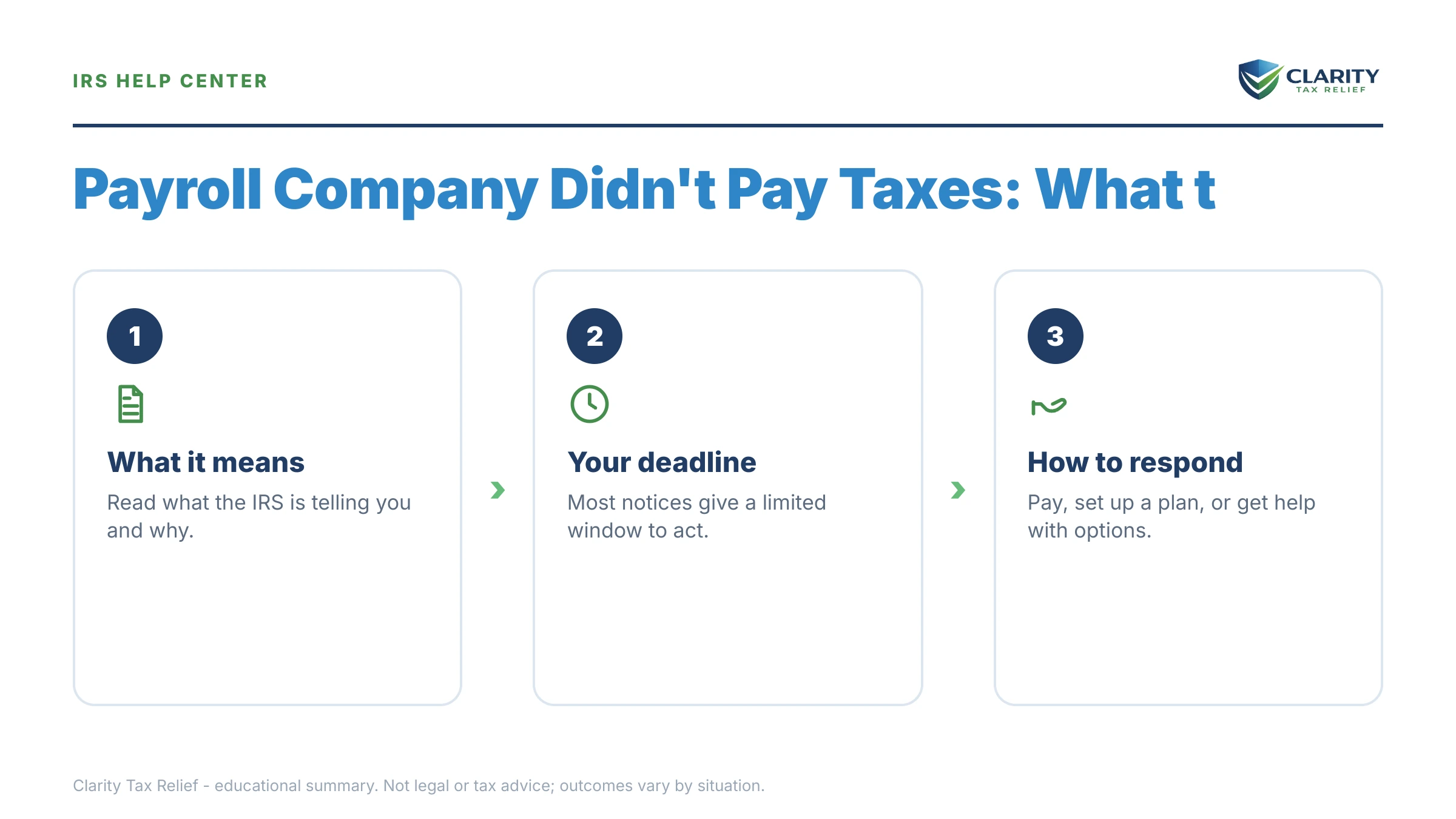
Payroll Company Didn't Pay Taxes: What to Do Now (2026)
The short answer: if your payroll company didn't pay taxes it collected from your business, the IRS still holds you liable for every missing deposit — plus penalties and interest. Paying the provider is not paying the Treasury. Verify what actually posted, take back your address of record, and document the fraud: it's your strongest penalty-relief evidence.
You paid, every single payday. The money for federal withholding, Social Security, and Medicare left your business account on schedule — and then an IRS notice arrived showing quarters of deposits that never happened. Your payroll provider kept the money, and the bill landed on your EIN.
This is fixable, and thousands of employers have walked this exact path when a provider folded or ran off with client funds. But the order you fix things in decides how much of the damage sticks. If a notice came with this discovery, keep it in front of you — the image below shows exactly what the IRS's bill for missing payroll deposits looks like and where to find the tax period and amount that drive every deadline that follows.
⏱ The real clock: there is no grace period because the theft wasn't your fault. The failure-to-deposit penalty on each missing deposit is already set and growing — and it jumps to 15% of the deposit once the IRS demands payment and the balance sits unpaid more than 10 days after that first notice. Respond by the date printed on the notice in front of you.
Why the IRS is billing you when your payroll company didn't pay taxes
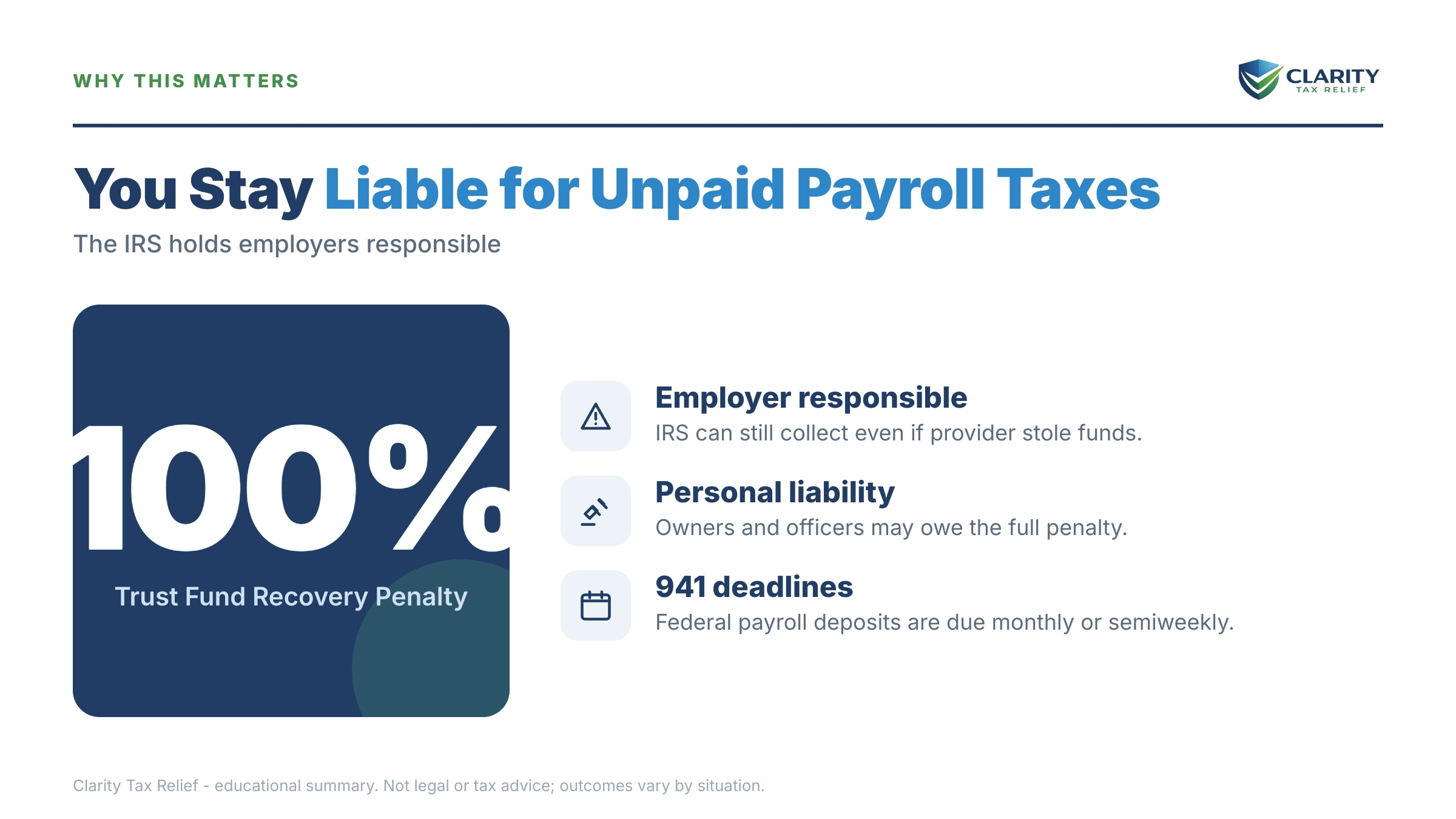
Federal law puts the duty to deposit employment taxes on the employer, and that duty cannot be delegated to a payroll company. When you signed up with the provider, you authorized it to act for you — but the IRS's position, upheld by courts again and again, is that money you sent to the provider does not count as money paid to the IRS. If the deposits never posted to your EIN, your business owes them, period.
This kind of fraud stays hidden by design. Providers that skim deposits usually change your address of record with the IRS to their own office, so the CP161 bills and warning notices go to the thief instead of to you. Some file your Form 941 returns accurately and just pocket the deposit money; others stop filing entirely, which layers unfiled 941 returns on top of the missing deposits.
That's why most victims discover several quarters of damage at once — often only when a levy warning finally reaches them directly, or when the provider's collapse hits the news. And check your state accounts the same day: providers that steal federal deposits almost always steal state withholding and unemployment deposits too.
Which type of payroll provider you used changes your exposure
Only one arrangement — an IRS-certified professional employer organization — shifts payroll tax liability off your business. Everything else, including the biggest household-name payroll services, leaves the full debt on your EIN. Find your service contract and figure out which of these you actually signed:
| Provider type | Who the IRS bills | What it means for you |
|---|---|---|
| Payroll service / reporting agent (most big-name providers) | Your business | Full liability stays with you; the provider is purely your agent |
| Section 3504 agent (appointed on Form 2678) | You and the agent, jointly | The IRS can collect from either — and usually starts with you |
| PEO (not IRS-certified) | Generally your business | Courts have repeatedly kept liability on the client employer |
| Certified PEO (CPEO) | The CPEO | Solely liable under IRC §3511 — but only for wages paid under the CPEO contract |
Most payroll companies are reporting agents, not CPEOs. If your provider claimed to be certified, verify it — the IRS publishes a public list of certified professional employer organizations, and certification requires bonding specifically so client employers are protected. If your provider genuinely was a CPEO and the unpaid quarters fall under your service contract, your defense is dramatically stronger: the law points the IRS at the CPEO, not at you.
What happens if you ignore the bill
Business payroll tax debt escalates faster than almost any other IRS debt, because withheld taxes are treated as employee money held in trust — and the collection sequence runs automatically whether or not a human ever reviews your file. Ignored, it moves through these stages:
- CP161 — the first business balance-due bill for each unpaid quarter. Billing only; this is the cheapest moment you will ever have to fix this.
- CP504B — the business Notice of Intent to Levy. The IRS can now seize your state tax refund under IRC §6331(d), and a federal tax lien against your business assets becomes likely. See the CP504B notice guide for what this letter does and doesn't authorize.
- LT11 / Letter 1058 — the final notice. A 30-day clock starts on your Collection Due Process rights (requested on Form 12153); after it runs, the IRS can levy your business bank account and accounts receivable.
- Revenue officer assignment — payroll cases are an enforcement priority, so a field officer may take over the file and visit in person. If that's already happened, start with what to do when a revenue officer shows up over payroll taxes.
- Trust fund recovery penalty investigation — a Letter 3164 contact, then a Form 4180 interview, then Letter 1153 proposing to assess the trust-fund portion against you personally, with 60 days to protest.
Meanwhile the numbers grow on their own. The federal tax deposit penalty runs 2%, 5%, or 10% of each late deposit depending on how late it is — and 15% once a deposit stays unpaid more than 10 days after the IRS's first notice demanding payment. On top of that, the 0.5%-per-month failure-to-pay penalty and daily-compounding interest run until the balance is gone. You can estimate what has already accrued on your quarters with our IRS Penalty & Interest Calculator.
The personal-liability piece deserves one honest sentence now, because it's where victims hurt themselves. Being defrauded is not willful — but the day you learn deposits are missing, willfulness can start: if you keep paying rent, vendors, and salaries while leaving the trust-fund taxes uncured, the IRS can argue you knowingly preferred other creditors, which is exactly what the trust fund recovery penalty punishes.
| Notice | Response window | What's at stake |
|---|---|---|
| CP161 (business balance due) | The "pay by" date printed on it | Billing stage only — resolving here avoids liens, levies, and the 15% deposit-penalty tier |
| CP504B (intent to levy) | The date printed on the notice | State refund seizure; lien filing against business assets becomes likely |
| LT11 / Letter 1058 (final notice) | 30 days | Your Collection Due Process hearing (Form 12153); bank and receivables levies can follow |
| Letter 1153 (TFRP proposal) | 60 days | Your only pre-assessment chance to fight personal liability for the trust-fund portion |
Your payroll company kept the money — but the bill has your EIN on it
Send us the notice and your deposit history before the failure-to-deposit penalty hits its 15% tier or a trust-fund investigation opens. An experienced tax professional will map exactly which quarters are missing, what's abatable as provider fraud, and how to keep this off your personal name — free and confidential. Call (888) 825-7779 or use the 2-minute form.
Your options when a payroll provider didn't pay the IRS
Every resolution option has the same entry requirement: your current quarter's deposits must be going in, on time, through a channel you can verify. Once you're current, these are the realistic paths — the general playbook for sequencing them lives in our guide to how to settle tax debt yourself; here's how each applies to a provider-fraud case:
| Option | Typically fits when | Cost / catch |
|---|---|---|
| Pay the missing deposits in full | You can re-fund the deposits now | Stops the failure-to-pay penalty and interest immediately; penalties already assessed may still be refundable via abatement |
| IBTF-Express installment agreement | Balance of $25,000 or less, full paid within 24 months | No financial statement required; direct debit required for balances over $10,000 |
| Regular business installment agreement | Balance above the IBTF-Express limits | Form 433-B financials required; a revenue officer may manage the case |
| Reasonable-cause penalty abatement | You funded the taxes and can document the provider's fraud | Form 843, generally per quarter; removes penalties — not the tax, and rarely the interest |
| Business offer in compromise | Rare — the business genuinely can never full-pay | Strict review; trust-fund balances get extra scrutiny |
| Civil suit / restitution against the provider | Always worth preserving, in parallel | Does not pause IRS collection; recovery often takes years |
Penalty abatement is where provider-fraud victims win back the most money. Documented third-party theft — a signed service contract, bank records proving you transferred the funds, police or FBI reports, news coverage of the provider's collapse — is one of the stronger reasonable-cause fact patterns the IRS sees. The mechanics of building that request for payroll penalties are covered in our 941 penalty abatement guide. Note that first-time abatement can also clear a single quarter if your prior compliance is clean, and starting summer 2026 the IRS's new Automatic Exemption from Penalty (AEP) applies qualifying relief automatically — but a multi-quarter fraud case is a reasonable-cause case, and it lives or dies on your documentation.
Interest is the exception. Interest on the unpaid tax can generally only be abated when the IRS itself caused an error or delay — not when a third party did. Budget for it.
On payment plans: the in-business trust fund rules are their own animal, with thresholds and terms that differ from personal agreements — the details are in our business payroll tax payment plan guide. If you're deciding whether to drain reserves, borrow, or finance the catch-up, compare the true costs in the best way to pay the IRS. And if the fraud has you considering shutting the business down, read the wind-down sequence in dissolve business owe IRS first — closing does not erase trust-fund liability, and closing in the wrong order can make the personal exposure worse.
What $54,600 in stolen deposits actually costs: a worked example
Say your six-person shop sent a payroll provider $54,600 in federal employment taxes across three quarters — $29,400 of withheld income tax, $12,600 of employee Social Security and Medicare, and $12,600 of the employer's matching share — and none of it reached the Treasury. Here's the hypothetical damage map:
- Failure-to-deposit penalty: deposits more than 15 days late draw the 10% tier — 10% × $54,600 = $5,460. If the balance sits unpaid more than 10 days after the IRS's first demand, the tier rises to 15%: $8,190. Acting inside that window saves $2,730 on the deposit penalty alone.
- Failure-to-pay penalty: 0.5% per month on the unpaid tax — roughly $273 per month at the start — plus interest compounding daily at the federal underpayment rate.
- Personal exposure: the trust-fund portion is the withheld income tax plus the employee share of FICA — $29,400 + $12,600 = $42,000. That is the amount the IRS could try to assess against you personally through the trust fund recovery penalty if the case goes sideways. For the quarters you funded in good faith, that assessment is defensible — which is exactly why the documentation steps below matter.
- What abatement recovers: if your reasonable-cause request succeeds, the $5,460 deposit penalty and the accrued failure-to-pay penalties come off. The $54,600 in tax and the interest remain yours to pay or schedule.
How to respond when your payroll company didn't pay the IRS, step by step
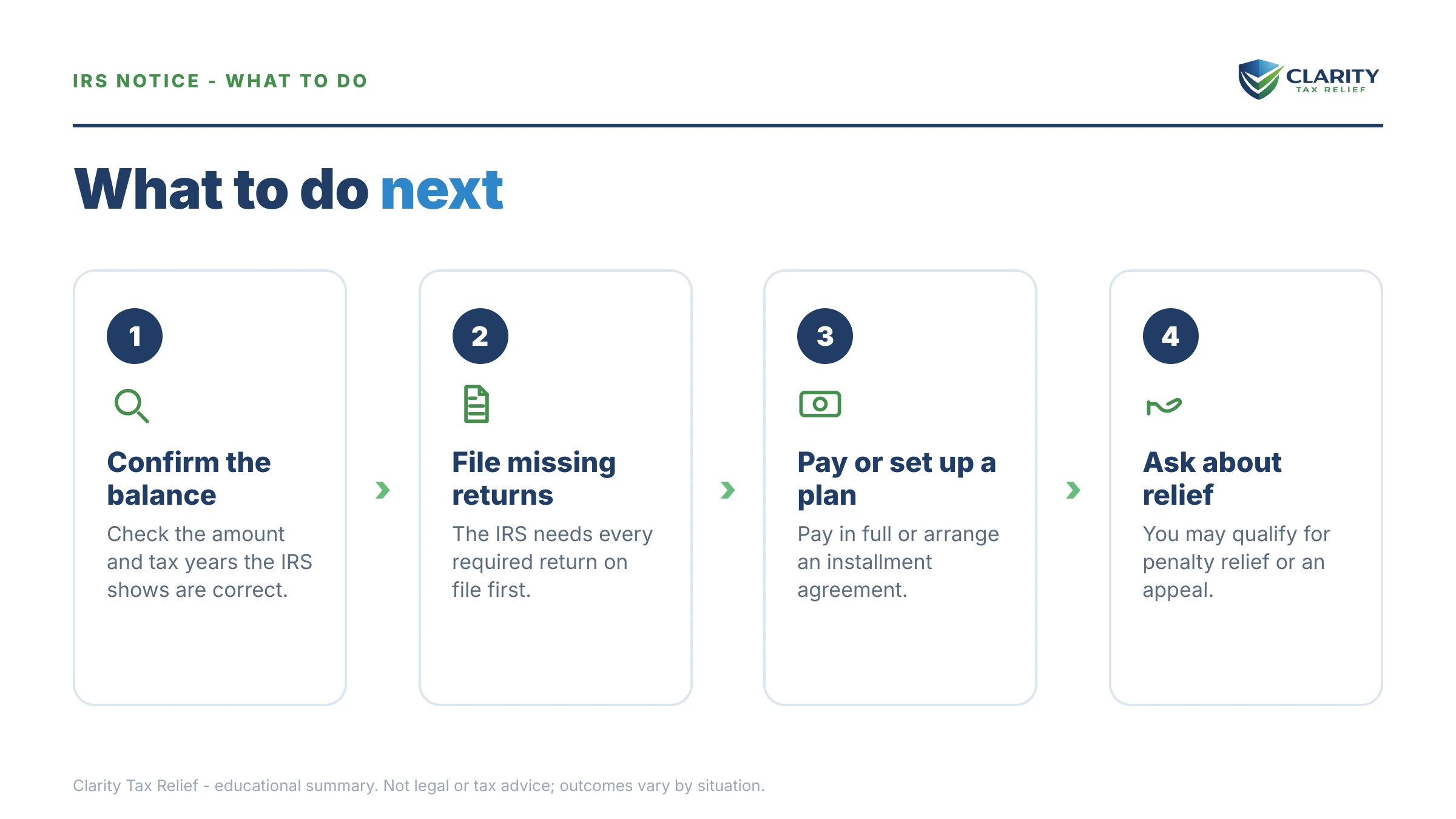
- Pull your real balance. Get your IRS business tax account or quarterly account transcripts and list every missing deposit and any unfiled 941s.
- Take back your address of record. File Form 8822-B so every IRS notice comes to you, and enroll in EFTPS so you can verify all future deposits yourself.
- Get current immediately. Run this quarter's deposits in-house or through a verified provider; current compliance is the entry ticket to every relief program.
- Document the fraud. Gather your service contract, bank transfers to the provider, and payroll registers, then report the theft to law enforcement and the IRS.
- Resolve the balance before enforcement starts. Set up full payment or a payment plan, then request penalty abatement on Form 843 with your fraud file attached.
When you can handle this yourself
Not every provider failure needs professional help. If the damage is one or two missed deposits, you caught it within weeks, and you can re-fund the money now, you can reasonably do this alone: verify the gap on your transcripts, pay directly at IRS.gov/payments, and send a Form 843 abatement request with your proof. Small, fast, documented cases resolve cleanly.
Experienced help changes outcomes when the stakes change shape: multiple quarters missing, a Form 4180 interview scheduled, a revenue officer assigned, or six figures on the table. The TFRP interview in particular is a one-shot event — what you say about who controlled the money and when you knew becomes the record the personal assessment is built on. The same goes if you're weighing closing the business, where sequence determines what follows you personally. And if IRS collection is threatening your ability to make payroll for current employees while you sort out the fraud, the Taxpayer Advocate Service can intervene in genuine-hardship cases at no cost.
Terms on your IRS notices, decoded
- Trust fund taxes: the withheld income tax and employee share of Social Security/Medicare — employee money your business held in trust, which is why the IRS treats it more severely than any other tax debt.
- Responsible person: anyone with the power to decide which bills get paid — owners, officers, sometimes bookkeepers — whom the IRS can assess personally for unpaid trust fund taxes.
- Willfulness: knowingly paying other creditors while trust fund taxes go unpaid; it does not require bad intent, and it can begin the day you learn deposits are missing.
- Failure-to-deposit penalty: the tiered penalty (2%, 5%, 10%, or 15%) charged on each payroll deposit that arrives late or never arrives.
- CPEO: a certified professional employer organization — the only provider type that legally assumes your payroll tax liability, and only for wages paid under its contract.
- EFTPS: the free Electronic Federal Tax Payment System, where you can watch every deposit post to your EIN yourself — the single best fraud-proofing step an employer can take.
Payroll company didn't pay taxes: your questions, answered
Is my business still liable if the payroll company didn't pay the IRS?
Yes — with one narrow exception, the IRS holds your business fully liable for employment taxes even when a third party you paid failed to deposit them. Paying your payroll provider is not the same as paying the Treasury. The exception is an IRS-certified PEO (CPEO), which assumes sole liability under IRC §3511 for wages it paid under your contract. Everyone else — reporting agents, standard payroll services, non-certified PEOs — leaves the debt on your EIN.
Can I get IRS penalties removed if my payroll provider committed fraud?
Often, yes — documented third-party fraud is one of the stronger reasonable-cause arguments for removing failure-to-deposit and failure-to-pay penalties. You'll need to show you funded the taxes, had no reason to suspect the provider, and acted quickly once you found out. Request abatement on Form 843 with your contract, bank records, and any criminal-case documentation attached. Interest on the tax itself almost always survives, because interest can only be abated for IRS error or delay.
How do I check whether my payroll tax deposits actually reached the IRS?
Pull the record straight from the source: your IRS business tax account or account transcripts for each quarter show every deposit that actually posted to your EIN. Enrolling in EFTPS — the free federal deposit system — lets you see and verify deposits going forward, even if a provider makes them for you. Compare what posted against your payroll registers and the amounts that left your bank account; the gap is your real exposure.
Can the IRS come after me personally for what the payroll company stole?
It can try, through the trust fund recovery penalty — but willfulness is required, and being defrauded is not willful. For quarters when you funded the taxes in good faith and had no idea deposits were missing, a TFRP assessment is very defensible. The danger starts the day you learn deposits are missing: if you keep paying other creditors instead of catching up the trust fund taxes, willfulness can attach from that point forward.
Should I keep using the payroll company while I sort this out?
No. Move your payroll in-house or to a verified provider immediately, because every resolution option — payment plans, penalty abatement, hardship status — requires you to be current on new deposits. Enroll in EFTPS so you can watch every future deposit post with your own eyes, and file Form 8822-B so IRS notices come to your address, not the provider's. Staying current is also your best evidence that the old failures weren't your doing.
Can I sue the payroll company that didn't pay my taxes?
Yes, and you should preserve that claim — but a lawsuit runs on a separate track from IRS collection. The IRS will not pause billing, penalties, or levies while your civil case or a criminal prosecution plays out, and court-ordered restitution often arrives years later, if at all. Resolve the IRS side first with a payment arrangement and penalty abatement, then pursue the provider for what the fraud cost you.
Does using a big-name payroll service protect me from liability?
No. Most household-name payroll services operate as reporting agents, which means they act purely as your agent — your business keeps 100% of the liability if deposits don't happen. Size and reputation lower the odds of fraud, but they change nothing legally. The only arrangement that shifts liability to the provider is a certified professional employer organization (CPEO), and only for wages paid under the CPEO contract; the IRS publishes a list of certified companies.
Who do I report a payroll provider's tax fraud to?
Report it to the IRS and to law enforcement — typically your local FBI field office or U.S. Attorney, since stealing federal tax deposits is a federal crime — and to your state attorney general. Also alert your state employment tax agency, because providers that steal federal deposits usually steal state ones too. Keep copies of every report you file; they become core evidence for your reasonable-cause penalty abatement.
Your next 24 hours
- Find the tax periods and amounts on the notice. Each quarter listed is a separate balance with its own penalties — write down every period, amount, and "pay by" date the IRS shows.
- Gather your fraud file. Pull the payroll service contract, the bank statements showing every transfer to the provider, and your payroll registers for the affected quarters — this stack drives both the penalty abatement and your civil claim.
- Get the whole picture reviewed free. Penalties and interest on those missing deposits are accruing now, and the trust-fund clock starts running the moment you know. Call (888) 825-7779 or use the 2-minute form and an experienced tax professional will map your quarters, your abatement case, and your personal exposure — before the IRS maps it for you.
This guide is general information, not tax or legal advice for your specific situation. Eligibility for IRS programs depends on individual facts and circumstances; no outcome is guaranteed.