
Business & Payroll Taxes
Unfiled 941 Returns: What Happens and How to Fix Them in 2026
The short answer: unfiled 941 returns don't stay hidden — the IRS cross-matches your W-2s and prior filings, then files the missing quarters for you under IRC §6020(b) at its own numbers, plus a 5%-per-month failure-to-file penalty (up to 25% per quarter). The fix: file every open quarter first, then negotiate the balance.
The first quarter slipped because the money wasn't there to send with the return. Filing the next one felt like raising your hand, so it slipped too. Now you're a few quarters deep, running payroll every two weeks, and quietly wondering how big the problem underneath has grown. Here's the honest map: this is fixable, it fixes in a specific order, and every month you wait adds 5% to the fastest-growing penalty in the stack.
One thing to know up front: the IRS does not need you to tell it a 941 is missing. Your employees' W-2s, your state payroll filings, and your own prior 941s already flag the gap. The image below shows exactly what the IRS's non-filer paperwork looks like and where to find the quarters it says are open — worth studying before you respond to anything.
⏱ Your real clock: there's no single printed deadline on unfiled 941s — the deadline is the penalty itself. The failure-to-file penalty grows 5% of each quarter's unpaid tax every month, until it caps at 25%. And if a Letter 1085 has arrived, you have 30 days from its date before the IRS files those quarters for you at its own numbers.
Why your 941s are unfiled — and why the IRS already knows
Form 941 is due the last day of the month after each quarter ends — April 30, July 31, October 31, and January 31 — and the IRS's systems flag a missing quarter automatically. Once you've filed a single 941 or issued a single W-2 under your EIN, the computer expects a return every quarter until you formally tell it you've stopped paying wages.
The detection isn't a human noticing. Three data streams betray a missing quarter: the W-2s and W-3 you (or your payroll software) transmit to the Social Security Administration, your state payroll and unemployment filings, and your own filing history. Your employees also claim the withholding from their paychecks on their 1040s — and they get full credit for that withholding whether or not you ever sent it in. The government funds their refunds either way, which is exactly why it treats this money differently from ordinary tax debt.
That difference matters for how far back you must go. For personal income taxes, the IRS's general enforcement practice is a six-year lookback — covered in our guide to how many years of back taxes you have to file. Unfiled 941s are treated more strictly: because the money was withheld from employee paychecks and held in trust, the IRS typically wants every open quarter filed, no matter how old. And if a balance already exists on quarters you did file, that's a related but separate problem — see our guide to 941 back taxes.
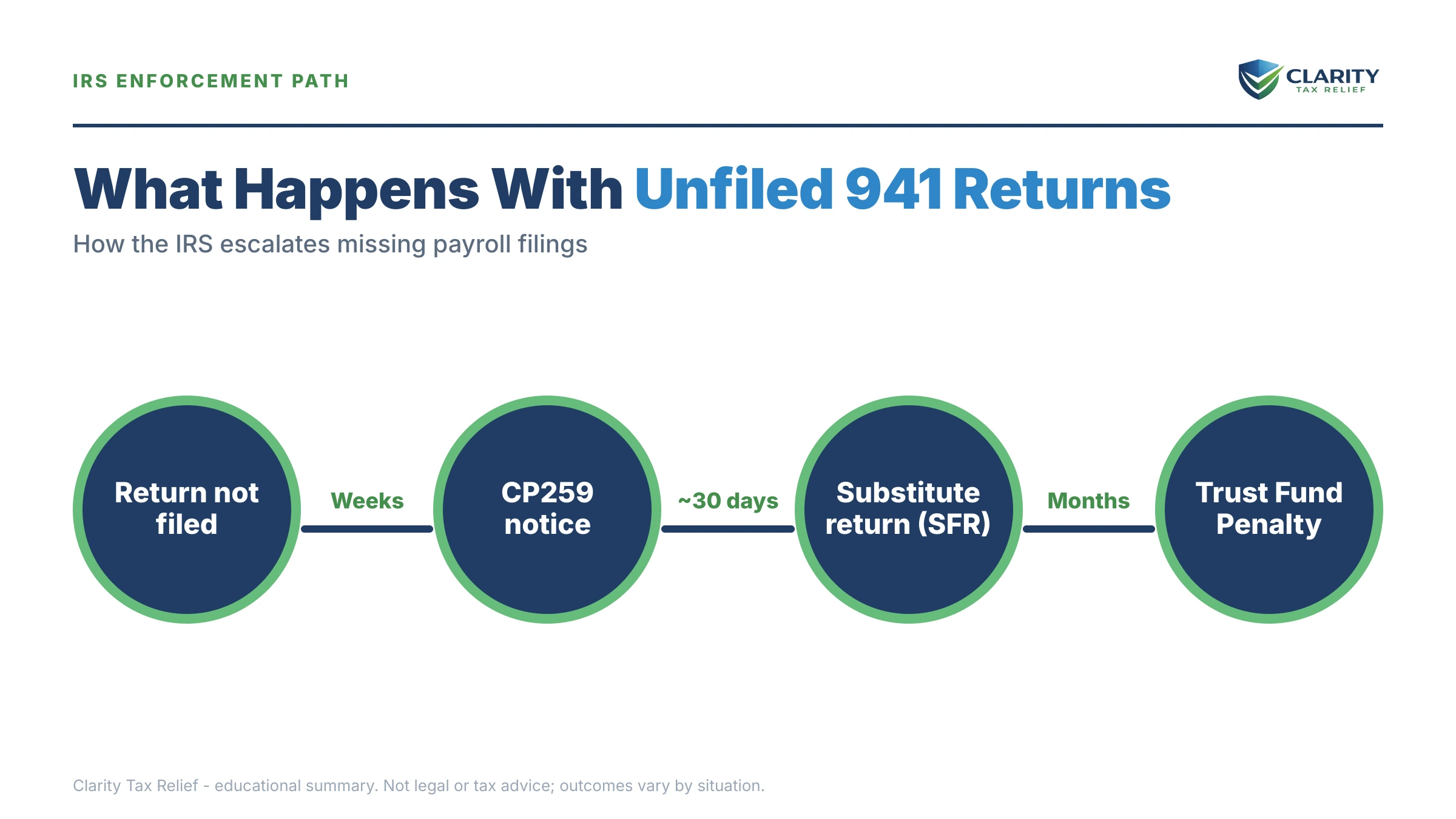
What happens if you ignore unfiled 941 returns
An unfiled 941 never expires: the assessment statute of limitations does not start running until a return is filed, so an ignored quarter stays legally open forever. What follows is a sequence, and each stage removes options you have at the one before it:
- CP259 — "You didn't file." The first automated non-filer notice, listing the missing quarter. See the CP259 notice guide. At this stage, nothing has been assessed and your numbers still control everything.
- LT18 — collections wants the returns. The file has moved from processing to the collection function. The LT18 notice demands the overdue returns directly and warns of enforcement if you stay silent.
- Letter 1085 — the 30-day substitute-return proposal. The IRS shows you the 941 it intends to file for you under IRC §6020(b), built from your W-2 data, prior quarters, and state filings — almost always without the adjustments that would favor you. Letter 1085 gives you 30 days to file your own return or protest before the IRS's version becomes the assessment.
- Assessment and balance-due notices. Once assessed — on your numbers or the IRS's — the account becomes a collectible debt. Balance-due notices arrive, penalties and interest are formally added, and a federal tax lien becomes possible.
- Intent to levy. Business-side levy notices (CP504B, then a final notice such as CP297) open the door to levies on the business bank account, and — critically for a business — on accounts receivable, which can cut off cash flow overnight. The final notice starts a 30-day clock with Collection Due Process appeal rights.
- Revenue officer and the Trust Fund Recovery Penalty. Payroll cases are the ones the IRS still assigns humans to. A field officer may visit the business — our guide covers what to do when a revenue officer shows up over payroll taxes — and open a TFRP investigation: a Form 4180 interview, then Letter 1153 proposing personal assessment, with a 60-day window to protest.
Two 2026 realities sharpen this. First, the IRS workforce shrank roughly 27% in 2025 — but CP259s, LT18s, and 6020(b) assessments are generated by automated systems that never took a buyout. Second, the pattern of continuing to withhold from paychecks quarter after quarter while never filing or paying is what the IRS calls pyramiding payroll taxes — the single behavior most likely to turn a civil payroll case into a criminal referral. Filing voluntarily, before the IRS forces the issue, is what keeps you firmly on the civil side of that line.
Sitting on unfiled 941 quarters right now?
Every month adds another 5% to the failure-to-file penalty, and once the IRS assesses its own numbers, you're negotiating from behind. Get your open quarters reviewed free — an experienced tax professional will map exactly which quarters are open, what they'll cost, and the cheapest order to fix them.
How much unfiled 941 returns cost: the penalty stack
An unfiled 941 triggers up to three separate penalties on the same dollars — failure-to-file, failure-to-pay, and failure-to-deposit — plus interest on all of it. This stacking is why payroll debt grows faster than any other kind of tax debt:
| Penalty | Rate | Maximum |
|---|---|---|
| Failure-to-file | 5% of unpaid tax per month (4.5% while failure-to-pay runs concurrently) | 25% per quarter |
| Failure-to-pay | 0.5% of unpaid tax per month | 25% per quarter |
| Federal tax deposit penalty | 2% / 5% / 10% tiers by lateness; 15% after an IRS demand | 15% of the undeposited amount |
| Trust Fund Recovery Penalty (entities) | 100% of the trust-fund portion, assessed against responsible persons personally | No cap — it mirrors the trust-fund balance |
| Interest | Federal rate, adjusted quarterly, compounding daily on tax and penalties | No cap |
To see how these rates play out on your own numbers, you can estimate the damage with our Penalty & Interest Calculator before anyone at the IRS runs it for you.
A worked example: $36,900 across four unfiled quarters
Say you're a sole proprietor with two employees and four unfiled quarters, and the unpaid payroll tax across them totals $36,900 — roughly $9,225 per quarter. This is a hypothetical, but the arithmetic is the real formula:
- Failure-to-file: because the failure-to-pay penalty runs concurrently, this accrues at the reduced 4.5% per month; once each quarter is five or more months late, it hits its reduced cap of 22.5% — about $8,303 across the four quarters.
- Failure-to-deposit: deposits unpaid more than 15 days draw the 10% tier — about $3,690 — rising to 15% (about $5,535) after an IRS demand notice.
- Failure-to-pay: 0.5% per month keeps running — roughly $185 a month on the full $36,900, still climbing toward its own 25% cap.
- Interest: compounds daily on the tax and the penalties.
Within about a year, that $36,900 debt is realistically in the $50,000 range — before a levy, before a lien, before the IRS assigns a human to the case. And because a sole proprietor is the business legally, every dollar of it is a personal debt reachable against personal accounts and assets, not just business ones. The full anatomy of that exposure is in our guide to sole proprietor payroll tax debt.
Your options once every quarter is filed
The IRS will not approve any payment plan, hardship status, or settlement while a required 941 is unfiled — filing compliance is the gate to every option below. It generally also requires you to be current on this quarter's deposits, because the IRS won't finance old payroll debt while new debt is still accumulating.
| Option | Who qualifies | Key requirement |
|---|---|---|
| Pay in full | Anyone | Stops all penalty accrual; penalties already assessed may still be abatable afterward |
| IBTF-Express installment agreement | Operating businesses owing about $25,000 or less | Full payment generally within 24 months; direct debit typically required above $10,000; no financial statement |
| In-business installment agreement (with financials) | Balances above the express threshold — like our $36,900 example | Form 433-B financial disclosure; must stay current on all deposits and filings |
| Currently Not Collectible | Businesses or individuals where any payment prevents basic operations/living expenses | Full financial review; debt remains and the IRS revisits when finances improve |
| Offer in Compromise | Rare for payroll debt — assets and income must genuinely fall short of the balance | $205 fee plus 20% down on lump-sum offers (waived with low-income certification); the IRS accepted roughly 1 in 5 offers in FY2024 |
| Penalty abatement | First-time abatement for one period with a clean prior 3 years; reasonable cause for the rest | Underlying tax stays; only penalties are removed — see below |
A tactic specific to balances just above the express threshold: in the $36,900 scenario, paying the balance down below roughly $25,000 before requesting the agreement can move you from a full Form 433-B financial review into the streamlined express lane. The in-business trust-fund rules, thresholds, and trade-offs are detailed in our business payroll tax payment plan guide.
On penalties: because the stack in the table above can approach half the underlying tax, abatement is often where the biggest dollars come back. First-time abatement can clear one period if your prior three years were clean, reasonable cause (illness, disaster, a payroll provider that failed you) covers the rest, and starting summer 2026 the IRS's new Automatic Exemption from Penalty (AEP) applies qualifying relief automatically — no request needed. The payroll-specific arguments are in our guide to 941 penalty abatement.
| Step / option | Upfront cost | Typical timeline |
|---|---|---|
| Preparing and filing the back 941s | Free if DIY; preparation fees if professionally rebuilt from bank records | Days to weeks to prepare; several weeks for the IRS to post them |
| IBTF-Express agreement | IRS setup fee (lower with direct debit; current tiers on the IRS payment plans page) | Often arranged in a single contact once the returns post |
| In-business agreement with Form 433-B | Setup fee plus the work of a full financial package | Weeks to a few months, depending on review |
| Currently Not Collectible | $0 to request | Weeks to months; the IRS periodically re-reviews |
| Offer in Compromise | $205 fee + 20% of the offer (lump sum), unless low-income certified | Commonly the better part of a year or more; auto-accepted if the IRS doesn't decide within 2 years |
| Penalty abatement | $0 to request | Weeks for first-time abatement; longer for reasonable-cause review |
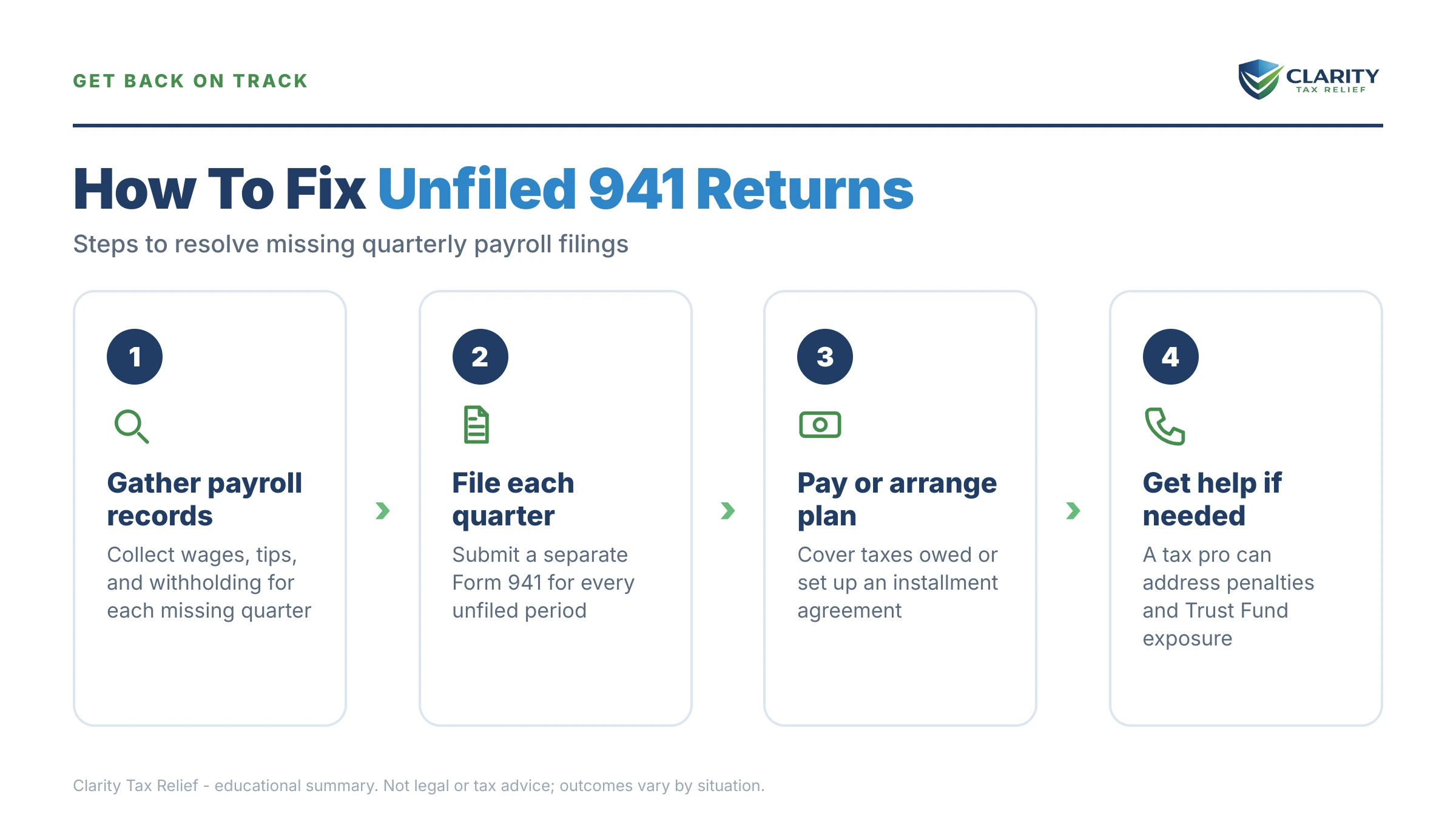
How to fix unfiled 941 returns, step by step
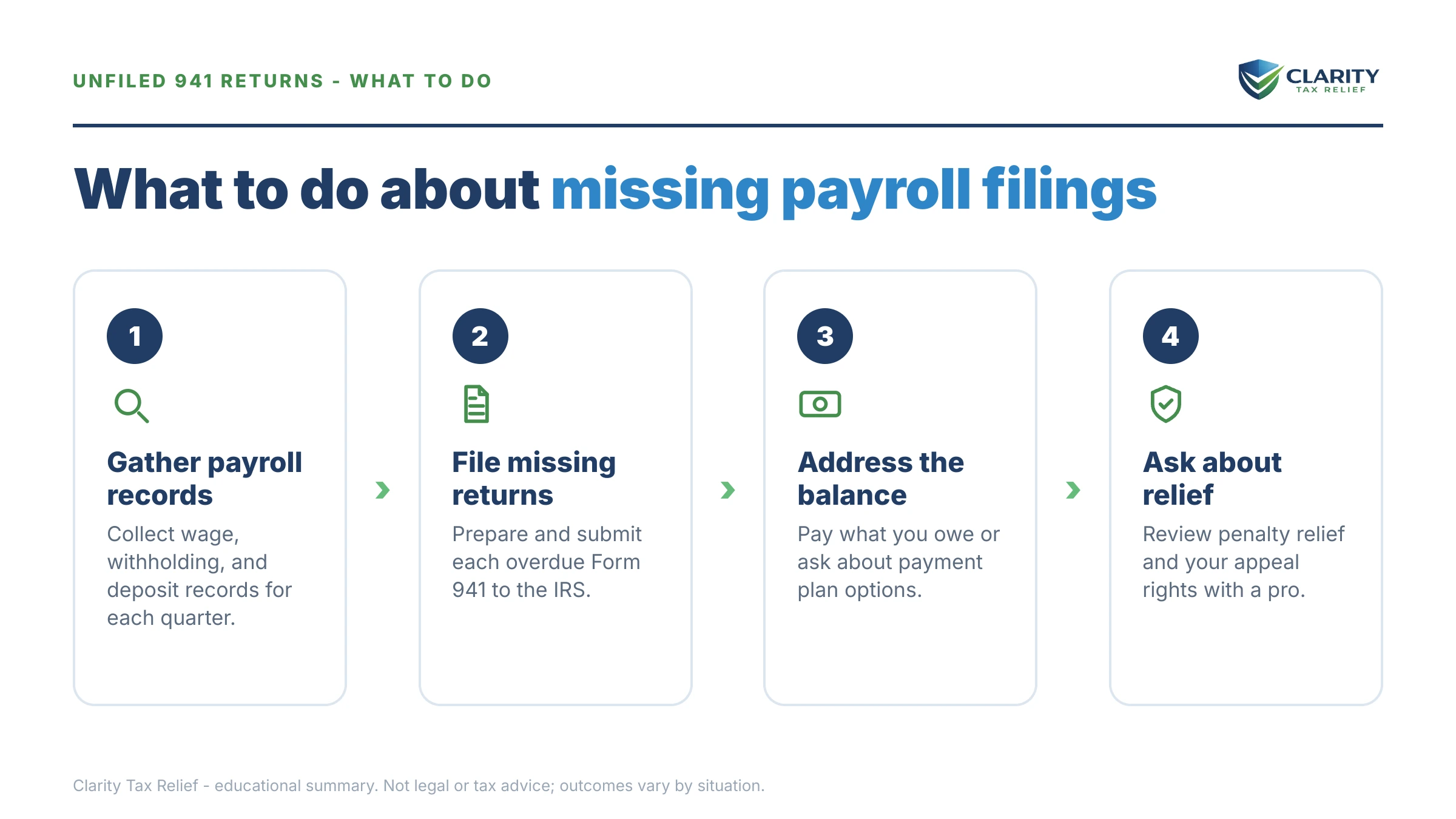
- Pull the records for every open quarter. Gather bank statements showing payroll runs, payroll software reports, W-2/W-3 copies, and your IRS business transcripts.
- Prepare an accurate Form 941 for each missing quarter. Use real numbers, even if you can't pay a dollar with them — filing is what stops the 5%-per-month penalty.
- File every open quarter at once. If you received Letter 1085, respond within its 30-day window so the IRS assesses your numbers, not its own.
- Restart federal tax deposits for the current quarter. No payroll resolution survives a new missed deposit, so fix the go-forward system before you negotiate the past.
- Negotiate the balance once every return is in. Choose a payment plan, hardship status, or penalty relief based on what the business can actually sustain.
The order is not optional. Filing before negotiating is an IRS rule; fixing current deposits before negotiating is an IRS expectation; and filing accurate returns before the IRS files inflated ones is simple self-defense. The current form and instructions live at the IRS's About Form 941 page.
Sole proprietor, LLC, or corporation: who owes the debt
Your business structure determines whether unfiled 941 debt is a business problem or already a personal one. For a sole proprietor — and generally a single-member LLC taxed as one — there is no separation: the entire payroll debt, penalties included, is collectible from your personal bank accounts and assets, because you and the business are the same taxpayer.
For corporations and multi-member LLCs, the entity owes the full balance, but the IRS can pierce through to people for the trust-fund portion — the income tax and employee-side FICA actually withheld from paychecks. That's the Trust Fund Recovery Penalty, and it reaches any "responsible person" who willfully failed to pay the money over: owners, officers, and sometimes bookkeepers or anyone with check-signing authority. In our $36,900 hypothetical, if the business were an LLC with employees, roughly the withheld-tax share — call it on the order of $27,000 — could be assessed against the owner personally even if the company folded.
Three edge cases worth knowing. If the business has closed, the trust-fund exposure survives the closure — dissolving the entity does not dissolve the TFRP. If a payroll provider took your money and never filed or deposited, you are still liable for the tax, though it can be strong reasonable-cause grounds against the penalties. And in bankruptcy, trust-fund payroll taxes are priority debts that are not dischargeable — you cannot file your way out of them in Chapter 7.
If the IRS already filed your 941s for you
A 6020(b) substitute return is the IRS's estimate, not a final verdict — you can still file your own accurate 941 for that quarter and have the assessment corrected. Substitute payroll returns are built from W-2 totals, prior-quarter patterns, and state data, and they routinely overstate what you owe because no one at the IRS is looking for the figures that help you.
Filing the true return after a 6020(b) assessment typically leads the IRS to adjust the balance to your numbers, which shrinks every percentage-based penalty stacked on top. One quirk cuts the other way: a 6020(b) return does not start the assessment statute of limitations — only a return you sign does. So even after the IRS has "filed for you," submitting your own return is what finally closes the quarter and starts the clocks running in your favor. If your case is already deep in collections, the Taxpayer Advocate Service can also intervene when IRS action threatens the business's survival.
If a revenue officer is involved or a Form 4180 interview is on the calendar, that's the moment representation changes outcomes most — get your quarters reviewed free before you answer trust-fund questions on the record.
When you can handle unfiled 941s yourself
Not every unfiled-941 case needs professional help. You can reasonably handle this yourself if you're missing only one or two quarters, your payroll records are intact, and the resulting balance is one the business can pay in full or under a simple express agreement. File the returns, pay what you can at IRS.gov/payments, request first-time abatement if your history is clean, and you may never need anyone.
Experienced help changes outcomes in specific situations: a revenue officer is assigned or a Form 4180 interview has been scheduled; the IRS has already assessed 6020(b) returns at inflated numbers; multiple years of quarters need reconstructing from bank records; the business can't yet make current deposits (the sequencing here is delicate); or you're weighing whether to keep operating, restructure, or wind down. In a TFRP investigation especially, what you say in the Form 4180 interview determines who gets assessed personally — that is not a conversation to improvise.
Terms on your 941 notices, decoded
- Trust fund taxes — the income tax and employee-side Social Security/Medicare actually withheld from paychecks, legally held "in trust" for the government.
- 6020(b) substitute return — a return the IRS prepares and assesses for a non-filing business, using its own data instead of yours.
- Responsible person — anyone with the authority and duty to collect and pay over payroll taxes; the target of a TFRP assessment.
- Federal tax deposit (FTD) — the required electronic deposit of payroll taxes during the quarter; missing it triggers its own tiered penalty separate from filing late.
- Trust Fund Recovery Penalty (TFRP) — a personal assessment equal to 100% of the trust-fund portion, collectible from responsible persons even after a business closes.
- Filing compliance — the IRS's requirement that all required returns be filed before it will approve any payment plan, hardship status, or offer.
Unfiled 941 questions, answered
What happens if you never file Form 941?
The IRS eventually files the missing quarters for you under IRC Section 6020(b) and assesses tax at its own numbers — usually higher than what you actually owe. Before that, you'll get non-filer notices like the CP259, and after assessment the account moves into full collections: liens, levies, and a possible Trust Fund Recovery Penalty against you personally. The failure-to-file penalty alone adds 5% per month, up to 25% of each quarter's unpaid tax.
Can the IRS file a 941 return for me?
Yes. Section 6020(b) of the tax code lets the IRS prepare a substitute 941 using your prior filings, W-2 data, and state payroll records. The IRS proposes it on Letter 1085 and gives you 30 days to respond before assessing. Its numbers rarely favor you — and a 6020(b) return does not start the assessment statute of limitations, so filing your own accurate return is almost always better.
Is there a statute of limitations on unfiled 941 returns?
No clock runs on a quarter you never filed. The assessment statute of limitations only starts when you file the return — and an IRS-prepared 6020(b) substitute does not start it either. The 10-year collection statute begins only after the tax is assessed. Practically, that means an unfiled 941 stays open indefinitely, which is one of the strongest reasons to file it voluntarily.
Can you go to jail for not filing 941 returns?
Most unfiled-941 cases are handled as civil collection matters, not criminal ones. But willfully failing to collect or pay over withheld payroll taxes is a felony under IRC Section 7202, and the risk rises sharply with pyramiding — continuing to withhold from paychecks quarter after quarter while never sending the money in. Filing voluntarily before the IRS forces the issue is the single best way to keep a case civil.
Should I file old 941s even if I can't pay them?
Yes — file every open quarter even if you can't pay a dollar. The failure-to-file penalty (5% per month) is ten times the failure-to-pay penalty (0.5% per month) — though in months where both apply, the failure-to-file portion drops to 4.5% (5% combined) — so filing immediately stops the fastest-growing cost. Filing also starts the statutes of limitations and is a hard requirement before the IRS will approve any payment plan, hardship status, or offer.
How do I reconstruct payroll records for old quarters?
Start with what already exists: bank statements showing payroll runs, copies of W-2s and W-3s you issued, state payroll filings, and reports from any payroll software you used. You can also request your business account transcripts from the IRS to see exactly which quarters are open and what income documents it holds. An experienced tax professional can often rebuild accurate quarters from bank records alone.
Am I personally liable for unfiled 941 taxes?
If you're a sole proprietor, yes — the entire payroll tax debt is yours personally, because there is no legal separation between you and the business. If you operate through an LLC or corporation, the IRS can still assess the trust-fund portion — the money withheld from employee paychecks — against you personally through the Trust Fund Recovery Penalty if you were a responsible person who willfully failed to pay it over.
Does first-time penalty abatement apply to 941 penalties?
Yes. If you have a clean compliance history for the prior three years, first-time abatement can remove the failure-to-file, failure-to-pay, and failure-to-deposit penalties for one period. Starting in summer 2026, the IRS is rolling out the Automatic Exemption from Penalty (AEP), which applies similar relief automatically. For the remaining quarters, reasonable-cause abatement is the path — illness, disaster, or reliance on a payroll provider that failed you.
Can I get an IRS payment plan with unfiled 941 returns outstanding?
No. Filing compliance comes first: the IRS will not approve an installment agreement, hardship status, or an offer in compromise while required returns are missing. For an in-business payroll plan, you generally also have to be current on this quarter's federal tax deposits. That's why the fix always runs in the same order — file every quarter, restart deposits, then negotiate the balance.
Your next 24 hours
- Identify every open quarter. Check any IRS notices for the tax periods listed (they appear as dates like "March 31, 2025" in the header), or pull your business account transcripts to see exactly which 941s the IRS shows as missing.
- Gather the raw materials. Bank statements covering each payroll run, W-2/W-3 copies, state payroll filings, and any payroll software reports — enough to rebuild each quarter accurately.
- Get a free case review. Call (888) 825-7779 or use the 2-minute form. Every month a quarter stays unfiled adds another 5% in penalties, and every week of delay is another week closer to the IRS assessing its own numbers instead of yours.
This guide is general information, not tax or legal advice for your specific situation. Eligibility for IRS programs depends on individual facts and circumstances; no outcome is guaranteed.