
IRS Business Notices
IRS Letter 1085: The 30-Day Business Substitute-for-Return Proposal (2026)
The short answer: IRS Letter 1085 is a 30-day letter: the IRS has prepared an unfiled business return for you — usually a Form 941 — under IRC §6020(b) and will assess its proposed tax, penalties, and interest unless you file your own return, agree, or request an Appeals conference within 30 days of the letter's date.
You've been making payroll every week while the 941 filings quietly slipped — and now the IRS has done the filing for you, at numbers it chose. That's the sting of this letter: the government wrote your return without you in the room. The good news is that for exactly 30 days, your real numbers can still replace theirs.
The image below shows exactly what a Letter 1085 looks like and where to find the two things that matter most — the response deadline and the list of forms and periods the IRS prepared. Everything you do next is organized around those two items.
⏱ Your deadline: You have 30 days from the date printed on Letter 1085 before the IRS assesses its proposed figures as a legally collectible debt. The clock runs from the letter's date, not the day it arrived — check the date in the upper right corner of page one.
Why you got Letter 1085
Letter 1085 arrives because your business has at least one unfiled return — most often a quarterly Form 941 payroll return — and earlier requests to file went unanswered. Under IRC §6020(b), the IRS has the authority to prepare that return itself, and this letter is the formal 30-day proposal of the version it built.
Before this letter, the IRS almost certainly sent a CP259 notice asking for the missing business return. When that produced nothing, a compliance unit assembled a return from wage reports, W-2/W-3 filings, your prior 941s, and other third-party data. Letter 1085 transmits that return and the balance the IRS computed from it.
This is not an audit — nobody examined your books. It's non-filing enforcement, and it usually covers every unfiled period the IRS can document, not just one quarter. If the letter lists a 940 or an 1120 alongside the 941s, each form and period is its own proposed assessment. (For general orientation on any IRS mail, see why did I get a letter from the IRS — but this page covers the 1085 specifically, because it behaves differently from almost every other letter.)
What the IRS put on your Letter 1085 — and why it's probably too high
A §6020(b) return gives your business no benefit of the doubt: the IRS computes tax from the highest figures the data supports, then stacks every percentage-based penalty on top.
Three things inflate the proposal:
- Projected wages. If the IRS lacks complete wage data for a quarter, it often projects from your last filed 941s. A business that cut staff, cut hours, or seasonally slowed will be billed as if payroll never shrank.
- No adjustments. A real 941 reconciles deposits, sick-pay adjustments, and corrections. The IRS's version claims none of them for you.
- Penalties on the inflated tax. The failure-to-file penalty builds at 5% per month up to 25% of the unpaid tax, and the federal tax deposit penalty adds its own tiered percentage — all calculated on the IRS's number, not yours. You can estimate how these charges stack with our IRS Penalty & Interest Calculator.
Because the tax is the base for every penalty and for interest, lowering the tax by filing your own return lowers everything downstream at the same time. That's why filing beats arguing in most 1085 cases.
What happens if you ignore Letter 1085
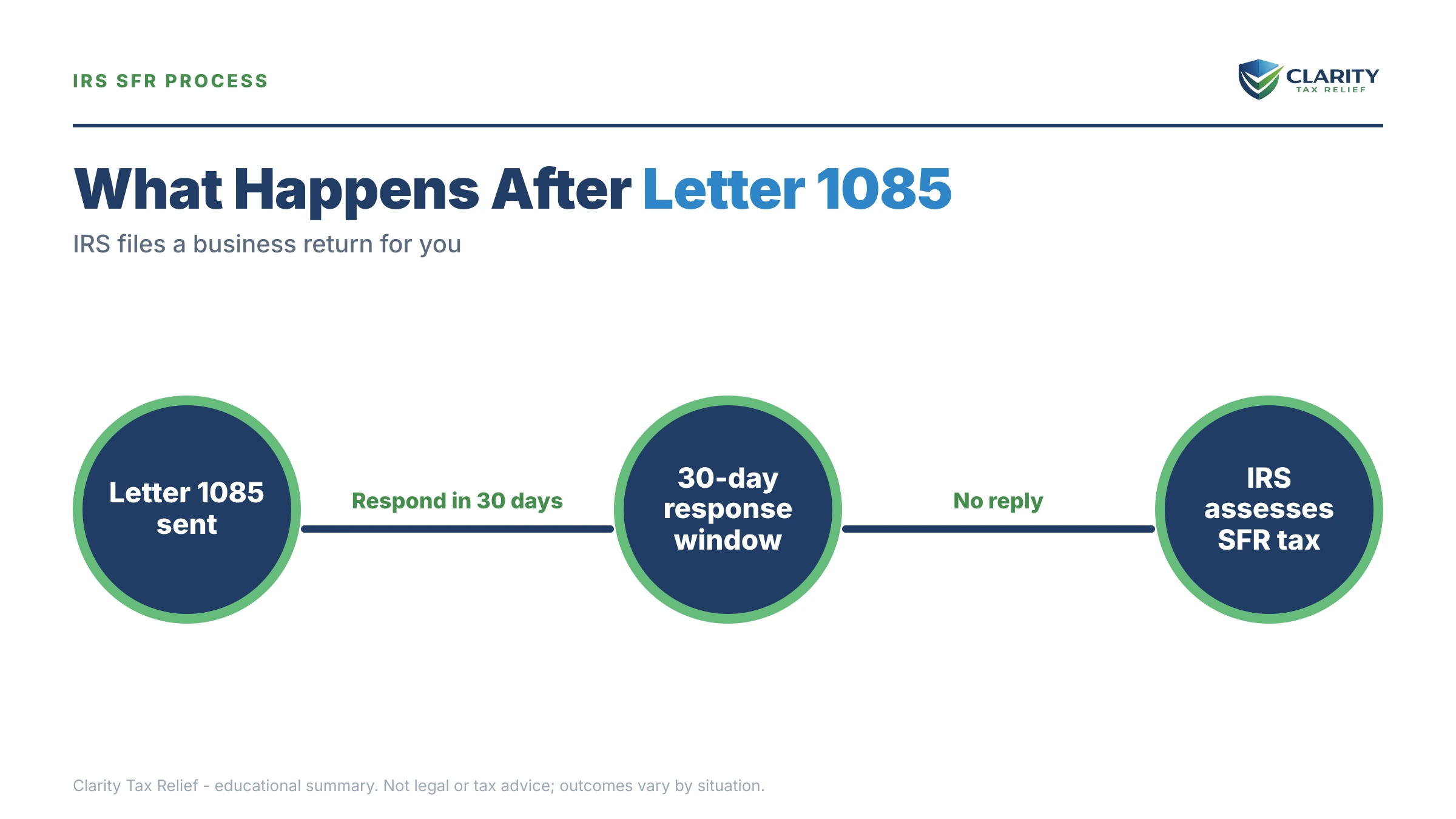
If the 30 days pass with no response, the IRS assesses its proposed figures and the proposal becomes an enforceable debt — there is no 90-day Tax Court letter for employment taxes, but the Letter 1085 itself gives you 30 days to file your own accurate returns or request a conference with IRS Appeals before the proposed assessment becomes final. Individuals who get a substitute return receive a notice of deficiency first; a business facing an employment-tax 6020(b) assessment does not. (If you're dealing with the personal version, see the IRS filed a substitute return for me — the rules are meaningfully different.)
Here is the sequence, in order:
- CP259 and delinquent-return notices — the IRS asked for the missing returns. That stage is over.
- Letter 1085 — the 30-day proposal. You are here, and this is the cheapest point to act.
- Assessment — the balance posts to the business's account as legal debt, and the 10-year collection statute starts running on it.
- CP161 bill — the first formal demand for the assessed balance (see the CP161 notice guide).
- CP504B — the business intent-to-levy notice; the CP504B notice means enforcement is being staged.
- LT11 / Letter 1058 — the final notice of intent to levy, which starts a 30-day clock and your Collection Due Process rights (full detail in the Letter 1058 IRS guide).
- Levy and the trust-fund track — the IRS can levy business bank accounts (funds are held 21 days before they leave) and accounts receivable, and in parallel begin a Trust Fund Recovery Penalty investigation aimed at you personally.
One 2026 reality check: IRS staffing fell sharply in 2025, but 6020(b) assessments and the notices that follow are generated by automated systems. Nobody has to pick up your file for the machine to escalate it — the staffing cuts mostly mean it's harder to reach a human once it does.
| Stage | What it means | Your window |
|---|---|---|
| CP259 / delinquency notices | IRS requests the unfiled business returns | Open — no assessment yet |
| Letter 1085 | Proposed §6020(b) return with tax + penalties | 30 days from the letter date |
| Assessment posts | Proposal becomes legal debt; 10-year collection clock starts | None — response windows now come from later notices |
| CP161 bill | First demand for the assessed balance | Pay-by date printed on the notice |
| CP504B | Business intent-to-levy notice | Escalation continues if unanswered |
| LT11 / Letter 1058 | Final notice of intent to levy | 30 days to request a CDP hearing |
| Levy + TFRP investigation | Bank levy (21-day hold), receivables levy, personal trust-fund proposal | Release requires action, not waiting |
Holding a Letter 1085 right now?
Get it reviewed free before the 30-day window closes. An experienced tax professional will check which periods are covered, whether the IRS's numbers are inflated, and the fastest way to replace them with yours — confidential, no pressure.
Your options in the 30-day window
Letter 1085 offers three formal responses — file your own return, agree to the IRS's figures, or request an Appeals conference — and a fourth path (do nothing) that costs the most.
| Option | What it costs | Timeline | Best when |
|---|---|---|---|
| File your own returns | Preparer fees only; usually lowers tax, penalties, and interest together | Within the 30 days; IRS processing follows | The IRS's figures are too high — the most common situation |
| Agree to the proposal | The full proposed balance, plus accruing interest | Assessment posts quickly; move straight to payment terms | The numbers are genuinely right and you want speed |
| Request Appeals conference | No IRS fee; professional help often warranted | Written request within 30 days; conferences take months | You dispute owing the tax at all (e.g., worker classification) |
| Do nothing | The inflated balance becomes legal debt; levies follow | Assessment after day 30; collection notices after that | Never — this is the only option with no upside |
Two notes that change how the options play out:
- Filing your own return starts the assessment statute of limitations; a §6020(b) return does not. Leaving the IRS's version in place keeps those periods open indefinitely. Your own filed return also becomes the foundation for penalty relief — 941 penalty abatement for reasonable cause can meaningfully cut the failure-to-file and deposit penalties once real numbers are on file. (Starting in summer 2026, the IRS's new Automatic Exemption from Penalty may remove some penalties without a request — but only relief you'd qualify for anyway; it's not a reason to wait.)
- Payment comes after the numbers are fixed. Once the correct balance is assessed, an operating business with payroll debt typically resolves it through a business payroll tax payment plan — and every payroll agreement requires staying current on new deposits. If you can't fund this quarter's deposits, fixing that comes before everything else, because new missed deposits restart the whole problem.
If the business has a whole run of missing quarters rather than one or two, the broader playbook in unfiled 941 returns covers how to sequence the catch-up filing so you don't trigger avoidable penalties along the way.
A worked example: the $76,400 proposal
Say you own a 12-person landscaping company and Letter 1085 proposes $76,400 across four unfiled 941 quarters. This is hypothetical, but the structure is typical:
- Proposed tax, projected from your last filed quarters: $14,000 × 4 = $56,000
- Failure-to-file penalty at the 25% cap: $14,000
- Failure-to-deposit penalty at 10%: $5,600
- Interest to date: roughly $800
- Total proposed: $76,400
Now say your records show you laid off three workers mid-year, so actual combined liability was $47,200, not $56,000. Filing your own four 941s cuts the tax by $8,800 — and because the penalties are percentages of the tax, they shrink with it: failure-to-file drops to about $11,800, the deposit penalty to about $4,720, interest to roughly $680. New total: about $64,400 — roughly $12,000 less, before any penalty-abatement request, just for filing your real numbers inside the window.
The remaining balance then goes onto payment terms while the business keeps its current-quarter deposits clean. Miss the 30 days, and you'd be chasing that same $12,000 correction through an adjustment request while CP161 and CP504B notices arrive on schedule.
The trust-fund problem underneath the letter
The Letter 1085 assessment is against the business — but the withheld-tax portion of unpaid 941s can become your personal debt through the Trust Fund Recovery Penalty. The IRS treats employee withholding as money held in trust, and once it's assessed and unpaid, the agency can pursue any "responsible person" who controlled the funds: owners, officers, and sometimes check-signers who aren't owners at all.
That proposal arrives later as its own letter with its own clock — Letter 1153, which gives you 60 days to protest the trust fund recovery penalty. The full liability rules are covered in the trust fund recovery penalty guide, but the point for today is simple: responding to Letter 1085 now, and getting the tax figure right, shrinks the trust-fund amount that could ever follow you personally — even if the business later closes.
How to respond to Letter 1085, step by step
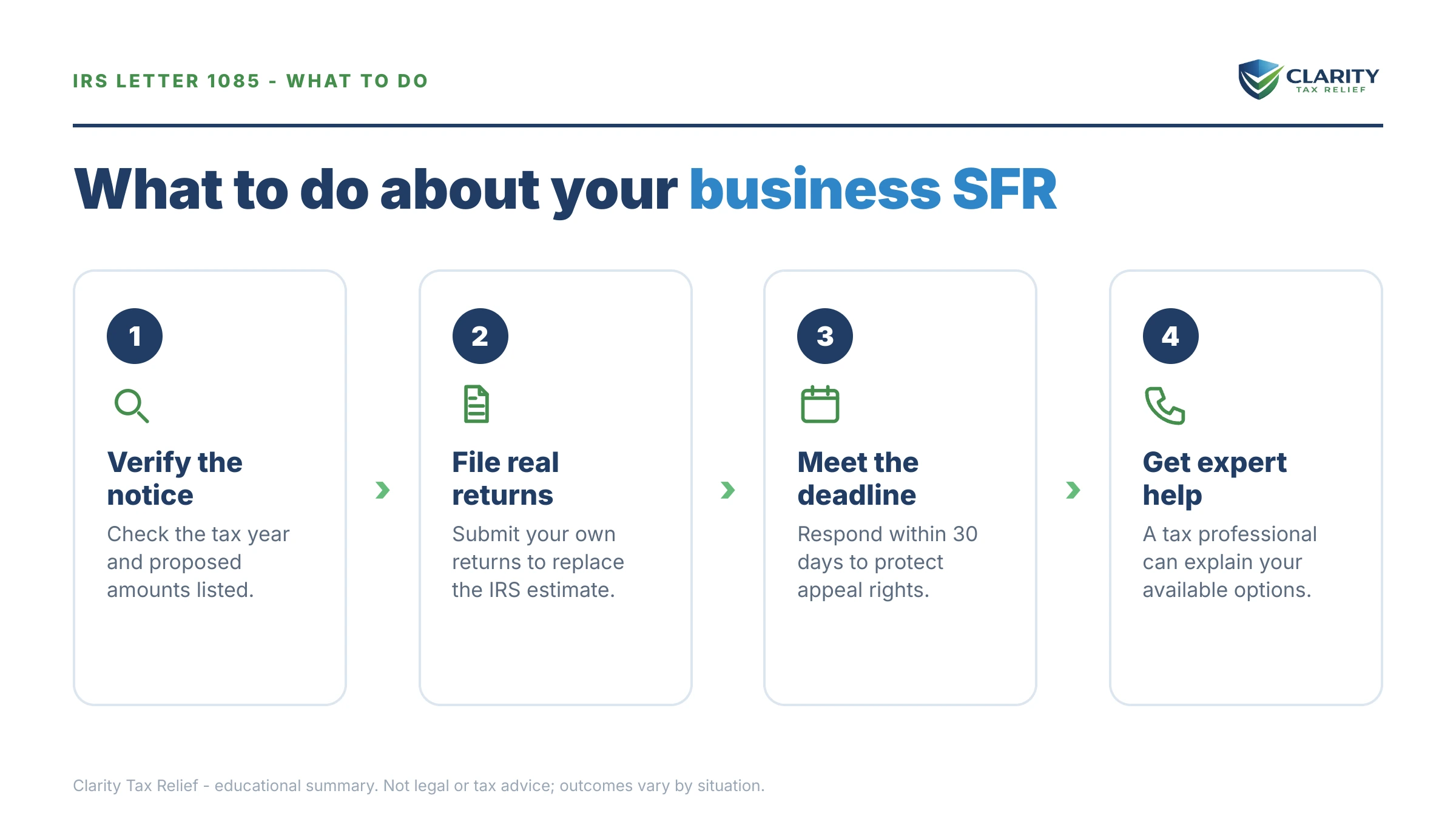
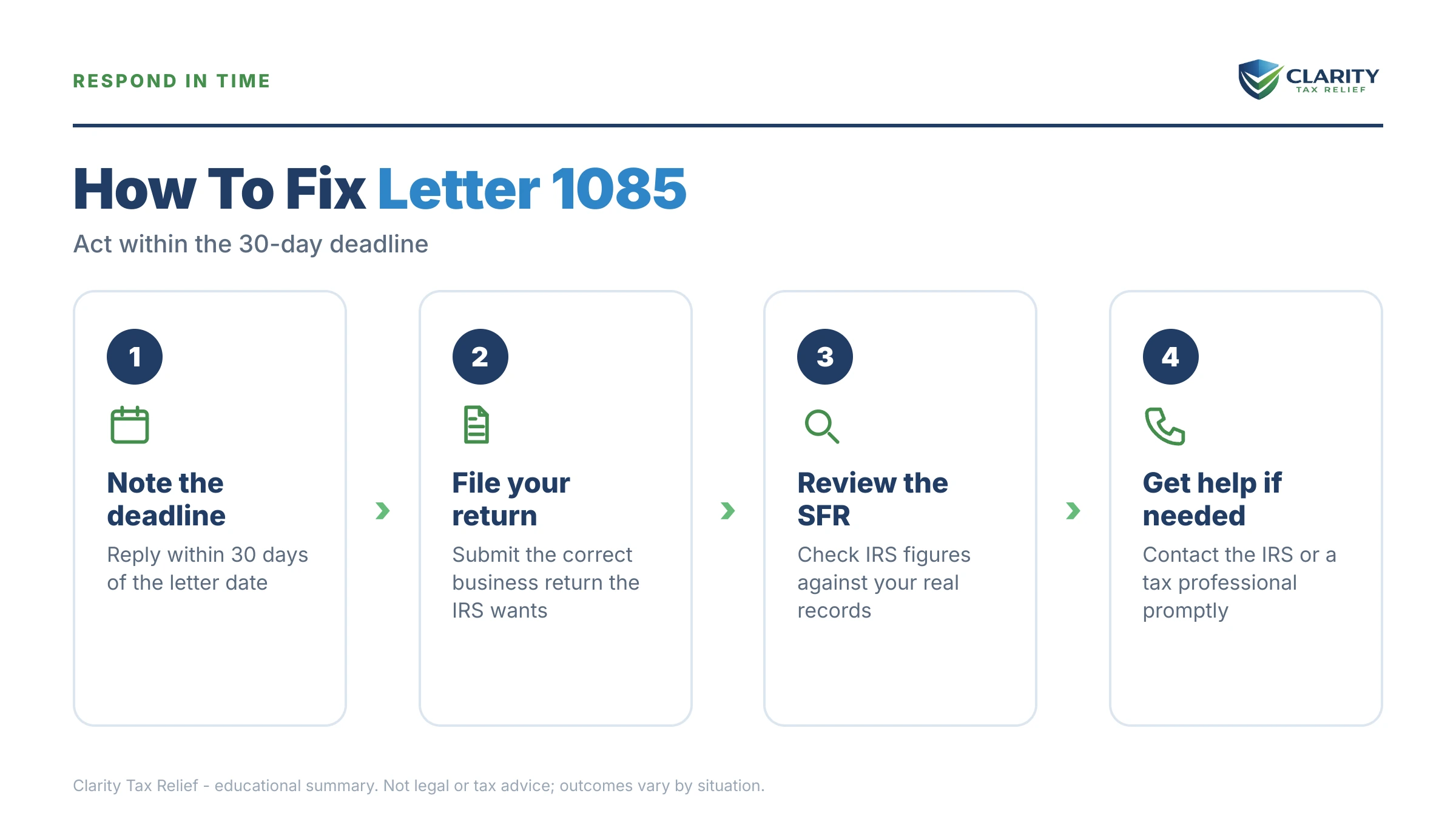
- Confirm the forms and periods covered. Page one of Letter 1085 lists each form (941, 940, 1120) and tax period the IRS prepared. Write them down — every later action is organized around this list.
- Pull your real payroll and income records. Gather payroll registers, bank statements, W-2/W-3 filings, and prior returns for the listed periods so your numbers, not the IRS's projections, control the outcome.
- Prepare and file your own returns within 30 days. File the actual returns for every listed period using the instructions and address on the letter, and note on each that it responds to Letter 1085.
- Request an Appeals conference in writing if you dispute liability. If you believe the business doesn't owe the tax at all, send a written appeal request to the address on the letter before the 30-day deadline.
- Arrange payment for the balance that remains. Pay what you can at IRS.gov/payments and set up a business installment agreement for the rest — staying current on new deposits is a condition of any agreement.
- Get a professional review if multiple periods or trust-fund exposure are involved. Several unfiled quarters, a revenue officer, or a looming Trust Fund Recovery Penalty investigation change the strategy — have an experienced tax professional map the sequence before you respond.
When you can handle this yourself
Plenty of 1085 responses don't need professional help. If the letter covers one or two quarters, your payroll records are complete, and the corrected balance is something the business can pay or put on a straightforward plan, the steps above are genuinely doable on your own — current-quarter filing rules and forms are on the IRS's Form 941 page.
Experienced help changes the outcome when the stakes compound: several years of unfiled business returns, records that have to be reconstructed from bank statements, a revenue officer already assigned, a worker-classification dispute buried in the numbers, or any sign the IRS is building a trust-fund case against you personally. In those situations the order of moves — which returns to file first, what to say and not say about who controlled the money, how to structure payment — determines what you ultimately pay and whether the debt stays on the business's side of the line. If collection action is already causing harm and you can't get a response from the IRS, the Taxpayer Advocate Service is an independent route inside the agency.
Terms on your Letter 1085, decoded
- Substitute for Return / §6020(b): the tax code section letting the IRS prepare a return for a non-filer using data it already has — always without the adjustments you'd claim yourself.
- Proposed assessment: the balance is not yet legal debt; it becomes one only when the 30 days expire or you agree.
- Trust-fund taxes: the income tax and employee-share FICA withheld from paychecks — the portion the IRS can later charge to responsible individuals personally.
- Failure-to-deposit penalty: the tiered penalty for payroll deposits made late or not at all, charged on top of the failure-to-file penalty.
- Appeals conference: a review by the IRS Independent Office of Appeals, separate from the unit that prepared the return — requested in writing within the 30 days.
- CSED: the Collection Statute Expiration Date — the IRS generally has 10 years to collect, counted from the assessment, not from the quarter you missed.
Letter 1085 questions, answered
What is IRS Letter 1085?
Letter 1085 is a 30-day letter telling a business that the IRS has prepared an unfiled tax return on its behalf — most often a Form 941 payroll return — under IRC §6020(b). It shows the tax, penalties, and interest the IRS intends to assess. You have 30 days from the letter's date to file your own return, agree to the figures, or request an Appeals conference.
How long do I have to respond to Letter 1085?
You have 30 days from the date printed on the letter, not the day you opened it. If the IRS receives nothing by then, it assesses the proposed amounts and the account moves into collection. Mail delays eat into the window, so date your response by certified mail and keep the receipt.
Can I still file my own return after getting Letter 1085?
Yes — filing your actual return within the 30 days is usually the single best response, because the IRS generally replaces its estimated figures with your real ones. Even after the assessment posts, you can still file and ask the IRS to adjust the account, but at that point you're unwinding a legal debt while collection notices keep coming, which takes far longer.
What happens if I ignore Letter 1085?
After the 30 days, the IRS assesses its proposed figures as a legally collectible debt and the business collection sequence begins: a CP161 bill, escalating notices, a CP504B intent-to-levy, then a final levy notice. For payroll taxes there is no 90-day Tax Court letter in between — the proposal converts straight to an enforceable balance. The IRS can then levy business bank accounts and receivables.
Are the numbers on Letter 1085 accurate?
They're usually the high end of what the data supports. A §6020(b) return is built from wage reports, prior filings, and third-party records, with no allowance for a shrinking payroll, corrected worker counts, or adjustments you'd claim on a real return — and percentage-based penalties are stacked on the inflated tax. Businesses that file their own returns frequently end up owing less than the proposal.
Can I appeal Letter 1085?
Yes. The letter gives you the right to request a conference with the IRS Independent Office of Appeals, in writing, within the 30-day window. Appeals makes sense when you dispute whether the business owed the tax at all — for example, a worker-classification disagreement. If your only issue is that the numbers are too high, filing an accurate return is usually faster than a formal appeal.
Does Letter 1085 mean I'm personally liable for the payroll taxes?
Not by itself — the proposed assessment is against the business. But once payroll taxes are assessed and unpaid, the IRS can pursue the Trust Fund Recovery Penalty against owners, officers, and anyone else who controlled the money, making the withheld-tax portion a personal debt. That proposal arrives later as Letter 1153, which carries its own 60-day deadline.
Is Letter 1085 the same as the substitute return individuals get?
No. When the IRS files a substitute return for an individual's Form 1040, the taxpayer receives a 90-day notice of deficiency with the right to petition Tax Court before assessment. Employment taxes proposed on Letter 1085 aren't covered by those deficiency procedures — once the 30 days pass, the IRS can assess immediately. That shorter runway is what makes this letter more urgent than it looks.
Your next 24 hours
- Find the date and the period list. The letter date in the upper right sets your 30-day deadline; the list of forms and periods on page one tells you exactly which returns need to exist. Count your remaining days today.
- Gather your records for those periods. Payroll registers, bank statements, W-2/W-3 copies, deposit confirmations, and your last filed returns — everything a preparer needs to build the real numbers.
- Get the letter reviewed free before the 30 days run out. Send us a photo of your Letter 1085 through the 2-minute form or call (888) 825-7779 — an experienced tax professional will tell you whether the IRS's figures are inflated and exactly how to answer in time.
This guide is general information, not tax or legal advice for your specific situation. Eligibility for IRS programs depends on individual facts and circumstances; no outcome is guaranteed.