
IRS Notices
IRS CP259 Notice: The Business Return the IRS Says Was Never Filed (2026)
The short answer: a CP259 notice means IRS records show your business never filed a required return — most often Form 941, 940, 1065, or 1120 — for the tax period printed on the notice. Respond by the date shown: either file the missing return, or tell the IRS in writing why you weren't required to file it.
The envelope is addressed to your business — maybe the LLC you set up for gig work back when an accountant said it would save on taxes, and haven't thought much about since. Inside, a CP259 says a return the IRS was expecting never arrived. Here's the good news: no tax has been assessed yet, nothing is being collected, and in many cases the fix is a single return or a one-paragraph explanation.
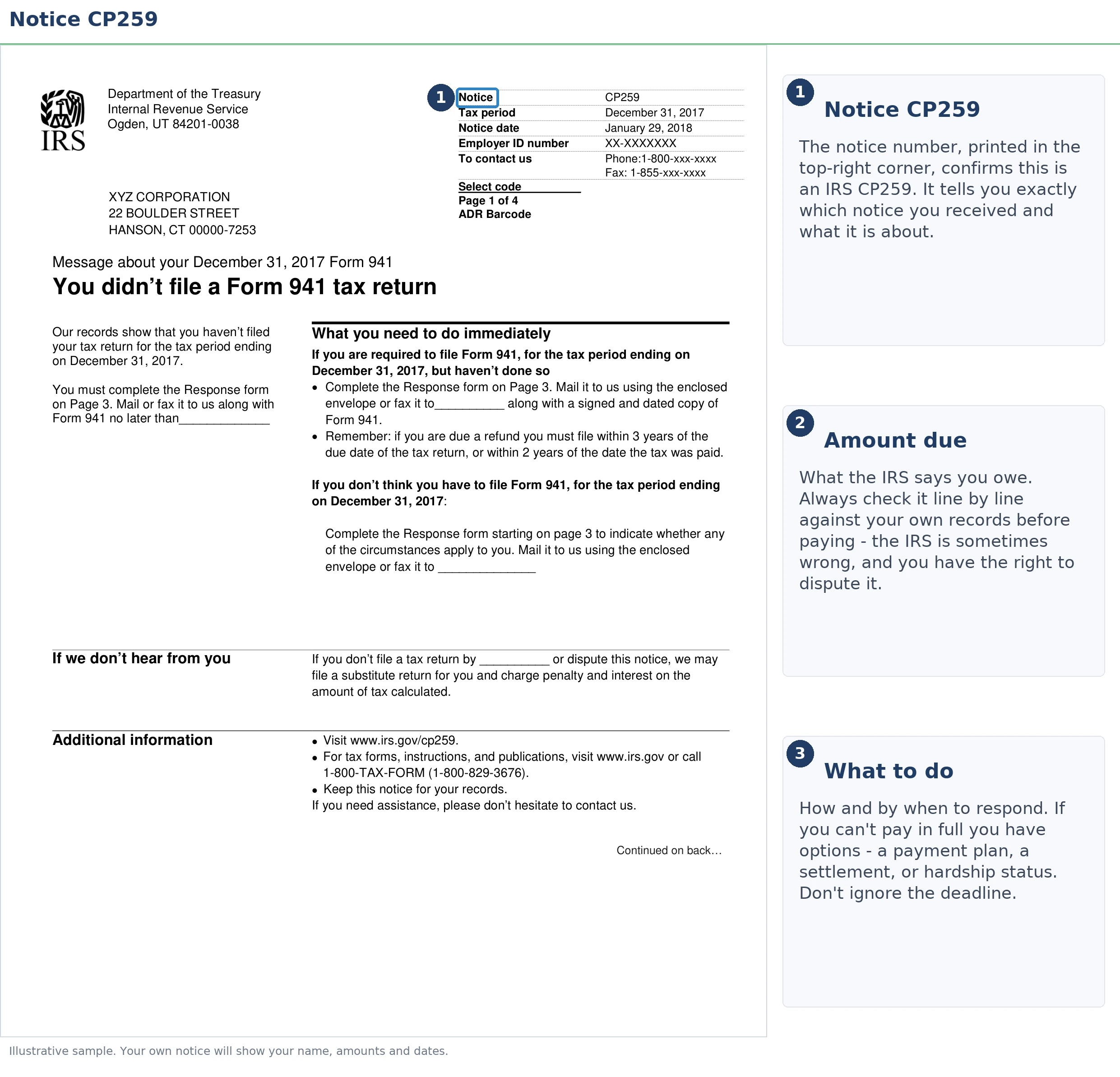
The two things you need before doing anything else are the form number and the tax period the IRS says is missing — both are printed on the notice itself. The image below shows exactly what a CP259 looks like and where to find them.
⏱ Your clock: respond by the date printed on your CP259 — there is no separate grace period. And if the missing return would show unpaid tax, the failure-to-file penalty is already growing at 5% of that tax per month, up to a 25% cap, whether or not you open the letter.
Why the IRS sent you a CP259 notice
A CP259 fires when the IRS's business master file expects a return under your EIN — and that return never posted. The expectation doesn't come from nowhere. It was created the moment you applied for an EIN and told the IRS what kind of entity you'd run, and it gets reinforced by every return you file afterward. File one Form 941, and the system expects a 941 every quarter until you formally tell it to stop.
This trips up gig workers and side-business owners constantly. You form an LLC, elect S-corp status because a video said to, run payroll for a year — then business slows down and you quietly stop filing. The IRS doesn't read your intentions. Filing requirements stay open until you close them, which is why CP259s so often arrive for businesses that, in the owner's mind, stopped existing years ago.
Two clarifications before you go further. First, a CP259 is not an audit — nobody is examining your books; the system just noticed a gap. Second, it's about your business account, not your personal one. The individual version of this notice is the CP59 notice, and if you're behind on both, they're resolved separately. For a broader map of what different IRS letters mean, see why did I get a letter from the IRS.
First: check whether you actually had to file
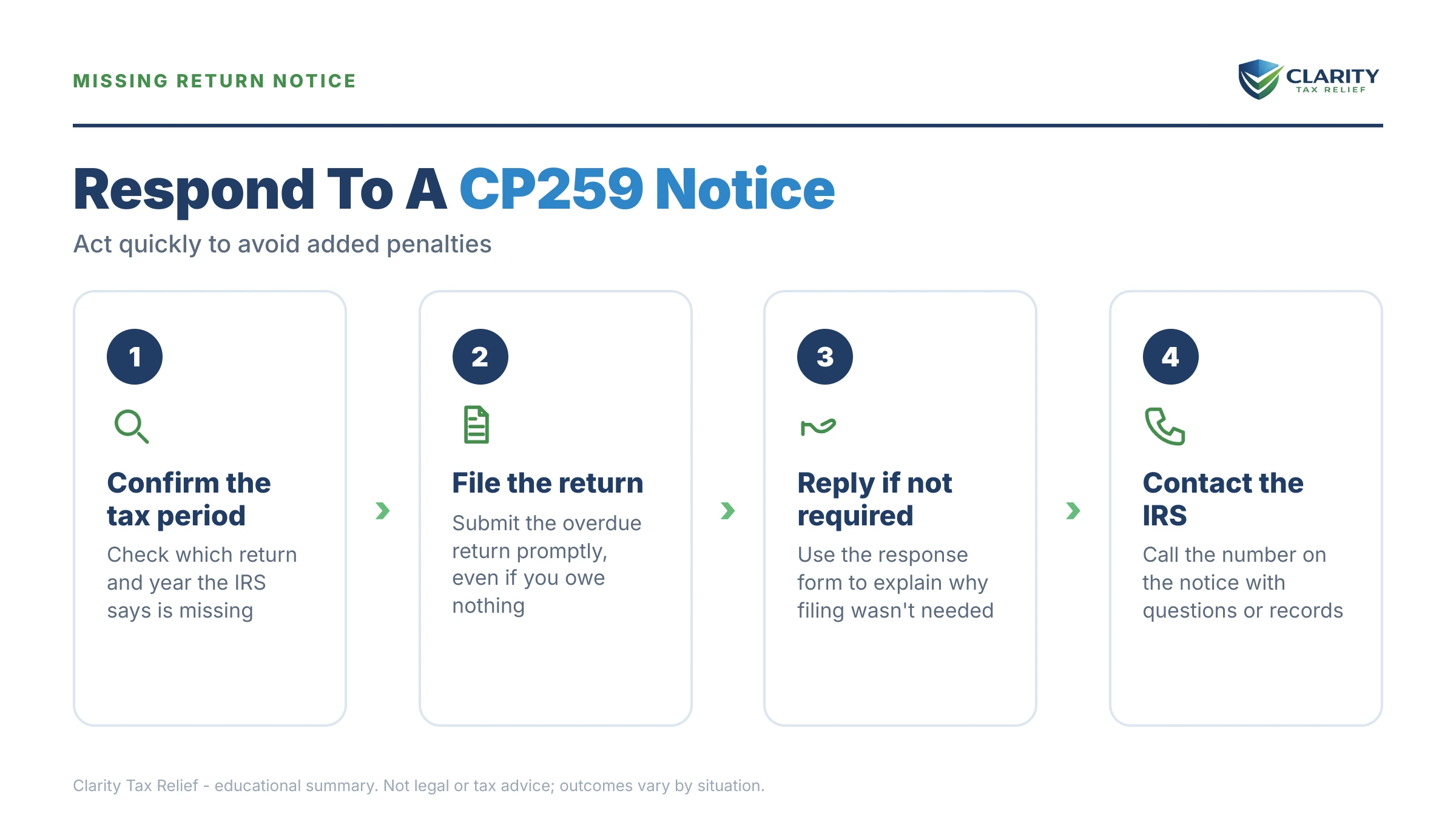
Not every CP259 means a return is genuinely owed — the notice itself gives you a way to respond that you aren't liable. Common situations where the right answer is an explanation, not a return:
- The business closed. You still need to respond — usually by filing final returns and telling the IRS the closure date — but the goal is shutting the account, not restarting quarterly filings.
- No employees or wages that quarter. Payroll requirements don't pause automatically. For Form 941, a no-wage quarter generally still requires a zero return unless you're registered as a seasonal filer or have filed a final return.
- The entity never actually operated. An LLC or corporation formed but never used may still show open filing requirements. Explain the facts using the notice's response option.
- You already filed. Paper returns and returns filed close to the notice date can cross in the system. If you filed, respond with a copy and proof of the filing date — don't file a duplicate blindly.
- Wrong return type. Entity elections change what's due — an LLC that revoked its S-corp election, for example, may owe a different return than the one the notice names.
The one thing that never works is silence. The IRS only stops asking when you tell it why — even a business that owes nothing has to say so.
What happens if you ignore a CP259 notice
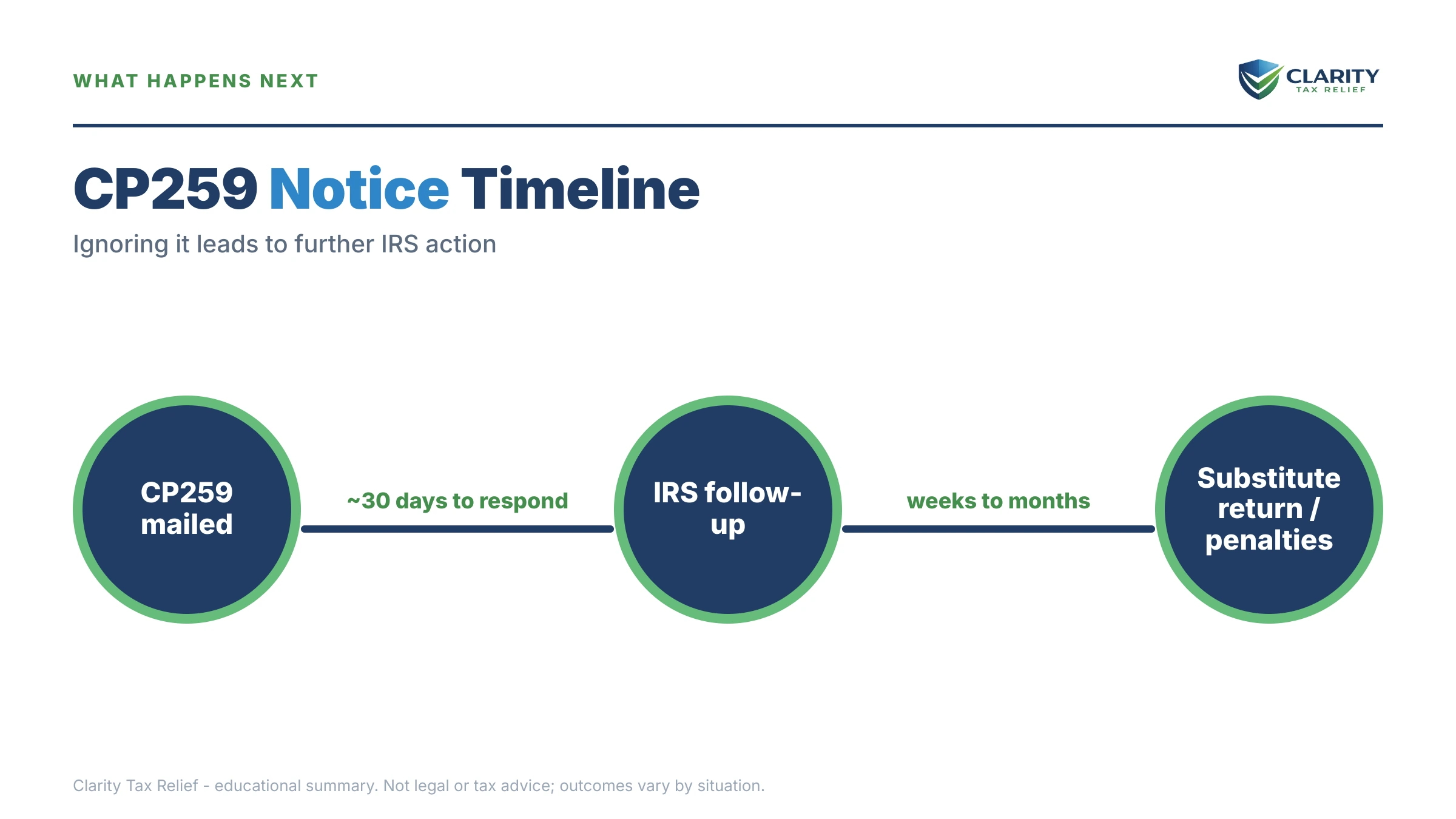
If you ignore a CP259, the IRS can eventually prepare the missing business return for you under IRC §6020(b) — using estimated numbers and none of your deductions — and then collect the result like any other tax debt. That's the single most important difference between this notice and a routine reminder: non-response doesn't make the question go away, it lets the IRS answer the question for you, at the worst possible number.
The sequence runs like this:
- CP259 — the first missing-return notice. You are here. Nothing has been assessed.
- Follow-up demands — notices like LT18 or Letter 3391 repeat the demand for the overdue return, each with its own response date.
- Letter 1085 — the IRS proposes a substitute return under §6020(b), built from your prior filings and payer records. You get 30 days to file your own return or protest before it becomes final.
- Assessment and billing — the estimated tax posts to your account, and a CP161 notice bills it, with penalties and interest attached, followed by reminders.
- CP504B notice — intent to levy. The IRS can now take certain state payments, and stronger enforcement is queuing up.
- Final notice (Letter 1058 / CP297) — after 30 days, the IRS can levy bank accounts and receivables. This notice carries Collection Due Process appeal rights, requested on Form 12153.
If the missing return is a Form 941, one more layer applies: the withheld income tax and FICA are trust fund money, and unpaid trust fund taxes can be assessed personally against owners and check-signers through the Trust Fund Recovery Penalty — a debt that survives even if the business folds. Our guide to unfiled 941 returns covers that path in detail.
And in 2026, don't count on the process stalling. IRS staffing fell roughly 27% in 2025, which makes humans harder to reach — but every stage above is generated by automated systems that never stopped running.
| Stage | Notice | What it means | Your window |
|---|---|---|---|
| 1 | CP259 | First notice that a required business return is missing | Response date printed on the notice |
| 2 | LT18 / Letter 3391 | Follow-up demands for the overdue return | Date printed on each notice |
| 3 | Letter 1085 | IRS proposes a §6020(b) substitute return with estimated numbers | 30 days to file your own return or protest |
| 4 | CP161 / CP163 | Estimated tax is assessed and billed, with penalties and interest | Pay-by date on the bill |
| 5 | CP504B | Intent to levy — state payments at risk, stronger action queued | Act before the next notice issues |
| 6 | Letter 1058 / CP297 | Final notice of intent to levy, with Collection Due Process rights | 30 days before levy can begin |
Holding a CP259 right now?
Send us a photo of it before the response date on your notice passes. An experienced tax professional will identify exactly which returns the IRS expects, whether you actually have to file them, and the cheapest order to fix it — free and confidential.
Your options: file, explain, or close the account
Every CP259 resolves one of three ways: you file the return, you show you weren't required to, or you file a final return that shuts the requirement down going forward. Which one applies depends on the form the notice names:
| Form named on the CP259 | What it reports | If you weren't liable for that period |
|---|---|---|
| Form 941 | Quarterly wages, withheld income tax, and FICA | File a zero return for a no-wage quarter — or a final 941 with the final-return box checked if payroll has ended |
| Form 940 | Annual federal unemployment (FUTA) tax | Respond that you had no employees during the year, or file a final 940 if the business closed |
| Form 1065 | Partnership income | A partnership with no activity may not owe a return — explain via the notice's response option; if one was due, the per-partner late penalty applies |
| Form 1120 / 1120-S | Corporate income | Corporations generally must file every year the entity exists, even with no activity, until formally dissolved |
| Form 720 | Quarterly federal excise taxes | Respond that you no longer engage in the excise activity, or file a final return |
| Form 2290 | Heavy highway vehicle use tax | Respond if the vehicle was sold, destroyed, or used below the annual mileage limit |
If filing the real return produces a balance you can't pay, that's a separate — and solvable — problem. A business IRS installment agreement spreads the balance over monthly payments while enforcement stops; interest and the late-payment penalty keep accruing, but at 0.5% per month that's a tenth of the failure-to-file rate you're stopping by getting the return in. Penalty relief comes after the return posts: first-time penalty abatement if your prior three years are clean, reasonable cause if illness, disaster, or another event beyond your control caused the lapse — and starting summer 2026, the IRS's Automatic Exemption from Penalty applies qualifying relief automatically, with no request needed.
One trap specific to pass-through entities: partnership and S-corp returns carry a late-filing penalty per owner, per month even when the return shows no tax at all. If your CP259 names a 1065 or 1120-S, read our CP162 notice guide before assuming a no-tax year means no cost.
Say the IRS is asking about three unfiled years: a $23,800 example
Here's a hypothetical that mirrors how CP259s actually escalate. Say you drove for delivery apps through an LLC that elected S-corp status. You ran payroll for yourself in year one, then business slowed and you stopped filing everything — no 941s, no 1120-S — for three years. CP259s went unanswered, Letter 1085 followed, and the IRS prepared the missing 941s under §6020(b) using your old wage levels:
- Estimated payroll tax across the missing quarters: $17,000
- Failure-to-file penalty (5% per month, capped at 25%): $4,250
- Failure-to-pay penalty and interest to date: roughly $2,550
- Total assessed: $23,800
Now say the truth is you cut your own salary in half after year one. Filing the real 941s drops the tax to roughly $8,900. The failure-to-file cap recomputes on the smaller base — about $2,225 — and failure-to-pay and interest shrink proportionally, bringing the balance to roughly $12,400 before any penalty relief. If the prior compliance history is clean, abatement could cut it further. That's the core math of every §6020(b) case: your real numbers almost always beat the IRS's estimate, because the estimate includes no deductions, no adjustments, and no benefit of the doubt.
Before you panic at an assessed figure, estimate what an accurate late return would actually cost with our IRS Penalty & Interest Calculator.
How to respond to a CP259, step by step
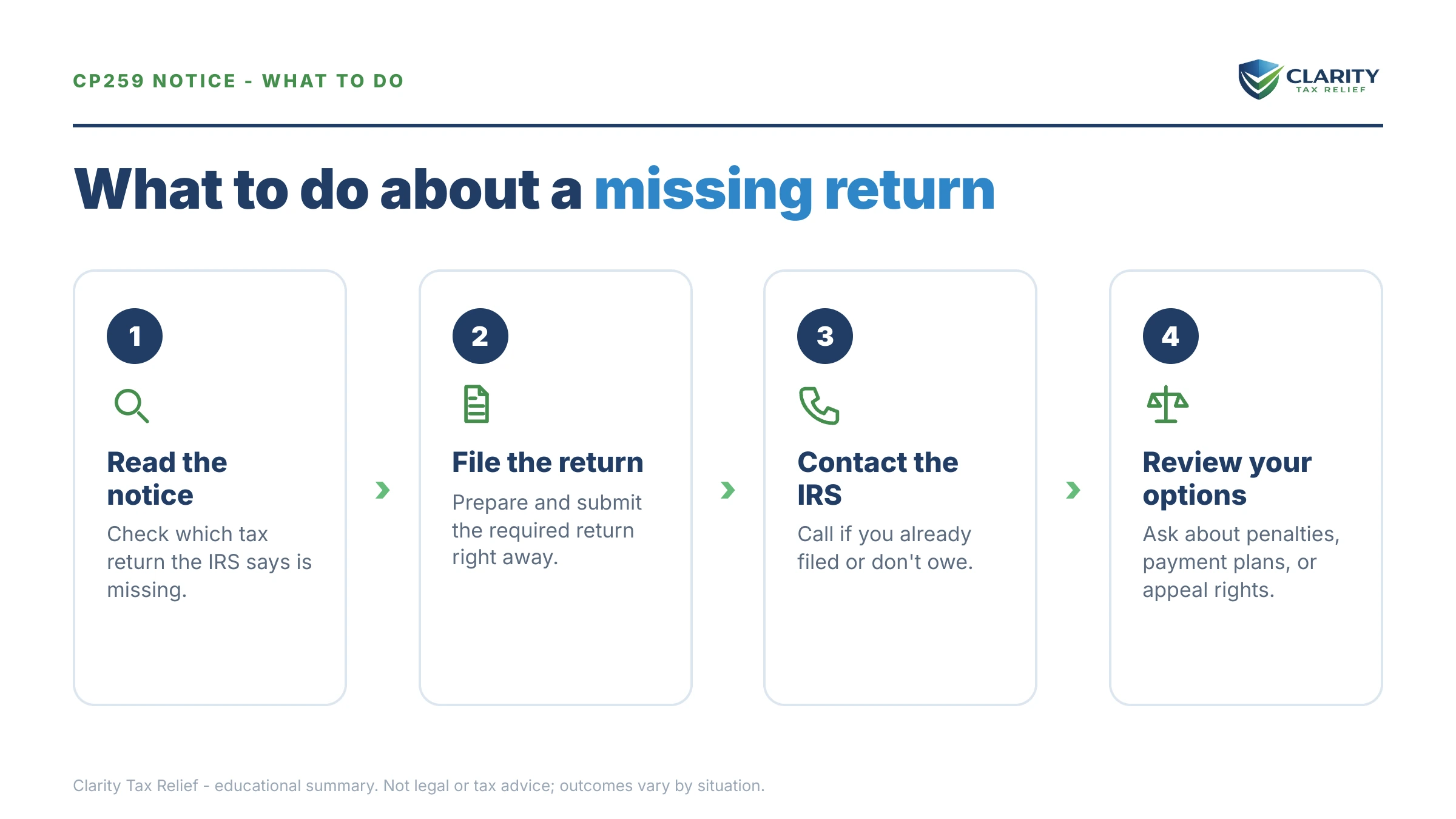
- Find the form number and tax period on the notice — the CP259 names exactly which return (941, 940, 1065, 1120, and so on) and which period the IRS expects, and everything you do next depends on that box.
- Pull your records for that period — bank statements, payroll records, 1099-Ks, prior-year returns, and your IRS business transcripts, so the return you file is built on real numbers.
- File the real return or send your not-liable explanation by the response date on the notice — a zero return, a final return with the final-return box checked, or a written explanation of why no return was required.
- Arrange payment if the return shows a balance — pay what you can at IRS.gov/payments and set up a payment plan for the rest; a return filed with a plan attached stops the escalation sequence.
- Request penalty relief once the return posts — first-time abatement if your prior three years are clean, reasonable cause if events beyond your control caused the lapse, and the new Automatic Exemption from Penalty starting summer 2026.
When you can handle a CP259 yourself
Plenty of CP259s need no professional at all. If the notice covers a single period, you have the records, and the answer is a zero return, a straightforward late return you can pay, or a simple "the business closed on this date" response, do it yourself — file, respond by the printed date, keep copies, and you're done. The IRS's own explainer at Understanding your CP259 notice walks through the response options on the form.
Experienced help changes the outcome in a different set of situations: multiple years of unfiled business returns, where the filing order and reconstruction of records affect what you ultimately owe; any CP259 naming Form 941, because trust fund exposure can turn a business debt into a personal one; a Letter 1085 or an existing §6020(b) assessment, where the goal is replacing the IRS's estimate with real numbers before or after it posts; and a closed business with debt left behind, where how you wind down determines who the IRS pursues. If money is unbearably tight, the Taxpayer Advocate Service and low-income taxpayer clinics offer free help for those who qualify.
Terms on your CP259, decoded
- Substitute for return — §6020(b): the IRS's legal authority to prepare a missing business return using estimates, with none of your deductions or adjustments.
- Delinquency notice: any notice demanding an overdue return — a filing problem, distinct from a bill demanding payment.
- Trust fund taxes: the income tax and FICA withheld from employee paychecks — money the IRS treats as held in trust, with personal liability for responsible people if it goes unpaid.
- Final-return box: the checkbox on Form 941 (and similar returns) that tells the IRS the business has stopped, closing the filing requirement going forward.
- Business master file (BMF): the IRS database tracking your EIN's open filing requirements — the CP259 fires when the BMF expects a return that never posted.
- Collection Due Process (CDP): the formal appeal right attached to a final levy notice, requested on Form 12153 within 30 days.
CP259 questions, answered
Is a CP259 notice serious?
Yes — but it's a filing problem, not yet a collection problem. A CP259 means the IRS believes a required business return was never filed; no tax has been assessed and nothing can be levied at this stage. The risk is inaction: if you don't respond, the IRS can eventually prepare the return itself under IRC §6020(b) using estimated numbers, and that assessment enters collections like any other tax debt.
Is a CP259 the same as a CP59?
No. A CP259 goes to a business (under its EIN) about a missing business return such as Form 941, 940, 1065, or 1120. A CP59 goes to an individual (under an SSN) about a missing Form 1040. If you run a business and haven't filed personally either, you can receive both — and they're resolved separately, one on the business account and one on your personal account.
My business closed — do I still have to respond to a CP259?
Yes. The IRS keeps expecting returns until you formally close the account, so it will keep sending notices — and can still assess tax — for a business that no longer exists. Respond by filing the final required returns (checking the final-return box on Form 941, for example) and telling the IRS the date the business closed. For payroll taxes, closing the business does not erase what was already owed.
What if my business had no income or no employees for that period?
Respond and say so — silence is what triggers escalation. For Form 941, if you had no wages in a quarter you generally still file a zero return unless you've told the IRS you're a seasonal filer or filed a final return. For income returns like the 1065 or 1120-S, whether a no-activity year requires filing depends on the entity's status, so explain your situation using the response options on the notice rather than ignoring it.
Can the IRS really file a business return for me?
Yes. For business returns like Forms 941, 940, and 720, IRC §6020(b) lets the IRS prepare a substitute return using estimates — typically based on your prior filings or payer records — with none of your actual deductions or adjustments. You'll usually see this proposed in Letter 1085 with 30 days to respond. Filing your own accurate return, even late, almost always produces a lower number.
Will I owe penalties if I file the missing return now?
Only if the return shows unpaid tax — and possibly even then, relief is available. The failure-to-file penalty runs 5% of the unpaid tax per month up to 25%, so a return with no balance due generally carries no failure-to-file penalty. The exceptions are partnership and S-corporation returns, which carry a per-owner, per-month late-filing penalty even with no tax due. First-time abatement — and, starting summer 2026, the IRS's Automatic Exemption from Penalty — can remove penalties for filers with a clean prior history.
Does a CP259 mean my business is being audited?
No. A CP259 is a filing-check notice generated automatically when the IRS's business master file expects a return that never arrived — nobody is examining your books. That said, prolonged non-filing is one of the things that can draw deeper attention, especially with payroll returns, because unpaid trust fund taxes create personal liability for owners and check-signers. Filing promptly is what keeps this routine.
Your next 24 hours
- Find the form number and tax period boxes near the top of your CP259, plus the response date — those three items define the entire problem.
- Gather what you'll need to answer it: bank statements and income records (1099-Ks, app earnings summaries) for the missing period, your last filed business return, and any payroll records — even partial records are enough to start.
- Get a free case review before the response date on your notice passes — call (888) 825-7779 or use the 2-minute form. If more than one year is unfiled or the notice names Form 941, the order you file in changes what you end up owing, and that's worth ten minutes with an experienced tax professional before you send anything.
This guide is general information, not tax or legal advice for your specific situation. Eligibility for IRS programs depends on individual facts and circumstances; no outcome is guaranteed.