
IRS Notices
IRS CP504B Notice: What It Means for Your Business and What to Do (2026)
The short answer: a CP504B notice is the IRS's notice of intent to levy sent to a business. Pay the balance by the date printed on the notice — typically 30 days — or the IRS can seize your state tax refund and move to the final levy notice (CP297 or LT11) that unlocks bank-account and receivables levies.
You signed for the certified envelope addressed to your business, and now you're reading "Notice of intent to seize (levy) your property or rights to property" printed above your company's EIN. That heading is written to get your attention — and it should. But a CP504B is a warning, not a seizure, and every option that fixes this is still fully open this week.
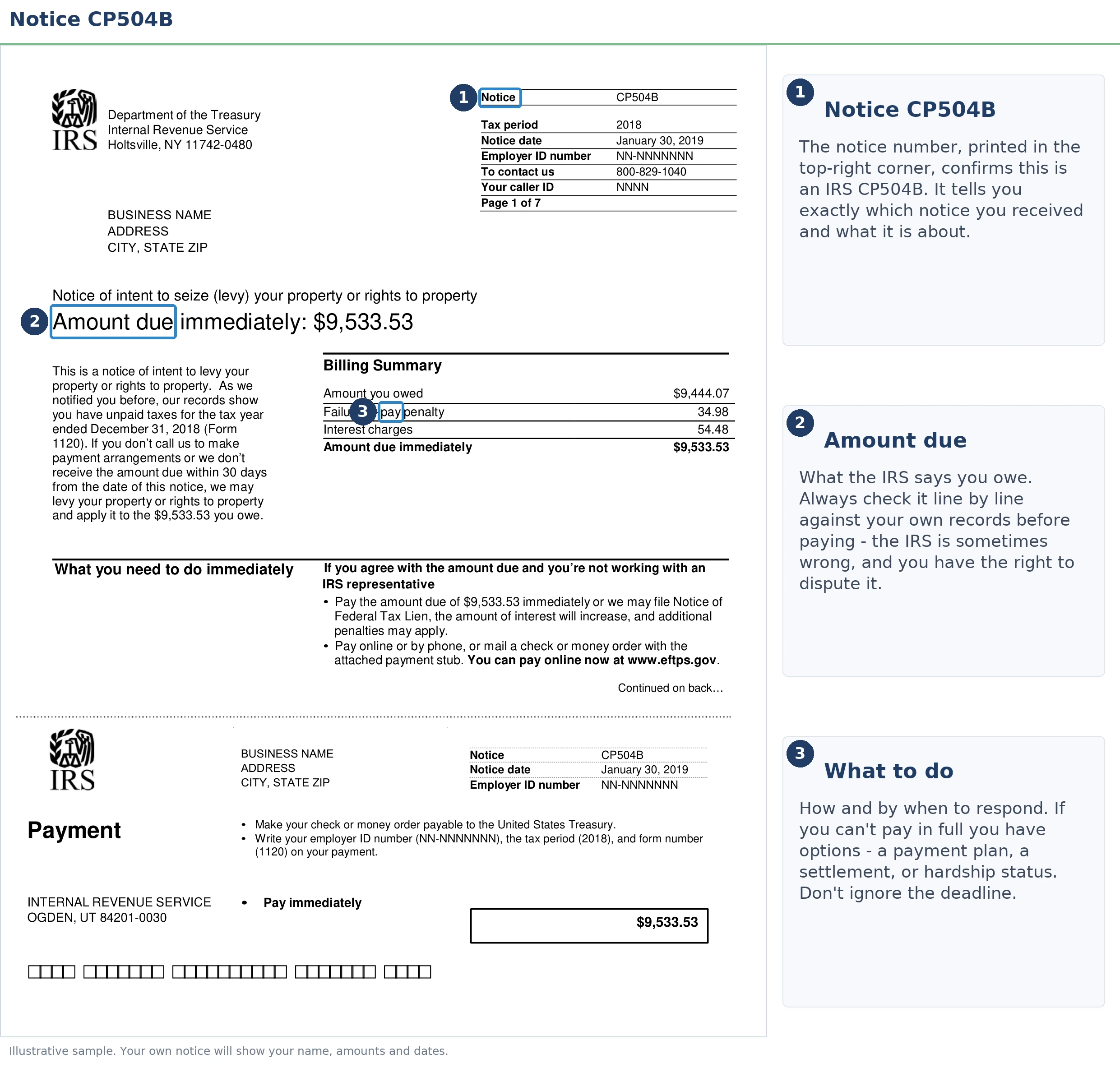
Two lines on the notice control everything: the total amount due and the pay-by date near the top. The image below shows exactly what a CP504B looks like and where to find those two lines, so you can pull the real numbers off your own copy as you read.
⏱ Your deadline: the pay-by date printed on your CP504B — typically 30 days from the notice date. After that date, the IRS can take your business's state tax refund and the automated system queues the final levy notice. Interest and a monthly late-payment penalty accrue the entire time.
Why your business got a CP504B notice
A CP504B means the IRS has already billed your business at least once for an unpaid balance, received no resolution, and is now formally stating its intent to levy. It's tied to your EIN, not your Social Security number — this is a business-account notice, which changes both what comes next and who may end up owing the money.
The most common balances behind a CP504B:
- Unpaid Form 941 payroll taxes — missed deposits of withheld income tax and FICA. This is the majority of CP504Bs, and the most dangerous kind (more on why below). See 941 back taxes for the full picture.
- Unpaid Form 940 FUTA tax — federal unemployment tax, often small but persistent.
- Corporate income tax — a Form 1120 balance the corporation filed but didn't pay.
- Civil penalties — including late-filing penalties on S-corp and partnership returns, which can run thousands per year with no underlying tax due.
Before this notice, your business almost certainly received a first bill — usually a CP161 notice — and possibly a reminder. If those went to an old address or got lost in a stack of mail, the CP504B may be the first one you've actually seen. (For the general anatomy of IRS mail, our guide to why you got a letter from the IRS covers it; this page stays focused on what's unique to the CP504B.)
One point that surprises solo operators: you don't need employees on staff today or a big company to get one. A 1099 contractor who ever ran payroll for a helper under an EIN, or whose LLC picked up a civil penalty, can receive a CP504B addressed to a "business" that's really just one person and a truck.
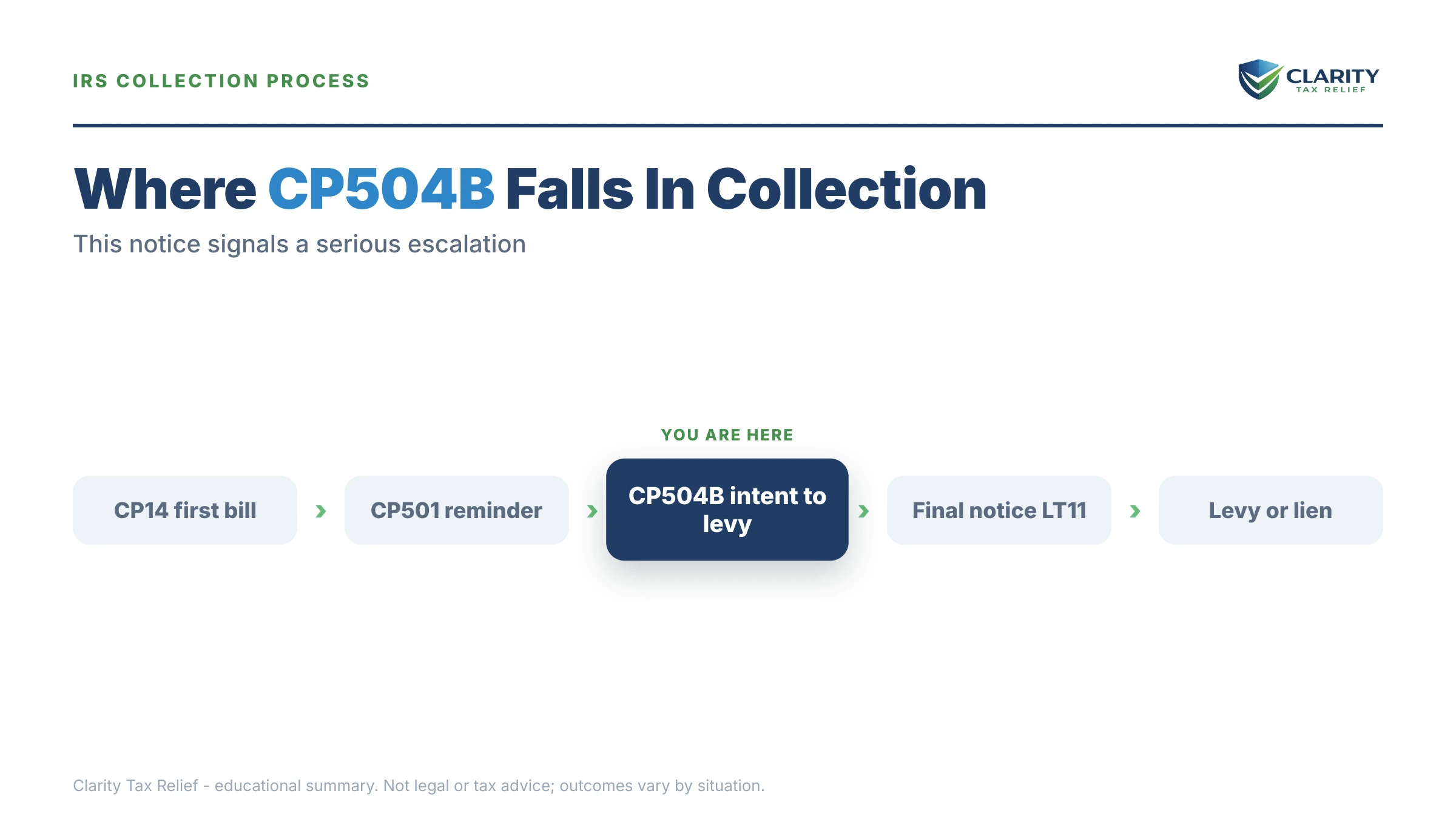
CP504B vs. CP504: which letter you're holding matters
The "B" means business: a CP504 goes to an individual's SSN account, while a CP504B goes to a business's EIN account — and the two escalate down different paths. Three differences change your strategy:
- The final notice is different. Individuals typically get an LT11 or Letter 1058 next. Business accounts typically get a CP297 or CP297A — the business final notice of intent to levy that starts the 30-day Collection Due Process clock.
- Payroll debt can become personal. If the balance is 941 tax, part of it can be assessed against owners, officers, and even bookkeepers individually — something a plain CP504 notice for personal income tax never threatens.
- Business assets have thinner protections. When a levy eventually hits a business bank account or its receivables, there are no wage-style exemption tables shielding a portion. The levy takes what's there.
If you operate as a sole proprietor, you may see both letter types over time, because your business debt is legally your personal debt. The notice type tells you which account the IRS is collecting from — not which one you can ignore.
What the IRS can — and can't — take after a CP504B
After a CP504B, the IRS can seize your business's state tax refund under IRC §6331(d) — but it cannot yet levy your bank account, your receivables, or your equipment. Those require one more notice plus a 30-day wait. That gap is your working room, and it's also why acting now is so much cheaper than acting after the business bank account levy lands.
Two things can happen at this stage without any further notice, though. Your state refund can be intercepted. And a Notice of Federal Tax Lien can be filed publicly — the statutory lien already exists once tax was assessed and demanded, and this is the stage where the IRS commonly makes it public. A filed lien shows up in records searches, complicates financing and bonding, and can cost you contracts with customers who screen vendors.
| What's at risk | After CP504B | After CP297/LT11 + 30 days |
|---|---|---|
| State tax refund | Yes — can be seized now | Yes |
| Public federal tax lien filing | Possible now | Likely if unresolved |
| Business bank accounts | No | Yes (21-day hold before funds leave) |
| Accounts receivable & merchant deposits | No | Yes — customers get ordered to pay the IRS instead of you |
| Equipment, vehicles, business property | No | Yes, with additional internal approvals |
What happens if you ignore a CP504B
Ignoring a CP504B leaves your business exactly one notice away from bank levies, receivables levies, and — for payroll debt — a personal assessment against you. The sequence is automated, and in 2026 that matters more than ever: IRS staffing dropped roughly 27% in 2025, but the notice-and-levy system runs on computers that were never laid off. Nobody has to review your file for the next stage to fire.
- CP161 (already happened) — the first business bill. No enforcement power, just a demand.
- CP504B (you are here) — intent to levy. State refund seizure is now authorized, and a public lien filing becomes a live possibility.
- CP297 / CP297A or Letter 1058 — the final notice. A 30-day clock starts, along with your Collection Due Process rights (requested on Form 12153). This is the last structured off-ramp.
- Levy — bank accounts (with a 21-day hold before funds transfer), accounts receivable, merchant processors, and eventually physical assets. For an operating business, an AR levy is often the killer: your customers get the levy notice, learn about your tax debt, and pay the IRS instead of you.
- The parallel track for payroll debt — while the business account escalates, the IRS can separately investigate who was responsible for the unpaid trust-fund taxes and propose a personal penalty via Letter 1153. This track doesn't wait for the levy stage.
| Stage | What it means | Your window |
|---|---|---|
| CP161 | First bill on the business account | The pay-by date printed on it |
| CP504B | Intent to levy; state refund + lien exposure begins | Typically 30 days from the notice date |
| CP297 / CP297A / Letter 1058 | Final notice; Collection Due Process rights attach | 30 days to request a CDP hearing |
| Levy | Bank, receivables, merchant accounts, assets | 21-day bank hold is the last chance for release |
Holding a CP504B right now?
There's a pay-by date printed near the top of your notice. Get the notice reviewed free before that date passes — an experienced tax professional will confirm what the IRS can actually do, whether the trust-fund risk applies to you, and which arrangement stops the final notice from issuing.
Your options if the business can't pay in full
Every IRS payment option is still on the table at the CP504B stage — the menu only shrinks after the final notice issues and levies begin. One rule sits above all of them: the IRS will not approve any arrangement unless your returns are filed and this quarter's deposits are current. Compliance first, then negotiation.
- Pay in full. Ends the sequence, stops penalty accrual, and usually prevents a lien filing. Even borrowing at commercial rates can beat the combined drag of IRS interest, penalties, and a public lien.
- Business installment agreement. Monthly payments on the balance. Smaller business balances can often be set up without full financial disclosure; larger ones can't. See our guide to the business IRS installment agreement for thresholds and setup.
- IBTF-Express (payroll debt of $25,000 or less). An In-Business Trust Fund Express agreement lets an operating business pay 941 debt within 24 months without submitting financial statements — direct debit is required between $10,000 and $25,000. Full details in business payroll tax payment plan. A side benefit that matters: getting on this agreement can head off the personal trust-fund assessment.
- Financial-statement agreement (over $25,000). Expect Form 433-B, documentation of income and assets, and possibly a revenue officer assigned to the case. The IRS sets the payment based on what the numbers show, not what feels affordable.
- Currently Not Collectible. Rare for an operating business — the IRS generally wants proof the business can at least stay current going forward — but real for businesses that are winding down or genuinely can't fund any payment.
- Business Offer in Compromise. Settling for less than the full balance exists for businesses, but it's uncommon and strict, especially on trust-fund debt. Read business offer in compromise before assuming it fits — the IRS accepted roughly 1 in 5 offers overall in FY2024, and business offers face harder scrutiny.
- Penalty relief. Businesses with a clean prior three years may qualify for first-time abatement, and reasonable cause (disaster, serious illness, provider failure) covers more situations than people expect — see business penalty abatement. Starting summer 2026, the IRS's new Automatic Exemption from Penalty (AEP) applies some relief automatically, with no request needed — so before paying penalties, check whether relief already applies. You can estimate how much of your balance is penalties and interest with our Penalty & Interest Calculator.
| You owe | Realistic options | What it takes |
|---|---|---|
| Under $10,000 | Full pay or a simple installment agreement | All returns filed; stay current on this quarter's deposits |
| $10,000 – $25,000 | IBTF-Express (payroll) within 24 months; standard business agreement otherwise | Direct debit required for payroll debt in this band; no financials needed |
| Over $25,000 | Financial-statement agreement; sometimes paying down below $25,000 to simplify | Form 433-B, documentation, possible revenue officer review |
| Business closed or closing | Asset resolution for the entity; trust-fund exposure shifts to individuals | Get the trust-fund math and assessment dates reviewed before deciding anything |
The trust-fund problem: how business debt becomes yours
If your CP504B covers payroll taxes, the withheld-income-tax and employee-FICA share of the debt can be assessed against you personally — even if the business is an LLC or corporation. That money was taken out of employees' paychecks and held "in trust" for the government, and the law treats not sending it in very differently from an ordinary unpaid bill.
The mechanism is the Trust Fund Recovery Penalty: a penalty equal to 100% of the unpaid trust-fund portion, assessable against any "responsible person" who willfully failed to pay it over — owners, officers, check-signers, sometimes bookkeepers. The IRS proposes it with Letter 1153, which starts a 60-day protest window. Once assessed, it follows you personally regardless of what happens to the business, and it isn't erased by dissolving the entity.
This is why the entity type on your CP504B matters less than the tax type. Corporate income tax on a 1120 generally stays with the corporation. Payroll tax reaches through it.
A worked example: $13,600 in payroll debt on a CP504B
Say you're a 1099 contractor with a single-member LLC, you brought on one W-2 helper during a busy stretch, and you fell two quarters behind on 941 deposits. By the time the CP504B arrives, the balance reads $13,600. Here's the real math (all figures hypothetical and rounded):
- The clock is costing you now. The failure-to-pay penalty runs 0.5% per month — about $68 a month on $13,600 — plus interest compounding daily on top. Waiting three months to deal with it adds roughly $200 in penalty alone before interest.
- IBTF-Express is on the table. At $13,600 you're under the $25,000 ceiling, so you can request payment within 24 months: $13,600 ÷ 24 ≈ $567/month on the balance, by required direct debit at this level, with interest and penalties continuing until it's paid so the true payoff runs somewhat higher. No financial statements needed — but your current quarter's deposits must be on time.
- Your personal exposure is real. If roughly $9,000 of the $13,600 is withheld income tax and the employees' share of FICA, that slice is what the IRS could assess against you personally through the TFRP if the business account defaults. Getting on and staying on an agreement is what keeps that track quiet.
- A partial paydown changes the game. If a slow-paying customer finally pays and you can put $4,000 down, the balance drops to $9,600 — under $10,000, a simpler agreement, direct debit optional, and a smaller base for the monthly penalty (about $48/month instead of $68).
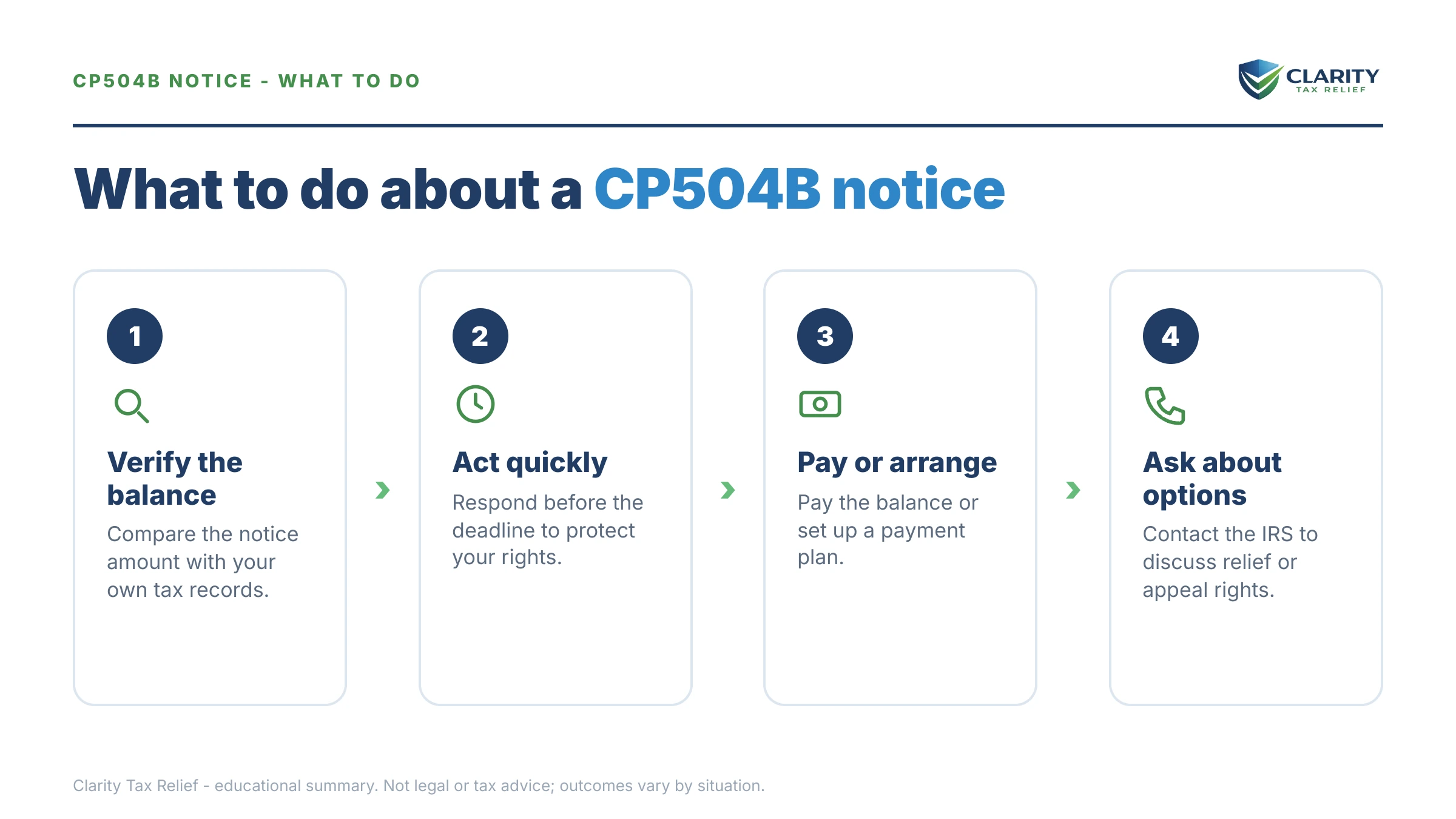
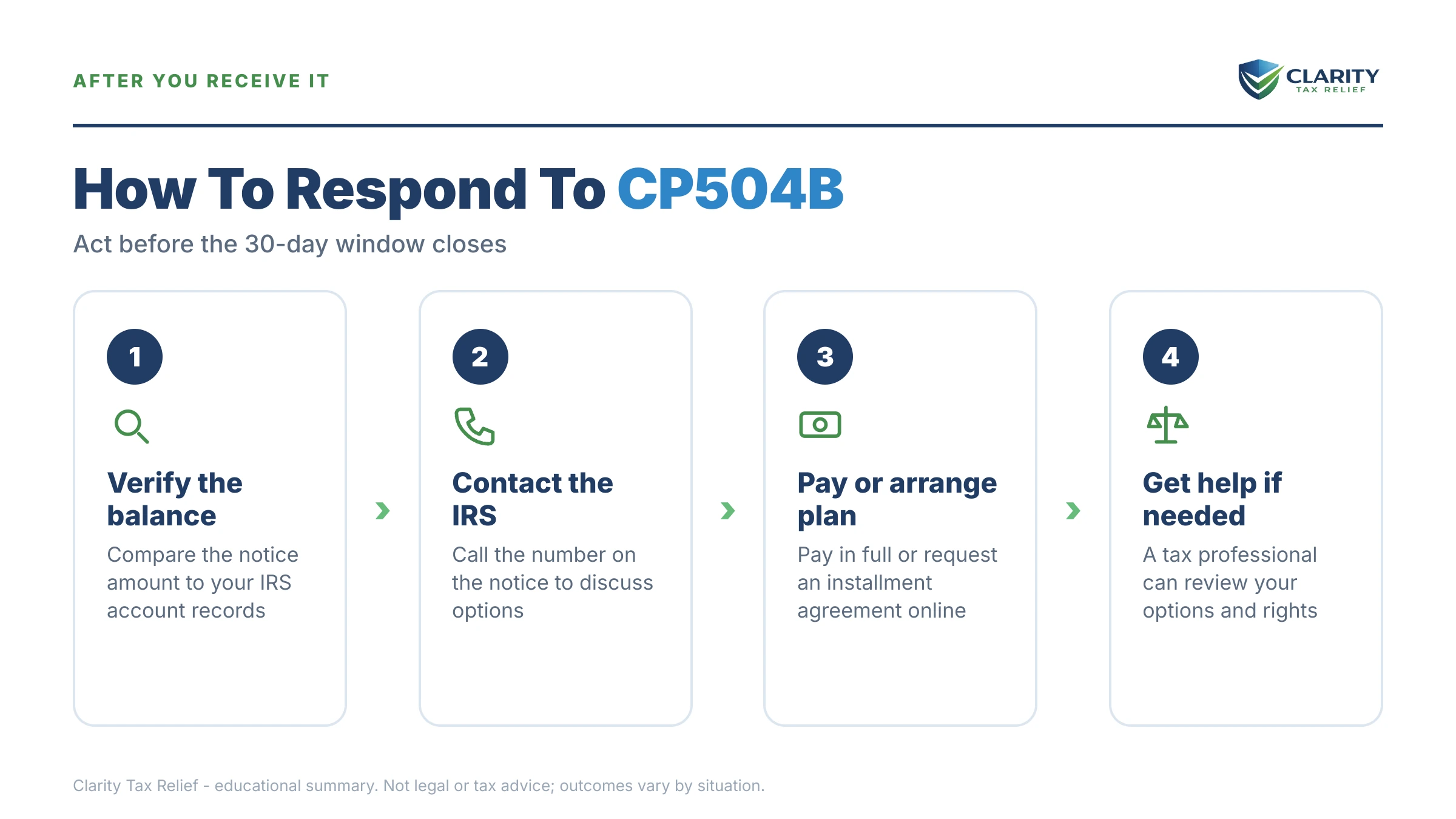
How to respond to a CP504B, step by step
- Verify the balance — match the tax form (941, 940, 1120, or civil penalty), the tax periods, and the amount on the notice against your filed returns and payment records before you pay anything.
- File anything unfiled — the IRS will not approve any payment arrangement while required returns are missing, so filing comes before negotiating.
- Pay in full if you can — pay by the date on the notice through EFTPS or IRS.gov/payments, which stops the notice sequence and the state-refund levy immediately.
- Set up an agreement if you can't — request a business installment agreement, or an In-Business Trust Fund Express agreement for payroll debt of $25,000 or less, before the final notice issues.
- Get experienced help if payroll taxes are involved — the trust-fund portion can become a personal assessment against you, and how you respond now affects who ends up owing it.
When you can handle a CP504B yourself
Honestly: many CP504Bs don't need professional help. If the notice covers one tax period, you agree with the amount, the balance is $25,000 or less, and your current deposits are on time, you can set up the agreement yourself by phone or through your IRS business account — the steps above are the whole playbook.
Experienced help changes the outcome in a narrower set of situations, and they're the expensive ones: multiple quarters of unpaid 941s, any contact about a trust-fund investigation (a Form 4180 interview request or Letter 1153), a revenue officer assigned to the case, a balance over $25,000 that requires Form 433-B, a penalty amount you dispute, or a business that's closing while the debt is open. In those cases the order of moves — what you file, what you say in the responsible-person interview, which agreement you request — directly changes who owes what. And if a levy is already causing genuine hardship, the Taxpayer Advocate Service exists precisely for cases the normal channels are mishandling.
Terms on your CP504B, decoded
- Levy vs. lien: a levy takes property (a refund, money in an account); a lien is a legal claim against your property that secures the debt without taking anything yet.
- IRC §6331(d): the statute requiring the IRS to notify you before levying — your CP504B is that notification, which is why the state refund is now reachable.
- Trust fund taxes: money withheld from employees' paychecks — income tax plus their share of Social Security and Medicare — that the business holds "in trust" for the government.
- TFRP (Trust Fund Recovery Penalty): a penalty equal to 100% of the unpaid trust-fund taxes, assessable personally against anyone responsible for paying them who willfully didn't.
- CDP (Collection Due Process): the formal hearing right that comes with the final notice — requested on Form 12153 within 30 days, it pauses levy action and preserves Tax Court review.
- CAP (Collection Appeals Program): a faster appeal (Form 9423) available even now, before CDP rights attach — but its decision is binding with no court review.
- CSED: the collection statute expiration date — generally 10 years from assessment, though certain events pause the clock.
The IRS's own page on this notice is at Understanding your CP504B notice — worth a read alongside your copy.
If your CP504B covers payroll taxes or more than one tax period, have an experienced tax professional review it free before the pay-by date passes — the trust-fund analysis alone is worth the call to (888) 825-7779.
CP504B questions, answered
Is a CP504B an actual levy?
No — a CP504B is a notice of intent to levy, not a levy itself. The only thing the IRS can seize based on this notice alone is your business's state tax refund. Bank accounts, receivables, and equipment require the final notice (CP297 or LT11) plus a 30-day waiting period first. That said, the gap between this notice and the final one is your best window to act.
What is the difference between a CP504 and a CP504B?
A CP504 goes to an individual's account under a Social Security number; a CP504B goes to a business account under an EIN. The business version typically escalates to CP297 or CP297A rather than LT11, and when the debt is payroll tax, it carries a risk the individual version doesn't: personal assessment of the trust-fund portion against owners and other responsible people.
How long do I have to respond to a CP504B?
The pay-by date printed on your notice controls, and it typically falls about 30 days after the notice date. Interest and a 0.5%-per-month failure-to-pay penalty keep accruing during that window, so waiting until the last day still costs money. After the date passes, the IRS can take your state tax refund and queue the final levy notice.
Can the IRS levy my business bank account after a CP504B?
Not on the strength of this notice alone. A bank or accounts-receivable levy requires the IRS to first send a final notice of intent to levy — CP297, CP297A, or Letter 1058 — and then wait 30 days. Once a bank levy does hit, the bank holds the funds for 21 days before sending them to the IRS, which is your last chance to get it released.
Am I personally responsible for my business's CP504B balance?
It depends on your entity type and the tax involved. A sole proprietor is personally liable for all of it. For an LLC or corporation, income tax generally stays with the entity — but the trust-fund portion of payroll taxes (withheld income tax and the employee share of FICA) can be assessed against any responsible person through the Trust Fund Recovery Penalty.
Can I still set up a payment plan after a CP504B?
Yes — every payment option remains available at this stage. Payroll debts of $25,000 or less can often go on an In-Business Trust Fund Express agreement paid within 24 months, with direct debit required between $10,000 and $25,000. Larger balances require Form 433-B financial disclosure. One condition applies to all of them: your returns must be filed and current deposits must be on time.
Can I appeal a CP504B?
Not through a Collection Due Process hearing — those rights attach to the final notice (CP297 or LT11), not this one. What you can use now is the Collection Appeals Program (CAP), requested on Form 9423, to challenge a proposed or actual levy or lien filing. CAP is fast, but its decision is final and you can't take it to Tax Court.
Will the IRS file a tax lien after a CP504B?
It can, and this is the stage where public lien filings commonly happen. The statutory lien already exists once tax is assessed and demanded; filing a Notice of Federal Tax Lien makes it public, which can hurt business credit, financing, and your ability to win contracts. Resolving the balance or getting on certain agreements can prevent or limit the filing.
What if my business already closed?
The debt doesn't disappear with the business. Corporate income tax may become uncollectible if the entity has no assets, but the trust-fund portion of any payroll debt follows the responsible individuals personally, and a sole proprietor's business debt was always personal. Before assuming anything is dead, have the periods and assessment dates reviewed — the 10-year collection statute may also be running.
Your next 24 hours
- Find the two numbers that matter — the total amount due and the pay-by date near the top of your CP504B — and put that date somewhere you can't miss it.
- Gather your paper trail — the notice itself, the returns for the periods listed (941s, 940, or 1120), payment and deposit confirmations, and a current snapshot of business income.
- Get a free case review before the pay-by date passes — the 2-minute form at claritytaxrelief.com/#consult or (888) 825-7779. An experienced tax professional will confirm whether the amount is right, whether trust-fund exposure applies to you, and which arrangement stops the final notice from ever issuing.
This guide is general information, not tax or legal advice for your specific situation. Eligibility for IRS programs depends on individual facts and circumstances; no outcome is guaranteed.