
Collections & Levies
IRS Levy on a Business Bank Account: What to Do in 2026
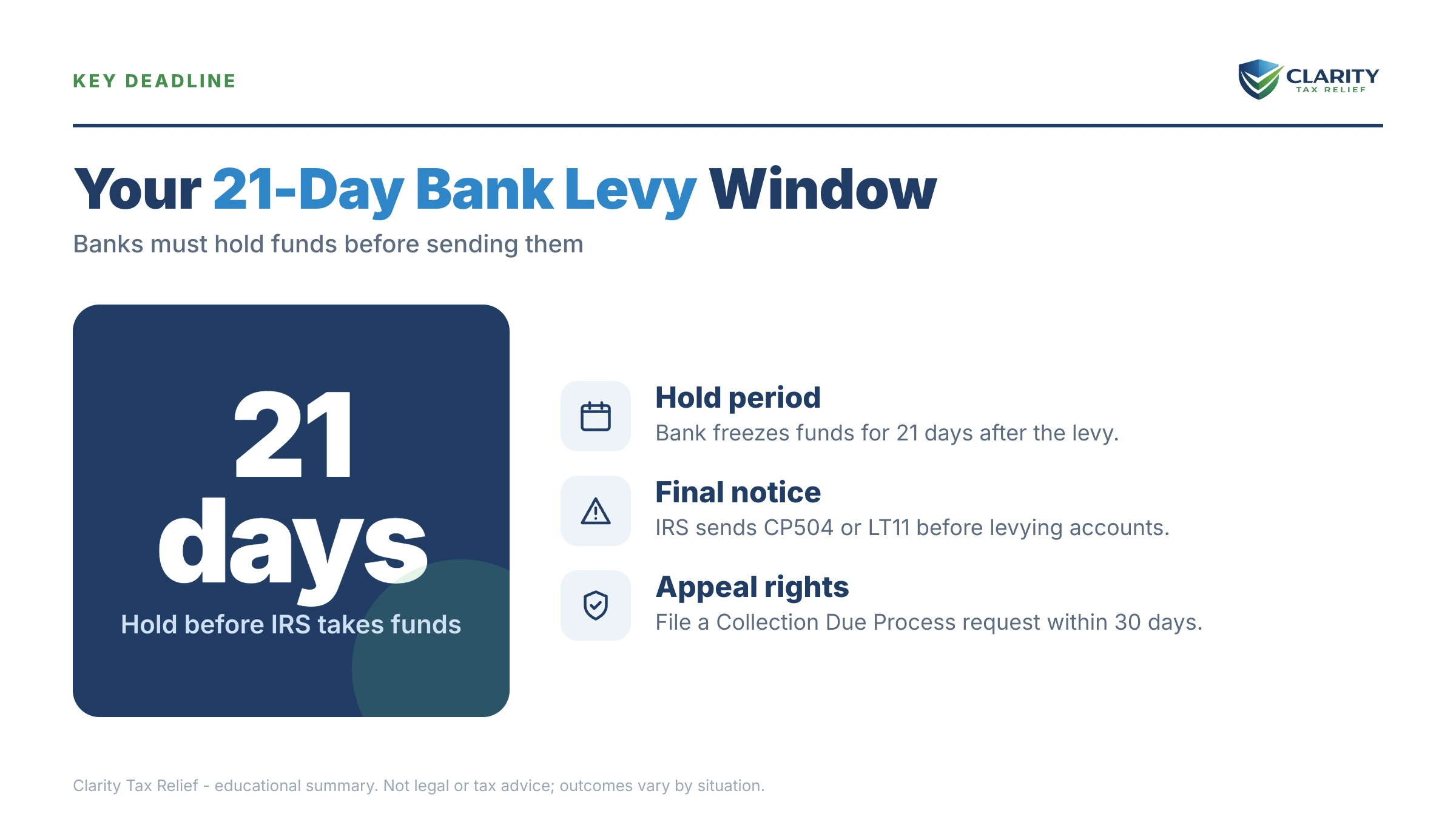
The short answer: an IRS levy on a business bank account is a one-time seizure of the funds sitting in the account the day the bank receives Form 668-A. The bank freezes that money for 21 days, then sends it to the IRS. It does not touch later deposits — but the IRS can levy the same account again.
You logged into your business banking and the balance reads zero, or your card was declined at the fuel pump, or your bank called about a "legal hold." An IRS levy on a business bank account freezes the money that was there when the levy landed — not your future deposits — and the bank holds it for a fixed count before releasing it to the government.
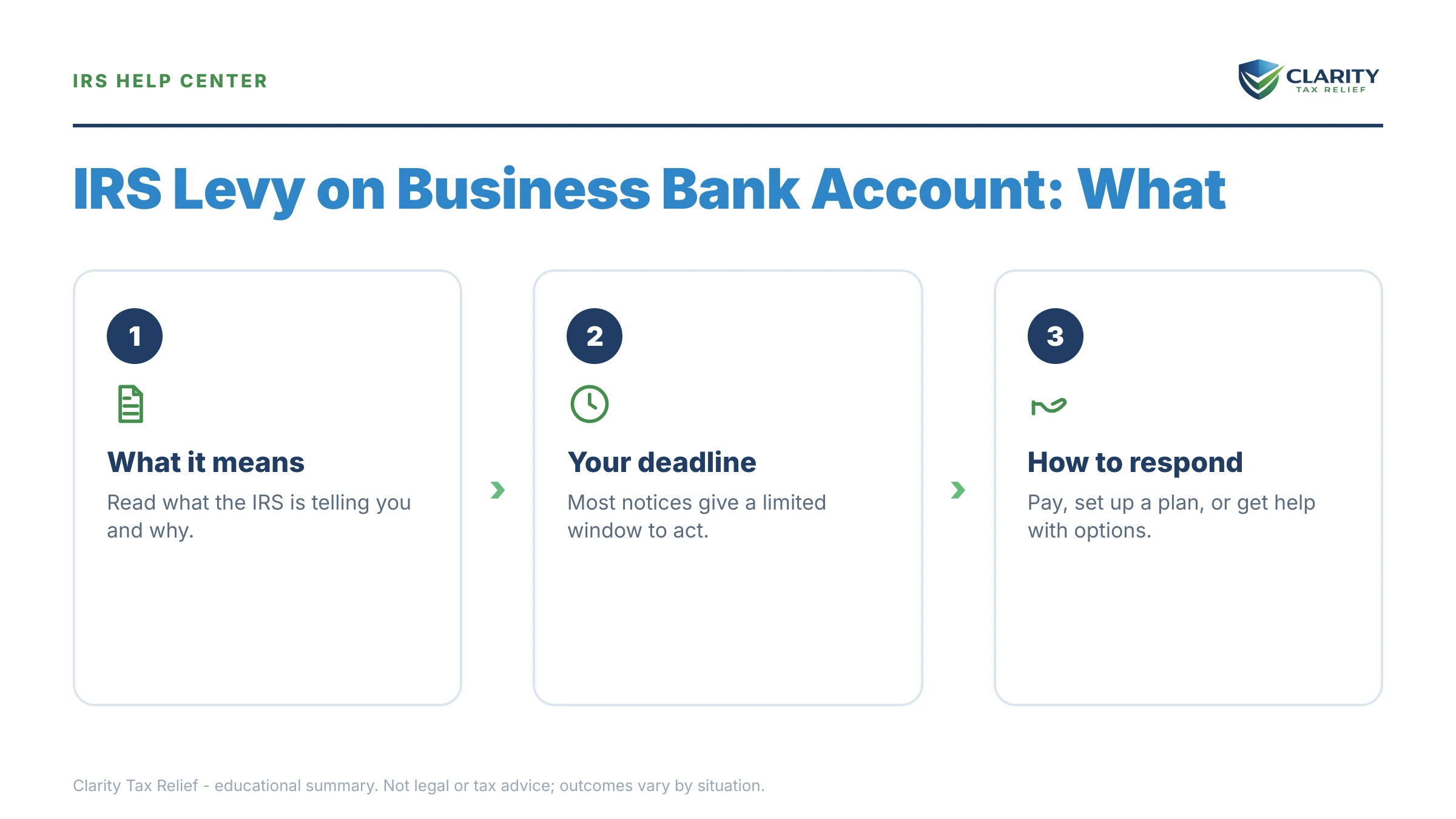
That count is the whole game. The image below shows what a bank levy looks like and where to find the date that starts your clock. Miss it and the funds leave; act inside it and you may keep them.
⏱ Your window: the bank holds levied funds for 21 days before sending them to the IRS. During that hold the money is frozen but still recoverable — a release before day 21 puts it back in your account. After the funds are forwarded, getting them back is far harder.
Why the IRS levied your business bank account
A business bank levy almost never comes out of nowhere — it is the last step in a notice sequence you likely received earlier. The IRS levies under IRC §6331 only after it has assessed a tax, billed you, and sent a Final Notice of Intent to Levy that gave you 30 days to respond.
The debt behind a business levy is usually one of three kinds:
- Unpaid income tax — a sole proprietor or single-member LLC that fell behind on 1040 balances, since the business account and the owner are the same taxpayer.
- Payroll (941) taxes — the most aggressively collected category, because part of that money was withheld from employees. This can also lead to a personal Trust Fund Recovery Penalty against owners and officers.
- Business balance-due notices that went unanswered — a CP161 notice and its reminders that escalated into levy authority.
If your business account was drained but the debt is your personal 1040 balance, the deciding factor is entity type. A single-member LLC or sole proprietorship is disregarded for tax purposes, so the IRS treats that account as yours. A corporation or multi-member LLC is a separate taxpayer, so a levy for your personal debt usually needs a separate assessment against you first.
What happens if you do nothing after the levy
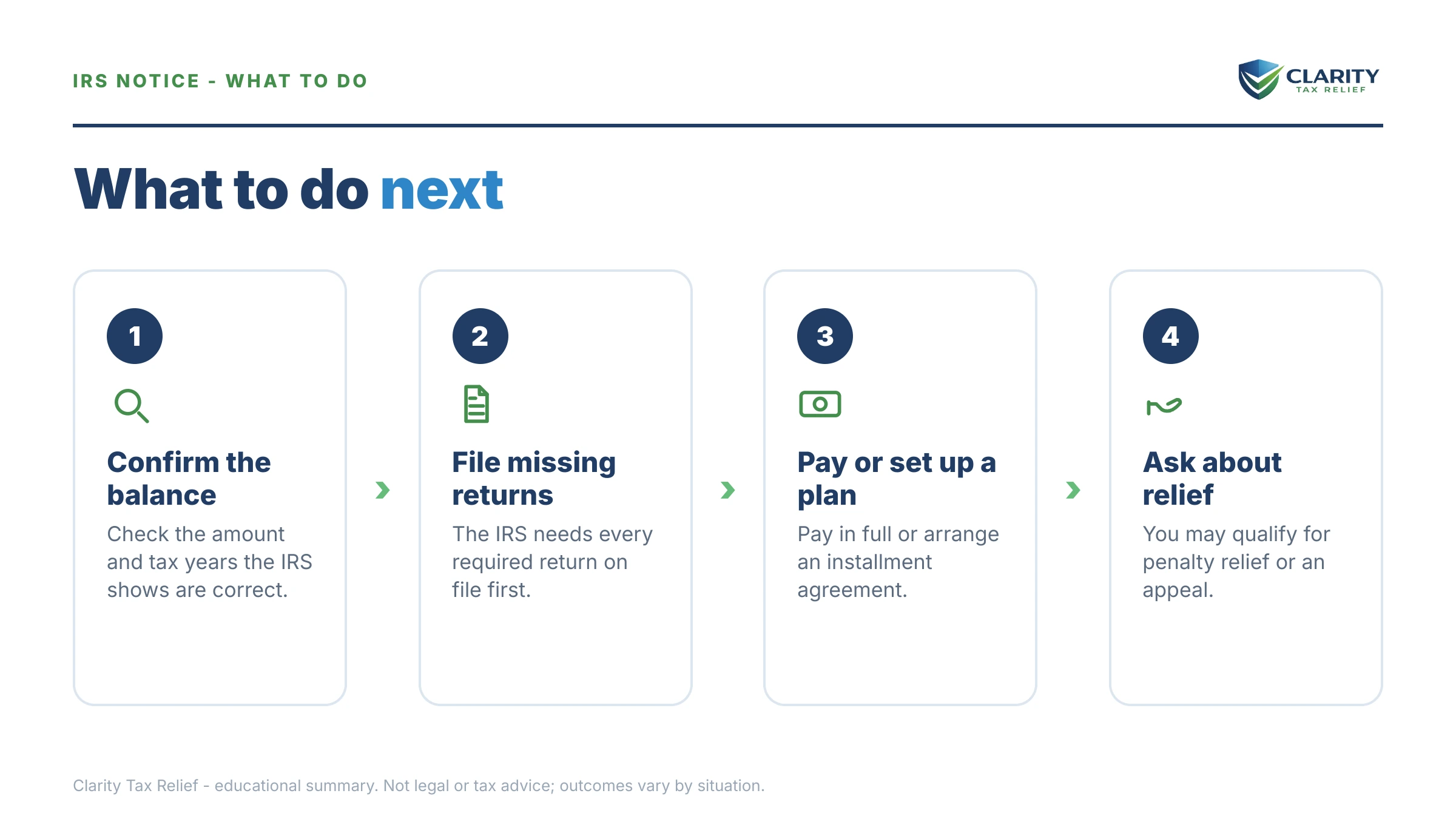
A bank levy is a one-time snapshot, but the collection machine behind it keeps running until the debt is resolved. Here is the sequence you are inside — and what comes next if you let the hold expire:
- Balance-due notices (CP161 → reminders) — the bill and its warnings. No enforcement yet, but penalties and interest build monthly.
- CP504B notice — Intent to Levy your state refund. Not the final notice, but the last quiet step.
- Final Notice (LT11 / Letter 1058 / CP297) — starts a 30-day clock and your Collection Due Process rights. This is the notice that unlocks bank and wage levies.
- The bank levy (Form 668-A) — served on your bank; funds frozen 21 days, then forwarded to the IRS.
- Re-levy and other seizures — the IRS can serve a fresh levy on the same account, an accounts receivable levy on customers who owe you, or move toward seizing business assets.
In 2026 this matters more than usual: IRS staffing was cut roughly 27% in 2025, but levies are issued by automated systems that never stopped. Fewer humans are available to talk to — the machine keeps escalating whether or not anyone reviews your file. A one-time levy today can become a repeat problem next month if the account keeps a balance and the debt stays open.
Levy on your business account right now?
The 21-day hold is your window to get the funds released — and it is already running. Send us the levy paperwork and an experienced tax professional will tell you exactly what release path fits your business, free and confidential.
Your options to release the levy and resolve the debt
The fastest way to free frozen funds is to give the IRS a reason to release the levy under IRC §6343 — and the most reliable reason is a resolution the IRS will accept. Which path fits depends on the size of the debt and whether the business can keep operating while paying.
| Option | Best when | What it does to the levy |
|---|---|---|
| Pay the balance in full | You have the cash outside the frozen account | Immediate release of the levy |
| Business installment agreement | Debt is manageable in monthly payments; returns are filed | Levy released once the agreement is accepted |
| Economic hardship release (§6343) | The levy stops you from meeting basic operating needs | Funds released; individual-hardship standard is stricter for entities |
| Currently Not Collectible | The business truly can't pay anything now | Collection paused; debt and interest remain |
| Business offer in compromise | Assets and future income genuinely can't cover the debt | Settles for less than full; roughly 1 in 5 offers accepted |
| Wrongful levy claim | The funds weren't yours or notice was skipped | Return of funds; procedural challenge |
One trap to avoid: the individual "economic hardship" release under §6343(a)(1)(D) is written for people who can't pay basic living expenses. A business does not automatically qualify on that ground. What usually works for a going concern is showing the IRS the levied money is needed to keep operating and paying future taxes — often paired with an installment agreement. For the shared mechanics of getting any levy lifted, see our guide on how to stop an IRS wage garnishment, which walks through the release process step by step.
Deadlines and rights on a business bank levy
Every date on a levy exists to protect a right you can still use. Here is what each deadline controls.
| Trigger | Your window | The right you lose if it passes |
|---|---|---|
| Final Notice of Intent to Levy (LT11 / 1058 / CP297) | 30 days from the notice date | Collection Due Process hearing via Form 12153 |
| Bank receives Form 668-A | 21-day hold before funds leave | The chance to get funds released before they reach the IRS |
| Wrongful or duplicate levy | Generally 2 years to file a claim | Right to demand return of improperly seized funds |
| Collection statute (CSED) | 10 years from assessment (pausable) | The IRS's authority to collect ends — but tolling extends it |
The 21-day hold is not a courtesy — it is written into the law specifically so account holders can dispute the levy or arrange a release. Read more about how that window works in the IRS bank levy and the 21-day rule.
A worked example: a retiree's small LLC gets levied
Say you're 68, drawing Social Security, and still running a one-person consulting LLC on the side. Two lean years left you owing $27,500 in income and self-employment tax, and the notices piled up faster than you handled them. The IRS serves Form 668-A on your business checking, which holds $6,200 that morning.
Here's the arithmetic. The bank freezes the $6,200 for 21 days. If nothing changes, the IRS takes it and applies it to the debt:
- $27,500 owed − $6,200 seized = $21,300 still owed after the levy.
- Penalties and interest keep accruing on that remaining balance.
- Because the levy is one-time, next month's client payments are safe from this levy — but a new levy can hit the same account.
There's a second exposure a retiree faces: the Federal Payment Levy Program can take up to 15% of Social Security benefits for federal tax debt. So the same $27,500 could be squeezed from two directions. A cleaner path is often to get the bank levy released, set the debt on a plan that fits fixed income, and — if benefits are your main income — explore IRS hardship on Social Security or Currently Not Collectible status so both the bank and the benefit are protected. If the debt genuinely exceeds what the business and its owner could ever pay, an offer in compromise may fit; you can estimate a realistic number with our Offer in Compromise Calculator. This is a hypothetical to show the math — your numbers set your options.
How to respond to a business bank levy, step by step
- Confirm the levy and the debt. Get the levy paperwork from your bank and match it to the tax year and notices you received; check your IRS account for the assessed balance.
- Move inside the 21-day hold. The clock started when the bank got Form 668-A — call the IRS or an experienced tax professional immediately, not after the weekend.
- Ask for the release ground that fits. Show the funds are needed to keep operating, propose a payment arrangement, or raise a hardship or wrongful-levy basis.
- Lock in a resolution. Set up an installment agreement, request Currently Not Collectible, or file an offer — a resolution is what keeps the account from being levied again.
- Protect ongoing cash flow. File any missing returns and make current deposits; the IRS will not release a levy for a business that keeps falling behind.
When you can handle this yourself — and when you shouldn't
Some business levies you can resolve on your own. If the debt is small, all your returns are filed, and you can pay it off or fit it inside a straightforward streamlined installment agreement, calling the IRS and setting up the plan can lift the levy without professional help. A single wrong-account levy with clear proof is also often a do-it-yourself fix.
Experienced help changes outcomes when the stakes rise: payroll (941) tax debt where a Trust Fund Recovery Penalty is looming, multiple unfiled years, a debt large enough that the IRS assigned a revenue officer, a levy that's threatening payroll or a going concern, or offer-in-compromise math you need done right the first time. In those cases the sequence you fix things in — and how you frame the release request — directly affects what you keep. If bankruptcy's automatic stay is on the table, that decision alone deserves a professional's read before you file.
Terms on your levy, decoded
- Form 668-A — the one-time bank levy served on your financial institution; it captures the balance present that day, not future deposits.
- Levy vs. lien — a levy takes property (your bank funds); a lien is a legal claim that secures the debt without seizing anything yet.
- 21-day hold — the mandatory freeze before the bank forwards funds to the IRS; your release window.
- CDP rights — Collection Due Process; your right to a hearing after a Final Notice, requested on Form 12153 within 30 days.
- Re-levy — a fresh Form 668-A on the same account; a bank levy is one-time, so the IRS uses new ones to keep collecting.
If money already left your account and you're trying to trace it, our guide on what to do when the IRS took money out of your bank account covers recovery routes.
Business bank levy questions, answered
Can the IRS levy my business bank account without warning?
In almost all cases, no — the IRS must first send a Final Notice of Intent to Levy (LT11, Letter 1058, or CP90) and give you 30 days to request a Collection Due Process hearing before it can serve your bank. The main exception is a jeopardy levy, where the IRS believes collection is at risk and can act immediately. If you never got a final notice and your account was still levied, that may be a procedural error worth challenging.
How long does the bank hold the money after an IRS levy?
The bank freezes the funds for 21 days before sending them to the IRS. That 21-day hold is your window to act — the money is frozen but has not left yet. If you get the levy released during that period, the funds stay in your account. Once the 21 days pass, the bank forwards the money and it is far harder to recover.
Is a business bank levy one-time or continuous?
A bank levy is a one-time snapshot — it captures only the funds sitting in the account the moment the bank receives Form 668-A. Deposits that arrive the next day are safe from that particular levy. The catch is that the IRS can issue a new levy anytime, so an account that keeps a balance can be hit again and again until the debt is resolved.
Can I get the levy released to make payroll?
Sometimes. The IRS can release a levy under IRC Section 6343 if it will create economic hardship or if releasing it helps you pay the tax, but the individual hardship standard does not automatically apply to a business. In practice the fastest release comes from setting up a resolution — an installment agreement or proving the money is needed to keep the business operating and paying future taxes. Act inside the 21-day hold.
Can the IRS levy my business account for my personal tax debt?
It depends on how the business is structured. For a sole proprietorship or single-member LLC treated as disregarded, the business account and its owner are the same taxpayer, so the IRS can levy the business account for the owner's 1040 debt. For a corporation or multi-member LLC, the entity is separate, so the IRS generally needs a separate assessment or a Trust Fund Recovery Penalty against you personally first.
What happens to checks that bounce after the levy?
When the levy freezes your balance, outstanding checks and auto-payments can bounce, triggering overdraft and returned-item fees from your bank and your vendors. The IRS is not responsible for those fees. This is why moving fast during the 21-day hold matters — a release restores access to the frozen funds, but only if it happens before the bank forwards the money.
Can the IRS levy an LLC account for the owner's tax debt?
A single-member LLC that has not elected corporate treatment is disregarded for tax purposes, so the IRS treats its bank account as the owner's and can levy it for the owner's personal taxes. A multi-member LLC or one taxed as a corporation is a separate legal entity, so a levy for the owner's personal 1040 debt is much harder to justify. The structure on file with the IRS controls the answer.
Your next 24 hours
- Find the date on the levy. Get the Form 668-A from your bank and note the day it was received — that starts your 21-day countdown.
- Gather your file. Pull the notices you received, your last filed returns, and a snapshot of what the business needs to keep operating this month.
- Get a free case review before the hold expires. The funds are frozen, not gone — call (888) 825-7779 or use the 2-minute form so an experienced tax professional can start the release path while the 21 days are still running.
Two authoritative starting points: the IRS explains levies at IRS.gov levy overview, and the independent Taxpayer Advocate Service can help when a levy is causing significant business hardship.
This guide is general information, not tax or legal advice for your specific situation. Eligibility for IRS programs depends on individual facts and circumstances; no outcome is guaranteed.