
Levies & Seizures
IRS Took Money Out of My Bank Account: What to Do Now (2026)
The short answer: if the IRS took money out of your bank account, it executed a bank levy — and in most cases the money hasn't actually left the bank yet. Your bank must hold the frozen funds for 21 days before sending them to the IRS. During that window, the levy can still be released.
Your card declined, you opened the banking app, and a chunk of your balance was gone — replaced by a "legal order hold" and a customer-service rep who could only say "the IRS sent us a levy." If the IRS took money out of my bank account is the exact phrase you just typed, here's the fact that changes everything: for most bank levies, the money is frozen at your bank, not spent by the government, and you have a defined window to get it back.
The document your bank received — IRS Form 668-A, Notice of Levy — is what started the clock, and it controls what happens over the next three weeks. The image below shows exactly what this levy paperwork looks like and where to find the date that starts your 21-day countdown.
⏱ Your deadline: your bank must hold the levied funds for 21 days from the date it received the levy before sending them to the IRS. Until that hold ends, a levy release returns your money without it ever leaving the bank. Call your bank today and ask for the exact receipt date — that date, not the day you noticed, starts the clock.

Why the IRS took money out of my bank account
The IRS can levy a bank account only after sending a final notice of intent to levy and waiting at least 30 days. That final warning is the LT11 notice or Letter 1058, and it went to your last known address — which, if you've moved recently, may not be where you live now. This matters enormously for anyone who relocated after a divorce or separation: the warning letters often went to the old house, the levy notice went to your bank, and the first thing you saw was the missing money.
Missing the warnings doesn't make the levy invalid. But the notice history matters, because it determines which appeal rights you still have — more on that in the options section below. And to be clear about what a bank levy is not: it isn't a criminal action, it isn't an accusation of fraud, and it doesn't mean an agent is watching your account. It's an automated collection step against an unresolved balance, issued by a system that escalates on a schedule.
One more structural fact that works in your favor: a bank levy is a one-time grab, not an ongoing drain. It attaches only to the funds in the account at the moment your bank received Form 668-A. Your next paycheck deposit is not covered by this levy — though the IRS can issue a new levy later if the debt stays unresolved.
The 21-day hold: your money hasn't left the bank yet
Federal law requires your bank to hold levied funds for 21 days before remitting them to the IRS. That holding period exists specifically so you can fix errors, prove hardship, or arrange a resolution before the money moves. Here's the full sequence — see our deeper guide to the IRS bank levy and the 21-day rule for the mechanics at the bank's end.
| Stage | What happens | What you can still do |
|---|---|---|
| Day 0 — bank receives Form 668-A | The bank freezes funds in the account up to the amount on the levy. Deposits made after this moment are not touched. | Call the bank, confirm the receipt date, get the levy paperwork and IRS contact number. |
| Days 1–21 — the holding period | The money sits frozen at your bank. It has not gone to the IRS. | Everything: dispute the debt, request a hardship release, set up a payment plan, file a wrongful levy claim. A release in this window returns the funds. |
| After day 21 — remittance | The bank sends the frozen funds to the IRS, where they're applied to your oldest balance. | Recovery is now the exception, not the rule — limited to IRS error, hardship, or a levy that violated an existing agreement. |
| Afterward — the debt continues | If the levy didn't cover the full balance, penalties and interest keep accruing on the rest. | Get into a resolution before the system issues the next levy. |
Two practical notes. First, many banks charge their own levy-processing fee against your account, and the IRS doesn't cover it. Second, if the account is joint, the IRS can reach the entire balance — even money the other owner deposited. If your name is on an account with a parent or new partner, read joint bank accounts with family and IRS levies before you assume whose money was taken.
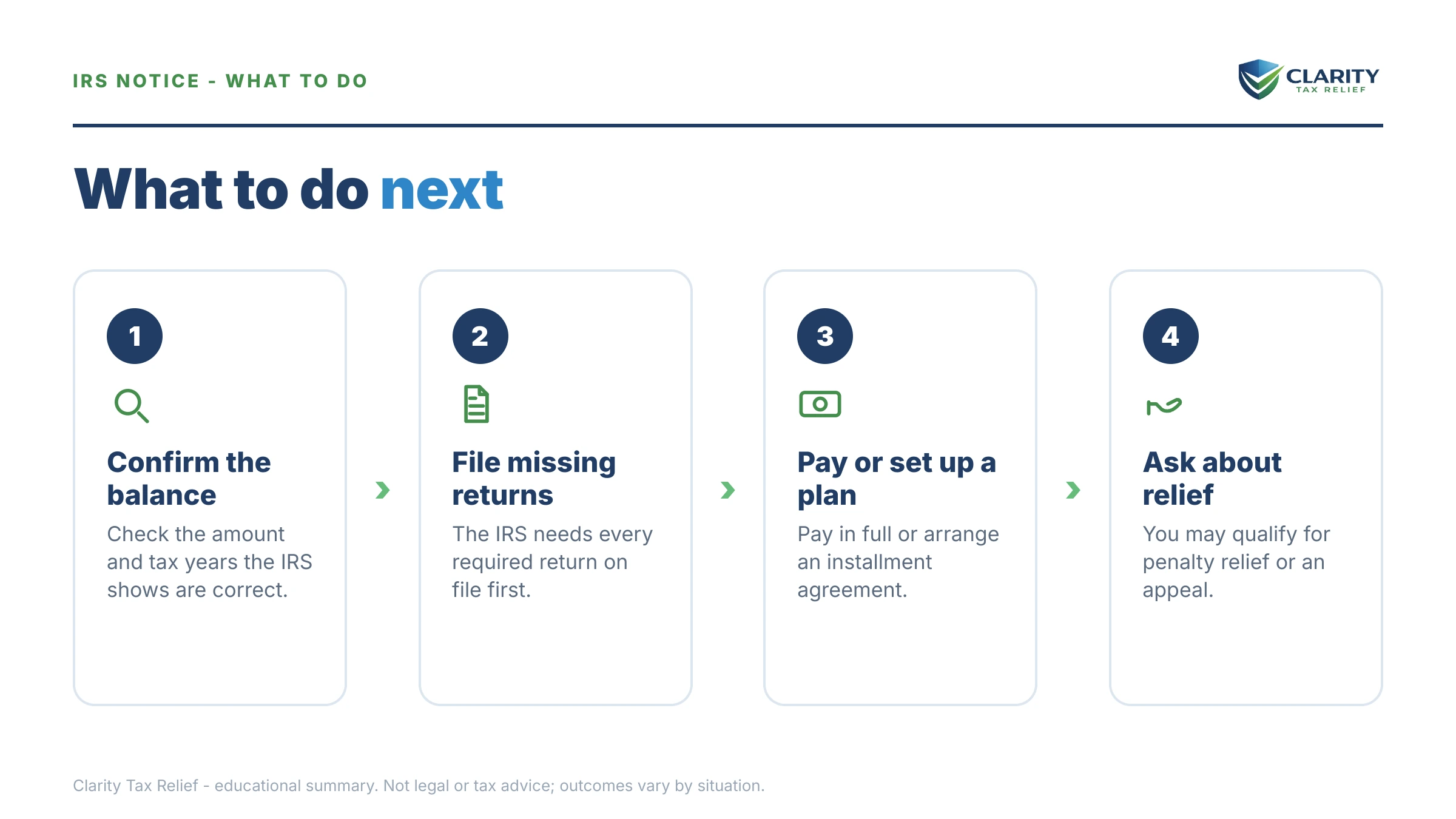
What happens if you do nothing
A bank levy is rarely the end of IRS collection — it's usually the opening move against an account the system has flagged as unresolved. If you let the 21 days pass and change nothing, the sequence continues in this order:
- The hold expires. Your bank remits the frozen funds to the IRS, which applies them to your oldest tax year. For most people the levy doesn't cover the full debt — the remaining balance survives.
- The balance keeps growing. The failure-to-pay penalty adds 0.5% per month and interest compounds daily on whatever remains.
- The IRS levies again. Nothing prevents a new Form 668-A next month — against the same account, a different bank, or even business payment platforms. Yes, the IRS can levy PayPal and Venmo balances tied to your identity.
- Wages come next. Unlike a bank levy, a wage levy is continuous — it takes a slice of every paycheck until released. You can estimate what one would take from your pay with our IRS wage garnishment calculator, and see how to stop an IRS wage garnishment if one has already started.
- Broader enforcement follows. Federal payments (including up to 15% of Social Security), state tax refunds, and — for larger balances — a public federal tax lien against your property are all on the automated menu.
One 2026 reality worth naming: the IRS workforce shrank roughly 27% in 2025, which makes a human hard to reach — but the levies are issued by computers that never got cut. The system escalates on schedule whether or not anyone answers the phone. That's a reason to start today, not a reason to panic.
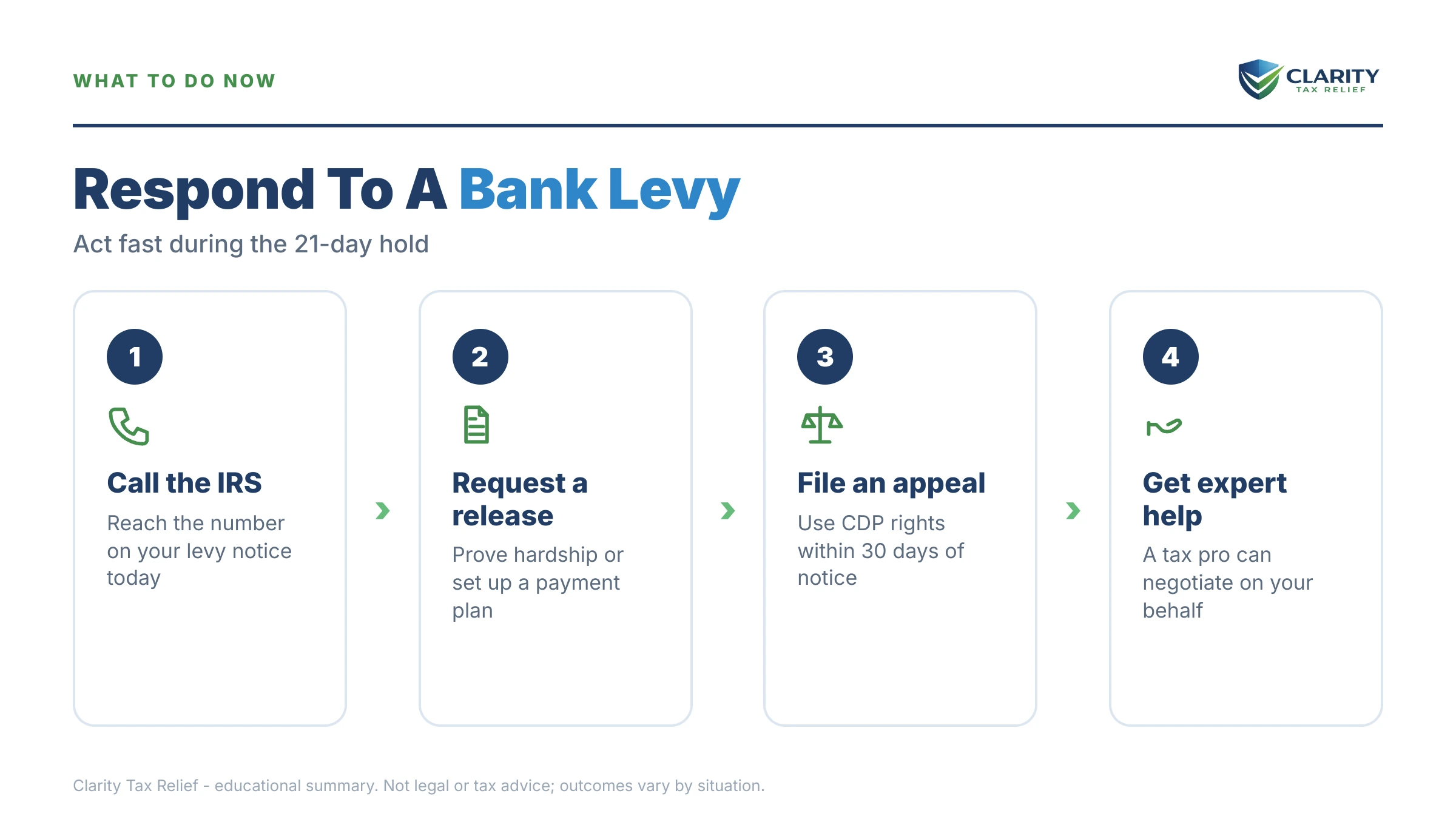
Your bank is holding that money for 21 days — use them
Send us the levy paperwork or your notice. An experienced tax professional will map your fastest release path before the bank remits — free, confidential, no pressure.
How to get the money back: every release option
The IRS releases bank levies for five main reasons: full payment, an approved payment arrangement, documented economic hardship, procedural error, or a successful appeal. Which one fits depends on your finances and your notice history. (For the full playbook on resolving the underlying balance itself, see our guide to how to settle tax debt yourself — this section focuses on freeing the frozen money.)
| Option | Who may qualify | Effect on the levy |
|---|---|---|
| Pay the balance in full | Anyone with access to the funds (see the best ways to pay the IRS) | Immediate release; ends the collection sequence entirely |
| Installment agreement | Balances up to $50,000 can usually be set up online without detailed financials; larger balances need Form 433-F | The IRS commonly releases the levy once the agreement is in place — ask for the release explicitly |
| Economic hardship release (IRC §6343) | Anyone who can document that the levy prevents paying basic living expenses | Required release when hardship is shown; see emergency levy release for hardship |
| Currently Not Collectible status | Income at or below allowable living expenses, shown on Form 433-F | Pauses levies while hardship lasts; the debt (and interest) remains |
| CDP or equivalent hearing | CDP if within 30 days of your LT11/1058; an equivalent hearing generally within one year after | Puts a human appeals officer between you and enforcement; file Form 12153 for a CDP hearing |
| Wrongful levy claim | A person whose money was taken for someone else's debt (joint accounts, wrong taxpayer) | Returns funds you can prove weren't the debtor's; see our wrongful levy guide |
| Offer in Compromise | Means-tested: the IRS accepted roughly 1 in 5 offers in FY2024 | Stops new levies while pending, but is too slow to beat a 21-day clock — pair it with a faster release path |
Three of these deserve extra detail, because they're the ones people misuse.
The hardship release is a right, not a favor. If the frozen funds were your rent, utilities, groceries, or medication money, IRC §6343 requires the IRS to release the levy — but only when you document it. Bring actual bills and income proof to the call, not just the situation's urgency.
The payment-plan release is the workhorse. For most people, agreeing to a monthly plan is the fastest route to a release, because it converts you from "unresolved account" to "resolved account" in the IRS's system. Critically, the release is not automatic — you must ask the agent to fax the release to your bank before the hold expires, and confirm your bank received it.
Appeals depend on your notice history. If your LT11 or Letter 1058 was mailed less than 30 days ago, a timely Form 12153 preserves full Collection Due Process rights, including Tax Court review. Past 30 days, you can generally still request an equivalent hearing within a year — fewer rights, but still a real forum, and especially useful when the warning notices went to an old address.
Say you owe $16,400: the math after a bank levy
This is a hypothetical, but a common shape for this exact situation. Say you're recently divorced and you owe $16,400 from your last jointly filed return — your decree says your ex would pay it, but the IRS levied $2,870 from your individual checking account anyway (the decree binds your ex, not the IRS; more on that below).
- Payment plan: at $16,400 you're under the $25,000 streamlined threshold, so you can set up a plan online for up to 72 months with no detailed financial disclosure. The minimum works out to roughly $16,400 ÷ 72 ≈ $228/month. But penalties and interest keep accruing — the failure-to-pay penalty alone starts around 0.5% × $16,400 ≈ $82/month — so paying $350–$400/month clears the debt years sooner and saves real money. Once the plan is accepted, you ask for the levy release and the $2,870 stays yours.
- Hardship release: if that $2,870 was earmarked for rent and utilities, a documented §6343 request before day 21 returns it — but the $16,400 still needs its own resolution, or the next levy is a matter of time.
- Offer in Compromise: only realistic if the IRS could never collect $16,400 from your income and assets over the remaining collection period. With steady wages and any equity, that math usually fails at this balance — and an offer takes months to process, so it can't beat the 21-day clock on its own.
- Innocent spouse route: if the $16,400 traces to your ex's unreported income or errors, relief that shifts the liability may exist alongside any of the above.
| Remaining balance | Fastest realistic release path | What the IRS will want |
|---|---|---|
| Under $10,000 | Guaranteed installment agreement or a 180-day short-term plan ($0 setup) | All returns filed; payoff within the plan terms |
| $10,000 – $25,000 | Streamlined installment agreement, set up online in one sitting | Up to 72 months; no detailed financial disclosure |
| $25,001 – $50,000 | Streamlined agreement with direct debit | Direct debit enrollment; up to 72 months |
| $50,001 – $100,000 | Negotiated agreement, CNC, or offer — with full financials | Form 433-F income, expense, and asset disclosure |
| Over $100,000 | Often assigned to a revenue officer; professional representation strongly advised | Complete financials, asset review, possible lien filing |
How to respond to an IRS bank levy, step by step
- Call your bank first. Ask for the exact date it received the levy, when the 21-day hold ends, and a copy of the levy paperwork with the IRS contact number on it.
- Verify the debt. Log in to your IRS online account and confirm the balance, the tax years, and that the levy is genuinely from the IRS — not a state agency or a private creditor.
- Call the IRS before the hold ends. Use the number on the levy notice, propose a resolution you can actually keep, and ask directly for a levy release before the bank remits.
- Document hardship if it applies. Gather rent, utility, medical, and food expenses plus proof of income — a §6343 economic hardship release depends on what you can show, not what you say.
- Lock in the long-term fix. Set up the payment plan, hardship status, or offer that fits your finances so the account never gets levied again.
- Escalate if you hit a wall. If the deadline is days away and you can't get through, contact the Taxpayer Advocate Service or an experienced tax professional the same day.
No IRS online account yet? Our IRS online account setup walkthrough gets you verified and looking at your real balance in about 15 minutes — which matters, because you should never negotiate a number you haven't confirmed. Payment plans themselves are set up at the official IRS payment plans page, and payments go only through IRS.gov/payments.
Divorced or separated? Why this debt followed you
A jointly filed return makes both spouses fully liable for the entire balance — and a divorce decree cannot change what the IRS is owed. The decree is a contract between you and your ex, enforceable in state court. The IRS wasn't a party to it, so it collects from whichever ex-spouse is easier to reach — often the one with the findable bank account.
That leaves you two separate tracks, and you can run both. Against your ex: the decree gives you a state-court claim if they were ordered to pay this debt and didn't. Against the liability itself: innocent spouse relief, separation-of-liability relief, or equitable relief may shift some or all of the debt to your ex if it traces to their income, their business, or errors you didn't know about. Our guide to divorce and IRS debt: who pays walks through which track fits which facts.
Two related traps for the recently divorced. If the levy hit an account that's still jointly titled with your ex, either spouse's debt exposes the whole balance — see whether the IRS can take my spouse's bank account for how titling controls the outcome. And if you moved after the split, file a change of address with the IRS now, because the next round of notices carries deadlines you can't afford to miss again.
When you can handle this yourself — and when help changes the outcome
You can very likely handle this alone if all of these are true: the balance is under about $25,000, all your returns are filed, you agree the debt is yours, and the 21-day hold has at least a week left. In that case the play is simple — set up a streamlined payment plan online, then call the number on the levy notice and request the release. No firm needs to charge you for that.
Experienced help genuinely changes outcomes when the clock or the facts get harder: the hold expires within days and you can't get through on the phone; the money has already been remitted and you're pursuing a return of proceeds; you have unfiled years (the IRS won't grant most resolutions until returns are in); the levy hit a joint or business account and a wrongful levy claim is in play; the balance is over $50,000 and full financial disclosure is required; or you're layering innocent spouse relief on top of a levy release. Those cases turn on documentation, sequencing, and knowing exactly what to ask the agent for — and a misstep can cost you the 21-day window.
One caution while you're searching for help tonight: a frozen bank account makes you a target for bad actors. Know the difference between a real firm and a fee mill — and if you've already been burned, here's what to do when a tax relief company took my money.
Terms on your levy paperwork, decoded
- Form 668-A — the one-time Notice of Levy the IRS sends your bank; its receipt date starts the 21-day hold. (Form 668-W is the wage version.)
- Levy vs. lien — a levy takes property (this is what happened to you); a lien is a legal claim against property that secures the debt without taking anything yet.
- 21-day holding period — the legally required window during which your bank holds levied funds before remitting them to the IRS.
- CDP hearing — the Collection Due Process appeal (requested on Form 12153) triggered by the LT11/Letter 1058 final notice; timely requests generally pause levy action on the years at issue.
- Economic hardship release (§6343) — the law requiring the IRS to release a levy that prevents you from paying basic living expenses.
- CSED — the Collection Statute Expiration Date: the IRS generally has 10 years from assessment to collect, though appeals, offers, and bankruptcy pause that clock.
If any of these apply to your situation and the hold is running out, get your levy paperwork reviewed free before day 21 — the review takes minutes; the remittance is permanent for most people.
IRS bank levy questions, answered
Can I get money back after the IRS levies my bank account?
Yes — if you act inside the 21-day hold, the funds are still at your bank, and a released levy means the money never leaves. After the bank remits, the IRS can return levied proceeds only in limited situations, such as a levy issued in error, a levy that violated an existing installment agreement, or documented economic hardship. The window before remittance is dramatically easier than any path after it.
Why didn't the IRS warn me before taking my money?
It almost certainly did — a bank levy legally requires a final notice of intent to levy (LT11 or Letter 1058) sent at least 30 days beforehand to your last known address. If you moved after a divorce or separation and never updated your address with the IRS, those notices likely went to your old home. Missing them doesn't invalidate the levy, but it may support an equivalent hearing request.
Can the IRS take money from a joint bank account?
Yes. A levy attaches to any account with the debtor's name on it, and the IRS can take the full balance even if the other owner deposited most of the money. The non-liable owner can file a wrongful levy claim to recover funds they can prove were theirs. Bank statements and deposit records are the evidence that wins those claims.
Will the IRS levy my bank account again?
It can. A bank levy is a one-time seizure of what was in the account the day the bank received it — but nothing stops the IRS from issuing a new levy next month if the balance stays unresolved. The only reliable way to stop repeat levies is to get into a resolution: a payment plan, hardship status, or a pending offer in compromise.
Did the IRS take deposits made after the levy hit?
No. A bank levy freezes only the funds in the account at the moment your bank received it. Your paycheck deposited the next day is not covered by that levy, and you can use it. But the same account can be levied again with a new notice, so the durable fix is resolving the debt rather than moving money around.
What if the levy left me unable to pay rent or bills?
Ask for an economic hardship release under IRC §6343. If the levy prevents you from meeting basic, reasonable living expenses — rent, utilities, food, medicine — the IRS is required to release it. Have your bills, income proof, and bank statements ready when you call, because the release turns on documentation, not on how stressful the situation feels.
Is my ex-spouse responsible for this tax debt after our divorce?
If the debt came from a jointly filed return, you are both fully liable to the IRS regardless of what your divorce decree says — the decree binds your ex, not the government. You can pursue your ex in state court for violating the decree, and separately you may qualify for innocent spouse or separation-of-liability relief with the IRS if the debt traces to your ex's income or errors.
Can the IRS garnish my paycheck too?
Yes, and unlike a bank levy, a wage levy is continuous — it keeps taking part of every paycheck until it's released or the debt is paid. An unresolved balance that already produced a bank levy is exactly the kind of account the IRS's automated system routes toward a wage levy next. Setting up a payment plan stops that progression.
Does my bank charge a fee for processing an IRS levy?
Many banks charge a levy-processing fee against your account on top of the frozen funds, and the IRS does not reimburse it. Your deposit agreement sets the amount. If the levy is later found to have been issued in error by the IRS, you may be able to request reimbursement of bank charges from the IRS using Form 8546.
Your next 24 hours
- Call your bank and get one date: the day it received the levy. Count 21 days forward — that's your real deadline, and everything else is planned around it. Ask them to send you the levy paperwork.
- Gather your file: the levy notice, any IRS letters (even at your old address — ask your ex or check mail forwarding), your last filed return, and a month of bills and pay stubs in case hardship is your fastest release.
- Get the levy reviewed free before the hold expires: the 2-minute form or (888) 825-7779. An experienced tax professional will tell you which release path fits your numbers — and if a resolution needs to be in place before day 21, every day you start earlier counts. If you'd rather go it alone and can't get through to the IRS in time, the Taxpayer Advocate Service exists for exactly these deadline emergencies.
This guide is general information, not tax or legal advice for your specific situation. Eligibility for IRS programs depends on individual facts and circumstances; no outcome is guaranteed.